Sustainable Textile Materials Market Size, Share & Trends Analysis Report by Material Type (Organic Materials, Recycled Materials, Bio-based Synthetic Materials, Regenerated Materials, Innovative Alternative Materials), Fiber Type, Product Type, Application, End-use Industry, Distribution Channel, and Geography (North America, Europe, Asia Pacific, Middle East, Africa, and South America) – Global Industry Data, Trends, and Forecasts, 2026–2035
|
|
|
Segmental Data Insights |
|
|
Demand Trends |
|
|
Competitive Landscape |
|
|
Strategic Development |
|
|
Future Outlook & Opportunities |
|
Sustainable-Textile-Materials-Market Size, Share, and Growth
The global sustainable textile materials market is witnessing strong growth, valued at USD 34.6 billion in 2025 and projected to reach USD 70.7 billion by 2035, expanding at a CAGR of 7.4% during the forecast period. The evolving technologies in fiber engineering, bio-polymer development, and optimization of life cycles are driving the global sustainable textile materials market so that manufacturers can increase the durability, breathability, recyclability, and carbon efficiency of fabrics in apparel, technical textiles, as well as home furnishings and mobility applications.
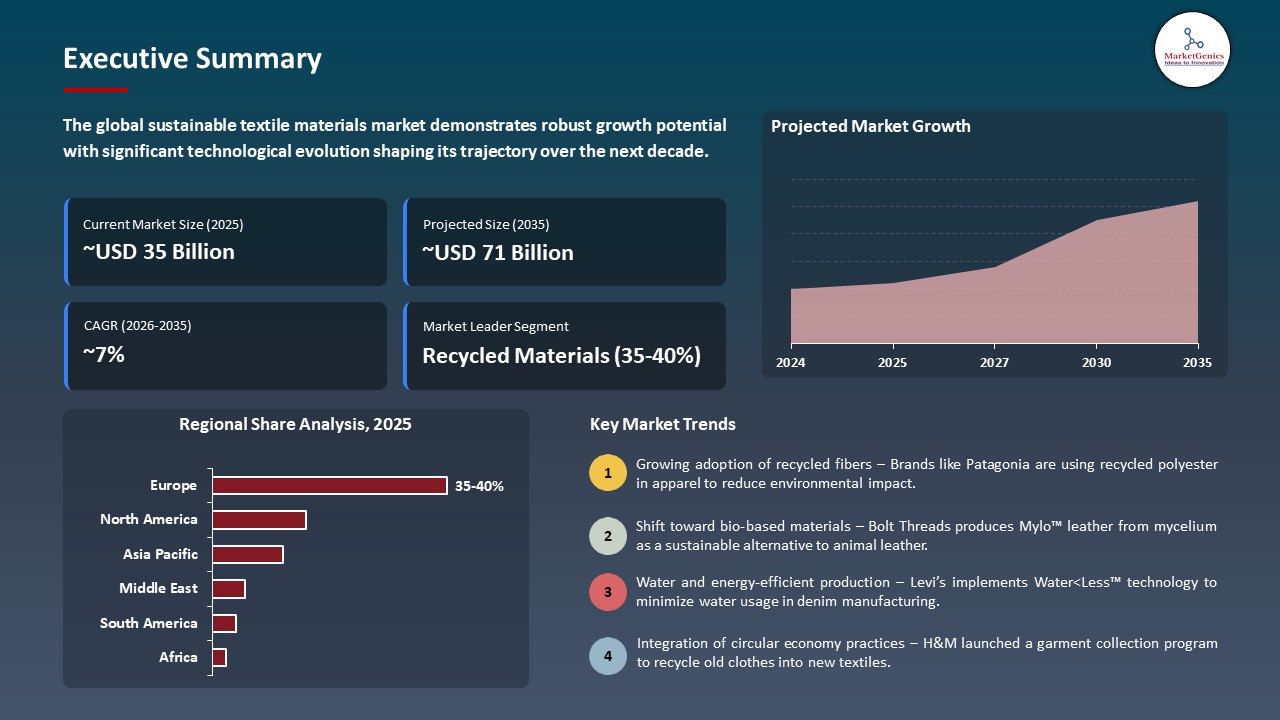
Yogendra Dandapure, Vice President, Raw Materials Innovation at lululemon, stated: What truly sets ZymoChem apart is their groundbreaking technology, which is capable of producing a bio-based material to create sustainable nylon 6,6 that provides the same look, feel, and quality expected from our high-performance products. By continuing to expand our partnerships with forward-thinking leaders like ZymoChem, we’re creating multiple pathways to transition to sustainable materials across our product portfolio.
The global sustainable textile materials market is experiencing a robust shift with brands, manufacturers, and material innovators focusing on the sustainability of apparel, home furnishings, mobility textiles and industrial fabrics with the principles of circularity, reduction in carbon and high-performance sustainability. Advancements in regenerative natural fibers, bio-synthesized polymers, enzymatic processing and textile to textile recycling technologies are permitting improved tensile performance, moisture control, thermal flexibility and increased product life cycles and reducing substantially planetary footprints.
Digital traceability, AI-based fiber optimization, and closed-loop recycling facilities are increasing the pace of material innovation by enhancing selection, predicting performance of fabrics and reducing waste of resources during production. The standards of compliance, emissions intensity, and sustainable sourcing strategies in the global textile ecosystems are being enhanced with the help of Lifecycle assessment tools, smart labelling technologies, and data-driven supply chain transparency models.
The adjacent opportunities in low-impact dye technology, waterless coloration technologies, biodegradable performance finishes and scalable circular manufacturing systems are also enhancing market appeal. Sustainable textile materials are no longer moving toward eco-friendly alternatives to develop into engineered value-added solutions, which are durable, recyclable, and carbon-efficient, making the global sustainable textile materials market a cornerstone of the new regenerative and circular materials economy.
 Sustainable Textile Materials market Dynamics and Trends
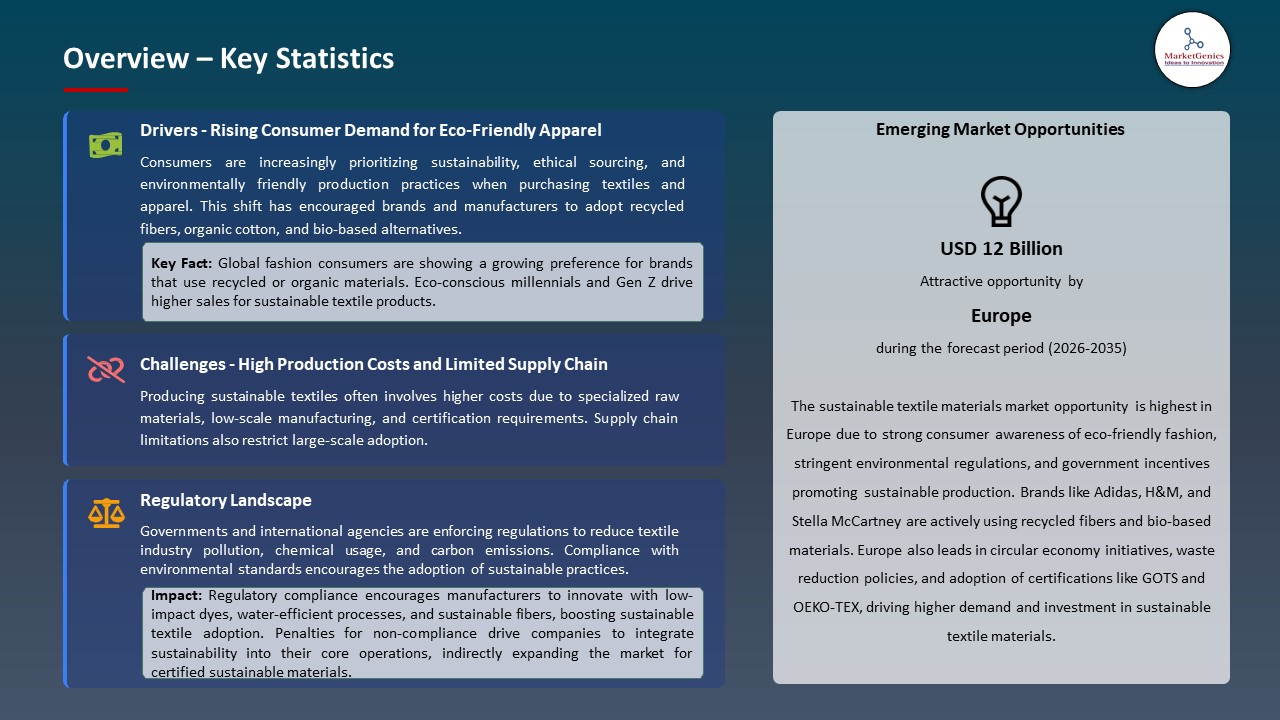
Driver: Growing demand for eco-friendly and high-performance fabrics
-
Global sustainable textile materials market is growing with an increasing consumer and brand demand of low-carbon, biodegradable and high-performance fabrics, whereby bio-based fibers, recycled polymer and functional textiles enhance the durability, water management, and environmental performance in their applications.
- The growing demand as sustainable textile materials find greater application in high-performance apparel and functional fashion, TENCEL next-generation sustainable fabric introductions, which demonstrated biodegradable fiber solutions that increase comfort, breathability and circular production.
- Sustainable growth of the market in the long term is being supported by the increased use of recyclable and bio-engineered textile materials globally.
Restraint: High production costs and supply chain challenges
-
The huge capital outlay that is necessary to install fiber-to-fiber recycling facilities, bio-based polymer processing plants, and certified sustainable production plants is still limiting mass adoption, especially with small and medium-sized textile producers.
- High operational expenses, such as traceability compliance systems, eco-certification procedures, high-level wastewater treatment, and sustainable dyeing systems also add more to the overall cost structure of sustainable textile materials production relative to conventional textiles.
- A small supply of recycled feedstocks, bio-based feeds, and effective collection systems in the emerging markets have remained a constraint to scalable implementation of global sustainable textile material market.
Opportunity: Integration with circular economy and industrial innovation
-
The combination of sustainable fabrics and closed-loop recycling and fiber-to-fiber regeneration solutions is generating high opportunities in the world as this allows them to recover materials, reduce waste and long-lasting product lifetimes in the apparel and technical textile sector.
- Circular solutions are being commercialized through strategic partnerships between textile recyclers, material innovators and fashion brands; in August 2024, Zara and Circ announced a new line of products using recycled polycotton blended textile waste turned into high-quality sustainable fiber-to-fiber through blending, with a list of examples that include blended textile waste as well as mono-fiber.
- Global adoption of textile recycling and regenerative material platforms empowers sustainable textile materials to enable circular economy systems and promote global prosperity.
Key Trend: Adoption of high-performance, multifunctional, and bio-based materials
-
The world is experiencing a rapid rate of developing bio-based fibers, engineered cellulose, and multifunctional textile chemistries, which allow the creation of high performance fabrics that are more durable, breathable, and environmentally friendly in their application in apparel and technical applications.
- New technologies in bio-inspired coloration technologies, biodegradable coating, and less impactful processing are changing the performance of textile by reducing the intensity of chemicals and water, for instance, in June 2025 introduction of the first plant-based bio-inspired structural colour ink by Sparxell and Positive Materials: a biodegradable cellulose-based solution for attaining vibrant colours without synthetic dyes or petroleum-based feedstock.
- The commercialization of renewable and performance-based textile materials is reinforcing scalable and sustainable production across the globe.
Sustainable Textile Materials Market Analysis and Segmental Data
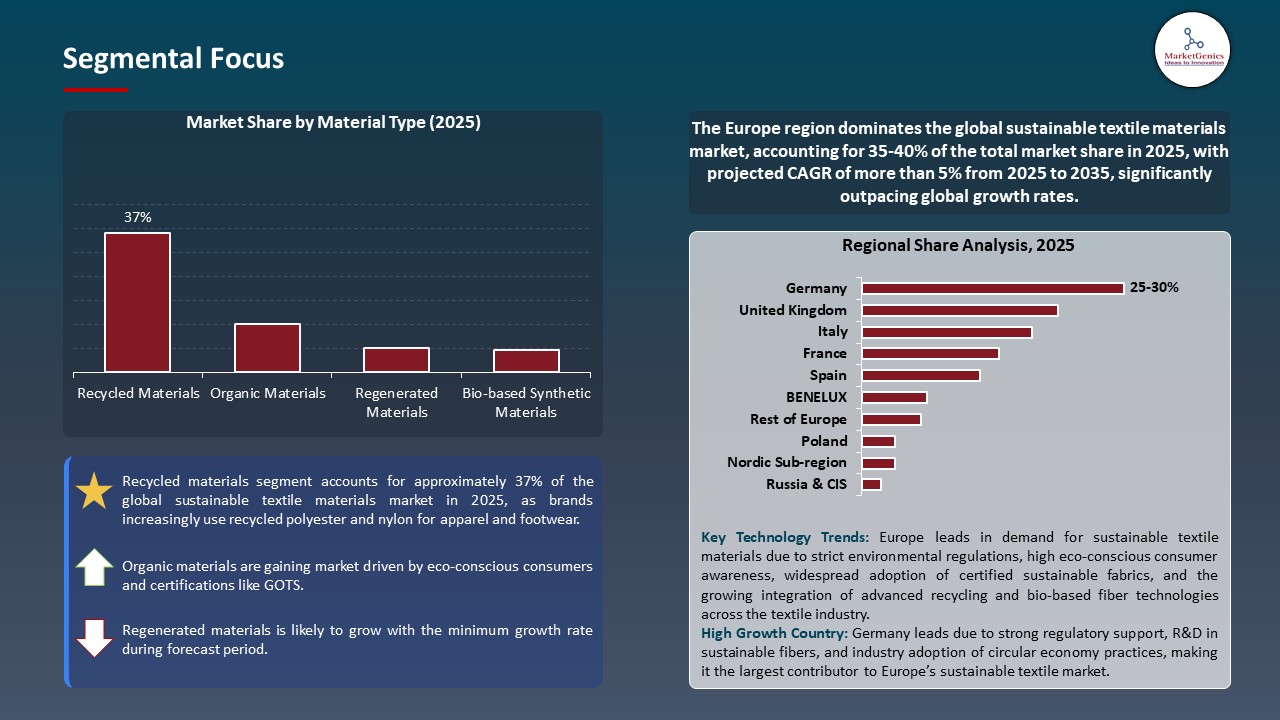
Recycled Materials Dominate Global Sustainable Textile Materials Market
-
Recycled fibers leads sustainable textile materials market due to they are highly sought after because they are less environmental, less water and less energy-consuming, and less harmful to the circular economy than virgin fibers.
- High-quality recycled fibers and fibre-to-fibre recycling technology are being swiftly implemented in apparel, industrial textiles, and home textiles and enhancing the performance of materials and their sustainability; for instance, in October 2025, H&M Group collaborated with Circ to use Circ-recycled polycotton fibers in apparel collections, such as sweatshirts and denim, further embedding the large-scale use of recycled materials in fashion supply chains.
- Recycled material dominance is supported by brand alliances and circular supply chain integration.
Europe Leads Global Sustainable Textile Materials Market Demand
-
Europe dominates the global sustainable textile materials market as a result of strict EU sustainability policies, high uptake of recycled and bio-based fibers, and the availability of large textile brands and manufacturers in Germany, Italy, France, and the UK that are contributing to high regional consumption.
- The use of sustainable textiles in eco-friendly textiles, circular textiles, and high-performance textiles is expanding at a fast pace; for instance, in November 2025, EURATEX joined the Textiles Recycling Expo to promote collaboration between fiber manufacturers, recyclers, and brands and circular textile solutions in Europe.
- The policy and rules in the government and those between government and the business community are working to strengthen the European leadership in the global sustainable textile material market.
Sustainable Textile Materials Market Ecosystem
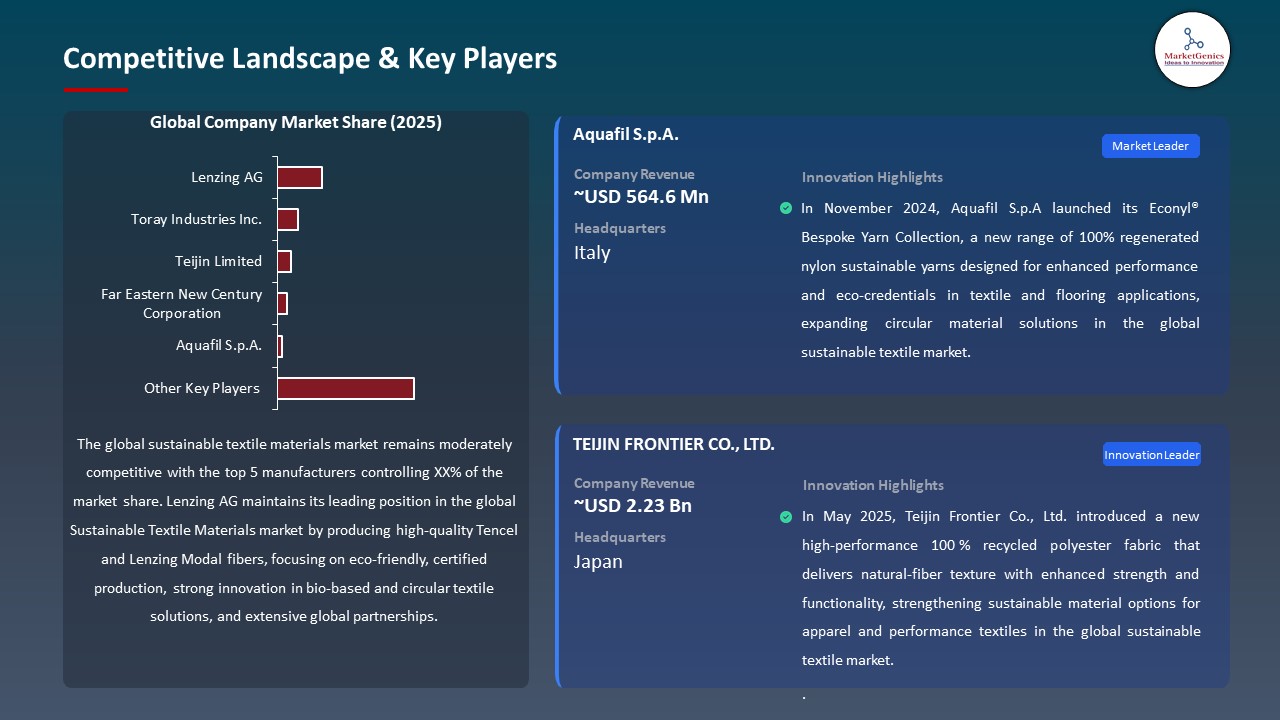
The global sustainable textile materials market is moderately consolidated and the competition is centered on the bio-based fibers, recycled yarns, functional coatings, high-performance polymers and the integration of IoT in the production monitoring. Lenzing AG, Toray Industries Inc., Teijin Limited, Far Eastern New Century Corporation, and Aquafil S.p.A. are the forces that create market share because they have offered integrated sustainable textile ecosystems, such as eco-friendly fibers, high-technology polymer processing, recycling technologies, functional fabric treatments, and digital supply chain platforms.
The TENCEL and LENZING ECOVERO fibers of Lenzing AG encourage production with low water and energy consumption and closed-loop recycling. Toray industries inc. specializes in bio-based polymers as well as high-performance textiles used in apparel and industry. Teijin Limited is a combination of sustainable polyester, thermoplastic fibers and IoT-based production systems. Far Eastern New Century Corporation focuses on using recycled PET and functional fabrics. Aquafil S.p.A. offers recycled nylon based on waste, called ECONYL, to aid in the creation of circular textiles.
Government sustainability incentives, corporate ESG requirements, and partnerships with fashion brands, material startups, and research institutes promote the development of bio-based fiber technology, closed-loop recycling, functional textile treatments, and smart manufacturing platforms. These ecosystem interactions contribute to competitive differentiation, large-scale sustainable textile deployment, and fast textile deployment of earth-friendly materials, which is why the global market of sustainable textile materials strives to minimize the environmental footprint, increase resource productivity, and aid in circles of economy activities.
 Recent Development and Strategic Overview
-
In March 2025, lululemon declared a multi-year partnership with biotechnology company ZymoChem to increase its utilization of bio-based nylon concentrating on transforming key chemical building blocks of nylon 6 used in its performance garments sustainably and commercializing the technology to adopt sustainable textile materials.
- In December 2025, SENSIL by NILIT and ROICA by Asahi Kasei announced a collaboration to introduce a new low‑impact stretch fabric concept combining Biomass Balanced Nylon 6.6 yarn (SENSIL ByNature) with Biomass Balanced ROICA premium stretch fiber, reducing environmental footprint while retaining performance and comfort in high‑performance apparel.
Report Scope
|
Detail |
|
|
Market Size in 2025 |
USD 34.6 Bn |
|
Market Forecast Value in 2035 |
USD 70.7 Bn |
|
Growth Rate (CAGR) |
7.4% |
|
Forecast Period |
2026 – 2035 |
|
Historical Data Available for |
2021 – 2024 |
|
Market Size Units |
US$ Billion for Value Tons for Volume |
|
Report Format |
Electronic (PDF) + Excel |
|
North America |
Europe |
Asia Pacific |
Middle East |
Africa |
South America |
|
|
|
|
|
|
|
Companies Covered |
|||||
|
|
|
|
|
|
Sustainable Textile Materials Market Segmentation and Highlights
|
Segment |
Sub-segment |
|
Sustainable Textile Materials Market, By Material Type |
|
|
Sustainable Textile Materials Market, By Fiber Type |
|
|
Sustainable Textile Materials Market, By Product Type |
|
|
Sustainable Textile Materials Market, By Application |
|
|
Sustainable Textile Materials Market, By End-use Industry |
|
|
Sustainable Textile Materials Market, Distribution Channel |
|
Frequently Asked Questions
Table of Contents
- 1. Research Methodology and Assumptions
- 1.1. Definitions
- 1.2. Research Design and Approach
- 1.3. Data Collection Methods
- 1.4. Base Estimates and Calculations
- 1.5. Forecasting Models
- 1.5.1. Key Forecast Factors & Impact Analysis
- 1.6. Secondary Research
- 1.6.1. Open Sources
- 1.6.2. Paid Databases
- 1.6.3. Associations
- 1.7. Primary Research
- 1.7.1. Primary Sources
- 1.7.2. Primary Interviews with Stakeholders across Ecosystem
- 2. Executive Summary
- 2.1. Global Sustainable Textile Materials Market Outlook
- 2.1.1. Sustainable Textile Materials Market Size (Value - US$ Bn), and Forecasts, 2021-2035
- 2.1.2. Compounded Annual Growth Rate Analysis
- 2.1.3. Growth Opportunity Analysis
- 2.1.4. Segmental Share Analysis
- 2.1.5. Geographical Share Analysis
- 2.2. Market Analysis and Facts
- 2.3. Supply-Demand Analysis
- 2.4. Competitive Benchmarking
- 2.5. Go-to- Market Strategy
- 2.5.1. Customer/ End-use Industry Assessment
- 2.5.2. Growth Opportunity Data, 2026-2035
- 2.5.2.1. Regional Data
- 2.5.2.2. Country Data
- 2.5.2.3. Segmental Data
- 2.5.3. Identification of Potential Market Spaces
- 2.5.4. GAP Analysis
- 2.5.5. Potential Attractive Price Points
- 2.5.6. Prevailing Market Risks & Challenges
- 2.5.7. Preferred Sales & Marketing Strategies
- 2.5.8. Key Recommendations and Analysis
- 2.5.9. A Way Forward
- 2.1. Global Sustainable Textile Materials Market Outlook
- 3. Industry Data and Premium Insights
- 3.1. Global Chemicals & Materials Industry Overview, 2025
- 3.1.1. Chemicals & Materials Industry Ecosystem Analysis
- 3.1.2. Key Trends for Chemicals & Materials Industry
- 3.1.3. Regional Distribution for Chemicals & Materials Industry
- 3.2. Supplier Customer Data
- 3.3. Technology Roadmap and Developments
- 3.4. Trade Analysis
- 3.4.1. Import & Export Analysis, 2025
- 3.4.2. Top Importing Countries
- 3.4.3. Top Exporting Countries
- 3.5. Trump Tariff Impact Analysis
- 3.5.1. Manufacturer
- 3.5.1.1. Based on the raw material
- 3.5.2. Supply Chain
- 3.5.3. End Consumer
- 3.5.1. Manufacturer
- 3.6. Raw Material Analysis
- 3.1. Global Chemicals & Materials Industry Overview, 2025
- 4. Market Overview
- 4.1. Market Dynamics
- 4.1.1. Drivers
- 4.1.1.1. Growing consumer demand for eco-friendly and ethically produced textiles.
- 4.1.1.2. Strict environmental regulations and corporate sustainability commitments.
- 4.1.1.3. Increased adoption of recycled and bio-based fibers by fashion and apparel brands.
- 4.1.2. Restraints
- 4.1.2.1. Higher production and raw material costs compared to conventional textiles.
- 4.1.2.2. Limited scalability and supply constraints of sustainable fiber sources.
- 4.1.1. Drivers
- 4.2. Key Trend Analysis
- 4.3. Regulatory Framework
- 4.3.1. Key Regulations, Norms, and Subsidies, by Key Countries
- 4.3.2. Tariffs and Standards
- 4.3.3. Impact Analysis of Regulations on the Market
- 4.4. Value Chain Analysis
- 4.4.1. Raw Material Suppliers
- 4.4.2. Sustainable Textile Materials Manufacturers
- 4.4.3. Distributors
- 4.4.4. End-Users/ Customers
- 4.5. Porter’s Five Forces Analysis
- 4.6. PESTEL Analysis
- 4.7. Global Sustainable Textile Materials Market Demand
- 4.7.1. Historical Market Size – Value (US$ Bn), 2020-2024
- 4.7.2. Current and Future Market Size – Value (US$ Bn), 2026–2035
- 4.7.2.1. Y-o-Y Growth Trends
- 4.7.2.2. Absolute $ Opportunity Assessment
- 4.1. Market Dynamics
- 5. Competition Landscape
- 5.1. Competition structure
- 5.1.1. Fragmented v/s consolidated
- 5.2. Company Share Analysis, 2025
- 5.2.1. Global Company Market Share
- 5.2.2. By Region
- 5.2.2.1. North America
- 5.2.2.2. Europe
- 5.2.2.3. Asia Pacific
- 5.2.2.4. Middle East
- 5.2.2.5. Africa
- 5.2.2.6. South America
- 5.3. Product Comparison Matrix
- 5.3.1. Specifications
- 5.3.2. Market Positioning
- 5.3.3. Pricing
- 5.1. Competition structure
- 6. Global Sustainable Textile Materials Market Analysis, by Material Type
- 6.1. Key Segment Analysis
- 6.2. Sustainable Textile Materials Market Size (Value - US$ Bn), Analysis, and Forecasts, by Material Type, 2021-2035
- 6.2.1. Organic Materials
- 6.2.1.1. Organic Cotton
- 6.2.1.2. Organic Linen
- 6.2.1.3. Organic Hemp
- 6.2.1.4. Organic Wool
- 6.2.1.5. Organic Silk
- 6.2.2. Recycled Materials
- 6.2.2.1. Recycled Polyester
- 6.2.2.2. Recycled Nylon
- 6.2.2.3. Recycled Cotton
- 6.2.2.4. Recycled Wool
- 6.2.3. Bio-based Synthetic Materials
- 6.2.3.1. Bio-Polyester
- 6.2.3.2. Bio-Nylon
- 6.2.3.3. Polylactic Acid (PLA)
- 6.2.3.4. Bio-Polyethylene
- 6.2.4. Regenerated Materials
- 6.2.4.1. Lyocell/Tencel
- 6.2.4.2. Modal
- 6.2.4.3. Viscose (Sustainable)
- 6.2.4.4. Cupro
- 6.2.5. Innovative Alternative Materials
- 6.2.5.1. Mushroom Leather
- 6.2.5.2. Pineapple Leather (Piñatex)
- 6.2.5.3. Apple Leather
- 6.2.5.4. Cactus Leather
- 6.2.5.5. Lab-grown Materials
- 6.2.1. Organic Materials
- 7. Global Sustainable Textile Materials Market Analysis, by Fiber Type
- 7.1. Key Segment Analysis
- 7.2. Sustainable Textile Materials Market Size (Value - US$ Bn), Analysis, and Forecasts, by Fiber Type, 2021-2035
- 7.2.1. Natural Fibers
- 7.2.1.1. Cotton-based
- 7.2.1.2. Linen-based
- 7.2.1.3. Hemp-based
- 7.2.1.4. Jute-based
- 7.2.1.5. Ramie
- 7.2.1.6. Wool-based
- 7.2.1.7. Silk-based
- 7.2.2. Man-made Cellulosic Fibers
- 7.2.2.1. Lyocell
- 7.2.2.2. Modal
- 7.2.2.3. Viscose
- 7.2.3. Synthetic Fibers
- 7.2.3.1. Polyester
- 7.2.3.2. Nylon
- 7.2.3.3. Acrylic
- 7.2.3.4. Elastane
- 7.2.4. Blended Fibers
- 7.2.4.1. Natural-Natural Blends
- 7.2.4.2. Natural-Synthetic Blends
- 7.2.4.3. Synthetic-Synthetic Blends
- 7.2.1. Natural Fibers
- 8. Global Sustainable Textile Materials Market Analysis, by Product Type
- 8.1. Key Segment Analysis
- 8.2. Sustainable Textile Materials Market Size (Value - US$ Bn), Analysis, and Forecasts, by Product Type, 2021-2035
- 8.2.1. Yarns
- 8.2.2. Fabrics
- 8.2.2.1. Woven Fabrics
- 8.2.2.2. Knitted Fabrics
- 8.2.2.3. Non-Woven Fabrics
- 8.2.3. Finished Textiles
- 8.2.4. Technical Textiles
- 8.2.5. Blended Materials
- 9. Global Sustainable Textile Materials Market Analysis, by Application
- 9.1. Key Segment Analysis
- 9.2. Sustainable Textile Materials Market Size (Value - US$ Bn), Analysis, and Forecasts, by Application, 2021-2035
- 9.2.1. Apparel
- 9.2.1.1. Activewear
- 9.2.1.2. Casual Wear
- 9.2.1.3. Formal Wear
- 9.2.1.4. Others
- 9.2.2. Home Textiles
- 9.2.2.1. Bedding
- 9.2.2.2. Upholstery
- 9.2.2.3. Curtains/Drapes
- 9.2.2.4. Towels
- 9.2.2.5. Carpets/Rugs
- 9.2.2.6. Others
- 9.2.3. Industrial Textiles
- 9.2.3.1. Protective Clothing
- 9.2.3.2. Geotextiles
- 9.2.3.3. Medical Textiles
- 9.2.3.4. Filtration
- 9.2.3.5. Others
- 9.2.4. Accessories
- 9.2.4.1. Bags
- 9.2.4.2. Footwear
- 9.2.4.3. Belts
- 9.2.4.4. Hats/Caps
- 9.2.4.5. Others
- 9.2.5. Automotive Textiles
- 9.2.6. Packaging Materials
- 9.2.1. Apparel
- 10. Global Sustainable Textile Materials Market Analysis, by End-use Industry
- 10.1. Key Segment Analysis
- 10.2. Sustainable Textile Materials Market Size (Value - US$ Bn), Analysis, and Forecasts, by End-use Industry, 2021-2035
- 10.2.1. Fashion & Apparel Industry
- 10.2.2. Fast Fashion (Sustainable Lines)
- 10.2.2.1. Luxury Fashion
- 10.2.2.2. Athleisure
- 10.2.2.3. Streetwear
- 10.2.2.4. Others
- 10.2.3. Home Furnishing Industry
- 10.2.3.1. Hospitality Industry
- 10.2.3.2. Hotels
- 10.2.3.3. Restaurants
- 10.2.3.4. Spas
- 10.2.3.5. Others
- 10.2.4. Healthcare Industry
- 10.2.5. Automotive Industry
- 10.2.6. Sports & Fitness Industry
- 10.2.7. Corporate/Workwear Industry
- 10.2.8. Retail Industry
- 10.2.9. E-commerce
- 10.2.10. Defense & Military
- 10.2.11. Others
- 11. Global Sustainable Textile Materials Market Analysis, by Distribution Channel
- 11.1. Key Segment Analysis
- 11.2. Sustainable Textile Materials Market Size (Value - US$ Bn), Analysis, and Forecasts, by Distribution Channel, 2021-2035
- 11.2.1. Direct Sales
- 11.2.2. B2B Direct
- 11.2.3. D2C
- 11.2.4. Indirect Sales
- 11.2.5. Online Channels
- 12. Global Sustainable Textile Materials Market Analysis and Forecasts, by Region
- 12.1. Key Findings
- 12.2. Sustainable Textile Materials Market Size (Value - US$ Bn), Analysis, and Forecasts, by Region, 2021-2035
- 12.2.1. North America
- 12.2.2. Europe
- 12.2.3. Asia Pacific
- 12.2.4. Middle East
- 12.2.5. Africa
- 12.2.6. South America
- 13. North America Sustainable Textile Materials Market Analysis
- 13.1. Key Segment Analysis
- 13.2. Regional Snapshot
- 13.3. North America Sustainable Textile Materials Market Size (Value - US$ Bn), Analysis, and Forecasts, 2021-2035
- 13.3.1. Material Type
- 13.3.2. Fiber Type
- 13.3.3. Product Type
- 13.3.4. Application
- 13.3.5. End-use Industry
- 13.3.6. Distribution Channel
- 13.3.7. Country
- 13.3.7.1. USA
- 13.3.7.2. Canada
- 13.3.7.3. Mexico
- 13.4. USA Sustainable Textile Materials Market
- 13.4.1. Country Segmental Analysis
- 13.4.2. Material Type
- 13.4.3. Fiber Type
- 13.4.4. Product Type
- 13.4.5. Application
- 13.4.6. End-use Industry
- 13.4.7. Distribution Channel
- 13.5. Canada Sustainable Textile Materials Market
- 13.5.1. Country Segmental Analysis
- 13.5.2. Material Type
- 13.5.3. Fiber Type
- 13.5.4. Product Type
- 13.5.5. Application
- 13.5.6. End-use Industry
- 13.5.7. Distribution Channel
- 13.6. Mexico Sustainable Textile Materials Market
- 13.6.1. Country Segmental Analysis
- 13.6.2. Material Type
- 13.6.3. Fiber Type
- 13.6.4. Product Type
- 13.6.5. Application
- 13.6.6. End-use Industry
- 13.6.7. Distribution Channel
- 14. Europe Sustainable Textile Materials Market Analysis
- 14.1. Key Segment Analysis
- 14.2. Regional Snapshot
- 14.3. Europe Sustainable Textile Materials Market Size (Value - US$ Bn), Analysis, and Forecasts, 2021-2035
- 14.3.1. Material Type
- 14.3.2. Fiber Type
- 14.3.3. Product Type
- 14.3.4. Application
- 14.3.5. End-use Industry
- 14.3.6. Distribution Channel
- 14.3.7. Country
- 14.3.7.1. Germany
- 14.3.7.2. United Kingdom
- 14.3.7.3. France
- 14.3.7.4. Italy
- 14.3.7.5. Spain
- 14.3.7.6. Netherlands
- 14.3.7.7. Nordic Countries
- 14.3.7.8. Poland
- 14.3.7.9. Russia & CIS
- 14.3.7.10. Rest of Europe
- 14.4. Germany Sustainable Textile Materials Market
- 14.4.1. Country Segmental Analysis
- 14.4.2. Material Type
- 14.4.3. Fiber Type
- 14.4.4. Product Type
- 14.4.5. Application
- 14.4.6. End-use Industry
- 14.4.7. Distribution Channel
- 14.5. United Kingdom Sustainable Textile Materials Market
- 14.5.1. Country Segmental Analysis
- 14.5.2. Material Type
- 14.5.3. Fiber Type
- 14.5.4. Product Type
- 14.5.5. Application
- 14.5.6. End-use Industry
- 14.5.7. Distribution Channel
- 14.6. France Sustainable Textile Materials Market
- 14.6.1. Country Segmental Analysis
- 14.6.2. Material Type
- 14.6.3. Fiber Type
- 14.6.4. Product Type
- 14.6.5. Application
- 14.6.6. End-use Industry
- 14.6.7. Distribution Channel
- 14.7. Italy Sustainable Textile Materials Market
- 14.7.1. Country Segmental Analysis
- 14.7.2. Material Type
- 14.7.3. Fiber Type
- 14.7.4. Product Type
- 14.7.5. Application
- 14.7.6. End-use Industry
- 14.7.7. Distribution Channel
- 14.8. Spain Sustainable Textile Materials Market
- 14.8.1. Country Segmental Analysis
- 14.8.2. Material Type
- 14.8.3. Fiber Type
- 14.8.4. Product Type
- 14.8.5. Application
- 14.8.6. End-use Industry
- 14.8.7. Distribution Channel
- 14.9. Netherlands Sustainable Textile Materials Market
- 14.9.1. Country Segmental Analysis
- 14.9.2. Material Type
- 14.9.3. Fiber Type
- 14.9.4. Product Type
- 14.9.5. Application
- 14.9.6. End-use Industry
- 14.9.7. Distribution Channel
- 14.10. Nordic Countries Sustainable Textile Materials Market
- 14.10.1. Country Segmental Analysis
- 14.10.2. Material Type
- 14.10.3. Fiber Type
- 14.10.4. Product Type
- 14.10.5. Application
- 14.10.6. End-use Industry
- 14.10.7. Distribution Channel
- 14.11. Poland Sustainable Textile Materials Market
- 14.11.1. Country Segmental Analysis
- 14.11.2. Material Type
- 14.11.3. Fiber Type
- 14.11.4. Product Type
- 14.11.5. Application
- 14.11.6. End-use Industry
- 14.11.7. Distribution Channel
- 14.12. Russia & CIS Sustainable Textile Materials Market
- 14.12.1. Country Segmental Analysis
- 14.12.2. Material Type
- 14.12.3. Fiber Type
- 14.12.4. Product Type
- 14.12.5. Application
- 14.12.6. End-use Industry
- 14.12.7. Distribution Channel
- 14.13. Rest of Europe Sustainable Textile Materials Market
- 14.13.1. Country Segmental Analysis
- 14.13.2. Material Type
- 14.13.3. Fiber Type
- 14.13.4. Product Type
- 14.13.5. Application
- 14.13.6. End-use Industry
- 14.13.7. Distribution Channel
- 15. Asia Pacific Sustainable Textile Materials Market Analysis
- 15.1. Key Segment Analysis
- 15.2. Regional Snapshot
- 15.3. Asia Pacific Sustainable Textile Materials Market Size (Value - US$ Bn), Analysis, and Forecasts, 2021-2035
- 15.3.1. Material Type
- 15.3.2. Fiber Type
- 15.3.3. Product Type
- 15.3.4. Application
- 15.3.5. End-use Industry
- 15.3.6. Distribution Channel
- 15.3.7. Country
- 15.3.7.1. China
- 15.3.7.2. India
- 15.3.7.3. Japan
- 15.3.7.4. South Korea
- 15.3.7.5. Australia and New Zealand
- 15.3.7.6. Indonesia
- 15.3.7.7. Malaysia
- 15.3.7.8. Thailand
- 15.3.7.9. Vietnam
- 15.3.7.10. Rest of Asia Pacific
- 15.4. China Sustainable Textile Materials Market
- 15.4.1. Country Segmental Analysis
- 15.4.2. Material Type
- 15.4.3. Fiber Type
- 15.4.4. Product Type
- 15.4.5. Application
- 15.4.6. End-use Industry
- 15.4.7. Distribution Channel
- 15.5. India Sustainable Textile Materials Market
- 15.5.1. Country Segmental Analysis
- 15.5.2. Material Type
- 15.5.3. Fiber Type
- 15.5.4. Product Type
- 15.5.5. Application
- 15.5.6. End-use Industry
- 15.5.7. Distribution Channel
- 15.6. Japan Sustainable Textile Materials Market
- 15.6.1. Country Segmental Analysis
- 15.6.2. Material Type
- 15.6.3. Fiber Type
- 15.6.4. Product Type
- 15.6.5. Application
- 15.6.6. End-use Industry
- 15.6.7. Distribution Channel
- 15.7. South Korea Sustainable Textile Materials Market
- 15.7.1. Country Segmental Analysis
- 15.7.2. Material Type
- 15.7.3. Fiber Type
- 15.7.4. Product Type
- 15.7.5. Application
- 15.7.6. End-use Industry
- 15.7.7. Distribution Channel
- 15.8. Australia and New Zealand Sustainable Textile Materials Market
- 15.8.1. Country Segmental Analysis
- 15.8.2. Material Type
- 15.8.3. Fiber Type
- 15.8.4. Product Type
- 15.8.5. Application
- 15.8.6. End-use Industry
- 15.8.7. Distribution Channel
- 15.9. Indonesia Sustainable Textile Materials Market
- 15.9.1. Country Segmental Analysis
- 15.9.2. Material Type
- 15.9.3. Fiber Type
- 15.9.4. Product Type
- 15.9.5. Application
- 15.9.6. End-use Industry
- 15.9.7. Distribution Channel
- 15.10. Malaysia Sustainable Textile Materials Market
- 15.10.1. Country Segmental Analysis
- 15.10.2. Material Type
- 15.10.3. Fiber Type
- 15.10.4. Product Type
- 15.10.5. Application
- 15.10.6. End-use Industry
- 15.10.7. Distribution Channel
- 15.11. Thailand Sustainable Textile Materials Market
- 15.11.1. Country Segmental Analysis
- 15.11.2. Material Type
- 15.11.3. Fiber Type
- 15.11.4. Product Type
- 15.11.5. Application
- 15.11.6. End-use Industry
- 15.11.7. Distribution Channel
- 15.12. Vietnam Sustainable Textile Materials Market
- 15.12.1. Country Segmental Analysis
- 15.12.2. Material Type
- 15.12.3. Fiber Type
- 15.12.4. Product Type
- 15.12.5. Application
- 15.12.6. End-use Industry
- 15.12.7. Distribution Channel
- 15.13. Rest of Asia Pacific Sustainable Textile Materials Market
- 15.13.1. Country Segmental Analysis
- 15.13.2. Material Type
- 15.13.3. Fiber Type
- 15.13.4. Product Type
- 15.13.5. Application
- 15.13.6. End-use Industry
- 15.13.7. Distribution Channel
- 16. Middle East Sustainable Textile Materials Market Analysis
- 16.1. Key Segment Analysis
- 16.2. Regional Snapshot
- 16.3. Middle East Sustainable Textile Materials Market Size (Value - US$ Bn), Analysis, and Forecasts, 2021-2035
- 16.3.1. Material Type
- 16.3.2. Fiber Type
- 16.3.3. Product Type
- 16.3.4. Application
- 16.3.5. End-use Industry
- 16.3.6. Distribution Channel
- 16.3.7. Country
- 16.3.7.1. Turkey
- 16.3.7.2. UAE
- 16.3.7.3. Saudi Arabia
- 16.3.7.4. Israel
- 16.3.7.5. Rest of Middle East
- 16.4. Turkey Sustainable Textile Materials Market
- 16.4.1. Country Segmental Analysis
- 16.4.2. Material Type
- 16.4.3. Fiber Type
- 16.4.4. Product Type
- 16.4.5. Application
- 16.4.6. End-use Industry
- 16.4.7. Distribution Channel
- 16.5. UAE Sustainable Textile Materials Market
- 16.5.1. Country Segmental Analysis
- 16.5.2. Material Type
- 16.5.3. Fiber Type
- 16.5.4. Product Type
- 16.5.5. Application
- 16.5.6. End-use Industry
- 16.5.7. Distribution Channel
- 16.6. Saudi Arabia Sustainable Textile Materials Market
- 16.6.1. Country Segmental Analysis
- 16.6.2. Material Type
- 16.6.3. Fiber Type
- 16.6.4. Product Type
- 16.6.5. Application
- 16.6.6. End-use Industry
- 16.6.7. Distribution Channel
- 16.7. Israel Sustainable Textile Materials Market
- 16.7.1. Country Segmental Analysis
- 16.7.2. Material Type
- 16.7.3. Fiber Type
- 16.7.4. Product Type
- 16.7.5. Application
- 16.7.6. End-use Industry
- 16.7.7. Distribution Channel
- 16.8. Rest of Middle East Sustainable Textile Materials Market
- 16.8.1. Country Segmental Analysis
- 16.8.2. Material Type
- 16.8.3. Fiber Type
- 16.8.4. Product Type
- 16.8.5. Application
- 16.8.6. End-use Industry
- 16.8.7. Distribution Channel
- 17. Africa Sustainable Textile Materials Market Analysis
- 17.1. Key Segment Analysis
- 17.2. Regional Snapshot
- 17.3. Africa Sustainable Textile Materials Market Size (Value - US$ Bn), Analysis, and Forecasts, 2021-2035
- 17.3.1. Material Type
- 17.3.2. Fiber Type
- 17.3.3. Product Type
- 17.3.4. Application
- 17.3.5. End-use Industry
- 17.3.6. Distribution Channel
- 17.3.7. Country
- 17.3.7.1. South Africa
- 17.3.7.2. Egypt
- 17.3.7.3. Nigeria
- 17.3.7.4. Algeria
- 17.3.7.5. Rest of Africa
- 17.4. South Africa Sustainable Textile Materials Market
- 17.4.1. Country Segmental Analysis
- 17.4.2. Material Type
- 17.4.3. Fiber Type
- 17.4.4. Product Type
- 17.4.5. Application
- 17.4.6. End-use Industry
- 17.4.7. Distribution Channel
- 17.5. Egypt Sustainable Textile Materials Market
- 17.5.1. Country Segmental Analysis
- 17.5.2. Material Type
- 17.5.3. Fiber Type
- 17.5.4. Product Type
- 17.5.5. Application
- 17.5.6. End-use Industry
- 17.5.7. Distribution Channel
- 17.6. Nigeria Sustainable Textile Materials Market
- 17.6.1. Country Segmental Analysis
- 17.6.2. Material Type
- 17.6.3. Fiber Type
- 17.6.4. Product Type
- 17.6.5. Application
- 17.6.6. End-use Industry
- 17.6.7. Distribution Channel
- 17.7. Algeria Sustainable Textile Materials Market
- 17.7.1. Country Segmental Analysis
- 17.7.2. Material Type
- 17.7.3. Fiber Type
- 17.7.4. Product Type
- 17.7.5. Application
- 17.7.6. End-use Industry
- 17.7.7. Distribution Channel
- 17.8. Rest of Africa Sustainable Textile Materials Market
- 17.8.1. Country Segmental Analysis
- 17.8.2. Material Type
- 17.8.3. Fiber Type
- 17.8.4. Product Type
- 17.8.5. Application
- 17.8.6. End-use Industry
- 17.8.7. Distribution Channel
- 18. South America Sustainable Textile Materials Market Analysis
- 18.1. Key Segment Analysis
- 18.2. Regional Snapshot
- 18.3. South America Sustainable Textile Materials Market Size (Value - US$ Bn), Analysis, and Forecasts, 2021-2035
- 18.3.1. Material Type
- 18.3.2. Fiber Type
- 18.3.3. Product Type
- 18.3.4. Application
- 18.3.5. End-use Industry
- 18.3.6. Distribution Channel
- 18.3.7. Country
- 18.3.7.1. Brazil
- 18.3.7.2. Argentina
- 18.3.7.3. Rest of South America
- 18.4. Brazil Sustainable Textile Materials Market
- 18.4.1. Country Segmental Analysis
- 18.4.2. Material Type
- 18.4.3. Fiber Type
- 18.4.4. Product Type
- 18.4.5. Application
- 18.4.6. End-use Industry
- 18.4.7. Distribution Channel
- 18.5. Argentina Sustainable Textile Materials Market
- 18.5.1. Country Segmental Analysis
- 18.5.2. Material Type
- 18.5.3. Fiber Type
- 18.5.4. Product Type
- 18.5.5. Application
- 18.5.6. End-use Industry
- 18.5.7. Distribution Channel
- 18.6. Rest of South America Sustainable Textile Materials Market
- 18.6.1. Country Segmental Analysis
- 18.6.2. Material Type
- 18.6.3. Fiber Type
- 18.6.4. Product Type
- 18.6.5. Application
- 18.6.6. End-use Industry
- 18.6.7. Distribution Channel
- 19. Key Players/ Company Profile
- 19.1. Acegreen Eco-Material Technology Co. Ltd.
- 19.1.1. Company Details/ Overview
- 19.1.2. Company Financials
- 19.1.3. Key Customers and Competitors
- 19.1.4. Business/ Industry Portfolio
- 19.1.5. Product Portfolio/ Specification Details
- 19.1.6. Pricing Data
- 19.1.7. Strategic Overview
- 19.1.8. Recent Developments
- 19.2. Aquafil S.p.A.
- 19.3. Bolt Threads
- 19.4. Far Eastern New Century Corporation
- 19.5. Grasim Industries Limited
- 19.6. Infinited Fiber Company
- 19.7. Interface Inc.
- 19.8. Lenzing AG
- 19.9. Modern Meadow
- 19.10. MycoWorks
- 19.11. Natural Fiber Welding Inc.
- 19.12. Orange Fiber S.r.l.
- 19.13. Patagonia
- 19.14. Piñatex (Ananas Anam)
- 19.15. Renewcell AB
- 19.16. Repreve (Unifi Inc.)
- 19.17. Sateri Holdings Limited
- 19.18. Spinnova Oyj
- 19.19. Tangshan Sanyou Group
- 19.20. Teijin Limited
- 19.21. Toray Industries Inc.
- 19.22. Trevira GmbH
- 19.23. Other Key Players
- 19.1. Acegreen Eco-Material Technology Co. Ltd.
Note* - This is just tentative list of players. While providing the report, we will cover more number of players based on their revenue and share for each geography
Research Design
Our research design integrates both demand-side and supply-side analysis through a balanced combination of primary and secondary research methodologies. By utilizing both bottom-up and top-down approaches alongside rigorous data triangulation methods, we deliver robust market intelligence that supports strategic decision-making.
MarketGenics' comprehensive research design framework ensures the delivery of accurate, reliable, and actionable market intelligence. Through the integration of multiple research approaches, rigorous validation processes, and expert analysis, we provide our clients with the insights needed to make informed strategic decisions and capitalize on market opportunities.
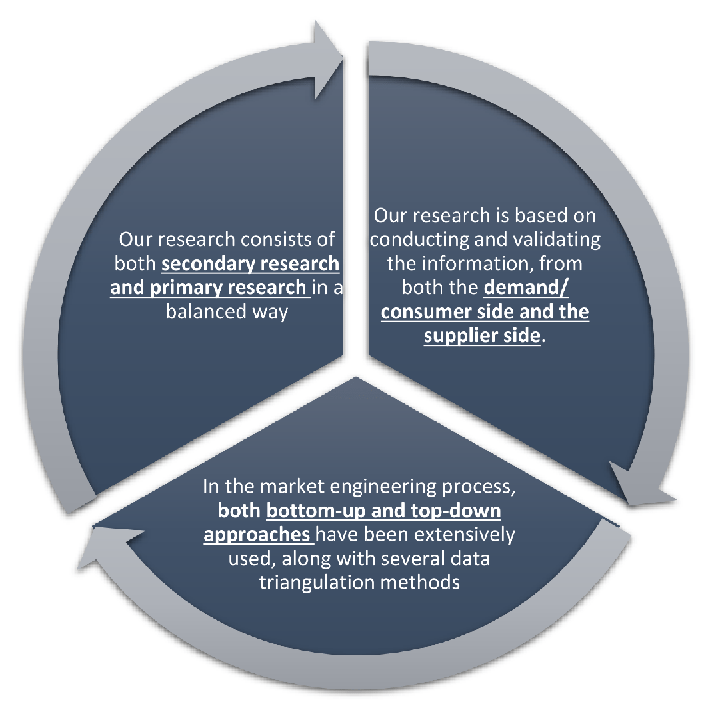
MarketGenics leverages a dedicated industry panel of experts and a comprehensive suite of paid databases to effectively collect, consolidate, and analyze market intelligence.
Our approach has consistently proven to be reliable and effective in generating accurate market insights, identifying key industry trends, and uncovering emerging business opportunities.
Through both primary and secondary research, we capture and analyze critical company-level data such as manufacturing footprints, including technical centers, R&D facilities, sales offices, and headquarters.
Our expert panel further enhances our ability to estimate market size for specific brands based on validated field-level intelligence.
Our data mining techniques incorporate both parametric and non-parametric methods, allowing for structured data collection, sorting, processing, and cleaning.
Demand projections are derived from large-scale data sets analyzed through proprietary algorithms, culminating in robust and reliable market sizing.
Research Approach
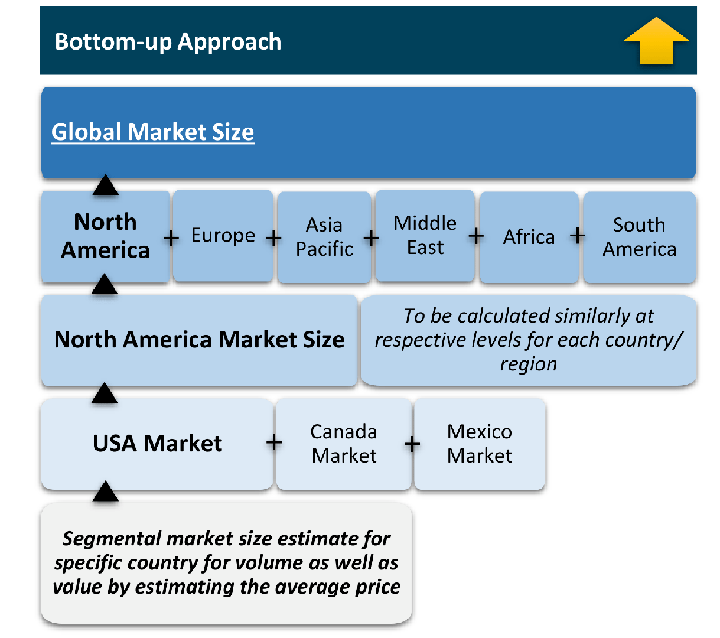
The bottom-up approach builds market estimates by starting with the smallest addressable market units and systematically aggregating them to create comprehensive market size projections.
This method begins with specific, granular data points and builds upward to create the complete market landscape.
Customer Analysis → Segmental Analysis → Geographical Analysis
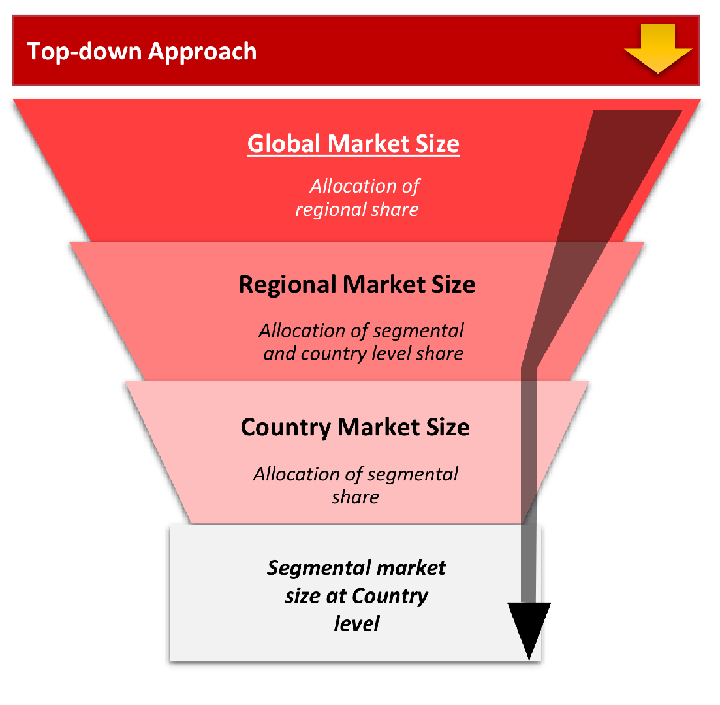
The top-down approach starts with the broadest possible market data and systematically narrows it down through a series of filters and assumptions to arrive at specific market segments or opportunities.
This method begins with the big picture and works downward to increasingly specific market slices.
TAM → SAM → SOM
Research Methods
Desk / Secondary Research
While analysing the market, we extensively study secondary sources, directories, and databases to identify and collect information useful for this technical, market-oriented, and commercial report. Secondary sources that we utilize are not only the public sources, but it is a combination of Open Source, Associations, Paid Databases, MG Repository & Knowledgebase, and others.
- Company websites, annual reports, financial reports, broker reports, and investor presentations
- National government documents, statistical databases and reports
- News articles, press releases and web-casts specific to the companies operating in the market, Magazines, reports, and others
- We gather information from commercial data sources for deriving company specific data such as segmental revenue, share for geography, product revenue, and others
- Internal and external proprietary databases (industry-specific), relevant patent, and regulatory databases
- Governing Bodies, Government Organizations
- Relevant Authorities, Country-specific Associations for Industries
We also employ the model mapping approach to estimate the product level market data through the players' product portfolio
Primary Research
Primary research/ interviews is vital in analyzing the market. Most of the cases involves paid primary interviews. Primary sources include primary interviews through e-mail interactions, telephonic interviews, surveys as well as face-to-face interviews with the different stakeholders across the value chain including several industry experts.
| Type of Respondents | Number of Primaries |
|---|---|
| Tier 2/3 Suppliers | ~20 |
| Tier 1 Suppliers | ~25 |
| End-users | ~25 |
| Industry Expert/ Panel/ Consultant | ~30 |
| Total | ~100 |
MG Knowledgebase
• Repository of industry blog, newsletter and case studies
• Online platform covering detailed market reports, and company profiles
Forecasting Factors and Models
Forecasting Factors
- Historical Trends – Past market patterns, cycles, and major events that shaped how markets behave over time. Understanding past trends helps predict future behavior.
- Industry Factors – Specific characteristics of the industry like structure, regulations, and innovation cycles that affect market dynamics.
- Macroeconomic Factors – Economic conditions like GDP growth, inflation, and employment rates that affect how much money people have to spend.
- Demographic Factors – Population characteristics like age, income, and location that determine who can buy your product.
- Technology Factors – How quickly people adopt new technology and how much technology infrastructure exists.
- Regulatory Factors – Government rules, laws, and policies that can help or restrict market growth.
- Competitive Factors – Analyzing competition structure such as degree of competition and bargaining power of buyers and suppliers.
Forecasting Models / Techniques
Multiple Regression Analysis
- Identify and quantify factors that drive market changes
- Statistical modeling to establish relationships between market drivers and outcomes
Time Series Analysis – Seasonal Patterns
- Understand regular cyclical patterns in market demand
- Advanced statistical techniques to separate trend, seasonal, and irregular components
Time Series Analysis – Trend Analysis
- Identify underlying market growth patterns and momentum
- Statistical analysis of historical data to project future trends
Expert Opinion – Expert Interviews
- Gather deep industry insights and contextual understanding
- In-depth interviews with key industry stakeholders
Multi-Scenario Development
- Prepare for uncertainty by modeling different possible futures
- Creating optimistic, pessimistic, and most likely scenarios
Time Series Analysis – Moving Averages
- Sophisticated forecasting for complex time series data
- Auto-regressive integrated moving average models with seasonal components
Econometric Models
- Apply economic theory to market forecasting
- Sophisticated economic models that account for market interactions
Expert Opinion – Delphi Method
- Harness collective wisdom of industry experts
- Structured, multi-round expert consultation process
Monte Carlo Simulation
- Quantify uncertainty and probability distributions
- Thousands of simulations with varying input parameters
Research Analysis
Our research framework is built upon the fundamental principle of validating market intelligence from both demand and supply perspectives. This dual-sided approach ensures comprehensive market understanding and reduces the risk of single-source bias.
Demand-Side Analysis: We understand end-user/application behavior, preferences, and market needs along with the penetration of the product for specific application.
Supply-Side Analysis: We estimate overall market revenue, analyze the segmental share along with industry capacity, competitive landscape, and market structure.
Validation & Evaluation
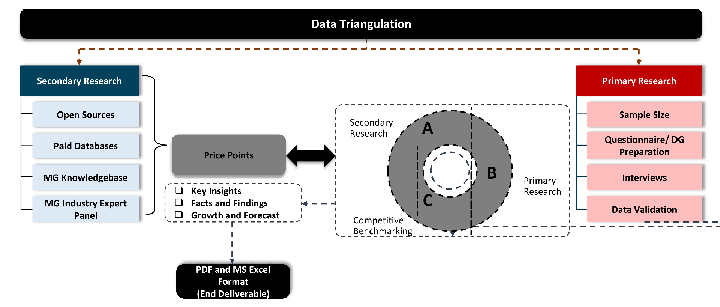
Data triangulation is a validation technique that uses multiple methods, sources, or perspectives to examine the same research question, thereby increasing the credibility and reliability of research findings. In market research, triangulation serves as a quality assurance mechanism that helps identify and minimize bias, validate assumptions, and ensure accuracy in market estimates.
- Data Source Triangulation – Using multiple data sources to examine the same phenomenon
- Methodological Triangulation – Using multiple research methods to study the same research question
- Investigator Triangulation – Using multiple researchers or analysts to examine the same data
- Theoretical Triangulation – Using multiple theoretical perspectives to interpret the same data
Custom Market Research Services
We will customise the research for you, in case the report listed above does not meet your requirements.
Get 10% Free Customisation