Xylitol Market Size, Share & Trends Analysis Report by Product Type (Crystalline Xylitol, Liquid Xylitol, Powdered Xylitol, Granulated Xylitol), Source, Purity Level, Distribution Channel, Packaging Type, End-Use Industry, and Geography (North America, Europe, Asia Pacific, Middle East, Africa, and South America) – Global Industry Data, Trends, and Forecasts, 2026–2035
|
|
|
Segmental Data Insights |
|
|
Demand Trends |
|
|
Competitive Landscape |
|
|
Strategic Development |
|
|
Future Outlook & Opportunities |
|
Xylitol-Market Size, Share, and Growth
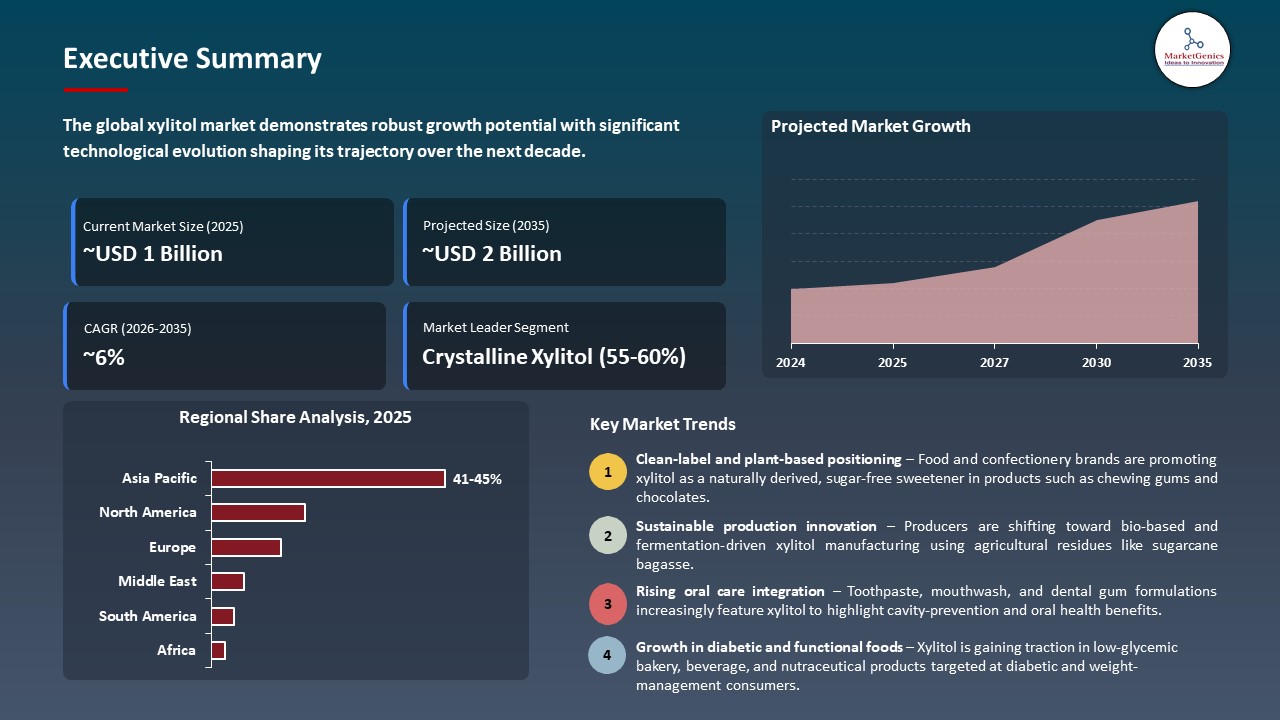
The global xylitol market is experiencing robust growth, with its estimated value of USD 0.9 billion in the year 2025 and USD 1.6 billion by 2035, registering a CAGR of 5.8%, during the forecast period. The global xylitol market is driven by growing health consciousness, rising preference for sugar‑free and low‑calorie products, increased use in dental care and pharmaceuticals, and expanding applications in food, beverages, and personal care products.
"The Better Juice technology adds a completely new dimension to our portfolio of sugar reduction solutions for food and beverage brands on a mission to meet increased consumer demand for less sugar," says Nate Yates, Sugar Reduction Business Leader at Ingredion. "This technology also provides manufacturers with more options to successfully reduce sugar without compromising on great taste or nutrition."
The xylitol market is growing due to increased consumer health awareness and demand of sugar-free products because manufacturers are addressing the increasing demand of low-calorie, diabetic, and clean-label substitutes in the food and beverage market. For instance, XYLISORB Xylitol, a sugar-free and low-glycemic sweetener, is promoted as a support of blood sugar regulation and oral health in confectionaries and health-conscious foods, by Roquette. This is increasing the speed at which xylitol is being introduced in food, beverage and oral care products, increasing market growth and prompting development of health-conscious sweeteners.
Additionally, the growing consumer awareness of oral health and dental health is leading to greater use of xylitol in toothpaste, chewing gum as well as mouthwash due to its non-fermentable properties that enhance dental benefits. For example, Colgate lists xylitol as a natural ingredient in some oral care formulations to help inhibit bacterial growth in the mouth, reflecting this expanded application trend. This is an increase in the use of xylitol in oral care products, which is expanding the market and providing possibilities of functional and preventive dental solutions.
Adjacent markets offering growth potential for the global xylitol market include sugar-free confectionery, functional beverages, oral care products, pharmaceutical formulations, and diabetic-friendly packaged foods. By increasing xylitol use in such industries, the manufacturers can take advantage of health-related trends as well as product portfolio diversification to improve cross-industry adoption and revenues. These adjacent markets are fueling increased xylitol usage, increasing the rate of market growth and opening up fresh horizons of innovation in health-conscious sweeteners.
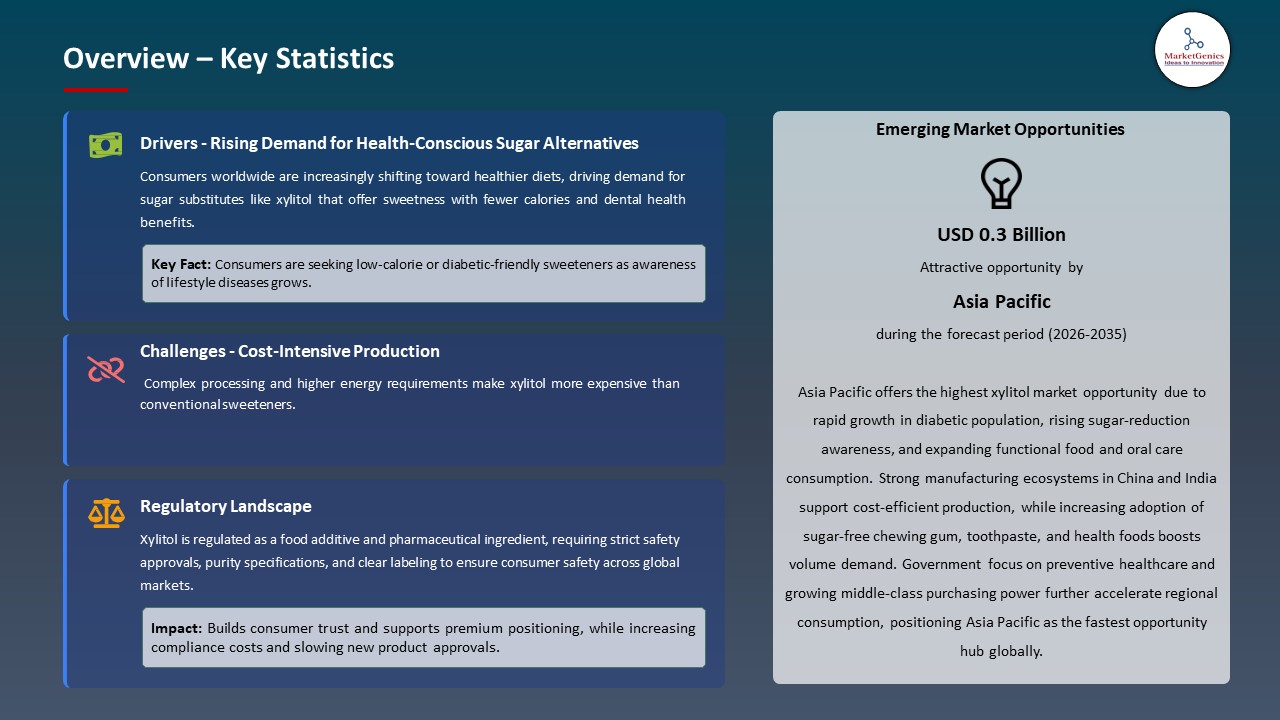
Xylitol Market Dynamics and Trends
Driver: Enhanced Functional Sweetener Innovation by Manufacturers
-
The xylitol market is currently driven by competitive product developments by major producers that add more functional values to the traditional sweetness conceptions, and which are potentially effective in meeting the changing needs of consumers and industrial uses.
- The innovation of major leaders, such as XYLISORB Xylitol portfolio by Roquette, is not only designed as a sugary sweetener but also as a product capable of providing other functional benefits, such as blood glucose management, oral health, and flexible formulation solutions that can be adjusted to confectionery, nutritional, or health-based products. These innovations will meet the increasing demands of consumers that have sought products with tangible health benefits without affecting taste and quality.
- Manufacturers are packaging xylitol as a multi-functional ingredient by combining both functionality and clean-label, and sugar-reduction trends, and responding to the growing demand of healthier foods, beverages, and pharmaceutical products.
- This focus on functional innovation of the sweetener is making xylitol enter new segments of application leading to increased usage, market growth and continued growth in the industry.
Restraint: High Production and Raw Material Cost Challenges
-
The high cost of production and raw materials availability is a major constraint to the xylitol market, because this aspect may adversely affect competitive pricing and the pace of mass adoption. Synthesis of xylitol is usually done in stages, where biomass feedstocks, e.g. birch wood, corn cobs, sugarcane bagasse undergo hydrogenation and purification.
- These complicated processes make xylitol less appealing to price-sensitive sectors of the food, beverage, and pharmaceutical sector since the sugar is more cost-effective than xylitol. Moreover, changes in supply and price of raw materials may pose a challenge to supply chain and restrict the ability to produce continuously and penetrate markets.
- High cost of manufacturing and shortages of raw materials decrease the cost of xylitol competitiveness in the market, limiting its market growth and decreasing its adoption compared to other low-cost sweetener products like sorbitol and erythritol.
Opportunity: Expansion into Pharmaceutical and Specialty Health Products
-
The growing use of xylitol in pharmaceutical and specialty health products with its low glycemic index, a good taste profile, and usefulness as a sweetener and excipient, xylitol is a growing product in terms of opportunity to the xylitol market as diabetes care, sugar-free medicine, syrup-flavored, vitamin supplements, chewables, and oral care are increasingly using xylitol as a low-calorie, low-carb product with potential to positively impact the health of patients taking their medication.
- For instance, Ingredion has strategized in India, acquiring majority interests in specialty ingredient companies to diversify its range of products to high-value pharmaceutical excipients and to formulators with additional ingredients that serve drug delivery and nutraceutical needs. The strategic growth of Ingredion is facilitating the wider use of xylitol in pharmaceutical and nutraceutical products that will lead to growth in the market and generation of new revenue.
- The market in pharmaceutical/specialty health applications is expanding and widening the application base of the xylitol market, resulting in higher volume uptake and long-term revenue growth.
Key Trend: Sustainable and Alternative Raw Material Adoption Initiatives
-
The tendency to transition to sustainable production based on alternative, plant-derived raw material and eco-friendly sourcing policies that limit carbon footprint and increase supply chain resilience is one among the major trends influencing the xylitol market.
- The major ingredient manufacturers are experimenting actively and incorporating non-traditional biomass feedstocks like sugarcane bagasse, wheat straw, and corn cobs into xylitol manufacture to reinforce the concept of a circular economy and appeal to customers conscious of environmental impact. For instance, in July 2024, Roquette announced a venture to use Brazilian sugarcane bagasse as a renewable feedstock to make xylitol, to support its overall sustainability goals and ESG, as well as less depend on traditional hardwood feeds.
- The shift toward green production and use of sustainable raw materials is making xylitol more marketable, making it a popular ingredient in clean-label and eco-friendly formulations and helping it to sustain steady market growth in the long term.
Xylitol-Market Analysis and Segmental Data
Crystalline Xylitol Dominate Global Xylitol Market
-
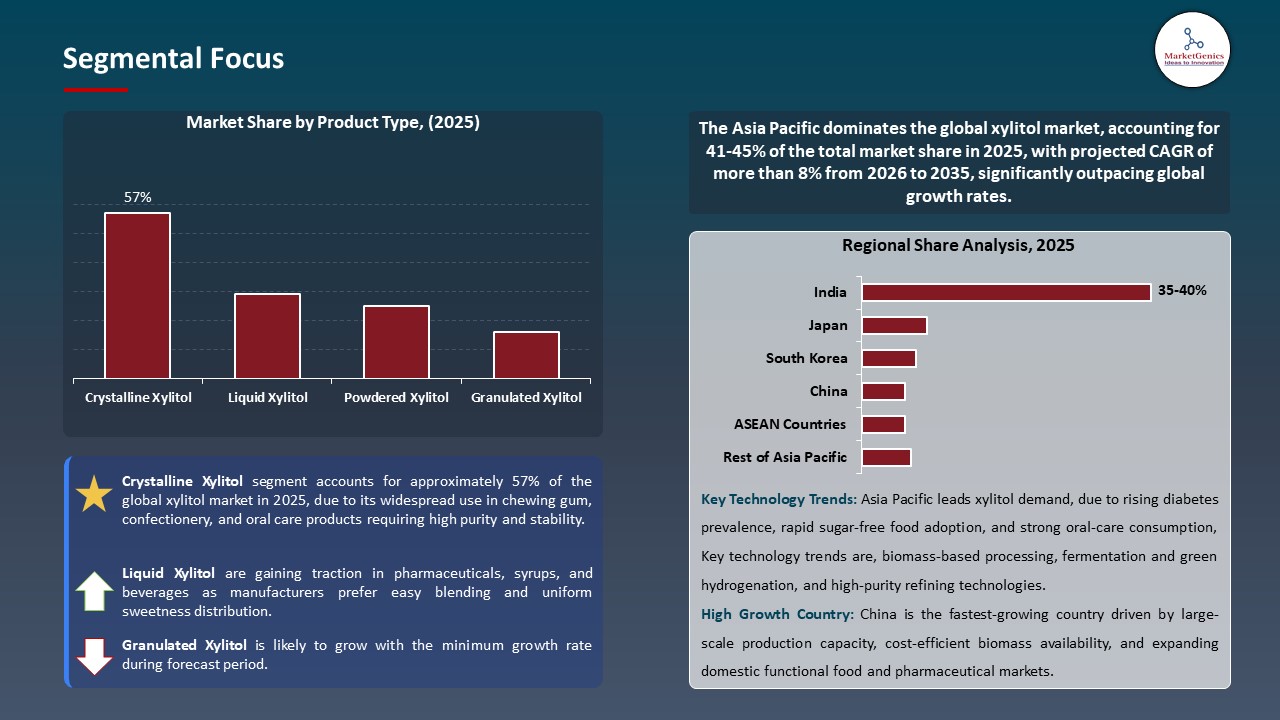
The crystalline xylitol segment dominates the global xylitol market, because of excellent processing performance, stability, and compatibility to multiple uses in food products as well as pharmaceuticals, oral care, and nutraceutical products. Its granular structure provides the sweetness comparable to sucrose, whereas providing the following functionality benefits, including low glycemic effect and clean cooling effect, which makes it very attractive in sugar-free chewing gums, candies, syrups, and toothpaste formulations.
- Manufacturers and suppliers around the globe prefer crystalline grades due to their ease of blending, precise dosing, and uniformity in quality usage in the industries. As an example, Foodchem International Corporation offers crystalline xylitol with a purity of ≥ 98.5% and finds wide application in confectionery, oral hygiene and dietary products, which highlights the popularity of crystalline xylitol in commercial preparations.
- The superiority of crystalline xylitol increases formulation ease and strengthens its use as the choice sweetener in health and functional product categories.
Asia Pacific Leads Global Xylitol Market Demand
-
Asia Pacific leads the xylitol market, as the growing popularity of low-calorie and diabetes-protective products is driving the adoption of xylitol, as people are searching to find healthier alternatives to traditional sugar in food, beverage and nutraceutical products. For instance, in 2024, Shandong Futaste Co., Ltd. was advised that the confectionary and oral care manufacturers showed strong demand, which is why it is planned to increase annual crystalline xylitol production to meet regional health-oriented consumption. Increasing xylitol production and adoption by the increasing health-conscious demand in the Asian Pacific is also strengthening the market leadership of the industry.
- Additionally, increased usage of xylitol in functional and value-added food and beverage products is a major source of market growth with brands developing to satisfy market needs of health and wellness through sugar-reduced formulations. For instance, Zerose xylitol by Cargill has been used more frequently by confectionery and beverage producers in Japan and South Korea to introduce new sugar-free products that attract health-conscious consumers, demonstrating a reaction of the industry to changing demand trends.
- The incorporation of xylitol into functional and sugar-reduced food and beverage items is enhancing market growth, innovation and consumer adoption in Asia pacific.
Xylitol-Market Ecosystem
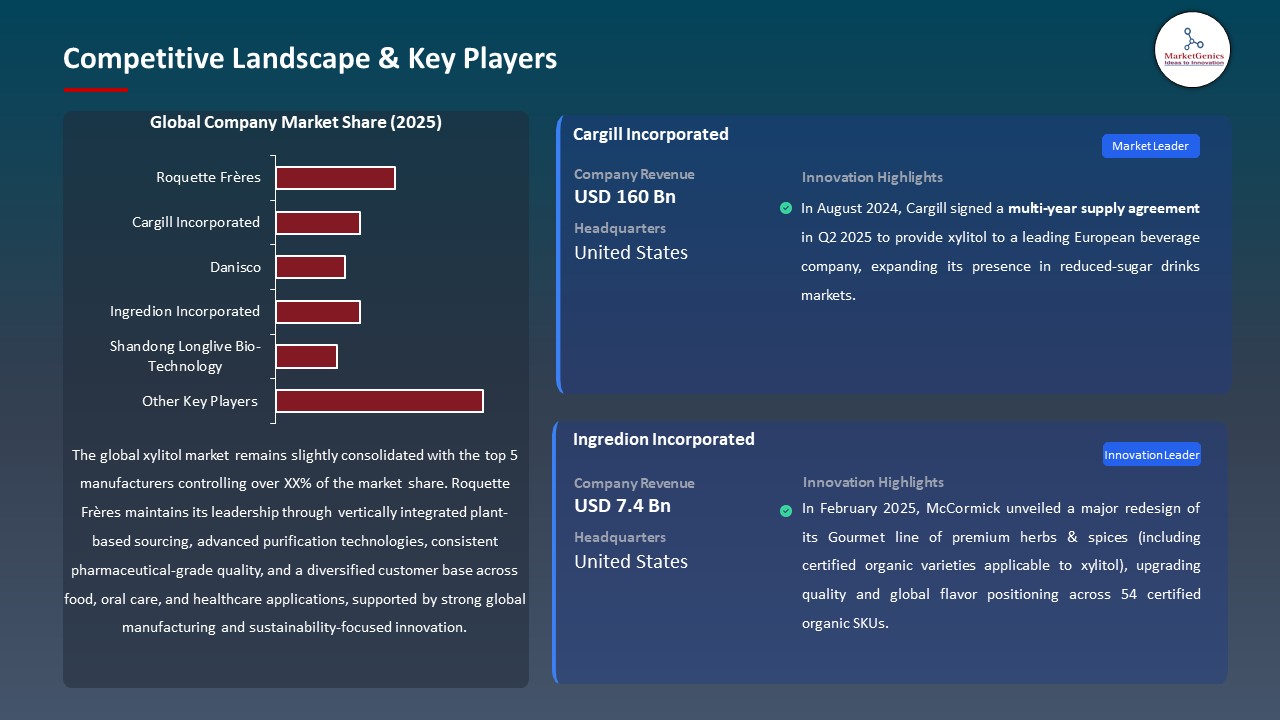
The global xylitol market is slightly consolidated, with high concentration among key players such as Roquette Frères, Cargill Incorporated, Danisco, Ingredion Incorporated, and Shandong Longlive Bio-Technology, dominates through strategic product innovations, expanded production capacities, and strong distribution networks across key regions.
This concentration allows major participants to control pricing, technological innovation and market standards, and establishes barriers to entry into the marketplace and a competitive emphasis on product differentiation and alliances.
Recent Development and Strategic Overview:
-
In June 2025, Univar Solutions Belgium N.V., announced an expansion of the partnership between their Foodology by Univar Solutions business and Ingredion Incorporated, to distribute in the Benelux region, enhancing supply of reduced‑sugar/functional sweetener systems to food and beverage manufacturers.
- In January 2024, Ingredion Incorporated spearheaded the Series A investment in Better Juice Ltd., facilitating the commercialization of enzymatic sugar‑reduction technologies that augment its polyol portfolio, including prospective xylitol applications in reduced‑sugar beverage formulations.
Report Scope
|
Detail |
|
|
Market Size in 2025 |
USD 0.9 Bn |
|
Market Forecast Value in 2035 |
USD 1.6 Bn |
|
Growth Rate (CAGR) |
5.8% |
|
Forecast Period |
2026 – 2035 |
|
Historical Data Available for |
2021 – 2024 |
|
Market Size Units |
US$ Billion for Value Tons for Volume |
|
Report Format |
Electronic (PDF) + Excel |
|
North America |
Europe |
Asia Pacific |
Middle East |
Africa |
South America |
|
|
|
|
|
|
|
Companies Covered |
|||||
|
|
|
|
|
|
Xylitol-Market Segmentation and Highlights
|
Segment |
Sub-segment |
|
Xylitol Market, By Product Type |
|
|
Xylitol Market, By Source |
|
|
Xylitol Market, By Purity Level |
|
|
Xylitol Market, By Distribution Channel |
|
|
Xylitol Market, By Packaging Type |
|
|
Xylitol Market, By End-Use Industry |
|
Frequently Asked Questions
Table of Contents
- 1. Research Methodology and Assumptions
- 1.1. Definitions
- 1.2. Research Design and Approach
- 1.3. Data Collection Methods
- 1.4. Base Estimates and Calculations
- 1.5. Forecasting Models
- 1.5.1. Key Forecast Factors & Impact Analysis
- 1.6. Secondary Research
- 1.6.1. Open Sources
- 1.6.2. Paid Databases
- 1.6.3. Associations
- 1.7. Primary Research
- 1.7.1. Primary Sources
- 1.7.2. Primary Interviews with Stakeholders across Ecosystem
- 2. Executive Summary
- 2.1. Global Xylitol Market Outlook
- 2.1.1. Xylitol Market Size (Volume - Tons and Value - US$ Bn), and Forecasts, 2021-2035
- 2.1.2. Compounded Annual Growth Rate Analysis
- 2.1.3. Growth Opportunity Analysis
- 2.1.4. Segmental Share Analysis
- 2.1.5. Geographical Share Analysis
- 2.2. Market Analysis and Facts
- 2.3. Supply-Demand Analysis
- 2.4. Competitive Benchmarking
- 2.5. Go-to- Market Strategy
- 2.5.1. Customer/ End-use Industry Assessment
- 2.5.2. Growth Opportunity Data, 2026-2035
- 2.5.2.1. Regional Data
- 2.5.2.2. Country Data
- 2.5.2.3. Segmental Data
- 2.5.3. Identification of Potential Market Spaces
- 2.5.4. GAP Analysis
- 2.5.5. Potential Attractive Price Points
- 2.5.6. Prevailing Market Risks & Challenges
- 2.5.7. Preferred Sales & Marketing Strategies
- 2.5.8. Key Recommendations and Analysis
- 2.5.9. A Way Forward
- 2.1. Global Xylitol Market Outlook
- 3. Industry Data and Premium Insights
- 3.1. Global Chemical & Materials Industry Overview, 2025
- 3.1.1. Chemical & Materials Industry Ecosystem Analysis
- 3.1.2. Key Trends for Chemical & Materials Industry
- 3.1.3. Regional Distribution for Chemical & Materials Industry
- 3.2. Supplier Customer Data
- 3.3. Technology Roadmap and Developments
- 3.4. Trade Analysis
- 3.4.1. Import & Export Analysis, 2025
- 3.4.2. Top Importing Countries
- 3.4.3. Top Exporting Countries
- 3.5. Trump Tariff Impact Analysis
- 3.5.1. Manufacturer
- 3.5.1.1. Based on the component & Raw material
- 3.5.2. Supply Chain
- 3.5.3. End Consumer
- 3.5.1. Manufacturer
- 3.6. Raw Material Analysis
- 3.1. Global Chemical & Materials Industry Overview, 2025
- 4. Market Overview
- 4.1. Market Dynamics
- 4.1.1. Drivers
- 4.1.1.1. Rising demand for low-calorie, diabetic-friendly sweeteners driven by global sugar-reduction and wellness trends
- 4.1.1.2. Strong adoption in oral care products due to xylitol’s proven anti-cariogenic and dental health benefits
- 4.1.1.3. Expanding use across food & beverages, pharmaceuticals, and nutraceutical formulations as a natural sugar substitute
- 4.1.2. Restraints
- 4.1.2.1. High production costs and energy-intensive processing compared with conventional sweeteners
- 4.1.2.2. Supply volatility and price sensitivity linked to limited availability of biomass-based raw materials
- 4.1.1. Drivers
- 4.2. Key Trend Analysis
- 4.3. Regulatory Framework
- 4.3.1. Key Regulations, Norms, and Subsidies, by Key Countries
- 4.3.2. Tariffs and Standards
- 4.3.3. Impact Analysis of Regulations on the Market
- 4.4. Value Chain Analysis
- 4.4.1. Raw Material Suppliers
- 4.4.2. Xylitol Manufacturers
- 4.4.3. Dealers/ Distributors
- 4.4.4. End-users/ Customers
- 4.5. Cost Structure Analysis
- 4.5.1. Parameter’s Share for Cost Associated
- 4.5.2. COGP vs COGS
- 4.5.3. Profit Margin Analysis
- 4.6. Pricing Analysis
- 4.6.1. Regional Pricing Analysis
- 4.6.2. Segmental Pricing Trends
- 4.6.3. Factors Influencing Pricing
- 4.7. Porter’s Five Forces Analysis
- 4.8. PESTEL Analysis
- 4.9. Global Xylitol Market Demand
- 4.9.1. Historical Market Size – Volume (Tons) and Value (US$ Bn), 2020-2024
- 4.9.2. Current and Future Market Size – Volume (Tons) and Value (US$ Bn), 2026–2035
- 4.9.2.1. Y-o-Y Growth Trends
- 4.9.2.2. Absolute $ Opportunity Assessment
- 4.1. Market Dynamics
- 5. Competition Landscape
- 5.1. Competition structure
- 5.1.1. Fragmented v/s consolidated
- 5.2. Company Share Analysis, 2025
- 5.2.1. Global Company Market Share
- 5.2.2. By Region
- 5.2.2.1. North America
- 5.2.2.2. Europe
- 5.2.2.3. Asia Pacific
- 5.2.2.4. Middle East
- 5.2.2.5. Africa
- 5.2.2.6. South America
- 5.3. Product Comparison Matrix
- 5.3.1. Specifications
- 5.3.2. Market Positioning
- 5.3.3. Pricing
- 5.1. Competition structure
- 6. Global Xylitol Market Analysis, by Product Type
- 6.1. Key Segment Analysis
- 6.2. Xylitol Market Size (Volume - Tons and Value - US$ Bn), Analysis, and Forecasts, by Product Type, 2021-2035
- 6.2.1. Crystalline Xylitol
- 6.2.2. Liquid Xylitol
- 6.2.3. Powdered Xylitol
- 6.2.4. Granulated Xylitol
- 7. Global Xylitol Market Analysis, by Source
- 7.1. Key Segment Analysis
- 7.2. Xylitol Market Size (Volume - Tons and Value - US$ Bn), Analysis, and Forecasts, by Source, 2021-2035
- 7.2.1. Corn Cob
- 7.2.2. Birch Wood
- 7.2.3. Beech Wood
- 7.2.4. Other Agricultural Residues
- 7.2.4.1. Sugarcane Bagasse
- 7.2.4.2. Rice Husk
- 7.2.4.3. Wheat Straw
- 8. Global Xylitol Market Analysis, by Purity Level
- 8.1. Key Segment Analysis
- 8.2. Xylitol Market Size (Volume - Tons and Value - US$ Bn), Analysis, and Forecasts, by Purity Level, 2021-2035
- 8.2.1. 95-98% Purity
- 8.2.2. 98-99% Purity
- 8.2.3. Above 99% Purity
- 9. Global Xylitol Market Analysis, by Distribution Channel
- 9.1. Key Segment Analysis
- 9.2. Xylitol Market Size (Volume - Tons and Value - US$ Bn), Analysis, and Forecasts, by Distribution Channel, 2021-2035
- 9.2.1. Direct Sales
- 9.2.1.1. B2B Direct
- 9.2.1.2. OEM Suppliers
- 9.2.2. Indirect Sales
- 9.2.2.1. Distributors
- 9.2.2.2. Wholesalers
- 9.2.2.3. Online Platforms
- 9.2.2.4. Retail Stores
- 9.2.1. Direct Sales
- 10. Global Xylitol Market Analysis, by Packaging Type
- 10.1. Key Segment Analysis
- 10.2. Xylitol Market Size (Volume - Tons and Value - US$ Bn), Analysis, and Forecasts, by Packaging Type, 2021-2035
- 10.2.1. Bulk Packaging
- 10.2.1.1. Drums
- 10.2.1.2. Bags (25kg/50kg)
- 10.2.1.3. Containers
- 10.2.2. Retail Packaging
- 10.2.2.1. Pouches
- 10.2.2.2. Bottles
- 10.2.2.3. Sachets
- 10.2.1. Bulk Packaging
- 11. Global Xylitol Market Analysis and Forecasts, by End-Use Industry
- 11.1. Key Findings
- 11.2. Xylitol Market Size (Volume - Tons and Value - US$ Bn), Analysis, and Forecasts, by End-Use Industry, 2021-2035
- 11.2.1. Food & Beverage
- 11.2.2. Pharmaceutical
- 11.2.3. Personal Care & Cosmetics
- 11.2.4. Animal Feed
- 11.2.5. Others
- 12. Global Xylitol Market Analysis and Forecasts, by Region
- 12.1. Key Findings
- 12.2. Xylitol Market Size (Volume - Tons and Value - US$ Bn), Analysis, and Forecasts, by Region, 2021-2035
- 12.2.1. North America
- 12.2.2. Europe
- 12.2.3. Asia Pacific
- 12.2.4. Middle East
- 12.2.5. Africa
- 12.2.6. South America
- 13. North America Xylitol Market Analysis
- 13.1. Key Segment Analysis
- 13.2. Regional Snapshot
- 13.3. North America Xylitol Market Size (Volume - Tons and Value - US$ Bn), Analysis, and Forecasts, 2021-2035
- 13.3.1. Product Type
- 13.3.2. Source
- 13.3.3. Purity Level
- 13.3.4. Distribution Channel
- 13.3.5. Packaging Type
- 13.3.6. End-Use Industry
- 13.3.7. Country
- 13.3.7.1. USA
- 13.3.7.2. Canada
- 13.3.7.3. Mexico
- 13.4. USA Xylitol Market
- 13.4.1. Country Segmental Analysis
- 13.4.2. Product Type
- 13.4.3. Source
- 13.4.4. Purity Level
- 13.4.5. Distribution Channel
- 13.4.6. Packaging Type
- 13.4.7. End-Use Industry
- 13.5. Canada Xylitol Market
- 13.5.1. Country Segmental Analysis
- 13.5.2. Product Type
- 13.5.3. Source
- 13.5.4. Purity Level
- 13.5.5. Distribution Channel
- 13.5.6. Packaging Type
- 13.5.7. End-Use Industry
- 13.6. Mexico Xylitol Market
- 13.6.1. Country Segmental Analysis
- 13.6.2. Product Type
- 13.6.3. Source
- 13.6.4. Purity Level
- 13.6.5. Distribution Channel
- 13.6.6. Packaging Type
- 13.6.7. End-Use Industry
- 14. Europe Xylitol Market Analysis
- 14.1. Key Segment Analysis
- 14.2. Regional Snapshot
- 14.3. Europe Xylitol Market Size (Volume - Tons and Value - US$ Bn), Analysis, and Forecasts, 2021-2035
- 14.3.1. Product Type
- 14.3.2. Source
- 14.3.3. Purity Level
- 14.3.4. Distribution Channel
- 14.3.5. Packaging Type
- 14.3.6. End-Use Industry
- 14.3.7. Country
- 14.3.7.1. Germany
- 14.3.7.2. United Kingdom
- 14.3.7.3. France
- 14.3.7.4. Italy
- 14.3.7.5. Spain
- 14.3.7.6. Netherlands
- 14.3.7.7. Nordic Countries
- 14.3.7.8. Poland
- 14.3.7.9. Russia & CIS
- 14.3.7.10. Rest of Europe
- 14.4. Germany Xylitol Market
- 14.4.1. Country Segmental Analysis
- 14.4.2. Product Type
- 14.4.3. Source
- 14.4.4. Purity Level
- 14.4.5. Distribution Channel
- 14.4.6. Packaging Type
- 14.4.7. End-Use Industry
- 14.5. United Kingdom Xylitol Market
- 14.5.1. Country Segmental Analysis
- 14.5.2. Product Type
- 14.5.3. Source
- 14.5.4. Purity Level
- 14.5.5. Distribution Channel
- 14.5.6. Packaging Type
- 14.5.7. End-Use Industry
- 14.6. France Xylitol Market
- 14.6.1. Country Segmental Analysis
- 14.6.2. Product Type
- 14.6.3. Source
- 14.6.4. Purity Level
- 14.6.5. Distribution Channel
- 14.6.6. Packaging Type
- 14.6.7. End-Use Industry
- 14.7. Italy Xylitol Market
- 14.7.1. Country Segmental Analysis
- 14.7.2. Product Type
- 14.7.3. Source
- 14.7.4. Purity Level
- 14.7.5. Distribution Channel
- 14.7.6. Packaging Type
- 14.7.7. End-Use Industry
- 14.8. Spain Xylitol Market
- 14.8.1. Country Segmental Analysis
- 14.8.2. Product Type
- 14.8.3. Source
- 14.8.4. Purity Level
- 14.8.5. Distribution Channel
- 14.8.6. Packaging Type
- 14.8.7. End-Use Industry
- 14.9. Netherlands Xylitol Market
- 14.9.1. Country Segmental Analysis
- 14.9.2. Product Type
- 14.9.3. Source
- 14.9.4. Purity Level
- 14.9.5. Distribution Channel
- 14.9.6. Packaging Type
- 14.9.7. End-Use Industry
- 14.10. Nordic Countries Xylitol Market
- 14.10.1. Country Segmental Analysis
- 14.10.2. Product Type
- 14.10.3. Source
- 14.10.4. Purity Level
- 14.10.5. Distribution Channel
- 14.10.6. Packaging Type
- 14.10.7. End-Use Industry
- 14.11. Poland Xylitol Market
- 14.11.1. Country Segmental Analysis
- 14.11.2. Product Type
- 14.11.3. Source
- 14.11.4. Purity Level
- 14.11.5. Distribution Channel
- 14.11.6. Packaging Type
- 14.11.7. End-Use Industry
- 14.12. Russia & CIS Xylitol Market
- 14.12.1. Country Segmental Analysis
- 14.12.2. Product Type
- 14.12.3. Source
- 14.12.4. Purity Level
- 14.12.5. Distribution Channel
- 14.12.6. Packaging Type
- 14.12.7. End-Use Industry
- 14.13. Rest of Europe Xylitol Market
- 14.13.1. Country Segmental Analysis
- 14.13.2. Product Type
- 14.13.3. Source
- 14.13.4. Purity Level
- 14.13.5. Distribution Channel
- 14.13.6. Packaging Type
- 14.13.7. End-Use Industry
- 15. Asia Pacific Xylitol Market Analysis
- 15.1. Key Segment Analysis
- 15.2. Regional Snapshot
- 15.3. Asia Pacific Xylitol Market Size (Volume - Tons and Value - US$ Bn), Analysis, and Forecasts, 2021-2035
- 15.3.1. Product Type
- 15.3.2. Source
- 15.3.3. Purity Level
- 15.3.4. Distribution Channel
- 15.3.5. Packaging Type
- 15.3.6. End-Use Industry
- 15.3.7. Country
- 15.3.7.1. China
- 15.3.7.2. India
- 15.3.7.3. Japan
- 15.3.7.4. South Korea
- 15.3.7.5. Australia and New Zealand
- 15.3.7.6. Indonesia
- 15.3.7.7. Malaysia
- 15.3.7.8. Thailand
- 15.3.7.9. Vietnam
- 15.3.7.10. Rest of Asia Pacific
- 15.4. China Xylitol Market
- 15.4.1. Country Segmental Analysis
- 15.4.2. Product Type
- 15.4.3. Source
- 15.4.4. Purity Level
- 15.4.5. Distribution Channel
- 15.4.6. Packaging Type
- 15.4.7. End-Use Industry
- 15.5. India Xylitol Market
- 15.5.1. Country Segmental Analysis
- 15.5.2. Product Type
- 15.5.3. Source
- 15.5.4. Purity Level
- 15.5.5. Distribution Channel
- 15.5.6. Packaging Type
- 15.5.7. End-Use Industry
- 15.6. Japan Xylitol Market
- 15.6.1. Country Segmental Analysis
- 15.6.2. Product Type
- 15.6.3. Source
- 15.6.4. Purity Level
- 15.6.5. Distribution Channel
- 15.6.6. Packaging Type
- 15.6.7. End-Use Industry
- 15.7. South Korea Xylitol Market
- 15.7.1. Country Segmental Analysis
- 15.7.2. Product Type
- 15.7.3. Source
- 15.7.4. Purity Level
- 15.7.5. Distribution Channel
- 15.7.6. Packaging Type
- 15.7.7. End-Use Industry
- 15.8. Australia and New Zealand Xylitol Market
- 15.8.1. Country Segmental Analysis
- 15.8.2. Product Type
- 15.8.3. Source
- 15.8.4. Purity Level
- 15.8.5. Distribution Channel
- 15.8.6. Packaging Type
- 15.8.7. End-Use Industry
- 15.9. Indonesia Xylitol Market
- 15.9.1. Country Segmental Analysis
- 15.9.2. Product Type
- 15.9.3. Source
- 15.9.4. Purity Level
- 15.9.5. Distribution Channel
- 15.9.6. Packaging Type
- 15.9.7. End-Use Industry
- 15.10. Malaysia Xylitol Market
- 15.10.1. Country Segmental Analysis
- 15.10.2. Product Type
- 15.10.3. Source
- 15.10.4. Purity Level
- 15.10.5. Distribution Channel
- 15.10.6. Packaging Type
- 15.10.7. End-Use Industry
- 15.11. Thailand Xylitol Market
- 15.11.1. Country Segmental Analysis
- 15.11.2. Product Type
- 15.11.3. Source
- 15.11.4. Purity Level
- 15.11.5. Distribution Channel
- 15.11.6. Packaging Type
- 15.11.7. End-Use Industry
- 15.12. Vietnam Xylitol Market
- 15.12.1. Country Segmental Analysis
- 15.12.2. Product Type
- 15.12.3. Source
- 15.12.4. Purity Level
- 15.12.5. Distribution Channel
- 15.12.6. Packaging Type
- 15.12.7. End-Use Industry
- 15.13. Rest of Asia Pacific Xylitol Market
- 15.13.1. Country Segmental Analysis
- 15.13.2. Product Type
- 15.13.3. Source
- 15.13.4. Purity Level
- 15.13.5. Distribution Channel
- 15.13.6. Packaging Type
- 15.13.7. End-Use Industry
- 16. Middle East Xylitol Market Analysis
- 16.1. Key Segment Analysis
- 16.2. Regional Snapshot
- 16.3. Middle East Xylitol Market Size (Volume - Tons and Value - US$ Bn), Analysis, and Forecasts, 2021-2035
- 16.3.1. Product Type
- 16.3.2. Source
- 16.3.3. Purity Level
- 16.3.4. Distribution Channel
- 16.3.5. Packaging Type
- 16.3.6. End-Use Industry
- 16.3.7. Country
- 16.3.7.1. Turkey
- 16.3.7.2. UAE
- 16.3.7.3. Saudi Arabia
- 16.3.7.4. Israel
- 16.3.7.5. Rest of Middle East
- 16.4. Turkey Xylitol Market
- 16.4.1. Country Segmental Analysis
- 16.4.2. Product Type
- 16.4.3. Source
- 16.4.4. Purity Level
- 16.4.5. Distribution Channel
- 16.4.6. Packaging Type
- 16.4.7. End-Use Industry
- 16.5. UAE Xylitol Market
- 16.5.1. Country Segmental Analysis
- 16.5.2. Product Type
- 16.5.3. Source
- 16.5.4. Purity Level
- 16.5.5. Distribution Channel
- 16.5.6. Packaging Type
- 16.5.7. End-Use Industry
- 16.6. Saudi Arabia Xylitol Market
- 16.6.1. Country Segmental Analysis
- 16.6.2. Product Type
- 16.6.3. Source
- 16.6.4. Purity Level
- 16.6.5. Distribution Channel
- 16.6.6. Packaging Type
- 16.6.7. End-Use Industry
- 16.7. Israel Xylitol Market
- 16.7.1. Country Segmental Analysis
- 16.7.2. Product Type
- 16.7.3. Source
- 16.7.4. Purity Level
- 16.7.5. Distribution Channel
- 16.7.6. Packaging Type
- 16.7.7. End-Use Industry
- 16.8. Rest of Middle East Xylitol Market
- 16.8.1. Country Segmental Analysis
- 16.8.2. Product Type
- 16.8.3. Source
- 16.8.4. Purity Level
- 16.8.5. Distribution Channel
- 16.8.6. Packaging Type
- 16.8.7. End-Use Industry
- 17. Africa Xylitol Market Analysis
- 17.1. Key Segment Analysis
- 17.2. Regional Snapshot
- 17.3. Africa Xylitol Market Size (Volume - Tons and Value - US$ Bn), Analysis, and Forecasts, 2021-2035
- 17.3.1. Product Type
- 17.3.2. Source
- 17.3.3. Purity Level
- 17.3.4. Distribution Channel
- 17.3.5. Packaging Type
- 17.3.6. End-Use Industry
- 17.3.7. Country
- 17.3.7.1. South Africa
- 17.3.7.2. Egypt
- 17.3.7.3. Nigeria
- 17.3.7.4. Algeria
- 17.3.7.5. Rest of Africa
- 17.4. South Africa Xylitol Market
- 17.4.1. Country Segmental Analysis
- 17.4.2. Product Type
- 17.4.3. Source
- 17.4.4. Purity Level
- 17.4.5. Distribution Channel
- 17.4.6. Packaging Type
- 17.4.7. End-Use Industry
- 17.5. Egypt Xylitol Market
- 17.5.1. Country Segmental Analysis
- 17.5.2. Product Type
- 17.5.3. Source
- 17.5.4. Purity Level
- 17.5.5. Distribution Channel
- 17.5.6. Packaging Type
- 17.5.7. End-Use Industry
- 17.6. Nigeria Xylitol Market
- 17.6.1. Country Segmental Analysis
- 17.6.2. Product Type
- 17.6.3. Source
- 17.6.4. Purity Level
- 17.6.5. Distribution Channel
- 17.6.6. Packaging Type
- 17.6.7. End-Use Industry
- 17.7. Algeria Xylitol Market
- 17.7.1. Country Segmental Analysis
- 17.7.2. Product Type
- 17.7.3. Source
- 17.7.4. Purity Level
- 17.7.5. Distribution Channel
- 17.7.6. Packaging Type
- 17.7.7. End-Use Industry
- 17.8. Rest of Africa Xylitol Market
- 17.8.1. Country Segmental Analysis
- 17.8.2. Product Type
- 17.8.3. Source
- 17.8.4. Purity Level
- 17.8.5. Distribution Channel
- 17.8.6. Packaging Type
- 17.8.7. End-Use Industry
- 18. South America Xylitol Market Analysis
- 18.1. Key Segment Analysis
- 18.2. Regional Snapshot
- 18.3. South America Xylitol Market Size (Volume - Tons and Value - US$ Bn), Analysis, and Forecasts, 2021-2035
- 18.3.1. Product Type
- 18.3.2. Source
- 18.3.3. Purity Level
- 18.3.4. Distribution Channel
- 18.3.5. Packaging Type
- 18.3.6. End-Use Industry
- 18.3.7. Country
- 18.3.7.1. Brazil
- 18.3.7.2. Argentina
- 18.3.7.3. Rest of South America
- 18.4. Brazil Xylitol Market
- 18.4.1. Country Segmental Analysis
- 18.4.2. Product Type
- 18.4.3. Source
- 18.4.4. Purity Level
- 18.4.5. Distribution Channel
- 18.4.6. Packaging Type
- 18.4.7. End-Use Industry
- 18.5. Argentina Xylitol Market
- 18.5.1. Country Segmental Analysis
- 18.5.2. Product Type
- 18.5.3. Source
- 18.5.4. Purity Level
- 18.5.5. Distribution Channel
- 18.5.6. Packaging Type
- 18.5.7. End-Use Industry
- 18.6. Rest of South America Xylitol Market
- 18.6.1. Country Segmental Analysis
- 18.6.2. Product Type
- 18.6.3. Source
- 18.6.4. Purity Level
- 18.6.5. Distribution Channel
- 18.6.6. Packaging Type
- 18.6.7. End-Use Industry
- 19. Key Players/ Company Profile
- 19.1. Cargill Incorporated
- 19.1.1. Company Details/ Overview
- 19.1.2. Company Financials
- 19.1.3. Key Customers and Competitors
- 19.1.4. Business/ Industry Portfolio
- 19.1.5. Product Portfolio/ Specification Details
- 19.1.6. Pricing Data
- 19.1.7. Strategic Overview
- 19.1.8. Recent Developments
- 19.2. Danisco (DuPont)
- 19.3. Foodchem International Corporation
- 19.4. Futaste Pharmaceutical
- 19.5. Hangzhou Shouxin Biological Technology
- 19.6. Hubei Xinnong Biotechnology
- 19.7. Ingredion Incorporated
- 19.8. Jiangsu Lanhai Biotechnology
- 19.9. Mitsubishi Shoji Foodtech
- 19.10. Novagreen Inc.
- 19.11. Roquette Frères
- 19.12. Shandong Longlive Bio-Technology
- 19.13. Shandong Lujian Biological Technology
- 19.14. Shandong Saigo Group Corporation
- 19.15. Thomson Biotech
- 19.16. Xlear Inc.
- 19.17. Yucheng Lujian Chemical Industry
- 19.18. Zhejiang Huakang Pharmaceutical
- 19.19. Zhucheng Dongxiao Biotechnology
- 19.20. Zuchem Inc.
- 19.21. Other Key Players
- 19.1. Cargill Incorporated
Note* - This is just tentative list of players. While providing the report, we will cover more number of players based on their revenue and share for each geography
Research Design
Our research design integrates both demand-side and supply-side analysis through a balanced combination of primary and secondary research methodologies. By utilizing both bottom-up and top-down approaches alongside rigorous data triangulation methods, we deliver robust market intelligence that supports strategic decision-making.
MarketGenics' comprehensive research design framework ensures the delivery of accurate, reliable, and actionable market intelligence. Through the integration of multiple research approaches, rigorous validation processes, and expert analysis, we provide our clients with the insights needed to make informed strategic decisions and capitalize on market opportunities.

MarketGenics leverages a dedicated industry panel of experts and a comprehensive suite of paid databases to effectively collect, consolidate, and analyze market intelligence.
Our approach has consistently proven to be reliable and effective in generating accurate market insights, identifying key industry trends, and uncovering emerging business opportunities.
Through both primary and secondary research, we capture and analyze critical company-level data such as manufacturing footprints, including technical centers, R&D facilities, sales offices, and headquarters.
Our expert panel further enhances our ability to estimate market size for specific brands based on validated field-level intelligence.
Our data mining techniques incorporate both parametric and non-parametric methods, allowing for structured data collection, sorting, processing, and cleaning.
Demand projections are derived from large-scale data sets analyzed through proprietary algorithms, culminating in robust and reliable market sizing.
Research Approach
The bottom-up approach builds market estimates by starting with the smallest addressable market units and systematically aggregating them to create comprehensive market size projections.
This method begins with specific, granular data points and builds upward to create the complete market landscape.
Customer Analysis → Segmental Analysis → Geographical Analysis
The top-down approach starts with the broadest possible market data and systematically narrows it down through a series of filters and assumptions to arrive at specific market segments or opportunities.
This method begins with the big picture and works downward to increasingly specific market slices.
TAM → SAM → SOM


Research Methods
Desk / Secondary Research
While analysing the market, we extensively study secondary sources, directories, and databases to identify and collect information useful for this technical, market-oriented, and commercial report. Secondary sources that we utilize are not only the public sources, but it is a combination of Open Source, Associations, Paid Databases, MG Repository & Knowledgebase, and others.
- Company websites, annual reports, financial reports, broker reports, and investor presentations
- National government documents, statistical databases and reports
- News articles, press releases and web-casts specific to the companies operating in the market, Magazines, reports, and others
- We gather information from commercial data sources for deriving company specific data such as segmental revenue, share for geography, product revenue, and others
- Internal and external proprietary databases (industry-specific), relevant patent, and regulatory databases
- Governing Bodies, Government Organizations
- Relevant Authorities, Country-specific Associations for Industries
We also employ the model mapping approach to estimate the product level market data through the players' product portfolio
Primary Research
Primary research/ interviews is vital in analyzing the market. Most of the cases involves paid primary interviews. Primary sources include primary interviews through e-mail interactions, telephonic interviews, surveys as well as face-to-face interviews with the different stakeholders across the value chain including several industry experts.
| Type of Respondents | Number of Primaries |
|---|---|
| Tier 2/3 Suppliers | ~20 |
| Tier 1 Suppliers | ~25 |
| End-users | ~25 |
| Industry Expert/ Panel/ Consultant | ~30 |
| Total | ~100 |
MG Knowledgebase
• Repository of industry blog, newsletter and case studies
• Online platform covering detailed market reports, and company profiles
Forecasting Factors and Models
Forecasting Factors
- Historical Trends – Past market patterns, cycles, and major events that shaped how markets behave over time. Understanding past trends helps predict future behavior.
- Industry Factors – Specific characteristics of the industry like structure, regulations, and innovation cycles that affect market dynamics.
- Macroeconomic Factors – Economic conditions like GDP growth, inflation, and employment rates that affect how much money people have to spend.
- Demographic Factors – Population characteristics like age, income, and location that determine who can buy your product.
- Technology Factors – How quickly people adopt new technology and how much technology infrastructure exists.
- Regulatory Factors – Government rules, laws, and policies that can help or restrict market growth.
- Competitive Factors – Analyzing competition structure such as degree of competition and bargaining power of buyers and suppliers.
Forecasting Models / Techniques
Multiple Regression Analysis
- Identify and quantify factors that drive market changes
- Statistical modeling to establish relationships between market drivers and outcomes
Time Series Analysis – Seasonal Patterns
- Understand regular cyclical patterns in market demand
- Advanced statistical techniques to separate trend, seasonal, and irregular components
Time Series Analysis – Trend Analysis
- Identify underlying market growth patterns and momentum
- Statistical analysis of historical data to project future trends
Expert Opinion – Expert Interviews
- Gather deep industry insights and contextual understanding
- In-depth interviews with key industry stakeholders
Multi-Scenario Development
- Prepare for uncertainty by modeling different possible futures
- Creating optimistic, pessimistic, and most likely scenarios
Time Series Analysis – Moving Averages
- Sophisticated forecasting for complex time series data
- Auto-regressive integrated moving average models with seasonal components
Econometric Models
- Apply economic theory to market forecasting
- Sophisticated economic models that account for market interactions
Expert Opinion – Delphi Method
- Harness collective wisdom of industry experts
- Structured, multi-round expert consultation process
Monte Carlo Simulation
- Quantify uncertainty and probability distributions
- Thousands of simulations with varying input parameters
Research Analysis
Our research framework is built upon the fundamental principle of validating market intelligence from both demand and supply perspectives. This dual-sided approach ensures comprehensive market understanding and reduces the risk of single-source bias.
Demand-Side Analysis: We understand end-user/application behavior, preferences, and market needs along with the penetration of the product for specific application.
Supply-Side Analysis: We estimate overall market revenue, analyze the segmental share along with industry capacity, competitive landscape, and market structure.
Validation & Evaluation
Data triangulation is a validation technique that uses multiple methods, sources, or perspectives to examine the same research question, thereby increasing the credibility and reliability of research findings. In market research, triangulation serves as a quality assurance mechanism that helps identify and minimize bias, validate assumptions, and ensure accuracy in market estimates.
- Data Source Triangulation – Using multiple data sources to examine the same phenomenon
- Methodological Triangulation – Using multiple research methods to study the same research question
- Investigator Triangulation – Using multiple researchers or analysts to examine the same data
- Theoretical Triangulation – Using multiple theoretical perspectives to interpret the same data

Custom Market Research Services
We will customise the research for you, in case the report listed above does not meet your requirements.
Get 10% Free Customisation