Yarn and Fabrics Market Size, Share & Trends Analysis Report by Product Type (Natural Fibers, Synthetic Fibers, Blended Fibers, Cotton-Polyester Blend, Wool-Synthetic Blend, Other Blends), Yarn Count/Denier, Fabric Construction, Fabric Weight (GSM - Grams per Square Meter), Production Capacity (Metric Tons per Annum), Processing Technology, Yarn Twist Level (Turns per Inch/Meter), End-Use, Distribution Channel, Finish Type, and Geography (North America, Europe, Asia Pacific, Middle East, Africa, and South America) – Global Industry Data, Trends, and Forecasts, 2026–2035
|
|
|
Segmental Data Insights |
|
|
Demand Trends |
|
|
Competitive Landscape |
|
|
Strategic Development |
|
|
Future Outlook & Opportunities |
|
Yarn-and-Fabrics-Market Size, Share, and Growth
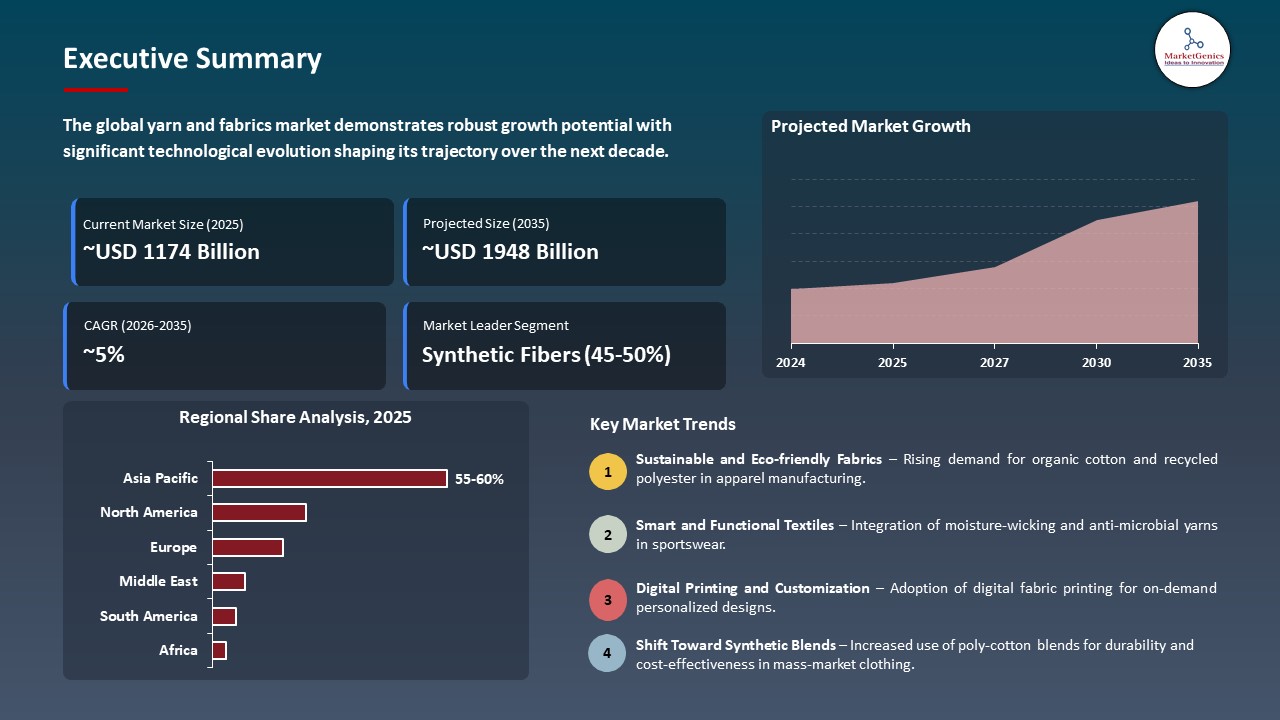
The global yarn and fabrics market is experiencing robust growth, with its estimated value of USD 1173.5 billion in the year 2025 and USD 1948.2 billion by the period 2035, registering a CAGR of 5.2%, during the forecast period. The global yarn and fabrics market is driven by rising apparel consumption, growth of fast fashion, expanding textile manufacturing in Asia, increasing preference for sustainable materials, and advancements in fiber technologies that enhance performance, durability, and customization across both apparel and industrial applications.
Yash Lohia, Executive President of Petchem Special Projects, Indorama Ventures said, "We are proud to join forces with such esteemed partners in this groundbreaking initiative. At Indorama Ventures, we are deeply committed to advancing sustainable solutions, and this project exemplifies our dedication to innovation and environmental stewardship and making strides towards Indorama Ventures’ ‘Vision 2030’. By utilizing CO2-derived materials, renewable resources, and bio-based alternatives, collaborative effort demonstrates the power of global cooperation in creating a more sustainable future for the textile industry and beyond."
The global yarn and fabrics market is becoming increasingly motivated by the growing presence of sustainable and circular economy fabrics in demand. As an example, in January 2025 Rudra Ecovation released a new collection of PET bottles upcycled into new fabrics labeled Anaura, an alternative to pet and fashionable uses of home textiles, athleisure and fashion. This trend is increasing the use of recycled and up cycled in global market, increasing the market share of the textile segments that are eco-friendly and supporting to minimize the waste of textiles and the use of resources.
Furthermore, the yarn and fabrics market is being driven by the use of new technologies in manufacturing and fiber-innovation, which facilitates new performance-based fabrics. For instance, in October 2025, Lenzing Group, together with OceanSafe, announced a development of a next-generation yarn, made of wood-based Lyocell fibers, bio-based co-polyester, and developed to be used in high-performance sportswear and activewear. This innovation broadens the opportunity of the market beyond traditional clothing so that it can embrace functional, high-performance fabrics and also helps diversify and expand the global yarn and fabrics market.
The global yarn and fabrics market present adjacent opportunities in sustainable textile fibers, technical and performance fabrics, smart textiles and wearable tech, home textiles and upholstery, and eco‑friendly packaging materials. These industries use innovation, recyclability, and multifunctionality in order to address changing consumer and industrial needs. The diversification, increase in revenue and robustness throughout the textile value chain is fueled by expansion into these adjacent markets.

Yarn and Fabrics Market Dynamics and Trends
Driver: Expansion of Commercial‑Scale Polyester Recycling by Major Yarn Manufacturers
-
The global market of yarns and fabrics is experiencing a remarkable development due to the high investments in polyester recycling as manufacturers are turning to the practices of the circular economy to satisfy the requirements of sustainability.
- For instance, in 2025, Filatex India stated it is constructing a 75 tonne /day polyester recycling facility, an investment of approximately 300 crores to transform textile waste into chips and subsequently progress it into yarn scheduled to be commissioned by 2026. This is a strategic step to augment supply of recycled yarn and would help reduce reliance on the virgin raw materials in light of resource scarcity.
- The manufacturer will use the current and future-oriented recycling technologies to make sure that the increasing domestic and global demand of sustainable yarn can be fulfilled without affecting the quality and scalability of products. This business move makes the industry a leader in the field of circular textiles and evidences the overall change towards sustainable production methods.
- The increased capacity to recycle empowers the provision of sustainable yarns and hastens the shift to the global textile industry towards the circular and resource-efficient production.
Restraint: Cost and Complexity of Recycling Technology Adoption for Smaller Mills
-
The global yarn and fabrics market face a major restraint in the form of the extreme amount of capital and technical difficulty with which they need to adopt the modern recycling technology. The procedures needed to transform the waste post-consumer of polyester or cotton into high-quality yarn require specialized machinery, specialized personnel, and significant changes in operation, which may be cost-prohibitive.
- The opportunities of smaller mid-sized manufacturers are that they do not have the financial resources or technical skills to adopt these systems which curtails their participation in the sustainable yarn segment. Even larger mills can struggle to incorporate recycling activities that do not affect current production lines or to pay a high cost to create an uneven balance in their adoption within the industry.
- As a result, the overall penetration of the recycled yarn in the market is still limited, and the transition to the scale-up of the models of continuous production in the sector is not as rapid as it should be.
- Recycling technologies, with their high cost and technical requirements, are limiting the implementation of sustainability barriers to the growth of sustainable yarn production and slow the transition of the whole market to a circular economy.
Opportunity: Rising Demand for Regenerated Fibres from Global Brands Encourages Yarn Makers
-
The global yarn and fabrics market present a significant growth opportunity in the provision of regenerated fibres to the global apparel and textile companies which are currently dedicated to sustainability. The increase in environmental consciousness, policies, and corporate sustainability are increasing the market share of recycled and environmentally friendly yarns, providing manufacturers with the possibility to provide high-quality sustainable fibres.
- For example, in 2025, Sateri released its Finex line that consists of recycled polyester and cellulosic fibres aimed at addressing the needs of large-scale supply chains globally. These fibres will guarantee quality, scalability, will be in accordance with the goals of brand sustainability, and allow penetration of the highest markets and long-term contracts.
- Moreover, the use of regenerated fibres minimises the reliance on vulnerable raw materials (volatile virgin) and strengthens the supply chain. By investing in the production of regenerative fibres, manufacturers will be able to tap into new sources of revenue as well as facilitating the overall shift to a circular production of textiles.
- The provision of regenerated fibres helps manufacturers to secure high contractual offers and long-term, stable market growth.
Key Trend: Growing Industry Collaboration for Textile‑to‑Textile Recycling Partnerships Worldwide
-
The global yarn and fabrics market is witnessing a key trend of is the increased co-operation between recyclers and fibre producers and yarn manufacturers to process an integrated textile-to-textile recycling system.
- For instance, in 2025, Ambercycle collaborated with Shenghong Chemical Fiber New Material Co., Ltd. to produce regenerated filament yarns at scale using the cycora technology developed by Ambercycle. This partnership enables textile wastes to be transformed into recyclable polyester yarn of high quality and will be easily incorporated into global supply chains.
- By combining technical skills, production capacity and access to markets, such alliances transcend operational and logistical hurdles more usefully than when acting alone. These partnerships will accelerate the rate of adoption of sustainable yarns, maintain a standard quality and assist in achieving strict sustainability certifications required by brands and institutional purchasers.
- Cross-industry collaboration will help accelerates the transition to the production of circular yarn, increase the range of sustainable fibres, and enhance the environmental impact of the global market.
Yarn-and-Fabrics-Market Analysis and Segmental Data
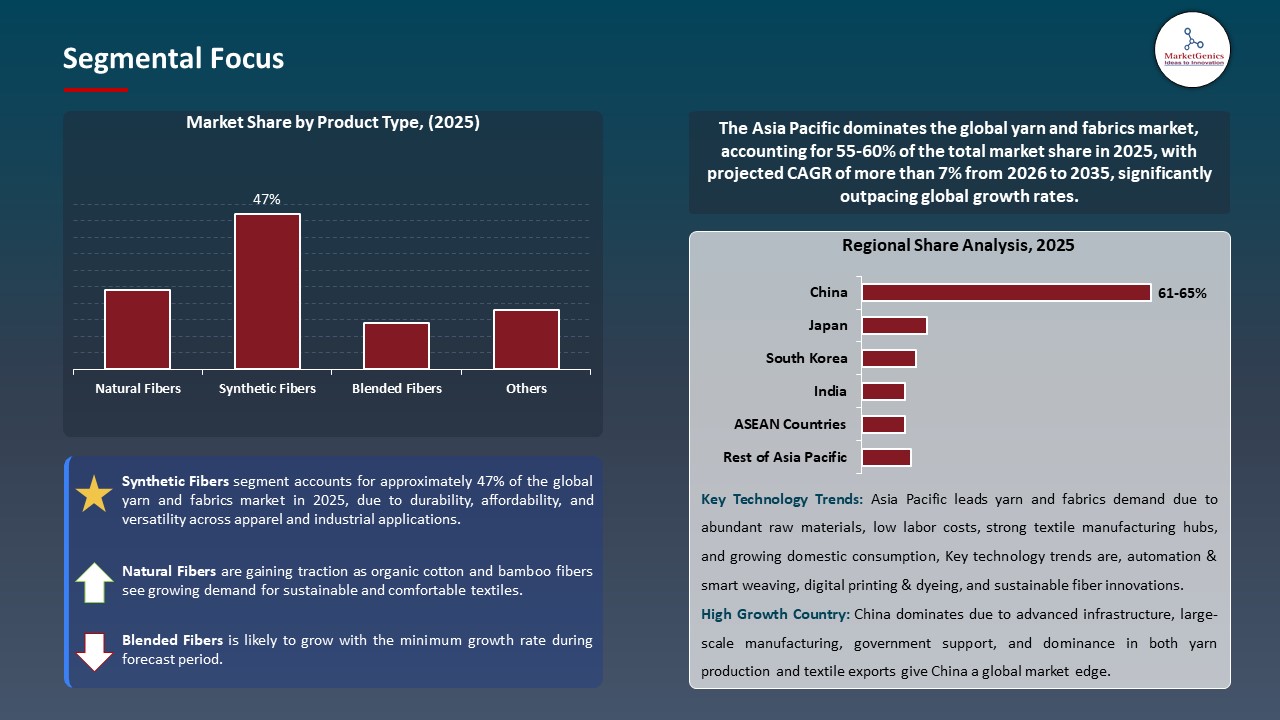
Synthetic Fibers Dominate Global Yarn and Fabrics Market
-
The synthetic fibers segment dominates the global yarn and fabrics market with their durability, low price, low maintenance, and their applicability in the apparel, home as well as technical textile segment. These characteristics allow high quantity production and reliability of quality, and as a result, synthetics are the most desirable to the manufacturers in the global.
- For instance, in 2025, synthetic‑yarn manufacturer UNIFI launched new yarn lines (under its REPREVE brand) that incorporate biodegradable‑enhanced polyester and nylon, blending performance with environmental credentials. By providing high performance with sustainability, the introduction of synthetic yarns with biodegradation improves the competitiveness of the market due to the increased demand on the eco-friendly textile.
- The dominance of synthetic fibers enforced through the development of new technologies, including biodegradable-enhanced yarns, promotes the development of the market by enhancing the performance, sustainability, and long-term adoption in the global textile supply chains.
Asia Pacific Leads Global Yarn and Fabrics Market Demand
-
Asia Pacific leads the global yarn and fabrics market, propelled by the highly established and integrated textile manufacturing infrastructure which allows vast economical production of fabrics and yarns. For instance, in October 2025, Sangam India Limited (SIL) in India setting up ₹500 crore to develop its spinning and weaving.
- The investment will increase the capacity of production of the yarn and add modern weaving technology to increase efficiency and improve the quality of the product and enhance supply to both the domestic and international markets.
- Moreover, robust domestic textile consumption and growing export business in major economies like India, China, and Vietnam keeps driving the demand of yarn and fabric in the Asia-Pacific region.
- As an example, in 2025, Vietnam registered a 12% per year increase in textile and garment exports between January and May that had been facilitated by an increase in shipments of yarn and fabric. This is indicative of the growing presence of Asia Pacific as a sourcing center with high competitiveness supported by low-cost production and continued repositioning of the global supply-chain.
- Asia Pacific has growing production capacity and export-led growth, which supports its role as the demand centre of yarn and fabrics, and provides a long-term market control and inflow of investment in the entire textile value chain in the region.
Yarn-and-Fabrics-Market Ecosystem
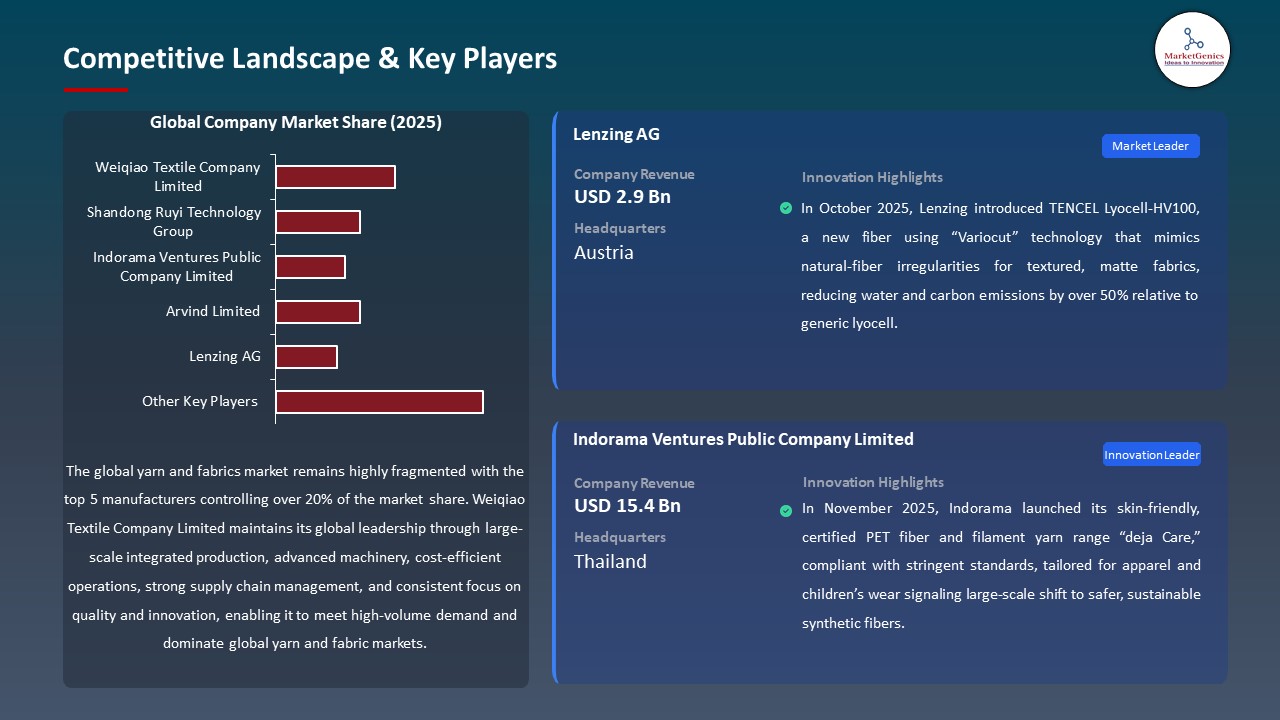
The global yarn and fabrics market is highly fragmented, with high concentration among key players such as Weiqiao Textile Company Limited, Shandong Ruyi Technology Group, Indorama Ventures Public Company Limited, Arvind Limited, and Lenzing AG, who dominate through their large scale production, wide distribution channels, technology advancement and diversified portfolio of products and hence, capture a large market share and are able to influence the trends and trends in the industry across the world.
For instance, in 2025, Indorama Ventures declared a joint venture with a chemical recycling company to increase the volume of recycled polyester yarns globally, which reflects its strategic decisions to invest in sustainable capacity and dominance in the market. This joint venture augments sustainable supply of yarns, market power, and leadership in the global yarn and fabrics industry of Indorama.
Recent Development and Strategic Overview:
-
In September 2025, Lenzing AG introduced “Lenzing Pro,” a digital platform providing a centralized fiber catalogue, certification resources, technical specifications, and supply-chain management tools, designed to enhance the adoption and integration of sustainable cellulosic fibers across global textile value chains.
- In July 2024, Indorama Ventures Public Company Limited joined a consortium to develop a next-generation supply chain for sustainable polyester fibers utilizing renewable and CO₂-derived feedstocks, supporting the shift away from fossil-based inputs and enabling high-performance apparel brands to incorporate lower-carbon, environmentally responsible materials.
Report Scope
|
Detail |
|
|
Market Size in 2025 |
USD 1173.5 Bn |
|
Market Forecast Value in 2035 |
USD 1948.2 Bn |
|
Growth Rate (CAGR) |
5.2% |
|
Forecast Period |
2026 – 2035 |
|
Historical Data Available for |
2021 – 2024 |
|
Market Size Units |
US$ Billion for Value |
|
Report Format |
Electronic (PDF) + Excel |
|
North America |
Europe |
Asia Pacific |
Middle East |
Africa |
South America |
|
|
|
|
|
|
|
Companies Covered |
|||||
|
|
|
|
|
|
Yarn-and-Fabrics-Market Segmentation and Highlights
|
Segment |
Sub-segment |
|
Yarn and Fabrics Market, By Product Type |
|
|
Yarn and Fabrics Market, By Yarn Count/Denier |
|
|
Yarn and Fabrics Market, By Fabric Construction |
|
|
Yarn and Fabrics Market, By Fabric Weight (GSM - Grams per Square Meter) |
|
|
Yarn and Fabrics Market, By Production Capacity (Metric Tons per Annum)
|
|
|
Yarn and Fabrics Market, By Processing Technology
|
|
|
Yarn and Fabrics Market, By Yarn Twist Level (Turns per Inch/Meter) |
|
|
Yarn and Fabrics Market, By End-Use |
|
|
Yarn and Fabrics Market, By Distribution Channel |
|
|
Yarn and Fabrics Market, By Finish Type |
|
Frequently Asked Questions
Table of Contents
- 1. Research Methodology and Assumptions
- 1.1. Definitions
- 1.2. Research Design and Approach
- 1.3. Data Collection Methods
- 1.4. Base Estimates and Calculations
- 1.5. Forecasting Models
- 1.5.1. Key Forecast Factors & Impact Analysis
- 1.6. Secondary Research
- 1.6.1. Open Sources
- 1.6.2. Paid Databases
- 1.6.3. Associations
- 1.7. Primary Research
- 1.7.1. Primary Sources
- 1.7.2. Primary Interviews with Stakeholders across Ecosystem
- 2. Executive Summary
- 2.1. Global Yarn and Fabrics Market Outlook
- 2.1.1. Yarn and Fabrics Market Size (Value - US$ Bn), and Forecasts, 2021-2035
- 2.1.2. Compounded Annual Growth Rate Analysis
- 2.1.3. Growth Opportunity Analysis
- 2.1.4. Segmental Share Analysis
- 2.1.5. Geographical Share Analysis
- 2.2. Market Analysis and Facts
- 2.3. Supply-Demand Analysis
- 2.4. Competitive Benchmarking
- 2.5. Go-to- Market Strategy
- 2.5.1. Customer/ End-use Industry Assessment
- 2.5.2. Growth Opportunity Data, 2026-2035
- 2.5.2.1. Regional Data
- 2.5.2.2. Country Data
- 2.5.2.3. Segmental Data
- 2.5.3. Identification of Potential Market Spaces
- 2.5.4. GAP Analysis
- 2.5.5. Potential Attractive Price Points
- 2.5.6. Prevailing Market Risks & Challenges
- 2.5.7. Preferred Sales & Marketing Strategies
- 2.5.8. Key Recommendations and Analysis
- 2.5.9. A Way Forward
- 2.1. Global Yarn and Fabrics Market Outlook
- 3. Industry Data and Premium Insights
- 3.1. Global Chemicals & Materials Industry Overview, 2025
- 3.1.1. Chemicals & Materials Industry Ecosystem Analysis
- 3.1.2. Key Trends for Chemicals & Materials Industry
- 3.1.3. Regional Distribution for Chemicals & Materials Industry
- 3.2. Supplier Customer Data
- 3.3. Technology Roadmap and Developments
- 3.4. Trade Analysis
- 3.4.1. Import & Export Analysis, 2025
- 3.4.2. Top Importing Countries
- 3.4.3. Top Exporting Countries
- 3.5. Trump Tariff Impact Analysis
- 3.5.1. Manufacturer
- 3.5.1.1. Based on the component & Raw material
- 3.5.2. Supply Chain
- 3.5.3. End Consumer
- 3.5.1. Manufacturer
- 3.6. Raw Material Analysis
- 3.1. Global Chemicals & Materials Industry Overview, 2025
- 4. Market Overview
- 4.1. Market Dynamics
- 4.1.1. Drivers
- 4.1.1.1. Rising global demand for apparel and home textiles
- 4.1.1.2. Growth in man-made fibres (MMF) and technical textiles
- 4.1.1.3. Expansion of e-commerce and fast fashion markets
- 4.1.2. Restraints
- 4.1.2.1. Volatile raw material prices (cotton, polyester)
- 4.1.2.2. Environmental regulations and sustainability pressures
- 4.1.1. Drivers
- 4.2. Key Trend Analysis
- 4.3. Regulatory Framework
- 4.3.1. Key Regulations, Norms, and Subsidies, by Key Countries
- 4.3.2. Tariffs and Standards
- 4.3.3. Impact Analysis of Regulations on the Market
- 4.4. Value Chain Analysis
- 4.4.1. Raw Material Suppliers
- 4.4.2. Yarn and Fabrics Manufacturers
- 4.4.3. Distributors / Retailers
- 4.4.4. End-Users/Application
- 4.5. Porter’s Five Forces Analysis
- 4.6. PESTEL Analysis
- 4.7. Global Yarn and Fabrics Market Demand
- 4.7.1. Historical Market Size – Value (US$ Bn), 2020-2024
- 4.7.2. Current and Future Market Size – Value (US$ Bn), 2026–2035
- 4.7.2.1. Y-o-Y Growth Trends
- 4.7.2.2. Absolute $ Opportunity Assessment
- 4.1. Market Dynamics
- 5. Competition Landscape
- 5.1. Competition structure
- 5.1.1. Fragmented v/s consolidated
- 5.2. Company Share Analysis, 2025
- 5.2.1. Global Company Market Share
- 5.2.2. By Region
- 5.2.2.1. North America
- 5.2.2.2. Europe
- 5.2.2.3. Asia Pacific
- 5.2.2.4. Middle East
- 5.2.2.5. Africa
- 5.2.2.6. South America
- 5.3. Product Comparison Matrix
- 5.3.1. Specifications
- 5.3.2. Market Positioning
- 5.3.3. Pricing
- 5.1. Competition structure
- 6. Global Yarn and Fabrics Market Analysis, by Product Type
- 6.1. Key Segment Analysis
- 6.2. Yarn and Fabrics Market Size (Value - US$ Bn), Analysis, and Forecasts, by Product Type, 2021-2035
- 6.2.1. Natural Fibers
- 6.2.1.1. Cotton Yarn/Fabric
- 6.2.1.2. Wool Yarn/Fabric
- 6.2.1.3. Silk Yarn/Fabric
- 6.2.1.4. Linen Yarn/Fabric
- 6.2.1.5. Jute Yarn/Fabric
- 6.2.1.6. Others
- 6.2.2. Synthetic Fibers
- 6.2.2.1. Polyester Yarn/Fabric
- 6.2.2.2. Nylon Yarn/Fabric
- 6.2.2.3. Acrylic Yarn/Fabric
- 6.2.2.4. Rayon Yarn/Fabric
- 6.2.2.5. Spandex/Elastane Yarn/Fabric
- 6.2.2.6. Others
- 6.2.3. Blended Fibers
- 6.2.4. Cotton-Polyester Blend
- 6.2.5. Wool-Synthetic Blend
- 6.2.6. Other Blends
- 6.2.1. Natural Fibers
- 7. Global Yarn and Fabrics Market Analysis, by Yarn Count/Denier
- 7.1. Key Segment Analysis
- 7.2. Yarn and Fabrics Market Size (Value - US$ Bn), Analysis, and Forecasts, by Yarn Count/Denier, 2021-2035
- 7.2.1. Ultra-Fine (Below 20s)
- 7.2.2. Fine (20s-40s)
- 7.2.3. Medium (40s-80s)
- 7.2.4. Coarse (80s-120s)
- 7.2.5. Super Coarse (Above 120s)
- 8. Global Yarn and Fabrics Market Analysis, by Fabric Construction
- 8.1. Key Segment Analysis
- 8.2. Yarn and Fabrics Market Size (Value - US$ Bn), Analysis, and Forecasts, by Fabric Construction, 2021-2035
- 8.2.1. Woven Fabrics
- 8.2.1.1. Plain Weave
- 8.2.1.2. Twill Weave
- 8.2.1.3. Satin Weave
- 8.2.1.4. Jacquard Weave
- 8.2.1.5. Others
- 8.2.2. Knitted Fabrics
- 8.2.2.1. Weft Knit
- 8.2.2.2. Warp Knit
- 8.2.2.3. Circular Knit
- 8.2.2.4. Flat Knit
- 8.2.2.5. Others
- 8.2.3. Non-Woven Fabrics
- 8.2.4. Braided Fabrics
- 8.2.1. Woven Fabrics
- 9. Global Yarn and Fabrics Market Analysis, by Fabric Weight (GSM - Grams per Square Meter)
- 9.1. Key Segment Analysis
- 9.2. Yarn and Fabrics Market Size (Value - US$ Bn), Analysis, and Forecasts, by Fabric Weight (GSM - Grams per Square Meter), 2021-2035
- 9.2.1. Lightweight (Below 150 GSM)
- 9.2.2. Medium Weight (150-250 GSM)
- 9.2.3. Heavy Weight (250-400 GSM)
- 9.2.4. Super Heavy Weight (Above 400 GSM)
- 10. Global Yarn and Fabrics Market Analysis, by Production Capacity (Metric Tons per Annum)
- 10.1. Key Segment Analysis
- 10.2. Yarn and Fabrics Market Size (Value - US$ Bn), Analysis, and Forecasts, by Production Capacity (Metric Tons per Annum), 2021-2035
- 10.2.1. Small Scale (Below 1,000 MT/year)
- 10.2.2. Medium Scale (1,000-10,000 MT/year)
- 10.2.3. Large Scale (10,000-50,000 MT/year)
- 10.2.4. Industrial Scale (Above 50,000 MT/year)
- 11. Global Yarn and Fabrics Market Analysis, by Processing Technology
- 11.1. Key Segment Analysis
- 11.2. Yarn and Fabrics Market Size (Value - US$ Bn), Analysis, and Forecasts, by Processing Technology, 2021-2035
- 11.2.1. Ring Spinning
- 11.2.2. Open-End (Rotor) Spinning
- 11.2.3. Air-Jet Spinning
- 11.2.4. Friction Spinning
- 11.2.5. Vortex Spinning
- 11.2.6. Compact Spinning
- 11.2.7. Others
- 12. Global Yarn and Fabrics Market Analysis, by Yarn Twist Level (Turns per Inch/Meter)
- 12.1. Key Segment Analysis
- 12.2. Yarn and Fabrics Market Size (Value - US$ Bn), Analysis, and Forecasts, by Yarn Twist Level (Turns per Inch/Meter), 2021-2035
- 12.2.1. Low Twist (Below 15 TPI)
- 12.2.2. Medium Twist (15-25 TPI)
- 12.2.3. High Twist (25-40 TPI)
- 12.2.4. Very High Twist (Above 40 TPI)
- 13. Global Yarn and Fabrics Market Analysis, by End-Use
- 13.1. Key Segment Analysis
- 13.2. Yarn and Fabrics Market Size (Value - US$ Bn), Analysis, and Forecasts, by End-Use, 2021-2035
- 13.2.1. Apparel & Fashion
- 13.2.1.1. Casual Wear
- 13.2.1.2. Formal Wear
- 13.2.1.3. Sportswear & Activewear
- 13.2.1.4. Innerwear & Intimates
- 13.2.1.5. Outerwear & Jackets
- 13.2.1.6. Children's Clothing
- 13.2.1.7. Uniforms & Workwear
- 13.2.1.8. Others
- 13.2.2. Home Textiles
- 13.2.2.1. Bed Linens & Sheets
- 13.2.2.2. Curtains & Draperies
- 13.2.2.3. Upholstery Fabrics
- 13.2.2.4. Towels & Bathrobes
- 13.2.2.5. Carpets & Rugs
- 13.2.2.6. Table Linens
- 13.2.2.7. Others
- 13.2.3. Technical Textiles
- 13.2.3.1. Medical & Healthcare Textiles
- 13.2.3.1.1. Surgical Gowns & Drapes
- 13.2.3.1.2. Wound Dressings
- 13.2.3.1.3. Implantable Textiles
- 13.2.3.1.4. Others
- 13.2.3.2. Automotive Textiles
- 13.2.3.2.1. Seat Covers
- 13.2.3.2.2. Airbags
- 13.2.3.2.3. Interior Trim
- 13.2.3.2.4. Tire Cord
- 13.2.3.2.5. Others
- 13.2.3.3. Geotextiles
- 13.2.3.3.1. Road Construction
- 13.2.3.3.2. Erosion Control
- 13.2.3.3.3. Drainage Systems
- 13.2.3.3.4. Others
- 13.2.3.4. Protective Textiles
- 13.2.3.4.1. Industrial Safety Wear
- 13.2.3.4.2. Military & Defense Uniforms
- 13.2.3.4.3. Firefighting Gear
- 13.2.3.4.4. Others
- 13.2.3.5. Agricultural Textiles (Agrotextiles)
- 13.2.3.5.1. Crop Protection Covers
- 13.2.3.5.2. Shade Nets
- 13.2.3.5.3. Mulch Mats
- 13.2.3.5.4. Others
- 13.2.3.6. Other Technical Textiles
- 13.2.3.1. Medical & Healthcare Textiles
- 13.2.4. Industrial Applications
- 13.2.4.1. Conveyor Belts
- 13.2.4.2. Ropes & Cordage
- 13.2.4.3. Tarpaulins & Covers
- 13.2.4.4. Packaging Materials
- 13.2.4.5. Composite Reinforcement
- 13.2.4.6. Others
- 13.2.5. Hospitality & Commercial
- 13.2.5.1. Hotel Linens
- 13.2.5.2. Restaurant Tablecloths
- 13.2.5.3. Healthcare Facility Textiles
- 13.2.5.4. Spa & Wellness Textiles
- 13.2.5.5. Others
- 13.2.1. Apparel & Fashion
- 14. Global Yarn and Fabrics Market Analysis and Forecasts, by Distribution Channel
- 14.1. Key Findings
- 14.2. Yarn and Fabrics Market Size (Value - US$ Bn), Analysis, and Forecasts, by Distribution Channel, 2021-2035
- 14.2.1. Direct Sales (B2B)
- 14.2.2. Wholesalers & Distributors
- 14.2.3. Retailers
- 14.2.4. E-commerce Platforms
- 14.2.5. Textile Trading Houses
- 15. Global Yarn and Fabrics Market Analysis and Forecasts, by Finish Type
- 15.1. Key Findings
- 15.2. Yarn and Fabrics Market Size (Value - US$ Bn), Analysis, and Forecasts, by Finish Type, 2021-2035
- 15.2.1. Greige/Unfinished
- 15.2.2. Dyed
- 15.2.3. Printed
- 15.2.4. Coated
- 15.2.5. Laminated
- 15.2.6. Treated (Water-repellent, Fire-retardant, Anti-microbial)
- 16. Global Yarn and Fabrics Market Analysis and Forecasts, by Region
- 16.1. Key Findings
- 16.2. Yarn and Fabrics Market Size (Value - US$ Bn), Analysis, and Forecasts, by Region, 2021-2035
- 16.2.1. North America
- 16.2.2. Europe
- 16.2.3. Asia Pacific
- 16.2.4. Middle East
- 16.2.5. Africa
- 16.2.6. South America
- 17. North America Yarn and Fabrics Market Analysis
- 17.1. Key Segment Analysis
- 17.2. Regional Snapshot
- 17.3. North America Yarn and Fabrics Market Size (Value - US$ Bn), Analysis, and Forecasts, 2021-2035
- 17.3.1. Product Type
- 17.3.2. Yarn Count/Denier
- 17.3.3. Fabric Construction
- 17.3.4. Fabric Weight (GSM - Grams per Square Meter)
- 17.3.5. Production Capacity (Metric Tons per Annum)
- 17.3.6. Processing Technology
- 17.3.7. Yarn Twist Level (Turns per Inch/Meter)
- 17.3.8. End-Use
- 17.3.9. Distribution Channel
- 17.3.10. Finish Type
- 17.3.11. Country
- 17.3.11.1. USA
- 17.3.11.2. Canada
- 17.3.11.3. Mexico
- 17.4. USA Yarn and Fabrics Market
- 17.4.1. Country Segmental Analysis
- 17.4.2. Product Type
- 17.4.3. Yarn Count/Denier
- 17.4.4. Fabric Construction
- 17.4.5. Fabric Weight (GSM - Grams per Square Meter)
- 17.4.6. Production Capacity (Metric Tons per Annum)
- 17.4.7. Processing Technology
- 17.4.8. Yarn Twist Level (Turns per Inch/Meter)
- 17.4.9. End-Use
- 17.4.10. Distribution Channel
- 17.4.11. Finish Type
- 17.5. Canada Yarn and Fabrics Market
- 17.5.1. Country Segmental Analysis
- 17.5.2. Product Type
- 17.5.3. Yarn Count/Denier
- 17.5.4. Fabric Construction
- 17.5.5. Fabric Weight (GSM - Grams per Square Meter)
- 17.5.6. Production Capacity (Metric Tons per Annum)
- 17.5.7. Processing Technology
- 17.5.8. Yarn Twist Level (Turns per Inch/Meter)
- 17.5.9. End-Use
- 17.5.10. Distribution Channel
- 17.5.11. Finish Type
- 17.6. Mexico Yarn and Fabrics Market
- 17.6.1. Country Segmental Analysis
- 17.6.2. Product Type
- 17.6.3. Yarn Count/Denier
- 17.6.4. Fabric Construction
- 17.6.5. Fabric Weight (GSM - Grams per Square Meter)
- 17.6.6. Production Capacity (Metric Tons per Annum)
- 17.6.7. Processing Technology
- 17.6.8. Yarn Twist Level (Turns per Inch/Meter)
- 17.6.9. End-Use
- 17.6.10. Distribution Channel
- 17.6.11. Finish Type
- 18. Europe Yarn and Fabrics Market Analysis
- 18.1. Key Segment Analysis
- 18.2. Regional Snapshot
- 18.3. Europe Yarn and Fabrics Market Size (Value - US$ Bn), Analysis, and Forecasts, 2021-2035
- 18.3.1. Product Type
- 18.3.2. Yarn Count/Denier
- 18.3.3. Fabric Construction
- 18.3.4. Fabric Weight (GSM - Grams per Square Meter)
- 18.3.5. Production Capacity (Metric Tons per Annum)
- 18.3.6. Processing Technology
- 18.3.7. Yarn Twist Level (Turns per Inch/Meter)
- 18.3.8. End-Use
- 18.3.9. Distribution Channel
- 18.3.10. Finish Type
- 18.3.11. Country
- 18.3.11.1. Germany
- 18.3.11.2. United Kingdom
- 18.3.11.3. France
- 18.3.11.4. Italy
- 18.3.11.5. Spain
- 18.3.11.6. Netherlands
- 18.3.11.7. Nordic Countries
- 18.3.11.8. Poland
- 18.3.11.9. Russia & CIS
- 18.3.11.10. Rest of Europe
- 18.4. Germany Yarn and Fabrics Market
- 18.4.1. Country Segmental Analysis
- 18.4.2. Product Type
- 18.4.3. Yarn Count/Denier
- 18.4.4. Fabric Construction
- 18.4.5. Fabric Weight (GSM - Grams per Square Meter)
- 18.4.6. Production Capacity (Metric Tons per Annum)
- 18.4.7. Processing Technology
- 18.4.8. Yarn Twist Level (Turns per Inch/Meter)
- 18.4.9. End-Use
- 18.4.10. Distribution Channel
- 18.4.11. Finish Type
- 18.5. United Kingdom Yarn and Fabrics Market
- 18.5.1. Country Segmental Analysis
- 18.5.2. Product Type
- 18.5.3. Yarn Count/Denier
- 18.5.4. Fabric Construction
- 18.5.5. Fabric Weight (GSM - Grams per Square Meter)
- 18.5.6. Production Capacity (Metric Tons per Annum)
- 18.5.7. Processing Technology
- 18.5.8. Yarn Twist Level (Turns per Inch/Meter)
- 18.5.9. End-Use
- 18.5.10. Distribution Channel
- 18.5.11. Finish Type
- 18.6. France Yarn and Fabrics Market
- 18.6.1. Country Segmental Analysis
- 18.6.2. Product Type
- 18.6.3. Yarn Count/Denier
- 18.6.4. Fabric Construction
- 18.6.5. Fabric Weight (GSM - Grams per Square Meter)
- 18.6.6. Production Capacity (Metric Tons per Annum)
- 18.6.7. Processing Technology
- 18.6.8. Yarn Twist Level (Turns per Inch/Meter)
- 18.6.9. End-Use
- 18.6.10. Distribution Channel
- 18.6.11. Finish Type
- 18.7. Italy Yarn and Fabrics Market
- 18.7.1. Country Segmental Analysis
- 18.7.2. Product Type
- 18.7.3. Yarn Count/Denier
- 18.7.4. Fabric Construction
- 18.7.5. Fabric Weight (GSM - Grams per Square Meter)
- 18.7.6. Production Capacity (Metric Tons per Annum)
- 18.7.7. Processing Technology
- 18.7.8. Yarn Twist Level (Turns per Inch/Meter)
- 18.7.9. End-Use
- 18.7.10. Distribution Channel
- 18.7.11. Finish Type
- 18.8. Spain Yarn and Fabrics Market
- 18.8.1. Country Segmental Analysis
- 18.8.2. Product Type
- 18.8.3. Yarn Count/Denier
- 18.8.4. Fabric Construction
- 18.8.5. Fabric Weight (GSM - Grams per Square Meter)
- 18.8.6. Production Capacity (Metric Tons per Annum)
- 18.8.7. Processing Technology
- 18.8.8. Yarn Twist Level (Turns per Inch/Meter)
- 18.8.9. End-Use
- 18.8.10. Distribution Channel
- 18.8.11. Finish Type
- 18.9. Netherlands Yarn and Fabrics Market
- 18.9.1. Country Segmental Analysis
- 18.9.2. Product Type
- 18.9.3. Yarn Count/Denier
- 18.9.4. Fabric Construction
- 18.9.5. Fabric Weight (GSM - Grams per Square Meter)
- 18.9.6. Production Capacity (Metric Tons per Annum)
- 18.9.7. Processing Technology
- 18.9.8. Yarn Twist Level (Turns per Inch/Meter)
- 18.9.9. End-Use
- 18.9.10. Distribution Channel
- 18.9.11. Finish Type
- 18.10. Nordic Countries Yarn and Fabrics Market
- 18.10.1. Country Segmental Analysis
- 18.10.2. Product Type
- 18.10.3. Yarn Count/Denier
- 18.10.4. Fabric Construction
- 18.10.5. Fabric Weight (GSM - Grams per Square Meter)
- 18.10.6. Production Capacity (Metric Tons per Annum)
- 18.10.7. Processing Technology
- 18.10.8. Yarn Twist Level (Turns per Inch/Meter)
- 18.10.9. End-Use
- 18.10.10. Distribution Channel
- 18.10.11. Finish Type
- 18.11. Poland Yarn and Fabrics Market
- 18.11.1. Country Segmental Analysis
- 18.11.2. Product Type
- 18.11.3. Yarn Count/Denier
- 18.11.4. Fabric Construction
- 18.11.5. Fabric Weight (GSM - Grams per Square Meter)
- 18.11.6. Production Capacity (Metric Tons per Annum)
- 18.11.7. Processing Technology
- 18.11.8. Yarn Twist Level (Turns per Inch/Meter)
- 18.11.9. End-Use
- 18.11.10. Distribution Channel
- 18.11.11. Finish Type
- 18.12. Russia & CIS Yarn and Fabrics Market
- 18.12.1. Country Segmental Analysis
- 18.12.2. Product Type
- 18.12.3. Yarn Count/Denier
- 18.12.4. Fabric Construction
- 18.12.5. Fabric Weight (GSM - Grams per Square Meter)
- 18.12.6. Production Capacity (Metric Tons per Annum)
- 18.12.7. Processing Technology
- 18.12.8. Yarn Twist Level (Turns per Inch/Meter)
- 18.12.9. End-Use
- 18.12.10. Distribution Channel
- 18.12.11. Finish Type
- 18.13. Rest of Europe Yarn and Fabrics Market
- 18.13.1. Country Segmental Analysis
- 18.13.2. Product Type
- 18.13.3. Yarn Count/Denier
- 18.13.4. Fabric Construction
- 18.13.5. Fabric Weight (GSM - Grams per Square Meter)
- 18.13.6. Production Capacity (Metric Tons per Annum)
- 18.13.7. Processing Technology
- 18.13.8. Yarn Twist Level (Turns per Inch/Meter)
- 18.13.9. End-Use
- 18.13.10. Distribution Channel
- 18.13.11. Finish Type
- 19. Asia Pacific Yarn and Fabrics Market Analysis
- 19.1. Key Segment Analysis
- 19.2. Regional Snapshot
- 19.3. Asia Pacific Yarn and Fabrics Market Size (Value - US$ Bn), Analysis, and Forecasts, 2021-2035
- 19.3.1. Product Type
- 19.3.2. Yarn Count/Denier
- 19.3.3. Fabric Construction
- 19.3.4. Fabric Weight (GSM - Grams per Square Meter)
- 19.3.5. Production Capacity (Metric Tons per Annum)
- 19.3.6. Processing Technology
- 19.3.7. Yarn Twist Level (Turns per Inch/Meter)
- 19.3.8. End-Use
- 19.3.9. Distribution Channel
- 19.3.10. Finish Type
- 19.3.11. Country
- 19.3.11.1. China
- 19.3.11.2. India
- 19.3.11.3. Japan
- 19.3.11.4. South Korea
- 19.3.11.5. Australia and New Zealand
- 19.3.11.6. Indonesia
- 19.3.11.7. Malaysia
- 19.3.11.8. Thailand
- 19.3.11.9. Vietnam
- 19.3.11.10. Rest of Asia Pacific
- 19.4. China Yarn and Fabrics Market
- 19.4.1. Country Segmental Analysis
- 19.4.2. Product Type
- 19.4.3. Yarn Count/Denier
- 19.4.4. Fabric Construction
- 19.4.5. Fabric Weight (GSM - Grams per Square Meter)
- 19.4.6. Production Capacity (Metric Tons per Annum)
- 19.4.7. Processing Technology
- 19.4.8. Yarn Twist Level (Turns per Inch/Meter)
- 19.4.9. End-Use
- 19.4.10. Distribution Channel
- 19.4.11. Finish Type
- 19.5. India Yarn and Fabrics Market
- 19.5.1. Country Segmental Analysis
- 19.5.2. Product Type
- 19.5.3. Yarn Count/Denier
- 19.5.4. Fabric Construction
- 19.5.5. Fabric Weight (GSM - Grams per Square Meter)
- 19.5.6. Production Capacity (Metric Tons per Annum)
- 19.5.7. Processing Technology
- 19.5.8. Yarn Twist Level (Turns per Inch/Meter)
- 19.5.9. End-Use
- 19.5.10. Distribution Channel
- 19.5.11. Finish Type
- 19.6. Japan Yarn and Fabrics Market
- 19.6.1. Country Segmental Analysis
- 19.6.2. Product Type
- 19.6.3. Yarn Count/Denier
- 19.6.4. Fabric Construction
- 19.6.5. Fabric Weight (GSM - Grams per Square Meter)
- 19.6.6. Production Capacity (Metric Tons per Annum)
- 19.6.7. Processing Technology
- 19.6.8. Yarn Twist Level (Turns per Inch/Meter)
- 19.6.9. End-Use
- 19.6.10. Distribution Channel
- 19.6.11. Finish Type
- 19.7. South Korea Yarn and Fabrics Market
- 19.7.1. Country Segmental Analysis
- 19.7.2. Product Type
- 19.7.3. Yarn Count/Denier
- 19.7.4. Fabric Construction
- 19.7.5. Fabric Weight (GSM - Grams per Square Meter)
- 19.7.6. Production Capacity (Metric Tons per Annum)
- 19.7.7. Processing Technology
- 19.7.8. Yarn Twist Level (Turns per Inch/Meter)
- 19.7.9. End-Use
- 19.7.10. Distribution Channel
- 19.7.11. Finish Type
- 19.8. Australia and New Zealand Yarn and Fabrics Market
- 19.8.1. Country Segmental Analysis
- 19.8.2. Product Type
- 19.8.3. Yarn Count/Denier
- 19.8.4. Fabric Construction
- 19.8.5. Fabric Weight (GSM - Grams per Square Meter)
- 19.8.6. Production Capacity (Metric Tons per Annum)
- 19.8.7. Processing Technology
- 19.8.8. Yarn Twist Level (Turns per Inch/Meter)
- 19.8.9. End-Use
- 19.8.10. Distribution Channel
- 19.8.11. Finish Type
- 19.9. Indonesia Yarn and Fabrics Market
- 19.9.1. Country Segmental Analysis
- 19.9.2. Product Type
- 19.9.3. Yarn Count/Denier
- 19.9.4. Fabric Construction
- 19.9.5. Fabric Weight (GSM - Grams per Square Meter)
- 19.9.6. Production Capacity (Metric Tons per Annum)
- 19.9.7. Processing Technology
- 19.9.8. Yarn Twist Level (Turns per Inch/Meter)
- 19.9.9. End-Use
- 19.9.10. Distribution Channel
- 19.9.11. Finish Type
- 19.10. Malaysia Yarn and Fabrics Market
- 19.10.1. Country Segmental Analysis
- 19.10.2. Product Type
- 19.10.3. Yarn Count/Denier
- 19.10.4. Fabric Construction
- 19.10.5. Fabric Weight (GSM - Grams per Square Meter)
- 19.10.6. Production Capacity (Metric Tons per Annum)
- 19.10.7. Processing Technology
- 19.10.8. Yarn Twist Level (Turns per Inch/Meter)
- 19.10.9. End-Use
- 19.10.10. Distribution Channel
- 19.10.11. Finish Type
- 19.11. Thailand Yarn and Fabrics Market
- 19.11.1. Country Segmental Analysis
- 19.11.2. Product Type
- 19.11.3. Yarn Count/Denier
- 19.11.4. Fabric Construction
- 19.11.5. Fabric Weight (GSM - Grams per Square Meter)
- 19.11.6. Production Capacity (Metric Tons per Annum)
- 19.11.7. Processing Technology
- 19.11.8. Yarn Twist Level (Turns per Inch/Meter)
- 19.11.9. End-Use
- 19.11.10. Distribution Channel
- 19.11.11. Finish Type
- 19.12. Vietnam Yarn and Fabrics Market
- 19.12.1. Country Segmental Analysis
- 19.12.2. Product Type
- 19.12.3. Yarn Count/Denier
- 19.12.4. Fabric Construction
- 19.12.5. Fabric Weight (GSM - Grams per Square Meter)
- 19.12.6. Production Capacity (Metric Tons per Annum)
- 19.12.7. Processing Technology
- 19.12.8. Yarn Twist Level (Turns per Inch/Meter)
- 19.12.9. End-Use
- 19.12.10. Distribution Channel
- 19.12.11. Finish Type
- 19.13. Rest of Asia Pacific Yarn and Fabrics Market
- 19.13.1. Country Segmental Analysis
- 19.13.2. Product Type
- 19.13.3. Yarn Count/Denier
- 19.13.4. Fabric Construction
- 19.13.5. Fabric Weight (GSM - Grams per Square Meter)
- 19.13.6. Production Capacity (Metric Tons per Annum)
- 19.13.7. Processing Technology
- 19.13.8. Yarn Twist Level (Turns per Inch/Meter)
- 19.13.9. End-Use
- 19.13.10. Distribution Channel
- 19.13.11. Finish Type
- 20. Middle East Yarn and Fabrics Market Analysis
- 20.1. Key Segment Analysis
- 20.2. Regional Snapshot
- 20.3. Middle East Yarn and Fabrics Market Size (Value - US$ Bn), Analysis, and Forecasts, 2021-2035
- 20.3.1. Product Type
- 20.3.2. Yarn Count/Denier
- 20.3.3. Fabric Construction
- 20.3.4. Fabric Weight (GSM - Grams per Square Meter)
- 20.3.5. Production Capacity (Metric Tons per Annum)
- 20.3.6. Processing Technology
- 20.3.7. Yarn Twist Level (Turns per Inch/Meter)
- 20.3.8. End-Use
- 20.3.9. Distribution Channel
- 20.3.10. Finish Type
- 20.3.11. Country
- 20.3.11.1. Turkey
- 20.3.11.2. UAE
- 20.3.11.3. Saudi Arabia
- 20.3.11.4. Israel
- 20.3.11.5. Rest of Middle East
- 20.4. Turkey Yarn and Fabrics Market
- 20.4.1. Country Segmental Analysis
- 20.4.2. Product Type
- 20.4.3. Yarn Count/Denier
- 20.4.4. Fabric Construction
- 20.4.5. Fabric Weight (GSM - Grams per Square Meter)
- 20.4.6. Production Capacity (Metric Tons per Annum)
- 20.4.7. Processing Technology
- 20.4.8. Yarn Twist Level (Turns per Inch/Meter)
- 20.4.9. End-Use
- 20.4.10. Distribution Channel
- 20.4.11. Finish Type
- 20.5. UAE Yarn and Fabrics Market
- 20.5.1. Country Segmental Analysis
- 20.5.2. Product Type
- 20.5.3. Yarn Count/Denier
- 20.5.4. Fabric Construction
- 20.5.5. Fabric Weight (GSM - Grams per Square Meter)
- 20.5.6. Production Capacity (Metric Tons per Annum)
- 20.5.7. Processing Technology
- 20.5.8. Yarn Twist Level (Turns per Inch/Meter)
- 20.5.9. End-Use
- 20.5.10. Distribution Channel
- 20.5.11. Finish Type
- 20.6. Saudi Arabia Yarn and Fabrics Market
- 20.6.1. Country Segmental Analysis
- 20.6.2. Product Type
- 20.6.3. Yarn Count/Denier
- 20.6.4. Fabric Construction
- 20.6.5. Fabric Weight (GSM - Grams per Square Meter)
- 20.6.6. Production Capacity (Metric Tons per Annum)
- 20.6.7. Processing Technology
- 20.6.8. Yarn Twist Level (Turns per Inch/Meter)
- 20.6.9. End-Use
- 20.6.10. Distribution Channel
- 20.6.11. Finish Type
- 20.7. Israel Yarn and Fabrics Market
- 20.7.1. Country Segmental Analysis
- 20.7.2. Product Type
- 20.7.3. Yarn Count/Denier
- 20.7.4. Fabric Construction
- 20.7.5. Fabric Weight (GSM - Grams per Square Meter)
- 20.7.6. Production Capacity (Metric Tons per Annum)
- 20.7.7. Processing Technology
- 20.7.8. Yarn Twist Level (Turns per Inch/Meter)
- 20.7.9. End-Use
- 20.7.10. Distribution Channel
- 20.7.11. Finish Type
- 20.8. Rest of Middle East Yarn and Fabrics Market
- 20.8.1. Country Segmental Analysis
- 20.8.2. Product Type
- 20.8.3. Yarn Count/Denier
- 20.8.4. Fabric Construction
- 20.8.5. Fabric Weight (GSM - Grams per Square Meter)
- 20.8.6. Production Capacity (Metric Tons per Annum)
- 20.8.7. Processing Technology
- 20.8.8. Yarn Twist Level (Turns per Inch/Meter)
- 20.8.9. End-Use
- 20.8.10. Distribution Channel
- 20.8.11. Finish Type
- 21. Africa Yarn and Fabrics Market Analysis
- 21.1. Key Segment Analysis
- 21.2. Regional Snapshot
- 21.3. Africa Yarn and Fabrics Market Size (Value - US$ Bn), Analysis, and Forecasts, 2021-2035
- 21.3.1. Product Type
- 21.3.2. Yarn Count/Denier
- 21.3.3. Fabric Construction
- 21.3.4. Fabric Weight (GSM - Grams per Square Meter)
- 21.3.5. Production Capacity (Metric Tons per Annum)
- 21.3.6. Processing Technology
- 21.3.7. Yarn Twist Level (Turns per Inch/Meter)
- 21.3.8. End-Use
- 21.3.9. Distribution Channel
- 21.3.10. Finish Type
- 21.3.11. Country
- 21.3.11.1. South Africa
- 21.3.11.2. Egypt
- 21.3.11.3. Nigeria
- 21.3.11.4. Algeria
- 21.3.11.5. Rest of Africa
- 21.4. South Africa Yarn and Fabrics Market
- 21.4.1. Country Segmental Analysis
- 21.4.2. Product Type
- 21.4.3. Yarn Count/Denier
- 21.4.4. Fabric Construction
- 21.4.5. Fabric Weight (GSM - Grams per Square Meter)
- 21.4.6. Production Capacity (Metric Tons per Annum)
- 21.4.7. Processing Technology
- 21.4.8. Yarn Twist Level (Turns per Inch/Meter)
- 21.4.9. End-Use
- 21.4.10. Distribution Channel
- 21.4.11. Finish Type
- 21.5. Egypt Yarn and Fabrics Market
- 21.5.1. Country Segmental Analysis
- 21.5.2. Product Type
- 21.5.3. Yarn Count/Denier
- 21.5.4. Fabric Construction
- 21.5.5. Fabric Weight (GSM - Grams per Square Meter)
- 21.5.6. Production Capacity (Metric Tons per Annum)
- 21.5.7. Processing Technology
- 21.5.8. Yarn Twist Level (Turns per Inch/Meter)
- 21.5.9. End-Use
- 21.5.10. Distribution Channel
- 21.5.11. Finish Type
- 21.6. Nigeria Yarn and Fabrics Market
- 21.6.1. Country Segmental Analysis
- 21.6.2. Product Type
- 21.6.3. Yarn Count/Denier
- 21.6.4. Fabric Construction
- 21.6.5. Fabric Weight (GSM - Grams per Square Meter)
- 21.6.6. Production Capacity (Metric Tons per Annum)
- 21.6.7. Processing Technology
- 21.6.8. Yarn Twist Level (Turns per Inch/Meter)
- 21.6.9. End-Use
- 21.6.10. Distribution Channel
- 21.6.11. Finish Type
- 21.7. Algeria Yarn and Fabrics Market
- 21.7.1. Country Segmental Analysis
- 21.7.2. Product Type
- 21.7.3. Yarn Count/Denier
- 21.7.4. Fabric Construction
- 21.7.5. Fabric Weight (GSM - Grams per Square Meter)
- 21.7.6. Production Capacity (Metric Tons per Annum)
- 21.7.7. Processing Technology
- 21.7.8. Yarn Twist Level (Turns per Inch/Meter)
- 21.7.9. End-Use
- 21.7.10. Distribution Channel
- 21.7.11. Finish Type
- 21.8. Rest of Africa Yarn and Fabrics Market
- 21.8.1. Country Segmental Analysis
- 21.8.2. Product Type
- 21.8.3. Yarn Count/Denier
- 21.8.4. Fabric Construction
- 21.8.5. Fabric Weight (GSM - Grams per Square Meter)
- 21.8.6. Production Capacity (Metric Tons per Annum)
- 21.8.7. Processing Technology
- 21.8.8. Yarn Twist Level (Turns per Inch/Meter)
- 21.8.9. End-Use
- 21.8.10. Distribution Channel
- 21.8.11. Finish Type
- 22. South America Yarn and Fabrics Market Analysis
- 22.1. Key Segment Analysis
- 22.2. Regional Snapshot
- 22.3. South America Yarn and Fabrics Market Size (Value - US$ Bn), Analysis, and Forecasts, 2021-2035
- 22.3.1. Product Type
- 22.3.2. Yarn Count/Denier
- 22.3.3. Fabric Construction
- 22.3.4. Fabric Weight (GSM - Grams per Square Meter)
- 22.3.5. Production Capacity (Metric Tons per Annum)
- 22.3.6. Processing Technology
- 22.3.7. Yarn Twist Level (Turns per Inch/Meter)
- 22.3.8. End-Use
- 22.3.9. Distribution Channel
- 22.3.10. Finish Type
- 22.3.11. Country
- 22.3.11.1. Brazil
- 22.3.11.2. Argentina
- 22.3.11.3. Rest of South America
- 22.4. Brazil Yarn and Fabrics Market
- 22.4.1. Country Segmental Analysis
- 22.4.2. Product Type
- 22.4.3. Yarn Count/Denier
- 22.4.4. Fabric Construction
- 22.4.5. Fabric Weight (GSM - Grams per Square Meter)
- 22.4.6. Production Capacity (Metric Tons per Annum)
- 22.4.7. Processing Technology
- 22.4.8. Yarn Twist Level (Turns per Inch/Meter)
- 22.4.9. End-Use
- 22.4.10. Distribution Channel
- 22.4.11. Finish Type
- 22.5. Argentina Yarn and Fabrics Market
- 22.5.1. Country Segmental Analysis
- 22.5.2. Product Type
- 22.5.3. Yarn Count/Denier
- 22.5.4. Fabric Construction
- 22.5.5. Fabric Weight (GSM - Grams per Square Meter)
- 22.5.6. Production Capacity (Metric Tons per Annum)
- 22.5.7. Processing Technology
- 22.5.8. Yarn Twist Level (Turns per Inch/Meter)
- 22.5.9. End-Use
- 22.5.10. Distribution Channel
- 22.5.11. Finish Type
- 22.6. Rest of South America Yarn and Fabrics Market
- 22.6.1. Country Segmental Analysis
- 22.6.2. Product Type
- 22.6.3. Yarn Count/Denier
- 22.6.4. Fabric Construction
- 22.6.5. Fabric Weight (GSM - Grams per Square Meter)
- 22.6.6. Production Capacity (Metric Tons per Annum)
- 22.6.7. Processing Technology
- 22.6.8. Yarn Twist Level (Turns per Inch/Meter)
- 22.6.9. End-Use
- 22.6.10. Distribution Channel
- 22.6.11. Finish Type
- 23. Key Players/ Company Profile
- 23.1. Aditya Birla Group (Grasim Industries)
- 23.1.1. Company Details/ Overview
- 23.1.2. Company Financials
- 23.1.3. Key Customers and Competitors
- 23.1.4. Business/ Industry Portfolio
- 23.1.5. Product Portfolio/ Specification Details
- 23.1.6. Pricing Data
- 23.1.7. Strategic Overview
- 23.1.8. Recent Developments
- 23.2. Alok Industries Limited
- 23.3. Arvind Limited
- 23.4. Bombay Dyeing
- 23.5. BSL Limited
- 23.6. China National Textile and Apparel Council
- 23.7. Huafu Fashion Co., Ltd.
- 23.8. Indorama Ventures Public Company Limited
- 23.9. Jiangsu Sunshine Group
- 23.10. KPR Mill Limited
- 23.11. Lakhani India Limited
- 23.12. Lenzing AG
- 23.13. Lindex Group
- 23.14. Loyal Textile Mills Limited
- 23.15. Luthai Textile Co., Ltd.
- 23.16. Nahar Industrial Enterprises Limited
- 23.17. Nishat Mills Limited
- 23.18. Parkdale Mills
- 23.19. Raymond Limited
- 23.20. Reliance Industries Limited
- 23.21. Sapphire Fibres Limited
- 23.22. Shandong Ruyi Technology Group
- 23.23. Siyaram Silk Mills Limited
- 23.24. Toray Industries, Inc.
- 23.25. Trident Limited
- 23.26. Vardhman Holdings Limited
- 23.27. Vardhman Textiles Limited
- 23.28. Weiqiao Textile Company Limited
- 23.29. Welspun India Limited
- 23.30. Other Key Players
- 23.1. Aditya Birla Group (Grasim Industries)
Note* - This is just tentative list of players. While providing the report, we will cover more number of players based on their revenue and share for each geography
Research Design
Our research design integrates both demand-side and supply-side analysis through a balanced combination of primary and secondary research methodologies. By utilizing both bottom-up and top-down approaches alongside rigorous data triangulation methods, we deliver robust market intelligence that supports strategic decision-making.
MarketGenics' comprehensive research design framework ensures the delivery of accurate, reliable, and actionable market intelligence. Through the integration of multiple research approaches, rigorous validation processes, and expert analysis, we provide our clients with the insights needed to make informed strategic decisions and capitalize on market opportunities.

MarketGenics leverages a dedicated industry panel of experts and a comprehensive suite of paid databases to effectively collect, consolidate, and analyze market intelligence.
Our approach has consistently proven to be reliable and effective in generating accurate market insights, identifying key industry trends, and uncovering emerging business opportunities.
Through both primary and secondary research, we capture and analyze critical company-level data such as manufacturing footprints, including technical centers, R&D facilities, sales offices, and headquarters.
Our expert panel further enhances our ability to estimate market size for specific brands based on validated field-level intelligence.
Our data mining techniques incorporate both parametric and non-parametric methods, allowing for structured data collection, sorting, processing, and cleaning.
Demand projections are derived from large-scale data sets analyzed through proprietary algorithms, culminating in robust and reliable market sizing.
Research Approach
The bottom-up approach builds market estimates by starting with the smallest addressable market units and systematically aggregating them to create comprehensive market size projections.
This method begins with specific, granular data points and builds upward to create the complete market landscape.
Customer Analysis → Segmental Analysis → Geographical Analysis
The top-down approach starts with the broadest possible market data and systematically narrows it down through a series of filters and assumptions to arrive at specific market segments or opportunities.
This method begins with the big picture and works downward to increasingly specific market slices.
TAM → SAM → SOM


Research Methods
Desk / Secondary Research
While analysing the market, we extensively study secondary sources, directories, and databases to identify and collect information useful for this technical, market-oriented, and commercial report. Secondary sources that we utilize are not only the public sources, but it is a combination of Open Source, Associations, Paid Databases, MG Repository & Knowledgebase, and others.
- Company websites, annual reports, financial reports, broker reports, and investor presentations
- National government documents, statistical databases and reports
- News articles, press releases and web-casts specific to the companies operating in the market, Magazines, reports, and others
- We gather information from commercial data sources for deriving company specific data such as segmental revenue, share for geography, product revenue, and others
- Internal and external proprietary databases (industry-specific), relevant patent, and regulatory databases
- Governing Bodies, Government Organizations
- Relevant Authorities, Country-specific Associations for Industries
We also employ the model mapping approach to estimate the product level market data through the players' product portfolio
Primary Research
Primary research/ interviews is vital in analyzing the market. Most of the cases involves paid primary interviews. Primary sources include primary interviews through e-mail interactions, telephonic interviews, surveys as well as face-to-face interviews with the different stakeholders across the value chain including several industry experts.
| Type of Respondents | Number of Primaries |
|---|---|
| Tier 2/3 Suppliers | ~20 |
| Tier 1 Suppliers | ~25 |
| End-users | ~25 |
| Industry Expert/ Panel/ Consultant | ~30 |
| Total | ~100 |
MG Knowledgebase
• Repository of industry blog, newsletter and case studies
• Online platform covering detailed market reports, and company profiles
Forecasting Factors and Models
Forecasting Factors
- Historical Trends – Past market patterns, cycles, and major events that shaped how markets behave over time. Understanding past trends helps predict future behavior.
- Industry Factors – Specific characteristics of the industry like structure, regulations, and innovation cycles that affect market dynamics.
- Macroeconomic Factors – Economic conditions like GDP growth, inflation, and employment rates that affect how much money people have to spend.
- Demographic Factors – Population characteristics like age, income, and location that determine who can buy your product.
- Technology Factors – How quickly people adopt new technology and how much technology infrastructure exists.
- Regulatory Factors – Government rules, laws, and policies that can help or restrict market growth.
- Competitive Factors – Analyzing competition structure such as degree of competition and bargaining power of buyers and suppliers.
Forecasting Models / Techniques
Multiple Regression Analysis
- Identify and quantify factors that drive market changes
- Statistical modeling to establish relationships between market drivers and outcomes
Time Series Analysis – Seasonal Patterns
- Understand regular cyclical patterns in market demand
- Advanced statistical techniques to separate trend, seasonal, and irregular components
Time Series Analysis – Trend Analysis
- Identify underlying market growth patterns and momentum
- Statistical analysis of historical data to project future trends
Expert Opinion – Expert Interviews
- Gather deep industry insights and contextual understanding
- In-depth interviews with key industry stakeholders
Multi-Scenario Development
- Prepare for uncertainty by modeling different possible futures
- Creating optimistic, pessimistic, and most likely scenarios
Time Series Analysis – Moving Averages
- Sophisticated forecasting for complex time series data
- Auto-regressive integrated moving average models with seasonal components
Econometric Models
- Apply economic theory to market forecasting
- Sophisticated economic models that account for market interactions
Expert Opinion – Delphi Method
- Harness collective wisdom of industry experts
- Structured, multi-round expert consultation process
Monte Carlo Simulation
- Quantify uncertainty and probability distributions
- Thousands of simulations with varying input parameters
Research Analysis
Our research framework is built upon the fundamental principle of validating market intelligence from both demand and supply perspectives. This dual-sided approach ensures comprehensive market understanding and reduces the risk of single-source bias.
Demand-Side Analysis: We understand end-user/application behavior, preferences, and market needs along with the penetration of the product for specific application.
Supply-Side Analysis: We estimate overall market revenue, analyze the segmental share along with industry capacity, competitive landscape, and market structure.
Validation & Evaluation
Data triangulation is a validation technique that uses multiple methods, sources, or perspectives to examine the same research question, thereby increasing the credibility and reliability of research findings. In market research, triangulation serves as a quality assurance mechanism that helps identify and minimize bias, validate assumptions, and ensure accuracy in market estimates.
- Data Source Triangulation – Using multiple data sources to examine the same phenomenon
- Methodological Triangulation – Using multiple research methods to study the same research question
- Investigator Triangulation – Using multiple researchers or analysts to examine the same data
- Theoretical Triangulation – Using multiple theoretical perspectives to interpret the same data

Custom Market Research Services
We will customise the research for you, in case the report listed above does not meet your requirements.
Get 10% Free Customisation