Introduction
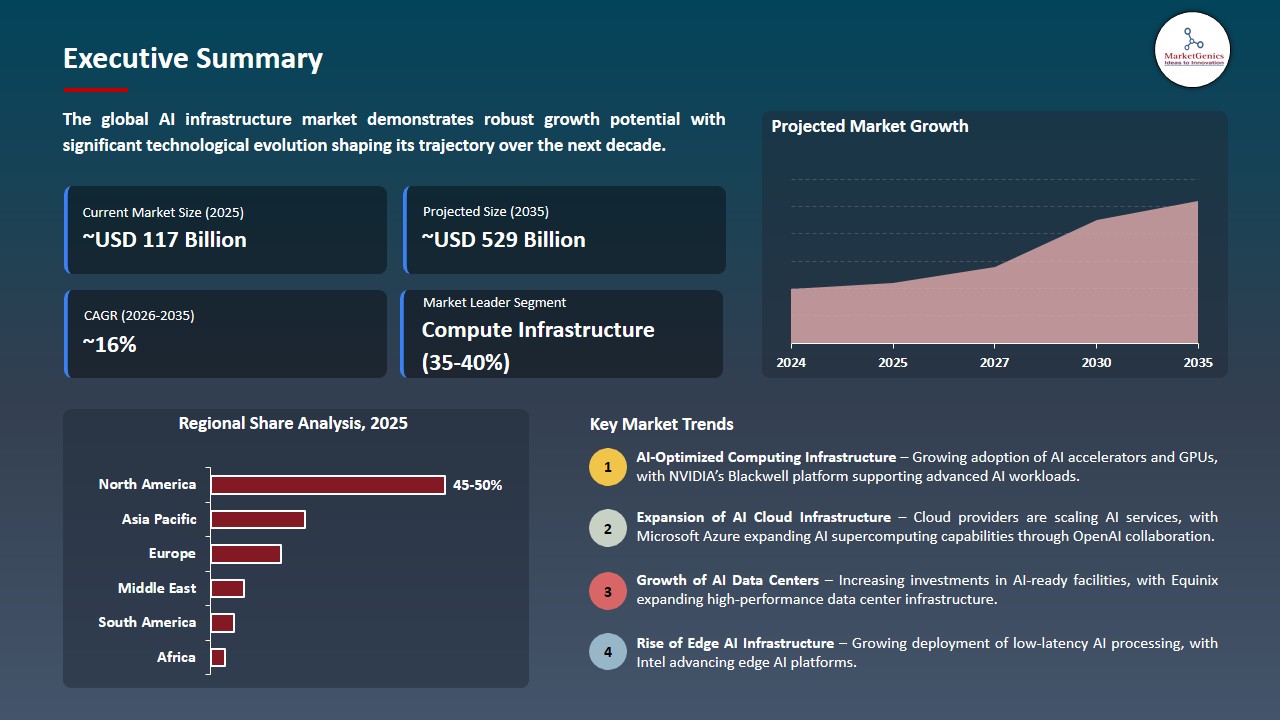
The global AI Infrastructure Market is valued at USD 116.8 billion in 2025 and is projected to reach USD 528.7 billion by 2035, expanding at a CAGR of 16.3% during the forecast period. The rapid adoption of generative AI, large language models, machine learning, autonomous systems, and real-time analytics is accelerating investments in scalable computing architectures, AI accelerators, cloud platforms, and high-performance systems.
AI infrastructure is becoming a critical foundation for enterprises seeking to deploy AI applications at scale. The increasing development of AI-ready data centers, AI factories, high-performance computing environments, and sustainable infrastructure is creating new opportunities across hardware, software, networking, storage, and managed services.
Demand Trends
Generative AI Adoption: The growing use of generative AI and large language models is increasing demand for GPUs, AI accelerators, high-speed networking, advanced storage, and powerful computing environments capable of supporting model training and inference.
Enterprise AI Modernization: Organizations across healthcare, financial services, manufacturing, telecommunications, retail, and technology are upgrading legacy IT environments with AI-ready infrastructure to support automation, predictive analytics, intelligent applications, and real-time decision-making.
Market Intelligence
The AI Infrastructure Market is benefiting from increasing investments in next-generation computing architectures and AI-optimized data centers. Businesses are adopting specialized processors, AI accelerators, cloud-based platforms, and high-performance computing systems to improve AI workload efficiency and accelerate innovation.
The emergence of AI-as-a-Service is also creating opportunities by enabling organizations to access scalable computing capabilities without significant upfront infrastructure investments. At the same time, high hardware costs, supply-chain limitations, and the technical expertise required to manage complex AI environments remain key challenges, particularly for smaller organizations.
Industry Trends Shaping the Market
AI Factories Are Transforming Computing Infrastructure
AI factories are emerging as specialized computing environments designed for large-scale AI training, inference, and model deployment. These facilities integrate advanced GPUs, high-speed networking, optimized data center architectures, and specialized infrastructure to support increasingly complex AI workloads.
AI Infrastructure Is Moving Toward Scalable and Energy-Efficient Systems
The growing computational requirements of AI are encouraging organizations to invest in high-performance computing, energy-efficient data centers, advanced networking, and flexible infrastructure models. Hybrid and cloud-based deployments are also gaining importance as enterprises seek scalable solutions for rapidly changing AI workloads.
AI Infrastructure Market Ecosystem
Key players in the global AI Infrastructure Market include Advanced Micro Devices (AMD), Arista Networks, Broadcom, Cisco Systems, Dell Technologies, Fujitsu, Hewlett Packard Enterprise, Huawei Technologies, IBM, Intel, Juniper Networks, Lenovo, Microsoft, NVIDIA, Qualcomm, Super Micro Computer, and Vertiv, along with other technology and infrastructure providers.
Competition is increasingly focused on AI accelerators, server performance, high-speed networking, cloud infrastructure, energy efficiency, infrastructure management, and integrated AI solutions. Strategic partnerships, product innovation, custom AI hardware, and investments in AI data centers are expected to remain important competitive strategies.
Regional Outlook
North America is expected to remain a prominent market for AI infrastructure, supported by leading AI technology companies, a mature semiconductor ecosystem, hyperscale cloud infrastructure, and strong enterprise investment in generative AI. The region's established AI data center and high-performance computing ecosystem is supporting adoption across major industries.
Asia Pacific is projected to experience the fastest market growth as countries expand data center capacity, cloud infrastructure, localized AI computing capabilities, and government-led AI initiatives. Increasing enterprise adoption of AI and investments in digital infrastructure are expected to create significant opportunities throughout the region.
Competitive Landscape
Competition within the AI Infrastructure Market is increasingly centered on computing performance, scalability, networking capabilities, energy efficiency, and cost optimization. Technology companies are developing advanced GPUs, CPUs, TPUs, ASICs, NPUs, AI servers, networking systems, storage solutions, and infrastructure management platforms to address rapidly evolving AI workloads.
Partnerships between semiconductor companies, cloud providers, data center operators, networking companies, and infrastructure suppliers are also becoming increasingly important as organizations build integrated AI computing ecosystems.
Conclusion
The AI Infrastructure Market is evolving into a fundamental component of the global digital economy as enterprises and technology providers accelerate AI adoption. Increasing demand for generative AI, machine learning, AI inference, autonomous systems, and intelligent automation is expected to sustain investments in computing, networking, storage, cloud platforms, and AI-ready data centers.
With the market projected to grow from USD 116.8 billion in 2025 to USD 528.7 billion by 2035, AI infrastructure is positioned for substantial long-term expansion. The development of AI factories, scalable computing architectures, energy-efficient data centers, and advanced AI hardware will continue to shape the competitive landscape and create new opportunities across the technology ecosystem.
Recent Development and Strategic Overview
In 2026, NVIDIA continued expanding its AI infrastructure ecosystem through next-generation accelerated computing platforms, networking technologies, and AI data center solutions, strengthening its position in the rapidly growing AI infrastructure market.
Microsoft is expanding its AI infrastructure capabilities through investments in Azure data centers, AI computing capacity, and specialized infrastructure designed to support growing demand for generative AI and large-scale AI workloads.
Amazon Web Services (AWS) is increasing its focus on AI infrastructure through advanced cloud computing capabilities, AI accelerators, and data center investments aimed at supporting enterprise AI training and inference workloads.
Dell Technologies is strengthening its AI infrastructure portfolio through AI-optimized servers, GPU-based computing platforms, storage, and networking solutions designed to help enterprises deploy and scale AI workloads.
Supermicro continues to expand its AI server and data center solutions, focusing on high-performance GPU systems, liquid-cooled infrastructure, and rack-scale solutions for demanding AI workloads.
Find More Information on the AI Infrastructure Market with expert analysis, market forecasts, competitive insights, segmentation, and strategic opportunities from MarketGenics @ https://marketgenics.co/reports/ai-infrastructure-market-11996