Introduction
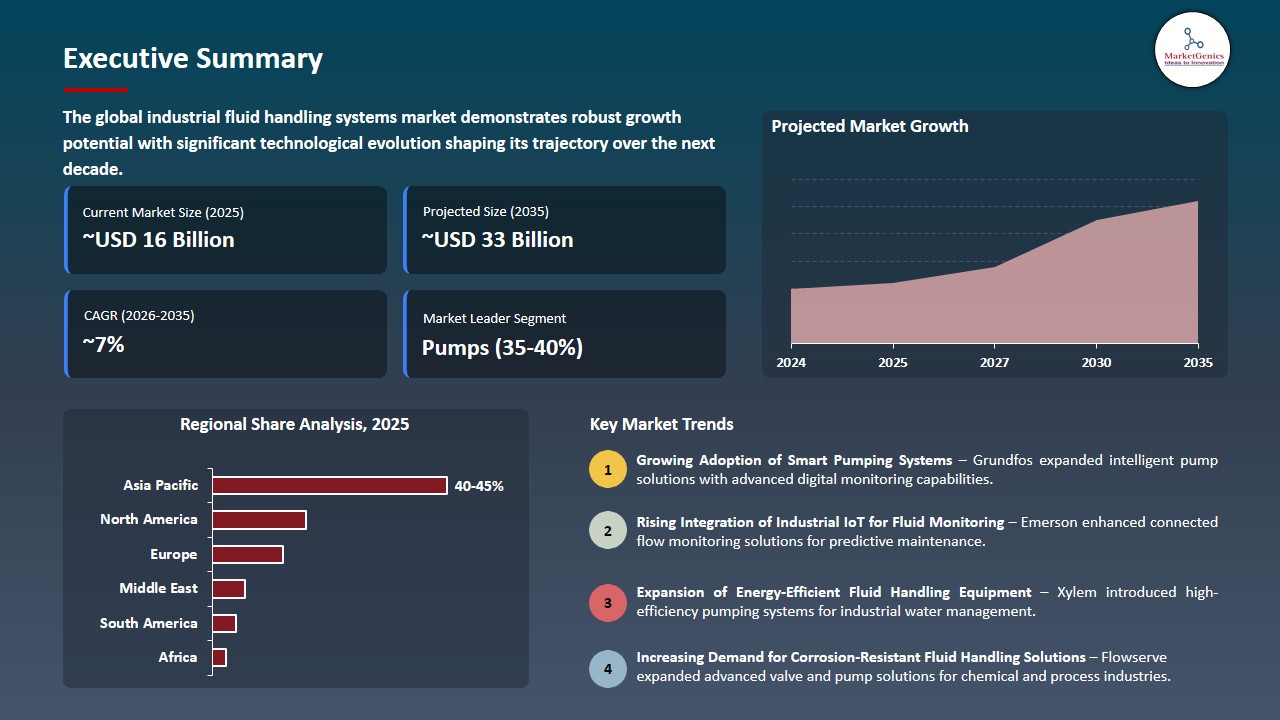
The global Industrial Fluid Handling Systems (IFHS) Market is valued at USD 16.4 billion in 2025 and is projected to reach USD 32.6 billion by 2035, expanding at a CAGR of 7.1% during the forecast period of 2026 to 2035.
Industrial fluid handling systems are essential to modern industrial operations, enabling the safe and efficient movement, control, measurement, filtration, and management of liquids, gases, chemicals, and other process fluids. From pumps and valves to compressors, flow meters, filtration equipment, pipes, fittings, and heat exchangers, these systems form a critical part of infrastructure across energy, chemical processing, manufacturing, water treatment, pharmaceuticals, food and beverage, and mining.
As industries increasingly focus on operational efficiency, energy conservation, automation, and environmental compliance, demand is shifting toward intelligent and highly integrated fluid handling solutions.
Demand Trends
Industrial Automation: Growing adoption of automated manufacturing and process-control systems is increasing demand for intelligent pumps, valves, sensors, flow meters, and automated fluid transfer solutions.
Energy Efficiency: Industries are increasingly replacing conventional equipment with high-efficiency pumps, compressors, and control systems to reduce energy consumption and operating costs.
Smart Monitoring: IoT-enabled sensors, predictive maintenance platforms, and digital monitoring technologies are becoming increasingly important for tracking equipment performance, detecting anomalies, and minimizing unplanned downtime.
Infrastructure Modernization: Investments in water and wastewater infrastructure, energy facilities, chemical plants, manufacturing facilities, and industrial processing infrastructure are supporting demand for modern fluid handling equipment.
Market Intelligence
The Industrial Fluid Handling Systems Market is benefiting from the growing requirement for reliable and efficient fluid movement across critical industrial processes. Pumps, valves, compressors, flow meters, filtration systems, and related equipment enable manufacturers and operators to maintain consistent flow rates, pressure levels, temperature conditions, and fluid quality.
According to MarketGenics, the oil & gas industry accounted for approximately 32% of the global fluid handling equipment market in 2025, making it the leading end-use segment. The sector relies extensively on fluid handling technologies across upstream production, midstream transportation, refining, storage, and distribution operations.
The market is also being transformed by digitalization. IoT sensors, AI-based predictive maintenance, real-time monitoring, and digital-twin technologies are enabling industrial operators to identify equipment issues before failures occur and optimize energy consumption.
In addition, increasing environmental and workplace safety requirements are encouraging industries to adopt equipment that minimizes leakage, improves process control, reduces waste, and supports regulatory compliance.
Industry Trends Shaping the Market
Smart and Connected Fluid Handling Systems
The integration of IoT, sensors, AI, and advanced analytics is transforming traditional fluid handling infrastructure. Connected equipment can provide real-time information about pressure, temperature, flow rate, vibration, energy consumption, and equipment health.
This allows operators to identify abnormal operating conditions, schedule maintenance proactively, and improve overall equipment utilization.
Energy-Efficient Equipment Gains Importance
Energy consumption represents a significant operating cost for many fluid-intensive industries. Manufacturers are therefore focusing on high-efficiency pumps, compressors, motors, and control systems that can deliver required performance while reducing power consumption.
Variable-speed technologies, intelligent controls, and optimized system designs are increasingly being adopted to improve energy efficiency.
Automation and Remote Monitoring
Fully automated and remotely monitored systems are gaining traction across industrial facilities. Automated valves, smart pumps, digital controllers, and centralized monitoring platforms allow operators to manage fluid processes with greater accuracy and less manual intervention.
This trend is particularly important for facilities where continuous operation, worker safety, and process consistency are critical.
Sustainability and Environmental Compliance
Growing pressure to reduce emissions, minimize fluid losses, prevent contamination, and improve resource efficiency is encouraging investment in advanced fluid handling technologies.
Modern systems are increasingly designed to reduce leakage, improve filtration and separation, optimize water consumption, and support more sustainable industrial processes.
Industrial Fluid Handling Systems Market Ecosystem
Key players operating across the global industrial fluid handling ecosystem include:
- ABB Ltd.
- Alfa Laval
- Danfoss
- Eaton Corporation
- Emerson Electric Co.
- Flowserve Corporation
- Grundfos
- ITT Inc.
- KSB SE & Co. KGaA
- Parker Hannifin Corporation
- Pentair plc
- Schneider Electric
- Siemens AG
- Sulzer Ltd.
- Valmet
- The Weir Group
- Xylem Inc.
The market remains competitive, with leading companies focusing on product innovation, digital technologies, energy-efficient solutions, aftermarket services, and strategic partnerships. MarketGenics estimates that the top five players accounted for nearly 55% of the global fluid handling equipment market in 2025, indicating a relatively consolidated competitive environment.
Regional Outlook
Asia-Pacific is emerging as the leading regional market for fluid handling equipment, supported by rapid industrialization, expanding manufacturing activity, infrastructure development, and increasing investments in energy and chemical industries. India, China, Japan, South Korea, and other regional economies are strengthening their industrial infrastructure and adopting automation technologies.
North America remains an important market due to established oil & gas, chemical, pharmaceutical, manufacturing, and water infrastructure. Increasing adoption of smart industrial technologies and predictive maintenance solutions is supporting demand for advanced fluid handling systems.
Europe is characterized by strong emphasis on energy efficiency, industrial automation, sustainability, and environmental regulations. These factors are encouraging the modernization of pumps, valves, filtration systems, and other fluid management equipment.
Middle East & Africa present opportunities through investments in oil & gas, desalination, water infrastructure, petrochemical facilities, and industrial development.
South America is supported by mining, energy, agriculture, food processing, and industrial infrastructure projects, creating demand for reliable fluid transportation and process-control technologies.
Competitive Landscape
Competition in the Industrial Fluid Handling Systems Market is increasingly focused on energy efficiency, automation, digital connectivity, reliability, and lifecycle performance.
Manufacturers are investing in smart pumps, intelligent valves, advanced flow measurement, automated fluid transfer systems, and digital monitoring platforms. Companies are also strengthening their aftermarket capabilities because maintenance, replacement components, upgrades, and service contracts represent important sources of recurring revenue.
Strategic product launches are reinforcing this transformation. In July 2025, Graco Inc. introduced QUANTM automated fluid transfer systems incorporating smart sensors and automated controls, targeting improved fluid-flow optimization, process accuracy, and waste reduction.
Similarly, Grundfos introduced its iSOLUTIONS smart pumping ecosystem, supporting remote monitoring, control, predictive maintenance, and energy optimization for pumping applications.
Conclusion
The Industrial Fluid Handling Systems Market is evolving from conventional pumps, valves, and piping infrastructure toward intelligent, connected, energy-efficient, and automated fluid management ecosystems.
Rising industrial automation, infrastructure modernization, energy-efficiency requirements, sustainability initiatives, and increasing demand for real-time process monitoring will continue to create opportunities for fluid handling equipment manufacturers and technology providers.
With the global market projected to increase from USD 16.4 billion in 2025 to USD 32.6 billion by 2035, companies that combine advanced fluid-handling technologies with digital monitoring, predictive maintenance, automation, and energy optimization are positioned to benefit from the next phase of industrial transformation.
Recent Development and Strategic Overview:
-
In June 2026, Flowserve completed the acquisition of Trillium Flow Technologies' Valves Division, expanding its portfolio of mission-critical valves and flow control equipment for nuclear power, conventional power generation, industrial processing, and critical infrastructure applications, strengthening its position in high-growth flow control markets.
- In April 2026, AxFlow Oceania acquired a majority stake in Dowdens Group, expanding its fluid handling capabilities in Australia across mining, agriculture, food & beverage, and water treatment sectors. The acquisition strengthens AxFlow’s service network, project capabilities, and lifecycle support offerings for industrial fluid handling solutions.
Find More Information on the Aerospace Foam Market with expert analysis, market forecasts, and strategic insights from MarketGenics @ https://marketgenics.co/reports/industrial-fluid-handling-systems-market-18343