Anime Merchandising Market Size, Share & Trends Analysis Report by Product Type (Apparel & Accessories, Figurines & Collectibles, Home & Living, Electronics & Accessories, Media & Entertainment), Distribution Channel, License Type, Age Group, Sales Model, and Geography (North America, Europe, Asia Pacific, Middle East, Africa, and South America) – Global Industry Data, Trends, and Forecasts, 2026–2035
|
|
|
Segmental Data Insights |
|
|
Demand Trends |
|
|
Competitive Landscape |
|
|
Strategic Development |
|
|
Future Outlook & Opportunities |
|
Anime-Merchandising-Market Size, Share, and Growth
The global anime merchandising market is experiencing robust growth, with its estimated value of USD 11.5 billion in the year 2025 and USD 26.2 billion by the period 2035, registering a CAGR of 8.6%, during the forecast period. The global anime merchandising market is growing at an alarming pace, creators, brands and licensors are putting more emphasis on authentic IP licensing, exquisite craftsmanship and sustainable production of products that are durable, collectible and entails the participation of the fans and decreases environmental degradation during the making and distributive processes.
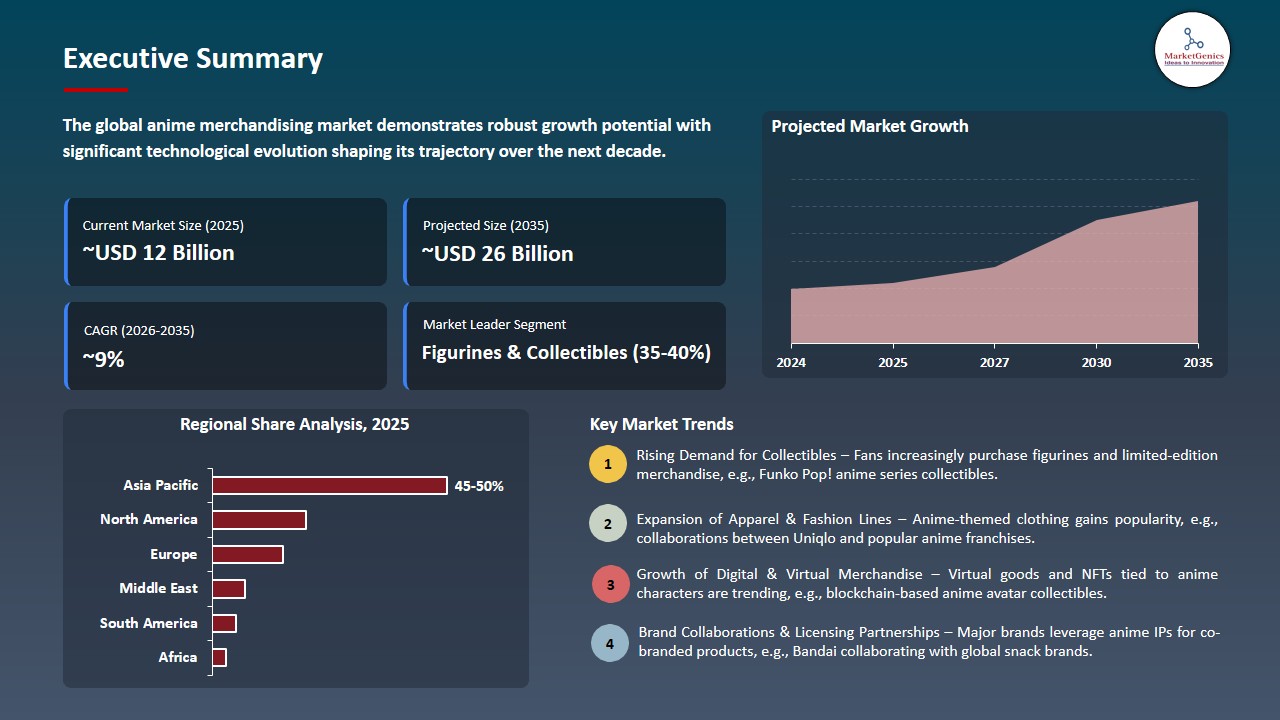
Cai, an industry expert in anime IP development, stated, In terms of merchandise, anime businesses need to think beyond movies to the comprehensive development of the IP. For example, during the production of films, companies can launch dramas and theatrical versions, merchandise, exhibitions, and even theme parks to keep fans engaged and open up new revenue streams.
The anime merchandising market is evolving to become a mainstream dynamic lifestyle and experiential retail sector, rather than the traditional fan-based segment. More and more brands are capitalizing on cross-cultural appeal and transmedia narratives to present goods that are a mix of anime IPs and streetwear, tech-enabled collectibles, and immersive experiences. Limited-edition drops, interactive AR/VR characters, and companion applications are looking to change the way fans interact with merchandise by establishing high-quality, high-value consumer touchpoints that are not directly related to the traditional collectibles.
The market is also being redefined by supply chain sophistication. Micro-factory manufacturing, micro-molded figure figures and limited editions guarantee quality of faithfulness to character designs as well as exclusivity. Combination of blockchain based authentication and region based pop-up activities will increase consumer confidence and will enhance fan-driven demand.
Adjacent opportunities to the anime merchandising market include collectible figurines and toys, apparel and fashion collaborations, stationery and lifestyle products, digital merchandise and NFTs, and themed home décor and accessories, leveraging strong fan engagement and brand loyalty, thereby expanding revenue streams, driving cross-industry collaborations, and increasing global adoption of anime-inspired products.
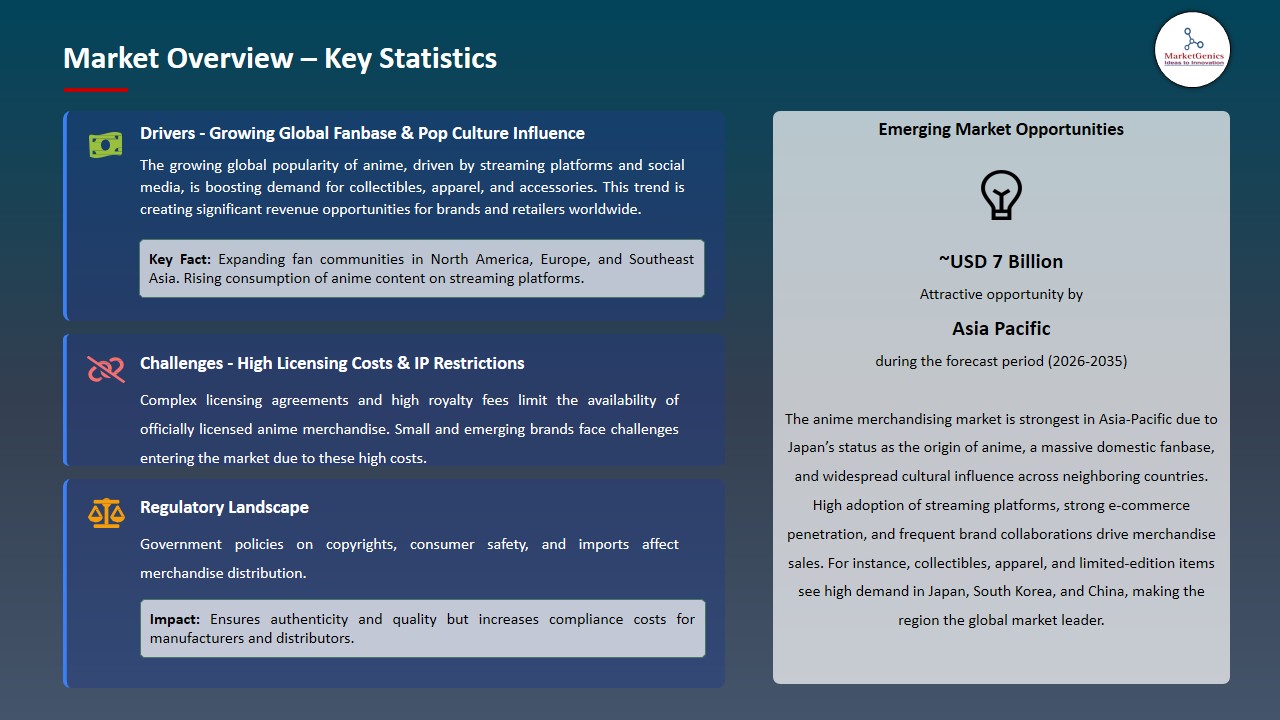
Anime Merchandising Market Dynamics and Trends
Driver: Growing Fan Base and IP-Based Demand
-
The global anime merchandising is gaining momentum due to the increasing fan base all over the world and the increasing popularity of anime. Fans are becoming eager to obtain licensed goods, such as figures, apparel, collectibles, and digital goods of the highest quality, and they are becoming the main causes of the huge demand behind merchandise based on popular anime IPs. Fan awareness and consumption are further growing through social media fan communities, streaming platforms and international conventions.
- The interactive and immersive products, including AR-enabled figures, digital companion applications, and special-edition releases, are also gaining increased interest among collectors and the general consumer population. For instance, Production I.G. and SEGA launched flagship stores in Shanghai in May 2025 with exclusive limited-edition anime merchandise that sold out quickly, so a strong fan community is driving the demand of official, IP-based merchandise in the most important markets.
- The increased interest in anime products, along with the need to have original and unique products are driving product development and uptake in e-commerce, specialty retail, and convention-based retail, boosting growth in the global market.
Restraint: High Production and Licensing Costs
-
Lack of production and licensing options have been a major challenge to the global anime merchandising industry since the official licensing of figures, collectibles, and apparel needs high IP charges, accuracy molds, and quality clean-up materials, which increases retail costs and makes it inaccessible to ordinary consumers.
- Other areas of cost pressure include small-scale specialty production, low levels of automation in figure production and hand-assembly of high-value collectibles. High fidelity to anime character designs and limited-run releases raise per-unit costs of production, and small manufacturers can hardly compete on the market.
- Specialized packaging, delicate handling and allover worldwide distribution are costly to move and those markets that are price sensitive and developing may not adopt.
Opportunity: Expansion into Digital and AR-Enabled Merchandise
-
The developing trend of interactive and tech-enhanced collectibles is a massive opportunity to the global anime merchandising market. Companies are adding augmented reality (AR), mobile apps, and digital content (QR) into the physical products and letting fans engage with the animations, mini-games, and virtual experiences directly through the figures, clothing, and collectibles.
- These AR-powered products are being adopted via e-commerce, fan communities online, and event-based sales and offer a more engaging and immersive experience. For instance, digital and XR figure merchandise like HoloModels, such as smartphone displays and redeemable online figure content via services like XMarket, shown at AnimeJapan 2025 and showing how AR-enabled merchandise can be used to engage with fans and create new monetization opportunities.
- Digital and AR-enhanced merchandise will assist companies in product differentiation, higher fan engagement, and recurring revenue, which opens up growth opportunities in old and new markets.
Key Trend: Collaborations with Lifestyle and Fashion Brands
-
The global anime merchandising market is experiencing an increase in cross-industry partnerships with anime IPs introduced with lifestyle, streetwear, and high-fashion manufacturers and created into restricted edition items, accessories, and shoes. The relationships serve to increase the popularity of anime products away from conventional collectibles as they are appealing to main consumers and strengthen brand recognition among the hardcore enthusiasts.
- The current trend is that companies are utilizing co-branded launches as a strategy to reach out to new segments and generate hype by hosting exclusive events and pop-up stores. For instance, in January 2025, anime production company N LITE collaborated with an American streetwear brand, HYPLAND, to release a multi-collection line of Afro-Anime fashion, starting with an Afro Samurai themed line of fashion, including creative input with Wu-Tang Clan producers.
- These partnerships promote premiumization, worldwide brand promotion, and repurchase behaviour, thus making anime products a mainstream lifestyle product.
Anime-Merchandising-Market Analysis and Segmental Data
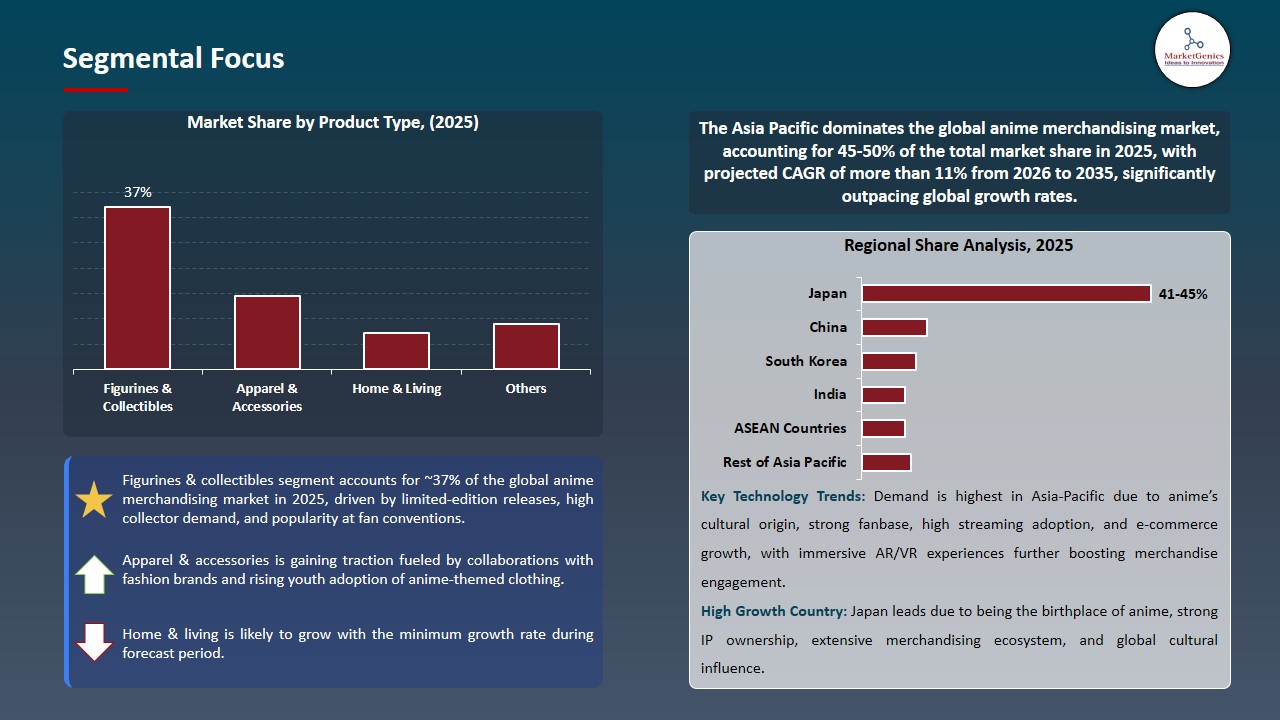
Figurines & Collectibles Dominate Global Anime Merchandising Market
-
Figurines and collectibles dominate the global anime merchandising market as the firmly preferred products with heavy demand tend to be of high quality, limited edition and officially authorized merchandise that appeal to the anime fandoms. It is driven by collector culture, nostalgia and fan involvement with applications including personal collections, gifting and exclusive releases in events.
- Innovation and licensing strategies are helping in accelerating the market. To improve the experiences of collectors, manufacturers are adding more and more augmented reality (AR) technologies and interactive packaging. The limited-edition S.H.Figuarts figures of Dragon Ball and other collectives designed specifically to sell at the San Diego Comic-Con 2025, created by Bandai Namco Toys and Collectibles America exerted a lot of demand among collectors and proved how much premium and event-focused product releases could influence the market.
- Premium manufacturing, professional licensing, and high e-commerce ensure that figurines and collectibles remain the central force, and small runs and partnerships result in repeat purchases and brand loyalty.
Asia Pacific Leads Global Anime Merchandising Market Demand
-
Asia Pacific dominates the anime merchandising market, owing region being the centre of production and consumption of anime IPs, well-established fan-base domestically and extensive incorporation of pop-culture. Additionally, demand is driven by high per-capita expenditures on figures, collectibles and character merchandise, fuelled by the high density of specialty retailers, and regular fan events in Japan, China, and South Korea.
- This area demonstrates fast innovation with regards to high quality and experience-based anime merchandise such as limited-edition figures, character lifestyle products, technology-enhanced collectibles, and collaboration-based apparel. For instance, in October 2025, the NBA worked with Crunchyroll in the second My Hero Academia × NBA apparel collaboration, which appealed so much to Asia Pacific fans.
- Fast product launches can be achieved through effective licensing ecosystems, localized production hubs, and a digital-first distribution strategy. Anime expos, online to offline retailing further supports the domination of Asia Pacific in anime merchandising globally.
Anime-Merchandising-Market Ecosystem
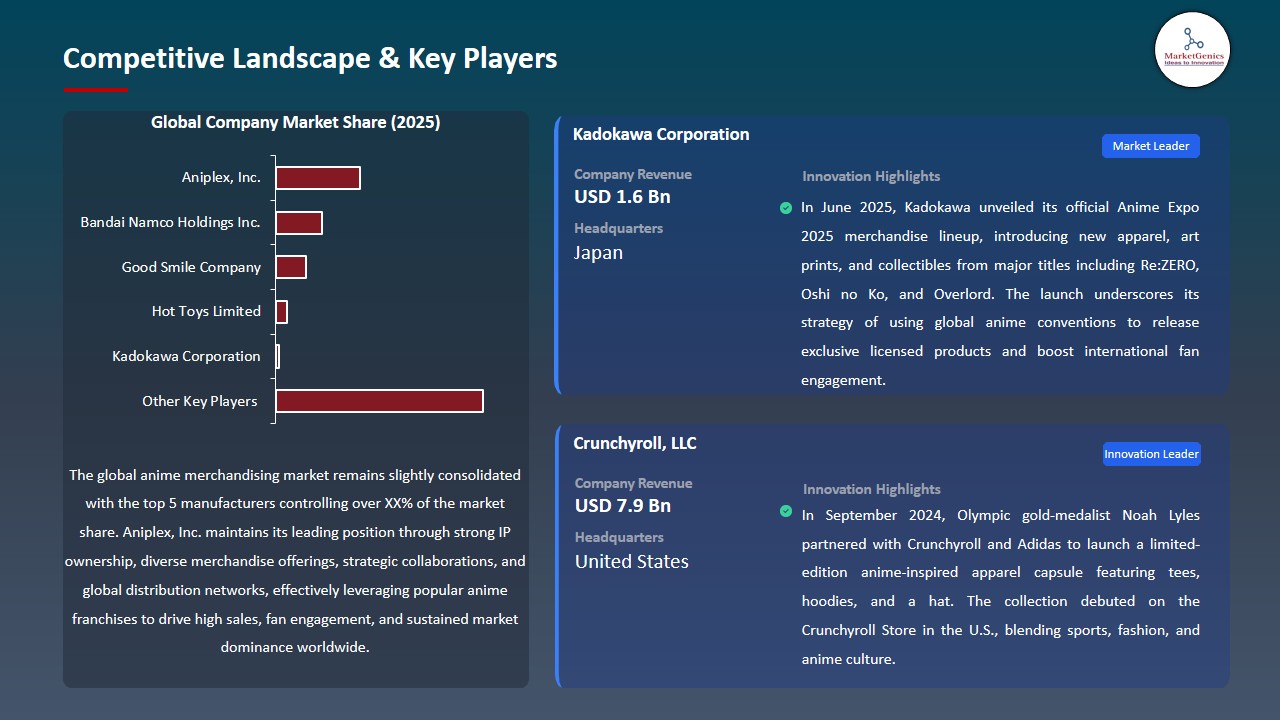
The global anime merchandising market is moderately consolidated, based on good intellectual property rights, licensing rights, and barriers to entry, which were based on brand recognition, creative abilities and global distribution coverage. Tier-1 operators control the ecosystem, using exclusive rights to IP of anime, massive scale of production, and developed global distribution networks of retail and online commerce, which leads to the high density of market concentration.
As part of vertically integrated models of IP creation, licensing, manufacturing and merchandising, Tier-1 companies such as Bandai Namco Holdings Inc., Kadokawa Corporation, Aniplex, Inc., Good Smile Company, and Hot Toys Limited have a strong competitive position. The players enjoy high-quality collectibles, the creation of figures, good communities with fans, and long-term deals with anime producers, streaming platforms, and international sellers.
Tier 2 participants include regional licensors, specialty merchandise brands, and mid-sized figure manufacturers are also part of the tier 2 participants and target niche fandom, limited-edition releases, and regional market-specification to create value differentiation. Local manufacturers, contract manufacturers, print-on-demand manufacturers and event-based sellers are classified as tier-3 players which enhance production upstream and local distribution. Material innovation, individualization, and online trading are still at the heart of ecosystem competitiveness.
Recent Development and Strategic Overview
-
In June 2025, Kadokawa revealed its official merchandise lineup at Anime Expo 2025, including new merchandise, art prints, and collectibles of such popular titles as Re:ZERO, Oshi no Ko, Bungo Stray Dogs, Delicious in Dungeon, and Overlord. The event underscores the approach used by Kadokawa to capitalize on large-scale anime based conventions to promote exclusive licensed merchandise and enhance international fan interaction.
- In September 2025, lympics gold-medalist Noah Lyles, anime platform Crunchyroll and sportswear brand Adidas released an exclusive anime-themed capsule collection of tees, hoodies and a hat in anime-themed artwork and his red accents. The line of limited apparel was launched on the Crunchyroll Store in the USA and combined the culture of sports, fashion and anime.
Report Scope
|
Detail |
|
|
Market Size in 2025 |
USD 11.5 Bn |
|
Market Forecast Value in 2035 |
USD 26.2 Bn |
|
Growth Rate (CAGR) |
8.6% |
|
Forecast Period |
2026 – 2035 |
|
Historical Data Available for |
2021 – 2024 |
|
Market Size Units |
US$ Billion for Value |
|
Report Format |
Electronic (PDF) + Excel |
|
North America |
Europe |
Asia Pacific |
Middle East |
Africa |
South America |
|
|
|
|
|
|
|
Companies Covered |
|||||
|
|
|
|
|
|
|
Anime-Merchandising-Market Segmentation and Highlights
|
Segment |
Sub-segment |
|
Anime Merchandising Market, By Product Type |
|
|
Anime Merchandising Market, By Distribution Channel |
|
|
Anime Merchandising Market, By License Type |
|
|
Anime Merchandising Market, By Age Group |
|
|
Anime Merchandising Market, By Sales Model |
|
Frequently Asked Questions
Table of Contents
- 1. Research Methodology and Assumptions
- 1.1. Definitions
- 1.2. Research Design and Approach
- 1.3. Data Collection Methods
- 1.4. Base Estimates and Calculations
- 1.5. Forecasting Models
- 1.5.1. Key Forecast Factors & Impact Analysis
- 1.6. Secondary Research
- 1.6.1. Open Sources
- 1.6.2. Paid Databases
- 1.6.3. Associations
- 1.7. Primary Research
- 1.7.1. Primary Sources
- 1.7.2. Primary Interviews with Stakeholders across Ecosystem
- 2. Executive Summary
- 2.1. Global Anime Merchandising Market Outlook
- 2.1.1. Anime Merchandising Market Size (Value - US$ Bn), and Forecasts, 2021-2035
- 2.1.2. Compounded Annual Growth Rate Analysis
- 2.1.3. Growth Opportunity Analysis
- 2.1.4. Segmental Share Analysis
- 2.1.5. Geographical Share Analysis
- 2.2. Market Analysis and Facts
- 2.3. Supply-Demand Analysis
- 2.4. Competitive Benchmarking
- 2.5. Go-to- Market Strategy
- 2.5.1. Customer/ End-use Industry Assessment
- 2.5.2. Growth Opportunity Data, 2026-2035
- 2.5.2.1. Regional Data
- 2.5.2.2. Country Data
- 2.5.2.3. Segmental Data
- 2.5.3. Identification of Potential Market Spaces
- 2.5.4. GAP Analysis
- 2.5.5. Potential Attractive Price Points
- 2.5.6. Prevailing Market Risks & Challenges
- 2.5.7. Preferred Sales & Marketing Strategies
- 2.5.8. Key Recommendations and Analysis
- 2.5.9. A Way Forward
- 2.1. Global Anime Merchandising Market Outlook
- 3. Industry Data and Premium Insights
- 3.1. Global Consumer Goods & Services Industry Overview, 2025
- 3.1.1. Consumer Goods & Services Industry Ecosystem Analysis
- 3.1.2. Key Trends for Consumer Goods & Services Industry
- 3.1.3. Regional Distribution for Consumer Goods & Services Industry
- 3.2. Supplier Customer Data
- 3.3. Technology Roadmap and Developments
- 3.4. Trade Analysis
- 3.4.1. Import & Export Analysis, 2025
- 3.4.2. Top Importing Countries
- 3.4.3. Top Exporting Countries
- 3.5. Trump Tariff Impact Analysis
- 3.5.1. Manufacturer
- 3.5.1.1. Based on the component & Raw material
- 3.5.2. Supply Chain
- 3.5.3. End Consumer
- 3.5.1. Manufacturer
- 3.6. Raw Material Analysis
- 3.1. Global Consumer Goods & Services Industry Overview, 2025
- 4. Market Overview
- 4.1. Market Dynamics
- 4.1.1. Drivers
- 4.1.1.1. Growing global popularity of anime across streaming platforms and social media.
- 4.1.1.2. Expansion of e-commerce and omnichannel retail improving merchandise accessibility.
- 4.1.1.3. Strong fan and collector demand for character-based and limited-edition products.
- 4.1.2. Restraints
- 4.1.2.1. High licensing fees and complex intellectual property agreements.
- 4.1.2.2. Widespread counterfeit and unlicensed products impacting brand revenues.
- 4.1.1. Drivers
- 4.2. Key Trend Analysis
- 4.3. Regulatory Framework
- 4.3.1. Key Regulations, Norms, and Subsidies, by Key Countries
- 4.3.2. Tariffs and Standards
- 4.3.3. Impact Analysis of Regulations on the Market
- 4.4. Value Chain Analysis
- 4.4.1. Raw Material Suppliers
- 4.4.2. Manufacturers
- 4.4.3. Dealers/ Distributors
- 4.4.4. End-Users/ Customers
- 4.5. Porter’s Five Forces Analysis
- 4.6. PESTEL Analysis
- 4.7. Global Anime Merchandising Market Demand
- 4.7.1. Historical Market Size – Value (US$ Bn), 2020-2024
- 4.7.2. Current and Future Market Size – Value (US$ Bn), 2026–2035
- 4.7.2.1. Y-o-Y Growth Trends
- 4.7.2.2. Absolute $ Opportunity Assessment
- 4.1. Market Dynamics
- 5. Competition Landscape
- 5.1. Competition structure
- 5.1.1. Fragmented v/s consolidated
- 5.2. Company Share Analysis, 2025
- 5.2.1. Global Company Market Share
- 5.2.2. By Region
- 5.2.2.1. North America
- 5.2.2.2. Europe
- 5.2.2.3. Asia Pacific
- 5.2.2.4. Middle East
- 5.2.2.5. Africa
- 5.2.2.6. South America
- 5.3. Product Comparison Matrix
- 5.3.1. Specifications
- 5.3.2. Market Positioning
- 5.3.3. Pricing
- 5.1. Competition structure
- 6. Global Anime Merchandising Market Analysis, by Product Type
- 6.1. Key Segment Analysis
- 6.2. Anime Merchandising Market Size (Value - US$ Bn), Analysis, and Forecasts, by Product Type, 2021-2035
- 6.2.1. Apparel & Accessories
- 6.2.1.1. T-shirts & Tops
- 6.2.1.2. Hoodies & Jackets
- 6.2.1.3. Cosplay Costumes
- 6.2.1.4. Hats & Caps
- 6.2.1.5. Bags & Backpacks
- 6.2.1.6. Jewelry & Watches
- 6.2.1.7. Others
- 6.2.2. Figurines & Collectibles
- 6.2.2.1. Action Figures
- 6.2.2.2. Plush Toys
- 6.2.2.3. Model Kits
- 6.2.2.4. Trading Cards
- 6.2.2.5. Gashapon/Capsule Toys
- 6.2.2.6. Others
- 6.2.3. Home & Living
- 6.2.3.1. Posters & Wall Art
- 6.2.3.2. Bedding & Pillows
- 6.2.3.3. Mugs & Drinkware
- 6.2.3.4. Furniture & Decor
- 6.2.3.5. Stationery
- 6.2.3.6. Others
- 6.2.4. Electronics & Accessories
- 6.2.4.1. Phone Cases
- 6.2.4.2. Gaming Accessories
- 6.2.4.3. Headphones
- 6.2.4.4. Smart Device Skins
- 6.2.4.5. Others
- 6.2.5. Media & Entertainment
- 6.2.5.1. Manga Books
- 6.2.5.2. Art Books
- 6.2.5.3. DVDs & Blu-rays
- 6.2.5.4. Video Games
- 6.2.5.5. Others
- 6.2.1. Apparel & Accessories
- 7. Global Anime Merchandising Market Analysis, by Distribution Channel
- 7.1. Key Segment Analysis
- 7.2. Anime Merchandising Market Size (Value - US$ Bn), Analysis, and Forecasts, by Distribution Channel, 2021-2035
- 7.2.1. Online Channels
- 7.2.1.1. Official Brand Websites
- 7.2.1.2. E-commerce Marketplaces
- 7.2.1.3. Specialty Anime Retailers Online
- 7.2.1.4. Social Media Platforms
- 7.2.1.5. Others
- 7.2.2. Offline Channels
- 7.2.2.1. Specialty Anime Stores
- 7.2.2.2. Convention & Event Sales
- 7.2.2.3. Department Stores
- 7.2.2.4. Pop-up Shops
- 7.2.2.5. Gaming & Hobby Stores
- 7.2.2.6. Others
- 7.2.1. Online Channels
- 8. Global Anime Merchandising Market Analysis, by License Type
- 8.1. Key Segment Analysis
- 8.2. Anime Merchandising Market Size (Value - US$ Bn), Analysis, and Forecasts, by License Type, 2021-2035
- 8.2.1. Official Licensed Merchandise
- 8.2.2. Collaboration/Limited Edition
- 8.2.3. Fan-Made/Independent
- 8.2.4. Bootleg/Unauthorized
- 9. Global Anime Merchandising Market Analysis, by Age Group
- 9.1. Key Segment Analysis
- 9.2. Anime Merchandising Market Size (Value - US$ Bn), Analysis, and Forecasts, by Age Group, 2021-2035
- 9.2.1. Children (Up to 12 years)
- 9.2.2. Teenagers (13-17 years)
- 9.2.3. Adults (Above18 years)
- 10. Global Anime Merchandising Market Analysis, by Sales Model
- 10.1. Key Segment Analysis
- 10.2. Anime Merchandising Market Size (Value - US$ Bn), Analysis, and Forecasts, by Sales Model, 2021-2035
- 10.2.1. Pre-order
- 10.2.2. Limited Release
- 10.2.3. Mass Production
- 10.2.4. Subscription Box
- 10.2.5. Seasonal Release
- 11. Global Anime Merchandising Market Analysis and Forecasts, by Region
- 11.1. Key Findings
- 11.2. Anime Merchandising Market Size (Value - US$ Bn), Analysis, and Forecasts, by Region, 2021-2035
- 11.2.1. North America
- 11.2.2. Europe
- 11.2.3. Asia Pacific
- 11.2.4. Middle East
- 11.2.5. Africa
- 11.2.6. South America
- 12. North America Anime Merchandising Market Analysis
- 12.1. Key Segment Analysis
- 12.2. Regional Snapshot
- 12.3. North America Anime Merchandising Market Size (Value - US$ Bn), Analysis, and Forecasts, 2021-2035
- 12.3.1. Product Type
- 12.3.2. Distribution Channel
- 12.3.3. License Type
- 12.3.4. Age Group
- 12.3.5. Sales Model
- 12.3.6. Country
- 12.3.6.1. USA
- 12.3.6.2. Canada
- 12.3.6.3. Mexico
- 12.4. USA Anime Merchandising Market
- 12.4.1. Country Segmental Analysis
- 12.4.2. Product Type
- 12.4.3. Distribution Channel
- 12.4.4. License Type
- 12.4.5. Age Group
- 12.4.6. Sales Model
- 12.5. Canada Anime Merchandising Market
- 12.5.1. Country Segmental Analysis
- 12.5.2. Product Type
- 12.5.3. Distribution Channel
- 12.5.4. License Type
- 12.5.5. Age Group
- 12.5.6. Sales Model
- 12.6. Mexico Anime Merchandising Market
- 12.6.1. Country Segmental Analysis
- 12.6.2. Product Type
- 12.6.3. Distribution Channel
- 12.6.4. License Type
- 12.6.5. Age Group
- 12.6.6. Sales Model
- 13. Europe Anime Merchandising Market Analysis
- 13.1. Key Segment Analysis
- 13.2. Regional Snapshot
- 13.3. Europe Anime Merchandising Market Size (Value - US$ Bn), Analysis, and Forecasts, 2021-2035
- 13.3.1. Product Type
- 13.3.2. Distribution Channel
- 13.3.3. License Type
- 13.3.4. Age Group
- 13.3.5. Sales Model
- 13.3.6. Country
- 13.3.6.1. Germany
- 13.3.6.2. United Kingdom
- 13.3.6.3. France
- 13.3.6.4. Italy
- 13.3.6.5. Spain
- 13.3.6.6. Netherlands
- 13.3.6.7. Nordic Countries
- 13.3.6.8. Poland
- 13.3.6.9. Russia & CIS
- 13.3.6.10. Rest of Europe
- 13.4. Germany Anime Merchandising Market
- 13.4.1. Country Segmental Analysis
- 13.4.2. Product Type
- 13.4.3. Distribution Channel
- 13.4.4. License Type
- 13.4.5. Age Group
- 13.4.6. Sales Model
- 13.5. United Kingdom Anime Merchandising Market
- 13.5.1. Country Segmental Analysis
- 13.5.2. Product Type
- 13.5.3. Distribution Channel
- 13.5.4. License Type
- 13.5.5. Age Group
- 13.5.6. Sales Model
- 13.6. France Anime Merchandising Market
- 13.6.1. Country Segmental Analysis
- 13.6.2. Product Type
- 13.6.3. Distribution Channel
- 13.6.4. License Type
- 13.6.5. Age Group
- 13.6.6. Sales Model
- 13.7. Italy Anime Merchandising Market
- 13.7.1. Country Segmental Analysis
- 13.7.2. Product Type
- 13.7.3. Distribution Channel
- 13.7.4. License Type
- 13.7.5. Age Group
- 13.7.6. Sales Model
- 13.8. Spain Anime Merchandising Market
- 13.8.1. Country Segmental Analysis
- 13.8.2. Product Type
- 13.8.3. Distribution Channel
- 13.8.4. License Type
- 13.8.5. Age Group
- 13.8.6. Sales Model
- 13.9. Netherlands Anime Merchandising Market
- 13.9.1. Country Segmental Analysis
- 13.9.2. Product Type
- 13.9.3. Distribution Channel
- 13.9.4. License Type
- 13.9.5. Age Group
- 13.9.6. Sales Model
- 13.10. Nordic Countries Anime Merchandising Market
- 13.10.1. Country Segmental Analysis
- 13.10.2. Product Type
- 13.10.3. Distribution Channel
- 13.10.4. License Type
- 13.10.5. Age Group
- 13.10.6. Sales Model
- 13.11. Poland Anime Merchandising Market
- 13.11.1. Country Segmental Analysis
- 13.11.2. Product Type
- 13.11.3. Distribution Channel
- 13.11.4. License Type
- 13.11.5. Age Group
- 13.11.6. Sales Model
- 13.12. Russia & CIS Anime Merchandising Market
- 13.12.1. Country Segmental Analysis
- 13.12.2. Product Type
- 13.12.3. Distribution Channel
- 13.12.4. License Type
- 13.12.5. Age Group
- 13.12.6. Sales Model
- 13.13. Rest of Europe Anime Merchandising Market
- 13.13.1. Country Segmental Analysis
- 13.13.2. Product Type
- 13.13.3. Distribution Channel
- 13.13.4. License Type
- 13.13.5. Age Group
- 13.13.6. Sales Model
- 14. Asia Pacific Anime Merchandising Market Analysis
- 14.1. Key Segment Analysis
- 14.2. Regional Snapshot
- 14.3. Asia Pacific Anime Merchandising Market Size (Value - US$ Bn), Analysis, and Forecasts, 2021-2035
- 14.3.1. Product Type
- 14.3.2. Distribution Channel
- 14.3.3. License Type
- 14.3.4. Age Group
- 14.3.5. Sales Model
- 14.3.6. Country
- 14.3.6.1. China
- 14.3.6.2. India
- 14.3.6.3. Japan
- 14.3.6.4. South Korea
- 14.3.6.5. Australia and New Zealand
- 14.3.6.6. Indonesia
- 14.3.6.7. Malaysia
- 14.3.6.8. Thailand
- 14.3.6.9. Vietnam
- 14.3.6.10. Rest of Asia Pacific
- 14.4. China Anime Merchandising Market
- 14.4.1. Country Segmental Analysis
- 14.4.2. Product Type
- 14.4.3. Distribution Channel
- 14.4.4. License Type
- 14.4.5. Age Group
- 14.4.6. Sales Model
- 14.5. India Anime Merchandising Market
- 14.5.1. Country Segmental Analysis
- 14.5.2. Product Type
- 14.5.3. Distribution Channel
- 14.5.4. License Type
- 14.5.5. Age Group
- 14.5.6. Sales Model
- 14.6. Japan Anime Merchandising Market
- 14.6.1. Country Segmental Analysis
- 14.6.2. Product Type
- 14.6.3. Distribution Channel
- 14.6.4. License Type
- 14.6.5. Age Group
- 14.6.6. Sales Model
- 14.7. South Korea Anime Merchandising Market
- 14.7.1. Country Segmental Analysis
- 14.7.2. Product Type
- 14.7.3. Distribution Channel
- 14.7.4. License Type
- 14.7.5. Age Group
- 14.7.6. Sales Model
- 14.8. Australia and New Zealand Anime Merchandising Market
- 14.8.1. Country Segmental Analysis
- 14.8.2. Product Type
- 14.8.3. Distribution Channel
- 14.8.4. License Type
- 14.8.5. Age Group
- 14.8.6. Sales Model
- 14.9. Indonesia Anime Merchandising Market
- 14.9.1. Country Segmental Analysis
- 14.9.2. Product Type
- 14.9.3. Distribution Channel
- 14.9.4. License Type
- 14.9.5. Age Group
- 14.9.6. Sales Model
- 14.10. Malaysia Anime Merchandising Market
- 14.10.1. Country Segmental Analysis
- 14.10.2. Product Type
- 14.10.3. Distribution Channel
- 14.10.4. License Type
- 14.10.5. Age Group
- 14.10.6. Sales Model
- 14.11. Thailand Anime Merchandising Market
- 14.11.1. Country Segmental Analysis
- 14.11.2. Product Type
- 14.11.3. Distribution Channel
- 14.11.4. License Type
- 14.11.5. Age Group
- 14.11.6. Sales Model
- 14.12. Vietnam Anime Merchandising Market
- 14.12.1. Country Segmental Analysis
- 14.12.2. Product Type
- 14.12.3. Distribution Channel
- 14.12.4. License Type
- 14.12.5. Age Group
- 14.12.6. Sales Model
- 14.13. Rest of Asia Pacific Anime Merchandising Market
- 14.13.1. Country Segmental Analysis
- 14.13.2. Product Type
- 14.13.3. Distribution Channel
- 14.13.4. License Type
- 14.13.5. Age Group
- 14.13.6. Sales Model
- 15. Middle East Anime Merchandising Market Analysis
- 15.1. Key Segment Analysis
- 15.2. Regional Snapshot
- 15.3. Middle East Anime Merchandising Market Size (Value - US$ Bn), Analysis, and Forecasts, 2021-2035
- 15.3.1. Product Type
- 15.3.2. Distribution Channel
- 15.3.3. License Type
- 15.3.4. Age Group
- 15.3.5. Sales Model
- 15.3.6. Country
- 15.3.6.1. Turkey
- 15.3.6.2. UAE
- 15.3.6.3. Saudi Arabia
- 15.3.6.4. Israel
- 15.3.6.5. Rest of Middle East
- 15.4. Turkey Anime Merchandising Market
- 15.4.1. Country Segmental Analysis
- 15.4.2. Product Type
- 15.4.3. Distribution Channel
- 15.4.4. License Type
- 15.4.5. Age Group
- 15.4.6. Sales Model
- 15.5. UAE Anime Merchandising Market
- 15.5.1. Country Segmental Analysis
- 15.5.2. Product Type
- 15.5.3. Distribution Channel
- 15.5.4. License Type
- 15.5.5. Age Group
- 15.5.6. Sales Model
- 15.6. Saudi Arabia Anime Merchandising Market
- 15.6.1. Country Segmental Analysis
- 15.6.2. Product Type
- 15.6.3. Distribution Channel
- 15.6.4. License Type
- 15.6.5. Age Group
- 15.6.6. Sales Model
- 15.7. Israel Anime Merchandising Market
- 15.7.1. Country Segmental Analysis
- 15.7.2. Product Type
- 15.7.3. Distribution Channel
- 15.7.4. License Type
- 15.7.5. Age Group
- 15.7.6. Sales Model
- 15.8. Rest of Middle East Anime Merchandising Market
- 15.8.1. Country Segmental Analysis
- 15.8.2. Product Type
- 15.8.3. Distribution Channel
- 15.8.4. License Type
- 15.8.5. Age Group
- 15.8.6. Sales Model
- 16. Africa Anime Merchandising Market Analysis
- 16.1. Key Segment Analysis
- 16.2. Regional Snapshot
- 16.3. Africa Anime Merchandising Market Size (Value - US$ Bn), Analysis, and Forecasts, 2021-2035
- 16.3.1. Product Type
- 16.3.2. Distribution Channel
- 16.3.3. License Type
- 16.3.4. Age Group
- 16.3.5. Sales Model
- 16.3.6. Country
- 16.3.6.1. South Africa
- 16.3.6.2. Egypt
- 16.3.6.3. Nigeria
- 16.3.6.4. Algeria
- 16.3.6.5. Rest of Africa
- 16.4. South Africa Anime Merchandising Market
- 16.4.1. Country Segmental Analysis
- 16.4.2. Product Type
- 16.4.3. Distribution Channel
- 16.4.4. License Type
- 16.4.5. Age Group
- 16.4.6. Sales Model
- 16.5. Egypt Anime Merchandising Market
- 16.5.1. Country Segmental Analysis
- 16.5.2. Product Type
- 16.5.3. Distribution Channel
- 16.5.4. License Type
- 16.5.5. Age Group
- 16.5.6. Sales Model
- 16.6. Nigeria Anime Merchandising Market
- 16.6.1. Country Segmental Analysis
- 16.6.2. Product Type
- 16.6.3. Distribution Channel
- 16.6.4. License Type
- 16.6.5. Age Group
- 16.6.6. Sales Model
- 16.7. Algeria Anime Merchandising Market
- 16.7.1. Country Segmental Analysis
- 16.7.2. Product Type
- 16.7.3. Distribution Channel
- 16.7.4. License Type
- 16.7.5. Age Group
- 16.7.6. Sales Model
- 16.8. Rest of Africa Anime Merchandising Market
- 16.8.1. Country Segmental Analysis
- 16.8.2. Product Type
- 16.8.3. Distribution Channel
- 16.8.4. License Type
- 16.8.5. Age Group
- 16.8.6. Sales Model
- 17. South America Anime Merchandising Market Analysis
- 17.1. Key Segment Analysis
- 17.2. Regional Snapshot
- 17.3. South America Anime Merchandising Market Size (Value - US$ Bn), Analysis, and Forecasts, 2021-2035
- 17.3.1. Product Type
- 17.3.2. Distribution Channel
- 17.3.3. License Type
- 17.3.4. Age Group
- 17.3.5. Sales Model
- 17.3.6. Country
- 17.3.6.1. Brazil
- 17.3.6.2. Argentina
- 17.3.6.3. Rest of South America
- 17.4. Brazil Anime Merchandising Market
- 17.4.1. Country Segmental Analysis
- 17.4.2. Product Type
- 17.4.3. Distribution Channel
- 17.4.4. License Type
- 17.4.5. Age Group
- 17.4.6. Sales Model
- 17.5. Argentina Anime Merchandising Market
- 17.5.1. Country Segmental Analysis
- 17.5.2. Product Type
- 17.5.3. Distribution Channel
- 17.5.4. License Type
- 17.5.5. Age Group
- 17.5.6. Sales Model
- 17.6. Rest of South America Anime Merchandising Market
- 17.6.1. Country Segmental Analysis
- 17.6.2. Product Type
- 17.6.3. Distribution Channel
- 17.6.4. License Type
- 17.6.5. Age Group
- 17.6.6. Sales Model
- 18. Key Players/ Company Profile
- 18.1. Aniplex, Inc.
- 18.1.1. Company Details/ Overview
- 18.1.2. Company Financials
- 18.1.3. Key Customers and Competitors
- 18.1.4. Business/ Industry Portfolio
- 18.1.5. Product Portfolio/ Specification Details
- 18.1.6. Pricing Data
- 18.1.7. Strategic Overview
- 18.1.8. Recent Developments
- 18.2. Bandai Namco Holdings Inc.
- 18.3. Funimation (Crunchyroll)
- 18.4. Good Smile Company
- 18.5. Hot Toys Limited
- 18.6. Kadokawa Corporation
- 18.7. Kotobukiya
- 18.8. Max Factory
- 18.9. Medicom Toy Corporation
- 18.10. MegaHouse Corporation
- 18.11. Prime 1 Studio
- 18.12. Sanrio Company, Ltd.
- 18.13. Shueisha Inc.
- 18.14. Sideshow Collectibles
- 18.15. Square Enix
- 18.16. Takara Tomy
- 18.17. TBS Holdings
- 18.18. Toei Animation
- 18.19. Union Creative International
- 18.20. Other Key Players
- 18.1. Aniplex, Inc.
Note* - This is just tentative list of players. While providing the report, we will cover more number of players based on their revenue and share for each geography
Research Design
Our research design integrates both demand-side and supply-side analysis through a balanced combination of primary and secondary research methodologies. By utilizing both bottom-up and top-down approaches alongside rigorous data triangulation methods, we deliver robust market intelligence that supports strategic decision-making.
MarketGenics' comprehensive research design framework ensures the delivery of accurate, reliable, and actionable market intelligence. Through the integration of multiple research approaches, rigorous validation processes, and expert analysis, we provide our clients with the insights needed to make informed strategic decisions and capitalize on market opportunities.

MarketGenics leverages a dedicated industry panel of experts and a comprehensive suite of paid databases to effectively collect, consolidate, and analyze market intelligence.
Our approach has consistently proven to be reliable and effective in generating accurate market insights, identifying key industry trends, and uncovering emerging business opportunities.
Through both primary and secondary research, we capture and analyze critical company-level data such as manufacturing footprints, including technical centers, R&D facilities, sales offices, and headquarters.
Our expert panel further enhances our ability to estimate market size for specific brands based on validated field-level intelligence.
Our data mining techniques incorporate both parametric and non-parametric methods, allowing for structured data collection, sorting, processing, and cleaning.
Demand projections are derived from large-scale data sets analyzed through proprietary algorithms, culminating in robust and reliable market sizing.
Research Approach
The bottom-up approach builds market estimates by starting with the smallest addressable market units and systematically aggregating them to create comprehensive market size projections.
This method begins with specific, granular data points and builds upward to create the complete market landscape.
Customer Analysis → Segmental Analysis → Geographical Analysis
The top-down approach starts with the broadest possible market data and systematically narrows it down through a series of filters and assumptions to arrive at specific market segments or opportunities.
This method begins with the big picture and works downward to increasingly specific market slices.
TAM → SAM → SOM


Research Methods
Desk / Secondary Research
While analysing the market, we extensively study secondary sources, directories, and databases to identify and collect information useful for this technical, market-oriented, and commercial report. Secondary sources that we utilize are not only the public sources, but it is a combination of Open Source, Associations, Paid Databases, MG Repository & Knowledgebase, and others.
- Company websites, annual reports, financial reports, broker reports, and investor presentations
- National government documents, statistical databases and reports
- News articles, press releases and web-casts specific to the companies operating in the market, Magazines, reports, and others
- We gather information from commercial data sources for deriving company specific data such as segmental revenue, share for geography, product revenue, and others
- Internal and external proprietary databases (industry-specific), relevant patent, and regulatory databases
- Governing Bodies, Government Organizations
- Relevant Authorities, Country-specific Associations for Industries
We also employ the model mapping approach to estimate the product level market data through the players' product portfolio
Primary Research
Primary research/ interviews is vital in analyzing the market. Most of the cases involves paid primary interviews. Primary sources include primary interviews through e-mail interactions, telephonic interviews, surveys as well as face-to-face interviews with the different stakeholders across the value chain including several industry experts.
| Type of Respondents | Number of Primaries |
|---|---|
| Tier 2/3 Suppliers | ~20 |
| Tier 1 Suppliers | ~25 |
| End-users | ~25 |
| Industry Expert/ Panel/ Consultant | ~30 |
| Total | ~100 |
MG Knowledgebase
• Repository of industry blog, newsletter and case studies
• Online platform covering detailed market reports, and company profiles
Forecasting Factors and Models
Forecasting Factors
- Historical Trends – Past market patterns, cycles, and major events that shaped how markets behave over time. Understanding past trends helps predict future behavior.
- Industry Factors – Specific characteristics of the industry like structure, regulations, and innovation cycles that affect market dynamics.
- Macroeconomic Factors – Economic conditions like GDP growth, inflation, and employment rates that affect how much money people have to spend.
- Demographic Factors – Population characteristics like age, income, and location that determine who can buy your product.
- Technology Factors – How quickly people adopt new technology and how much technology infrastructure exists.
- Regulatory Factors – Government rules, laws, and policies that can help or restrict market growth.
- Competitive Factors – Analyzing competition structure such as degree of competition and bargaining power of buyers and suppliers.
Forecasting Models / Techniques
Multiple Regression Analysis
- Identify and quantify factors that drive market changes
- Statistical modeling to establish relationships between market drivers and outcomes
Time Series Analysis – Seasonal Patterns
- Understand regular cyclical patterns in market demand
- Advanced statistical techniques to separate trend, seasonal, and irregular components
Time Series Analysis – Trend Analysis
- Identify underlying market growth patterns and momentum
- Statistical analysis of historical data to project future trends
Expert Opinion – Expert Interviews
- Gather deep industry insights and contextual understanding
- In-depth interviews with key industry stakeholders
Multi-Scenario Development
- Prepare for uncertainty by modeling different possible futures
- Creating optimistic, pessimistic, and most likely scenarios
Time Series Analysis – Moving Averages
- Sophisticated forecasting for complex time series data
- Auto-regressive integrated moving average models with seasonal components
Econometric Models
- Apply economic theory to market forecasting
- Sophisticated economic models that account for market interactions
Expert Opinion – Delphi Method
- Harness collective wisdom of industry experts
- Structured, multi-round expert consultation process
Monte Carlo Simulation
- Quantify uncertainty and probability distributions
- Thousands of simulations with varying input parameters
Research Analysis
Our research framework is built upon the fundamental principle of validating market intelligence from both demand and supply perspectives. This dual-sided approach ensures comprehensive market understanding and reduces the risk of single-source bias.
Demand-Side Analysis: We understand end-user/application behavior, preferences, and market needs along with the penetration of the product for specific application.
Supply-Side Analysis: We estimate overall market revenue, analyze the segmental share along with industry capacity, competitive landscape, and market structure.
Validation & Evaluation
Data triangulation is a validation technique that uses multiple methods, sources, or perspectives to examine the same research question, thereby increasing the credibility and reliability of research findings. In market research, triangulation serves as a quality assurance mechanism that helps identify and minimize bias, validate assumptions, and ensure accuracy in market estimates.
- Data Source Triangulation – Using multiple data sources to examine the same phenomenon
- Methodological Triangulation – Using multiple research methods to study the same research question
- Investigator Triangulation – Using multiple researchers or analysts to examine the same data
- Theoretical Triangulation – Using multiple theoretical perspectives to interpret the same data

Custom Market Research Services
We will customise the research for you, in case the report listed above does not meet your requirements.
Get 10% Free Customisation