Cottonseed Hulls Market Size, Share & Trends Analysis Report by Product Type (Whole Cottonseed Hulls, Ground Cottonseed Hulls, Pelletized Cottonseed Hulls, Fine Ground Cottonseed Hulls, Coarse Ground Cottonseed Hulls), Packaging Type, Application, Distribution Channel, and Geography (North America, Europe, Asia Pacific, Middle East, Africa, and South America) – Global Industry Data, Trends, and Forecasts, 2026–2035
|
|
|
Segmental Data Insights |
|
|
Demand Trends |
|
|
Competitive Landscape |
|
|
Strategic Development |
|
|
Future Outlook & Opportunities |
|
Cottonseed-Hulls-Market Size, Share, and Growth
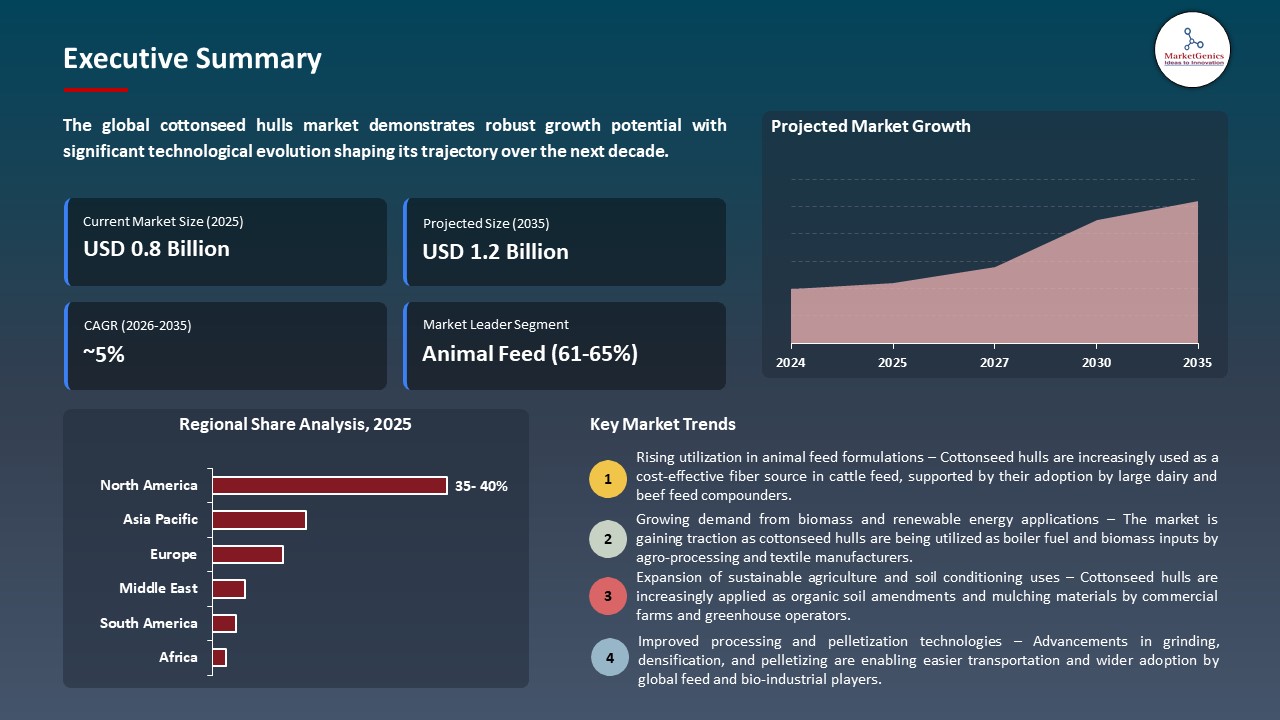
The global cottonseed hulls market is experiencing robust growth, with its estimated value of USD 0.8 billion in the year 2025 and USD 1.2 billion by the period 2035, registering a CAGR of 4.5%, during the forecast period. The cottonseed hulls market is developing rapidly as manufacturers, feed production companies, and agribusinesses recognize that utilizing cotton seed hulls as a sustainable and renewable by-product with minimal impacts can enhance livestock dieting, aid circular farming practices, and improve operational efficiency without compromising feed quality or industrial performance.
John Grossmann, president of ADM's North American Ag Services and Oilseeds business, said: ADM is continuing to deliver on opportunities for strategic simplification across its global footprint. Bringing together these two cottonseed processing operations in Lubbock will allow us to continue to serve customer needs while offering opportunities for enhanced operational efficiencies.
The cottonseed hulls market is changing as a conventional livestock food by-product into a multifunctional strategic resource. Its use is facilitated by the increased focus on the use of the circular economy, the use of renewable by-products, and cost-efficient feed options, which precondition the diversity of cottonseed hulls as a resource in the agricultural, feed, and industrial sectors. Market growth is further accelerating by increasing demand of livestock across the globe and sustainable agricultural programs.
Cottonseed hulls are increasingly hulled into pellets, densified fibers and blends formulations and have enhanced handling, storage and performance. Their rich fiber, digestibility as well as their soil-conditioning properties are some of the reasons why they are the livestock feeding preference, sustainable agriculture, and eco-friendly industrial use. The technology of upgrading processing has improved uniformity of every product and improved their end use in various industries.
Adjacent opportunities to the cottonseed hulls market include animal feed and forage additives, bio-based fertilizers and soil conditioners, industrial absorbents, biocomposite and packaging materials, and mushroom cultivation substrates, leveraging cottonseed hulls’ fibrous and nutrient-rich properties, thereby expanding applications across agriculture, livestock, and sustainable materials, enhancing value extraction, and reducing dependence on conventional agricultural by-products.
Cottonseed Hulls Market Dynamics and Trends
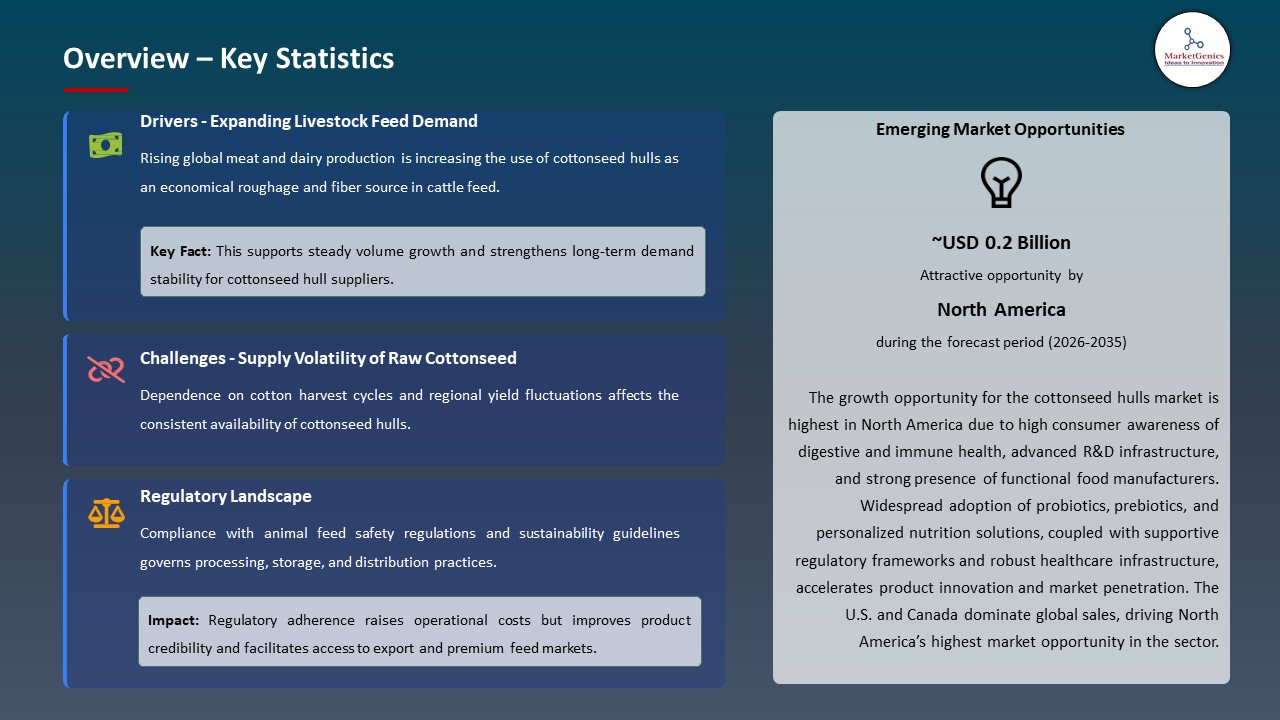
Driver: Rising Demand from Commercial Livestock Feed
-
The global cottonseeds hulls market is motivated by the rising demand of inexpensive and high-fiber feed supplies used in commercial livestock production. Dairy producers and the feed makers aiming at enhancing rumen health, feed conversion ratio, and general animal performance, cottonseed hulls have become a favored fiber source to the cattle, dairy and feedlot rations.
- Large-scale livestock integrators and feed mill operators are sampling to use more cottonseed hulls in pelleted, blended, and formulated rations and this trend is a transition to optimize and nutrient-balanced feed solutions. Technical progress in feed processing, densification and distribution supports this trend and facilitates quality and regular supply.
- The increasing livestock numbers around the globe, the rising meat and dairy production as well as the necessity to use by-products in a sustainable manner is increasing the pace of the use of cottonseed hulls, which have become one of the primary functional fiber ingredients in commercial animal food and industrial feed solutions.
Restraint: Dependence on Cotton Production Cycles
-
The cottonseed hulls market experiences a major limitation as it is dependent on the seasonal cotton production that generates alterations in the supply of raw material and has a direct effect on the consistency of the supply in feed, agricultural, and industrial applications. This reliance also exposes the market to the trends of the global cotton market and the international trade disturbances.
- Unpredictability in cotton crop production, because of weather conditions, pests, and the practices of individual areas, causes fluctuations in prices and intermittent production, making it difficult on the feed manufacturing and industrial users who need predictable amounts of cottonseed hulls throughout the year. This unpredictability may be a setback to long term contracts and long-term planning of masses of buyers.
- Poor processing facilities in close proximity to cotton fields raise the cost of logistics and supply bottlenecks, limiting the scale of adoption and profitability of mid and small-scale operators.
Opportunity: Expansion into Sustainable Agricultural and Industrial Uses
-
The increased use of circle farming and resource-efficient farming is a huge opportunity to the cotton seed hulls global market. With agribusinesses in search of biodegradable inputs and soil-enhancing inputs, cotton seed hulls are coming forward as sustainable inputs to soil conditioning, moisture retention and organic matter additions to crop production systems.
- Industrial industries are also developing a new demand of natural, low-carbon absorbents and biomass feeds due to a tightening environmental regulation and corporate sustainability targets. Cottonseed hulls provide utility in controlling spills, filtering media and as renewable energy feedstock, and therefore can be used more widely than in the past feed applications.
- As an alternative to other materials, cotton seed hulls contribute to closed-loop agricultural and industrial value chain, promote sustainability, and provide a wide range of uses.
Key Trend: Increasing Value-Added Processing and Supply Chain Optimization
-
An increased uptake of value-added processing technology, such as pelletizing, micronization and fiber standardization, to improve flowability, bulk density and functional performance, in cottonseed hulls markets around the world. Such innovations allow the cottonseed hulls to satisfy the technical needs of contemporary feed mills, automated handling systems and the industrial end-users and minimize the logistics and storage inefficiencies.
- Manufacturers and agribusiness processors are creating application-specific cattle feed hull formats of cottonseeds, soil conditioner and industrial absorbents. Investments in processing centers within the region of cotton gins are promoting the traceability, minimization of the transportation losses, and faster hulls incorporation into downstream supply chains, increasing the commercial scalability.
- The adoption of optimized cotton seed hull solutions is being driven by better consistency, predictable fiber content and sustainability benefits and making it suitable in a larger range of applications: feed, agriculture and biomass.
Cottonseed-Hulls-Market Analysis and Segmental Data
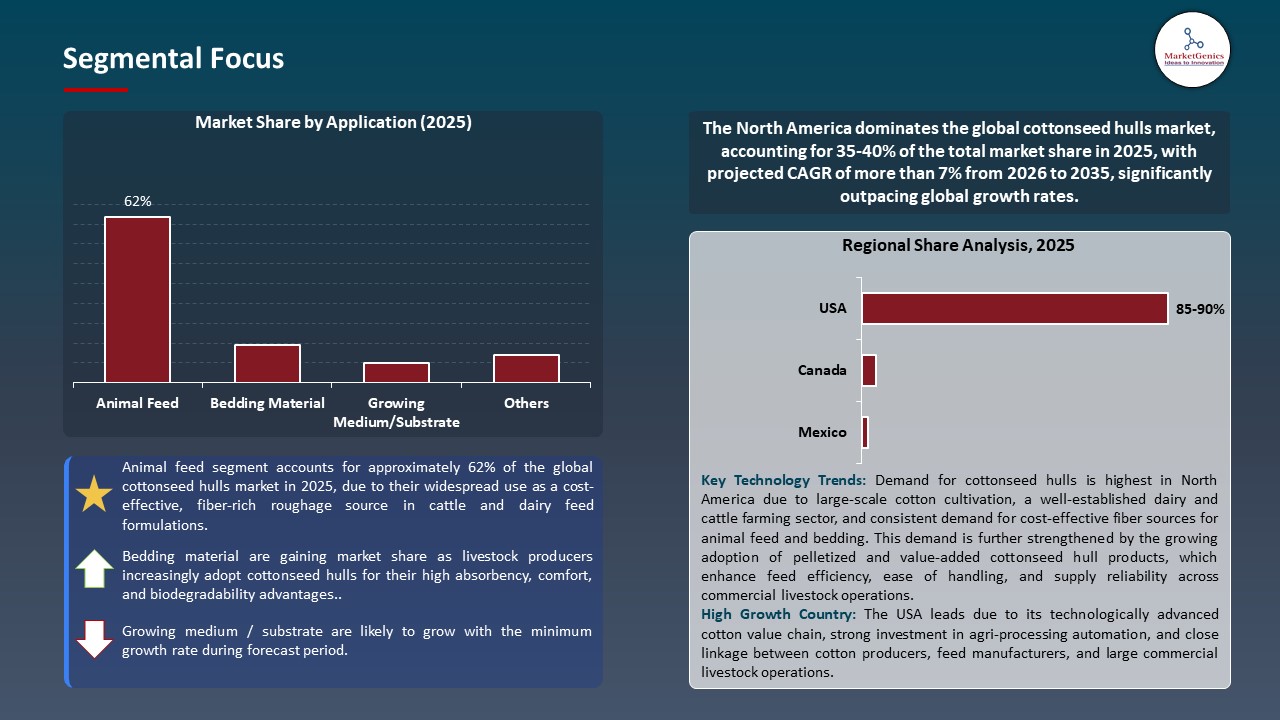
Animal Feed Dominate Global Cottonseed Hulls Market
-
The global cottonseed hulls segment has been primarily controlled by the animal feed sector, this is mainly because of the high level of crude fiber in the material, rumen-friendly digestibility and low-cost relative to the conventional roughage. The use of cotton seed hulls in cattle, dairy and feedlot rations has been shown to improve intestinal functions, decrease the costs of feed formulations and the efficiency of overall feed consumption, especially in intensive livestock production systems.
- The livestock industry is experiencing increased focus on feed optimization and valorization of by-products. Integrated feed processors have broadened the pellet and meal hulling of cottonseeds in pelleted and blended feed mixtures with the reality of commercial feasibility of agricultural by-products in line with sustainability and waste-reduction policies.
- Cottonseed hulls are increasingly replacing traditional fiber sources such as straw and hay due to their consistent quality, ease of handling, and compatibility with automated feed systems. As a result, they dominate most commercial feed processes worldwide.
North America Leads Global Cottonseed Hulls Market Demand
-
North America is at the forefront of cotton seed hulls due to its large-scale cotton production, advanced mechanization in ginning processes, and significant demand in downstream markets such as cattle feed, dairy meal, and feedlot activities. The US, especially Texas, California and the Mississippi Delta, can boast a significant portion of steady supply of cottonseed hulls because of built-in cotton-seeding crushing and by-product recovery programs.
- Advanced feed formulation methods and consistent regulatory environments are allowing the use of cottonseed hulls in rumen health, bedding, and pellet binders by the region feed manufacturers as an effective source of functional fibers. Large agribusinesses are streamlining logistics, densification, and storage processes to provide bulk and pellet hulls all year round to the commercial livestock producer.
- North America is the dominant player in the global cottonseed hull market, driven by integrated supply chains and a strong demand for quality livestock feed.
Cottonseed-Hulls-Market Ecosystem
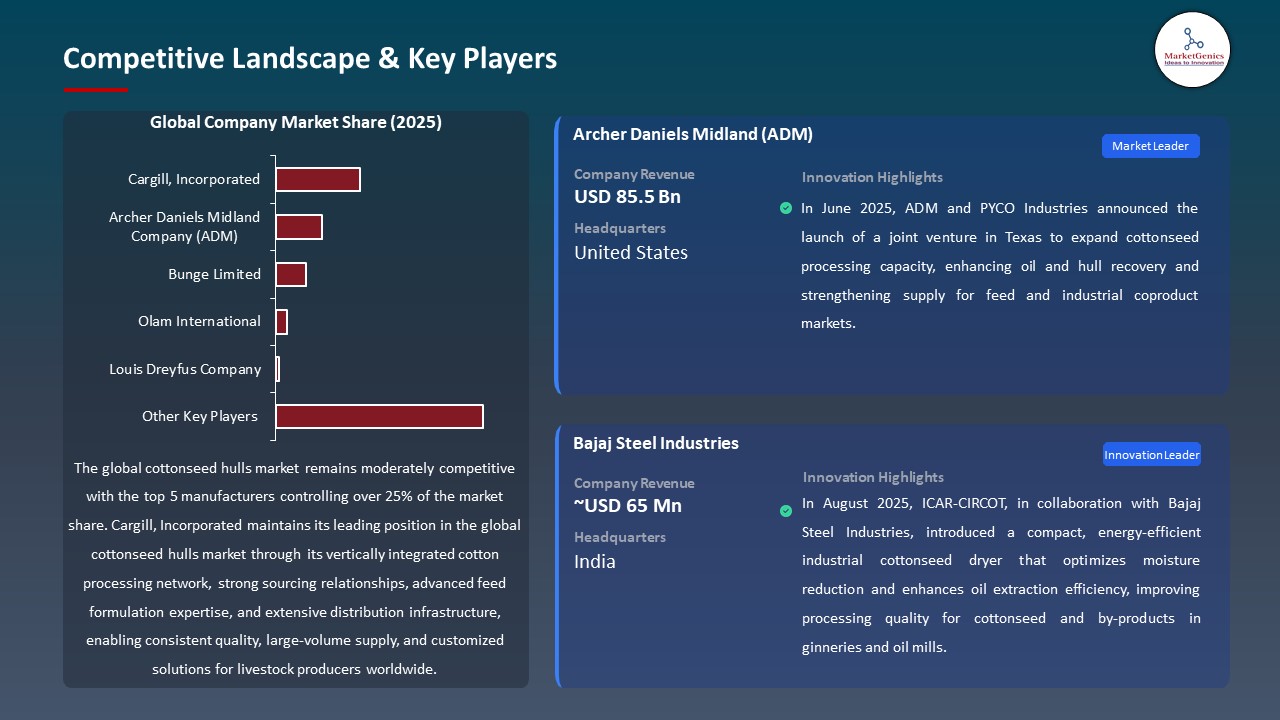
The global cottonseed hulls market is moderately consolidated with the presence of large, vertically integrated, agribusiness corporations, and yet open to the regional and local processors. The degree of consolidation is moderate because the share of processing capacity and international trade is taken by Tier-1 players, but the market is not monopolized because cotton is widely grown and the ginning operations are decentralized.
The ecosystem is controlled by the presence of tier-1 companies Cargill, Incorporated; Archer Daniels Midland Company (ADM); Bunge Limited, Olam International; and Louis Dreyfus Company that have integrated cottonseed sourcing, crushing, by-product recovery, and global distribution. Their size, logistics base as well as long term relations with suppliers allow them to have a steady supply and prices.
The Tier 2 participants are regional cotton seed processors, feed ingredient producers, and agribusiness companies that cater to the domestic livestock and dairy industry.Tier 3 players consist of small cotton gins, farmer cooperatives and local traders who supply raw cotton seed hulls. The growth of the feed demand, the effectiveness of utilizing the by-products, and the optimization of the supply chain are the drivers of market competitiveness.
Recent Development and Strategic Overview
-
In June 2025, ADM and PYCO Industries, Inc. announced that they have signed an agreement to launch a cottonseed processing joint venture in Lubbock, Texas. The venture will combine each company’s cottonseed processing facilities, be majority-owned by PYCO, and governed by a six-member board with equal representation from both partners.
- In August 2025, ICAR‑CIRCOT, in collaboration with Bajaj Steel Industries, introduced a compact, energy‑efficient industrial cottonseed dryer that optimizes moisture reduction and enhances oil extraction efficiency, improving processing quality for cottonseed and by‑products in ginneries and oil mills.
Report Scope
|
Detail |
|
|
Market Size in 2025 |
USD 0.8 Bn |
|
Market Forecast Value in 2035 |
USD 1.2 Bn |
|
Growth Rate (CAGR) |
4.5% |
|
Forecast Period |
2026 – 2035 |
|
Historical Data Available for |
2021 – 2024 |
|
Market Size Units |
US$ Billion for Value Tons for Volume |
|
Report Format |
Electronic (PDF) + Excel |
|
North America |
Europe |
Asia Pacific |
Middle East |
Africa |
South America |
|
|
|
|
|
|
|
Companies Covered |
|||||
|
|
|
|
|
|
Cottonseed-Hulls-Market Segmentation and Highlights
|
Segment |
Sub-segment |
|
Cottonseed Hulls Market, By Product Type |
|
|
Cottonseed Hulls Market, By Packaging Type |
|
|
Cottonseed Hulls Market, By Application |
|
|
Cottonseed Hulls Market, By Distribution Channel |
|
Frequently Asked Questions
Table of Contents
- 1. Research Methodology and Assumptions
- 1.1. Definitions
- 1.2. Research Design and Approach
- 1.3. Data Collection Methods
- 1.4. Base Estimates and Calculations
- 1.5. Forecasting Models
- 1.5.1. Key Forecast Factors & Impact Analysis
- 1.6. Secondary Research
- 1.6.1. Open Sources
- 1.6.2. Paid Databases
- 1.6.3. Associations
- 1.7. Primary Research
- 1.7.1. Primary Sources
- 1.7.2. Primary Interviews with Stakeholders across Ecosystem
- 2. Executive Summary
- 2.1. Global Cottonseed Hulls Market Outlook
- 2.1.1. Cottonseed Hulls Market Size Volume (Tons) and Value (US$ Bn), and Forecasts, 2021-2035
- 2.1.2. Compounded Annual Growth Rate Analysis
- 2.1.3. Growth Opportunity Analysis
- 2.1.4. Segmental Share Analysis
- 2.1.5. Geographical Share Analysis
- 2.2. Market Analysis and Facts
- 2.3. Supply-Demand Analysis
- 2.4. Competitive Benchmarking
- 2.5. Go-to- Market Strategy
- 2.5.1. Customer/ End-use Industry Assessment
- 2.5.2. Growth Opportunity Data, 2026-2035
- 2.5.2.1. Regional Data
- 2.5.2.2. Country Data
- 2.5.2.3. Segmental Data
- 2.5.3. Identification of Potential Market Spaces
- 2.5.4. GAP Analysis
- 2.5.5. Potential Attractive Price Points
- 2.5.6. Prevailing Market Risks & Challenges
- 2.5.7. Preferred Sales & Marketing Strategies
- 2.5.8. Key Recommendations and Analysis
- 2.5.9. A Way Forward
- 2.1. Global Cottonseed Hulls Market Outlook
- 3. Industry Data and Premium Insights
- 3.1. Global Food & Beverages Industry Overview, 2025
- 3.1.1. Food & Beverages Industry Ecosystem Analysis
- 3.1.2. Key Trends for Food & Beverages Industry
- 3.1.3. Regional Distribution for Food & Beverages Industry
- 3.2. Supplier Customer Data
- 3.3. Technology Roadmap and Developments
- 3.4. Trade Analysis
- 3.4.1. Import & Export Analysis, 2025
- 3.4.2. Top Importing Countries
- 3.4.3. Top Exporting Countries
- 3.5. Trump Tariff Impact Analysis
- 3.5.1. Manufacturer
- 3.5.1.1. Based on the component & Raw material
- 3.5.2. Supply Chain
- 3.5.3. End Consumer
- 3.5.1. Manufacturer
- 3.6. Raw Material Analysis
- 3.1. Global Food & Beverages Industry Overview, 2025
- 4. Market Overview
- 4.1. Market Dynamics
- 4.1.1. Drivers
- 4.1.1.1. Rising utilization of cottonseed hulls as cost-effective, high-fiber feed ingredients in livestock and dairy nutrition.
- 4.1.1.2. Growing adoption in bio-based materials, biomass fuel, and soil conditioning applications supporting circular agriculture.
- 4.1.1.3. Expanding cotton production and improved by-product recovery efficiency across major cotton-growing regions.
- 4.1.2. Restraints
- 4.1.2.1. Price volatility and supply fluctuations linked to seasonal cotton output and weather dependency.
- 4.1.2.2. Limited awareness and standardization for industrial applications beyond traditional feed uses.
- 4.1.1. Drivers
- 4.2. Key Trend Analysis
- 4.3. Regulatory Framework
- 4.3.1. Key Regulations, Norms, and Subsidies, by Key Countries
- 4.3.2. Tariffs and Standards
- 4.3.3. Impact Analysis of Regulations on the Market
- 4.4. Value Chain Analysis
- 4.4.1. Raw Material Suppliers
- 4.4.2. Manufacturers
- 4.4.3. Dealers/ Distributors
- 4.4.4. End-Users/ Customers
- 4.5. Porter’s Five Forces Analysis
- 4.6. PESTEL Analysis
- 4.7. Global Cottonseed Hulls Market Demand
- 4.7.1. Historical Market Size – Volume (Tons) and Value (US$ Bn), 2020-2024
- 4.7.2. Current and Future Market Size – Volume (Tons) and Value (US$ Bn), 2026–2035
- 4.7.2.1. Y-o-Y Growth Trends
- 4.7.2.2. Absolute $ Opportunity Assessment
- 4.1. Market Dynamics
- 5. Competition Landscape
- 5.1. Competition structure
- 5.1.1. Fragmented v/s consolidated
- 5.2. Company Share Analysis, 2025
- 5.2.1. Global Company Market Share
- 5.2.2. By Region
- 5.2.2.1. North America
- 5.2.2.2. Europe
- 5.2.2.3. Asia Pacific
- 5.2.2.4. Middle East
- 5.2.2.5. Africa
- 5.2.2.6. South America
- 5.3. Product Comparison Matrix
- 5.3.1. Specifications
- 5.3.2. Market Positioning
- 5.3.3. Pricing
- 5.1. Competition structure
- 6. Global Cottonseed Hulls Market Analysis, by Product Type
- 6.1. Key Segment Analysis
- 6.2. Cottonseed Hulls Market Size Volume (Tons) and Value (US$ Bn), Analysis, and Forecasts, by Product Type, 2021-2035
- 6.2.1. Whole Cottonseed Hulls
- 6.2.2. Ground Cottonseed Hulls
- 6.2.3. Pelletized Cottonseed Hulls
- 6.2.4. Fine Ground Cottonseed Hulls
- 6.2.5. Coarse Ground Cottonseed Hulls
- 7. Global Cottonseed Hulls Market Analysis, by Packaging Type
- 7.1. Key Segment Analysis
- 7.2. Cottonseed Hulls Market Size Volume (Tons) and Value (US$ Bn), Analysis, and Forecasts, by Packaging Type, 2021-2035
- 7.2.1. Bulk (Loose)
- 7.2.2. Bagged
- 7.2.2.1. Up to 25kg
- 7.2.2.2. 25kg-100kg
- 7.2.2.3. Above 100kg
- 7.2.3. Containerized
- 8. Global Cottonseed Hulls Market Analysis, by Application
- 8.1. Key Segment Analysis
- 8.2. Cottonseed Hulls Market Size Volume (Tons) and Value (US$ Bn), Analysis, and Forecasts, by Application, 2021-2035
- 8.2.1. Animal Feed
- 8.2.1.1. Ruminant Feed (Cattle, Sheep, Goats)
- 8.2.1.2. Poultry Feed
- 8.2.1.3. Swine Feed
- 8.2.1.4. Aquaculture Feed
- 8.2.1.5. Others
- 8.2.2. Bedding Material
- 8.2.2.1. Livestock Bedding
- 8.2.2.2. Poultry Bedding
- 8.2.2.3. Horse Bedding
- 8.2.2.4. Others
- 8.2.3. Growing Medium/Substrate
- 8.2.3.1. Mushroom Cultivation
- 8.2.3.2. Hydroponics
- 8.2.3.3. Soil Amendment
- 8.2.3.4. Others
- 8.2.4. Industrial Applications
- 8.2.4.1. Biofuel Production
- 8.2.4.2. Paper Industry
- 8.2.4.3. Biochemical Production
- 8.2.4.4. Others
- 8.2.5. Pet Products
- 8.2.5.1. Cat Litter
- 8.2.5.2. Small Animal Bedding
- 8.2.5.3. Others
- 8.2.1. Animal Feed
- 9. Global Cottonseed Hulls Market Analysis, by Distribution Channel
- 9.1. Key Segment Analysis
- 9.2. Cottonseed Hulls Market Size Volume (Tons) and Value (US$ Bn), Analysis, and Forecasts, by Distribution Channel, 2021-2035
- 9.2.1. Direct Sales
- 9.2.2. Distributors/Wholesalers
- 9.2.3. Online Retail
- 10. Global Cottonseed Hulls Market Analysis and Forecasts, by Region
- 10.1. Key Findings
- 10.2. Cottonseed Hulls Market Size Volume (Tons) and Value (US$ Bn), Analysis, and Forecasts, by Region, 2021-2035
- 10.2.1. North America
- 10.2.2. Europe
- 10.2.3. Asia Pacific
- 10.2.4. Middle East
- 10.2.5. Africa
- 10.2.6. South America
- 11. North America Cottonseed Hulls Market Analysis
- 11.1. Key Segment Analysis
- 11.2. Regional Snapshot
- 11.3. North America Cottonseed Hulls Market Size Volume (Tons) and Value (US$ Bn), Analysis, and Forecasts, 2021-2035
- 11.3.1. Product Type
- 11.3.2. Packaging Type
- 11.3.3. Application
- 11.3.4. Distribution Channel
- 11.3.5. Country
- 11.3.5.1. USA
- 11.3.5.2. Canada
- 11.3.5.3. Mexico
- 11.4. USA Cottonseed Hulls Market
- 11.4.1. Country Segmental Analysis
- 11.4.2. Product Type
- 11.4.3. Packaging Type
- 11.4.4. Application
- 11.4.5. Distribution Channel
- 11.5. Canada Cottonseed Hulls Market
- 11.5.1. Country Segmental Analysis
- 11.5.2. Product Type
- 11.5.3. Packaging Type
- 11.5.4. Application
- 11.5.5. Distribution Channel
- 11.6. Mexico Cottonseed Hulls Market
- 11.6.1. Country Segmental Analysis
- 11.6.2. Product Type
- 11.6.3. Packaging Type
- 11.6.4. Application
- 11.6.5. Distribution Channel
- 12. Europe Cottonseed Hulls Market Analysis
- 12.1. Key Segment Analysis
- 12.2. Regional Snapshot
- 12.3. Europe Cottonseed Hulls Market Size Volume (Tons) and Value (US$ Bn), Analysis, and Forecasts, 2021-2035
- 12.3.1. Product Type
- 12.3.2. Packaging Type
- 12.3.3. Application
- 12.3.4. Distribution Channel
- 12.3.5. Country
- 12.3.5.1. Germany
- 12.3.5.2. United Kingdom
- 12.3.5.3. France
- 12.3.5.4. Italy
- 12.3.5.5. Spain
- 12.3.5.6. Netherlands
- 12.3.5.7. Nordic Countries
- 12.3.5.8. Poland
- 12.3.5.9. Russia & CIS
- 12.3.5.10. Rest of Europe
- 12.4. Germany Cottonseed Hulls Market
- 12.4.1. Country Segmental Analysis
- 12.4.2. Product Type
- 12.4.3. Packaging Type
- 12.4.4. Application
- 12.4.5. Distribution Channel
- 12.5. United Kingdom Cottonseed Hulls Market
- 12.5.1. Country Segmental Analysis
- 12.5.2. Product Type
- 12.5.3. Packaging Type
- 12.5.4. Application
- 12.5.5. Distribution Channel
- 12.6. France Cottonseed Hulls Market
- 12.6.1. Country Segmental Analysis
- 12.6.2. Product Type
- 12.6.3. Packaging Type
- 12.6.4. Application
- 12.6.5. Distribution Channel
- 12.7. Italy Cottonseed Hulls Market
- 12.7.1. Country Segmental Analysis
- 12.7.2. Product Type
- 12.7.3. Packaging Type
- 12.7.4. Application
- 12.7.5. Distribution Channel
- 12.8. Spain Cottonseed Hulls Market
- 12.8.1. Country Segmental Analysis
- 12.8.2. Product Type
- 12.8.3. Packaging Type
- 12.8.4. Application
- 12.8.5. Distribution Channel
- 12.9. Netherlands Cottonseed Hulls Market
- 12.9.1. Country Segmental Analysis
- 12.9.2. Product Type
- 12.9.3. Packaging Type
- 12.9.4. Application
- 12.9.5. Distribution Channel
- 12.10. Nordic Countries Cottonseed Hulls Market
- 12.10.1. Country Segmental Analysis
- 12.10.2. Product Type
- 12.10.3. Packaging Type
- 12.10.4. Application
- 12.10.5. Distribution Channel
- 12.11. Poland Cottonseed Hulls Market
- 12.11.1. Country Segmental Analysis
- 12.11.2. Product Type
- 12.11.3. Packaging Type
- 12.11.4. Application
- 12.11.5. Distribution Channel
- 12.12. Russia & CIS Cottonseed Hulls Market
- 12.12.1. Country Segmental Analysis
- 12.12.2. Product Type
- 12.12.3. Packaging Type
- 12.12.4. Application
- 12.12.5. Distribution Channel
- 12.13. Rest of Europe Cottonseed Hulls Market
- 12.13.1. Country Segmental Analysis
- 12.13.2. Product Type
- 12.13.3. Packaging Type
- 12.13.4. Application
- 12.13.5. Distribution Channel
- 13. Asia Pacific Cottonseed Hulls Market Analysis
- 13.1. Key Segment Analysis
- 13.2. Regional Snapshot
- 13.3. Asia Pacific Cottonseed Hulls Market Size Volume (Tons) and Value (US$ Bn), Analysis, and Forecasts, 2021-2035
- 13.3.1. Product Type
- 13.3.2. Packaging Type
- 13.3.3. Application
- 13.3.4. Distribution Channel
- 13.3.5. Country
- 13.3.5.1. China
- 13.3.5.2. India
- 13.3.5.3. Japan
- 13.3.5.4. South Korea
- 13.3.5.5. Australia and New Zealand
- 13.3.5.6. Indonesia
- 13.3.5.7. Malaysia
- 13.3.5.8. Thailand
- 13.3.5.9. Vietnam
- 13.3.5.10. Rest of Asia Pacific
- 13.4. China Cottonseed Hulls Market
- 13.4.1. Country Segmental Analysis
- 13.4.2. Product Type
- 13.4.3. Packaging Type
- 13.4.4. Application
- 13.4.5. Distribution Channel
- 13.5. India Cottonseed Hulls Market
- 13.5.1. Country Segmental Analysis
- 13.5.2. Product Type
- 13.5.3. Packaging Type
- 13.5.4. Application
- 13.5.5. Distribution Channel
- 13.6. Japan Cottonseed Hulls Market
- 13.6.1. Country Segmental Analysis
- 13.6.2. Product Type
- 13.6.3. Packaging Type
- 13.6.4. Application
- 13.6.5. Distribution Channel
- 13.7. South Korea Cottonseed Hulls Market
- 13.7.1. Country Segmental Analysis
- 13.7.2. Product Type
- 13.7.3. Packaging Type
- 13.7.4. Application
- 13.7.5. Distribution Channel
- 13.8. Australia and New Zealand Cottonseed Hulls Market
- 13.8.1. Country Segmental Analysis
- 13.8.2. Product Type
- 13.8.3. Packaging Type
- 13.8.4. Application
- 13.8.5. Distribution Channel
- 13.9. Indonesia Cottonseed Hulls Market
- 13.9.1. Country Segmental Analysis
- 13.9.2. Product Type
- 13.9.3. Packaging Type
- 13.9.4. Application
- 13.9.5. Distribution Channel
- 13.10. Malaysia Cottonseed Hulls Market
- 13.10.1. Country Segmental Analysis
- 13.10.2. Product Type
- 13.10.3. Packaging Type
- 13.10.4. Application
- 13.10.5. Distribution Channel
- 13.11. Thailand Cottonseed Hulls Market
- 13.11.1. Country Segmental Analysis
- 13.11.2. Product Type
- 13.11.3. Packaging Type
- 13.11.4. Application
- 13.11.5. Distribution Channel
- 13.12. Vietnam Cottonseed Hulls Market
- 13.12.1. Country Segmental Analysis
- 13.12.2. Product Type
- 13.12.3. Packaging Type
- 13.12.4. Application
- 13.12.5. Distribution Channel
- 13.13. Rest of Asia Pacific Cottonseed Hulls Market
- 13.13.1. Country Segmental Analysis
- 13.13.2. Product Type
- 13.13.3. Packaging Type
- 13.13.4. Application
- 13.13.5. Distribution Channel
- 14. Middle East Cottonseed Hulls Market Analysis
- 14.1. Key Segment Analysis
- 14.2. Regional Snapshot
- 14.3. Middle East Cottonseed Hulls Market Size Volume (Tons) and Value (US$ Bn), Analysis, and Forecasts, 2021-2035
- 14.3.1. Product Type
- 14.3.2. Packaging Type
- 14.3.3. Application
- 14.3.4. Distribution Channel
- 14.3.5. Country
- 14.3.5.1. Turkey
- 14.3.5.2. UAE
- 14.3.5.3. Saudi Arabia
- 14.3.5.4. Israel
- 14.3.5.5. Rest of Middle East
- 14.4. Turkey Cottonseed Hulls Market
- 14.4.1. Country Segmental Analysis
- 14.4.2. Product Type
- 14.4.3. Packaging Type
- 14.4.4. Application
- 14.4.5. Distribution Channel
- 14.5. UAE Cottonseed Hulls Market
- 14.5.1. Country Segmental Analysis
- 14.5.2. Product Type
- 14.5.3. Packaging Type
- 14.5.4. Application
- 14.5.5. Distribution Channel
- 14.6. Saudi Arabia Cottonseed Hulls Market
- 14.6.1. Country Segmental Analysis
- 14.6.2. Product Type
- 14.6.3. Packaging Type
- 14.6.4. Application
- 14.6.5. Distribution Channel
- 14.7. Israel Cottonseed Hulls Market
- 14.7.1. Country Segmental Analysis
- 14.7.2. Product Type
- 14.7.3. Packaging Type
- 14.7.4. Application
- 14.7.5. Distribution Channel
- 14.8. Rest of Middle East Cottonseed Hulls Market
- 14.8.1. Country Segmental Analysis
- 14.8.2. Product Type
- 14.8.3. Packaging Type
- 14.8.4. Application
- 14.8.5. Distribution Channel
- 15. Africa Cottonseed Hulls Market Analysis
- 15.1. Key Segment Analysis
- 15.2. Regional Snapshot
- 15.3. Africa Cottonseed Hulls Market Size Volume (Tons) and Value (US$ Bn), Analysis, and Forecasts, 2021-2035
- 15.3.1. Product Type
- 15.3.2. Packaging Type
- 15.3.3. Application
- 15.3.4. Distribution Channel
- 15.3.5. Country
- 15.3.5.1. South Africa
- 15.3.5.2. Egypt
- 15.3.5.3. Nigeria
- 15.3.5.4. Algeria
- 15.3.5.5. Rest of Africa
- 15.4. South Africa Cottonseed Hulls Market
- 15.4.1. Country Segmental Analysis
- 15.4.2. Product Type
- 15.4.3. Packaging Type
- 15.4.4. Application
- 15.4.5. Distribution Channel
- 15.5. Egypt Cottonseed Hulls Market
- 15.5.1. Country Segmental Analysis
- 15.5.2. Product Type
- 15.5.3. Packaging Type
- 15.5.4. Application
- 15.5.5. Distribution Channel
- 15.6. Nigeria Cottonseed Hulls Market
- 15.6.1. Country Segmental Analysis
- 15.6.2. Product Type
- 15.6.3. Packaging Type
- 15.6.4. Application
- 15.6.5. Distribution Channel
- 15.7. Algeria Cottonseed Hulls Market
- 15.7.1. Country Segmental Analysis
- 15.7.2. Product Type
- 15.7.3. Packaging Type
- 15.7.4. Application
- 15.7.5. Distribution Channel
- 15.8. Rest of Africa Cottonseed Hulls Market
- 15.8.1. Country Segmental Analysis
- 15.8.2. Product Type
- 15.8.3. Packaging Type
- 15.8.4. Application
- 15.8.5. Distribution Channel
- 16. South America Cottonseed Hulls Market Analysis
- 16.1. Key Segment Analysis
- 16.2. Regional Snapshot
- 16.3. South America Cottonseed Hulls Market Size Volume (Tons) and Value (US$ Bn), Analysis, and Forecasts, 2021-2035
- 16.3.1. Product Type
- 16.3.2. Packaging Type
- 16.3.3. Application
- 16.3.4. Distribution Channel
- 16.3.5. Country
- 16.3.5.1. Brazil
- 16.3.5.2. Argentina
- 16.3.5.3. Rest of South America
- 16.4. Brazil Cottonseed Hulls Market
- 16.4.1. Country Segmental Analysis
- 16.4.2. Product Type
- 16.4.3. Packaging Type
- 16.4.4. Application
- 16.4.5. Distribution Channel
- 16.5. Argentina Cottonseed Hulls Market
- 16.5.1. Country Segmental Analysis
- 16.5.2. Product Type
- 16.5.3. Packaging Type
- 16.5.4. Application
- 16.5.5. Distribution Channel
- 16.6. Rest of South America Cottonseed Hulls Market
- 16.6.1. Country Segmental Analysis
- 16.6.2. Product Type
- 16.6.3. Packaging Type
- 16.6.4. Application
- 16.6.5. Distribution Channel
- 17. Key Players/ Company Profile
- 17.1. Allenberg Cotton Company
- 17.1.1. Company Details/ Overview
- 17.1.2. Company Financials
- 17.1.3. Key Customers and Competitors
- 17.1.4. Business/ Industry Portfolio
- 17.1.5. Product Portfolio/ Specification Details
- 17.1.6. Pricing Data
- 17.1.7. Strategic Overview
- 17.1.8. Recent Developments
- 17.2. American Cotton Growers
- 17.3. Anderson Clayton & Company
- 17.4. Archer Daniels Midland Company (ADM)
- 17.5. Bunge Limited
- 17.6. Calcot Ltd.
- 17.7. Cargill, Incorporated
- 17.8. Cotton Holdings
- 17.9. Delta Cotton Cooperative
- 17.10. Dunavant Enterprises
- 17.11. Gold Kist
- 17.12. J.G. Boswell Company
- 17.13. Louis Dreyfus Company
- 17.14. Olam International
- 17.15. Paramount Cotton Company
- 17.16. Plains Cotton Cooperative Association
- 17.17. Pyco Industries
- 17.18. Southern States Cooperative
- 17.19. Staplcotn
- 17.20. Tennessee Farmers Cooperative
- 17.21. Texas Cotton Ginners' Association
- 17.22. Other Key Players
- 17.1. Allenberg Cotton Company
Note* - This is just tentative list of players. While providing the report, we will cover more number of players based on their revenue and share for each geography
Research Design
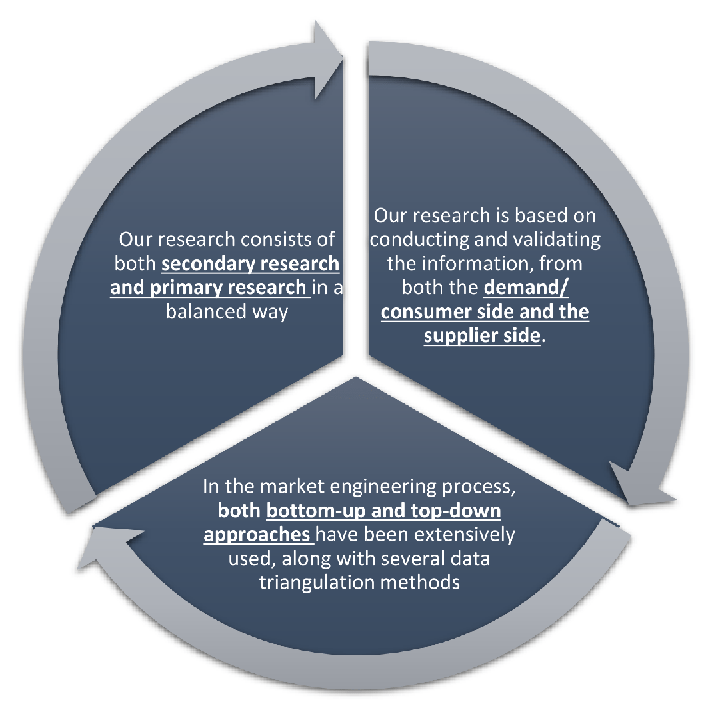
Our research design integrates both demand-side and supply-side analysis through a balanced combination of primary and secondary research methodologies. By utilizing both bottom-up and top-down approaches alongside rigorous data triangulation methods, we deliver robust market intelligence that supports strategic decision-making.
MarketGenics' comprehensive research design framework ensures the delivery of accurate, reliable, and actionable market intelligence. Through the integration of multiple research approaches, rigorous validation processes, and expert analysis, we provide our clients with the insights needed to make informed strategic decisions and capitalize on market opportunities.
MarketGenics leverages a dedicated industry panel of experts and a comprehensive suite of paid databases to effectively collect, consolidate, and analyze market intelligence.
Our approach has consistently proven to be reliable and effective in generating accurate market insights, identifying key industry trends, and uncovering emerging business opportunities.
Through both primary and secondary research, we capture and analyze critical company-level data such as manufacturing footprints, including technical centers, R&D facilities, sales offices, and headquarters.
Our expert panel further enhances our ability to estimate market size for specific brands based on validated field-level intelligence.
Our data mining techniques incorporate both parametric and non-parametric methods, allowing for structured data collection, sorting, processing, and cleaning.
Demand projections are derived from large-scale data sets analyzed through proprietary algorithms, culminating in robust and reliable market sizing.
Research Approach
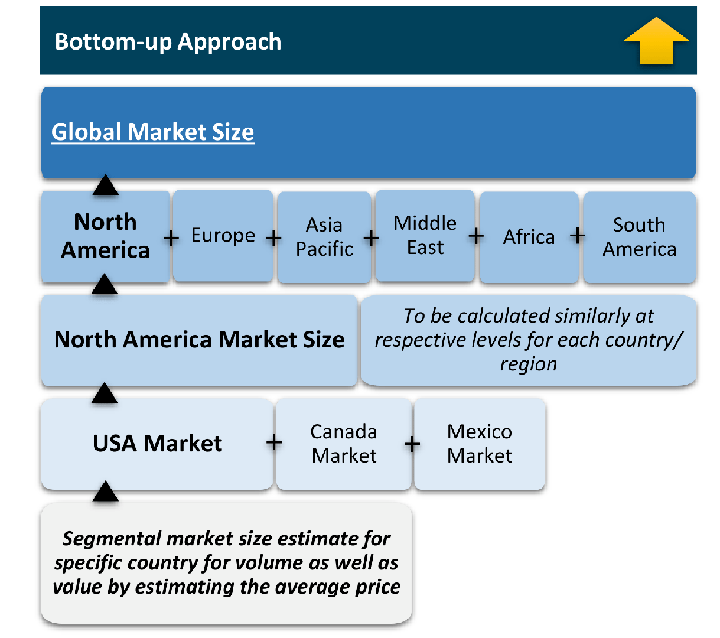
The bottom-up approach builds market estimates by starting with the smallest addressable market units and systematically aggregating them to create comprehensive market size projections.
This method begins with specific, granular data points and builds upward to create the complete market landscape.
Customer Analysis → Segmental Analysis → Geographical Analysis
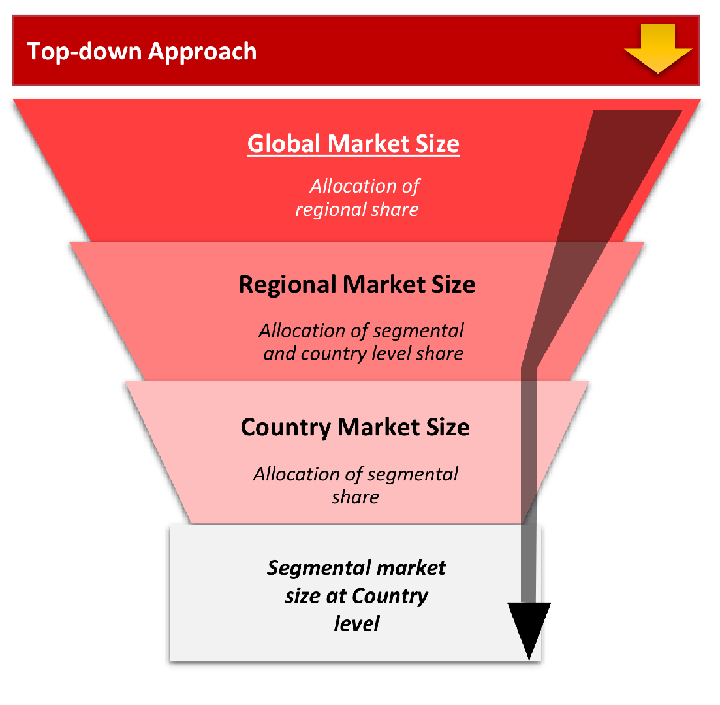
The top-down approach starts with the broadest possible market data and systematically narrows it down through a series of filters and assumptions to arrive at specific market segments or opportunities.
This method begins with the big picture and works downward to increasingly specific market slices.
TAM → SAM → SOM
Research Methods
Desk / Secondary Research
While analysing the market, we extensively study secondary sources, directories, and databases to identify and collect information useful for this technical, market-oriented, and commercial report. Secondary sources that we utilize are not only the public sources, but it is a combination of Open Source, Associations, Paid Databases, MG Repository & Knowledgebase, and others.
- Company websites, annual reports, financial reports, broker reports, and investor presentations
- National government documents, statistical databases and reports
- News articles, press releases and web-casts specific to the companies operating in the market, Magazines, reports, and others
- We gather information from commercial data sources for deriving company specific data such as segmental revenue, share for geography, product revenue, and others
- Internal and external proprietary databases (industry-specific), relevant patent, and regulatory databases
- Governing Bodies, Government Organizations
- Relevant Authorities, Country-specific Associations for Industries
We also employ the model mapping approach to estimate the product level market data through the players' product portfolio
Primary Research
Primary research/ interviews is vital in analyzing the market. Most of the cases involves paid primary interviews. Primary sources include primary interviews through e-mail interactions, telephonic interviews, surveys as well as face-to-face interviews with the different stakeholders across the value chain including several industry experts.
| Type of Respondents | Number of Primaries |
|---|---|
| Tier 2/3 Suppliers | ~20 |
| Tier 1 Suppliers | ~25 |
| End-users | ~25 |
| Industry Expert/ Panel/ Consultant | ~30 |
| Total | ~100 |
MG Knowledgebase
• Repository of industry blog, newsletter and case studies
• Online platform covering detailed market reports, and company profiles
Forecasting Factors and Models
Forecasting Factors
- Historical Trends – Past market patterns, cycles, and major events that shaped how markets behave over time. Understanding past trends helps predict future behavior.
- Industry Factors – Specific characteristics of the industry like structure, regulations, and innovation cycles that affect market dynamics.
- Macroeconomic Factors – Economic conditions like GDP growth, inflation, and employment rates that affect how much money people have to spend.
- Demographic Factors – Population characteristics like age, income, and location that determine who can buy your product.
- Technology Factors – How quickly people adopt new technology and how much technology infrastructure exists.
- Regulatory Factors – Government rules, laws, and policies that can help or restrict market growth.
- Competitive Factors – Analyzing competition structure such as degree of competition and bargaining power of buyers and suppliers.
Forecasting Models / Techniques
Multiple Regression Analysis
- Identify and quantify factors that drive market changes
- Statistical modeling to establish relationships between market drivers and outcomes
Time Series Analysis – Seasonal Patterns
- Understand regular cyclical patterns in market demand
- Advanced statistical techniques to separate trend, seasonal, and irregular components
Time Series Analysis – Trend Analysis
- Identify underlying market growth patterns and momentum
- Statistical analysis of historical data to project future trends
Expert Opinion – Expert Interviews
- Gather deep industry insights and contextual understanding
- In-depth interviews with key industry stakeholders
Multi-Scenario Development
- Prepare for uncertainty by modeling different possible futures
- Creating optimistic, pessimistic, and most likely scenarios
Time Series Analysis – Moving Averages
- Sophisticated forecasting for complex time series data
- Auto-regressive integrated moving average models with seasonal components
Econometric Models
- Apply economic theory to market forecasting
- Sophisticated economic models that account for market interactions
Expert Opinion – Delphi Method
- Harness collective wisdom of industry experts
- Structured, multi-round expert consultation process
Monte Carlo Simulation
- Quantify uncertainty and probability distributions
- Thousands of simulations with varying input parameters
Research Analysis
Our research framework is built upon the fundamental principle of validating market intelligence from both demand and supply perspectives. This dual-sided approach ensures comprehensive market understanding and reduces the risk of single-source bias.
Demand-Side Analysis: We understand end-user/application behavior, preferences, and market needs along with the penetration of the product for specific application.
Supply-Side Analysis: We estimate overall market revenue, analyze the segmental share along with industry capacity, competitive landscape, and market structure.
Validation & Evaluation
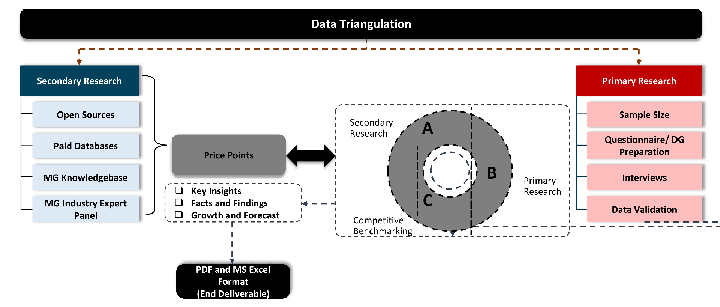
Data triangulation is a validation technique that uses multiple methods, sources, or perspectives to examine the same research question, thereby increasing the credibility and reliability of research findings. In market research, triangulation serves as a quality assurance mechanism that helps identify and minimize bias, validate assumptions, and ensure accuracy in market estimates.
- Data Source Triangulation – Using multiple data sources to examine the same phenomenon
- Methodological Triangulation – Using multiple research methods to study the same research question
- Investigator Triangulation – Using multiple researchers or analysts to examine the same data
- Theoretical Triangulation – Using multiple theoretical perspectives to interpret the same data
Custom Market Research Services
We will customise the research for you, in case the report listed above does not meet your requirements.
Get 10% Free Customisation