Dental Chews for Pets Market Size, Share & Trends Analysis Report by Product Type (Rawhide-based Chews, Vegetable-based Chews, Synthetic/Polymer-based Chews, Natural Bone Chews, Dental Sticks and Bones, Dental Treats and Biscuits, Others), Pet Type, Ingredient Type, Texture/Hardness Level, Functional Benefits, Age Group of Pets, Distribution Channel, End-Use, and Geography (North America, Europe, Asia Pacific, Middle East, Africa, and South America) – Global Industry Data, Trends, and Forecasts, 2026–2035
|
|
|
Segmental Data Insights |
|
|
Demand Trends |
|
|
Competitive Landscape |
|
|
Strategic Development |
|
|
Future Outlook & Opportunities |
|
Dental Chews for Pets Market Size, Share, and Growth
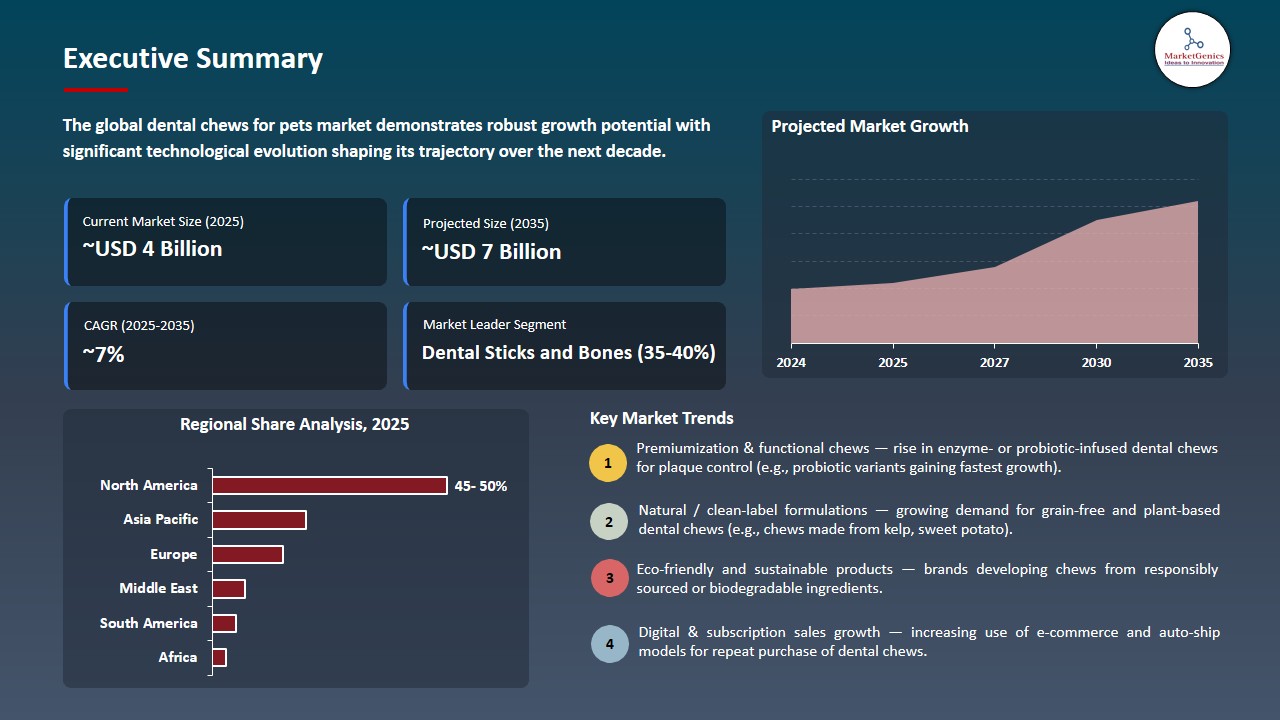
The global dental chews for pets market is experiencing robust growth, with its estimated value of USD 3.7 billion in the year 2025 and USD 7.2 billion by the period 2035, registering a CAGR of 6.9%, during the forecast period. The global dental chews for pets market is rising due to consumer awareness of the pet wellness, oral health and sustainability. The owners of pets are interested in items that can help maintain health of the gum, to decrease the level of plaque, tartar, to ensure long chewing and safe and digestible form of the items. It is creating pressure on the need to have quality, clinically validated formulation using natural and non-toxic substances.
Greg Reinhart, Ph.D., Chief Scientific Officer at Pet Honesty, stated, These bites deliver meaningful health benefits in a form cats actually enjoy, and that’s a game changer for pet parents.
The dental chews for pets market is moving towards changing values among the pet owners, where there is an increased focus on pet wellness, sustainability, and functional health. Due to the fact that pet parents treat dogs as a family member, demand is shifting away from infrequent or occasional treats to chews that provide actual oral-health benefits such as plaque control, gum support, and breath freshening and not merely taste or entertainment. The product standards are changing due to consumer demand to be informed, to use clean ingredients and to be ethical in their sourcing.
The recent product introductions and innovations can be seen as a reflection of this change. For instance, NPIC launched Flossta by N-Bone a dental chew in 2024 carefully designed and made of an elastic floss-shaped structure and natural herbs to clean hard-to-reach areas of the gums and teeth. The pet parents are becoming more sophisticated and brands reformulate their portfolios with natural and grain-free chews and even chews with a functional purpose.
With these processes taking shape, dental chews with health-related, transparent and sustainably manufactured products have high chances of gaining the increasing demand. Their success will be based on additional innovation such as texture and ingredient design, clean-label guarantee, and compatibility of products with pet-owner values on health and sustainability.
Dental Chews for Pets Market Dynamics and Trends
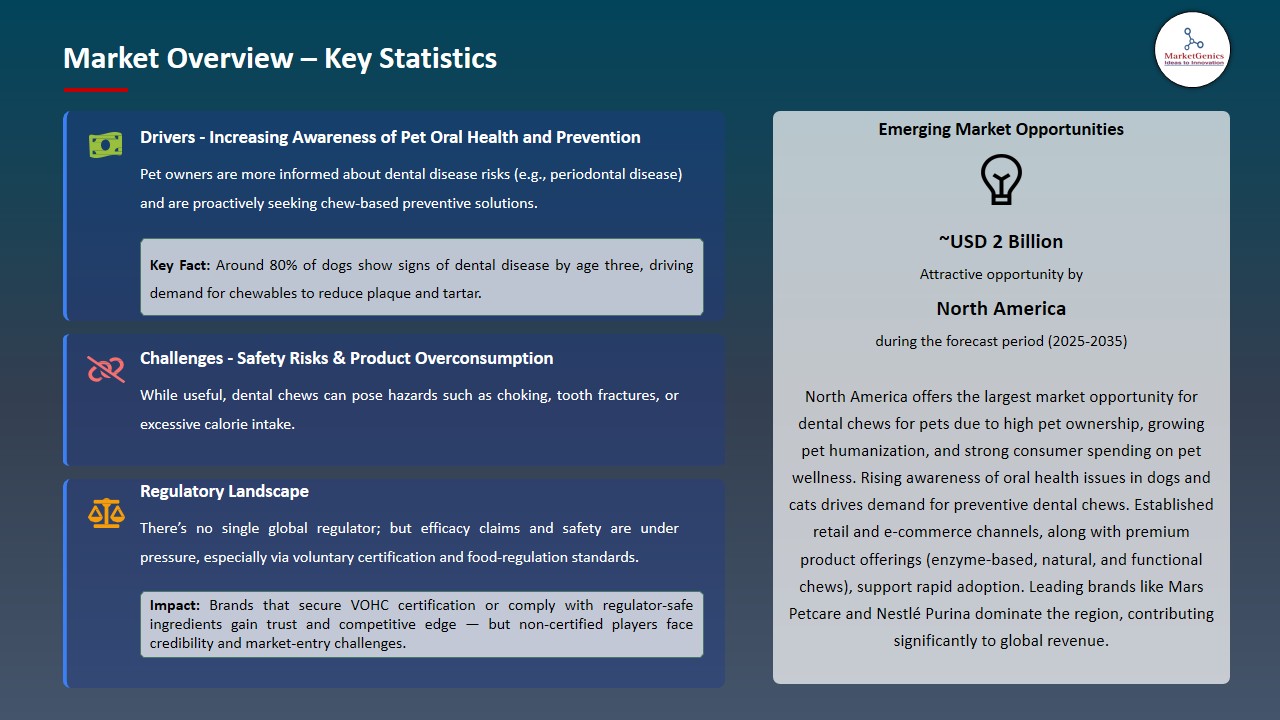
Driver: Rising Pet Humanization and Preventive Healthcare Adoption
-
The increased humanization of pets and the focus on preventive healthcare are changing the market of dental chews for pets, affecting the way owners shop the product, their demands, and trust in brands. Due to the growing number of pet owners who regard pets as full-fledged family members, the desire is no longer on mere treats but on high-quality oral-health products that possess functional value.
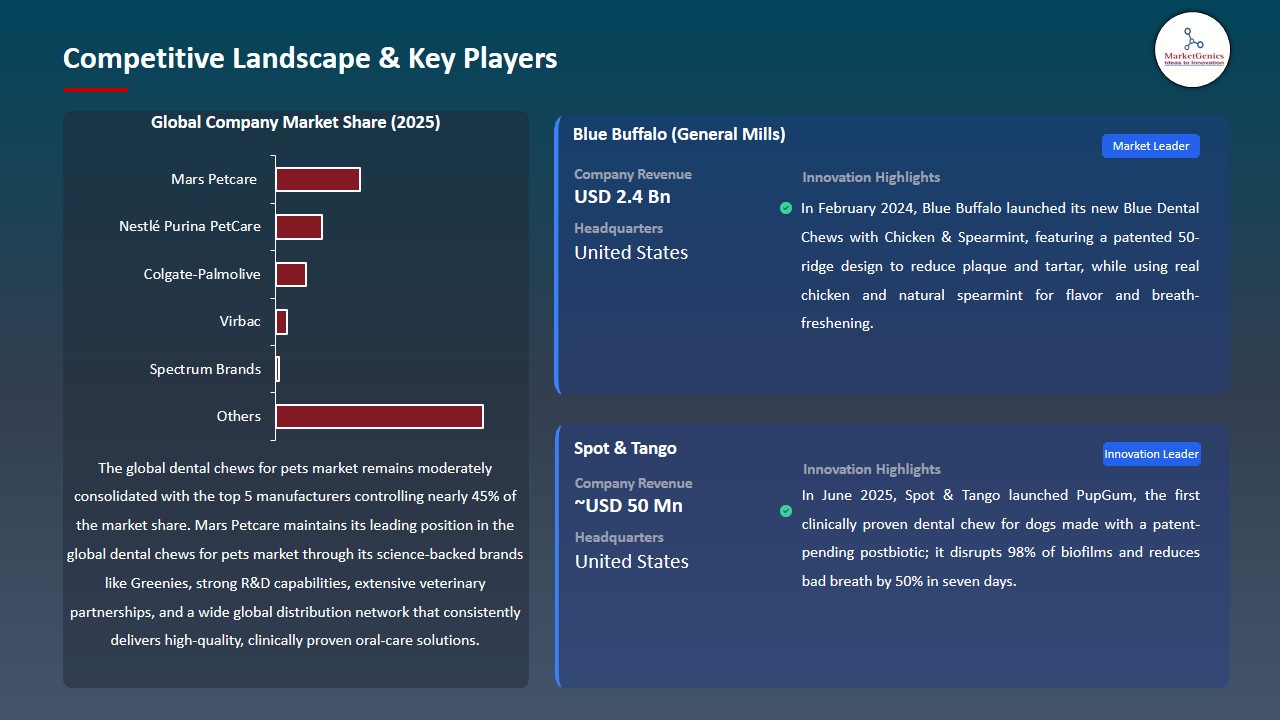
- The global dentalc chews for pets market is constantly growing with a huge portion taken by dental chews as pet owners begin to focus more on preventative dental health. For instance, in June 2025, Spot and Tango released PupGum, a dental chew clinically proven to reduce bad breath in dogs in seven days, by attacking plaque and oral biofilms. Owners are choosing chews not only as a treat but also as health, wellness, and longevity and are compelling brands to rebrand their portfolios, focus on ingredient transparency, and clarify larger product benefits.
- Providing health-oriented, high-quality, and transparent dental chews is a great opportunity for brands to capitalize on rising demand and build consumer loyalty in this dynamic sector.
Restraint: Safety Concerns and Choking Hazards
-
The dental chews for pets market is growing tight with the safety issues and choking risks. Bones, antlers or compact sticks are considered hard chews and they are real threat of tooth fractures, oral injuries, and intestinal blockages in case the chews are not swallowed in the right way. Small breeds which do not fit in large or too hard chews as well as the aggressive chewers are particularly at risk of these risks.
- The increasing awareness of such risks has elicited increased questioning. A client of a veterinary-safety device company claimed in 2025 that occurrences of chew-related events result in more than 1 million vet visits per year in the United States, demonstrating the extent of the chew-related emergency and the necessity for safer chewing alternatives. This rising consciousness limits the use of chew-based dental products by consumers, particularly by the hesitant pet owners and those with small or old dogs.
- Market participants are facing regulatory warnings, decreased customer confidence, and a preference for safer substitutes. To overcome these limits, the company must have unambiguous safety certification, superior product design, and effective consumer education, which raises its expenses and delays its entry into the mass market.
Opportunity: Expansion in Prescription Dental Therapeutic Products
-
Increasing knowledge of pet oral health problems and the growing desire to find preventive and curative products are another major growth prospect of dental chews and vitamins. Prescription grade and clinically proven products have the potential to fulfil the consumer expectations of effectiveness, safety and convenience that enable a company to distinguish itself in the face of competition. Companies that have invested in formulations that have undergone research and those with the right distribution channels will be in a good position to take advantage of this changing environment.
- Examples of this trend include the current product innovations. Firms are starting to look into postbiotic and clinically substantiated ingredients to improve efficacy and overcome root-cause oral health problems. For instnace, in May 2025, Other Half Pet has recently opened Doggie Dental, a dog oral-health supplement, that contains a clinically validated postbiotic (COHP) that lowers the amount of plaque, biofilm, and bad breath and helps maintain the overall balance in the oral microbiome.
- The further growth will be based on the expansion to the premium products, subscription, and direct-to-consumer, where the companies will use the veterinary partnership relations and consumer insights to form the loyalty and differentiation.
Key Trend: Development of Functional Ingredients and Enzymatic Formulations
-
The increased trend in the application of functional ingredients and enzymatic formulations is altering the currently competitive global dental-chews-pets market, through the transformation of products once considered as a simple treat + chew into oral-health solutions. Manufacturers are now adding active enzymes, biofilm-disrupting agents, or postbiotics into chews to provide chews that not only scrape plaque mechanically but also chemically target plaque, tartar, and oral bacteria as at the root causes of dental problems and which are becoming more health-conscious.
- This tendency is more and more indicated in new products that focus more on enzymatic and functional properties. For instance, in November 2025, Chewsday introduced a new line of dog chews that contain enzymatic dental chews that have been specifically developed to break down biofilm and promote healthy gums, not through the use of abrasive chewing alone. It shows how the market is inventing something out of sticks and bones and satisfying the needs of useful dental cleaning, breath-freshening and general pet-wellness advantages.
- Businesses can leverage the growing popularity of mass-market chews to differentiate their products, position them as premium, build recurring-purchase patterns, and enhance consumer interactions and value.
Dental-Chews-for-Pets-Market Analysis and Segmental Data
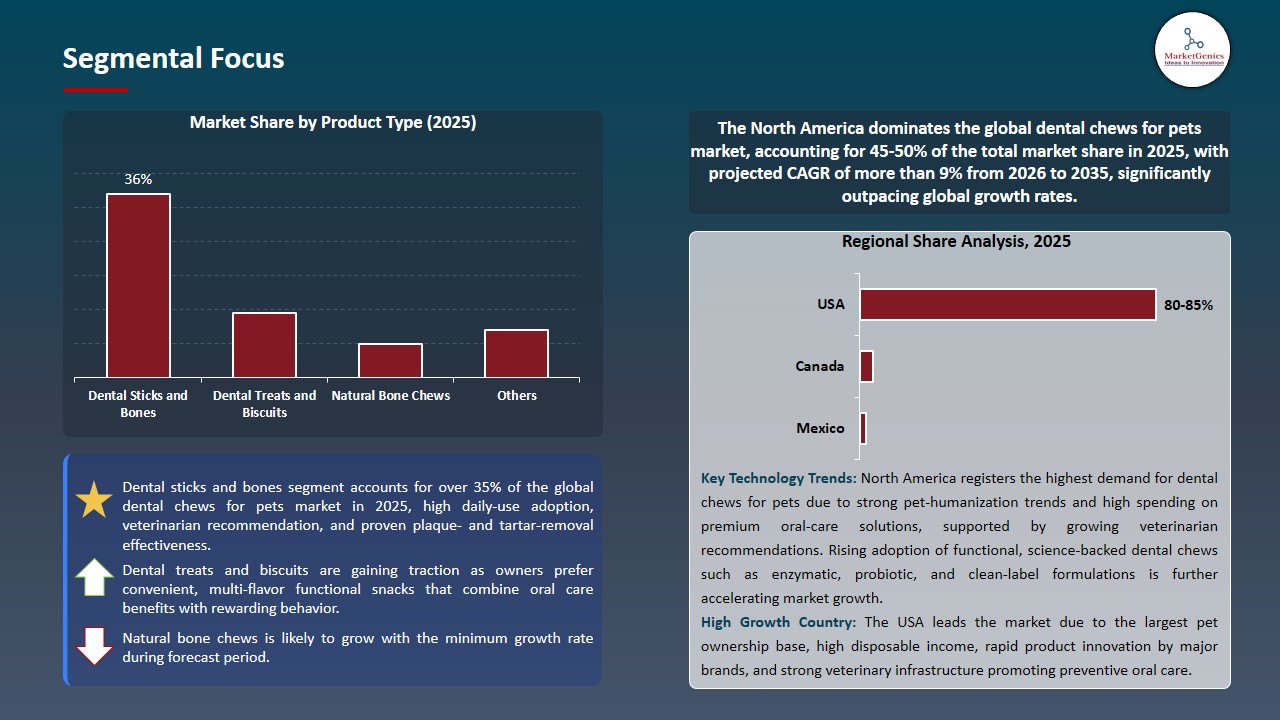
Dental Sticks and Bones Dominate Global Dental Chews for Pets Market
-
Dental sticks and bones remain the leading segment in the global pet dental-chews market due to their rigid texture and durable structure, which provide effective mechanical cleaning, helping remove plaque and tartar while satisfying dogs’ natural chewing instincts. Their long-lasting chewability reduces the need for frequent replacements and supports dental hygiene in a simple, low-maintenance way, making them highly attractive to pet owners.
- The segment’s dominance is further reinforced by the versatility of these formats. Sticks and bones can accommodate a wide range of sizes, flavors, and functional ingredients, allowing brands to tailor products to different breeds, age groups, and health needs. The format also supports the integration of natural, hypoallergenic, and functional components, enhancing overall oral health while aligning with consumer preferences for safe and sustainable products.
- Dental sticks and bones remain a market leader because to established manufacturing methods, substantial retail distribution, and great consumer trust.
North America Leads Global Dental Chews for Pets Market Demand
-
North America leads the global dental chews to pets market, due to one of the highest rates of pet ownership in the world, and a high amount of money taken up by consumers in preventive pet health. The advanced taste of the consumer, such as the readiness to use high-quality wellness products, preconditions the high adoption of dental chews beyond mere snacks.
- Full developed retail infrastructure and extensive penetration of e-commerce ensures that these products are easily accessible in both urban and suburban regions and culturally pets are starting to be considered family members, which promotes routine oral care practice. Major urban centers are the innovation hubs, which will allow the brands to test new formulations, confirm the trends, and engage the influencers.
- For instance, in August 2024, Nulo released an operational line of treats and dental chews with sustainably-sourced yak chews, and illustrates how North American companies use the fact that consumers are more interested in health-conscious and environmentally-conscious products. These inventions are an indication of willingness of the region to embrace various, premium and utilitarian dental-chew solutions.
- North America's leadership is supported by high-quality veterinary care, strong regulatory support for product safety, and digitally savvy pet owners who prioritize quality, effectiveness, and sustainability.
Dental-Chews-for-Pets-Market Ecosystem
The global dental chews of pets market is moderately consolidated with multinational conglomerates, specialized branding and direct-to-consumer startups competing on various fronts at various price points. Such major players as Mars Petcare, Nestle Purina Petcare, Colgate-Palmolive, Virbac, and Spectrum Brands use their scale, high research and development, and well-established distribution channels to stay competitive in mass-market segments.
Differentiation of specialty and niche brands is in innovative formulations, natural or functional components and specific consumer interaction, to serve the premium sector and health-conscious pet owners. With a market value chain covering ingredient sourcing, formulation development, contract manufacturing, packaging, distribution, retail and marketing services, and the chain has end-to-end product delivery.
The growing interest among the companies lies in vertical integration, direct-to-consumer and digital marketing capabilities to reinforce the competitive positioning, maximize profitability, and develop a direct relationship with consumers. These plans will assist in personalization’s, innovation, and greater customer loyalty within a changing and competitive oral-care pet industry.
Recent Development and Strategic Overview
-
In April 2025, Fera Pets released its first-ever dental supplement, an all-powdered dog and cat formula that can be sprinkled on the food after eating. The supplement is a combination of botanicals, oral-health enzymes and a clinically-studied postbiotic to promote a fresh breath, clean teeth, healthy gums and a balanced oral microbiome as an alternative to the traditional dental care that requires no brushing or chewing of teeth.
- In August 2025, Woof launched HonestChew, a new plant-powered, ultra-durable dog chew designed to be safer than traditional bones or nylon chews: made of food-grade plant materials, powdered antler bone and vegetable broth hypoallergenic, free from plastic/rawhide/nylon, and engineered to flake (not splinter) for reduced choking hazard.
Report Scope
|
Detail |
|
|
Market Size in 2025 |
USD 3.7 Bn |
|
Market Forecast Value in 2035 |
USD 7.2 Bn |
|
Growth Rate (CAGR) |
6.9% |
|
Forecast Period |
2026 – 2035 |
|
Historical Data Available for |
2021 – 2024 |
|
Market Size Units |
US$ Billion for Value Million Units for Volume |
|
Report Format |
Electronic (PDF) + Excel |
|
North America |
Europe |
Asia Pacific |
Middle East |
Africa |
South America |
|
|
|
|
|
|
|
Companies Covered |
|||||
|
|
|
|
|
|
Dental-Chews-for-Pets-Market Segmentation and Highlights
|
Segment |
Sub-segment |
|
Dental Chews for Pets Market, By Product Type |
|
|
Dental Chews for Pets Market, By Pet Type |
|
|
Dental Chews for Pets Market, By Ingredient Type |
|
|
Dental Chews for Pets Market, By Texture/Hardness Level |
|
|
Dental Chews for Pets Market, By Functional Benefits |
|
|
Dental Chews for Pets Market, By Age Group of Pets |
|
|
Dental Chews for Pets Market, By Distribution Channel |
|
|
Dental Chews for Pets Market, By End-Use |
|
Frequently Asked Questions
Table of Contents
- 1. Research Methodology and Assumptions
- 1.1. Definitions
- 1.2. Research Design and Approach
- 1.3. Data Collection Methods
- 1.4. Base Estimates and Calculations
- 1.5. Forecasting Models
- 1.5.1. Key Forecast Factors & Impact Analysis
- 1.6. Secondary Research
- 1.6.1. Open Sources
- 1.6.2. Paid Databases
- 1.6.3. Associations
- 1.7. Primary Research
- 1.7.1. Primary Sources
- 1.7.2. Primary Interviews with Stakeholders across Ecosystem
- 2. Executive Summary
- 2.1. Global Dental Chews for Pets Market Outlook
- 2.1.1. Dental Chews for Pets Market Size (Volume - Million Units and Value - US$ Bn), and Forecasts, 2021-2035
- 2.1.2. Compounded Annual Growth Rate Analysis
- 2.1.3. Growth Opportunity Analysis
- 2.1.4. Segmental Share Analysis
- 2.1.5. Geographical Share Analysis
- 2.2. Market Analysis and Facts
- 2.3. Supply-Demand Analysis
- 2.4. Competitive Benchmarking
- 2.5. Go-to- Market Strategy
- 2.5.1. Customer/ End-use Industry Assessment
- 2.5.2. Growth Opportunity Data, 2026-2035
- 2.5.2.1. Regional Data
- 2.5.2.2. Country Data
- 2.5.2.3. Segmental Data
- 2.5.3. Identification of Potential Market Spaces
- 2.5.4. GAP Analysis
- 2.5.5. Potential Attractive Price Points
- 2.5.6. Prevailing Market Risks & Challenges
- 2.5.7. Preferred Sales & Marketing Strategies
- 2.5.8. Key Recommendations and Analysis
- 2.5.9. A Way Forward
- 2.1. Global Dental Chews for Pets Market Outlook
- 3. Industry Data and Premium Insights
- 3.1. Global Consumer Goods & Services Industry Overview, 2025
- 3.1.1. Consumer Goods & Services Industry Ecosystem Analysis
- 3.1.2. Key Trends for Consumer Goods & Services Industry
- 3.1.3. Regional Distribution for Consumer Goods & Services Industry
- 3.2. Supplier Customer Data
- 3.3. Technology Roadmap and Developments
- 3.4. Trade Analysis
- 3.4.1. Import & Export Analysis, 2025
- 3.4.2. Top Importing Countries
- 3.4.3. Top Exporting Countries
- 3.5. Trump Tariff Impact Analysis
- 3.5.1. Manufacturer
- 3.5.1.1. Based on the component & Raw material
- 3.5.2. Supply Chain
- 3.5.3. End Consumer
- 3.5.1. Manufacturer
- 3.6. Raw Material Analysis
- 3.1. Global Consumer Goods & Services Industry Overview, 2025
- 4. Market Overview
- 4.1. Market Dynamics
- 4.1.1. Drivers
- 4.1.1.1. Rising awareness of oral health issues in pets (e.g., periodontal disease).
- 4.1.1.2. Increasing pet ownership and higher pet‑care expenditure.
- 4.1.1.3. Innovation in dental chews (e.g., enzyme-based, natural ingredients, sustainable formulations).
- 4.1.2. Restraints
- 4.1.2.1. Regulatory and safety concerns (e.g., choking risk, variable ingredient regulation).
- 4.1.2.2. High cost of premium-quality dental chews limits affordability.
- 4.1.1. Drivers
- 4.2. Key Trend Analysis
- 4.3. Regulatory Framework
- 4.3.1. Key Regulations, Norms, and Subsidies, by Key Countries
- 4.3.2. Tariffs and Standards
- 4.3.3. Impact Analysis of Regulations on the Market
- 4.4. Value Chain Analysis
- 4.4.1. Raw Material Suppliers
- 4.4.2. Manufacturers
- 4.4.3. Dealers/ Distributors
- 4.4.4. End-Users/ Customers
- 4.5. Porter’s Five Forces Analysis
- 4.6. PESTEL Analysis
- 4.7. Global Dental Chews for Pets Market Demand
- 4.7.1. Historical Market Size – Volume (Million Units) and Value (US$ Bn), 2020-2024
- 4.7.2. Current and Future Market Size – Volume (Million Units) and Value (US$ Bn), 2026–2035
- 4.7.2.1. Y-o-Y Growth Trends
- 4.7.2.2. Absolute $ Opportunity Assessment
- 4.1. Market Dynamics
- 5. Competition Landscape
- 5.1. Competition structure
- 5.1.1. Fragmented v/s consolidated
- 5.2. Company Share Analysis, 2025
- 5.2.1. Global Company Market Share
- 5.2.2. By Region
- 5.2.2.1. North America
- 5.2.2.2. Europe
- 5.2.2.3. Asia Pacific
- 5.2.2.4. Middle East
- 5.2.2.5. Africa
- 5.2.2.6. South America
- 5.3. Product Comparison Matrix
- 5.3.1. Specifications
- 5.3.2. Market Positioning
- 5.3.3. Pricing
- 5.1. Competition structure
- 6. Global Dental Chews for Pets Market Analysis, by Product Type
- 6.1. Key Segment Analysis
- 6.2. Dental Chews for Pets Market Size (Volume - Million Units and Value - US$ Bn), Analysis, and Forecasts, by Product Type, 2021-2035
- 6.2.1. Rawhide-based Chews
- 6.2.2. Vegetable-based Chews
- 6.2.3. Synthetic/Polymer-based Chews
- 6.2.4. Natural Bone Chews
- 6.2.5. Dental Sticks and Bones
- 6.2.6. Dental Treats and Biscuits
- 6.2.7. Others
- 7. Global Dental Chews for Pets Market Analysis, by Pet Type
- 7.1. Key Segment Analysis
- 7.2. Dental Chews for Pets Market Size (Volume - Million Units and Value - US$ Bn), Analysis, and Forecasts, by Pet Type, 2021-2035
- 7.2.1. Dogs
- 7.2.1.1. Small Breeds (up to 10 kg)
- 7.2.1.2. Medium Breeds (10-25 kg)
- 7.2.1.3. Large Breeds (above 25 kg)
- 7.2.2. Cats
- 7.2.2.1. Kittens
- 7.2.2.2. Adult Cats
- 7.2.2.3. Senior Cats
- 7.2.3. Other Pets (rabbits, ferrets, etc.)
- 7.2.1. Dogs
- 8. Global Dental Chews for Pets Market Analysis, by Ingredient Type
- 8.1. Key Segment Analysis
- 8.2. Dental Chews for Pets Market Size (Volume - Million Units and Value - US$ Bn), Analysis, and Forecasts, by Ingredient Type, 2021-2035
- 8.2.1. Meat-based
- 8.2.2. Plant-based
- 8.2.3. Fish-based
- 8.2.4. Grain-free
- 8.2.5. Synthetic Ingredients
- 9. Global Dental Chews for Pets Market Analysis, by Texture/Hardness Level
- 9.1. Key Segment Analysis
- 9.2. Dental Chews for Pets Market Size (Volume - Million Units and Value - US$ Bn), Analysis, and Forecasts, by Texture/Hardness Level, 2021-2035
- 9.2.1. Soft Chews
- 9.2.2. Medium-Hard Chews
- 9.2.3. Hard Chews
- 9.2.4. Extra Hard Chews
- 10. Global Dental Chews for Pets Market Analysis, by Functional Benefits
- 10.1. Key Segment Analysis
- 10.2. Dental Chews for Pets Market Size (Volume - Million Units and Value - US$ Bn), Analysis, and Forecasts, by Functional Benefits, 2021-2035
- 10.2.1. Tartar Control
- 10.2.2. Plaque Reduction
- 10.2.3. Breath Freshening
- 10.2.4. Gum Health
- 10.2.5. Teeth Whitening
- 10.2.6. Multi-functional (Combined Benefits)
- 11. Global Dental Chews for Pets Market Analysis, by Age Group of Pets
- 11.1. Key Segment Analysis
- 11.2. Dental Chews for Pets Market Size (Volume - Million Units and Value - US$ Bn), Analysis, and Forecasts, by Age Group of Pets, 2021-2035
- 11.2.1. Puppy/Kitten (0-1 year)
- 11.2.2. Adult (1-7 years)
- 11.2.3. Senior (7+ years)
- 11.2.4. All Life Stages
- 12. Global Dental Chews for Pets Market Analysis, by Distribution Channel
- 12.1. Key Segment Analysis
- 12.2. Dental Chews for Pets Market Size (Volume - Million Units and Value - US$ Bn), Analysis, and Forecasts, by Distribution Channel, 2021-2035
- 12.2.1. Online Retail
- 12.2.1.1. E-commerce Platforms
- 12.2.1.2. Brand Websites
- 12.2.2. Offline Retail
- 12.2.2.1. Pet Specialty Stores
- 12.2.2.2. Supermarkets/Hypermarkets
- 12.2.2.3. Veterinary Clinics
- 12.2.2.4. Convenience Stores
- 12.2.2.5. Others
- 12.2.1. Online Retail
- 13. Global Dental Chews for Pets Market Analysis, by End-Use
- 13.1. Key Segment Analysis
- 13.2. Dental Chews for Pets Market Size (Volume - Million Units and Value - US$ Bn), Analysis, and Forecasts, by End-Use, 2021-2035
- 13.2.1. Residential/Household Pet Owners
- 13.2.1.1. Daily Dental Care
- 13.2.1.2. Occasional Treats
- 13.2.1.3. Behavioral Training
- 13.2.1.4. Entertainment/Recreation
- 13.2.1.5. Others
- 13.2.2. Commercial Pet Care Facilities
- 13.2.2.1. Pet Hotels and Boarding Facilities
- 13.2.2.2. Pet Daycare Centers
- 13.2.2.3. Pet Grooming Salons
- 13.2.2.4. Pet Training Centers
- 13.2.2.5. Others
- 13.2.3. Veterinary and Healthcare
- 13.2.3.1. Veterinary Clinics
- 13.2.3.2. Animal Hospitals
- 13.2.3.3. Pet Dental Specialists
- 13.2.3.4. Preventive Care Programs
- 13.2.3.5. Others
- 13.2.4. Pet Breeding and Kennels
- 13.2.4.1. Professional Breeders
- 13.2.4.2. Kennel Clubs
- 13.2.4.3. Show Dogs/Cats Preparation
- 13.2.4.4. Others
- 13.2.5. Retail and Distribution
- 13.2.5.1. Pet Retail Chains
- 13.2.5.2. Online Pet Stores
- 13.2.5.3. Wholesale Distributors
- 13.2.5.4. Others
- 13.2.1. Residential/Household Pet Owners
- 14. Global Dental Chews for Pets Market Analysis and Forecasts, by Region
- 14.1. Key Findings
- 14.2. Dental Chews for Pets Market Size (Volume - Million Units and Value - US$ Bn), Analysis, and Forecasts, by Region, 2021-2035
- 14.2.1. North America
- 14.2.2. Europe
- 14.2.3. Asia Pacific
- 14.2.4. Middle East
- 14.2.5. Africa
- 14.2.6. South America
- 15. North America Dental Chews for Pets Market Analysis
- 15.1. Key Segment Analysis
- 15.2. Regional Snapshot
- 15.3. North America Dental Chews for Pets Market Size (Volume - Million Units and Value - US$ Bn), Analysis, and Forecasts, 2021-2035
- 15.3.1. Product Type
- 15.3.2. Pet Type
- 15.3.3. Ingredient Type
- 15.3.4. Texture/Hardness Level
- 15.3.5. Functional Benefits
- 15.3.6. Age Group of Pets
- 15.3.7. Distribution Channel
- 15.3.8. End-Use
- 15.3.9. Country
- 15.3.9.1. USA
- 15.3.9.2. Canada
- 15.3.9.3. Mexico
- 15.4. USA Dental Chews for Pets Market
- 15.4.1. Country Segmental Analysis
- 15.4.2. Product Type
- 15.4.3. Pet Type
- 15.4.4. Ingredient Type
- 15.4.5. Texture/Hardness Level
- 15.4.6. Functional Benefits
- 15.4.7. Age Group of Pets
- 15.4.8. Distribution Channel
- 15.4.9. End-Use
- 15.5. Canada Dental Chews for Pets Market
- 15.5.1. Country Segmental Analysis
- 15.5.2. Product Type
- 15.5.3. Pet Type
- 15.5.4. Ingredient Type
- 15.5.5. Texture/Hardness Level
- 15.5.6. Functional Benefits
- 15.5.7. Age Group of Pets
- 15.5.8. Distribution Channel
- 15.5.9. End-Use
- 15.6. Mexico Dental Chews for Pets Market
- 15.6.1. Country Segmental Analysis
- 15.6.2. Product Type
- 15.6.3. Pet Type
- 15.6.4. Ingredient Type
- 15.6.5. Texture/Hardness Level
- 15.6.6. Functional Benefits
- 15.6.7. Age Group of Pets
- 15.6.8. Distribution Channel
- 15.6.9. End-Use
- 16. Europe Dental Chews for Pets Market Analysis
- 16.1. Key Segment Analysis
- 16.2. Regional Snapshot
- 16.3. Europe Dental Chews for Pets Market Size (Volume - Million Units and Value - US$ Bn), Analysis, and Forecasts, 2021-2035
- 16.3.1. Product Type
- 16.3.2. Pet Type
- 16.3.3. Ingredient Type
- 16.3.4. Texture/Hardness Level
- 16.3.5. Functional Benefits
- 16.3.6. Age Group of Pets
- 16.3.7. Distribution Channel
- 16.3.8. End-Use
- 16.3.9. Country
- 16.3.9.1. Germany
- 16.3.9.2. United Kingdom
- 16.3.9.3. France
- 16.3.9.4. Italy
- 16.3.9.5. Spain
- 16.3.9.6. Netherlands
- 16.3.9.7. Nordic Countries
- 16.3.9.8. Poland
- 16.3.9.9. Russia & CIS
- 16.3.9.10. Rest of Europe
- 16.4. Germany Dental Chews for Pets Market
- 16.4.1. Country Segmental Analysis
- 16.4.2. Product Type
- 16.4.3. Pet Type
- 16.4.4. Ingredient Type
- 16.4.5. Texture/Hardness Level
- 16.4.6. Functional Benefits
- 16.4.7. Age Group of Pets
- 16.4.8. Distribution Channel
- 16.4.9. End-Use
- 16.5. United Kingdom Dental Chews for Pets Market
- 16.5.1. Country Segmental Analysis
- 16.5.2. Product Type
- 16.5.3. Pet Type
- 16.5.4. Ingredient Type
- 16.5.5. Texture/Hardness Level
- 16.5.6. Functional Benefits
- 16.5.7. Age Group of Pets
- 16.5.8. Distribution Channel
- 16.5.9. End-Use
- 16.6. France Dental Chews for Pets Market
- 16.6.1. Country Segmental Analysis
- 16.6.2. Product Type
- 16.6.3. Pet Type
- 16.6.4. Ingredient Type
- 16.6.5. Texture/Hardness Level
- 16.6.6. Functional Benefits
- 16.6.7. Age Group of Pets
- 16.6.8. Distribution Channel
- 16.6.9. End-Use
- 16.7. Italy Dental Chews for Pets Market
- 16.7.1. Country Segmental Analysis
- 16.7.2. Product Type
- 16.7.3. Pet Type
- 16.7.4. Ingredient Type
- 16.7.5. Texture/Hardness Level
- 16.7.6. Functional Benefits
- 16.7.7. Age Group of Pets
- 16.7.8. Distribution Channel
- 16.7.9. End-Use
- 16.8. Spain Dental Chews for Pets Market
- 16.8.1. Country Segmental Analysis
- 16.8.2. Product Type
- 16.8.3. Pet Type
- 16.8.4. Ingredient Type
- 16.8.5. Texture/Hardness Level
- 16.8.6. Functional Benefits
- 16.8.7. Age Group of Pets
- 16.8.8. Distribution Channel
- 16.8.9. End-Use
- 16.9. Netherlands Dental Chews for Pets Market
- 16.9.1. Country Segmental Analysis
- 16.9.2. Product Type
- 16.9.3. Pet Type
- 16.9.4. Ingredient Type
- 16.9.5. Texture/Hardness Level
- 16.9.6. Functional Benefits
- 16.9.7. Age Group of Pets
- 16.9.8. Distribution Channel
- 16.9.9. End-Use
- 16.10. Nordic Countries Dental Chews for Pets Market
- 16.10.1. Country Segmental Analysis
- 16.10.2. Product Type
- 16.10.3. Pet Type
- 16.10.4. Ingredient Type
- 16.10.5. Texture/Hardness Level
- 16.10.6. Functional Benefits
- 16.10.7. Age Group of Pets
- 16.10.8. Distribution Channel
- 16.10.9. End-Use
- 16.11. Poland Dental Chews for Pets Market
- 16.11.1. Country Segmental Analysis
- 16.11.2. Product Type
- 16.11.3. Pet Type
- 16.11.4. Ingredient Type
- 16.11.5. Texture/Hardness Level
- 16.11.6. Functional Benefits
- 16.11.7. Age Group of Pets
- 16.11.8. Distribution Channel
- 16.11.9. End-Use
- 16.12. Russia & CIS Dental Chews for Pets Market
- 16.12.1. Country Segmental Analysis
- 16.12.2. Product Type
- 16.12.3. Pet Type
- 16.12.4. Ingredient Type
- 16.12.5. Texture/Hardness Level
- 16.12.6. Functional Benefits
- 16.12.7. Age Group of Pets
- 16.12.8. Distribution Channel
- 16.12.9. End-Use
- 16.13. Rest of Europe Dental Chews for Pets Market
- 16.13.1. Country Segmental Analysis
- 16.13.2. Product Type
- 16.13.3. Pet Type
- 16.13.4. Ingredient Type
- 16.13.5. Texture/Hardness Level
- 16.13.6. Functional Benefits
- 16.13.7. Age Group of Pets
- 16.13.8. Distribution Channel
- 16.13.9. End-Use
- 17. Asia Pacific Dental Chews for Pets Market Analysis
- 17.1. Key Segment Analysis
- 17.2. Regional Snapshot
- 17.3. Asia Pacific Dental Chews for Pets Market Size (Volume - Million Units and Value - US$ Bn), Analysis, and Forecasts, 2021-2035
- 17.3.1. Product Type
- 17.3.2. Pet Type
- 17.3.3. Ingredient Type
- 17.3.4. Texture/Hardness Level
- 17.3.5. Functional Benefits
- 17.3.6. Age Group of Pets
- 17.3.7. Distribution Channel
- 17.3.8. End-Use
- 17.3.9. Country
- 17.3.9.1. China
- 17.3.9.2. India
- 17.3.9.3. Japan
- 17.3.9.4. South Korea
- 17.3.9.5. Australia and New Zealand
- 17.3.9.6. Indonesia
- 17.3.9.7. Malaysia
- 17.3.9.8. Thailand
- 17.3.9.9. Vietnam
- 17.3.9.10. Rest of Asia Pacific
- 17.4. China Dental Chews for Pets Market
- 17.4.1. Country Segmental Analysis
- 17.4.2. Product Type
- 17.4.3. Pet Type
- 17.4.4. Ingredient Type
- 17.4.5. Texture/Hardness Level
- 17.4.6. Functional Benefits
- 17.4.7. Age Group of Pets
- 17.4.8. Distribution Channel
- 17.4.9. End-Use
- 17.5. India Dental Chews for Pets Market
- 17.5.1. Country Segmental Analysis
- 17.5.2. Product Type
- 17.5.3. Pet Type
- 17.5.4. Ingredient Type
- 17.5.5. Texture/Hardness Level
- 17.5.6. Functional Benefits
- 17.5.7. Age Group of Pets
- 17.5.8. Distribution Channel
- 17.5.9. End-Use
- 17.6. Japan Dental Chews for Pets Market
- 17.6.1. Country Segmental Analysis
- 17.6.2. Product Type
- 17.6.3. Pet Type
- 17.6.4. Ingredient Type
- 17.6.5. Texture/Hardness Level
- 17.6.6. Functional Benefits
- 17.6.7. Age Group of Pets
- 17.6.8. Distribution Channel
- 17.6.9. End-Use
- 17.7. South Korea Dental Chews for Pets Market
- 17.7.1. Country Segmental Analysis
- 17.7.2. Product Type
- 17.7.3. Pet Type
- 17.7.4. Ingredient Type
- 17.7.5. Texture/Hardness Level
- 17.7.6. Functional Benefits
- 17.7.7. Age Group of Pets
- 17.7.8. Distribution Channel
- 17.7.9. End-Use
- 17.8. Australia and New Zealand Dental Chews for Pets Market
- 17.8.1. Country Segmental Analysis
- 17.8.2. Product Type
- 17.8.3. Pet Type
- 17.8.4. Ingredient Type
- 17.8.5. Texture/Hardness Level
- 17.8.6. Functional Benefits
- 17.8.7. Age Group of Pets
- 17.8.8. Distribution Channel
- 17.8.9. End-Use
- 17.9. Indonesia Dental Chews for Pets Market
- 17.9.1. Country Segmental Analysis
- 17.9.2. Product Type
- 17.9.3. Pet Type
- 17.9.4. Ingredient Type
- 17.9.5. Texture/Hardness Level
- 17.9.6. Functional Benefits
- 17.9.7. Age Group of Pets
- 17.9.8. Distribution Channel
- 17.9.9. End-Use
- 17.10. Malaysia Dental Chews for Pets Market
- 17.10.1. Country Segmental Analysis
- 17.10.2. Product Type
- 17.10.3. Pet Type
- 17.10.4. Ingredient Type
- 17.10.5. Texture/Hardness Level
- 17.10.6. Functional Benefits
- 17.10.7. Age Group of Pets
- 17.10.8. Distribution Channel
- 17.10.9. End-Use
- 17.11. Thailand Dental Chews for Pets Market
- 17.11.1. Country Segmental Analysis
- 17.11.2. Product Type
- 17.11.3. Pet Type
- 17.11.4. Ingredient Type
- 17.11.5. Texture/Hardness Level
- 17.11.6. Functional Benefits
- 17.11.7. Age Group of Pets
- 17.11.8. Distribution Channel
- 17.11.9. End-Use
- 17.12. Vietnam Dental Chews for Pets Market
- 17.12.1. Country Segmental Analysis
- 17.12.2. Product Type
- 17.12.3. Pet Type
- 17.12.4. Ingredient Type
- 17.12.5. Texture/Hardness Level
- 17.12.6. Functional Benefits
- 17.12.7. Age Group of Pets
- 17.12.8. Distribution Channel
- 17.12.9. End-Use
- 17.13. Rest of Asia Pacific Dental Chews for Pets Market
- 17.13.1. Country Segmental Analysis
- 17.13.2. Product Type
- 17.13.3. Pet Type
- 17.13.4. Ingredient Type
- 17.13.5. Texture/Hardness Level
- 17.13.6. Functional Benefits
- 17.13.7. Age Group of Pets
- 17.13.8. Distribution Channel
- 17.13.9. End-Use
- 18. Middle East Dental Chews for Pets Market Analysis
- 18.1. Key Segment Analysis
- 18.2. Regional Snapshot
- 18.3. Middle East Dental Chews for Pets Market Size (Volume - Million Units and Value - US$ Bn), Analysis, and Forecasts, 2021-2035
- 18.3.1. Product Type
- 18.3.2. Pet Type
- 18.3.3. Ingredient Type
- 18.3.4. Texture/Hardness Level
- 18.3.5. Functional Benefits
- 18.3.6. Age Group of Pets
- 18.3.7. Distribution Channel
- 18.3.8. End-Use
- 18.3.9. Country
- 18.3.9.1. Turkey
- 18.3.9.2. UAE
- 18.3.9.3. Saudi Arabia
- 18.3.9.4. Israel
- 18.3.9.5. Rest of Middle East
- 18.4. Turkey Dental Chews for Pets Market
- 18.4.1. Country Segmental Analysis
- 18.4.2. Product Type
- 18.4.3. Pet Type
- 18.4.4. Ingredient Type
- 18.4.5. Texture/Hardness Level
- 18.4.6. Functional Benefits
- 18.4.7. Age Group of Pets
- 18.4.8. Distribution Channel
- 18.4.9. End-Use
- 18.5. UAE Dental Chews for Pets Market
- 18.5.1. Country Segmental Analysis
- 18.5.2. Product Type
- 18.5.3. Pet Type
- 18.5.4. Ingredient Type
- 18.5.5. Texture/Hardness Level
- 18.5.6. Functional Benefits
- 18.5.7. Age Group of Pets
- 18.5.8. Distribution Channel
- 18.5.9. End-Use
- 18.6. Saudi Arabia Dental Chews for Pets Market
- 18.6.1. Country Segmental Analysis
- 18.6.2. Product Type
- 18.6.3. Pet Type
- 18.6.4. Ingredient Type
- 18.6.5. Texture/Hardness Level
- 18.6.6. Functional Benefits
- 18.6.7. Age Group of Pets
- 18.6.8. Distribution Channel
- 18.6.9. End-Use
- 18.7. Israel Dental Chews for Pets Market
- 18.7.1. Country Segmental Analysis
- 18.7.2. Product Type
- 18.7.3. Pet Type
- 18.7.4. Ingredient Type
- 18.7.5. Texture/Hardness Level
- 18.7.6. Functional Benefits
- 18.7.7. Age Group of Pets
- 18.7.8. Distribution Channel
- 18.7.9. End-Use
- 18.8. Rest of Middle East Dental Chews for Pets Market
- 18.8.1. Country Segmental Analysis
- 18.8.2. Product Type
- 18.8.3. Pet Type
- 18.8.4. Ingredient Type
- 18.8.5. Texture/Hardness Level
- 18.8.6. Functional Benefits
- 18.8.7. Age Group of Pets
- 18.8.8. Distribution Channel
- 18.8.9. End-Use
- 19. Africa Dental Chews for Pets Market Analysis
- 19.1. Key Segment Analysis
- 19.2. Regional Snapshot
- 19.3. Africa Dental Chews for Pets Market Size (Volume - Million Units and Value - US$ Bn), Analysis, and Forecasts, 2021-2035
- 19.3.1. Product Type
- 19.3.2. Pet Type
- 19.3.3. Ingredient Type
- 19.3.4. Texture/Hardness Level
- 19.3.5. Functional Benefits
- 19.3.6. Age Group of Pets
- 19.3.7. Distribution Channel
- 19.3.8. End-Use
- 19.3.9. Country
- 19.3.9.1. South Africa
- 19.3.9.2. Egypt
- 19.3.9.3. Nigeria
- 19.3.9.4. Algeria
- 19.3.9.5. Rest of Africa
- 19.4. South Africa Dental Chews for Pets Market
- 19.4.1. Country Segmental Analysis
- 19.4.2. Product Type
- 19.4.3. Pet Type
- 19.4.4. Ingredient Type
- 19.4.5. Texture/Hardness Level
- 19.4.6. Functional Benefits
- 19.4.7. Age Group of Pets
- 19.4.8. Distribution Channel
- 19.4.9. End-Use
- 19.5. Egypt Dental Chews for Pets Market
- 19.5.1. Country Segmental Analysis
- 19.5.2. Product Type
- 19.5.3. Pet Type
- 19.5.4. Ingredient Type
- 19.5.5. Texture/Hardness Level
- 19.5.6. Functional Benefits
- 19.5.7. Age Group of Pets
- 19.5.8. Distribution Channel
- 19.5.9. End-Use
- 19.6. Nigeria Dental Chews for Pets Market
- 19.6.1. Country Segmental Analysis
- 19.6.2. Product Type
- 19.6.3. Pet Type
- 19.6.4. Ingredient Type
- 19.6.5. Texture/Hardness Level
- 19.6.6. Functional Benefits
- 19.6.7. Age Group of Pets
- 19.6.8. Distribution Channel
- 19.6.9. End-Use
- 19.7. Algeria Dental Chews for Pets Market
- 19.7.1. Country Segmental Analysis
- 19.7.2. Product Type
- 19.7.3. Pet Type
- 19.7.4. Ingredient Type
- 19.7.5. Texture/Hardness Level
- 19.7.6. Functional Benefits
- 19.7.7. Age Group of Pets
- 19.7.8. Distribution Channel
- 19.7.9. End-Use
- 19.8. Rest of Africa Dental Chews for Pets Market
- 19.8.1. Country Segmental Analysis
- 19.8.2. Product Type
- 19.8.3. Pet Type
- 19.8.4. Ingredient Type
- 19.8.5. Texture/Hardness Level
- 19.8.6. Functional Benefits
- 19.8.7. Age Group of Pets
- 19.8.8. Distribution Channel
- 19.8.9. End-Use
- 20. South America Dental Chews for Pets Market Analysis
- 20.1. Key Segment Analysis
- 20.2. Regional Snapshot
- 20.3. South America Dental Chews for Pets Market Size (Volume - Million Units and Value - US$ Bn), Analysis, and Forecasts, 2021-2035
- 20.3.1. Product Type
- 20.3.2. Pet Type
- 20.3.3. Ingredient Type
- 20.3.4. Texture/Hardness Level
- 20.3.5. Functional Benefits
- 20.3.6. Age Group of Pets
- 20.3.7. Distribution Channel
- 20.3.8. End-Use
- 20.3.9. Country
- 20.3.9.1. Brazil
- 20.3.9.2. Argentina
- 20.3.9.3. Rest of South America
- 20.4. Brazil Dental Chews for Pets Market
- 20.4.1. Country Segmental Analysis
- 20.4.2. Product Type
- 20.4.3. Pet Type
- 20.4.4. Ingredient Type
- 20.4.5. Texture/Hardness Level
- 20.4.6. Functional Benefits
- 20.4.7. Age Group of Pets
- 20.4.8. Distribution Channel
- 20.4.9. End-Use
- 20.5. Argentina Dental Chews for Pets Market
- 20.5.1. Country Segmental Analysis
- 20.5.2. Product Type
- 20.5.3. Pet Type
- 20.5.4. Ingredient Type
- 20.5.5. Texture/Hardness Level
- 20.5.6. Functional Benefits
- 20.5.7. Age Group of Pets
- 20.5.8. Distribution Channel
- 20.5.9. End-Use
- 20.6. Rest of South America Dental Chews for Pets Market
- 20.6.1. Country Segmental Analysis
- 20.6.2. Product Type
- 20.6.3. Pet Type
- 20.6.4. Ingredient Type
- 20.6.5. Texture/Hardness Level
- 20.6.6. Functional Benefits
- 20.6.7. Age Group of Pets
- 20.6.8. Distribution Channel
- 20.6.9. End-Use
- 21. Key Players/ Company Profile
- 21.1. Arm & Hammer Pet Care
- 21.1.1. Company Details/ Overview
- 21.1.2. Company Financials
- 21.1.3. Key Customers and Competitors
- 21.1.4. Business/ Industry Portfolio
- 21.1.5. Product Portfolio/ Specification Details
- 21.1.6. Pricing Data
- 21.1.7. Strategic Overview
- 21.1.8. Recent Developments
- 21.2. Benebone
- 21.3. Blue Buffalo (General Mills)
- 21.4. Blue Ridge Naturals
- 21.5. Colgate-Palmolive (Hill's Pet Nutrition)
- 21.6. Greenies (Mars Petcare)
- 21.7. Mars Petcare
- 21.8. Merrick Pet Care
- 21.9. Nestlé Purina PetCare
- 21.10. Nylabone Products
- 21.11. OraVet (Merial/Boehringer Ingelheim)
- 21.12. Petco Animal Supplies
- 21.13. PetSmart (Private Label)
- 21.14. Spectrum Brands (United Pet Group)
- 21.15. The J.M. Smucker Company (Milk-Bone)
- 21.16. TropiClean
- 21.17. Virbac
- 21.18. Wellness Pet Company
- 21.19. Whimzees (WellPet LLC)
- 21.20. Zuke's (Nestlé Purina)
- 21.21. Other Key Players
- 21.1. Arm & Hammer Pet Care
Note* - This is just tentative list of players. While providing the report, we will cover more number of players based on their revenue and share for each geography
Research Design
Our research design integrates both demand-side and supply-side analysis through a balanced combination of primary and secondary research methodologies. By utilizing both bottom-up and top-down approaches alongside rigorous data triangulation methods, we deliver robust market intelligence that supports strategic decision-making.
MarketGenics' comprehensive research design framework ensures the delivery of accurate, reliable, and actionable market intelligence. Through the integration of multiple research approaches, rigorous validation processes, and expert analysis, we provide our clients with the insights needed to make informed strategic decisions and capitalize on market opportunities.

MarketGenics leverages a dedicated industry panel of experts and a comprehensive suite of paid databases to effectively collect, consolidate, and analyze market intelligence.
Our approach has consistently proven to be reliable and effective in generating accurate market insights, identifying key industry trends, and uncovering emerging business opportunities.
Through both primary and secondary research, we capture and analyze critical company-level data such as manufacturing footprints, including technical centers, R&D facilities, sales offices, and headquarters.
Our expert panel further enhances our ability to estimate market size for specific brands based on validated field-level intelligence.
Our data mining techniques incorporate both parametric and non-parametric methods, allowing for structured data collection, sorting, processing, and cleaning.
Demand projections are derived from large-scale data sets analyzed through proprietary algorithms, culminating in robust and reliable market sizing.
Research Approach
The bottom-up approach builds market estimates by starting with the smallest addressable market units and systematically aggregating them to create comprehensive market size projections.
This method begins with specific, granular data points and builds upward to create the complete market landscape.
Customer Analysis → Segmental Analysis → Geographical Analysis
The top-down approach starts with the broadest possible market data and systematically narrows it down through a series of filters and assumptions to arrive at specific market segments or opportunities.
This method begins with the big picture and works downward to increasingly specific market slices.
TAM → SAM → SOM


Research Methods
Desk / Secondary Research
While analysing the market, we extensively study secondary sources, directories, and databases to identify and collect information useful for this technical, market-oriented, and commercial report. Secondary sources that we utilize are not only the public sources, but it is a combination of Open Source, Associations, Paid Databases, MG Repository & Knowledgebase, and others.
- Company websites, annual reports, financial reports, broker reports, and investor presentations
- National government documents, statistical databases and reports
- News articles, press releases and web-casts specific to the companies operating in the market, Magazines, reports, and others
- We gather information from commercial data sources for deriving company specific data such as segmental revenue, share for geography, product revenue, and others
- Internal and external proprietary databases (industry-specific), relevant patent, and regulatory databases
- Governing Bodies, Government Organizations
- Relevant Authorities, Country-specific Associations for Industries
We also employ the model mapping approach to estimate the product level market data through the players' product portfolio
Primary Research
Primary research/ interviews is vital in analyzing the market. Most of the cases involves paid primary interviews. Primary sources include primary interviews through e-mail interactions, telephonic interviews, surveys as well as face-to-face interviews with the different stakeholders across the value chain including several industry experts.
| Type of Respondents | Number of Primaries |
|---|---|
| Tier 2/3 Suppliers | ~20 |
| Tier 1 Suppliers | ~25 |
| End-users | ~25 |
| Industry Expert/ Panel/ Consultant | ~30 |
| Total | ~100 |
MG Knowledgebase
• Repository of industry blog, newsletter and case studies
• Online platform covering detailed market reports, and company profiles
Forecasting Factors and Models
Forecasting Factors
- Historical Trends – Past market patterns, cycles, and major events that shaped how markets behave over time. Understanding past trends helps predict future behavior.
- Industry Factors – Specific characteristics of the industry like structure, regulations, and innovation cycles that affect market dynamics.
- Macroeconomic Factors – Economic conditions like GDP growth, inflation, and employment rates that affect how much money people have to spend.
- Demographic Factors – Population characteristics like age, income, and location that determine who can buy your product.
- Technology Factors – How quickly people adopt new technology and how much technology infrastructure exists.
- Regulatory Factors – Government rules, laws, and policies that can help or restrict market growth.
- Competitive Factors – Analyzing competition structure such as degree of competition and bargaining power of buyers and suppliers.
Forecasting Models / Techniques
Multiple Regression Analysis
- Identify and quantify factors that drive market changes
- Statistical modeling to establish relationships between market drivers and outcomes
Time Series Analysis – Seasonal Patterns
- Understand regular cyclical patterns in market demand
- Advanced statistical techniques to separate trend, seasonal, and irregular components
Time Series Analysis – Trend Analysis
- Identify underlying market growth patterns and momentum
- Statistical analysis of historical data to project future trends
Expert Opinion – Expert Interviews
- Gather deep industry insights and contextual understanding
- In-depth interviews with key industry stakeholders
Multi-Scenario Development
- Prepare for uncertainty by modeling different possible futures
- Creating optimistic, pessimistic, and most likely scenarios
Time Series Analysis – Moving Averages
- Sophisticated forecasting for complex time series data
- Auto-regressive integrated moving average models with seasonal components
Econometric Models
- Apply economic theory to market forecasting
- Sophisticated economic models that account for market interactions
Expert Opinion – Delphi Method
- Harness collective wisdom of industry experts
- Structured, multi-round expert consultation process
Monte Carlo Simulation
- Quantify uncertainty and probability distributions
- Thousands of simulations with varying input parameters
Research Analysis
Our research framework is built upon the fundamental principle of validating market intelligence from both demand and supply perspectives. This dual-sided approach ensures comprehensive market understanding and reduces the risk of single-source bias.
Demand-Side Analysis: We understand end-user/application behavior, preferences, and market needs along with the penetration of the product for specific application.
Supply-Side Analysis: We estimate overall market revenue, analyze the segmental share along with industry capacity, competitive landscape, and market structure.
Validation & Evaluation
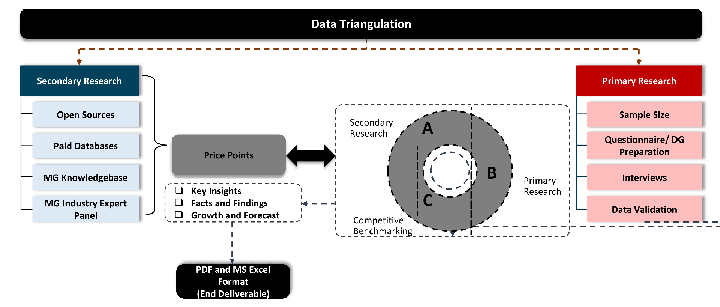
Data triangulation is a validation technique that uses multiple methods, sources, or perspectives to examine the same research question, thereby increasing the credibility and reliability of research findings. In market research, triangulation serves as a quality assurance mechanism that helps identify and minimize bias, validate assumptions, and ensure accuracy in market estimates.
- Data Source Triangulation – Using multiple data sources to examine the same phenomenon
- Methodological Triangulation – Using multiple research methods to study the same research question
- Investigator Triangulation – Using multiple researchers or analysts to examine the same data
- Theoretical Triangulation – Using multiple theoretical perspectives to interpret the same data
Custom Market Research Services
We will customise the research for you, in case the report listed above does not meet your requirements.
Get 10% Free Customisation