Feminine Hygiene Disposal Products Market Size, Share & Trends Analysis Report by Product Type (Sanitary Disposal bins/Units, Sanitary Disposal Bags, Incinerators, Disposal Liners, Pedal-operated Units, Hands-free Automatic Units, Wall-mounted Units, Freestanding Units, Others), Technology/Operation Type, Rated Capacity, Service Model, Design/Mounting Type, Design/Mounting Type, Odor Control Technology, Distribution Channel, End-users, and Geography (North America, Europe, Asia Pacific, Middle East, Africa, and South America) – Global Industry Data, Trends, and Forecasts, 2026–2035
|
|
|
Segmental Data Insights |
|
|
Demand Trends |
|
|
Competitive Landscape |
|
|
Strategic Development |
|
|
Future Outlook & Opportunities |
|
Feminine Hygiene Disposal Products Market Size, Share, and Growth
The global feminine hygiene disposal products market is experiencing robust growth, with its estimated value of USD 2.3 billion in the year 2025 and USD 4.2 billion by the period 2035, registering a CAGR of 6.3%, during the forecast period. The feminine hygiene disposal products market is being saturated by the increasing consumer sentiment of hygiene, safety and environmental sustainability. Females are prioritizing hygienic and conveniently disposing products, which are environmentally friendly, with the demand of high-quality, safe, and purposefully designed items.

Claire Coder, founder and chief estrogen officer at Aunt Flow, said, “Hygienic, responsible disposal of period products goes a long way in deterring facility plumbing nightmares as well as creating a safer environment for janitorial staff and bathroom guests by reducing exposure to blood-borne pathogens. As a company built by menstruators, we know how unsanitary and problematic traditional period product disposal ‘systems’ are for everyone involved, and we are committed to providing a real solution, one stall at a time.
The feminine hygiene disposal products market is reporting a healthy growth due to the changing consumer tastes, technological advancement, and increased awareness on health, wellness and sustainability. People are increasingly preferring products that are a representation of their own values and are focusing on transparency, ethical sourcing, established efficacy and environmental responsibility. For instance, in 2025, Menstrual Hygiene Day is celebrated by Whisper, with the campaign, and campaign name “PeriodFriendlyWorld”, where it holds awareness programs and reaches out to underserved communities about promoting sanitary menstrual hygiene and proper disposal.
Competitors are developing bins, unit, and disposal systems to enhance hygiene, sustainability, and convenience to users. Some of the initiatives involve the introduction of touch-free and odor neutralizing, biodegradable or recyclable materials, environmental certification, and consumer education campaigns to encourage responsible and safe disposal methods.
The adjacent market opportunities are subscription-based disposal services, fitment of smart-washrooms, optimization of disposal units with Internet of Things, and the development of complementary sanitation and personal-care solutions. The avenues enable companies to diversify the revenue streams, customer satisfaction, and integrated hygiene ecosystems that meet the health, convenience, and environmental sustainability requirements.

Feminine Hygiene Disposal Products Market Dynamics and Trends
Driver: Increasing Awareness of Menstrual Hygiene and Sanitation Standards
-
The increasing consciousness of menstrual hygiene and sanitation standards is transforming the feminine hygiene disposal products market by affecting the consumer preferences, brand loyalty and product development. Health, environmental, and quality are rising as a significant concern especially with millennial and Gen Z buyers who prioritize authenticity, transparency, and being true to their own values.
- Market leaders are in turn retaliating by increasing product portfolios, achieving certifications, introducing traceability systems, and expressing corporate values with selected marketing. For instance, in April 2025, the Pinkishe Foundation, in partnership with P&G Whisper initiated Project Kishori in Uttar Pradesh, where they held school-based menstrual-health and hygiene sensitization through street plays and community outreach to destigmatize menstruation and encourage proper hygiene and disposal habits. These programs boost brand credibility, consumer faith and social impact.
- The outcome is continued market growth, particularly in the developed markets since customers are ready to pay the products that provide efficacy, safety, sustainability and social responsibility.
Restraint: Limited Infrastructure in Developing Regions
-
Limited infrastructural coverage in developing areas is a big constraint to the feminine hygiene disposal products market, which has an impact on growth, market penetration, and profitability. The challenges are the lack of awareness, financial limitations, regulatory issues, and insufficient waste-management systems, which altogether limit the growth and increase of the operations.
- The ways that companies are overcoming these barriers are by education, influencer programs, clinical validation, pricing tactics, and diversified channels of distribution. Such challenges do not go away without long term investments, cultural sensitivity and responsiveness to local market dynamics and consumer preferences.
- Premium products have strong brand value and client loyalty, whereas mass market categories demand efficient and inventive marketing techniques to retain competitive standing.
Opportunity: Growth in Biodegradable and Eco-Friendly Solutions
-
The biodegradable and eco-friendly feminine hygienic disposal products represents an important growth opportunity to companies that provide differentiated, sustainable solutions. Proactive suppliers are investing in product innovation, channel enhancement, strategic alliance and capability building to enhance market positioning.
- The main areas of growth opportunities are geographic expansion into new markets, expansion into related products, creation of high-end products, and direct-to-consumer models that can offer custom experience. For instance, in 2023, Niine (India) introduced compostable sanitary pads made of PLA in 2023, the fully biodegradable pads and packaging, which degrades within one year, is aimed at environmental conscious consumers. To seize the opportunity, there must be solid consumer understanding, digital expertise, quick reaction, and constant innovation.
- Partnerships with other brands, technology, medical practitioners and even influencers enhance adoption, minimizes risks of investment and offers expertise. The firms that utilize these kinds of innovations are able to experience the growth that is above competition and build a stronger competitive position.
Key Trend: Development of Odor-Neutralizing and Antimicrobial Technologies
-
The combination of odor eliminating and antimicrobial benefits is transforming product functions, customer demands and competitive forces in the feminine hygiene disposal industry. This trend indicates the convergence of technological innovation, sustainability demands, and consumer needs in the efficiency, safety and environmental responsibility solutions. Technology leadership is being established and competitive advantages being created by early adopters.
- The advantages of companies utilizing this trend have better product performance, consumer satisfaction, better brand differentiation, and better price power in the high-level markets. For instance, PadCare Labs has provided bins capable of holding used sanitary pads to a duration of 30 days without any odor or bacteria growth. The waste collected is then constructed using patented technology which recycles the waste, separating the pulp and plastic which is further manufactured and made into different products including paper, plant pots and paver blocks.
- These advanced capabilities will lead to market transformation that will be sustained, competitive hierarchies will be redefined and new business models will be suggested, including customized solutions and subscriptions.
Feminine-Hygiene-Disposal-Products-Market Analysis and Segmental Data
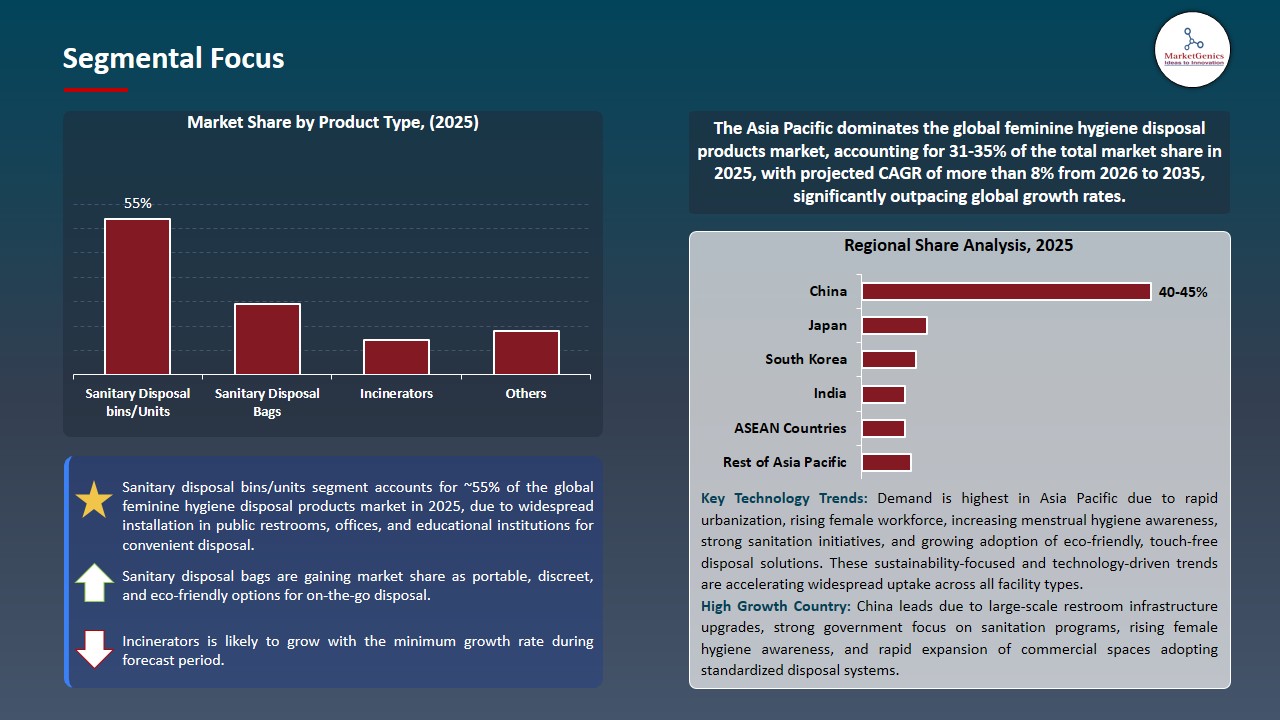
Sanitary Disposal bins/Units Dominate Global Feminine Hygiene Disposal Products Market
-
The sanitary disposal bins/units segment dominates the feminine hygiene disposal products market due to the rising focus on menstrual hygiene, urbanization, and the increasing need to use hygienic and environmentally friendly disposal products. It has good regulatory frameworks, it is widely present in schools, offices, public toilets and hospitality industries and its perceived convenience and safety in the market makes it well adopted even with entry of new business players in the market.
- There are innovations like touch-free units, odor-control, and biodegradable liners which enhance hygiene, user experience and sustainability. For instance, in March 2024, the installation of 25 sanitary disposal bins in the toilets of women on its main building by Pune Municipal Corporation in partnership with the NGO Pad Care; these bins are filled regularly to avoid improper disposal and encourage hygiene.
- The segment offers well-developed supply chains, regulatory adherence, as well as customer knowledge, to assist in the growth to new geographies, premium product ranges, and high-traffic social places.
Asia Pacific Leads Global Feminine Hygiene Disposal Products Market Demand
-
Asia Pacific leads the feminine hygiene disposal products market, which is mainly supported by the increase in menstrual-hygiene awareness, fast urbanization, and the enlargement of modern washrooms in schools, offices, hospitality and open areas. Efforts made by the government to promote sanitary and waste practices and female health education also help in its adoption and the market is also empowered by public-health campaigns, NGO activities and corporate projects to upgrade washrooms that are already in place in the region.
- Significant in Bhutan, there is a push to use a better approach to manage menstrual-waste. For instance, in 2025, Her Royal Highness Princess Eeuphelma Choden Wangchuck, Royal Patron of Red Dot Bhutan, requested all the districts and municipalities to install sanitary pad disposal bins in the public toilets. It was a countrywide program that encompassed 562 schools and 32 nunneries, and offered safe and respectful methods of disposal and encouraging cleaner communities and organized waste disposal activities.
- Occupancy of women in the work force has increased, incomes have increased and the demand to find hygienic and environmentally friendly solutions will only increase the market growth making Asia Pacific the most vibrant regional market in feminine hygiene disposal.
Feminine-Hygiene-Disposal-Products-Market Ecosystem
The feminine hygiene disposals products market is moderately fragmented and the incumbents of the services and specialized hygiene-technology firms also compete in the commercial and institutional marketplaces. Rentokil initial plc, SaniPod Inc., Shredall SDS Group, Hagleitner Hygiene International GmbH, and Mediclinics SA are the major market participants that reinforce themselves with the help of integrated washroom-hygiene solution, proprietary dispensing technologies, and service-based business models.
The high-volume operators such as Rentokil Initial enjoy large service networks, facility-management and long-term client contracts and the innovators such as SaniPod and Hagleitner feature touch-free systems, digital monitoring and design-led sanitary disposal units. The value chain is broader and it includes hygiene-system manufacturers, waste-management partners, commercial distribution channels, and hygiene-system suppliers.
The main trends of the major companies are the growth of vertical integration, the deepening of direct relations with customers, and the development of digital service platforms to enhance the efficiency of operations and customer retention. The change allows tracking of the performance in real time, customized hygiene programs, and sustained innovation in accordance with the changing needs of hygiene, sustainability, and compliance.
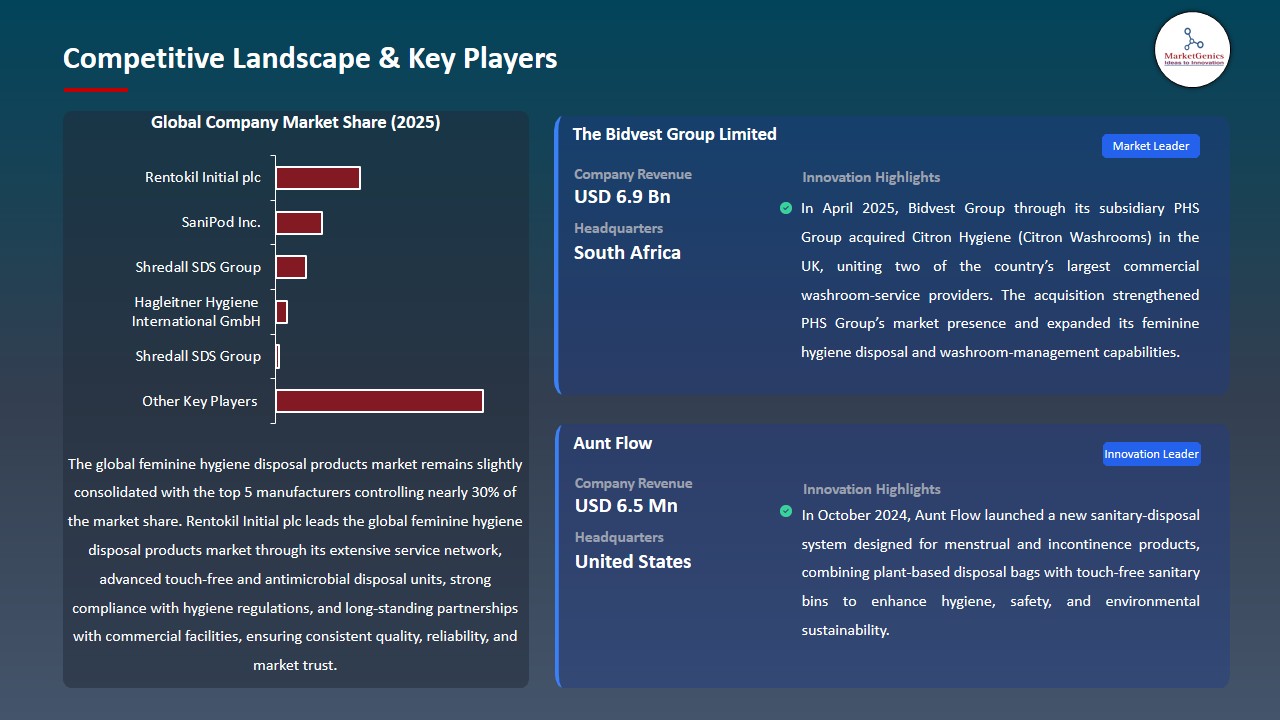
Recent Development and Strategic Overview
-
In April 2025, Bidvest Group has purchased Citron Hygiene (Citron Washrooms) in the UK, combining two of the largest suppliers of commercial washroom-services in the country. The purchase enhanced the market position of PHS Group and increased its market reach in regards to feminine hygiene disposal and washroom-management.
- In October 2024, Aunt Flow introduced a new sanitary-disposal system with disposal bags that were plant-based and had touch-free sanitary bins to boost hygiene, safety, and environmentally sustainability.
Report Scope
|
Detail |
|
|
Market Size in 2025 |
USD 2.3 Bn |
|
Market Forecast Value in 2035 |
USD 4.2 Bn |
|
Growth Rate (CAGR) |
6.3% |
|
Forecast Period |
2026 – 2035 |
|
Historical Data Available for |
2021 – 2024 |
|
Market Size Units |
US$ Billion for Value |
|
Report Format |
Electronic (PDF) + Excel |
|
North America |
Europe |
Asia Pacific |
Middle East |
Africa |
South America |
|
|
|
|
|
|
|
Companies Covered |
|||||
|
|
|
|
|
|
Feminine-Hygiene-Disposal-Products-Market Segmentation and Highlights
|
Segment |
Sub-segment |
|
Feminine Hygiene Disposal Products Market, By Product Type |
|
|
Feminine Hygiene Disposal Products Market, By Technology/Operation Type |
|
|
Feminine Hygiene Disposal Products Market, By Rated Capacity |
|
|
Feminine Hygiene Disposal Products Market, By Service Model |
|
|
Feminine Hygiene Disposal Products Market, By Design/Mounting Type |
|
|
Feminine Hygiene Disposal Products Market, By Odor Control Technology |
|
|
Feminine Hygiene Disposal Products Market, By Distribution Channel |
|
|
Feminine Hygiene Disposal Products Market, By End-users |
|
Frequently Asked Questions
Table of Contents
- 1. Research Methodology and Assumptions
- 1.1. Definitions
- 1.2. Research Design and Approach
- 1.3. Data Collection Methods
- 1.4. Base Estimates and Calculations
- 1.5. Forecasting Models
- 1.5.1. Key Forecast Factors & Impact Analysis
- 1.6. Secondary Research
- 1.6.1. Open Sources
- 1.6.2. Paid Databases
- 1.6.3. Associations
- 1.7. Primary Research
- 1.7.1. Primary Sources
- 1.7.2. Primary Interviews with Stakeholders across Ecosystem
- 2. Executive Summary
- 2.1. Global Feminine Hygiene Disposal Products Market Outlook
- 2.1.1. Feminine Hygiene Disposal Products Market Size (Value - US$ Bn), and Forecasts, 2021-2035
- 2.1.2. Compounded Annual Growth Rate Analysis
- 2.1.3. Growth Opportunity Analysis
- 2.1.4. Segmental Share Analysis
- 2.1.5. Geographical Share Analysis
- 2.2. Market Analysis and Facts
- 2.3. Supply-Demand Analysis
- 2.4. Competitive Benchmarking
- 2.5. Go-to- Market Strategy
- 2.5.1. Customer/ End-use Industry Assessment
- 2.5.2. Growth Opportunity Data, 2026-2035
- 2.5.2.1. Regional Data
- 2.5.2.2. Country Data
- 2.5.2.3. Segmental Data
- 2.5.3. Identification of Potential Market Spaces
- 2.5.4. GAP Analysis
- 2.5.5. Potential Attractive Price Points
- 2.5.6. Prevailing Market Risks & Challenges
- 2.5.7. Preferred Sales & Marketing Strategies
- 2.5.8. Key Recommendations and Analysis
- 2.5.9. A Way Forward
- 2.1. Global Feminine Hygiene Disposal Products Market Outlook
- 3. Industry Data and Premium Insights
- 3.1. Global Consumer Goods & Services Industry Overview, 2025
- 3.1.1. Consumer Goods & Services Industry Ecosystem Analysis
- 3.1.2. Key Trends for Consumer Goods & Services Industry
- 3.1.3. Regional Distribution for Consumer Goods & Services Industry
- 3.2. Supplier Customer Data
- 3.3. Technology Roadmap and Developments
- 3.4. Trade Analysis
- 3.4.1. Import & Export Analysis, 2025
- 3.4.2. Top Importing Countries
- 3.4.3. Top Exporting Countries
- 3.5. Trump Tariff Impact Analysis
- 3.5.1. Manufacturer
- 3.5.1.1. Based on the component & Raw material
- 3.5.2. Supply Chain
- 3.5.3. End Consumer
- 3.5.1. Manufacturer
- 3.6. Raw Material Analysis
- 3.1. Global Consumer Goods & Services Industry Overview, 2025
- 4. Market Overview
- 4.1. Market Dynamics
- 4.1.1. Drivers
- 4.1.1.1. Growing awareness of menstrual health and hygiene.
- 4.1.1.2. Rising disposable incomes and urbanization.
- 4.1.1.3. Product innovation, especially eco‑friendly and biodegradable feminine hygiene products.
- 4.1.2. Restraints
- 4.1.2.1. Social stigma and cultural taboos around menstruation.
- 4.1.2.2. High cost of premium or sustainable products and limited affordability in developing regions.
- 4.1.1. Drivers
- 4.2. Key Trend Analysis
- 4.3. Regulatory Framework
- 4.3.1. Key Regulations, Norms, and Subsidies, by Key Countries
- 4.3.2. Tariffs and Standards
- 4.3.3. Impact Analysis of Regulations on the Market
- 4.4. Pricing Analysis
- 4.4.1. Regional Pricing Analysis
- 4.4.2. Segmental Pricing Trends
- 4.4.3. Factors Influencing Pricing
- 4.5. Porter’s Five Forces Analysis
- 4.6. PESTEL Analysis
- 4.7. Global Feminine Hygiene Disposal Products Market Demand
- 4.7.1. Historical Market Size – Value (US$ Bn), 2020-2024
- 4.7.2. Current and Future Market Size – Value (US$ Bn), 2026–2035
- 4.7.2.1. Y-o-Y Growth Trends
- 4.7.2.2. Absolute $ Opportunity Assessment
- 4.1. Market Dynamics
- 5. Competition Landscape
- 5.1. Competition structure
- 5.1.1. Fragmented v/s consolidated
- 5.2. Company Share Analysis, 2025
- 5.2.1. Global Company Market Share
- 5.2.2. By Region
- 5.2.2.1. North America
- 5.2.2.2. Europe
- 5.2.2.3. Asia Pacific
- 5.2.2.4. Middle East
- 5.2.2.5. Africa
- 5.2.2.6. South America
- 5.3. Product Comparison Matrix
- 5.3.1. Specifications
- 5.3.2. Market Positioning
- 5.3.3. Pricing
- 5.1. Competition structure
- 6. Global Feminine Hygiene Disposal Products Market Analysis, by Product Type
- 6.1. Key Segment Analysis
- 6.2. Feminine Hygiene Disposal Products Market Size (Value - US$ Bn), Analysis, and Forecasts, by Product Type, 2021-2035
- 6.2.1. Sanitary Disposal bins/Units
- 6.2.2. Sanitary Disposal Bags
- 6.2.3. Incinerators
- 6.2.4. Disposal Liners
- 6.2.5. Pedal-operated Units
- 6.2.6. Hands-free Automatic Units
- 6.2.7. Wall-mounted Units
- 6.2.8. Freestanding Units
- 6.2.9. Others
- 7. Global Feminine Hygiene Disposal Products Market Analysis, by Technology/Operation Type
- 7.1. Key Segment Analysis
- 7.2. Feminine Hygiene Disposal Products Market Size (Value - US$ Bn), Analysis, and Forecasts, by Technology/Operation Type, 2021-2035
- 7.2.1. Manual disposal Units
- 7.2.2. Pedal-operated systems
- 7.2.3. Sensor-based automatic Units
- 7.2.4. Smart IoT-enabled Units
- 7.2.5. Others
- 8. Global Feminine Hygiene Disposal Products Market Analysis, by Rated Capacity
- 8.1. Key Segment Analysis
- 8.2. Feminine Hygiene Disposal Products Market Size (Value - US$ Bn), Analysis, and Forecasts, by Rated Capacity, 2021-2035
- 8.2.1. Small Capacity (up to 10 liters)
- 8.2.2. Medium Capacity (10-20 liters)
- 8.2.3. Large Capacity (20-40 liters)
- 8.2.4. Extra-large Capacity (above 40 liters)
- 9. Global Feminine Hygiene Disposal Products Market Analysis, by Service Model
- 9.1. Key Segment Analysis
- 9.2. Feminine Hygiene Disposal Products Market Size (Value - US$ Bn), Analysis, and Forecasts, by Service Model, 2021-2035
- 9.2.1. Purchase/ownership model
- 9.2.2. Rental/leasing services
- 9.2.3. Service contracts with disposal
- 9.2.4. Maintenance-inclusive models
- 9.2.5. Waste collection subscription services
- 10. Global Feminine Hygiene Disposal Products Market Analysis, by Design/Mounting Type
- 10.1. Key Segment Analysis
- 10.2. Feminine Hygiene Disposal Products Market Size (Value - US$ Bn), Analysis, and Forecasts, by Design/Mounting Type, 2021-2035
- 10.2.1. Wall-mounted units
- 10.2.2. Floor-standing units
- 10.2.3. Under-counter units
- 10.2.4. Recessed/built-in units
- 10.2.5. Portable/mobile units
- 10.2.6. Counter-top units
- 11. Global Feminine Hygiene Disposal Products Market Analysis, by Odor Control Technology
- 11.1. Key Segment Analysis
- 11.2. Feminine Hygiene Disposal Products Market Size (Value - US$ Bn), Analysis, and Forecasts, by Odor Control Technology, 2021-2035
- 11.2.1. Carbon filter systems
- 11.2.2. Fragrance dispenser integrated
- 11.2.3. Sealed/airtight design
- 11.2.4. Antimicrobial treatment
- 11.2.5. UV sterilization
- 11.2.6. No odor control (basic units)
- 12. Global Feminine Hygiene Disposal Products Market Analysis, by Distribution Channel
- 12.1. Key Segment Analysis
- 12.2. Feminine Hygiene Disposal Products Market Size (Value - US$ Bn), Analysis, and Forecasts, by Distribution Channel, 2021-2035
- 12.2.1. Direct sales
- 12.2.2. Distributors/wholesalers
- 12.2.3. Online retail platforms
- 12.2.4. Facility management companies
- 12.2.5. Hygiene service providers
- 13. Global Feminine Hygiene Disposal Products Market Analysis, by End-users
- 13.1. Key Segment Analysis
- 13.2. Feminine Hygiene Disposal Products Market Size (Value - US$ Bn), Analysis, and Forecasts, by End-users, 2021-2035
- 13.2.1. Corporate/Commercial Offices
- 13.2.1.1. Employee restrooms
- 13.2.1.2. Visitor facilities
- 13.2.1.3. Executive washrooms
- 13.2.1.4. Common area facilities
- 13.2.1.5. Others
- 13.2.2. Healthcare Facilities
- 13.2.2.1. Hospital restrooms
- 13.2.2.2. Clinic washrooms
- 13.2.2.3. Patient rooms
- 13.2.2.4. Staff facilities
- 13.2.2.5. Outpatient departments
- 13.2.2.6. Others
- 13.2.3. Educational Institutions
- 13.2.3.1. School restrooms
- 13.2.3.2. University facilities
- 13.2.3.3. Dormitory bathrooms
- 13.2.3.4. Faculty washrooms
- 13.2.3.5. Sports facility restrooms
- 13.2.3.6. Others
- 13.2.4. Residential
- 13.2.4.1. Multi-family apartments
- 13.2.4.2. Condominiums
- 13.2.4.3. Housing societies
- 13.2.4.4. Residential care homes
- 13.2.4.5. Others
- 13.2.5. Hospitality & Recreation
- 13.2.6. Retail & Shopping Centers
- 13.2.7. Transportation Hubs
- 13.2.8. Industrial & Manufacturing
- 13.2.9. Government & Public Buildings
- 13.2.10. Other End-users
- 13.2.1. Corporate/Commercial Offices
- 14. Global Feminine Hygiene Disposal Products Market Analysis and Forecasts, by Region
- 14.1. Key Findings
- 14.2. Feminine Hygiene Disposal Products Market Size (Value - US$ Bn), Analysis, and Forecasts, by Region, 2021-2035
- 14.2.1. North America
- 14.2.2. Europe
- 14.2.3. Asia Pacific
- 14.2.4. Middle East
- 14.2.5. Africa
- 14.2.6. South America
- 15. North America Feminine Hygiene Disposal Products Market Analysis
- 15.1. Key Segment Analysis
- 15.2. Regional Snapshot
- 15.3. North America Feminine Hygiene Disposal Products Market Size (Value - US$ Bn), Analysis, and Forecasts, 2021-2035
- 15.3.1. Product Type
- 15.3.2. Technology/Operation Type
- 15.3.3. Rated Capacity
- 15.3.4. Service Model
- 15.3.5. Design/Mounting Type
- 15.3.6. Odor Control Technology
- 15.3.7. Distribution Channel
- 15.3.8. End-users
- 15.3.9. Country
- 15.3.9.1. USA
- 15.3.9.2. Canada
- 15.3.9.3. Mexico
- 15.4. USA Feminine Hygiene Disposal Products Market
- 15.4.1. Country Segmental Analysis
- 15.4.2. Product Type
- 15.4.3. Technology/Operation Type
- 15.4.4. Rated Capacity
- 15.4.5. Service Model
- 15.4.6. Design/Mounting Type
- 15.4.7. Odor Control Technology
- 15.4.8. Distribution Channel
- 15.4.9. End-users
- 15.5. Canada Feminine Hygiene Disposal Products Market
- 15.5.1. Country Segmental Analysis
- 15.5.2. Product Type
- 15.5.3. Technology/Operation Type
- 15.5.4. Rated Capacity
- 15.5.5. Service Model
- 15.5.6. Design/Mounting Type
- 15.5.7. Odor Control Technology
- 15.5.8. Distribution Channel
- 15.5.9. End-users
- 15.6. Mexico Feminine Hygiene Disposal Products Market
- 15.6.1. Country Segmental Analysis
- 15.6.2. Product Type
- 15.6.3. Technology/Operation Type
- 15.6.4. Rated Capacity
- 15.6.5. Service Model
- 15.6.6. Design/Mounting Type
- 15.6.7. Odor Control Technology
- 15.6.8. Distribution Channel
- 15.6.9. End-users
- 16. Europe Feminine Hygiene Disposal Products Market Analysis
- 16.1. Key Segment Analysis
- 16.2. Regional Snapshot
- 16.3. Europe Feminine Hygiene Disposal Products Market Size (Value - US$ Bn), Analysis, and Forecasts, 2021-2035
- 16.3.1. Product Type
- 16.3.2. Technology/Operation Type
- 16.3.3. Rated Capacity
- 16.3.4. Service Model
- 16.3.5. Design/Mounting Type
- 16.3.6. Odor Control Technology
- 16.3.7. Distribution Channel
- 16.3.8. End-users
- 16.3.9. Country
- 16.3.9.1. Germany
- 16.3.9.2. United Kingdom
- 16.3.9.3. France
- 16.3.9.4. Italy
- 16.3.9.5. Spain
- 16.3.9.6. Netherlands
- 16.3.9.7. Nordic Countries
- 16.3.9.8. Poland
- 16.3.9.9. Russia & CIS
- 16.3.9.10. Rest of Europe
- 16.4. Germany Feminine Hygiene Disposal Products Market
- 16.4.1. Country Segmental Analysis
- 16.4.2. Product Type
- 16.4.3. Technology/Operation Type
- 16.4.4. Rated Capacity
- 16.4.5. Service Model
- 16.4.6. Design/Mounting Type
- 16.4.7. Odor Control Technology
- 16.4.8. Distribution Channel
- 16.4.9. End-users
- 16.5. United Kingdom Feminine Hygiene Disposal Products Market
- 16.5.1. Country Segmental Analysis
- 16.5.2. Product Type
- 16.5.3. Technology/Operation Type
- 16.5.4. Rated Capacity
- 16.5.5. Service Model
- 16.5.6. Design/Mounting Type
- 16.5.7. Odor Control Technology
- 16.5.8. Distribution Channel
- 16.5.9. End-users
- 16.6. France Feminine Hygiene Disposal Products Market
- 16.6.1. Country Segmental Analysis
- 16.6.2. Product Type
- 16.6.3. Technology/Operation Type
- 16.6.4. Rated Capacity
- 16.6.5. Service Model
- 16.6.6. Design/Mounting Type
- 16.6.7. Odor Control Technology
- 16.6.8. Distribution Channel
- 16.6.9. End-users
- 16.7. Italy Feminine Hygiene Disposal Products Market
- 16.7.1. Country Segmental Analysis
- 16.7.2. Product Type
- 16.7.3. Technology/Operation Type
- 16.7.4. Rated Capacity
- 16.7.5. Service Model
- 16.7.6. Design/Mounting Type
- 16.7.7. Odor Control Technology
- 16.7.8. Distribution Channel
- 16.7.9. End-users
- 16.8. Spain Feminine Hygiene Disposal Products Market
- 16.8.1. Country Segmental Analysis
- 16.8.2. Product Type
- 16.8.3. Technology/Operation Type
- 16.8.4. Rated Capacity
- 16.8.5. Service Model
- 16.8.6. Design/Mounting Type
- 16.8.7. Odor Control Technology
- 16.8.8. Distribution Channel
- 16.8.9. End-users
- 16.9. Netherlands Feminine Hygiene Disposal Products Market
- 16.9.1. Country Segmental Analysis
- 16.9.2. Product Type
- 16.9.3. Technology/Operation Type
- 16.9.4. Rated Capacity
- 16.9.5. Service Model
- 16.9.6. Design/Mounting Type
- 16.9.7. Odor Control Technology
- 16.9.8. Distribution Channel
- 16.9.9. End-users
- 16.10. Nordic Countries Feminine Hygiene Disposal Products Market
- 16.10.1. Country Segmental Analysis
- 16.10.2. Product Type
- 16.10.3. Technology/Operation Type
- 16.10.4. Rated Capacity
- 16.10.5. Service Model
- 16.10.6. Design/Mounting Type
- 16.10.7. Odor Control Technology
- 16.10.8. Distribution Channel
- 16.10.9. End-users
- 16.11. Poland Feminine Hygiene Disposal Products Market
- 16.11.1. Country Segmental Analysis
- 16.11.2. Product Type
- 16.11.3. Technology/Operation Type
- 16.11.4. Rated Capacity
- 16.11.5. Service Model
- 16.11.6. Design/Mounting Type
- 16.11.7. Odor Control Technology
- 16.11.8. Distribution Channel
- 16.11.9. End-users
- 16.12. Russia & CIS Feminine Hygiene Disposal Products Market
- 16.12.1. Country Segmental Analysis
- 16.12.2. Product Type
- 16.12.3. Technology/Operation Type
- 16.12.4. Rated Capacity
- 16.12.5. Service Model
- 16.12.6. Design/Mounting Type
- 16.12.7. Odor Control Technology
- 16.12.8. Distribution Channel
- 16.12.9. End-users
- 16.13. Rest of Europe Feminine Hygiene Disposal Products Market
- 16.13.1. Country Segmental Analysis
- 16.13.2. Product Type
- 16.13.3. Technology/Operation Type
- 16.13.4. Rated Capacity
- 16.13.5. Service Model
- 16.13.6. Design/Mounting Type
- 16.13.7. Odor Control Technology
- 16.13.8. Distribution Channel
- 16.13.9. End-users
- 17. Asia Pacific Feminine Hygiene Disposal Products Market Analysis
- 17.1. Key Segment Analysis
- 17.2. Regional Snapshot
- 17.3. Asia Pacific Feminine Hygiene Disposal Products Market Size (Value - US$ Bn), Analysis, and Forecasts, 2021-2035
- 17.3.1. Product Type
- 17.3.2. Technology/Operation Type
- 17.3.3. Rated Capacity
- 17.3.4. Service Model
- 17.3.5. Design/Mounting Type
- 17.3.6. Odor Control Technology
- 17.3.7. Distribution Channel
- 17.3.8. End-users
- 17.3.9. Country
- 17.3.9.1. China
- 17.3.9.2. India
- 17.3.9.3. Japan
- 17.3.9.4. South Korea
- 17.3.9.5. Australia and New Zealand
- 17.3.9.6. Indonesia
- 17.3.9.7. Malaysia
- 17.3.9.8. Thailand
- 17.3.9.9. Vietnam
- 17.3.9.10. Rest of Asia Pacific
- 17.4. China Feminine Hygiene Disposal Products Market
- 17.4.1. Country Segmental Analysis
- 17.4.2. Product Type
- 17.4.3. Technology/Operation Type
- 17.4.4. Rated Capacity
- 17.4.5. Service Model
- 17.4.6. Design/Mounting Type
- 17.4.7. Odor Control Technology
- 17.4.8. Distribution Channel
- 17.4.9. End-users
- 17.5. India Feminine Hygiene Disposal Products Market
- 17.5.1. Country Segmental Analysis
- 17.5.2. Product Type
- 17.5.3. Technology/Operation Type
- 17.5.4. Rated Capacity
- 17.5.5. Service Model
- 17.5.6. Design/Mounting Type
- 17.5.7. Odor Control Technology
- 17.5.8. Distribution Channel
- 17.5.9. End-users
- 17.6. Japan Feminine Hygiene Disposal Products Market
- 17.6.1. Country Segmental Analysis
- 17.6.2. Product Type
- 17.6.3. Technology/Operation Type
- 17.6.4. Rated Capacity
- 17.6.5. Service Model
- 17.6.6. Design/Mounting Type
- 17.6.7. Odor Control Technology
- 17.6.8. Distribution Channel
- 17.6.9. End-users
- 17.7. South Korea Feminine Hygiene Disposal Products Market
- 17.7.1. Country Segmental Analysis
- 17.7.2. Product Type
- 17.7.3. Technology/Operation Type
- 17.7.4. Rated Capacity
- 17.7.5. Service Model
- 17.7.6. Design/Mounting Type
- 17.7.7. Odor Control Technology
- 17.7.8. Distribution Channel
- 17.7.9. End-users
- 17.8. Australia and New Zealand Feminine Hygiene Disposal Products Market
- 17.8.1. Country Segmental Analysis
- 17.8.2. Product Type
- 17.8.3. Technology/Operation Type
- 17.8.4. Rated Capacity
- 17.8.5. Service Model
- 17.8.6. Design/Mounting Type
- 17.8.7. Odor Control Technology
- 17.8.8. Distribution Channel
- 17.8.9. End-users
- 17.9. Indonesia Feminine Hygiene Disposal Products Market
- 17.9.1. Country Segmental Analysis
- 17.9.2. Product Type
- 17.9.3. Technology/Operation Type
- 17.9.4. Rated Capacity
- 17.9.5. Service Model
- 17.9.6. Design/Mounting Type
- 17.9.7. Odor Control Technology
- 17.9.8. Distribution Channel
- 17.9.9. End-users
- 17.10. Malaysia Feminine Hygiene Disposal Products Market
- 17.10.1. Country Segmental Analysis
- 17.10.2. Product Type
- 17.10.3. Technology/Operation Type
- 17.10.4. Rated Capacity
- 17.10.5. Service Model
- 17.10.6. Design/Mounting Type
- 17.10.7. Odor Control Technology
- 17.10.8. Distribution Channel
- 17.10.9. End-users
- 17.11. Thailand Feminine Hygiene Disposal Products Market
- 17.11.1. Country Segmental Analysis
- 17.11.2. Product Type
- 17.11.3. Technology/Operation Type
- 17.11.4. Rated Capacity
- 17.11.5. Service Model
- 17.11.6. Design/Mounting Type
- 17.11.7. Odor Control Technology
- 17.11.8. Distribution Channel
- 17.11.9. End-users
- 17.12. Vietnam Feminine Hygiene Disposal Products Market
- 17.12.1. Country Segmental Analysis
- 17.12.2. Product Type
- 17.12.3. Technology/Operation Type
- 17.12.4. Rated Capacity
- 17.12.5. Service Model
- 17.12.6. Design/Mounting Type
- 17.12.7. Odor Control Technology
- 17.12.8. Distribution Channel
- 17.12.9. End-users
- 17.13. Rest of Asia Pacific Feminine Hygiene Disposal Products Market
- 17.13.1. Country Segmental Analysis
- 17.13.2. Product Type
- 17.13.3. Technology/Operation Type
- 17.13.4. Rated Capacity
- 17.13.5. Service Model
- 17.13.6. Design/Mounting Type
- 17.13.7. Odor Control Technology
- 17.13.8. Distribution Channel
- 17.13.9. End-users
- 18. Middle East Feminine Hygiene Disposal Products Market Analysis
- 18.1. Key Segment Analysis
- 18.2. Regional Snapshot
- 18.3. Middle East Feminine Hygiene Disposal Products Market Size (Value - US$ Bn), Analysis, and Forecasts, 2021-2035
- 18.3.1. Product Type
- 18.3.2. Technology/Operation Type
- 18.3.3. Rated Capacity
- 18.3.4. Service Model
- 18.3.5. Design/Mounting Type
- 18.3.6. Odor Control Technology
- 18.3.7. Distribution Channel
- 18.3.8. End-users
- 18.3.9. Country
- 18.3.9.1. Turkey
- 18.3.9.2. UAE
- 18.3.9.3. Saudi Arabia
- 18.3.9.4. Israel
- 18.3.9.5. Rest of Middle East
- 18.4. Turkey Feminine Hygiene Disposal Products Market
- 18.4.1. Country Segmental Analysis
- 18.4.2. Product Type
- 18.4.3. Technology/Operation Type
- 18.4.4. Rated Capacity
- 18.4.5. Service Model
- 18.4.6. Design/Mounting Type
- 18.4.7. Odor Control Technology
- 18.4.8. Distribution Channel
- 18.4.9. End-users
- 18.5. UAE Feminine Hygiene Disposal Products Market
- 18.5.1. Country Segmental Analysis
- 18.5.2. Product Type
- 18.5.3. Technology/Operation Type
- 18.5.4. Rated Capacity
- 18.5.5. Service Model
- 18.5.6. Design/Mounting Type
- 18.5.7. Odor Control Technology
- 18.5.8. Distribution Channel
- 18.5.9. End-users
- 18.6. Saudi Arabia Feminine Hygiene Disposal Products Market
- 18.6.1. Country Segmental Analysis
- 18.6.2. Product Type
- 18.6.3. Technology/Operation Type
- 18.6.4. Rated Capacity
- 18.6.5. Service Model
- 18.6.6. Design/Mounting Type
- 18.6.7. Odor Control Technology
- 18.6.8. Distribution Channel
- 18.6.9. End-users
- 18.7. Israel Feminine Hygiene Disposal Products Market
- 18.7.1. Country Segmental Analysis
- 18.7.2. Product Type
- 18.7.3. Technology/Operation Type
- 18.7.4. Rated Capacity
- 18.7.5. Service Model
- 18.7.6. Design/Mounting Type
- 18.7.7. Odor Control Technology
- 18.7.8. Distribution Channel
- 18.7.9. End-users
- 18.8. Rest of Middle East Feminine Hygiene Disposal Products Market
- 18.8.1. Country Segmental Analysis
- 18.8.2. Product Type
- 18.8.3. Technology/Operation Type
- 18.8.4. Rated Capacity
- 18.8.5. Service Model
- 18.8.6. Design/Mounting Type
- 18.8.7. Odor Control Technology
- 18.8.8. Distribution Channel
- 18.8.9. End-users
- 19. Africa Feminine Hygiene Disposal Products Market Analysis
- 19.1. Key Segment Analysis
- 19.2. Regional Snapshot
- 19.3. Africa Feminine Hygiene Disposal Products Market Size (Value - US$ Bn), Analysis, and Forecasts, 2021-2035
- 19.3.1. Product Type
- 19.3.2. Technology/Operation Type
- 19.3.3. Rated Capacity
- 19.3.4. Service Model
- 19.3.5. Design/Mounting Type
- 19.3.6. Odor Control Technology
- 19.3.7. Distribution Channel
- 19.3.8. End-users
- 19.3.9. Country
- 19.3.9.1. South Africa
- 19.3.9.2. Egypt
- 19.3.9.3. Nigeria
- 19.3.9.4. Algeria
- 19.3.9.5. Rest of Africa
- 19.4. South Africa Feminine Hygiene Disposal Products Market
- 19.4.1. Country Segmental Analysis
- 19.4.2. Product Type
- 19.4.3. Technology/Operation Type
- 19.4.4. Rated Capacity
- 19.4.5. Service Model
- 19.4.6. Design/Mounting Type
- 19.4.7. Odor Control Technology
- 19.4.8. Distribution Channel
- 19.4.9. End-users
- 19.5. Egypt Feminine Hygiene Disposal Products Market
- 19.5.1. Country Segmental Analysis
- 19.5.2. Product Type
- 19.5.3. Technology/Operation Type
- 19.5.4. Rated Capacity
- 19.5.5. Service Model
- 19.5.6. Design/Mounting Type
- 19.5.7. Odor Control Technology
- 19.5.8. Distribution Channel
- 19.5.9. End-users
- 19.6. Nigeria Feminine Hygiene Disposal Products Market
- 19.6.1. Country Segmental Analysis
- 19.6.2. Product Type
- 19.6.3. Technology/Operation Type
- 19.6.4. Rated Capacity
- 19.6.5. Service Model
- 19.6.6. Design/Mounting Type
- 19.6.7. Odor Control Technology
- 19.6.8. Distribution Channel
- 19.6.9. End-users
- 19.7. Algeria Feminine Hygiene Disposal Products Market
- 19.7.1. Country Segmental Analysis
- 19.7.2. Product Type
- 19.7.3. Technology/Operation Type
- 19.7.4. Rated Capacity
- 19.7.5. Service Model
- 19.7.6. Design/Mounting Type
- 19.7.7. Odor Control Technology
- 19.7.8. Distribution Channel
- 19.7.9. End-users
- 19.8. Rest of Africa Feminine Hygiene Disposal Products Market
- 19.8.1. Country Segmental Analysis
- 19.8.2. Product Type
- 19.8.3. Technology/Operation Type
- 19.8.4. Rated Capacity
- 19.8.5. Service Model
- 19.8.6. Design/Mounting Type
- 19.8.7. Odor Control Technology
- 19.8.8. Distribution Channel
- 19.8.9. End-users
- 20. South America Feminine Hygiene Disposal Products Market Analysis
- 20.1. Key Segment Analysis
- 20.2. Regional Snapshot
- 20.3. South America Feminine Hygiene Disposal Products Market Size (Value - US$ Bn), Analysis, and Forecasts, 2021-2035
- 20.3.1. Product Type
- 20.3.2. Technology/Operation Type
- 20.3.3. Rated Capacity
- 20.3.4. Service Model
- 20.3.5. Design/Mounting Type
- 20.3.6. Odor Control Technology
- 20.3.7. Distribution Channel
- 20.3.8. End-users
- 20.3.9. Country
- 20.3.9.1. Brazil
- 20.3.9.2. Argentina
- 20.3.9.3. Rest of South America
- 20.4. Brazil Feminine Hygiene Disposal Products Market
- 20.4.1. Country Segmental Analysis
- 20.4.2. Product Type
- 20.4.3. Technology/Operation Type
- 20.4.4. Rated Capacity
- 20.4.5. Service Model
- 20.4.6. Design/Mounting Type
- 20.4.7. Odor Control Technology
- 20.4.8. Distribution Channel
- 20.4.9. End-users
- 20.5. Argentina Feminine Hygiene Disposal Products Market
- 20.5.1. Country Segmental Analysis
- 20.5.2. Product Type
- 20.5.3. Technology/Operation Type
- 20.5.4. Rated Capacity
- 20.5.5. Service Model
- 20.5.6. Design/Mounting Type
- 20.5.7. Odor Control Technology
- 20.5.8. Distribution Channel
- 20.5.9. End-users
- 20.6. Rest of South America Feminine Hygiene Disposal Products Market
- 20.6.1. Country Segmental Analysis
- 20.6.2. Product Type
- 20.6.3. Technology/Operation Type
- 20.6.4. Rated Capacity
- 20.6.5. Service Model
- 20.6.6. Design/Mounting Type
- 20.6.7. Odor Control Technology
- 20.6.8. Distribution Channel
- 20.6.9. End-users
- 21. Key Players/ Company Profile
- 21.1. A&R Cleaners
- 21.1.1. Company Details/ Overview
- 21.1.2. Company Financials
- 21.1.3. Key Customers and Competitors
- 21.1.4. Business/ Industry Portfolio
- 21.1.5. Product Portfolio/ Specification Details
- 21.1.6. Pricing Data
- 21.1.7. Strategic Overview
- 21.1.8. Recent Developments
- 21.2. Alsco Inc.
- 21.3. Brightwell Dispensers
- 21.4. Cannon Hygiene
- 21.5. Citron Hygiene
- 21.6. Clean Cube
- 21.7. Cleanline Services
- 21.8. Complete Hygiene Supplies
- 21.9. Elis SA
- 21.10. Enviro-Rental Services
- 21.11. Feminine Hygiene Services
- 21.12. Hagleitner Hygiene International GmbH
- 21.13. Hygiene Concepts
- 21.14. Hygiene Services Group
- 21.15. Initial Hygiene
- 21.16. Mediclinics SA
- 21.17. PB Health Ltd
- 21.18. PHS Group
- 21.19. Rentokil Initial plc
- 21.20. SaniPod Inc.
- 21.21. Sanokil
- 21.22. Shredall SDS Group
- 21.23. Other Key Players
- 21.1. A&R Cleaners
Note* - This is just tentative list of players. While providing the report, we will cover more number of players based on their revenue and share for each geography
Research Design
Our research design integrates both demand-side and supply-side analysis through a balanced combination of primary and secondary research methodologies. By utilizing both bottom-up and top-down approaches alongside rigorous data triangulation methods, we deliver robust market intelligence that supports strategic decision-making.
MarketGenics' comprehensive research design framework ensures the delivery of accurate, reliable, and actionable market intelligence. Through the integration of multiple research approaches, rigorous validation processes, and expert analysis, we provide our clients with the insights needed to make informed strategic decisions and capitalize on market opportunities.
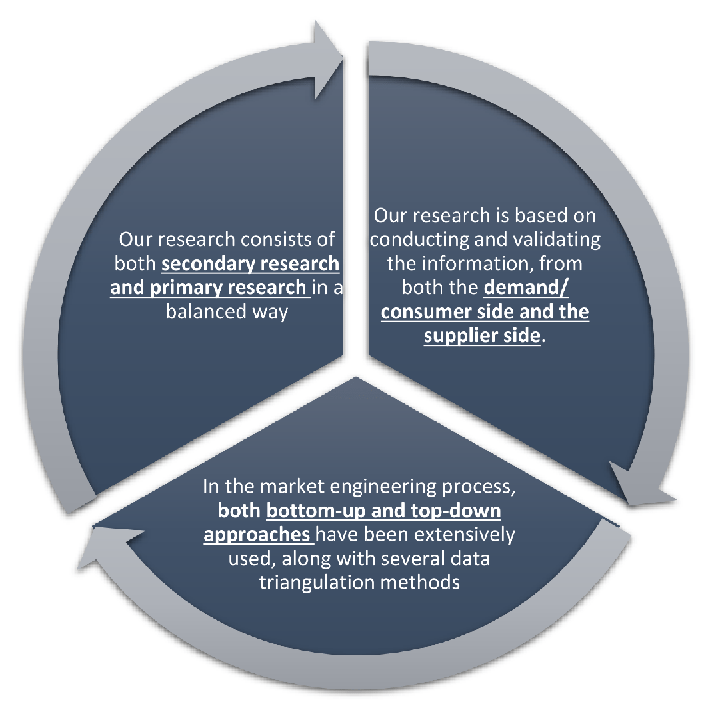
MarketGenics leverages a dedicated industry panel of experts and a comprehensive suite of paid databases to effectively collect, consolidate, and analyze market intelligence.
Our approach has consistently proven to be reliable and effective in generating accurate market insights, identifying key industry trends, and uncovering emerging business opportunities.
Through both primary and secondary research, we capture and analyze critical company-level data such as manufacturing footprints, including technical centers, R&D facilities, sales offices, and headquarters.
Our expert panel further enhances our ability to estimate market size for specific brands based on validated field-level intelligence.
Our data mining techniques incorporate both parametric and non-parametric methods, allowing for structured data collection, sorting, processing, and cleaning.
Demand projections are derived from large-scale data sets analyzed through proprietary algorithms, culminating in robust and reliable market sizing.
Research Approach
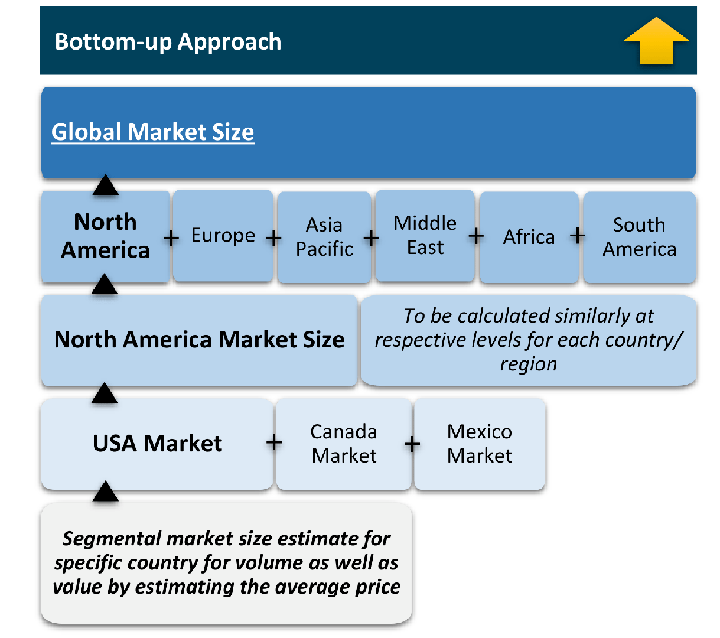
The bottom-up approach builds market estimates by starting with the smallest addressable market units and systematically aggregating them to create comprehensive market size projections.
This method begins with specific, granular data points and builds upward to create the complete market landscape.
Customer Analysis → Segmental Analysis → Geographical Analysis
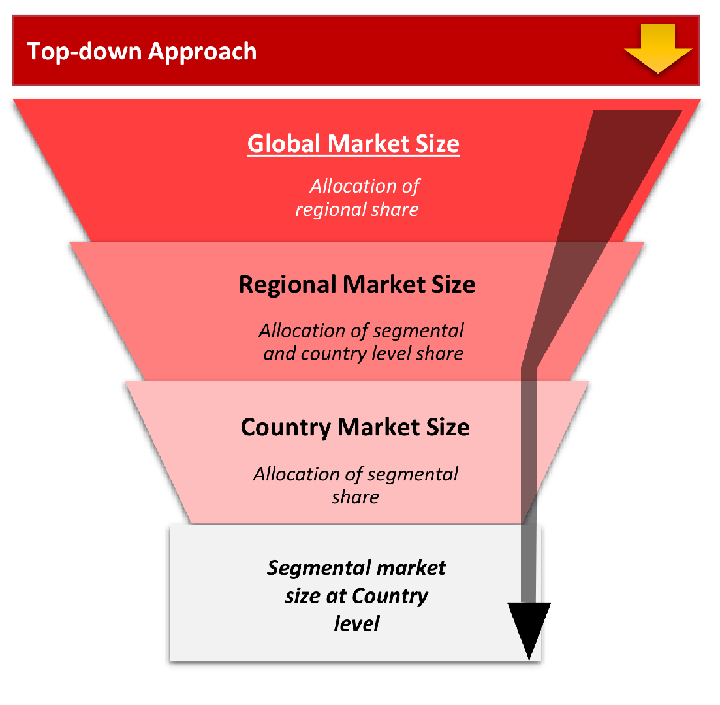
The top-down approach starts with the broadest possible market data and systematically narrows it down through a series of filters and assumptions to arrive at specific market segments or opportunities.
This method begins with the big picture and works downward to increasingly specific market slices.
TAM → SAM → SOM
Research Methods
Desk / Secondary Research
While analysing the market, we extensively study secondary sources, directories, and databases to identify and collect information useful for this technical, market-oriented, and commercial report. Secondary sources that we utilize are not only the public sources, but it is a combination of Open Source, Associations, Paid Databases, MG Repository & Knowledgebase, and others.
- Company websites, annual reports, financial reports, broker reports, and investor presentations
- National government documents, statistical databases and reports
- News articles, press releases and web-casts specific to the companies operating in the market, Magazines, reports, and others
- We gather information from commercial data sources for deriving company specific data such as segmental revenue, share for geography, product revenue, and others
- Internal and external proprietary databases (industry-specific), relevant patent, and regulatory databases
- Governing Bodies, Government Organizations
- Relevant Authorities, Country-specific Associations for Industries
We also employ the model mapping approach to estimate the product level market data through the players' product portfolio
Primary Research
Primary research/ interviews is vital in analyzing the market. Most of the cases involves paid primary interviews. Primary sources include primary interviews through e-mail interactions, telephonic interviews, surveys as well as face-to-face interviews with the different stakeholders across the value chain including several industry experts.
| Type of Respondents | Number of Primaries |
|---|---|
| Tier 2/3 Suppliers | ~20 |
| Tier 1 Suppliers | ~25 |
| End-users | ~25 |
| Industry Expert/ Panel/ Consultant | ~30 |
| Total | ~100 |
MG Knowledgebase
• Repository of industry blog, newsletter and case studies
• Online platform covering detailed market reports, and company profiles
Forecasting Factors and Models
Forecasting Factors
- Historical Trends – Past market patterns, cycles, and major events that shaped how markets behave over time. Understanding past trends helps predict future behavior.
- Industry Factors – Specific characteristics of the industry like structure, regulations, and innovation cycles that affect market dynamics.
- Macroeconomic Factors – Economic conditions like GDP growth, inflation, and employment rates that affect how much money people have to spend.
- Demographic Factors – Population characteristics like age, income, and location that determine who can buy your product.
- Technology Factors – How quickly people adopt new technology and how much technology infrastructure exists.
- Regulatory Factors – Government rules, laws, and policies that can help or restrict market growth.
- Competitive Factors – Analyzing competition structure such as degree of competition and bargaining power of buyers and suppliers.
Forecasting Models / Techniques
Multiple Regression Analysis
- Identify and quantify factors that drive market changes
- Statistical modeling to establish relationships between market drivers and outcomes
Time Series Analysis – Seasonal Patterns
- Understand regular cyclical patterns in market demand
- Advanced statistical techniques to separate trend, seasonal, and irregular components
Time Series Analysis – Trend Analysis
- Identify underlying market growth patterns and momentum
- Statistical analysis of historical data to project future trends
Expert Opinion – Expert Interviews
- Gather deep industry insights and contextual understanding
- In-depth interviews with key industry stakeholders
Multi-Scenario Development
- Prepare for uncertainty by modeling different possible futures
- Creating optimistic, pessimistic, and most likely scenarios
Time Series Analysis – Moving Averages
- Sophisticated forecasting for complex time series data
- Auto-regressive integrated moving average models with seasonal components
Econometric Models
- Apply economic theory to market forecasting
- Sophisticated economic models that account for market interactions
Expert Opinion – Delphi Method
- Harness collective wisdom of industry experts
- Structured, multi-round expert consultation process
Monte Carlo Simulation
- Quantify uncertainty and probability distributions
- Thousands of simulations with varying input parameters
Research Analysis
Our research framework is built upon the fundamental principle of validating market intelligence from both demand and supply perspectives. This dual-sided approach ensures comprehensive market understanding and reduces the risk of single-source bias.
Demand-Side Analysis: We understand end-user/application behavior, preferences, and market needs along with the penetration of the product for specific application.
Supply-Side Analysis: We estimate overall market revenue, analyze the segmental share along with industry capacity, competitive landscape, and market structure.
Validation & Evaluation
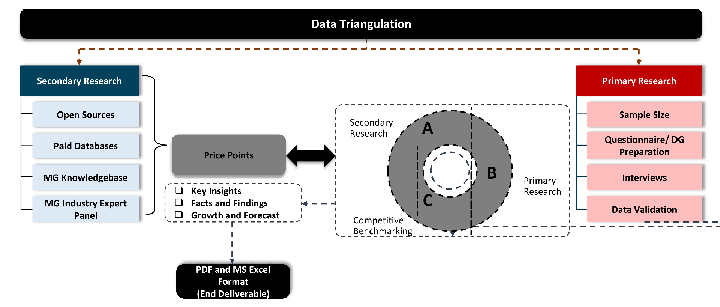
Data triangulation is a validation technique that uses multiple methods, sources, or perspectives to examine the same research question, thereby increasing the credibility and reliability of research findings. In market research, triangulation serves as a quality assurance mechanism that helps identify and minimize bias, validate assumptions, and ensure accuracy in market estimates.
- Data Source Triangulation – Using multiple data sources to examine the same phenomenon
- Methodological Triangulation – Using multiple research methods to study the same research question
- Investigator Triangulation – Using multiple researchers or analysts to examine the same data
- Theoretical Triangulation – Using multiple theoretical perspectives to interpret the same data
Custom Market Research Services
We will customise the research for you, in case the report listed above does not meet your requirements.
Get 10% Free Customisation