Functional Pet Treats Market Size, Share & Trends Analysis Report by Product Type (Dental Care Treats, Hip & Joint Support Treats, Skin & Coat Health Treats, Digestive Health Treats, Calming & Anxiety Relief Treats, Weight Management Treats, Immune Support Treats, Other Product Type), Pet Type, Ingredient Type, Form Factor, Age Group (Target), Distribution Channel, Packaging Type, and Geography (North America, Europe, Asia Pacific, Middle East, Africa, and South America) – Global Industry Data, Trends, and Forecasts, 2026–2035
|
|
|
Segmental Data Insights |
|
|
Demand Trends |
|
|
Competitive Landscape |
|
|
Strategic Development |
|
|
Future Outlook & Opportunities |
|
Functional-Pet-Treats-Market Size, Share, and Growth
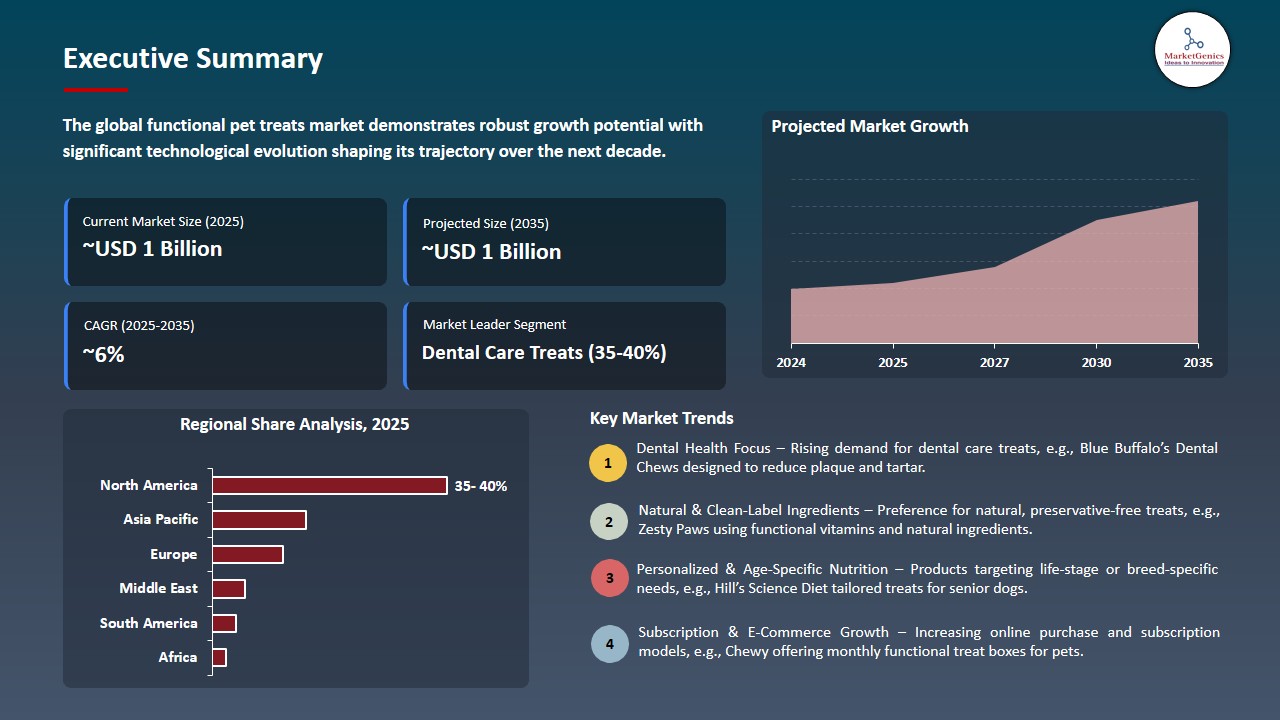
The global functional pet treats market is experiencing robust growth, with its estimated value of USD 0.7 billion in the year 2025 and USD 1.3 billion by the period 2035, registering a CAGR of 6.3%, during the forecast period. The growing consumer attention to the health and well-being of pets, along with preventive care, is pushing the global functional pet treats market. Due to an increasing awareness of long-term health outcomes in their pets, pet owners are giving preference to products that assist in digestive health, immune health, joint health, and cognitive development.
Michael Seely, Co-Founder and CEO of Native Microbials, said, We're thrilled to partner with Zesty Paws to deliver first-of-its-kind microbial solutions that directly target GI health in dogs. This is a great example of how science-driven partnerships can deliver much needed innovation to market. We've only scratched the surface of what's possible with our microbial genomics platform, which can unlock entirely new classes of solutions for pets across a range of health needs. We look forward to expanding our partnership with Zesty Paws and bringing critical innovation to the companion animal health industry.
The functional pet treats are a dynamic growing market that is shaped by the changing consumer trends, technology and the demand to consider health and wellness as well as sustainability issues. Consumers are placing more emphasis on products that reflect their values with a desire to find out what is in their products, how it is sourced ethically, has a proven effectiveness, and is environmentally responsible during product lifecycles and supply chains. For instance, in June 2024, ADM introduced seven turnkey functional pet treat and supplement formulas in Europe, covering gut health, mobility, skin & coat, dental, calming, and longevity benefits, which reflects the responsiveness of ADM to the increasing consumer demand of holistic solutions to the well-being of their pets.
The predominant brands are addressing these trends by reformulating their products to align with the functional and clean-label trends, using the digital medium to engage consumers, securing certifications and incorporating clinical validation to support product claims. For instance, in October 2025, THE PACK and MicroHarvest released the first commercially available dog treats in the UK using microbial proteins, Gut Bites, which are also considered gut-healthy and are made by fermentation of agricultural by-products, thereby being eco-friendly. These innovations enhance brand differentiation, consumer confidence as well as competitive advantages in markets where informed pet owners push premium pricing prospects.
The close-by prospects like the provision of subscriptions, customized recipes, and the combination with pet wellness telehealth applications enable companies to diversify the income sources, build loyalty, and develop the complete ecosystem that considers pet health and lifestyle need.
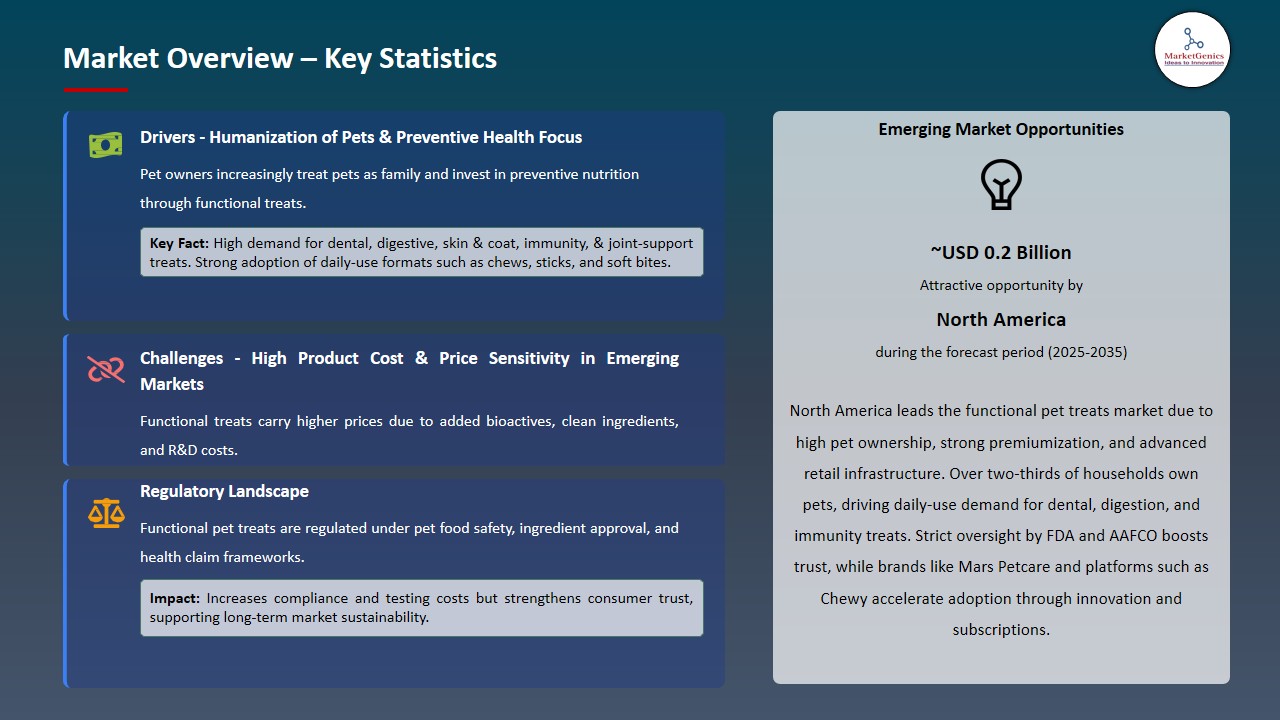
Functional Pet Treats Market Dynamics and Trends
Driver: Aging Pet Population and Chronic Disease Management
-
The trend of increasing number of aging pets and high occurrence of chronic diseases in pets are transforming the functional pet treats market in terms of purchasing decision, product innovation and brand loyalty. The pet owners are becoming more concerned with wellness-oriented, targeted nutrition products designed to promote joint health, digestion, immunity, and vitality. The increasing consumer awareness about product quality, safety and scientific validation is increasing the demand of ingredient transparent and effective functional treats.
- Some of the market leaders are responding by coming up with specialized formulations, getting certification, and educating the consumer on the benefits of health. For instance, in August 2025, PawCo Foods launching its Magic Cookie line, which would include gut health and joint support among other functional products in the form of cookies. These health-based products indicate the changing consumer needs and complement the brand differentiation of these companies that are now in a position to capture the highest segments and increase market share.
- High demand for science-backed premium snacks in developed markets indicates sustained growth. This dynamic creates opportunities for innovators while forcing traditional firms to adapt to shifting needs and competition.
Restraint: Regulatory Uncertainty Between Treats and Therapeutics
-
Ambiguous regulatory representation between functional pet food and therapeutic products is a major market threat that affects growth, market penetration, and commercial success. Uneven rules, complications in approvals, and distribution of compliance needs per region make companies that want to scale their operations and innovate in a responsible way to be impeded.
- Firms are trying to overcome these limitations by doing educational programs, clinical validation, strategic alliance, optimum pricing and distributed channels. Nonetheless, the process of overcoming regulatory uncertainty requires long-term investment, responsiveness to local market conditions, and the ability to adapt to the changes in consumer expectations and competitiveness.
- Premium offerings are more resilient due to strong brand equity and high differentiation of value propositions, whereas mass-market products face increased pressure, necessitating constant efficiency gains, marketing creativity, and value engineering to keep them competitive and in compliance with regulations.
Opportunity: Growth in CBD and Hemp-Derived Formulations
-
The functional pet treats market is witnessing the growth of the demand of the products, which are infused with CBD and hemp with references to the pet owners, who want to use the products to reduce stress and improve their health of their joints and health in general. The brands with safe and scientifically tested formulations are in a good position to take the niche markets with premiums and enhance consumer loyalty.
- Innovation has been driven by the need to meet differentiated, functional products by consumers. For instance, in March 2024, CV Sciences added to the +PlusCBD Pet product line with the introduction of two new products Hip & Joint Health and Calming Care chews, which will combine hemp-derived cannabinoids with functional ingredients to promote the well-being of pets. This is an example of how firms are operationalizing the opportunity, based on scientific validation, quality certifications and consumer trust to be differentiated in the increasingly competitive CBD pet-treat segment.
- Growing adoption allows brands to scale direct-to-consumer channels, customize formulations, and offer subscription plans, leading to improved customer engagement, data-driven personalization, and a competitive edge in the functional pet treats segment.
Key Trend: Integration of Veterinary-Backed Clinical Validation
-
Integration of veterinary-supported clinical validation is redefining the functional pet treats market as pet owners are seeking products that provide quantifiable health benefits with established safety and effectiveness. This tendency is attributed to the increasing consumer sophistication, increasing focus on preventive pet wellness, and increasing regulatory and quality pressures.
- Major players have been forced to be innovative because of consumer demand of clinically tested products. Most brands integrate convenience with formulations, which have been vetted by veterinarians to make sure that they are effective. For instance, in February 2025, Elanco Animal Health introduced Pet Protect, a brand of dog and cat supplements designed by veterinarians to support the joints, digestive system, immune and skin health.
- As clinical validation grows popularity, even mass-market and price-sensitive groups should adhere to these requirements. This will result in long-term market revolution by allowing for individualized formulas, subscriptions, and outcome assurances, which will boost consumer loyalty and lifetime value.
Functional-Pet-Treats-Market Analysis and Segmental Data
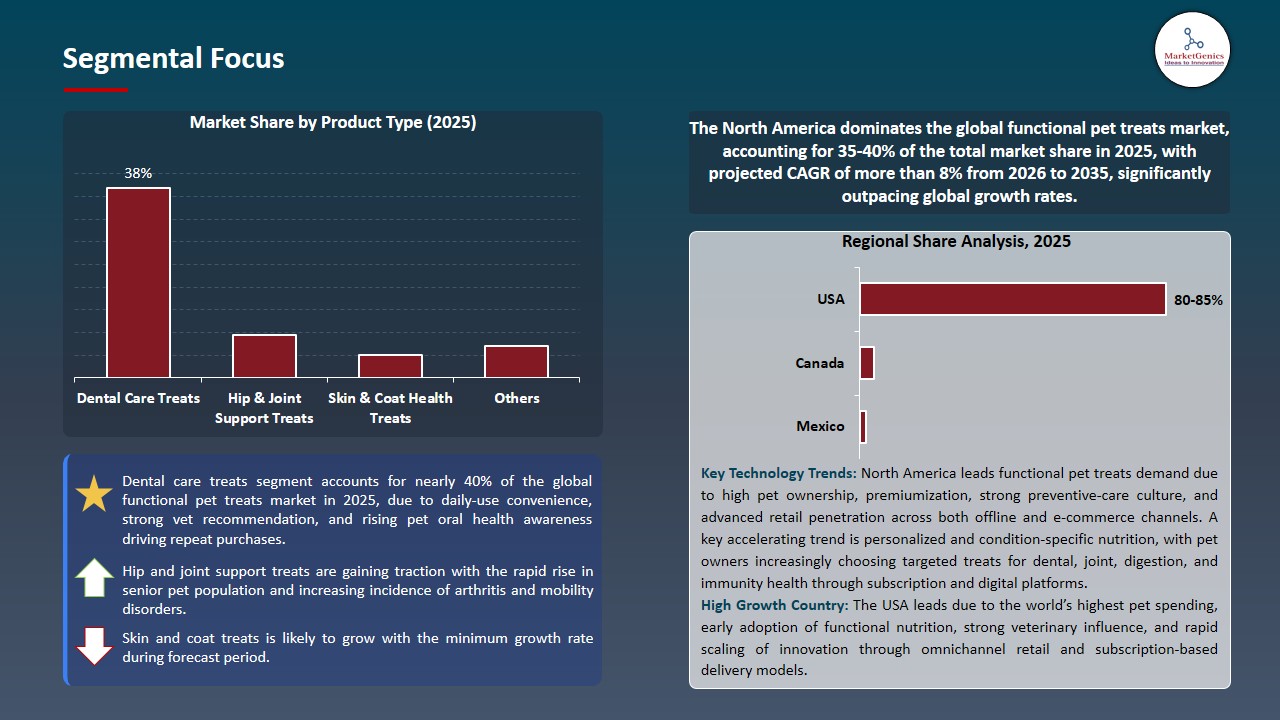
Dental Care Treats Dominate Global Functional Pet Treats Market
-
Dental care treats dominates global functional pet-treats market because growing interest by pet-owners in oral health and the growing awareness that the idea of brushing pets regularly or taking them to the veterinarian is unrealistic to most dog owners. Consequently, there has been an explosion in demand of chewable treats or products with plaque, tartar, gum-health and breath-freshening benefits.
- The market is characterized by a demand of scientifically supported, easy-to-use solutions in dental care, which is observed in new products. For instance, in May 2025, Woof released Doggy Dental Mix, a just-add-water dental mix, which is a mix of enzymes and postbiotics and used with Pupscale toy to provide dogs with more oral-contact time to clean their mouths. This product brings about the importance of the repositioning of dental treats by companies as snacks to wellness functional tools.
- Dental-care treats are poised to maintain their position as the leader in the functional pet-treats market, owing to established supply networks, regulatory predictability, and delivery via specialty pet and e-commerce.
North America Leads Global Functional Pet Treats Market Demand
-
The functional pet treat market is primarily driven by North America, which has high rates of pet ownership, pet-care premiumization, and consumer willingness to invest in pet wellness. The prevalence of high levels of disposable income, urbanization, and the increasing humanization of pets as members of the family has resulted in a sizable market base for health-conscious pet food.
- Clear-label and open-source ingredient sourcing is being used to create scientifically developed treats and supplements that promote gut health, immunity, and overall wellness. For example, in November 2025, Zesty Paws collaborated with Native Microbials to launch a new brand of dog probiotics based on new microbial strains cultured from healthy dogs' gut microbiomes, the first of its kind in the United States, with the goal of supporting dogs' digestive health and gastrointestinal balance.
- Effective supply chains, regulatory transparency, and go-to-market processes enable rapid product launch and manufacturing scalability. These organizational qualities help North America to maintain its leadership position, particularly as global pet care priorities shift toward efficacy, wellness, and science-based innovation.
Functional-Pet-Treats-Market Ecosystem
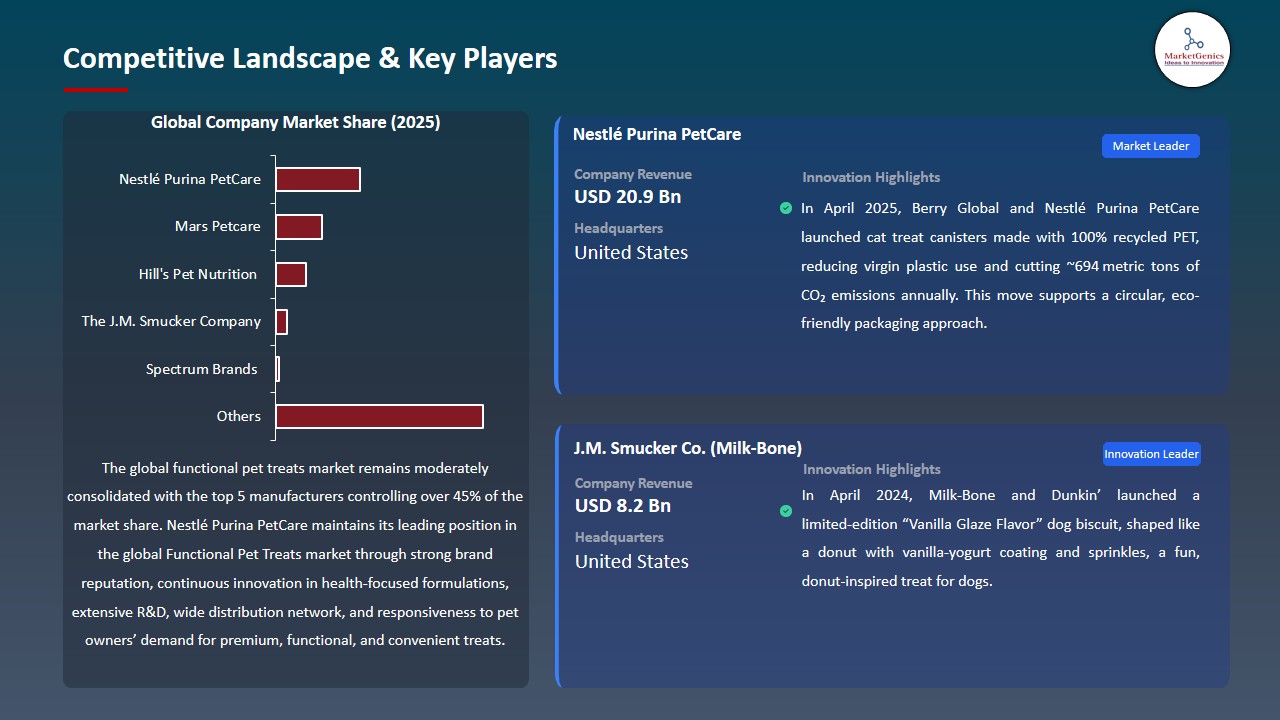
The global functional pet treats market is a moderately consolidated business with multinational conglomerates, specialty brands, and direct-to-consumer start-ups operating on different lines and levels of cost. Nestle Purina PetCare, Mars Petcare, Hills Pet Nutrition, The J.M. Smucker Company and Spectrum Brands, among others, use years of research and development, distribution system, and brand loyalty to sustain leadership within the mass market segments.
Premium and specialty brands are differentiating, authentic, and target-oriented consumers to reach niche markets. Market value chain includes suppliers of ingredients, formulation developers, and contract manufacturing firms, packaging firms, distribution partners, retail distribution and marketing agencies. The main directions that the leading companies are taking are the implementation of vertical integration, direct-to-consumer, or in other words, more sophisticated digital marketing tools to improve the efficiency of operations, increase margins, and enable direct communication with consumers.
Such strategies facilitate product innovation and customization which is data-driven and helps in brand loyalty and sensitivity to changing consumer orientation. The ecosystem focuses on partnership among the stakeholders to provide holistic and health-oriented pet treat solutions.
Recent Development and Strategic Overview
-
In April 2025, Farmina Pet Foods launched more than 20 innovations at Global Pet Expo 2025, including its first ever working line of dog treats, N&D Dog Treats and VetLife Dog Treats. The new delicacies are dental care, digestion, weight, skin and coat, and veterinary specific dietary demand-based, which solidifies the presence of Farmina in the functional pet nutrition segment.
- In November 2025, Native Microbials collaborated with Zesty Paws to create a new range of dog probiotic supplements with novel microbial strains isolated using the gut microbiomes of healthy dogs. The partnership will be used to introduce daily digestive-health probiotics and clinical-strength GI support products to dogs.
Report Scope
|
Detail |
|
|
Market Size in 2025 |
USD 0.7 Bn |
|
Market Forecast Value in 2035 |
USD 1.3 Bn |
|
Growth Rate (CAGR) |
6.3% |
|
Forecast Period |
2026 – 2035 |
|
Historical Data Available for |
2021 – 2024 |
|
Market Size Units |
US$ Billion for Value |
|
Report Format |
Electronic (PDF) + Excel |
|
North America |
Europe |
Asia Pacific |
Middle East |
Africa |
South America |
|
|
|
|
|
|
|
Companies Covered |
|||||
|
|
|
|
|
|
|
Functional-Pet-Treats-Market Segmentation and Highlights
|
Segment |
Sub-segment |
|
Functional Pet Treats Market, By Product Type |
|
|
Functional Pet Treats Market, By Pet Type |
|
|
Functional Pet Treats Market, By Ingredient Type |
|
|
Functional Pet Treats Market, By Form Factor |
|
|
Functional Pet Treats Market, By Age Group (Target) |
|
|
Functional Pet Treats Market, By Distribution Channel |
|
|
Functional Pet Treats Market, By Packaging Type |
|
Frequently Asked Questions
Table of Contents
- 1. Research Methodology and Assumptions
- 1.1. Definitions
- 1.2. Research Design and Approach
- 1.3. Data Collection Methods
- 1.4. Base Estimates and Calculations
- 1.5. Forecasting Models
- 1.5.1. Key Forecast Factors & Impact Analysis
- 1.6. Secondary Research
- 1.6.1. Open Sources
- 1.6.2. Paid Databases
- 1.6.3. Associations
- 1.7. Primary Research
- 1.7.1. Primary Sources
- 1.7.2. Primary Interviews with Stakeholders across Ecosystem
- 2. Executive Summary
- 2.1. Global Functional Pet Treats Market Outlook
- 2.1.1. Functional Pet Treats Market Size (Value - US$ Bn), and Forecasts, 2021-2035
- 2.1.2. Compounded Annual Growth Rate Analysis
- 2.1.3. Growth Opportunity Analysis
- 2.1.4. Segmental Share Analysis
- 2.1.5. Geographical Share Analysis
- 2.2. Market Analysis and Facts
- 2.3. Supply-Demand Analysis
- 2.4. Competitive Benchmarking
- 2.5. Go-to- Market Strategy
- 2.5.1. Customer/ End-use Industry Assessment
- 2.5.2. Growth Opportunity Data, 2026-2035
- 2.5.2.1. Regional Data
- 2.5.2.2. Country Data
- 2.5.2.3. Segmental Data
- 2.5.3. Identification of Potential Market Spaces
- 2.5.4. GAP Analysis
- 2.5.5. Potential Attractive Price Points
- 2.5.6. Prevailing Market Risks & Challenges
- 2.5.7. Preferred Sales & Marketing Strategies
- 2.5.8. Key Recommendations and Analysis
- 2.5.9. A Way Forward
- 2.1. Global Functional Pet Treats Market Outlook
- 3. Industry Data and Premium Insights
- 3.1. Global Consumer Goods & Services Industry Overview, 2025
- 3.1.1. Consumer Goods & Services Industry Ecosystem Analysis
- 3.1.2. Key Trends for Consumer Goods & Services Industry
- 3.1.3. Regional Distribution for Consumer Goods & Services Industry
- 3.2. Supplier Customer Data
- 3.3. Technology Roadmap and Developments
- 3.4. Trade Analysis
- 3.4.1. Import & Export Analysis, 2025
- 3.4.2. Top Importing Countries
- 3.4.3. Top Exporting Countries
- 3.5. Trump Tariff Impact Analysis
- 3.5.1. Manufacturer
- 3.5.1.1. Based on the component & Raw material
- 3.5.2. Supply Chain
- 3.5.3. End Consumer
- 3.5.1. Manufacturer
- 3.6. Raw Material Analysis
- 3.1. Global Consumer Goods & Services Industry Overview, 2025
- 4. Market Overview
- 4.1. Market Dynamics
- 4.1.1. Drivers
- 4.1.1.1. Rising pet humanization and preventive healthcare adoption
- 4.1.1.2. Growing demand for functional, natural, and clean-label pet nutrition
- 4.1.1.3. Expansion of e-commerce and premium pet specialty retail.
- 4.1.2. Restraints
- 4.1.2.1. High product costs compared to conventional treats
- 4.1.2.2. Regulatory complexity and varying approval standards across regions.
- 4.1.1. Drivers
- 4.2. Key Trend Analysis
- 4.3. Regulatory Framework
- 4.3.1. Key Regulations, Norms, and Subsidies, by Key Countries
- 4.3.2. Tariffs and Standards
- 4.3.3. Impact Analysis of Regulations on the Market
- 4.4. Value Chain Analysis
- 4.4.1. Raw Material Suppliers
- 4.4.2. Manufacturers
- 4.4.3. Dealers/ Distributors
- 4.4.4. End-Users/ Customers
- 4.5. Porter’s Five Forces Analysis
- 4.6. PESTEL Analysis
- 4.7. Global Functional Pet Treats Market Demand
- 4.7.1. Historical Market Size – Value (US$ Bn), 2020-2024
- 4.7.2. Current and Future Market Size – Value (US$ Bn), 2026–2035
- 4.7.2.1. Y-o-Y Growth Trends
- 4.7.2.2. Absolute $ Opportunity Assessment
- 4.1. Market Dynamics
- 5. Competition Landscape
- 5.1. Competition structure
- 5.1.1. Fragmented v/s consolidated
- 5.2. Company Share Analysis, 2025
- 5.2.1. Global Company Market Share
- 5.2.2. By Region
- 5.2.2.1. North America
- 5.2.2.2. Europe
- 5.2.2.3. Asia Pacific
- 5.2.2.4. Middle East
- 5.2.2.5. Africa
- 5.2.2.6. South America
- 5.3. Product Comparison Matrix
- 5.3.1. Specifications
- 5.3.2. Market Positioning
- 5.3.3. Pricing
- 5.1. Competition structure
- 6. Global Functional Pet Treats Market Analysis, by Product Type
- 6.1. Key Segment Analysis
- 6.2. Functional Pet Treats Market Size (Value - US$ Bn), Analysis, and Forecasts, by Product Type, 2021-2035
- 6.2.1. Dental Care Treats
- 6.2.1.1. Dental Chews
- 6.2.1.2. Teeth Cleaning Sticks
- 6.2.1.3. Plaque Control Treats
- 6.2.1.4. Others
- 6.2.2. Hip & Joint Support Treats
- 6.2.2.1. Glucosamine-based Treats
- 6.2.2.2. Chondroitin-enriched Treats
- 6.2.2.3. MSM-infused Treats
- 6.2.2.4. Others
- 6.2.3. Skin & Coat Health Treats
- 6.2.3.1. Omega-3 Enriched Treats
- 6.2.3.2. Biotin-based Treats
- 6.2.3.3. Vitamin E Treats
- 6.2.3.4. Others
- 6.2.4. Digestive Health Treats
- 6.2.4.1. Probiotic Treats
- 6.2.4.2. Prebiotic Treats
- 6.2.4.3. Fiber-enriched Treats
- 6.2.4.4. Others
- 6.2.5. Calming & Anxiety Relief Treats
- 6.2.5.1. CBD-infused Treats
- 6.2.5.2. Melatonin Treats
- 6.2.5.3. L-Theanine Treats
- 6.2.5.4. Others
- 6.2.6. Weight Management Treats
- 6.2.7. Immune Support Treats
- 6.2.8. Other Product Type
- 6.2.1. Dental Care Treats
- 7. Global Functional Pet Treats Market Analysis, by Pet Type
- 7.1. Key Segment Analysis
- 7.2. Functional Pet Treats Market Size (Value - US$ Bn), Analysis, and Forecasts, by Material Type, 2021-2035
- 7.2.1. Dog Treats
- 7.2.2. Cat Treats
- 7.2.3. Other Pets (Rabbits, Guinea Pigs, Birds, etc.)
- 8. Global Functional Pet Treats Market Analysis, by Ingredient Type
- 8.1. Key Segment Analysis
- 8.2. Functional Pet Treats Market Size (Value - US$ Bn), Analysis, and Forecasts, by Ingredient Type, 2021-2035
- 8.2.1. Meat-based
- 8.2.1.1. Chicken
- 8.2.1.2. Beef
- 8.2.1.3. Lamb
- 8.2.1.4. Fish
- 8.2.1.5. Others
- 8.2.2. Plant-based
- 8.2.2.1. Vegetables
- 8.2.2.2. Fruits
- 8.2.2.3. Grains
- 8.2.2.4. Others
- 8.2.3. Synthetic/Artificially Enhanced
- 8.2.4. Mixed/Hybrid Ingredients
- 8.2.1. Meat-based
- 9. Global Functional Pet Treats Market Analysis, by Form Factor
- 9.1. Key Segment Analysis
- 9.2. Functional Pet Treats Market Size (Value - US$ Bn), Analysis, and Forecasts, by Form Factor, 2021-2035
- 9.2.1. Soft/Chewy Treats
- 9.2.2. Hard/Crunchy Treats
- 9.2.3. Freeze-dried Treats
- 9.2.4. Baked Treats
- 9.2.5. Jerky/Strips
- 9.2.6. Powdered/Supplement Form
- 10. Global Functional Pet Treats Market Analysis, by Age Group (Target)
- 10.1. Key Segment Analysis
- 10.2. Functional Pet Treats Market Size (Value - US$ Bn), Analysis, and Forecasts, by Age Group (Target), 2021-2035
- 10.2.1. Puppy/Kitten Treats
- 10.2.2. Adult Pet Treats
- 10.2.3. Senior Pet Treats
- 10.2.4. All Life Stages
- 11. Global Functional Pet Treats Market Analysis, by Distribution Channel
- 11.1. Key Segment Analysis
- 11.2. Functional Pet Treats Market Size (Value - US$ Bn), Analysis, and Forecasts, by Distribution Channel, 2021-2035
- 11.2.1. Online Retail
- 11.2.1.1. E-commerce Platforms
- 11.2.1.2. Company Websites
- 11.2.1.3. Others
- 11.2.2. Offline Retail
- 11.2.2.1. Pet Specialty Stores
- 11.2.2.2. Supermarkets/Hypermarkets
- 11.2.2.3. Veterinary Clinics
- 11.2.2.4. Convenience Stores
- 11.2.2.5. Others
- 11.2.1. Online Retail
- 12. Global Functional Pet Treats Market Analysis, by Packaging Type
- 12.1. Key Segment Analysis
- 12.2. Functional Pet Treats Market Size (Value - US$ Bn), Analysis, and Forecasts, by Packaging Type, 2021-2035
- 12.2.1. Resealable Pouches
- 12.2.2. Plastic Jars/Containers
- 12.2.3. Cardboard Boxes
- 12.2.4. Vacuum-sealed Packs
- 12.2.5. Eco-friendly/Sustainable Packaging
- 13. Global Functional Pet Treats Market Analysis and Forecasts, by Region
- 13.1. Key Findings
- 13.2. Functional Pet Treats Market Size (Value - US$ Bn), Analysis, and Forecasts, by Region, 2021-2035
- 13.2.1. North America
- 13.2.2. Europe
- 13.2.3. Asia Pacific
- 13.2.4. Middle East
- 13.2.5. Africa
- 13.2.6. South America
- 14. North America Functional Pet Treats Market Analysis
- 14.1. Key Segment Analysis
- 14.2. Regional Snapshot
- 14.3. North America Functional Pet Treats Market Size (Value - US$ Bn), Analysis, and Forecasts, 2021-2035
- 14.3.1. Product Type
- 14.3.2. Pet Type
- 14.3.3. Ingredient Type
- 14.3.4. Form Factor
- 14.3.5. Age Group (Target)
- 14.3.6. Distribution Channel
- 14.3.7. Packaging Type
- 14.3.8. Country
- 14.3.8.1. USA
- 14.3.8.2. Canada
- 14.3.8.3. Mexico
- 14.4. USA Functional Pet Treats Market
- 14.4.1. Country Segmental Analysis
- 14.4.2. Product Type
- 14.4.3. Pet Type
- 14.4.4. Ingredient Type
- 14.4.5. Form Factor
- 14.4.6. Age Group (Target)
- 14.4.7. Distribution Channel
- 14.4.8. Packaging Type
- 14.5. Canada Functional Pet Treats Market
- 14.5.1. Country Segmental Analysis
- 14.5.2. Product Type
- 14.5.3. Pet Type
- 14.5.4. Ingredient Type
- 14.5.5. Form Factor
- 14.5.6. Age Group (Target)
- 14.5.7. Distribution Channel
- 14.5.8. Packaging Type
- 14.6. Mexico Functional Pet Treats Market
- 14.6.1. Country Segmental Analysis
- 14.6.2. Product Type
- 14.6.3. Pet Type
- 14.6.4. Ingredient Type
- 14.6.5. Form Factor
- 14.6.6. Age Group (Target)
- 14.6.7. Distribution Channel
- 14.6.8. Packaging Type
- 15. Europe Functional Pet Treats Market Analysis
- 15.1. Key Segment Analysis
- 15.2. Regional Snapshot
- 15.3. Europe Functional Pet Treats Market Size (Value - US$ Bn), Analysis, and Forecasts, 2021-2035
- 15.3.1. Product Type
- 15.3.2. Pet Type
- 15.3.3. Ingredient Type
- 15.3.4. Form Factor
- 15.3.5. Age Group (Target)
- 15.3.6. Distribution Channel
- 15.3.7. Packaging Type
- 15.3.8. Country
- 15.3.8.1. Germany
- 15.3.8.2. United Kingdom
- 15.3.8.3. France
- 15.3.8.4. Italy
- 15.3.8.5. Spain
- 15.3.8.6. Netherlands
- 15.3.8.7. Nordic Countries
- 15.3.8.8. Poland
- 15.3.8.9. Russia & CIS
- 15.3.8.10. Rest of Europe
- 15.4. Germany Functional Pet Treats Market
- 15.4.1. Country Segmental Analysis
- 15.4.2. Product Type
- 15.4.3. Pet Type
- 15.4.4. Ingredient Type
- 15.4.5. Form Factor
- 15.4.6. Age Group (Target)
- 15.4.7. Distribution Channel
- 15.4.8. Packaging Type
- 15.5. United Kingdom Functional Pet Treats Market
- 15.5.1. Country Segmental Analysis
- 15.5.2. Product Type
- 15.5.3. Pet Type
- 15.5.4. Ingredient Type
- 15.5.5. Form Factor
- 15.5.6. Age Group (Target)
- 15.5.7. Distribution Channel
- 15.5.8. Packaging Type
- 15.6. France Functional Pet Treats Market
- 15.6.1. Country Segmental Analysis
- 15.6.2. Product Type
- 15.6.3. Pet Type
- 15.6.4. Ingredient Type
- 15.6.5. Form Factor
- 15.6.6. Age Group (Target)
- 15.6.7. Distribution Channel
- 15.6.8. Packaging Type
- 15.7. Italy Functional Pet Treats Market
- 15.7.1. Country Segmental Analysis
- 15.7.2. Product Type
- 15.7.3. Pet Type
- 15.7.4. Ingredient Type
- 15.7.5. Form Factor
- 15.7.6. Age Group (Target)
- 15.7.7. Distribution Channel
- 15.7.8. Packaging Type
- 15.8. Spain Functional Pet Treats Market
- 15.8.1. Country Segmental Analysis
- 15.8.2. Product Type
- 15.8.3. Pet Type
- 15.8.4. Ingredient Type
- 15.8.5. Form Factor
- 15.8.6. Age Group (Target)
- 15.8.7. Distribution Channel
- 15.8.8. Packaging Type
- 15.9. Netherlands Functional Pet Treats Market
- 15.9.1. Country Segmental Analysis
- 15.9.2. Product Type
- 15.9.3. Pet Type
- 15.9.4. Ingredient Type
- 15.9.5. Form Factor
- 15.9.6. Age Group (Target)
- 15.9.7. Distribution Channel
- 15.9.8. Packaging Type
- 15.10. Nordic Countries Functional Pet Treats Market
- 15.10.1. Country Segmental Analysis
- 15.10.2. Product Type
- 15.10.3. Pet Type
- 15.10.4. Ingredient Type
- 15.10.5. Form Factor
- 15.10.6. Age Group (Target)
- 15.10.7. Distribution Channel
- 15.10.8. Packaging Type
- 15.11. Poland Functional Pet Treats Market
- 15.11.1. Country Segmental Analysis
- 15.11.2. Product Type
- 15.11.3. Pet Type
- 15.11.4. Ingredient Type
- 15.11.5. Form Factor
- 15.11.6. Age Group (Target)
- 15.11.7. Distribution Channel
- 15.11.8. Packaging Type
- 15.12. Russia & CIS Functional Pet Treats Market
- 15.12.1. Country Segmental Analysis
- 15.12.2. Product Type
- 15.12.3. Pet Type
- 15.12.4. Ingredient Type
- 15.12.5. Form Factor
- 15.12.6. Age Group (Target)
- 15.12.7. Distribution Channel
- 15.12.8. Packaging Type
- 15.13. Rest of Europe Functional Pet Treats Market
- 15.13.1. Country Segmental Analysis
- 15.13.2. Product Type
- 15.13.3. Pet Type
- 15.13.4. Ingredient Type
- 15.13.5. Form Factor
- 15.13.6. Age Group (Target)
- 15.13.7. Distribution Channel
- 15.13.8. Packaging Type
- 16. Asia Pacific Functional Pet Treats Market Analysis
- 16.1. Key Segment Analysis
- 16.2. Regional Snapshot
- 16.3. Asia Pacific Functional Pet Treats Market Size (Value - US$ Bn), Analysis, and Forecasts, 2021-2035
- 16.3.1. Product Type
- 16.3.2. Pet Type
- 16.3.3. Ingredient Type
- 16.3.4. Form Factor
- 16.3.5. Age Group (Target)
- 16.3.6. Distribution Channel
- 16.3.7. Packaging Type
- 16.3.8. Country
- 16.3.8.1. China
- 16.3.8.2. India
- 16.3.8.3. Japan
- 16.3.8.4. South Korea
- 16.3.8.5. Australia and New Zealand
- 16.3.8.6. Indonesia
- 16.3.8.7. Malaysia
- 16.3.8.8. Thailand
- 16.3.8.9. Vietnam
- 16.3.8.10. Rest of Asia Pacific
- 16.4. China Functional Pet Treats Market
- 16.4.1. Country Segmental Analysis
- 16.4.2. Product Type
- 16.4.3. Pet Type
- 16.4.4. Ingredient Type
- 16.4.5. Form Factor
- 16.4.6. Age Group (Target)
- 16.4.7. Distribution Channel
- 16.4.8. Packaging Type
- 16.5. India Functional Pet Treats Market
- 16.5.1. Country Segmental Analysis
- 16.5.2. Product Type
- 16.5.3. Pet Type
- 16.5.4. Ingredient Type
- 16.5.5. Form Factor
- 16.5.6. Age Group (Target)
- 16.5.7. Distribution Channel
- 16.5.8. Packaging Type
- 16.6. Japan Functional Pet Treats Market
- 16.6.1. Country Segmental Analysis
- 16.6.2. Product Type
- 16.6.3. Pet Type
- 16.6.4. Ingredient Type
- 16.6.5. Form Factor
- 16.6.6. Age Group (Target)
- 16.6.7. Distribution Channel
- 16.6.8. Packaging Type
- 16.7. South Korea Functional Pet Treats Market
- 16.7.1. Country Segmental Analysis
- 16.7.2. Product Type
- 16.7.3. Pet Type
- 16.7.4. Ingredient Type
- 16.7.5. Form Factor
- 16.7.6. Age Group (Target)
- 16.7.7. Distribution Channel
- 16.7.8. Packaging Type
- 16.8. Australia and New Zealand Functional Pet Treats Market
- 16.8.1. Country Segmental Analysis
- 16.8.2. Product Type
- 16.8.3. Pet Type
- 16.8.4. Ingredient Type
- 16.8.5. Form Factor
- 16.8.6. Age Group (Target)
- 16.8.7. Distribution Channel
- 16.8.8. Packaging Type
- 16.9. Indonesia Functional Pet Treats Market
- 16.9.1. Country Segmental Analysis
- 16.9.2. Product Type
- 16.9.3. Pet Type
- 16.9.4. Ingredient Type
- 16.9.5. Form Factor
- 16.9.6. Age Group (Target)
- 16.9.7. Distribution Channel
- 16.9.8. Packaging Type
- 16.10. Malaysia Functional Pet Treats Market
- 16.10.1. Country Segmental Analysis
- 16.10.2. Product Type
- 16.10.3. Pet Type
- 16.10.4. Ingredient Type
- 16.10.5. Form Factor
- 16.10.6. Age Group (Target)
- 16.10.7. Distribution Channel
- 16.10.8. Packaging Type
- 16.11. Thailand Functional Pet Treats Market
- 16.11.1. Country Segmental Analysis
- 16.11.2. Product Type
- 16.11.3. Pet Type
- 16.11.4. Ingredient Type
- 16.11.5. Form Factor
- 16.11.6. Age Group (Target)
- 16.11.7. Distribution Channel
- 16.11.8. Packaging Type
- 16.12. Vietnam Functional Pet Treats Market
- 16.12.1. Country Segmental Analysis
- 16.12.2. Product Type
- 16.12.3. Pet Type
- 16.12.4. Ingredient Type
- 16.12.5. Form Factor
- 16.12.6. Age Group (Target)
- 16.12.7. Distribution Channel
- 16.12.8. Packaging Type
- 16.13. Rest of Asia Pacific Functional Pet Treats Market
- 16.13.1. Country Segmental Analysis
- 16.13.2. Product Type
- 16.13.3. Pet Type
- 16.13.4. Ingredient Type
- 16.13.5. Form Factor
- 16.13.6. Age Group (Target)
- 16.13.7. Distribution Channel
- 16.13.8. Packaging Type
- 17. Middle East Functional Pet Treats Market Analysis
- 17.1. Key Segment Analysis
- 17.2. Regional Snapshot
- 17.3. Middle East Functional Pet Treats Market Size (Value - US$ Bn), Analysis, and Forecasts, 2021-2035
- 17.3.1. Product Type
- 17.3.2. Pet Type
- 17.3.3. Ingredient Type
- 17.3.4. Form Factor
- 17.3.5. Age Group (Target)
- 17.3.6. Distribution Channel
- 17.3.7. Packaging Type
- 17.3.8. Country
- 17.3.8.1. Turkey
- 17.3.8.2. UAE
- 17.3.8.3. Saudi Arabia
- 17.3.8.4. Israel
- 17.3.8.5. Rest of Middle East
- 17.4. Turkey Functional Pet Treats Market
- 17.4.1. Country Segmental Analysis
- 17.4.2. Product Type
- 17.4.3. Pet Type
- 17.4.4. Ingredient Type
- 17.4.5. Form Factor
- 17.4.6. Age Group (Target)
- 17.4.7. Distribution Channel
- 17.4.8. Packaging Type
- 17.5. UAE Functional Pet Treats Market
- 17.5.1. Country Segmental Analysis
- 17.5.2. Product Type
- 17.5.3. Pet Type
- 17.5.4. Ingredient Type
- 17.5.5. Form Factor
- 17.5.6. Age Group (Target)
- 17.5.7. Distribution Channel
- 17.5.8. Packaging Type
- 17.6. Saudi Arabia Functional Pet Treats Market
- 17.6.1. Country Segmental Analysis
- 17.6.2. Product Type
- 17.6.3. Pet Type
- 17.6.4. Ingredient Type
- 17.6.5. Form Factor
- 17.6.6. Age Group (Target)
- 17.6.7. Distribution Channel
- 17.6.8. Packaging Type
- 17.7. Israel Functional Pet Treats Market
- 17.7.1. Country Segmental Analysis
- 17.7.2. Product Type
- 17.7.3. Pet Type
- 17.7.4. Ingredient Type
- 17.7.5. Form Factor
- 17.7.6. Age Group (Target)
- 17.7.7. Distribution Channel
- 17.7.8. Packaging Type
- 17.8. Rest of Middle East Functional Pet Treats Market
- 17.8.1. Country Segmental Analysis
- 17.8.2. Product Type
- 17.8.3. Pet Type
- 17.8.4. Ingredient Type
- 17.8.5. Form Factor
- 17.8.6. Age Group (Target)
- 17.8.7. Distribution Channel
- 17.8.8. Packaging Type
- 18. Africa Functional Pet Treats Market Analysis
- 18.1. Key Segment Analysis
- 18.2. Regional Snapshot
- 18.3. Africa Functional Pet Treats Market Size (Value - US$ Bn), Analysis, and Forecasts, 2021-2035
- 18.3.1. Product Type
- 18.3.2. Pet Type
- 18.3.3. Ingredient Type
- 18.3.4. Form Factor
- 18.3.5. Age Group (Target)
- 18.3.6. Distribution Channel
- 18.3.7. Packaging Type
- 18.3.8. Country
- 18.3.8.1. South Africa
- 18.3.8.2. Egypt
- 18.3.8.3. Nigeria
- 18.3.8.4. Algeria
- 18.3.8.5. Rest of Africa
- 18.4. South Africa Functional Pet Treats Market
- 18.4.1. Country Segmental Analysis
- 18.4.2. Product Type
- 18.4.3. Pet Type
- 18.4.4. Ingredient Type
- 18.4.5. Form Factor
- 18.4.6. Age Group (Target)
- 18.4.7. Distribution Channel
- 18.4.8. Packaging Type
- 18.5. Egypt Functional Pet Treats Market
- 18.5.1. Country Segmental Analysis
- 18.5.2. Product Type
- 18.5.3. Pet Type
- 18.5.4. Ingredient Type
- 18.5.5. Form Factor
- 18.5.6. Age Group (Target)
- 18.5.7. Distribution Channel
- 18.5.8. Packaging Type
- 18.6. Nigeria Functional Pet Treats Market
- 18.6.1. Country Segmental Analysis
- 18.6.2. Product Type
- 18.6.3. Pet Type
- 18.6.4. Ingredient Type
- 18.6.5. Form Factor
- 18.6.6. Age Group (Target)
- 18.6.7. Distribution Channel
- 18.6.8. Packaging Type
- 18.7. Algeria Functional Pet Treats Market
- 18.7.1. Country Segmental Analysis
- 18.7.2. Product Type
- 18.7.3. Pet Type
- 18.7.4. Ingredient Type
- 18.7.5. Form Factor
- 18.7.6. Age Group (Target)
- 18.7.7. Distribution Channel
- 18.7.8. Packaging Type
- 18.8. Rest of Africa Functional Pet Treats Market
- 18.8.1. Country Segmental Analysis
- 18.8.2. Product Type
- 18.8.3. Pet Type
- 18.8.4. Ingredient Type
- 18.8.5. Form Factor
- 18.8.6. Age Group (Target)
- 18.8.7. Distribution Channel
- 18.8.8. Packaging Type
- 19. South America Functional Pet Treats Market Analysis
- 19.1. Key Segment Analysis
- 19.2. Regional Snapshot
- 19.3. South America Functional Pet Treats Market Size (Value - US$ Bn), Analysis, and Forecasts, 2021-2035
- 19.3.1. Product Type
- 19.3.2. Pet Type
- 19.3.3. Ingredient Type
- 19.3.4. Form Factor
- 19.3.5. Age Group (Target)
- 19.3.6. Distribution Channel
- 19.3.7. Packaging Type
- 19.3.8. Country
- 19.3.8.1. Brazil
- 19.3.8.2. Argentina
- 19.3.8.3. Rest of South America
- 19.4. Brazil Functional Pet Treats Market
- 19.4.1. Country Segmental Analysis
- 19.4.2. Product Type
- 19.4.3. Pet Type
- 19.4.4. Ingredient Type
- 19.4.5. Form Factor
- 19.4.6. Age Group (Target)
- 19.4.7. Distribution Channel
- 19.4.8. Packaging Type
- 19.5. Argentina Functional Pet Treats Market
- 19.5.1. Country Segmental Analysis
- 19.5.2. Product Type
- 19.5.3. Pet Type
- 19.5.4. Ingredient Type
- 19.5.5. Form Factor
- 19.5.6. Age Group (Target)
- 19.5.7. Distribution Channel
- 19.5.8. Packaging Type
- 19.6. Rest of South America Functional Pet Treats Market
- 19.6.1. Country Segmental Analysis
- 19.6.2. Product Type
- 19.6.3. Pet Type
- 19.6.4. Ingredient Type
- 19.6.5. Form Factor
- 19.6.6. Age Group (Target)
- 19.6.7. Distribution Channel
- 19.6.8. Packaging Type
- 20. Key Players/ Company Profile
- 20.1. Ark Naturals
- 20.1.1. Company Details/ Overview
- 20.1.2. Company Financials
- 20.1.3. Key Customers and Competitors
- 20.1.4. Business/ Industry Portfolio
- 20.1.5. Product Portfolio/ Specification Details
- 20.1.6. Pricing Data
- 20.1.7. Strategic Overview
- 20.1.8. Recent Developments
- 20.2. Blue Buffalo (General Mills)
- 20.3. Bocce's Bakery
- 20.4. Diamond Pet Foods
- 20.5. Get Joy
- 20.6. Hill's Pet Nutrition
- 20.7. Himalayan Pet Supply
- 20.8. Mars Petcare
- 20.9. Nestlé Purina PetCare
- 20.10. Nutramax Laboratories
- 20.11. Nutro (Mars Petcare)
- 20.12. PetHonesty
- 20.13. Plato Pet Treats
- 20.14. Solid Gold Pet
- 20.15. Spectrum Brands
- 20.16. The J.M. Smucker Company
- 20.17. VetIQ
- 20.18. Virbac
- 20.19. Wellness Pet Company
- 20.20. Zesty Paws
- 20.21. Other Key Players
- 20.1. Ark Naturals
Note* - This is just tentative list of players. While providing the report, we will cover more number of players based on their revenue and share for each geography
Research Design
Our research design integrates both demand-side and supply-side analysis through a balanced combination of primary and secondary research methodologies. By utilizing both bottom-up and top-down approaches alongside rigorous data triangulation methods, we deliver robust market intelligence that supports strategic decision-making.
MarketGenics' comprehensive research design framework ensures the delivery of accurate, reliable, and actionable market intelligence. Through the integration of multiple research approaches, rigorous validation processes, and expert analysis, we provide our clients with the insights needed to make informed strategic decisions and capitalize on market opportunities.

MarketGenics leverages a dedicated industry panel of experts and a comprehensive suite of paid databases to effectively collect, consolidate, and analyze market intelligence.
Our approach has consistently proven to be reliable and effective in generating accurate market insights, identifying key industry trends, and uncovering emerging business opportunities.
Through both primary and secondary research, we capture and analyze critical company-level data such as manufacturing footprints, including technical centers, R&D facilities, sales offices, and headquarters.
Our expert panel further enhances our ability to estimate market size for specific brands based on validated field-level intelligence.
Our data mining techniques incorporate both parametric and non-parametric methods, allowing for structured data collection, sorting, processing, and cleaning.
Demand projections are derived from large-scale data sets analyzed through proprietary algorithms, culminating in robust and reliable market sizing.
Research Approach
The bottom-up approach builds market estimates by starting with the smallest addressable market units and systematically aggregating them to create comprehensive market size projections.
This method begins with specific, granular data points and builds upward to create the complete market landscape.
Customer Analysis → Segmental Analysis → Geographical Analysis
The top-down approach starts with the broadest possible market data and systematically narrows it down through a series of filters and assumptions to arrive at specific market segments or opportunities.
This method begins with the big picture and works downward to increasingly specific market slices.
TAM → SAM → SOM


Research Methods
Desk / Secondary Research
While analysing the market, we extensively study secondary sources, directories, and databases to identify and collect information useful for this technical, market-oriented, and commercial report. Secondary sources that we utilize are not only the public sources, but it is a combination of Open Source, Associations, Paid Databases, MG Repository & Knowledgebase, and others.
- Company websites, annual reports, financial reports, broker reports, and investor presentations
- National government documents, statistical databases and reports
- News articles, press releases and web-casts specific to the companies operating in the market, Magazines, reports, and others
- We gather information from commercial data sources for deriving company specific data such as segmental revenue, share for geography, product revenue, and others
- Internal and external proprietary databases (industry-specific), relevant patent, and regulatory databases
- Governing Bodies, Government Organizations
- Relevant Authorities, Country-specific Associations for Industries
We also employ the model mapping approach to estimate the product level market data through the players' product portfolio
Primary Research
Primary research/ interviews is vital in analyzing the market. Most of the cases involves paid primary interviews. Primary sources include primary interviews through e-mail interactions, telephonic interviews, surveys as well as face-to-face interviews with the different stakeholders across the value chain including several industry experts.
| Type of Respondents | Number of Primaries |
|---|---|
| Tier 2/3 Suppliers | ~20 |
| Tier 1 Suppliers | ~25 |
| End-users | ~25 |
| Industry Expert/ Panel/ Consultant | ~30 |
| Total | ~100 |
MG Knowledgebase
• Repository of industry blog, newsletter and case studies
• Online platform covering detailed market reports, and company profiles
Forecasting Factors and Models
Forecasting Factors
- Historical Trends – Past market patterns, cycles, and major events that shaped how markets behave over time. Understanding past trends helps predict future behavior.
- Industry Factors – Specific characteristics of the industry like structure, regulations, and innovation cycles that affect market dynamics.
- Macroeconomic Factors – Economic conditions like GDP growth, inflation, and employment rates that affect how much money people have to spend.
- Demographic Factors – Population characteristics like age, income, and location that determine who can buy your product.
- Technology Factors – How quickly people adopt new technology and how much technology infrastructure exists.
- Regulatory Factors – Government rules, laws, and policies that can help or restrict market growth.
- Competitive Factors – Analyzing competition structure such as degree of competition and bargaining power of buyers and suppliers.
Forecasting Models / Techniques
Multiple Regression Analysis
- Identify and quantify factors that drive market changes
- Statistical modeling to establish relationships between market drivers and outcomes
Time Series Analysis – Seasonal Patterns
- Understand regular cyclical patterns in market demand
- Advanced statistical techniques to separate trend, seasonal, and irregular components
Time Series Analysis – Trend Analysis
- Identify underlying market growth patterns and momentum
- Statistical analysis of historical data to project future trends
Expert Opinion – Expert Interviews
- Gather deep industry insights and contextual understanding
- In-depth interviews with key industry stakeholders
Multi-Scenario Development
- Prepare for uncertainty by modeling different possible futures
- Creating optimistic, pessimistic, and most likely scenarios
Time Series Analysis – Moving Averages
- Sophisticated forecasting for complex time series data
- Auto-regressive integrated moving average models with seasonal components
Econometric Models
- Apply economic theory to market forecasting
- Sophisticated economic models that account for market interactions
Expert Opinion – Delphi Method
- Harness collective wisdom of industry experts
- Structured, multi-round expert consultation process
Monte Carlo Simulation
- Quantify uncertainty and probability distributions
- Thousands of simulations with varying input parameters
Research Analysis
Our research framework is built upon the fundamental principle of validating market intelligence from both demand and supply perspectives. This dual-sided approach ensures comprehensive market understanding and reduces the risk of single-source bias.
Demand-Side Analysis: We understand end-user/application behavior, preferences, and market needs along with the penetration of the product for specific application.
Supply-Side Analysis: We estimate overall market revenue, analyze the segmental share along with industry capacity, competitive landscape, and market structure.
Validation & Evaluation
Data triangulation is a validation technique that uses multiple methods, sources, or perspectives to examine the same research question, thereby increasing the credibility and reliability of research findings. In market research, triangulation serves as a quality assurance mechanism that helps identify and minimize bias, validate assumptions, and ensure accuracy in market estimates.
- Data Source Triangulation – Using multiple data sources to examine the same phenomenon
- Methodological Triangulation – Using multiple research methods to study the same research question
- Investigator Triangulation – Using multiple researchers or analysts to examine the same data
- Theoretical Triangulation – Using multiple theoretical perspectives to interpret the same data

Custom Market Research Services
We will customise the research for you, in case the report listed above does not meet your requirements.
Get 10% Free Customisation