Gelatin Market Size, Share & Trends Analysis Report by Source/Raw Material (Porcine Gelatin, Bovine Gelatin, Fish Gelatin, Poultry Gelatin, Other Sources), Type, Form, Grade/Quality, Function, Bloom Strength, Application, Distribution Channel, and Geography (North America, Europe, Asia Pacific, Middle East, Africa, and South America) – Global Industry Data, Trends, and Forecasts, 2026–2035
|
|
|
Segmental Data Insights |
|
|
Demand Trends |
|
|
Competitive Landscape |
|
|
Strategic Development |
|
|
Future Outlook & Opportunities |
|
Gelatin-Market Size, Share, and Growth
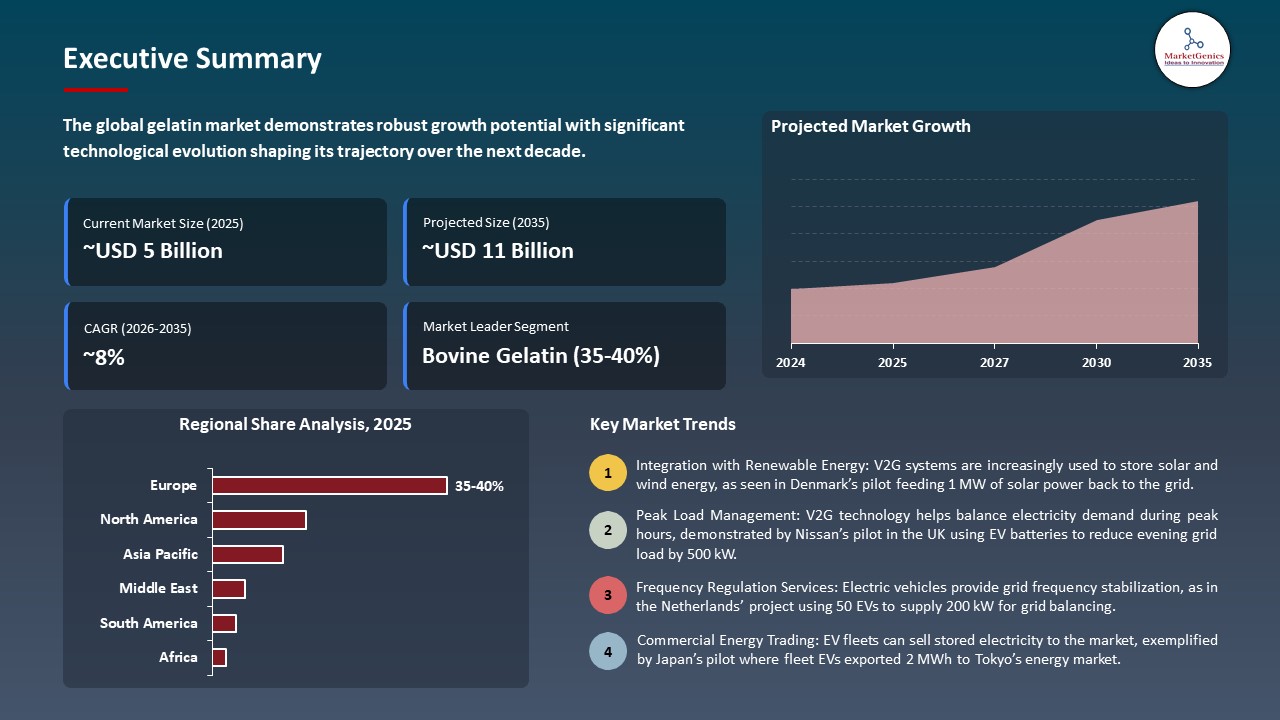
The global gelatin market is experiencing robust growth, with its estimated value of USD 4.8 billion in the year 2025 and USD 10.7 billion by the period 2035, registering a CAGR of 8.3%, during the forecast period. The global gelatin market is growing because pharmaceutical, nutraceutical and functional foods companies are growing more conscious about the significance of high-purity, reliable and traceable gelatin. Increasing demand in terms of uniform product performance, solubility, digestibility and adherence to halal, kosher and safety dictates is propelling its consumption in capsules, soft-gummies, and dietary supplements and soft-gelles in soft-gummies and dietary supplements.
Chuck Newswanger, Director, Global Commercial Innovation and Technical Development Pharmaceutical Packaging at CSI, said, In the OTC and nutraceutical market, child-resistant closures demonstrate a brand’s commitment to consumer safety and regulatory compliance. A well-engineered design meets the expectations of today’s health-conscious shoppers, ensures compliance, and integrates seamlessly with high-speed filling and capping lines.
The global gelatin market is evolving into a strategic facilitator of pharmaceutical, nutraceutical, functional food, and dietary supplements besides being a simple ingredient. Increased regulatory pressure, consumer interest in product safety, and the need to have high-purity ingredients is driving manufacturers to considering gelatin as one of the most important functional and quality-assurance ingredients in capsules, soft-gels, gummies and specialty formulations.
This shift is being brought about by the material innovation and formulation advances. Producers are targeting high levels of purity, sustainably produced bovine and porcine gelatin, which have better solubility, digestibility and stability and satisfy halal, kosher and traceability requirements. Gelatin-based dosage forms including soft-gels and gummies offer the added benefit of precise dosing, extended shelf-life and portability to support consumer convenience and supply-chain effectiveness.
Production that is amenable to automation, scalable sourcing, and circular-economy efforts are helping manufacturers to enter into new markets with demanding regulation. Gelatin has now been placed as high-end, functional and regulation-compliant ingredient reinforcing product differentiation, consumer trust and international market penetration.
Gelatin Market Dynamics and Trends
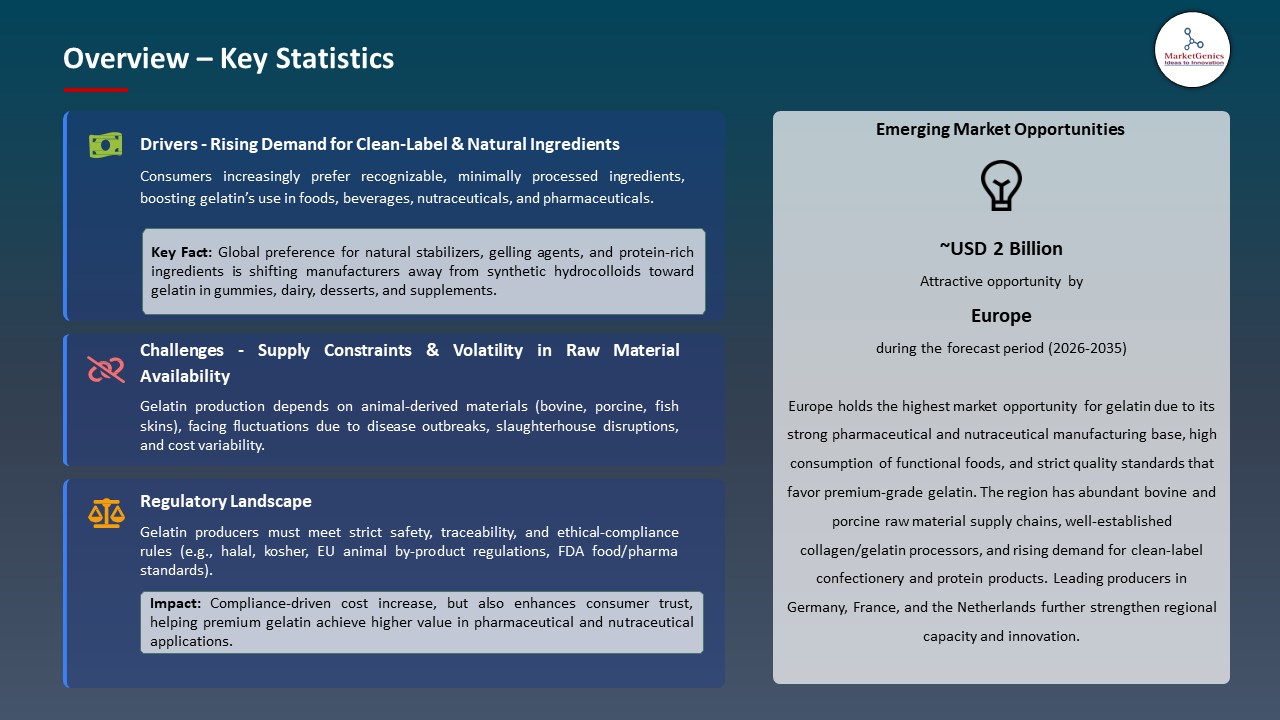
Driver: Rising Demand for Gelatin in Pharmaceuticals and Nutraceuticals
-
The global gelatin market owing to increasing use in capsules, soft-gels, functional supplements and nutraceutical product. The rise in demand by consumers of convenient and protein fortified, and clean-labeled supplements is pushing pharmaceutical and nutraceutical firms to adopt high-purity gelatin as one of the critical functional ingredients. Gelatin improves bioavailability, texture and stability of capsules, soft-gels and gummies and other dosages forms, product efficacy and consumer satisfaction.
- The manufacturers are ever coming up with innovations in order to meet the functional, regulatory, and quality demands. The focus is on enhancing solubility, digestibility, and performance of the product without violating international standards of pharmaceuticals, nutraceutical, and food usage. This spurs research in new gelatin formulations and grades which are high-performance and can be used in specialty applications.
- The global gelatin market is experiencing long-term growth due to factors such as regulatory compliance, product efficacy, and growing consumer concerns about health, nutrition, and safety.
Restraint: Volatility in Raw-Material Supply and Regulatory Challenges
-
Gelatin market depends on supplies of animal protein such as bovine hides, porcine skins and fish by-products. There are seasonal variations in the supply of livestock, disease outbreaks, and restrictions on imports and exports which may interfere with supply chains causing unstable availability and prices.
- The fact that the gelatin is of high purity and is of the pharmaceutical- or nutraceutical-grade also further adds to the cost pressures. The manufacturers have to maintain standard functionality, high quality of safety and traceability which adds complexity in operations and raises the cost of production.
- Regulatory compliance is an additional barrier. Manufacturers must comply with food safety regulations, halal and kosher certification, and worldwide traceability, which may slow down the approval process, increase the expense of testing and inspection, and limit their ability to obtain raw materials fast.
- These regulatory and supply problems limit the scalability of gelatin production and the rapid growth of high-quality gelatin as functional foods, nutraceuticals, and pharmaceutical goods in the international market.
Opportunity: Expansion of Gelatin in Functional Foods and Supplements
-
The global gelatin market is experiencing robustness in the functional foods, dietary products and protein-enriched products. The increasing consumer preference toward clean-label foods and beverages with high protein content and fortification enriches is fueling the trend in manufacturers to increase their consumption of gelatin in bars, gummies, soft-gels, and other nutraceutical delivery systems.
- Produces and producers are inventing to place functionality and nutritional benefits together. For instance, in April 2023, purchase of Gelnex, a Brazilian gelatin and collagen manufacturer, by Darling Ingredients that increases their manufacturing capacity to approximately 46,000 tonnes per year. This growth reinforces world supply of gelatin in nutraceuticals, pharmaceutical and functional foods, and promotes escalating demand of high-quality and functional gelatin products.
- New gelatin formulations are being developed to boost proteins, low-calorie foods, and dietary supplements, as consumers demand enriched and convenient products. The incorporation of gelatin into functional foods and supplements is another significant growth opportunity for the global nutraceutical and food markets.
Key Trend: Innovation in High-Purity and Sustainable Gelatin
-
The global gelatin market is shifting towards high purity and sustainable manufactured gelatin in pharmaceutical, nutraceutical, and high-value food products. Increasing trends in the demand of clean, functional and superior protein ingredients are prompting manufacturers to focus on better consistency, safety and sustainability of production processes in regard to environmental quality.
- The production processes are getting updated to enhance functionality and environmental friendliness. In 2025, Gelita AG installed a new bovine gelatin plant in Europe that will produce high-quality gelatin to use in the capsules, soft-gels, and nutritional product markets with the focus on sustainable sourcing and effective use of the by-products of the meat industry.
- Sustainable production practices include sustainable extraction, optimum raw material utilization, and a circular economy. Bovine hides and bones can be transformed into gelatin and collagen products. These technologies reduce waste, increase functional characteristics, and reinstall high purity, sustainable gelatin as a vital ingredient in global pharmaceutical, nutraceutical, and food markets.
Gelatin-Market Analysis and Segmental Data
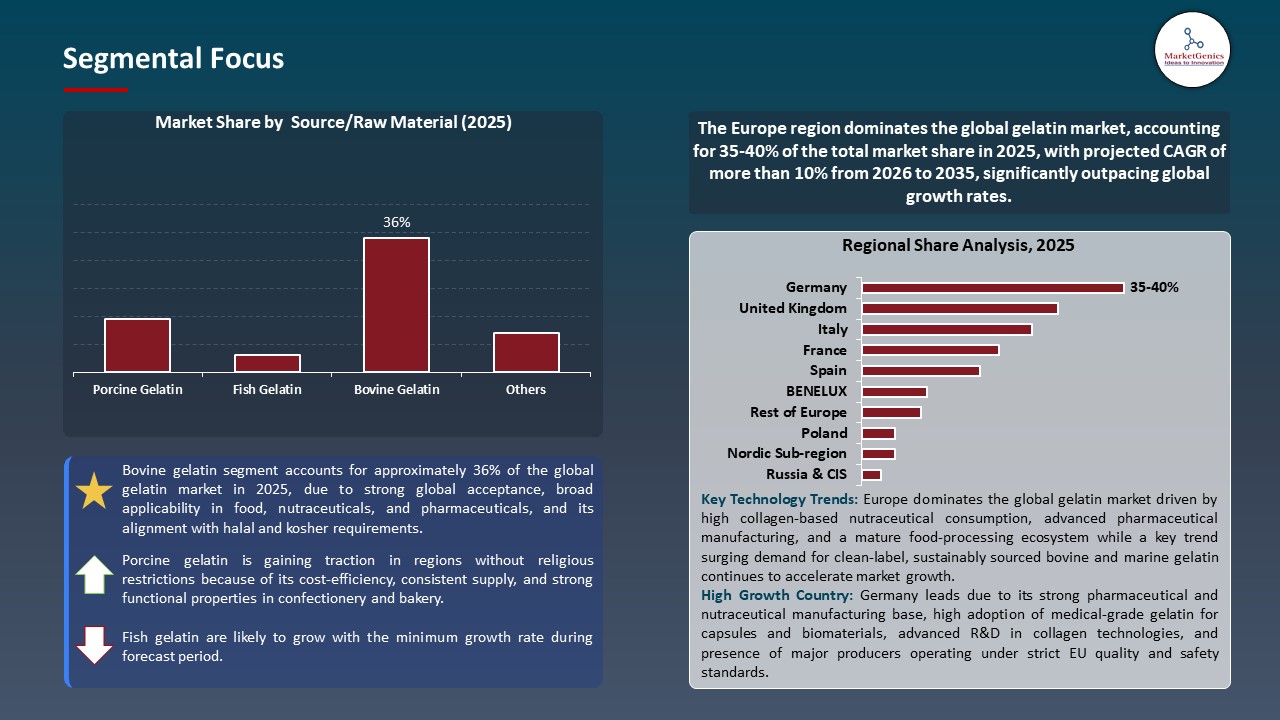
Bovine Gelatin Dominate Global Gelatin Market
-
Bovine gelatin leads the global gelatin market because it is highly reliable, complies with regulations, and performs its functional role in the pharmaceutical, nutraceutical, and food and beverage products. Its characteristics of constant gelling, stabilization and binding make it safe to handle and produce formulations of the highest quality in capsules, soft-gels, and functional foods.
- Trends on innovation are on high purity, standard bovine gelatin to use in advanced application. For instance, in july 2025, , Closure Systems International (CSI) released the Defender-Lok Child-Resistant Closure, a recyclable OTC and nutraceutical bottle cap, that improves safety and compliance of the gelatin-containing product and facilitates production lines.
- Bovine gelatin is versatile, scalable, and compatible with pharmaceutical and food processing technology. Despite meeting regulatory, quality, and functional standards, it remains the preferred medicine in the global pharmaceutical, nutraceutical, and food sectors.
Europe Leads Global Gelatin Market Demand
-
Europe leads the global gelatin market, as pharmaceuticals, nutraceuticals, confectionery, dairy, and personal-care markets present significant demand in the gelatin market. Mature healthcare and food-processing industries, and growing use of dietary supplements, soft-gel capsules, and functional foods are the spurring forces to steady use of high-quality gelatin.
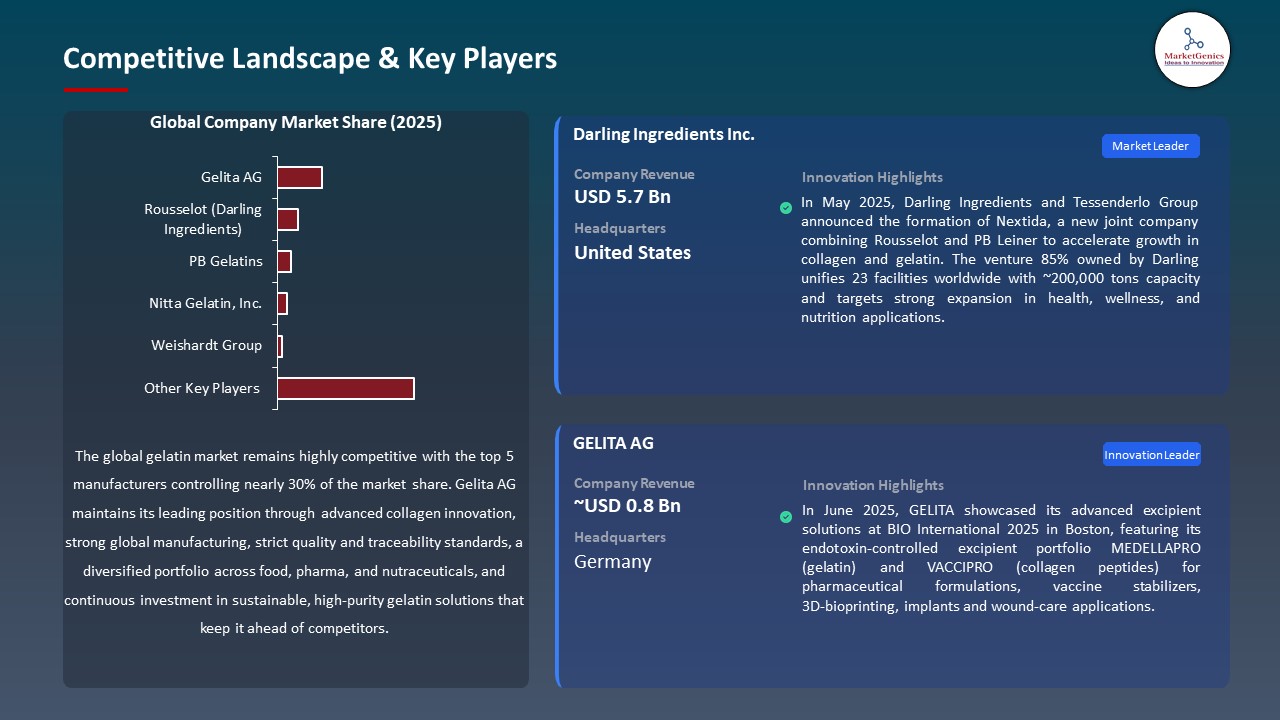
- Manufacturers and ingredient suppliers are increasing output and innovation to meet compliance, quality, and sustainability standards. For example, Rousselot (Darling Ingredients) and PB Leiner (Tessenderlo Group) announced the formation of Nextida, a new worldwide gelatin and collagen joint venture, by pooling their resources to improve supply reliability and capacity.
- The initiative helps the expansion of the European market and targets high-value pharmaceutical, nutraceutical, and food items. Investing in local production, innovative extraction processes, and effective quality control strengthens European supply networks.
- These factors provide European companies a strong position in the gelatin industry, allowing them to provide reliable, regulation-compliant, and cost-effective gelatin to the pharmaceutical, nutraceutical, and food industries in international markets.
Gelatin-Market Ecosystem
The global gelatin market is moderately competitive with multinational collagen-based ingredient producers and sophisticated biofunctional materials developers serving the food and beverage sector, nutraceutical industry, pharmaceutical industry, orthopedic and cosmetic markets.
High-purity gelatin, customized bloom-strength products, pharmaceutical excipients, and collagen peptides of the next generation are controlled by Gelita AG, Rousselot (Darling Ingredients), PB Gelatins, Nitta Gelatin, Inc., and Weishardt Group. The combination of their processing networks, adherence to global pharmacopeial standards (USP, EP, JP) and constant innovation of bioactive formulations enables them to provide consistent quality, high traceability and scalable supplies globally.
Gelatin value chain extends to the bovine, porcine, piscine and specialty collagen suppliers, extraction and refining facilities, hydrolysate processing facilities, formulation partners, capsule manufacturers, functional food brands, and downstream retail and clinical distribution network. The ecosystem is being reinforced by making specific investments in enzymatic extraction, low-endotoxin refinement, clean-label refinement, and collagen alternatives supported by precision-fermentation.
Necessary stakeholders are increasingly using closed-loop resource management, digital batch monitoring, and contamination-free automated systems to achieve functional performance, sustainability measurements, and consistency of various end-use applications. These strategic priorities encompass the vertical control of its raw materials, reduction of allergens, tailored molecular-weight profiles, and efficient production lines which cater to the increasing global demands of safety, purity and biofunctional value.
Recent Development and Strategic Overview
-
In January 2025, GELITA unveiled a new line of endotoxin regulated gelatin and collagen excipients, VACCIPRO and MEDELLAPRO, used in vaccines, medical devices and increased bioprocessing. The release enhanced the safety standards of biopharma through the provision of high-endotoxin and high-purity materials to enable injectable, implantable, and 3D-bioprinting activity.
- In December 2024, BIO INX announced BIORES INX, a gelatin-based DLP (digital light processing) resin to 3D bioprint using gelatin with natural extracellular-matrix characteristics at the same time as high biocompatibility and processing at room temperature in December 2024. The resin is ISO 10993-5 biocompatibility, which makes sterilization and workflow of tissue-engineering bio-medical and bio-fabrication easier.
Report Scope
|
Detail |
|
|
Market Size in 2025 |
USD 4.8 Bn |
|
Market Forecast Value in 2035 |
USD 10.7 Bn |
|
Growth Rate (CAGR) |
8.3% |
|
Forecast Period |
2026 – 2035 |
|
Historical Data Available for |
2021 – 2024 |
|
Market Size Units |
US$ Billion for Value Tons for Volume |
|
Report Format |
Electronic (PDF) + Excel |
|
North America |
Europe |
Asia Pacific |
Middle East |
Africa |
South America |
|
|
|
|
|
|
|
Companies Covered |
|||||
|
|
|
|
|
|
Gelatin-Market Segmentation and Highlights
|
Segment |
Sub-segment |
|
Gelatin Market, By Source/Raw Material |
|
|
Gelatin Market, By Type |
|
|
Gelatin Market, By Form |
|
|
Gelatin Market, By Grade/Quality |
|
|
Gelatin Market, By Function |
|
|
Gelatin Market, By Bloom Strength |
|
|
Gelatin Market, By Application |
|
|
Gelatin Market, By Distribution Channel |
|
Frequently Asked Questions
Table of Contents
- 1. Research Methodology and Assumptions
- 1.1. Definitions
- 1.2. Research Design and Approach
- 1.3. Data Collection Methods
- 1.4. Base Estimates and Calculations
- 1.5. Forecasting Models
- 1.5.1. Key Forecast Factors & Impact Analysis
- 1.6. Secondary Research
- 1.6.1. Open Sources
- 1.6.2. Paid Databases
- 1.6.3. Associations
- 1.7. Primary Research
- 1.7.1. Primary Sources
- 1.7.2. Primary Interviews with Stakeholders across Ecosystem
- 2. Executive Summary
- 2.1. Global Gelatin Market Outlook
- 2.1.1. Gelatin Market Size Volume (Tons) and Value (US$ Bn), and Forecasts, 2021-2035
- 2.1.2. Compounded Annual Growth Rate Analysis
- 2.1.3. Growth Opportunity Analysis
- 2.1.4. Segmental Share Analysis
- 2.1.5. Geographical Share Analysis
- 2.2. Market Analysis and Facts
- 2.3. Supply-Demand Analysis
- 2.4. Competitive Benchmarking
- 2.5. Go-to- Market Strategy
- 2.5.1. Customer/ End-use Industry Assessment
- 2.5.2. Growth Opportunity Data, 2026-2035
- 2.5.2.1. Regional Data
- 2.5.2.2. Country Data
- 2.5.2.3. Segmental Data
- 2.5.3. Identification of Potential Market Spaces
- 2.5.4. GAP Analysis
- 2.5.5. Potential Attractive Price Points
- 2.5.6. Prevailing Market Risks & Challenges
- 2.5.7. Preferred Sales & Marketing Strategies
- 2.5.8. Key Recommendations and Analysis
- 2.5.9. A Way Forward
- 2.1. Global Gelatin Market Outlook
- 3. Industry Data and Premium Insights
- 3.1. Global Food & Beverages Industry Overview, 2025
- 3.1.1. Food & Beverages Industry Ecosystem Analysis
- 3.1.2. Key Trends for Food & Beverages Industry
- 3.1.3. Regional Distribution for Food & Beverages Industry
- 3.2. Supplier Customer Data
- 3.3. Technology Roadmap and Developments
- 3.4. Trade Analysis
- 3.4.1. Import & Export Analysis, 2025
- 3.4.2. Top Importing Countries
- 3.4.3. Top Exporting Countries
- 3.5. Trump Tariff Impact Analysis
- 3.5.1. Manufacturer
- 3.5.1.1. Based on the component & Raw material
- 3.5.2. Supply Chain
- 3.5.3. End Consumer
- 3.5.1. Manufacturer
- 3.6. Raw Material Analysis
- 3.1. Global Food & Beverages Industry Overview, 2025
- 4. Market Overview
- 4.1. Market Dynamics
- 4.1.1. Drivers
- 4.1.1.1. Increasing demand from food & beverages industry (gummies, desserts, dairy products).
- 4.1.1.2. Growing use in pharmaceutical and nutraceutical applications (capsules, supplements).
- 4.1.1.3. Rising adoption in cosmetics and personal care products (skincare, collagen-based products).
- 4.1.2. Restraints
- 4.1.2.1. High dependency on animal sources, limiting vegetarian/vegan acceptance.
- 4.1.2.2. Strict regulatory standards and quality compliance requirements across regions.
- 4.1.1. Drivers
- 4.2. Key Trend Analysis
- 4.3. Regulatory Framework
- 4.3.1. Key Regulations, Norms, and Subsidies, by Key Countries
- 4.3.2. Tariffs and Standards
- 4.3.3. Impact Analysis of Regulations on the Market
- 4.4. Value Chain Analysis
- 4.4.1. Raw Material Suppliers
- 4.4.2. Gelatin Manufacturers
- 4.4.3. Distributors
- 4.4.4. End-Users
- 4.5. Cost Structure Analysis
- 4.5.1. Parameter’s Share for Cost Associated
- 4.5.2. COGP vs COGS
- 4.5.3. Profit Margin Analysis
- 4.6. Pricing Analysis
- 4.6.1. Regional Pricing Analysis
- 4.6.2. Segmental Pricing Trends
- 4.6.3. Factors Influencing Pricing
- 4.7. Porter’s Five Forces Analysis
- 4.8. PESTEL Analysis
- 4.9. Global Gelatin Market Demand
- 4.9.1. Historical Market Size – Volume (Tons) and Value (US$ Bn), 2020-2024
- 4.9.2. Current and Future Market Size – Volume (Tons) and Value (US$ Bn), 2026–2035
- 4.9.2.1. Y-o-Y Growth Trends
- 4.9.2.2. Absolute $ Opportunity Assessment
- 4.1. Market Dynamics
- 5. Competition Landscape
- 5.1. Competition structure
- 5.1.1. Fragmented v/s consolidated
- 5.2. Company Share Analysis, 2025
- 5.2.1. Global Company Market Share
- 5.2.2. By Region
- 5.2.2.1. North America
- 5.2.2.2. Europe
- 5.2.2.3. Asia Pacific
- 5.2.2.4. Middle East
- 5.2.2.5. Africa
- 5.2.2.6. South America
- 5.3. Product Comparison Matrix
- 5.3.1. Specifications
- 5.3.2. Market Positioning
- 5.3.3. Pricing
- 5.1. Competition structure
- 6. Global Gelatin Market Analysis, by Source/Raw Material
- 6.1. Key Segment Analysis
- 6.2. Gelatin Market Size Volume (Tons) and Value (US$ Bn), Analysis, and Forecasts, by Source/Raw Material, 2021-2035
- 6.2.1. Porcine Gelatin
- 6.2.2. Bovine Gelatin
- 6.2.3. Fish Gelatin
- 6.2.4. Poultry Gelatin
- 6.2.5. Other Sources
- 7. Global Gelatin Market Analysis, by Type
- 7.1. Key Segment Analysis
- 7.2. Gelatin Market Size Volume (Tons) and Value (US$ Bn), Analysis, and Forecasts, by Type, 2021-2035
- 7.2.1. Type A Gelatin (Acid-treated)
- 7.2.2. Type B Gelatin (Alkali-treated)
- 8. Global Gelatin Market Analysis, by Form
- 8.1. Key Segment Analysis
- 8.2. Gelatin Market Size Volume (Tons) and Value (US$ Bn), Analysis, and Forecasts, by Form, 2021-2035
- 8.2.1. Powder
- 8.2.2. Granules
- 8.2.3. Sheets/Leaves
- 8.2.4. Liquid/Hydrolysate
- 9. Global Gelatin Market Analysis, by Grade/Quality
- 9.1. Key Segment Analysis
- 9.2. Gelatin Market Size Volume (Tons) and Value (US$ Bn), Analysis, and Forecasts, by Grade/Quality, 2021-2035
- 9.2.1. Pharmaceutical Grade
- 9.2.2. Food Grade
- 9.2.3. Industrial Grade
- 9.2.4. Photographic Grade
- 9.2.5. Technical Grade
- 10. Global Gelatin Market Analysis, by Function
- 10.1. Key Segment Analysis
- 10.2. Gelatin Market Size Volume (Tons) and Value (US$ Bn), Analysis, and Forecasts, by Function, 2021-2035
- 10.2.1. Gelling Agent
- 10.2.2. Stabilizer
- 10.2.3. Thickener
- 10.2.4. Emulsifier
- 10.2.5. Coating Agent
- 10.2.6. Binding Agent
- 10.2.7. Clarifying Agent
- 10.2.8. Foaming Agent
- 10.2.9. Others
- 11. Global Gelatin Market Analysis, by Bloom Strength
- 11.1. Key Segment Analysis
- 11.2. Gelatin Market Size Volume (Tons) and Value (US$ Bn), Analysis, and Forecasts, by Bloom Strength, 2021-2035
- 11.2.1. Low Bloom (50-150)
- 11.2.2. Medium Bloom (150-220)
- 11.2.3. High Bloom (220-300)
- 12. Global Gelatin Market Analysis, by Application
- 12.1. Key Segment Analysis
- 12.2. Gelatin Market Size Volume (Tons) and Value (US$ Bn), Analysis, and Forecasts, by Application, 2021-2035
- 12.2.1. Beverages
- 12.2.2. Confectionery
- 12.2.3. Dairy Products
- 12.2.4. Meat Products
- 12.2.5. Desserts & Bakery
- 12.2.6. Nutraceuticals
- 12.2.7. Capsules (Hard & Soft)
- 12.2.8. Tablets
- 12.2.9. Wound Dressings
- 12.2.10. Implants & Drug Delivery
- 12.2.11. Cosmetics & Personal Care
- 12.2.12. Photography
- 12.2.13. Paper & Packaging
- 12.2.14. Other Application
- 13. Global Gelatin Market Analysis, by Distribution Channel
- 13.1. Key Segment Analysis
- 13.2. Gelatin Market Size Volume (Tons) and Value (US$ Bn), Analysis, and Forecasts, by Distribution Channel, 2021-2035
- 13.2.1. Direct Sales/B2B
- 13.2.2. Distributors
- 13.2.3. Online Retail
- 13.2.4. Offline Retail
- 14. Global Gelatin Market Analysis and Forecasts, by Region
- 14.1. Key Findings
- 14.2. Gelatin Market Size Volume (Tons) and Value (US$ Bn), Analysis, and Forecasts, by Region, 2021-2035
- 14.2.1. North America
- 14.2.2. Europe
- 14.2.3. Asia Pacific
- 14.2.4. Middle East
- 14.2.5. Africa
- 14.2.6. South America
- 15. North America Gelatin Market Analysis
- 15.1. Key Segment Analysis
- 15.2. Regional Snapshot
- 15.3. North America Gelatin Market Size- Volume (Tons) and Value (US$ Bn), Analysis, and Forecasts, 2021-2035
- 15.3.1. Source/Raw Material
- 15.3.2. Type
- 15.3.3. Form
- 15.3.4. Grade/Quality
- 15.3.5. Function
- 15.3.6. Bloom Strength
- 15.3.7. Application
- 15.3.8. Distribution Channel
- 15.3.9. Country
- 15.3.9.1. USA
- 15.3.9.2. Canada
- 15.3.9.3. Mexico
- 15.4. USA Gelatin Market
- 15.4.1. Country Segmental Analysis
- 15.4.2. Source/Raw Material
- 15.4.3. Type
- 15.4.4. Form
- 15.4.5. Grade/Quality
- 15.4.6. Function
- 15.4.7. Bloom Strength
- 15.4.8. Application
- 15.4.9. Distribution Channel
- 15.5. Canada Gelatin Market
- 15.5.1. Country Segmental Analysis
- 15.5.2. Source/Raw Material
- 15.5.3. Type
- 15.5.4. Form
- 15.5.5. Grade/Quality
- 15.5.6. Function
- 15.5.7. Bloom Strength
- 15.5.8. Application
- 15.5.9. Distribution Channel
- 15.6. Mexico Gelatin Market
- 15.6.1. Country Segmental Analysis
- 15.6.2. Source/Raw Material
- 15.6.3. Type
- 15.6.4. Form
- 15.6.5. Grade/Quality
- 15.6.6. Function
- 15.6.7. Bloom Strength
- 15.6.8. Application
- 15.6.9. Distribution Channel
- 16. Europe Gelatin Market Analysis
- 16.1. Key Segment Analysis
- 16.2. Regional Snapshot
- 16.3. Europe Gelatin Market Size Volume (Tons) and Value (US$ Bn), Analysis, and Forecasts, 2021-2035
- 16.3.1. Source/Raw Material
- 16.3.2. Type
- 16.3.3. Form
- 16.3.4. Grade/Quality
- 16.3.5. Function
- 16.3.6. Bloom Strength
- 16.3.7. Application
- 16.3.8. Distribution Channel
- 16.3.9. Country
- 16.3.9.1. Germany
- 16.3.9.2. United Kingdom
- 16.3.9.3. France
- 16.3.9.4. Italy
- 16.3.9.5. Spain
- 16.3.9.6. Netherlands
- 16.3.9.7. Nordic Countries
- 16.3.9.8. Poland
- 16.3.9.9. Russia & CIS
- 16.3.9.10. Rest of Europe
- 16.4. Germany Gelatin Market
- 16.4.1. Country Segmental Analysis
- 16.4.2. Source/Raw Material
- 16.4.3. Type
- 16.4.4. Form
- 16.4.5. Grade/Quality
- 16.4.6. Function
- 16.4.7. Bloom Strength
- 16.4.8. Application
- 16.4.9. Distribution Channel
- 16.5. United Kingdom Gelatin Market
- 16.5.1. Country Segmental Analysis
- 16.5.2. Source/Raw Material
- 16.5.3. Type
- 16.5.4. Form
- 16.5.5. Grade/Quality
- 16.5.6. Function
- 16.5.7. Bloom Strength
- 16.5.8. Application
- 16.5.9. Distribution Channel
- 16.6. France Gelatin Market
- 16.6.1. Country Segmental Analysis
- 16.6.2. Source/Raw Material
- 16.6.3. Type
- 16.6.4. Form
- 16.6.5. Grade/Quality
- 16.6.6. Function
- 16.6.7. Bloom Strength
- 16.6.8. Application
- 16.6.9. Distribution Channel
- 16.7. Italy Gelatin Market
- 16.7.1. Country Segmental Analysis
- 16.7.2. Source/Raw Material
- 16.7.3. Type
- 16.7.4. Form
- 16.7.5. Grade/Quality
- 16.7.6. Function
- 16.7.7. Bloom Strength
- 16.7.8. Application
- 16.7.9. Distribution Channel
- 16.8. Spain Gelatin Market
- 16.8.1. Country Segmental Analysis
- 16.8.2. Source/Raw Material
- 16.8.3. Type
- 16.8.4. Form
- 16.8.5. Grade/Quality
- 16.8.6. Function
- 16.8.7. Bloom Strength
- 16.8.8. Application
- 16.8.9. Distribution Channel
- 16.9. Netherlands Gelatin Market
- 16.9.1. Country Segmental Analysis
- 16.9.2. Source/Raw Material
- 16.9.3. Type
- 16.9.4. Form
- 16.9.5. Grade/Quality
- 16.9.6. Function
- 16.9.7. Bloom Strength
- 16.9.8. Application
- 16.9.9. Distribution Channel
- 16.10. Nordic Countries Gelatin Market
- 16.10.1. Country Segmental Analysis
- 16.10.2. Source/Raw Material
- 16.10.3. Type
- 16.10.4. Form
- 16.10.5. Grade/Quality
- 16.10.6. Function
- 16.10.7. Bloom Strength
- 16.10.8. Application
- 16.10.9. Distribution Channel
- 16.11. Poland Gelatin Market
- 16.11.1. Country Segmental Analysis
- 16.11.2. Source/Raw Material
- 16.11.3. Type
- 16.11.4. Form
- 16.11.5. Grade/Quality
- 16.11.6. Function
- 16.11.7. Bloom Strength
- 16.11.8. Application
- 16.11.9. Distribution Channel
- 16.12. Russia & CIS Gelatin Market
- 16.12.1. Country Segmental Analysis
- 16.12.2. Source/Raw Material
- 16.12.3. Type
- 16.12.4. Form
- 16.12.5. Grade/Quality
- 16.12.6. Function
- 16.12.7. Bloom Strength
- 16.12.8. Application
- 16.12.9. Distribution Channel
- 16.13. Rest of Europe Gelatin Market
- 16.13.1. Country Segmental Analysis
- 16.13.2. Source/Raw Material
- 16.13.3. Type
- 16.13.4. Form
- 16.13.5. Grade/Quality
- 16.13.6. Function
- 16.13.7. Bloom Strength
- 16.13.8. Application
- 16.13.9. Distribution Channel
- 17. Asia Pacific Gelatin Market Analysis
- 17.1. Key Segment Analysis
- 17.2. Regional Snapshot
- 17.3. Asia Pacific Gelatin Market Size Volume (Tons) and Value (US$ Bn), Analysis, and Forecasts, 2021-2035
- 17.3.1. Source/Raw Material
- 17.3.2. Type
- 17.3.3. Form
- 17.3.4. Grade/Quality
- 17.3.5. Function
- 17.3.6. Bloom Strength
- 17.3.7. Application
- 17.3.8. Distribution Channel
- 17.3.9. Country
- 17.3.9.1. China
- 17.3.9.2. India
- 17.3.9.3. Japan
- 17.3.9.4. South Korea
- 17.3.9.5. Australia and New Zealand
- 17.3.9.6. Indonesia
- 17.3.9.7. Malaysia
- 17.3.9.8. Thailand
- 17.3.9.9. Vietnam
- 17.3.9.10. Rest of Asia Pacific
- 17.4. China Gelatin Market
- 17.4.1. Country Segmental Analysis
- 17.4.2. Source/Raw Material
- 17.4.3. Type
- 17.4.4. Form
- 17.4.5. Grade/Quality
- 17.4.6. Function
- 17.4.7. Bloom Strength
- 17.4.8. Application
- 17.4.9. Distribution Channel
- 17.5. India Gelatin Market
- 17.5.1. Country Segmental Analysis
- 17.5.2. Source/Raw Material
- 17.5.3. Type
- 17.5.4. Form
- 17.5.5. Grade/Quality
- 17.5.6. Function
- 17.5.7. Bloom Strength
- 17.5.8. Application
- 17.5.9. Distribution Channel
- 17.6. Japan Gelatin Market
- 17.6.1. Country Segmental Analysis
- 17.6.2. Source/Raw Material
- 17.6.3. Type
- 17.6.4. Form
- 17.6.5. Grade/Quality
- 17.6.6. Function
- 17.6.7. Bloom Strength
- 17.6.8. Application
- 17.6.9. Distribution Channel
- 17.7. South Korea Gelatin Market
- 17.7.1. Country Segmental Analysis
- 17.7.2. Source/Raw Material
- 17.7.3. Type
- 17.7.4. Form
- 17.7.5. Grade/Quality
- 17.7.6. Function
- 17.7.7. Bloom Strength
- 17.7.8. Application
- 17.7.9. Distribution Channel
- 17.8. Australia and New Zealand Gelatin Market
- 17.8.1. Country Segmental Analysis
- 17.8.2. Source/Raw Material
- 17.8.3. Type
- 17.8.4. Form
- 17.8.5. Grade/Quality
- 17.8.6. Function
- 17.8.7. Bloom Strength
- 17.8.8. Application
- 17.8.9. Distribution Channel
- 17.9. Indonesia Gelatin Market
- 17.9.1. Country Segmental Analysis
- 17.9.2. Source/Raw Material
- 17.9.3. Type
- 17.9.4. Form
- 17.9.5. Grade/Quality
- 17.9.6. Function
- 17.9.7. Bloom Strength
- 17.9.8. Application
- 17.9.9. Distribution Channel
- 17.10. Malaysia Gelatin Market
- 17.10.1. Country Segmental Analysis
- 17.10.2. Source/Raw Material
- 17.10.3. Type
- 17.10.4. Form
- 17.10.5. Grade/Quality
- 17.10.6. Function
- 17.10.7. Bloom Strength
- 17.10.8. Application
- 17.10.9. Distribution Channel
- 17.11. Thailand Gelatin Market
- 17.11.1. Country Segmental Analysis
- 17.11.2. Source/Raw Material
- 17.11.3. Type
- 17.11.4. Form
- 17.11.5. Grade/Quality
- 17.11.6. Function
- 17.11.7. Bloom Strength
- 17.11.8. Application
- 17.11.9. Distribution Channel
- 17.12. Vietnam Gelatin Market
- 17.12.1. Country Segmental Analysis
- 17.12.2. Source/Raw Material
- 17.12.3. Type
- 17.12.4. Form
- 17.12.5. Grade/Quality
- 17.12.6. Function
- 17.12.7. Bloom Strength
- 17.12.8. Application
- 17.12.9. Distribution Channel
- 17.13. Rest of Asia Pacific Gelatin Market
- 17.13.1. Country Segmental Analysis
- 17.13.2. Source/Raw Material
- 17.13.3. Type
- 17.13.4. Form
- 17.13.5. Grade/Quality
- 17.13.6. Function
- 17.13.7. Bloom Strength
- 17.13.8. Application
- 17.13.9. Distribution Channel
- 18. Middle East Gelatin Market Analysis
- 18.1. Key Segment Analysis
- 18.2. Regional Snapshot
- 18.3. Middle East Gelatin Market Size Volume (Tons) and Value (US$ Bn), Analysis, and Forecasts, 2021-2035
- 18.3.1. Source/Raw Material
- 18.3.2. Type
- 18.3.3. Form
- 18.3.4. Grade/Quality
- 18.3.5. Function
- 18.3.6. Bloom Strength
- 18.3.7. Application
- 18.3.8. Distribution Channel
- 18.3.9. Country
- 18.3.9.1. Turkey
- 18.3.9.2. UAE
- 18.3.9.3. Saudi Arabia
- 18.3.9.4. Israel
- 18.3.9.5. Rest of Middle East
- 18.4. Turkey Gelatin Market
- 18.4.1. Country Segmental Analysis
- 18.4.2. Source/Raw Material
- 18.4.3. Type
- 18.4.4. Form
- 18.4.5. Grade/Quality
- 18.4.6. Function
- 18.4.7. Bloom Strength
- 18.4.8. Application
- 18.4.9. Distribution Channel
- 18.5. UAE Gelatin Market
- 18.5.1. Country Segmental Analysis
- 18.5.2. Source/Raw Material
- 18.5.3. Type
- 18.5.4. Form
- 18.5.5. Grade/Quality
- 18.5.6. Function
- 18.5.7. Bloom Strength
- 18.5.8. Application
- 18.5.9. Distribution Channel
- 18.6. Saudi Arabia Gelatin Market
- 18.6.1. Country Segmental Analysis
- 18.6.2. Source/Raw Material
- 18.6.3. Type
- 18.6.4. Form
- 18.6.5. Grade/Quality
- 18.6.6. Function
- 18.6.7. Bloom Strength
- 18.6.8. Application
- 18.6.9. Distribution Channel
- 18.7. Israel Gelatin Market
- 18.7.1. Country Segmental Analysis
- 18.7.2. Source/Raw Material
- 18.7.3. Type
- 18.7.4. Form
- 18.7.5. Grade/Quality
- 18.7.6. Function
- 18.7.7. Bloom Strength
- 18.7.8. Application
- 18.7.9. Distribution Channel
- 18.8. Rest of Middle East Gelatin Market
- 18.8.1. Country Segmental Analysis
- 18.8.2. Source/Raw Material
- 18.8.3. Type
- 18.8.4. Form
- 18.8.5. Grade/Quality
- 18.8.6. Function
- 18.8.7. Bloom Strength
- 18.8.8. Application
- 18.8.9. Distribution Channel
- 19. Africa Gelatin Market Analysis
- 19.1. Key Segment Analysis
- 19.2. Regional Snapshot
- 19.3. Africa Gelatin Market Size Volume (Tons) and Value (US$ Bn), Analysis, and Forecasts, 2021-2035
- 19.3.1. Source/Raw Material
- 19.3.2. Type
- 19.3.3. Form
- 19.3.4. Grade/Quality
- 19.3.5. Function
- 19.3.6. Bloom Strength
- 19.3.7. Application
- 19.3.8. Distribution Channel
- 19.3.9. country
- 19.3.9.1. South Africa
- 19.3.9.2. Egypt
- 19.3.9.3. Nigeria
- 19.3.9.4. Algeria
- 19.3.9.5. Rest of Africa
- 19.4. South Africa Gelatin Market
- 19.4.1. Country Segmental Analysis
- 19.4.2. Source/Raw Material
- 19.4.3. Type
- 19.4.4. Form
- 19.4.5. Grade/Quality
- 19.4.6. Function
- 19.4.7. Bloom Strength
- 19.4.8. Application
- 19.4.9. Distribution Channel
- 19.5. Egypt Gelatin Market
- 19.5.1. Country Segmental Analysis
- 19.5.2. Source/Raw Material
- 19.5.3. Type
- 19.5.4. Form
- 19.5.5. Grade/Quality
- 19.5.6. Function
- 19.5.7. Bloom Strength
- 19.5.8. Application
- 19.5.9. Distribution Channel
- 19.6. Nigeria Gelatin Market
- 19.6.1. Country Segmental Analysis
- 19.6.2. Source/Raw Material
- 19.6.3. Type
- 19.6.4. Form
- 19.6.5. Grade/Quality
- 19.6.6. Function
- 19.6.7. Bloom Strength
- 19.6.8. Application
- 19.6.9. Distribution Channel
- 19.7. Algeria Gelatin Market
- 19.7.1. Country Segmental Analysis
- 19.7.2. Source/Raw Material
- 19.7.3. Type
- 19.7.4. Form
- 19.7.5. Grade/Quality
- 19.7.6. Function
- 19.7.7. Bloom Strength
- 19.7.8. Application
- 19.7.9. Distribution Channel
- 19.8. Rest of Africa Gelatin Market
- 19.8.1. Country Segmental Analysis
- 19.8.2. Source/Raw Material
- 19.8.3. Type
- 19.8.4. Form
- 19.8.5. Grade/Quality
- 19.8.6. Function
- 19.8.7. Bloom Strength
- 19.8.8. Application
- 19.8.9. Distribution Channel
- 20. South America Gelatin Market Analysis
- 20.1. Key Segment Analysis
- 20.2. Regional Snapshot
- 20.3. South America Gelatin Market Size Volume (Tons) and Value (US$ Bn), Analysis, and Forecasts, 2021-2035
- 20.3.1. Source/Raw Material
- 20.3.2. Type
- 20.3.3. Form
- 20.3.4. Grade/Quality
- 20.3.5. Function
- 20.3.6. Bloom Strength
- 20.3.7. Application
- 20.3.8. Distribution Channel
- 20.3.9. Country
- 20.3.9.1. Brazil
- 20.3.9.2. Argentina
- 20.3.9.3. Rest of South America
- 20.4. Brazil Gelatin Market
- 20.4.1. Country Segmental Analysis
- 20.4.2. Source/Raw Material
- 20.4.3. Type
- 20.4.4. Form
- 20.4.5. Grade/Quality
- 20.4.6. Function
- 20.4.7. Bloom Strength
- 20.4.8. Application
- 20.4.9. Distribution Channel
- 20.5. Argentina Gelatin Market
- 20.5.1. Country Segmental Analysis
- 20.5.2. Source/Raw Material
- 20.5.3. Type
- 20.5.4. Form
- 20.5.5. Grade/Quality
- 20.5.6. Function
- 20.5.7. Bloom Strength
- 20.5.8. Application
- 20.5.9. Distribution Channel
- 20.6. Rest of South America Gelatin Market
- 20.6.1. Country Segmental Analysis
- 20.6.2. Source/Raw Material
- 20.6.3. Type
- 20.6.4. Form
- 20.6.5. Grade/Quality
- 20.6.6. Function
- 20.6.7. Bloom Strength
- 20.6.8. Application
- 20.6.9. Distribution Channel
- 21. Key Players/ Company Profile
- 21.1. Dongbao Bio-Tech Co., Ltd.
- 21.1.1. Company Details/ Overview
- 21.1.2. Company Financials
- 21.1.3. Key Customers and Competitors
- 21.1.4. Business/ Industry Portfolio
- 21.1.5. Product Portfolio/ Specification Details
- 21.1.6. Pricing Data
- 21.1.7. Strategic Overview
- 21.1.8. Recent Developments
- 21.2. Ewald Gelatine GmbH
- 21.3. GELCO SA
- 21.4. Gelita AG
- 21.5. Gelnex
- 21.6. Great Lakes Gelatin Company
- 21.7. Guangdong Huiyan Pharmaceutical Technology
- 21.8. Henan Boom Gelatin Co., Ltd.
- 21.9. Holista CollTech Limited
- 21.10. India Gelatine & Chemicals Ltd.
- 21.11. Italgelatine S.p.A.
- 21.12. Jellice Group
- 21.13. Junca Gelatines SL
- 21.14. Lapi Gelatine S.p.A.
- 21.15. Narmada Gelatines Ltd.
- 21.16. Nitta Gelatin Inc.
- 21.17. PB Gelatins
- 21.18. Qinghai Gelatin Co., Ltd.
- 21.19. Qunli Gelatin Chemical Co., Ltd.
- 21.20. REINERT GRUPPE Ingredients
- 21.21. Rousselot (Darling Ingredients)
- 21.22. Sterling Gelatin
- 21.23. Tessenderlo Group (PB Leiner)
- 21.24. Trobas Gelatine B.V.
- 21.25. Weishardt Group
- 21.26. Yasin Gelatin
- 21.27. Other Key Players
- 21.1. Dongbao Bio-Tech Co., Ltd.
Note* - This is just tentative list of players. While providing the report, we will cover more number of players based on their revenue and share for each geography
Research Design
Our research design integrates both demand-side and supply-side analysis through a balanced combination of primary and secondary research methodologies. By utilizing both bottom-up and top-down approaches alongside rigorous data triangulation methods, we deliver robust market intelligence that supports strategic decision-making.
MarketGenics' comprehensive research design framework ensures the delivery of accurate, reliable, and actionable market intelligence. Through the integration of multiple research approaches, rigorous validation processes, and expert analysis, we provide our clients with the insights needed to make informed strategic decisions and capitalize on market opportunities.

MarketGenics leverages a dedicated industry panel of experts and a comprehensive suite of paid databases to effectively collect, consolidate, and analyze market intelligence.
Our approach has consistently proven to be reliable and effective in generating accurate market insights, identifying key industry trends, and uncovering emerging business opportunities.
Through both primary and secondary research, we capture and analyze critical company-level data such as manufacturing footprints, including technical centers, R&D facilities, sales offices, and headquarters.
Our expert panel further enhances our ability to estimate market size for specific brands based on validated field-level intelligence.
Our data mining techniques incorporate both parametric and non-parametric methods, allowing for structured data collection, sorting, processing, and cleaning.
Demand projections are derived from large-scale data sets analyzed through proprietary algorithms, culminating in robust and reliable market sizing.
Research Approach
The bottom-up approach builds market estimates by starting with the smallest addressable market units and systematically aggregating them to create comprehensive market size projections.
This method begins with specific, granular data points and builds upward to create the complete market landscape.
Customer Analysis → Segmental Analysis → Geographical Analysis
The top-down approach starts with the broadest possible market data and systematically narrows it down through a series of filters and assumptions to arrive at specific market segments or opportunities.
This method begins with the big picture and works downward to increasingly specific market slices.
TAM → SAM → SOM


Research Methods
Desk / Secondary Research
While analysing the market, we extensively study secondary sources, directories, and databases to identify and collect information useful for this technical, market-oriented, and commercial report. Secondary sources that we utilize are not only the public sources, but it is a combination of Open Source, Associations, Paid Databases, MG Repository & Knowledgebase, and others.
- Company websites, annual reports, financial reports, broker reports, and investor presentations
- National government documents, statistical databases and reports
- News articles, press releases and web-casts specific to the companies operating in the market, Magazines, reports, and others
- We gather information from commercial data sources for deriving company specific data such as segmental revenue, share for geography, product revenue, and others
- Internal and external proprietary databases (industry-specific), relevant patent, and regulatory databases
- Governing Bodies, Government Organizations
- Relevant Authorities, Country-specific Associations for Industries
We also employ the model mapping approach to estimate the product level market data through the players' product portfolio
Primary Research
Primary research/ interviews is vital in analyzing the market. Most of the cases involves paid primary interviews. Primary sources include primary interviews through e-mail interactions, telephonic interviews, surveys as well as face-to-face interviews with the different stakeholders across the value chain including several industry experts.
| Type of Respondents | Number of Primaries |
|---|---|
| Tier 2/3 Suppliers | ~20 |
| Tier 1 Suppliers | ~25 |
| End-users | ~25 |
| Industry Expert/ Panel/ Consultant | ~30 |
| Total | ~100 |
MG Knowledgebase
• Repository of industry blog, newsletter and case studies
• Online platform covering detailed market reports, and company profiles
Forecasting Factors and Models
Forecasting Factors
- Historical Trends – Past market patterns, cycles, and major events that shaped how markets behave over time. Understanding past trends helps predict future behavior.
- Industry Factors – Specific characteristics of the industry like structure, regulations, and innovation cycles that affect market dynamics.
- Macroeconomic Factors – Economic conditions like GDP growth, inflation, and employment rates that affect how much money people have to spend.
- Demographic Factors – Population characteristics like age, income, and location that determine who can buy your product.
- Technology Factors – How quickly people adopt new technology and how much technology infrastructure exists.
- Regulatory Factors – Government rules, laws, and policies that can help or restrict market growth.
- Competitive Factors – Analyzing competition structure such as degree of competition and bargaining power of buyers and suppliers.
Forecasting Models / Techniques
Multiple Regression Analysis
- Identify and quantify factors that drive market changes
- Statistical modeling to establish relationships between market drivers and outcomes
Time Series Analysis – Seasonal Patterns
- Understand regular cyclical patterns in market demand
- Advanced statistical techniques to separate trend, seasonal, and irregular components
Time Series Analysis – Trend Analysis
- Identify underlying market growth patterns and momentum
- Statistical analysis of historical data to project future trends
Expert Opinion – Expert Interviews
- Gather deep industry insights and contextual understanding
- In-depth interviews with key industry stakeholders
Multi-Scenario Development
- Prepare for uncertainty by modeling different possible futures
- Creating optimistic, pessimistic, and most likely scenarios
Time Series Analysis – Moving Averages
- Sophisticated forecasting for complex time series data
- Auto-regressive integrated moving average models with seasonal components
Econometric Models
- Apply economic theory to market forecasting
- Sophisticated economic models that account for market interactions
Expert Opinion – Delphi Method
- Harness collective wisdom of industry experts
- Structured, multi-round expert consultation process
Monte Carlo Simulation
- Quantify uncertainty and probability distributions
- Thousands of simulations with varying input parameters
Research Analysis
Our research framework is built upon the fundamental principle of validating market intelligence from both demand and supply perspectives. This dual-sided approach ensures comprehensive market understanding and reduces the risk of single-source bias.
Demand-Side Analysis: We understand end-user/application behavior, preferences, and market needs along with the penetration of the product for specific application.
Supply-Side Analysis: We estimate overall market revenue, analyze the segmental share along with industry capacity, competitive landscape, and market structure.
Validation & Evaluation
Data triangulation is a validation technique that uses multiple methods, sources, or perspectives to examine the same research question, thereby increasing the credibility and reliability of research findings. In market research, triangulation serves as a quality assurance mechanism that helps identify and minimize bias, validate assumptions, and ensure accuracy in market estimates.
- Data Source Triangulation – Using multiple data sources to examine the same phenomenon
- Methodological Triangulation – Using multiple research methods to study the same research question
- Investigator Triangulation – Using multiple researchers or analysts to examine the same data
- Theoretical Triangulation – Using multiple theoretical perspectives to interpret the same data

Custom Market Research Services
We will customise the research for you, in case the report listed above does not meet your requirements.
Get 10% Free Customisation