Home Remodeling Market Size, Share & Trends Analysis Report by Project Type (Structural Remodeling, Interior Remodeling, Exterior Remodeling, Systems Upgrade), Material Type, Service Type, Technology Integration, Mode of Hiring, End-Users, and Geography (North America, Europe, Asia Pacific, Middle East, Africa, and South America) – Global Industry Data, Trends, and Forecasts, 2026–2035
|
|
|
Segmental Data Insights |
|
|
Demand Trends |
|
|
Competitive Landscape |
|
|
Strategic Development |
|
|
Future Outlook & Opportunities |
|
Home-Remodeling-Market Size, Share, and Growth
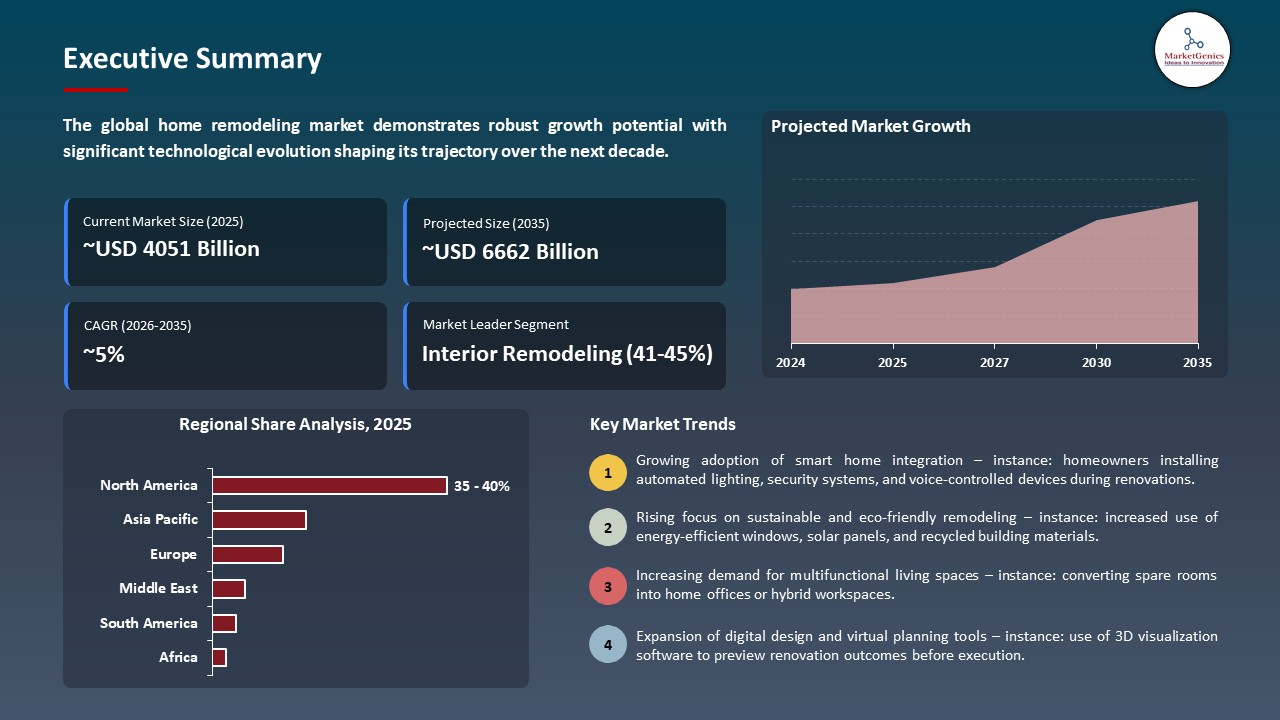
The global home remodeling market is witnessing strong growth, valued at USD 4051.1 billion in 2025 and projected to reach USD 6661.9 billion by 2035, expanding at a CAGR of 5.1% during the forecast period. The global home remodeling market is utilizing AI-based project management, real-time contractor allocation, and automated material tracking to ensure efficient project completion, optimal workforce utilization, and quality outcomes in urban and suburban remodeling projects.
Erica O'Brien, Sr. Marketing Manager – Reveal by KOHLER, said: "Reveal by KOHLER delivers a seamless bath and shower remodeling experience without the stress. Homeowners can expect a beautiful design, expert craftsmanship, and a convenient process that delivers quality results from a trusted and reputable brand."
The global home remodeling market is gaining immense traction, with more and more homeowners looking to create functional, beautiful, and tech-savvy spaces within their homes. The market is witnessing the increasing adoption of digital design tools, AI-based project planning, and virtual visualization technologies to accurately simulate interior layouts, materials, and budgets. For instance, in 2025, Wayfair introduced its AI-based tool, “Muse,” which enables homeowners to visualize unique interior styles and design concepts in real-time, driving remodeling inspiration. Modular interior designs, eco-friendly material usage, and smart home technologies are adding more flexibility to remodeling projects.
The application of AI in home remodeling projects has revolutionized the operational efficiency of remodeling service providers. AI-based technologies offer precise cost estimation, workflow management, and real-time contractor matching, creating more efficient project workflows. AI-based analytics and recommendations provide personalized design suggestions, project timelines, and pricing, ensuring more efficient project execution.
Adjacent opportunities in terms of smart home integrations, living solutions, and home ecosystems are changing the way the market competes. It is transforming into a digital-first, design-centric ecosystem, which encompasses all the players in the market, including contractors, technology companies, and suppliers. It is seamlessly integrating project planning, energy efficiency, and hyper-personalized interior living spaces. As a result, the global home remodeling market is transforming the way people live in the urban and suburban environments across the globe.
 Home Remodeling market Dynamics and Trends
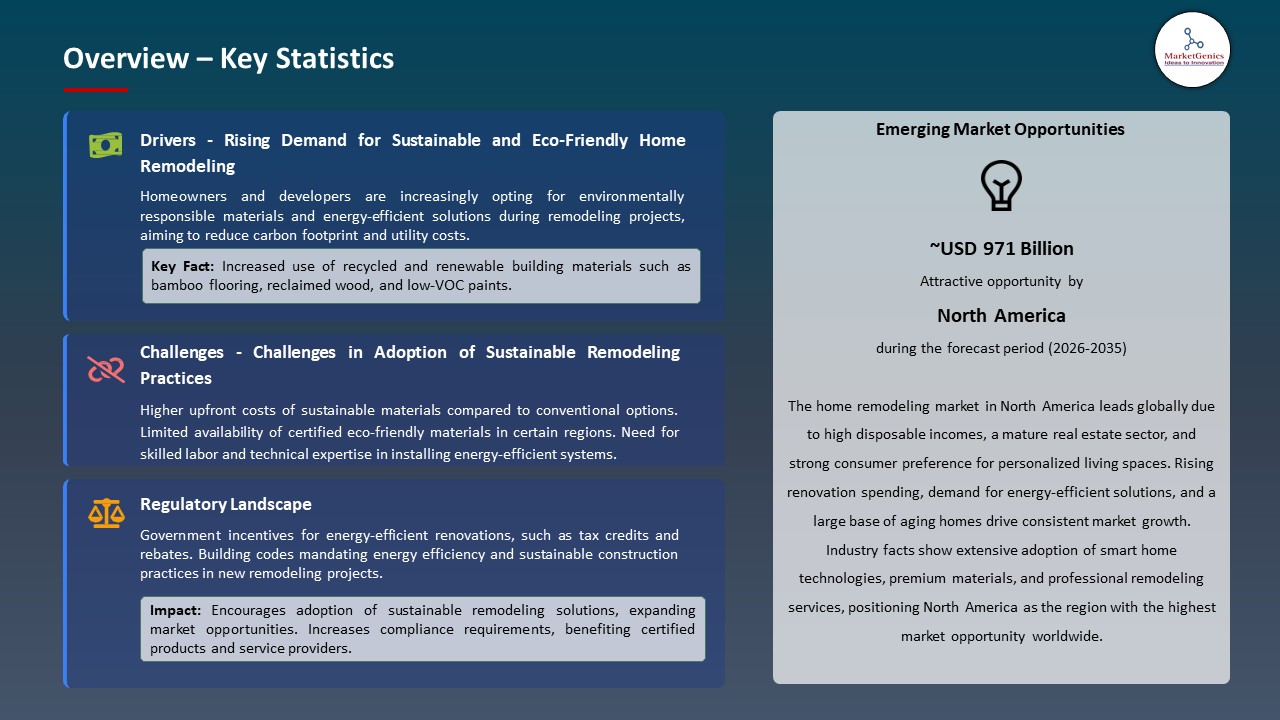
Driver: Rising Demand for Energy-Efficient and Sustainable Homes
-
The increasing integration of connected energy systems, AI-driven efficiency tools, and low-carbon building materials is driving the global home remodeling market, as homeowners seek cost savings, enhanced comfort, and sustainable living upgrades through renovation.
- Innovations in terms of smart home and energy management solutions are allowing homeowners to achieve the best possible results in terms of energy efficiency. For instance, in November 2024, Johnson Controls introduced AI-based features to its OpenBlue platform. These features will allow homeowners to integrate the best possible solutions for energy optimization and smart HVAC integrations.
- AI-based optimization, demand response, and efficiency in terms of HVAC integrations are making the global home remodeling market grow.
Restraint: High Cost of Materials and Remodeling Projects
-
Material costs, labor costs, and supply chain challenges are making the global home remodeling market less affordable.
- Additional cost burdens such as design consultation fees, permit approvals, compliance requirements, and investment in advanced tools and technologies are increasing total project expenses and extending renovation timelines, creating challenges for both contractors and homeowners.
- Material shortages and skilled labor dependence increase project costs and limit scalability.
Opportunity: Integration of Smart Home Technologies
-
Rapidly rising adoption of IoT-enabled devices, connected home ecosystems, and smart energy management solutions also provides significant opportunities, as it enables homeowners to increase the level of convenience, optimize energy consumption, and enhance security without significant structural changes.
- The trend of integrating smart devices with remodeling services is on the rise through partnerships between smart device manufacturers and home remodeling companies. For instance, in June 2025, Schneider Electric introduced its expanded smart home solutions for residences, offering integrated features for monitoring and automating energy consumption.
- Smart lighting solutions, automated temperature control solutions, and artificial intelligence-based home automation solutions are the major contributors to the growth of smart home remodeling.
Key Trend: Customization and Personalization of Living Spaces
-
The introduction of artificial intelligence-based virtual advisors, advanced design configuration solutions, and data-based recommendation solutions has helped in offering customized home remodeling solutions to homeowners.
- The trend of integrated personalization ecosystems is on the rise due to the integration of digital design solutions, product marketplaces, and home remodeling services through unified platforms. For instance, in March 2025, Lowe's Companies introduced its artificial intelligence-based virtual advisor, “MyLow,” in collaboration with OpenAI. The solution offers homeowners real-time guidance, personalization, and assistance for home improvement projects.
- Artificial intelligence-based recommendations, real-time solutions, and customization have enhanced the personalization of home remodeling solutions, thus increasing the overall value of home remodeling globally.
Home Remodeling Market Analysis and Segmental Data
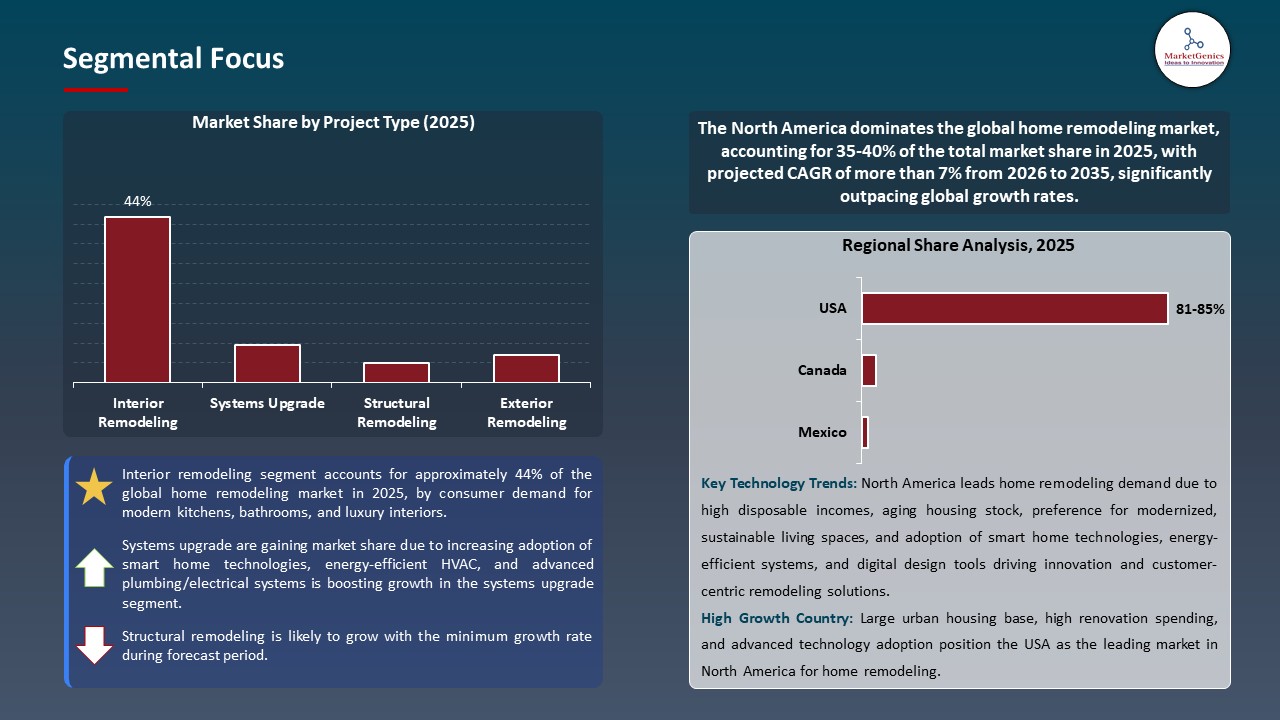
Interior Remodeling Dominate Global Home Remodeling Market
-
Interior remodeling has dominated the global home remodeling market due to the rising demand for kitchen, bathroom, and living space remodeling, along with the increase in the adoption of modular interior solutions.
- The increased rate of growth of AI-based project planning tools, digital procurement platforms, and smart renovation solutions is also driving growth. For instance, in January 2026, The Home Depot launched its Material List Builder AI, allowing contractors and remodelers to create a complete and accurate material list in minutes, thereby driving efficiency, accuracy, and interior remodeling project execution.
- The rise of personalized interiors, smart fixtures, and premium finishes continues to drive the leadership position of interior remodeling in the global home remodeling market.
North America Leads Global Home Remodeling Market Demand
-
The home remodeling market in North America leads in terms of growth, driven by strong contractor ecosystems, advanced retail infrastructure, and digitally integrated procurement platforms, making North America a leading region for technology-enabled residential remodeling activities.
- The rise of professional contractor services, digital solutions, and strategic partnerships is driving growth in the home remodeling market. For instance, in February 2026, Lowe's Companies strengthened its Pro experience for small and mid-sized contractors, thereby driving growth through digital tools, supply chain, and strategic partnerships.
- The strong contractor ecosystem and continuous innovation in digital solutions drive the leadership position of North America in terms of growth.
Home Remodeling Market Ecosystem
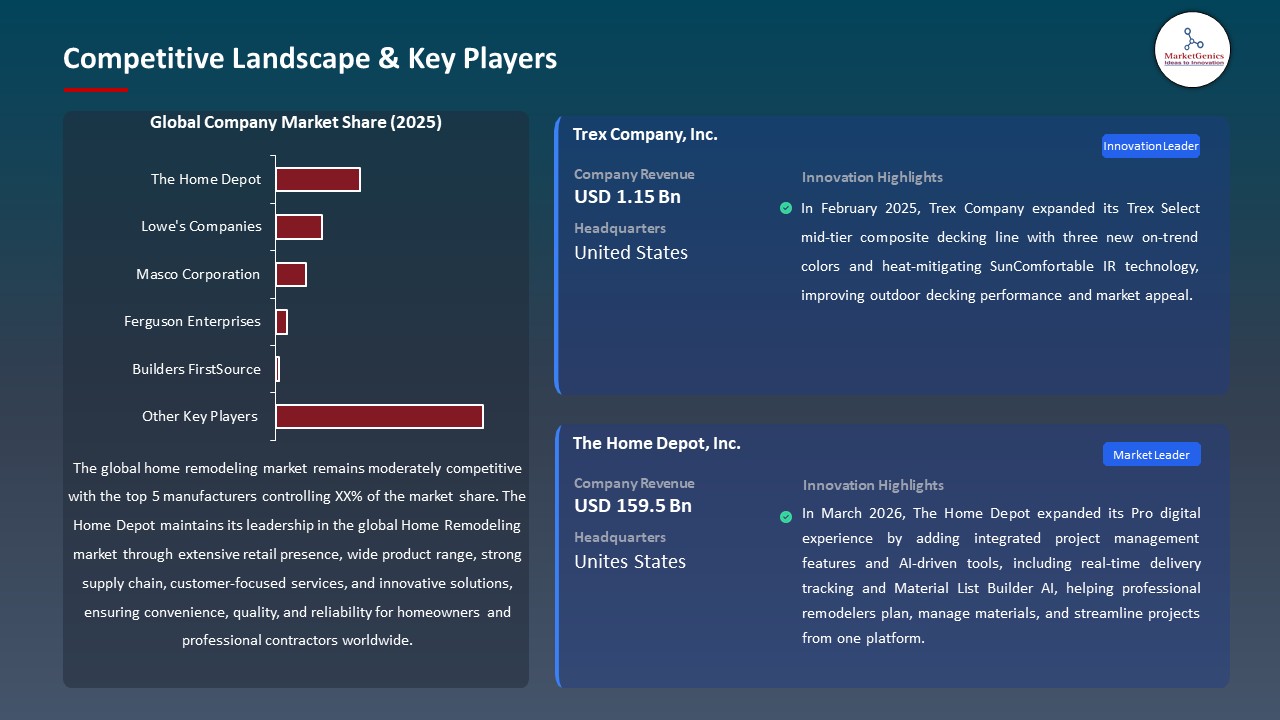
The global home remodeling market is moderately consolidated, and competition is based on integrated supply chains, digital project management tools, AI-based project planning tools, and advanced digital procurement solutions. The market share is high because of the presence of The Home Depot, Lowe's Companies, Masco Corporation, Ferguson Enterprises, and Builders FirstSource, offering integrated home remodeling solutions platforms.
The Home Depot is focused on omnichannel retailing, digital tools for contractors, and product distribution networks to ensure project efficiency and customer experience. Lowe’s Companies is focused on project planning tools enabled by AI, loyalty programs for professionals, and the integration of online and physical remodeling services to ensure improved customer experience. Masco Corporation is focused on building brands, innovation in plumbing and decorative architectural products, and distribution partnerships to ensure improved renovation activities. Ferguson Enterprises is focused on supply chain optimization, digital procurement tools, and product availability to ensure improved efficiency in the renovation activities of contractors.
Builders FirstSource is a multi-channel supplier with a focus on prefabrication solutions, value-added services, and partnerships with builders and contractors to ensure improved efficiency in the renovation activities. Interaction with the ecosystem is being fueled by the growing demand for home remodeling, the rise in urbanization, and the growing demand for personalized living spaces. This is helping the global home remodeling market to increase the level of competitiveness, efficiency, and customer loyalty to ensure improved customer experience with the help of efficient home renovation solutions.
 Recent Development and Strategic Overview
- In February 2026, Kohler Co. introduced its new remodeling service called “Reveal by Kohler”, which provides end-to-end renovation solutions for bath and shower renovations with the help of its strategic partnership with designer Genevieve Gorder to ensure improved customer-centric remodeling experiences.
- In March 2026, The Home Depot introduced its Pro digital experience with advanced project management tools and AI tools to ensure improved home remodeling project execution.
Report Scope
|
Detail |
|
|
Market Size in 2025 |
USD 4051.1 Bn |
|
Market Forecast Value in 2035 |
USD 6661.9 Bn |
|
Growth Rate (CAGR) |
5.1% |
|
Forecast Period |
2026 – 2035 |
|
Historical Data Available for |
2021 – 2024 |
|
Market Size Units |
US$ Billion for Value |
|
Report Format |
Electronic (PDF) + Excel |
|
North America |
Europe |
Asia Pacific |
Middle East |
Africa |
South America |
|
|
|
|
|
|
|
Companies Covered |
|||||
|
|
|
|
|
|
Home Remodeling Market Segmentation and Highlights
|
Segment |
Sub-segment |
|
Home Remodeling Market, By Project Type |
|
|
Home Remodeling Market, By Material Type |
|
|
Home Remodeling Market, By Service Type |
|
|
Home Remodeling Market, By Technology Integration |
|
|
Home Remodeling Market, By Mode of Hiring |
|
|
Home Remodeling Market, End-Users |
|
Frequently Asked Questions
Table of Contents
- 1. Research Methodology and Assumptions
- 1.1. Definitions
- 1.2. Research Design and Approach
- 1.3. Data Collection Methods
- 1.4. Base Estimates and Calculations
- 1.5. Forecasting Models
- 1.5.1. Key Forecast Factors & Impact Analysis
- 1.6. Secondary Research
- 1.6.1. Open Sources
- 1.6.2. Paid Databases
- 1.6.3. Associations
- 1.7. Primary Research
- 1.7.1. Primary Sources
- 1.7.2. Primary Interviews with Stakeholders across Ecosystem
- 2. Executive Summary
- 2.1. Global Home Remodeling Market Outlook
- 2.1.1. Home Remodeling Market Size (Value - US$ Bn), and Forecasts, 2021-2035
- 2.1.2. Compounded Annual Growth Rate Analysis
- 2.1.3. Growth Opportunity Analysis
- 2.1.4. Segmental Share Analysis
- 2.1.5. Geographical Share Analysis
- 2.2. Market Analysis and Facts
- 2.3. Supply-Demand Analysis
- 2.4. Competitive Benchmarking
- 2.5. Go-to- Market Strategy
- 2.5.1. Customer/ End-use Industry Assessment
- 2.5.2. Growth Opportunity Data, 2026-2035
- 2.5.2.1. Regional Data
- 2.5.2.2. Country Data
- 2.5.2.3. Segmental Data
- 2.5.3. Identification of Potential Market Spaces
- 2.5.4. GAP Analysis
- 2.5.5. Potential Attractive Price Points
- 2.5.6. Prevailing Market Risks & Challenges
- 2.5.7. Preferred Sales & Marketing Strategies
- 2.5.8. Key Recommendations and Analysis
- 2.5.9. A Way Forward
- 2.1. Global Home Remodeling Market Outlook
- 3. Industry Data and Premium Insights
- 3.1. Global Consumer Goods & Services Industry Overview, 2025
- 3.1.1. Consumer Goods & Services Industry Ecosystem Analysis
- 3.1.2. Key Trends for Consumer Goods & Services Industry
- 3.1.3. Regional Distribution for Consumer Goods & Services Industry
- 3.2. Supplier Customer Data
- 3.3. Technology Roadmap and Developments
- 3.4. Trade Analysis
- 3.4.1. Import & Export Analysis, 2025
- 3.4.2. Top Importing Countries
- 3.4.3. Top Exporting Countries
- 3.5. Trump Tariff Impact Analysis
- 3.5.1. Manufacturer
- 3.5.1.1. Based on the component & Raw material
- 3.5.2. Supply Chain
- 3.5.3. End Consumer
- 3.5.1. Manufacturer
- 3.6. Raw Material Analysis
- 3.1. Global Consumer Goods & Services Industry Overview, 2025
- 4. Market Overview
- 4.1. Market Dynamics
- 4.1.1. Drivers
- 4.1.1.1. Rising disposable income and home improvement spending
- 4.1.1.2. Aging housing stock requiring renovation and upgrades
- 4.1.1.3. Increasing adoption of smart home and energy-efficient solutions.
- 4.1.2. Restraints
- 4.1.2.1. High cost of remodeling and raw material price fluctuations
- 4.1.2.2. Shortage of skilled labor and project delays
- 4.1.1. Drivers
- 4.2. Key Trend Analysis
- 4.3. Regulatory Framework
- 4.3.1. Key Regulations, Norms, and Subsidies, by Key Countries
- 4.3.2. Tariffs and Standards
- 4.3.3. Impact Analysis of Regulations on the Market
- 4.4. Value Chain Analysis
- 4.4.1. Raw Material Suppliers
- 4.4.2. Manufacturers
- 4.4.3. Dealers/ Distributors
- 4.4.4. End-Users/ Customers
- 4.5. Porter’s Five Forces Analysis
- 4.6. PESTEL Analysis
- 4.7. Global Home Remodeling Market Demand
- 4.7.1. Historical Market Size – Value (US$ Bn), 2020-2024
- 4.7.2. Current and Future Market Size – Value (US$ Bn), 2026–2035
- 4.7.2.1. Y-o-Y Growth Trends
- 4.7.2.2. Absolute $ Opportunity Assessment
- 4.1. Market Dynamics
- 5. Competition Landscape
- 5.1. Competition structure
- 5.1.1. Fragmented v/s consolidated
- 5.2. Company Share Analysis, 2025
- 5.2.1. Global Company Market Share
- 5.2.2. By Region
- 5.2.2.1. North America
- 5.2.2.2. Europe
- 5.2.2.3. Asia Pacific
- 5.2.2.4. Middle East
- 5.2.2.5. Africa
- 5.2.2.6. South America
- 5.3. Product Comparison Matrix
- 5.3.1. Specifications
- 5.3.2. Market Positioning
- 5.3.3. Pricing
- 5.1. Competition structure
- 6. Global Home Remodeling Market Analysis, by Project Type
- 6.1. Key Segment Analysis
- 6.2. Home Remodeling Market Size (Value - US$ Bn), Analysis, and Forecasts, by Project Type, 2021-2035
- 6.2.1. Structural Remodeling
- 6.2.1.1. Room Additions
- 6.2.1.2. Garage Conversions
- 6.2.1.3. Basement Finishing
- 6.2.1.4. Attic Conversions
- 6.2.1.5. Others
- 6.2.2. Interior Remodeling
- 6.2.2.1. Kitchen Remodeling
- 6.2.2.2. Bathroom Remodeling
- 6.2.2.3. Living Room & Bedroom Renovation
- 6.2.2.4. Basement & Attic Remodeling
- 6.2.2.5. Others
- 6.2.3. Exterior Remodeling
- 6.2.3.1. Roofing & Siding
- 6.2.3.2. Window & Door Replacement
- 6.2.3.3. Deck, Patio & Porch Addition
- 6.2.3.4. Driveway & Landscaping
- 6.2.3.5. Others
- 6.2.4. Systems Upgrade
- 6.2.4.1. HVAC System Replacement
- 6.2.4.2. Plumbing Upgrades
- 6.2.4.3. Electrical System Upgrades
- 6.2.4.4. Insulation & Weatherproofing
- 6.2.4.5. Others
- 6.2.1. Structural Remodeling
- 7. Global Home Remodeling Market Analysis, by Material Type
- 7.1. Key Segment Analysis
- 7.2. Home Remodeling Market Size (Value - US$ Bn), Analysis, and Forecasts, by Material Type, 2021-2035
- 7.2.1. Building Materials
- 7.2.1.1. Wood & Engineered Wood
- 7.2.1.2. Concrete & Masonry
- 7.2.1.3. Steel & Metal Framing
- 7.2.1.4. Composites & Laminates
- 7.2.1.5. Others
- 7.2.2. Flooring Materials
- 7.2.2.1. Hardwood & Laminate
- 7.2.2.2. Ceramic & Porcelain Tiles
- 7.2.2.3. Vinyl & Luxury Vinyl Plank (LVP)
- 7.2.2.4. Carpet & Rugs
- 7.2.2.5. Others
- 7.2.3. Wall & Ceiling Materials
- 7.2.3.1. Drywall & Gypsum Board
- 7.2.3.2. Paneling & Wainscoting
- 7.2.3.3. Paint & Coatings
- 7.2.3.4. Wallcoverings & Wallpaper
- 7.2.3.5. Others
- 7.2.4. Roofing Materials
- 7.2.4.1. Asphalt Shingles
- 7.2.4.2. Metal Roofing
- 7.2.4.3. Clay & Concrete Tiles
- 7.2.4.4. Flat Roof Membranes
- 7.2.4.5. Others
- 7.2.5. Insulation Materials
- 7.2.5.1. Fiberglass Batts
- 7.2.5.2. Spray Foam Insulation
- 7.2.5.3. Rigid Foam Board
- 7.2.5.4. Cellulose Insulation
- 7.2.5.5. Others
- 7.2.6. Doors & Windows
- 7.2.6.1. Entry Doors (Wood, Fiberglass, Steel)
- 7.2.6.2. Interior Doors
- 7.2.6.3. Single/Double/Triple Pane Windows
- 7.2.6.4. Skylights & Glass Blocks
- 7.2.6.5. Others
- 7.2.7. Cabinetry & Millwork
- 7.2.7.1. Stock Cabinets
- 7.2.7.2. Semi-Custom Cabinets
- 7.2.7.3. Custom Cabinets
- 7.2.7.4. Trim, Molding & Millwork
- 7.2.7.5. Others
- 7.2.8. Plumbing Fixtures & Fittings
- 7.2.8.1. Faucets & Sinks
- 7.2.8.2. Bathtubs & Showers
- 7.2.8.3. Toilets & Bidets
- 7.2.8.4. Pipes & Valves
- 7.2.8.5. Others
- 7.2.1. Building Materials
- 8. Global Home Remodeling Market Analysis, by Service Type
- 8.1. Key Segment Analysis
- 8.2. Home Remodeling Market Size (Value - US$ Bn), Analysis, and Forecasts, by Service Type, 2021-2035
- 8.2.1. Design & Architecture Services
- 8.2.1.1. Interior Design Consulting
- 8.2.1.2. Architectural Planning & Drafting
- 8.2.1.3. 3D Visualization & Rendering
- 8.2.1.4. Others
- 8.2.2. Construction & Installation Services
- 8.2.2.1. General Contracting
- 8.2.2.2. Specialty Trade Work
- 8.2.2.3. Carpentry & Joinery
- 8.2.2.4. Others
- 8.2.3. Repair & Maintenance Services
- 8.2.3.1. Structural Repair
- 8.2.3.2. Cosmetic Restoration
- 8.2.3.3. Preventive Maintenance
- 8.2.3.4. Others
- 8.2.4. Smart Home Integration Services
- 8.2.4.1. Home Automation Setup
- 8.2.4.2. Security System Installation
- 8.2.4.3. Energy Management System Integration
- 8.2.4.4. Others
- 8.2.1. Design & Architecture Services
- 9. Global Home Remodeling Market Analysis, by Technology Integration
- 9.1. Key Segment Analysis
- 9.2. Home Remodeling Market Size (Value - US$ Bn), Analysis, and Forecasts, by Technology Integration, 2021-2035
- 9.2.1. Conventional / Traditional Remodeling
- 9.2.2. Smart Home Technology Integration
- 9.2.2.1. Smart Lighting Systems
- 9.2.2.2. Smart Thermostats & HVAC Controls
- 9.2.2.3. Home Security & Surveillance
- 9.2.2.4. Voice-Assisted & IoT-Enabled Appliances
- 9.2.2.5. Others
- 9.2.3. Green & Sustainable Technology
- 9.2.3.1. Solar Panel Installation
- 9.2.3.2. Energy-Efficient Window Systems
- 9.2.3.3. Rainwater Harvesting Systems
- 9.2.3.4. Green Roofing Systems
- 9.2.3.5. Others
- 9.2.4. Prefabricated & Modular Solutions
- 9.2.4.1. Modular Kitchen Units
- 9.2.4.2. Prefabricated Bathroom Pods
- 9.2.4.3. Panelized Wall Systems
- 9.2.4.4. Others
- 10. Global Home Remodeling Market Analysis, by Mode of Hiring
- 10.1. Key Segment Analysis
- 10.2. Home Remodeling Market Size (Value - US$ Bn), Analysis, and Forecasts, by Mode of Hiring, 2021-2035
- 10.2.1. DIY (Do-It-Yourself)
- 10.2.1.1. DIY with Retail Product Purchase
- 10.2.1.2. DIY with Online Tutorial Assistance
- 10.2.2. Professional Contractors
- 10.2.2.1. General Contractors
- 10.2.2.2. Specialty Subcontractors
- 10.2.3. Hybrid Model (DIY + Professional for Different Phases)
- 10.2.4. Design-Build Firms
- 10.2.5. Franchise-Based Remodeling Companies
- 10.2.1. DIY (Do-It-Yourself)
- 11. Global Home Remodeling Market Analysis, by End-Users
- 11.1. Key Segment Analysis
- 11.2. Home Remodeling Market Size (Value - US$ Bn), Analysis, and Forecasts, by End-Users, 2021-2035
- 11.2.1. Residential
- 11.2.1.1. Single-Family Homes
- 11.2.1.2. Multi-Family Housing
- 11.2.1.3. Vacation & Second Homes
- 11.2.1.4. Senior & Assisted Living Residences
- 11.2.1.5. Others
- 11.2.2. Hospitality
- 11.2.2.1. Hotels & Motels
- 11.2.2.2. Resorts & Boutique Properties
- 11.2.2.3. Bed & Breakfasts
- 11.2.2.4. Others
- 11.2.3. Healthcare & Senior Care
- 11.2.3.1. Hospitals & Clinics
- 11.2.3.2. Nursing Homes & Senior Living Facilities
- 11.2.3.3. Medical & Dental Offices
- 11.2.3.4. Others
- 11.2.4. Retail & Commercial
- 11.2.4.1. Retail Stores & Shopping Centers
- 11.2.4.2. Restaurants & Food Service Outlets
- 11.2.4.3. Office Buildings
- 11.2.4.4. Others
- 11.2.5. Education
- 11.2.5.1. K–12 Schools
- 11.2.5.2. Colleges & Universities
- 11.2.5.3. Vocational & Training Centers
- 11.2.5.4. Others
- 11.2.6. Government & Institutional
- 11.2.6.1. Public Housing Projects
- 11.2.6.2. Municipal & Government Buildings
- 11.2.6.3. Historic & Heritage Properties
- 11.2.6.4. Others
- 11.2.7. Real Estate & Property Investment
- 11.2.7.1. House Flippers & Real Estate Investors
- 11.2.7.2. Property Management Companies
- 11.2.7.3. REITs (Real Estate Investment Trusts)
- 11.2.7.4. Others
- 11.2.8. Industrial & Adaptive Reuse
- 11.2.8.1. Warehouses & Factories
- 11.2.8.2. Mixed-Use Development Projects
- 11.2.1. Residential
- 12. Global Home Remodeling Market Analysis and Forecasts, by Region
- 12.1. Key Findings
- 12.2. Home Remodeling Market Size (Value - US$ Bn), Analysis, and Forecasts, by Region, 2021-2035
- 12.2.1. North America
- 12.2.2. Europe
- 12.2.3. Asia Pacific
- 12.2.4. Middle East
- 12.2.5. Africa
- 12.2.6. South America
- 13. North America Home Remodeling Market Analysis
- 13.1. Key Segment Analysis
- 13.2. Regional Snapshot
- 13.3. North America Home Remodeling Market Size (Value - US$ Bn), Analysis, and Forecasts, 2021-2035
- 13.3.1. Project Type
- 13.3.2. Material Type
- 13.3.3. Service Type
- 13.3.4. Technology Integration
- 13.3.5. Mode of Hiring
- 13.3.6. End-Users
- 13.3.7. Country
- 13.3.7.1. USA
- 13.3.7.2. Canada
- 13.3.7.3. Mexico
- 13.4. USA Home Remodeling Market
- 13.4.1. Country Segmental Analysis
- 13.4.2. Project Type
- 13.4.3. Material Type
- 13.4.4. Service Type
- 13.4.5. Technology Integration
- 13.4.6. Mode of Hiring
- 13.4.7. End-Users
- 13.5. Canada Home Remodeling Market
- 13.5.1. Country Segmental Analysis
- 13.5.2. Project Type
- 13.5.3. Material Type
- 13.5.4. Service Type
- 13.5.5. Technology Integration
- 13.5.6. Mode of Hiring
- 13.5.7. End-Users
- 13.6. Mexico Home Remodeling Market
- 13.6.1. Country Segmental Analysis
- 13.6.2. Project Type
- 13.6.3. Material Type
- 13.6.4. Service Type
- 13.6.5. Technology Integration
- 13.6.6. Mode of Hiring
- 13.6.7. End-Users
- 14. Europe Home Remodeling Market Analysis
- 14.1. Key Segment Analysis
- 14.2. Regional Snapshot
- 14.3. Europe Home Remodeling Market Size (Value - US$ Bn), Analysis, and Forecasts, 2021-2035
- 14.3.1. Project Type
- 14.3.2. Material Type
- 14.3.3. Service Type
- 14.3.4. Technology Integration
- 14.3.5. Mode of Hiring
- 14.3.6. End-Users
- 14.3.7. Country
- 14.3.7.1. Germany
- 14.3.7.2. United Kingdom
- 14.3.7.3. France
- 14.3.7.4. Italy
- 14.3.7.5. Spain
- 14.3.7.6. Netherlands
- 14.3.7.7. Nordic Countries
- 14.3.7.8. Poland
- 14.3.7.9. Russia & CIS
- 14.3.7.10. Rest of Europe
- 14.4. Germany Home Remodeling Market
- 14.4.1. Country Segmental Analysis
- 14.4.2. Project Type
- 14.4.3. Material Type
- 14.4.4. Service Type
- 14.4.5. Technology Integration
- 14.4.6. Mode of Hiring
- 14.4.7. End-Users
- 14.5. United Kingdom Home Remodeling Market
- 14.5.1. Country Segmental Analysis
- 14.5.2. Project Type
- 14.5.3. Material Type
- 14.5.4. Service Type
- 14.5.5. Technology Integration
- 14.5.6. Mode of Hiring
- 14.5.7. End-Users
- 14.6. France Home Remodeling Market
- 14.6.1. Country Segmental Analysis
- 14.6.2. Project Type
- 14.6.3. Material Type
- 14.6.4. Service Type
- 14.6.5. Technology Integration
- 14.6.6. Mode of Hiring
- 14.6.7. End-Users
- 14.7. Italy Home Remodeling Market
- 14.7.1. Country Segmental Analysis
- 14.7.2. Project Type
- 14.7.3. Material Type
- 14.7.4. Service Type
- 14.7.5. Technology Integration
- 14.7.6. Mode of Hiring
- 14.7.7. End-Users
- 14.8. Spain Home Remodeling Market
- 14.8.1. Country Segmental Analysis
- 14.8.2. Project Type
- 14.8.3. Material Type
- 14.8.4. Service Type
- 14.8.5. Technology Integration
- 14.8.6. Mode of Hiring
- 14.8.7. End-Users
- 14.9. Netherlands Home Remodeling Market
- 14.9.1. Country Segmental Analysis
- 14.9.2. Project Type
- 14.9.3. Material Type
- 14.9.4. Service Type
- 14.9.5. Technology Integration
- 14.9.6. Mode of Hiring
- 14.9.7. End-Users
- 14.10. Nordic Countries Home Remodeling Market
- 14.10.1. Country Segmental Analysis
- 14.10.2. Project Type
- 14.10.3. Material Type
- 14.10.4. Service Type
- 14.10.5. Technology Integration
- 14.10.6. Mode of Hiring
- 14.10.7. End-Users
- 14.11. Poland Home Remodeling Market
- 14.11.1. Country Segmental Analysis
- 14.11.2. Project Type
- 14.11.3. Material Type
- 14.11.4. Service Type
- 14.11.5. Technology Integration
- 14.11.6. Mode of Hiring
- 14.11.7. End-Users
- 14.12. Russia & CIS Home Remodeling Market
- 14.12.1. Country Segmental Analysis
- 14.12.2. Project Type
- 14.12.3. Material Type
- 14.12.4. Service Type
- 14.12.5. Technology Integration
- 14.12.6. Mode of Hiring
- 14.12.7. End-Users
- 14.13. Rest of Europe Home Remodeling Market
- 14.13.1. Country Segmental Analysis
- 14.13.2. Project Type
- 14.13.3. Material Type
- 14.13.4. Service Type
- 14.13.5. Technology Integration
- 14.13.6. Mode of Hiring
- 14.13.7. End-Users
- 15. Asia Pacific Home Remodeling Market Analysis
- 15.1. Key Segment Analysis
- 15.2. Regional Snapshot
- 15.3. Asia Pacific Home Remodeling Market Size (Value - US$ Bn), Analysis, and Forecasts, 2021-2035
- 15.3.1. Project Type
- 15.3.2. Material Type
- 15.3.3. Service Type
- 15.3.4. Technology Integration
- 15.3.5. Mode of Hiring
- 15.3.6. End-Users
- 15.3.7. Country
- 15.3.7.1. China
- 15.3.7.2. India
- 15.3.7.3. Japan
- 15.3.7.4. South Korea
- 15.3.7.5. Australia and New Zealand
- 15.3.7.6. Indonesia
- 15.3.7.7. Malaysia
- 15.3.7.8. Thailand
- 15.3.7.9. Vietnam
- 15.3.7.10. Rest of Asia Pacific
- 15.4. China Home Remodeling Market
- 15.4.1. Country Segmental Analysis
- 15.4.2. Project Type
- 15.4.3. Material Type
- 15.4.4. Service Type
- 15.4.5. Technology Integration
- 15.4.6. Mode of Hiring
- 15.4.7. End-Users
- 15.5. India Home Remodeling Market
- 15.5.1. Country Segmental Analysis
- 15.5.2. Project Type
- 15.5.3. Material Type
- 15.5.4. Service Type
- 15.5.5. Technology Integration
- 15.5.6. Mode of Hiring
- 15.5.7. End-Users
- 15.6. Japan Home Remodeling Market
- 15.6.1. Country Segmental Analysis
- 15.6.2. Project Type
- 15.6.3. Material Type
- 15.6.4. Service Type
- 15.6.5. Technology Integration
- 15.6.6. Mode of Hiring
- 15.6.7. End-Users
- 15.7. South Korea Home Remodeling Market
- 15.7.1. Country Segmental Analysis
- 15.7.2. Project Type
- 15.7.3. Material Type
- 15.7.4. Service Type
- 15.7.5. Technology Integration
- 15.7.6. Mode of Hiring
- 15.7.7. End-Users
- 15.8. Australia and New Zealand Home Remodeling Market
- 15.8.1. Country Segmental Analysis
- 15.8.2. Project Type
- 15.8.3. Material Type
- 15.8.4. Service Type
- 15.8.5. Technology Integration
- 15.8.6. Mode of Hiring
- 15.8.7. End-Users
- 15.9. Indonesia Home Remodeling Market
- 15.9.1. Country Segmental Analysis
- 15.9.2. Project Type
- 15.9.3. Material Type
- 15.9.4. Service Type
- 15.9.5. Technology Integration
- 15.9.6. Mode of Hiring
- 15.9.7. End-Users
- 15.10. Malaysia Home Remodeling Market
- 15.10.1. Country Segmental Analysis
- 15.10.2. Project Type
- 15.10.3. Material Type
- 15.10.4. Service Type
- 15.10.5. Technology Integration
- 15.10.6. Mode of Hiring
- 15.10.7. End-Users
- 15.11. Thailand Home Remodeling Market
- 15.11.1. Country Segmental Analysis
- 15.11.2. Project Type
- 15.11.3. Material Type
- 15.11.4. Service Type
- 15.11.5. Technology Integration
- 15.11.6. Mode of Hiring
- 15.11.7. End-Users
- 15.12. Vietnam Home Remodeling Market
- 15.12.1. Country Segmental Analysis
- 15.12.2. Project Type
- 15.12.3. Material Type
- 15.12.4. Service Type
- 15.12.5. Technology Integration
- 15.12.6. Mode of Hiring
- 15.12.7. End-Users
- 15.13. Rest of Asia Pacific Home Remodeling Market
- 15.13.1. Country Segmental Analysis
- 15.13.2. Project Type
- 15.13.3. Material Type
- 15.13.4. Service Type
- 15.13.5. Technology Integration
- 15.13.6. Mode of Hiring
- 15.13.7. End-Users
- 16. Middle East Home Remodeling Market Analysis
- 16.1. Key Segment Analysis
- 16.2. Regional Snapshot
- 16.3. Middle East Home Remodeling Market Size (Value - US$ Bn), Analysis, and Forecasts, 2021-2035
- 16.3.1. Project Type
- 16.3.2. Material Type
- 16.3.3. Service Type
- 16.3.4. Technology Integration
- 16.3.5. Mode of Hiring
- 16.3.6. End-Users
- 16.3.7. Country
- 16.3.7.1. Turkey
- 16.3.7.2. UAE
- 16.3.7.3. Saudi Arabia
- 16.3.7.4. Israel
- 16.3.7.5. Rest of Middle East
- 16.4. Turkey Home Remodeling Market
- 16.4.1. Country Segmental Analysis
- 16.4.2. Project Type
- 16.4.3. Material Type
- 16.4.4. Service Type
- 16.4.5. Technology Integration
- 16.4.6. Mode of Hiring
- 16.4.7. End-Users
- 16.5. UAE Home Remodeling Market
- 16.5.1. Country Segmental Analysis
- 16.5.2. Project Type
- 16.5.3. Material Type
- 16.5.4. Service Type
- 16.5.5. Technology Integration
- 16.5.6. Mode of Hiring
- 16.5.7. End-Users
- 16.6. Saudi Arabia Home Remodeling Market
- 16.6.1. Country Segmental Analysis
- 16.6.2. Project Type
- 16.6.3. Material Type
- 16.6.4. Service Type
- 16.6.5. Technology Integration
- 16.6.6. Mode of Hiring
- 16.6.7. End-Users
- 16.7. Israel Home Remodeling Market
- 16.7.1. Country Segmental Analysis
- 16.7.2. Project Type
- 16.7.3. Material Type
- 16.7.4. Service Type
- 16.7.5. Technology Integration
- 16.7.6. Mode of Hiring
- 16.7.7. End-Users
- 16.8. Rest of Middle East Home Remodeling Market
- 16.8.1. Country Segmental Analysis
- 16.8.2. Project Type
- 16.8.3. Material Type
- 16.8.4. Service Type
- 16.8.5. Technology Integration
- 16.8.6. Mode of Hiring
- 16.8.7. End-Users
- 17. Africa Home Remodeling Market Analysis
- 17.1. Key Segment Analysis
- 17.2. Regional Snapshot
- 17.3. Africa Home Remodeling Market Size (Value - US$ Bn), Analysis, and Forecasts, 2021-2035
- 17.3.1. Project Type
- 17.3.2. Material Type
- 17.3.3. Service Type
- 17.3.4. Technology Integration
- 17.3.5. Mode of Hiring
- 17.3.6. End-Users
- 17.3.7. Country
- 17.3.7.1. South Africa
- 17.3.7.2. Egypt
- 17.3.7.3. Nigeria
- 17.3.7.4. Algeria
- 17.3.7.5. Rest of Africa
- 17.4. South Africa Home Remodeling Market
- 17.4.1. Country Segmental Analysis
- 17.4.2. Project Type
- 17.4.3. Material Type
- 17.4.4. Service Type
- 17.4.5. Technology Integration
- 17.4.6. Mode of Hiring
- 17.4.7. End-Users
- 17.5. Egypt Home Remodeling Market
- 17.5.1. Country Segmental Analysis
- 17.5.2. Project Type
- 17.5.3. Material Type
- 17.5.4. Service Type
- 17.5.5. Technology Integration
- 17.5.6. Mode of Hiring
- 17.5.7. End-Users
- 17.6. Nigeria Home Remodeling Market
- 17.6.1. Country Segmental Analysis
- 17.6.2. Project Type
- 17.6.3. Material Type
- 17.6.4. Service Type
- 17.6.5. Technology Integration
- 17.6.6. Mode of Hiring
- 17.6.7. End-Users
- 17.7. Algeria Home Remodeling Market
- 17.7.1. Country Segmental Analysis
- 17.7.2. Project Type
- 17.7.3. Material Type
- 17.7.4. Service Type
- 17.7.5. Technology Integration
- 17.7.6. Mode of Hiring
- 17.7.7. End-Users
- 17.8. Rest of Africa Home Remodeling Market
- 17.8.1. Country Segmental Analysis
- 17.8.2. Project Type
- 17.8.3. Material Type
- 17.8.4. Service Type
- 17.8.5. Technology Integration
- 17.8.6. Mode of Hiring
- 17.8.7. End-Users
- 18. South America Home Remodeling Market Analysis
- 18.1. Key Segment Analysis
- 18.2. Regional Snapshot
- 18.3. South America Home Remodeling Market Size (Value - US$ Bn), Analysis, and Forecasts, 2021-2035
- 18.3.1. Project Type
- 18.3.2. Material Type
- 18.3.3. Service Type
- 18.3.4. Technology Integration
- 18.3.5. Mode of Hiring
- 18.3.6. End-Users
- 18.3.7. Country
- 18.3.7.1. Brazil
- 18.3.7.2. Argentina
- 18.3.7.3. Rest of South America
- 18.4. Brazil Home Remodeling Market
- 18.4.1. Country Segmental Analysis
- 18.4.2. Project Type
- 18.4.3. Material Type
- 18.4.4. Service Type
- 18.4.5. Technology Integration
- 18.4.6. Mode of Hiring
- 18.4.7. End-Users
- 18.5. Argentina Home Remodeling Market
- 18.5.1. Country Segmental Analysis
- 18.5.2. Project Type
- 18.5.3. Material Type
- 18.5.4. Service Type
- 18.5.5. Technology Integration
- 18.5.6. Mode of Hiring
- 18.5.7. End-Users
- 18.6. Rest of South America Home Remodeling Market
- 18.6.1. Country Segmental Analysis
- 18.6.2. Project Type
- 18.6.3. Material Type
- 18.6.4. Service Type
- 18.6.5. Technology Integration
- 18.6.6. Mode of Hiring
- 18.6.7. End-Users
- 19. Key Players/ Company Profile
- 19.1. 84 Lumber Company
- 19.1.1. Company Details/ Overview
- 19.1.2. Company Financials
- 19.1.3. Key Customers and Competitors
- 19.1.4. Business/ Industry Portfolio
- 19.1.5. Product Portfolio/ Specification Details
- 19.1.6. Pricing Data
- 19.1.7. Strategic Overview
- 19.1.8. Recent Developments
- 19.2. ABC Supply Co.
- 19.3. American Woodmark Corporation
- 19.4. Andersen Corporation
- 19.5. Armstrong World Industries
- 19.6. Builders FirstSource
- 19.7. Ferguson Enterprises
- 19.8. Home Depot
- 19.9. JELD-WEN Holding
- 19.10. Louisiana-Pacific Corporation
- 19.11. Lowe's Companies
- 19.12. Marvin Windows and Doors
- 19.13. Masco Corporation
- 19.14. Menards
- 19.15. Mohawk Industries
- 19.16. Pella Corporation
- 19.17. Re-Bath LLC
- 19.18. Shaw Industries Group
- 19.19. Stanley Martin Homes
- 19.20. Trex Company
- 19.21. US LBM Holdings
- 19.22. USG Corporation
- 19.23. Other Key Players
- 19.1. 84 Lumber Company
Note* - This is just tentative list of players. While providing the report, we will cover more number of players based on their revenue and share for each geography
Research Design
Our research design integrates both demand-side and supply-side analysis through a balanced combination of primary and secondary research methodologies. By utilizing both bottom-up and top-down approaches alongside rigorous data triangulation methods, we deliver robust market intelligence that supports strategic decision-making.
MarketGenics' comprehensive research design framework ensures the delivery of accurate, reliable, and actionable market intelligence. Through the integration of multiple research approaches, rigorous validation processes, and expert analysis, we provide our clients with the insights needed to make informed strategic decisions and capitalize on market opportunities.
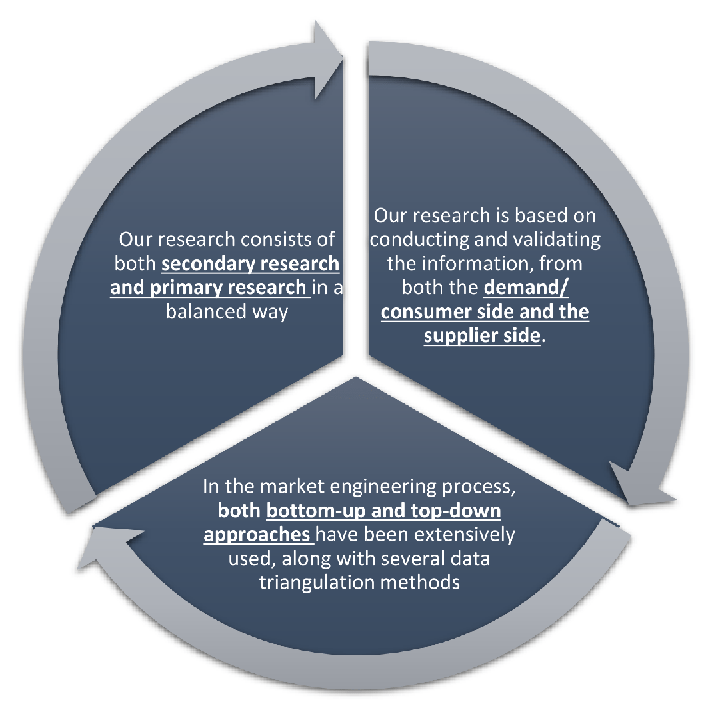
MarketGenics leverages a dedicated industry panel of experts and a comprehensive suite of paid databases to effectively collect, consolidate, and analyze market intelligence.
Our approach has consistently proven to be reliable and effective in generating accurate market insights, identifying key industry trends, and uncovering emerging business opportunities.
Through both primary and secondary research, we capture and analyze critical company-level data such as manufacturing footprints, including technical centers, R&D facilities, sales offices, and headquarters.
Our expert panel further enhances our ability to estimate market size for specific brands based on validated field-level intelligence.
Our data mining techniques incorporate both parametric and non-parametric methods, allowing for structured data collection, sorting, processing, and cleaning.
Demand projections are derived from large-scale data sets analyzed through proprietary algorithms, culminating in robust and reliable market sizing.
Research Approach
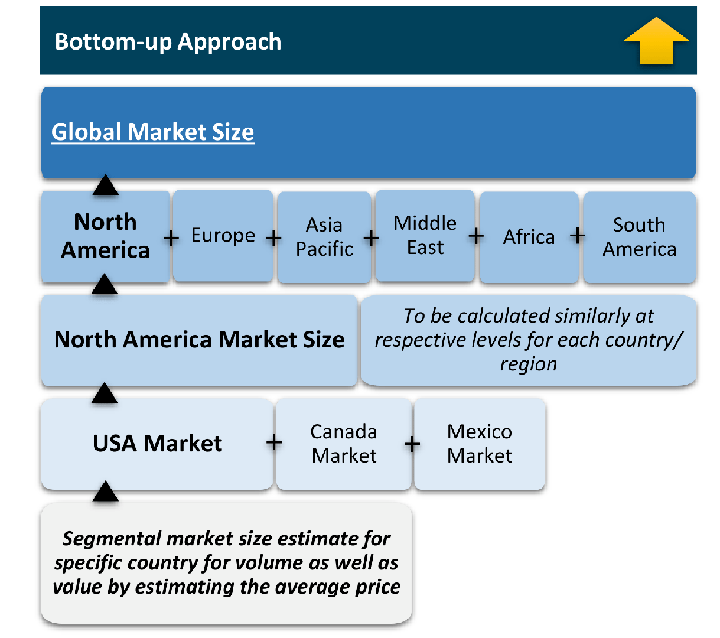
The bottom-up approach builds market estimates by starting with the smallest addressable market units and systematically aggregating them to create comprehensive market size projections.
This method begins with specific, granular data points and builds upward to create the complete market landscape.
Customer Analysis → Segmental Analysis → Geographical Analysis
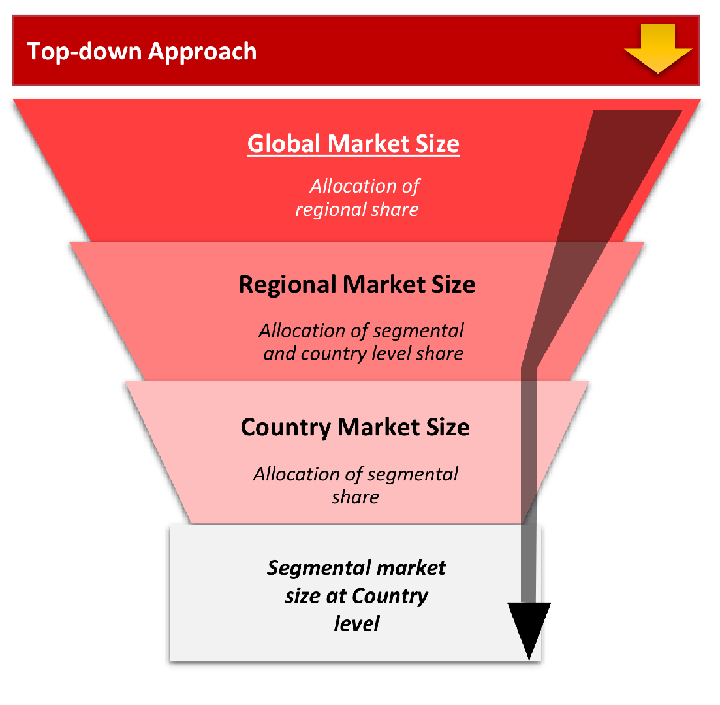
The top-down approach starts with the broadest possible market data and systematically narrows it down through a series of filters and assumptions to arrive at specific market segments or opportunities.
This method begins with the big picture and works downward to increasingly specific market slices.
TAM → SAM → SOM
Research Methods
Desk / Secondary Research
While analysing the market, we extensively study secondary sources, directories, and databases to identify and collect information useful for this technical, market-oriented, and commercial report. Secondary sources that we utilize are not only the public sources, but it is a combination of Open Source, Associations, Paid Databases, MG Repository & Knowledgebase, and others.
- Company websites, annual reports, financial reports, broker reports, and investor presentations
- National government documents, statistical databases and reports
- News articles, press releases and web-casts specific to the companies operating in the market, Magazines, reports, and others
- We gather information from commercial data sources for deriving company specific data such as segmental revenue, share for geography, product revenue, and others
- Internal and external proprietary databases (industry-specific), relevant patent, and regulatory databases
- Governing Bodies, Government Organizations
- Relevant Authorities, Country-specific Associations for Industries
We also employ the model mapping approach to estimate the product level market data through the players' product portfolio
Primary Research
Primary research/ interviews is vital in analyzing the market. Most of the cases involves paid primary interviews. Primary sources include primary interviews through e-mail interactions, telephonic interviews, surveys as well as face-to-face interviews with the different stakeholders across the value chain including several industry experts.
| Type of Respondents | Number of Primaries |
|---|---|
| Tier 2/3 Suppliers | ~20 |
| Tier 1 Suppliers | ~25 |
| End-users | ~25 |
| Industry Expert/ Panel/ Consultant | ~30 |
| Total | ~100 |
MG Knowledgebase
• Repository of industry blog, newsletter and case studies
• Online platform covering detailed market reports, and company profiles
Forecasting Factors and Models
Forecasting Factors
- Historical Trends – Past market patterns, cycles, and major events that shaped how markets behave over time. Understanding past trends helps predict future behavior.
- Industry Factors – Specific characteristics of the industry like structure, regulations, and innovation cycles that affect market dynamics.
- Macroeconomic Factors – Economic conditions like GDP growth, inflation, and employment rates that affect how much money people have to spend.
- Demographic Factors – Population characteristics like age, income, and location that determine who can buy your product.
- Technology Factors – How quickly people adopt new technology and how much technology infrastructure exists.
- Regulatory Factors – Government rules, laws, and policies that can help or restrict market growth.
- Competitive Factors – Analyzing competition structure such as degree of competition and bargaining power of buyers and suppliers.
Forecasting Models / Techniques
Multiple Regression Analysis
- Identify and quantify factors that drive market changes
- Statistical modeling to establish relationships between market drivers and outcomes
Time Series Analysis – Seasonal Patterns
- Understand regular cyclical patterns in market demand
- Advanced statistical techniques to separate trend, seasonal, and irregular components
Time Series Analysis – Trend Analysis
- Identify underlying market growth patterns and momentum
- Statistical analysis of historical data to project future trends
Expert Opinion – Expert Interviews
- Gather deep industry insights and contextual understanding
- In-depth interviews with key industry stakeholders
Multi-Scenario Development
- Prepare for uncertainty by modeling different possible futures
- Creating optimistic, pessimistic, and most likely scenarios
Time Series Analysis – Moving Averages
- Sophisticated forecasting for complex time series data
- Auto-regressive integrated moving average models with seasonal components
Econometric Models
- Apply economic theory to market forecasting
- Sophisticated economic models that account for market interactions
Expert Opinion – Delphi Method
- Harness collective wisdom of industry experts
- Structured, multi-round expert consultation process
Monte Carlo Simulation
- Quantify uncertainty and probability distributions
- Thousands of simulations with varying input parameters
Research Analysis
Our research framework is built upon the fundamental principle of validating market intelligence from both demand and supply perspectives. This dual-sided approach ensures comprehensive market understanding and reduces the risk of single-source bias.
Demand-Side Analysis: We understand end-user/application behavior, preferences, and market needs along with the penetration of the product for specific application.
Supply-Side Analysis: We estimate overall market revenue, analyze the segmental share along with industry capacity, competitive landscape, and market structure.
Validation & Evaluation
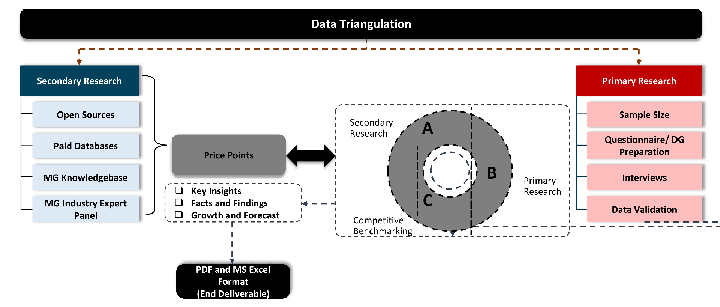
Data triangulation is a validation technique that uses multiple methods, sources, or perspectives to examine the same research question, thereby increasing the credibility and reliability of research findings. In market research, triangulation serves as a quality assurance mechanism that helps identify and minimize bias, validate assumptions, and ensure accuracy in market estimates.
- Data Source Triangulation – Using multiple data sources to examine the same phenomenon
- Methodological Triangulation – Using multiple research methods to study the same research question
- Investigator Triangulation – Using multiple researchers or analysts to examine the same data
- Theoretical Triangulation – Using multiple theoretical perspectives to interpret the same data
Custom Market Research Services
We will customise the research for you, in case the report listed above does not meet your requirements.
Get 10% Free Customisation