Luxury Goods Market Size, Share & Trends Analysis Report by Product Category (Fashion & Apparel, Luxury Jewelry, Fragrances & Cosmetics, Leather Goods, Eyewear, Fine Wines & Spirits, Luxury Home Décor & Furniture, Automobiles, Accessories (Handbags, Belts, etc.)), Material Type, Consumer Demographic, Sales Channel, and Geography (North America, Europe, Asia Pacific, Middle East, Africa, and South America) – Global Industry Data, Trends, and Forecasts, 2026–2035
|
|
|
Segmental Data Insights |
|
|
Demand Trends |
|
|
Competitive Landscape |
|
|
Strategic Development |
|
|
Future Outlook & Opportunities |
|
Luxury-Goods-Market Size, Share, and Growth
The global luxury goods market is exhibiting strong growth, with an estimated value of USD 334.2 billion in 2025 and USD 480.6 billion by 2035, achieving a CAGR of 3.7%, during the forecast period. The global luxury goods are driven by rising disposable incomes, increasing wealth among high-net-worth individuals, a growing appetite for premium experiences, strong brand heritage, digital engagement through e-commerce and social media, and the influence of younger affluent consumers seeking status, exclusivity, and personalized high-end products.
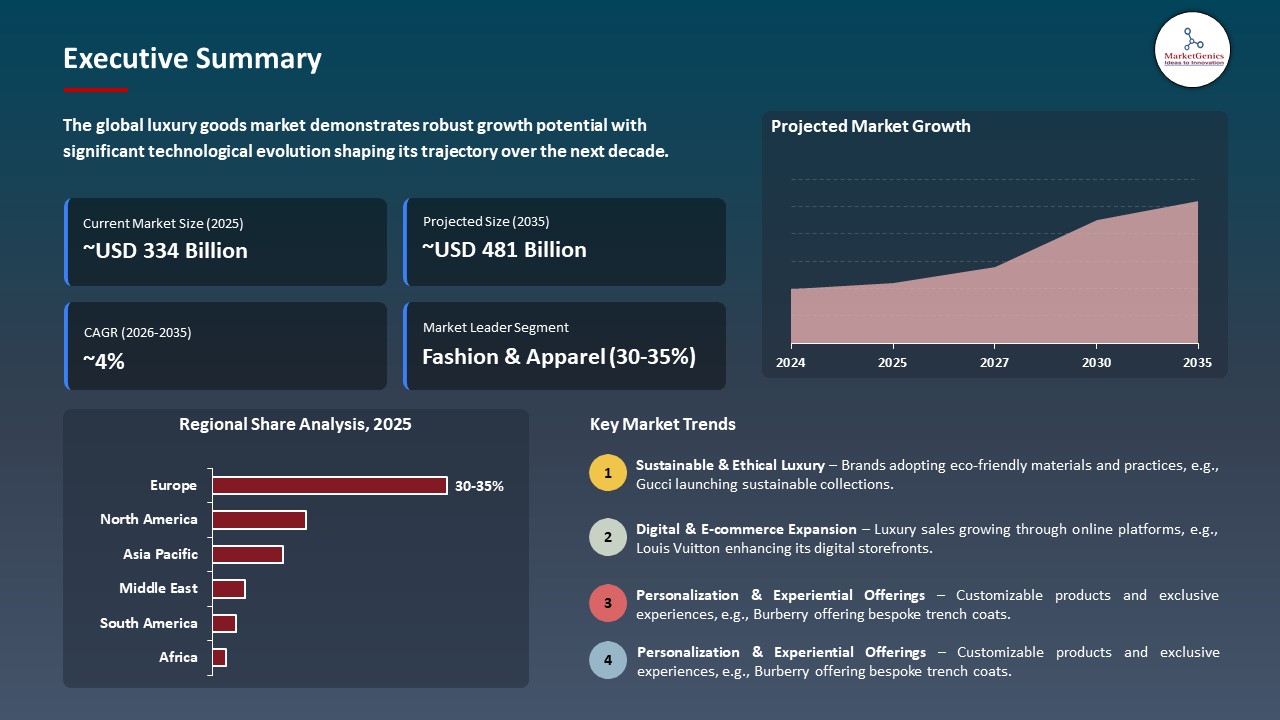
Riccardo Bellini CEO of Valentino in August, said, “Marrying Valentino’s matchless creativity and iconic style with Kering Eyewear’s unrivalled know-how in luxury eyewear manufacturing and distribution, we will work together to further elevate the Valentino Eyewear experience. We also wish to express our sincere gratitude to AKN Group for the collaboration and the successful development of our eyewear business over the past years.”
The rapid adoption of omnichannel and digital engagement tactics by luxury houses, which improve customer experiences across online and physical touchpoints, is driving the luxury goods sector. For instance, in May 2025, Gucci has expanded its omnichannel operations through interactive digital experiences, online consults, and AR capabilities, to enhance its brand accessibility, appeal to younger upscale shoppers, and increase its relevance in the constantly changing luxury retail environment. Digital innovation through omnichannel reinforces customer interaction and increases the market penetration, which helps to maintain premium demand in different regions.
Further, the trend of sustainable and socially responsible luxury goods is boosting the growth of market since the higher-end consumers focus more on environmental concerns and social responsibility. For instance, in June 2025, Chanel introduced Nevold, a circular materials platform, to use more of the recycled and traceable fibers to make sustainability a central plan in the strategy and align with the values and expectations of the consumers and the regulations. The sustainability programs will increase brand equity and appeal to value-conscious luxury consumers, broadening market applicability and sustainability.
Key adjacent opportunities to the global luxury goods market include luxury experiences and travel, high-end cosmetics and skincare, premium fragrances, collectible luxury watches and jewelry, and luxury home decor. These industries take advantage of brand equity and consumer longing to win over increased expenditure in the various way of life segments. The growth into the nearby luxury segments would increase the diversification of revenue and improve the long-term engagement with the brand.
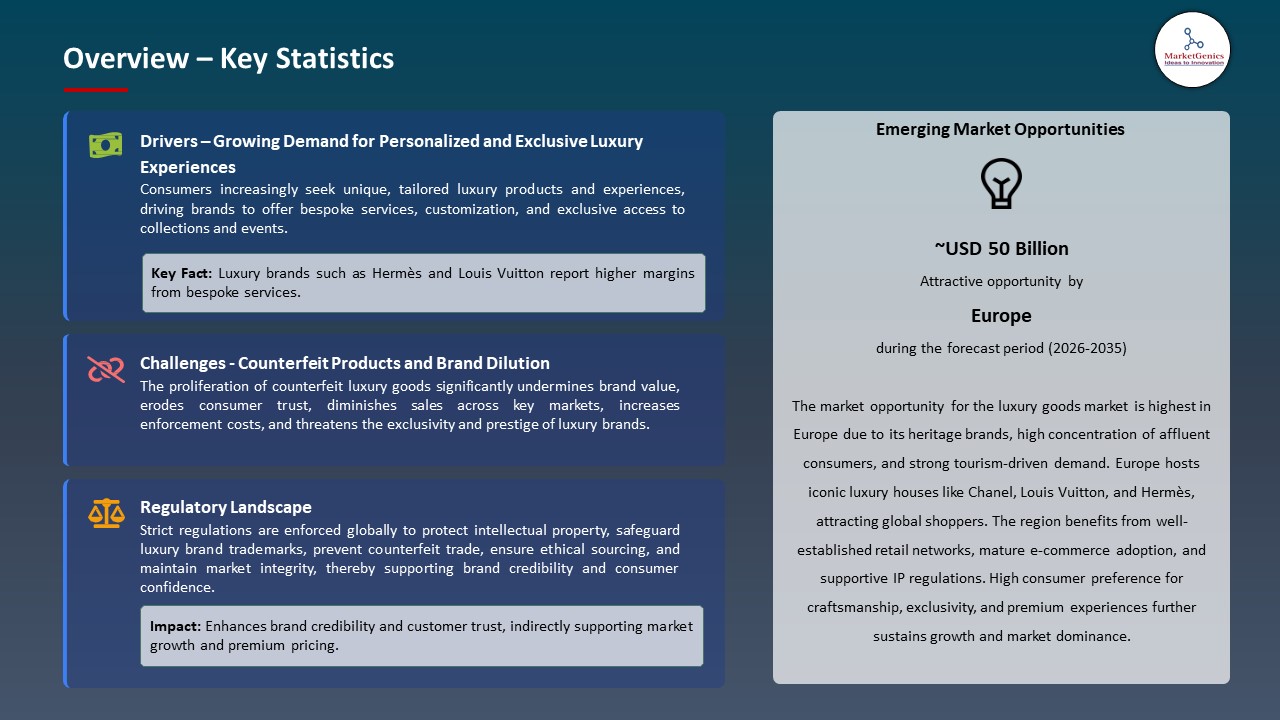
Luxury Goods Market Dynamics and Trends
Driver: Strategic Diversification into Luxury Beauty Enhances Brand Reach
-
The premium fashion houses that are increasingly diversifying into related product businesses, like high-end beauty and cosmetics, are driving the luxury goods market forward to increase consumer interests and open up new business opportunities. This will allow brands to exploit the demand of wealthy consumers in lifestyle related products that no longer rely on conventional fashion and accessories, and the brand history to reaffirm competitive strength.
- Diversification into beauty and cosmetics is an initiative that improves the level of consumer engagement and the general brand ecosystem. For instance, in February 2025, Louis Vuitton released La Beauté Louis Vuitton, a full range of luxury makeup that includes 55 lipsticks, 10 lip balms and eight eyeshadow palettes in the form of refillable objects d’art, combining craftsmanship with a radical formulation.
- The increase of complementary product lines increases the resilience of the market, appeals to the younger wealthy buyers and strengthens the brand equity over the long term.
Restraint: Rising Raw Material and Production Costs Compress Profit Margins
-
The high cost of high-end raw materials, handcrafted workmanship and production in limited quantity are some of the limiting factors of the luxury goods market lines as these are the main distinguishing characteristics of luxury products. The luxury brands focus on the sourcing of higher-quality materials and the use of specialized ateliers that adds a lot to the production costs and makes it hard to maintain the margins, especially during supply chain disruptions or inflationary pressures.
- Luxury maisons purchasing exclusive textiles, high-quality leather and proprietary parts are faced with the two-fold problem of absorbing the increased cost or transferring it to the consumer making pricing strategies more challenging and preserving brand exclusivity. Increased input prices, such as high-quality fabrics, custom hardware, highly qualified staff, etc. will put a strain on the operational effectiveness, and it might need the price or production to be changed to keep preventing profit loss without impacting the brand image.
- Rising material and manufacturing costs may trigger profitability limits and barriers to new product introductions unless managed by strategic sourcing, process innovations, and cost reduction strategies.
Opportunity: Expansion of Immersive Retail and Pop‑Up Luxury Experiences
-
The luxury goods market can be substantially increased after the development of immersive retail and experiential brand activations, which reinforce emotional appeal and consumer loyalty. Pop-up boutiques, curated experiences, and destination-based luxury experiences will enable the brands to develop high impact, memorable consumer experiences that go beyond shopping, enabling them to build brand advocacy and relationships with consumers on a long-term basis.
- The experiential luxury programs can catalyze consumer response, spur tourism-related sales, and brand prestige in key global markets. For instance, in May 2025, Christian Dior opened Dioriviera pop-up stores in major resort destinations, including themed interior and customized retail experiences that celebrate the history of the brand and offer the affluent travelers exclusive and curated experiences.
- Internet-based investment into immersive retail increases consumer experiences, brand loyalty and provides premium pricing strategies.
Key Trend: Increasing Brand Value and Strength Signals Consumer Preference Shifts
-
The rising brand value and power of top maisons, which reflect changing consumer tastes and ongoing need for recognizable luxury brands, is a significant development in the luxury goods industry. With the aid of heritage, storytelling, and innovation, luxury brands remain at the center of discretionary spend to consumers who believe in emotional appeal and symbolic status.
- According to the Brand Finance Luxury & Premium 50 2025 report, Chanel grew its brand value 45 % to USD 37.9 billion as the fastest-growing luxury brand, while Dior strengthened its brand ranking, reaffirming its leadership in brand power and consumer appeal. The trend underscores that the strategic positioning of the brand, tailored experiences, and premium craftsmanship are the key factors in maintaining customer interest in the luxury brands of the highest quality, even in the time of the economic cycles.
- High brand value and brand strength increase competitive differentiation, create lasting customer loyalty, and sustain premium pricing strategies.
 Luxury Goods Market Analysis and Segmental Data
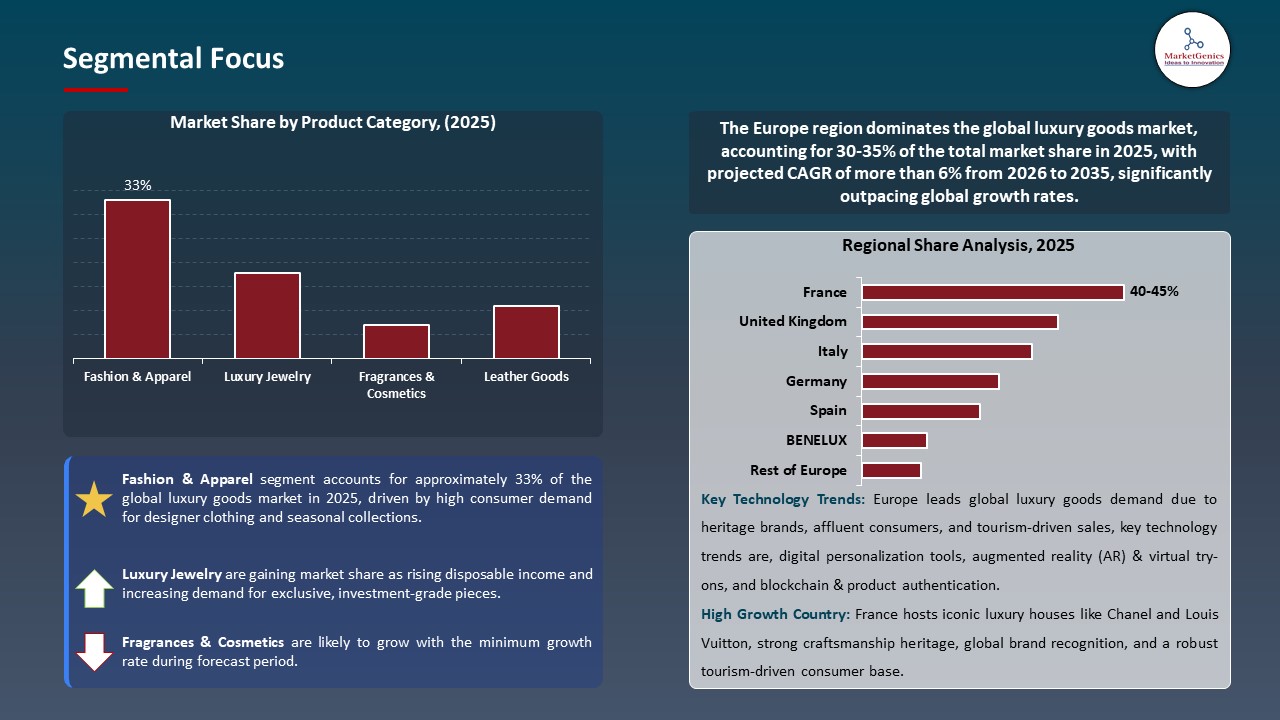
Fashion & Apparel Dominate Global Luxury Goods Market
-
The fashion & apparel segment dominates the global luxury goods market, consistently contributing the largest share of industry revenue through strong demand for designer apparel, leather goods, and ready-to-wear collections.
- According to LVMH’s official reporting, its Fashion & Leather Goods division generated approximately €37.8 billion in revenue in 2025, underscoring its central role within the company’s portfolio and the sustained global appeal of high-end fashion.
- The dominance of fashion and apparel drives sustained revenue growth, reinforces brand equity, and positions luxury companies to capitalize on global consumer demand, solidifying their leadership and long-term competitiveness in the luxury goods market.
Europe Leads Global Luxury Goods Market Demand
-
Europe leads the Luxury Goods market, because of concentration of historic luxury capitals, iconic brands, and robust tourism‑driven retail environments that solidify its position as the cultural and commercial epicenter of high‑end fashion and accessories. The European luxury sector already represents a significant share of the global market and contributes substantially to regional economic output, underscoring its enduring leadership role.
- Additionally, the European luxury sector accounted for approximately 70 % of the global high‑end goods market and contributed around 5 % of Europe’s GDP, reinforcing its strength in both production and consumption of luxury brands.
- Moreover, luxury brands continued expanding premium retail footprints across European luxury streets, with numerous new store openings in key cities, reflecting sustained demand for in‑person luxury experiences despite broader market normalization.
- Europe’s dominance in luxury goods drives strong market stability, high consumer engagement, and sustained revenue growth, reinforcing the region’s strategic importance in the global luxury sector.
Luxury Goods Market Ecosystem
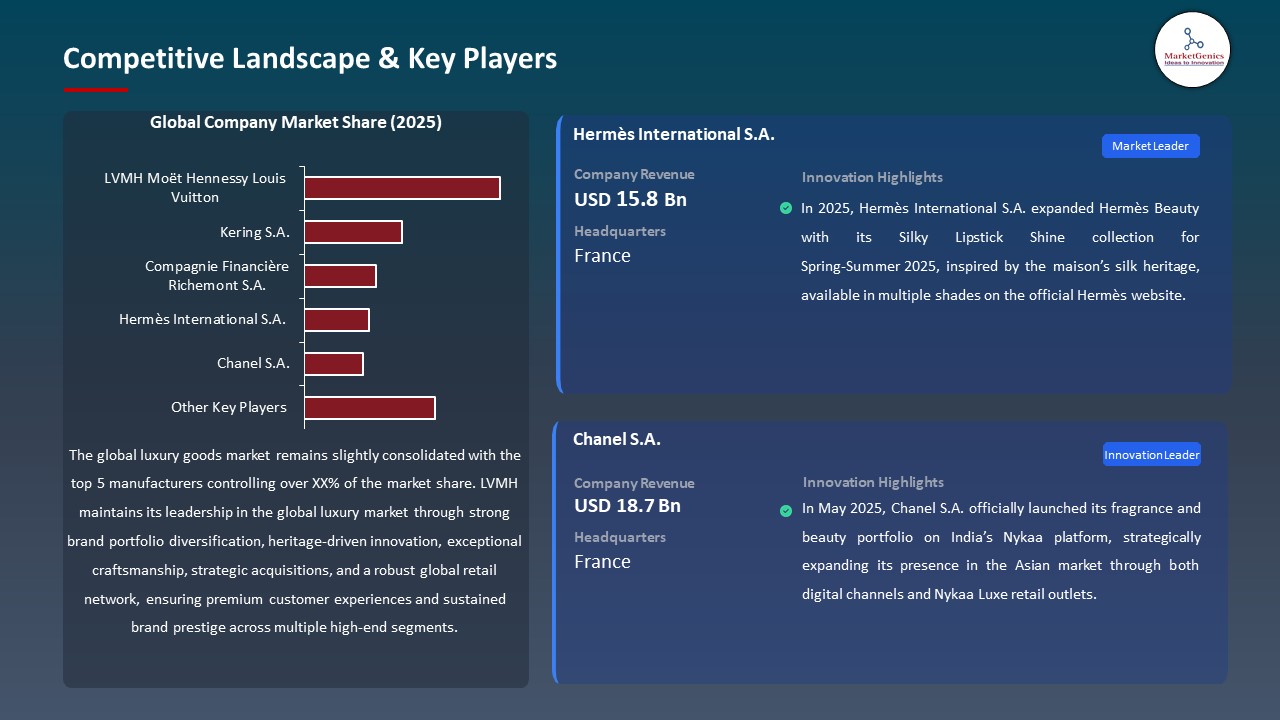
The global luxury goods market is slightly consolidated, with leading luxury conglomerates such as LVMH Moët Hennessy Louis Vuitton, Kering S.A., Compagnie Financière Richemont S.A., Hermès International S.A., and Chanel S.A. dominating through strong brand portfolios, digital transformation, and advanced technology integration that enhances customer engagement, operational efficiency, and supply chain resilience. These industry giants leverage AI, blockchain, and immersive digital platforms to differentiate their offerings and protect brand value while maintaining exclusivity.
These key players emphasize niche innovations that boost both product desirability and technological advancement, from blockchain‑backed authenticity systems and AR‑enabled virtual try‑ons to AI‑driven personalization engines and digital concierge services, thereby elevating customer experience and supporting premium pricing strategies.
Luxury firms continue to pursue product diversification and portfolio expansion by adopting integrated digital solutions, sustainable materials, and cross‑category collaborations that improve productivity, traceability, and customer loyalty across global markets. For instance, in June 2025 saw LVMH partners utilize 3D content creation technology to reduce production costs and enhance online visual experiences, demonstrating measurable improvements in content quality and digital engagement.
These technological and strategic initiatives reinforce market leadership, drive higher customer engagement, and strengthen profitability while positioning luxury brands for sustainable, long-term growth in the global market.
 Recent Development and Strategic Overview:
-
In July 2025, Compagnie Financière Richemont S.A. launched a significant High Jewellery collection under Vhernier during Paris Haute Couture Week, representing a prominent post‑acquisition debut and strategically enhancing Richemont’s premium jewellery portfolio within the global luxury market.
- In February 2025, LVMH Moët Hennessy Louis Vuitton formalized a strategic collaboration as the Global Luxury Partner of Formula 1, integrating Louis Vuitton, TAG Heuer, and Moët & Chandon into F1’s 75th anniversary season to strengthen global luxury lifestyle engagement.
Report Scope
|
Detail |
|
|
Market Size in 2025 |
USD 334.2 Bn |
|
Market Forecast Value in 2035 |
USD 480.6 Bn |
|
Growth Rate (CAGR) |
3.7% |
|
Forecast Period |
2026 – 2035 |
|
Historical Data Available for |
2021 – 2024 |
|
Market Size Units |
US$ Billion for Value |
|
Report Format |
Electronic (PDF) + Excel |
|
North America |
Europe |
Asia Pacific |
Middle East |
Africa |
South America |
|
|
|
|
|
|
|
Companies Covered |
|||||
|
|
|
|
|
|
Luxury Goods Market Segmentation and Highlights
|
Segment |
Sub-segment |
|
Luxury Goods Market, By Product Category |
|
|
Luxury Goods Market, By Material Type |
|
|
Luxury Goods Market, By Consumer Demographic |
|
|
Luxury Goods Market, By Sales Channel |
|
Frequently Asked Questions
Table of Contents
- 1. Research Methodology and Assumptions
- 1.1. Definitions
- 1.2. Research Design and Approach
- 1.3. Data Collection Methods
- 1.4. Base Estimates and Calculations
- 1.5. Forecasting Models
- 1.5.1. Key Forecast Factors & Impact Analysis
- 1.6. Secondary Research
- 1.6.1. Open Sources
- 1.6.2. Paid Databases
- 1.6.3. Associations
- 1.7. Primary Research
- 1.7.1. Primary Sources
- 1.7.2. Primary Interviews with Stakeholders across Ecosystem
- 2. Executive Summary
- 2.1. Global Luxury Goods Market Outlook
- 2.1.1. Luxury Goods Market Size (Value - US$ Bn), and Forecasts, 2021-2035
- 2.1.2. Compounded Annual Growth Rate Analysis
- 2.1.3. Growth Opportunity Analysis
- 2.1.4. Segmental Share Analysis
- 2.1.5. Geographical Share Analysis
- 2.2. Market Analysis and Facts
- 2.3. Supply-Demand Analysis
- 2.4. Competitive Benchmarking
- 2.5. Go-to- Market Strategy
- 2.5.1. Customer/ End-use Industry Assessment
- 2.5.2. Growth Opportunity Data, 2026-2035
- 2.5.2.1. Regional Data
- 2.5.2.2. Country Data
- 2.5.2.3. Segmental Data
- 2.5.3. Identification of Potential Market Spaces
- 2.5.4. GAP Analysis
- 2.5.5. Potential Attractive Price Points
- 2.5.6. Prevailing Market Risks & Challenges
- 2.5.7. Preferred Sales & Marketing Strategies
- 2.5.8. Key Recommendations and Analysis
- 2.5.9. A Way Forward
- 2.1. Global Luxury Goods Market Outlook
- 3. Industry Data and Premium Insights
- 3.1. Global Consumer Goods & Services Industry Overview, 2025
- 3.1.1. Consumer Goods & Services Ecosystem Analysis
- 3.1.2. Key Trends for Consumer Goods & Services Industry
- 3.1.3. Regional Distribution for Consumer Goods & Services Industry
- 3.2. Supplier Customer Data
- 3.3. Technology Roadmap and Developments
- 3.4. Trade Analysis
- 3.4.1. Import & Export Analysis, 2025
- 3.4.2. Top Importing Countries
- 3.4.3. Top Exporting Countries
- 3.5. Trump Tariff Impact Analysis
- 3.5.1. Manufacturer
- 3.5.1.1. Based on the component & Raw material
- 3.5.2. Supply Chain
- 3.5.3. End Consumer
- 3.5.1. Manufacturer
- 3.6. Raw Material Analysis
- 3.1. Global Consumer Goods & Services Industry Overview, 2025
- 4. Market Overview
- 4.1. Market Dynamics
- 4.1.1. Drivers
- 4.1.1.1. Rising disposable income and growing high-net-worth population globally
- 4.1.1.2. Increasing demand for personalized and exclusive luxury experiences
- 4.1.1.3. Expansion of e-commerce and digital luxury retail platforms
- 4.1.2. Restraints
- 4.1.2.1. Economic slowdown and geopolitical uncertainties affecting consumer spending
- 4.1.2.2. Counterfeit products and brand dilution impacting market credibility
- 4.1.1. Drivers
- 4.2. Key Trend Analysis
- 4.3. Regulatory Framework
- 4.3.1. Key Regulations, Norms, and Subsidies, by Key Countries
- 4.3.2. Tariffs and Standards
- 4.3.3. Impact Analysis of Regulations on the Market
- 4.4. Value Chain Analysis
- 4.5. Porter’s Five Forces Analysis
- 4.6. PESTEL Analysis
- 4.7. Global Luxury Goods Market Demand
- 4.7.1. Historical Market Size – in Value (US$ Bn), 2020-2024
- 4.7.2. Current and Future Market Size – in Value (US$ Bn), 2026–2035
- 4.7.2.1. Y-o-Y Growth Trends
- 4.7.2.2. Absolute $ Opportunity Assessment
- 4.1. Market Dynamics
- 5. Competition Landscape
- 5.1. Competition structure
- 5.1.1. Fragmented v/s consolidated
- 5.2. Company Share Analysis, 2025
- 5.2.1. Global Company Market Share
- 5.2.2. By Region
- 5.2.2.1. North America
- 5.2.2.2. Europe
- 5.2.2.3. Asia Pacific
- 5.2.2.4. Middle East
- 5.2.2.5. Africa
- 5.2.2.6. South America
- 5.3. Product Comparison Matrix
- 5.3.1. Specifications
- 5.3.2. Market Positioning
- 5.3.3. Pricing
- 5.1. Competition structure
- 6. Global Luxury Goods Market Analysis, by Product Category
- 6.1. Key Segment Analysis
- 6.2. Luxury Goods Market Size (Value - US$ Bn), Analysis, and Forecasts, by Product Category, 2021-2035
- 6.2.1. Fashion & Apparel
- 6.2.1.1. Haute Couture
- 6.2.1.2. Ready-to-Wear
- 6.2.1.3. Luxury Sportswear
- 6.2.1.4. Designer Footwear
- 6.2.1.5. Others
- 6.2.2. Luxury Jewelry
- 6.2.2.1. Fine Jewelry
- 6.2.2.2. Fashion Jewelry
- 6.2.2.3. Luxury Watches
- 6.2.3. Fragrances & Cosmetics
- 6.2.4. Leather Goods
- 6.2.5. Eyewear
- 6.2.6. Fine Wines & Spirits
- 6.2.7. Luxury Home Décor & Furniture
- 6.2.8. Automobiles
- 6.2.9. Accessories (Handbags, Belts, etc.)
- 6.2.1. Fashion & Apparel
- 7. Global Luxury Goods Market Analysis, by Material Type
- 7.1. Key Segment Analysis
- 7.2. Luxury Goods Market Size (Value - US$ Bn), Analysis, and Forecasts, by Material Type, 2021-2035
- 7.2.1. Precious Metals
- 7.2.1.1. Gold
- 7.2.1.2. Platinum
- 7.2.1.3. Silver
- 7.2.2. Gemstones & Diamonds
- 7.2.3. Exotic Leather
- 7.2.4. Premium Fabrics
- 7.2.5. Sustainable/Alternative Materials
- 7.2.6. High-Tech Materials
- 7.2.1. Precious Metals
- 8. Global Luxury Goods Market Analysis, by Consumer Demographic
- 8.1. Key Segment Analysis
- 8.2. Luxury Goods Market Size (Value - US$ Bn), Analysis, and Forecasts, by Consumer Demographic, 2021-2035
- 8.2.1. By Gender
- 8.2.1.1. Men's Luxury
- 8.2.1.2. Women's Luxury
- 8.2.1.3. Unisex/Gender-Neutral
- 8.2.2. Age Group
- 8.2.2.1. Gen Z (18-27 years)
- 8.2.2.2. Millennials (28-43 years)
- 8.2.2.3. Gen X (44-59 years)
- 8.2.2.4. Baby Boomers (60+ years)
- 8.2.3. Income Level
- 8.2.3.1. High-Net-Worth Individuals
- 8.2.3.2. Ultra-High-Net-Worth
- 8.2.4. Geographic Consumer Base
- 8.2.4.1. Emerging Markets
- 8.2.4.2. Developed Markets
- 8.2.1. By Gender
- 9. Global Luxury Goods Market Analysis, by Sales Channel
- 9.1. Key Segment Analysis
- 9.2. Luxury Goods Market Size (Value - US$ Bn), Analysis, and Forecasts, by Sales Channel, 2021-2035
- 9.2.1. Online Channels
- 9.2.1.1. Brand Official Websites
- 9.2.1.2. E-commerce Luxury Platforms
- 9.2.1.3. Social Commerce
- 9.2.1.4. Others
- 9.2.2. Offline Channels
- 9.2.2.1. Mono-Brand Stores/Boutiques
- 9.2.2.2. Multi-Brand Luxury Retailers
- 9.2.2.3. Department Stores
- 9.2.2.4. Duty-Free Stores
- 9.2.2.5. Others
- 9.2.1. Online Channels
- 10. Global Luxury Goods Market Analysis, by Region
- 10.1. Key Findings
- 10.2. Luxury Goods Market Size (Value - US$ Bn), Analysis, and Forecasts, by Region, 2021-2035
- 10.2.1. North America
- 10.2.2. Europe
- 10.2.3. Asia Pacific
- 10.2.4. Middle East
- 10.2.5. Africa
- 10.2.6. South America
- 11. North America Luxury Goods Market Analysis
- 11.1. Key Segment Analysis
- 11.2. Regional Snapshot
- 11.3. North America Luxury Goods Market Size Value - US$ Bn), Analysis, and Forecasts, 2021-2035
- 11.3.1. Product Category
- 11.3.2. Material Type
- 11.3.3. Consumer Demographic
- 11.3.4. Sales Channel
- 11.3.5. Country
- 11.3.5.1. USA
- 11.3.5.2. Canada
- 11.3.5.3. Mexico
- 11.4. USA Luxury Goods Market
- 11.4.1. Country Segmental Analysis
- 11.4.2. Product Category
- 11.4.3. Material Type
- 11.4.4. Consumer Demographic
- 11.4.5. Sales Channel
- 11.5. Canada Luxury Goods Market
- 11.5.1. Country Segmental Analysis
- 11.5.2. Product Category
- 11.5.3. Material Type
- 11.5.4. Consumer Demographic
- 11.5.5. Sales Channel
- 11.6. Mexico Luxury Goods Market
- 11.6.1. Country Segmental Analysis
- 11.6.2. Product Category
- 11.6.3. Material Type
- 11.6.4. Consumer Demographic
- 11.6.5. Sales Channel
- 12. Europe Luxury Goods Market Analysis
- 12.1. Key Segment Analysis
- 12.2. Regional Snapshot
- 12.3. Europe Luxury Goods Market Size (Value - US$ Bn), Analysis, and Forecasts, 2021-2035
- 12.3.1. Product Category
- 12.3.2. Material Type
- 12.3.3. Consumer Demographic
- 12.3.4. Sales Channel
- 12.3.5. Country
- 12.3.5.1. Germany
- 12.3.5.2. United Kingdom
- 12.3.5.3. France
- 12.3.5.4. Italy
- 12.3.5.5. Spain
- 12.3.5.6. Netherlands
- 12.3.5.7. Nordic Countries
- 12.3.5.8. Poland
- 12.3.5.9. Russia & CIS
- 12.3.5.10. Rest of Europe
- 12.4. Germany Luxury Goods Market
- 12.4.1. Country Segmental Analysis
- 12.4.2. Product Category
- 12.4.3. Material Type
- 12.4.4. Consumer Demographic
- 12.4.5. Sales Channel
- 12.5. United Kingdom Luxury Goods Market
- 12.5.1. Country Segmental Analysis
- 12.5.2. Product Category
- 12.5.3. Material Type
- 12.5.4. Consumer Demographic
- 12.5.5. Sales Channel
- 12.6. France Luxury Goods Market
- 12.6.1. Country Segmental Analysis
- 12.6.2. Product Category
- 12.6.3. Material Type
- 12.6.4. Consumer Demographic
- 12.6.5. Sales Channel
- 12.7. Italy Luxury Goods Market
- 12.7.1. Country Segmental Analysis
- 12.7.2. Product Category
- 12.7.3. Material Type
- 12.7.4. Consumer Demographic
- 12.7.5. Sales Channel
- 12.8. Spain Luxury Goods Market
- 12.8.1. Country Segmental Analysis
- 12.8.2. Product Category
- 12.8.3. Material Type
- 12.8.4. Consumer Demographic
- 12.8.5. Sales Channel
- 12.9. Netherlands Luxury Goods Market
- 12.9.1. Country Segmental Analysis
- 12.9.2. Product Category
- 12.9.3. Material Type
- 12.9.4. Consumer Demographic
- 12.9.5. Sales Channel
- 12.10. Nordic Countries Luxury Goods Market
- 12.10.1. Country Segmental Analysis
- 12.10.2. Product Category
- 12.10.3. Material Type
- 12.10.4. Consumer Demographic
- 12.10.5. Sales Channel
- 12.11. Poland Luxury Goods Market
- 12.11.1. Country Segmental Analysis
- 12.11.2. Product Category
- 12.11.3. Material Type
- 12.11.4. Consumer Demographic
- 12.11.5. Sales Channel
- 12.12. Russia & CIS Luxury Goods Market
- 12.12.1. Country Segmental Analysis
- 12.12.2. Product Category
- 12.12.3. Material Type
- 12.12.4. Consumer Demographic
- 12.12.5. Sales Channel
- 12.13. Rest of Europe Luxury Goods Market
- 12.13.1. Country Segmental Analysis
- 12.13.2. Product Category
- 12.13.3. Material Type
- 12.13.4. Consumer Demographic
- 12.13.5. Sales Channel
- 13. Asia Pacific Luxury Goods Market Analysis
- 13.1. Key Segment Analysis
- 13.2. Regional Snapshot
- 13.3. Asia Pacific Luxury Goods Market Size (Value - US$ Bn), Analysis, and Forecasts, 2021-2035
- 13.3.1. Product Category
- 13.3.2. Material Type
- 13.3.3. Consumer Demographic
- 13.3.4. Sales Channel
- 13.3.5. Country
- 13.3.5.1. China
- 13.3.5.2. India
- 13.3.5.3. Japan
- 13.3.5.4. South Korea
- 13.3.5.5. Australia and New Zealand
- 13.3.5.6. Indonesia
- 13.3.5.7. Malaysia
- 13.3.5.8. Thailand
- 13.3.5.9. Vietnam
- 13.3.5.10. Rest of Asia Pacific
- 13.4. China Luxury Goods Market
- 13.4.1. Country Segmental Analysis
- 13.4.2. Product Category
- 13.4.3. Material Type
- 13.4.4. Consumer Demographic
- 13.4.5. Sales Channel
- 13.5. India Luxury Goods Market
- 13.5.1. Country Segmental Analysis
- 13.5.2. Product Category
- 13.5.3. Material Type
- 13.5.4. Consumer Demographic
- 13.5.5. Sales Channel
- 13.6. Japan Luxury Goods Market
- 13.6.1. Country Segmental Analysis
- 13.6.2. Product Category
- 13.6.3. Material Type
- 13.6.4. Consumer Demographic
- 13.6.5. Sales Channel
- 13.7. South Korea Luxury Goods Market
- 13.7.1. Country Segmental Analysis
- 13.7.2. Product Category
- 13.7.3. Material Type
- 13.7.4. Consumer Demographic
- 13.7.5. Sales Channel
- 13.8. Australia and New Zealand Luxury Goods Market
- 13.8.1. Country Segmental Analysis
- 13.8.2. Product Category
- 13.8.3. Material Type
- 13.8.4. Consumer Demographic
- 13.8.5. Sales Channel
- 13.9. Indonesia Luxury Goods Market
- 13.9.1. Country Segmental Analysis
- 13.9.2. Product Category
- 13.9.3. Material Type
- 13.9.4. Consumer Demographic
- 13.9.5. Sales Channel
- 13.10. Malaysia Luxury Goods Market
- 13.10.1. Country Segmental Analysis
- 13.10.2. Product Category
- 13.10.3. Material Type
- 13.10.4. Consumer Demographic
- 13.10.5. Sales Channel
- 13.11. Thailand Luxury Goods Market
- 13.11.1. Country Segmental Analysis
- 13.11.2. Product Category
- 13.11.3. Material Type
- 13.11.4. Consumer Demographic
- 13.11.5. Sales Channel
- 13.12. Vietnam Luxury Goods Market
- 13.12.1. Country Segmental Analysis
- 13.12.2. Product Category
- 13.12.3. Material Type
- 13.12.4. Consumer Demographic
- 13.12.5. Sales Channel
- 13.13. Rest of Asia Pacific Luxury Goods Market
- 13.13.1. Country Segmental Analysis
- 13.13.2. Product Category
- 13.13.3. Material Type
- 13.13.4. Consumer Demographic
- 13.13.5. Sales Channel
- 14. Middle East Luxury Goods Market Analysis
- 14.1. Key Segment Analysis
- 14.2. Regional Snapshot
- 14.3. Middle East Luxury Goods Market Size (Value - US$ Bn), Analysis, and Forecasts, 2021-2035
- 14.3.1. Product Category
- 14.3.2. Material Type
- 14.3.3. Consumer Demographic
- 14.3.4. Sales Channel
- 14.3.5. Country
- 14.3.5.1. Turkey
- 14.3.5.2. UAE
- 14.3.5.3. Saudi Arabia
- 14.3.5.4. Israel
- 14.3.5.5. Rest of Middle East
- 14.4. Turkey Luxury Goods Market
- 14.4.1. Country Segmental Analysis
- 14.4.2. Product Category
- 14.4.3. Material Type
- 14.4.4. Consumer Demographic
- 14.4.5. Sales Channel
- 14.5. UAE Luxury Goods Market
- 14.5.1. Country Segmental Analysis
- 14.5.2. Product Category
- 14.5.3. Material Type
- 14.5.4. Consumer Demographic
- 14.5.5. Sales Channel
- 14.6. Saudi Arabia Luxury Goods Market
- 14.6.1. Country Segmental Analysis
- 14.6.2. Product Category
- 14.6.3. Material Type
- 14.6.4. Consumer Demographic
- 14.6.5. Sales Channel
- 14.7. Israel Luxury Goods Market
- 14.7.1. Country Segmental Analysis
- 14.7.2. Product Category
- 14.7.3. Material Type
- 14.7.4. Consumer Demographic
- 14.7.5. Sales Channel
- 14.8. Rest of Middle East Luxury Goods Market
- 14.8.1. Country Segmental Analysis
- 14.8.2. Product Category
- 14.8.3. Material Type
- 14.8.4. Consumer Demographic
- 14.8.5. Sales Channel
- 15. Africa Luxury Goods Market Analysis
- 15.1. Key Segment Analysis
- 15.2. Regional Snapshot
- 15.3. Africa Luxury Goods Market Size (Value - US$ Bn), Analysis, and Forecasts, 2021-2035
- 15.3.1. Product Category
- 15.3.2. Material Type
- 15.3.3. Consumer Demographic
- 15.3.4. Sales Channel
- 15.3.5. Country
- 15.3.5.1. South Africa
- 15.3.5.2. Egypt
- 15.3.5.3. Nigeria
- 15.3.5.4. Algeria
- 15.3.5.5. Rest of Africa
- 15.4. South Africa Luxury Goods Market
- 15.4.1. Country Segmental Analysis
- 15.4.2. Product Category
- 15.4.3. Material Type
- 15.4.4. Consumer Demographic
- 15.4.5. Sales Channel
- 15.5. Egypt Luxury Goods Market
- 15.5.1. Country Segmental Analysis
- 15.5.2. Product Category
- 15.5.3. Material Type
- 15.5.4. Consumer Demographic
- 15.5.5. Sales Channel
- 15.6. Nigeria Luxury Goods Market
- 15.6.1. Country Segmental Analysis
- 15.6.2. Product Category
- 15.6.3. Material Type
- 15.6.4. Consumer Demographic
- 15.6.5. Sales Channel
- 15.7. Algeria Luxury Goods Market
- 15.7.1. Country Segmental Analysis
- 15.7.2. Product Category
- 15.7.3. Material Type
- 15.7.4. Consumer Demographic
- 15.7.5. Sales Channel
- 15.8. Rest of Africa Luxury Goods Market
- 15.8.1. Country Segmental Analysis
- 15.8.2. Product Category
- 15.8.3. Material Type
- 15.8.4. Consumer Demographic
- 15.8.5. Sales Channel
- 16. South America Luxury Goods Market Analysis
- 16.1. Key Segment Analysis
- 16.2. Regional Snapshot
- 16.3. South America Luxury Goods Market Size (Value - US$ Bn), Analysis, and Forecasts, 2021-2035
- 16.3.1. Product Category
- 16.3.2. Material Type
- 16.3.3. Consumer Demographic
- 16.3.4. Sales Channel
- 16.3.5. Country
- 16.3.5.1. Brazil
- 16.3.5.2. Argentina
- 16.3.5.3. Rest of South America
- 16.4. Brazil Luxury Goods Market
- 16.4.1. Country Segmental Analysis
- 16.4.2. Product Category
- 16.4.3. Material Type
- 16.4.4. Consumer Demographic
- 16.4.5. Sales Channel
- 16.5. Argentina Luxury Goods Market
- 16.5.1. Country Segmental Analysis
- 16.5.2. Product Category
- 16.5.3. Material Type
- 16.5.4. Consumer Demographic
- 16.5.5. Sales Channel
- 16.6. Rest of South America Luxury Goods Market
- 16.6.1. Country Segmental Analysis
- 16.6.2. Product Category
- 16.6.3. Material Type
- 16.6.4. Consumer Demographic
- 16.6.5. Sales Channel
- 17. Key Players/ Company Profile
- 17.1. Armani Group
- 17.1.1. Company Details/ Overview
- 17.1.2. Company Financials
- 17.1.3. Key Customers and Competitors
- 17.1.4. Business/ Industry Portfolio
- 17.1.5. Product Portfolio/ Specification Details
- 17.1.6. Pricing Data
- 17.1.7. Strategic Overview
- 17.1.8. Recent Developments
- 17.2. Audemars Piguet Holding SA
- 17.3. Balenciaga SA
- 17.4. Burberry Group PLC
- 17.5. Chanel S.A.
- 17.6. Compagnie Financière Richemont S.A.
- 17.7. Coty Inc.
- 17.8. Dior S.E.
- 17.9. Dolce & Gabbana S.r.l.
- 17.10. Gianni Versace S.p.A.
- 17.11. Hermès International S.A.
- 17.12. Kering S.A.
- 17.13. L'Oréal S.A.
- 17.14. LVMH Moët Hennessy Louis Vuitton
- 17.15. Montblanc
- 17.16. Patek Philippe SA
- 17.17. Prada S.p.A.
- 17.18. Ralph Lauren Corporation
- 17.19. Rolex SA
- 17.20. Salvatore Ferragamo S.p.A.
- 17.21. Shiseido Company Limited
- 17.22. Swatch Group Ltd.
- 17.23. The Estée Lauder Companies Inc.
- 17.24. Tiffany & Co.
- 17.25. Other Key Players
- 17.1. Armani Group
Note* - This is just tentative list of players. While providing the report, we will cover more number of players based on their revenue and share for each geography
Research Design
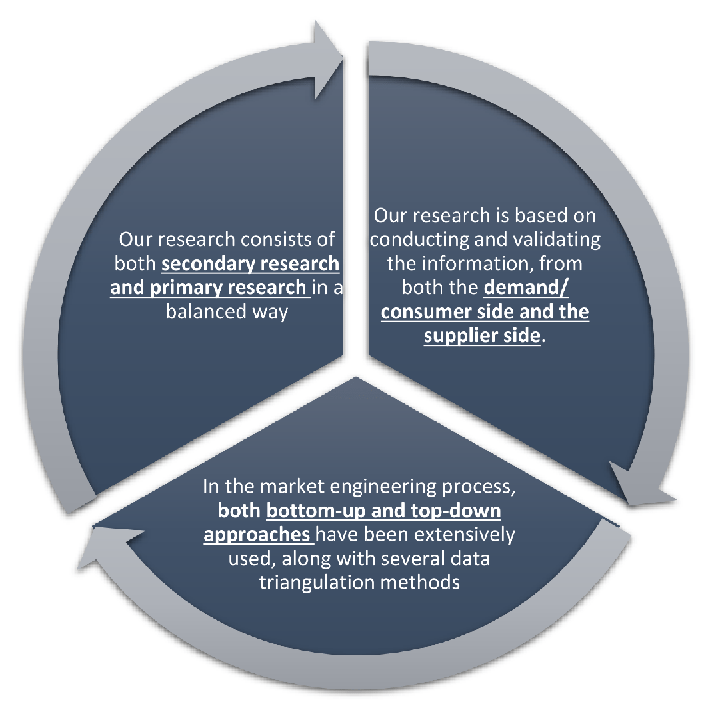
Our research design integrates both demand-side and supply-side analysis through a balanced combination of primary and secondary research methodologies. By utilizing both bottom-up and top-down approaches alongside rigorous data triangulation methods, we deliver robust market intelligence that supports strategic decision-making.
MarketGenics' comprehensive research design framework ensures the delivery of accurate, reliable, and actionable market intelligence. Through the integration of multiple research approaches, rigorous validation processes, and expert analysis, we provide our clients with the insights needed to make informed strategic decisions and capitalize on market opportunities.
MarketGenics leverages a dedicated industry panel of experts and a comprehensive suite of paid databases to effectively collect, consolidate, and analyze market intelligence.
Our approach has consistently proven to be reliable and effective in generating accurate market insights, identifying key industry trends, and uncovering emerging business opportunities.
Through both primary and secondary research, we capture and analyze critical company-level data such as manufacturing footprints, including technical centers, R&D facilities, sales offices, and headquarters.
Our expert panel further enhances our ability to estimate market size for specific brands based on validated field-level intelligence.
Our data mining techniques incorporate both parametric and non-parametric methods, allowing for structured data collection, sorting, processing, and cleaning.
Demand projections are derived from large-scale data sets analyzed through proprietary algorithms, culminating in robust and reliable market sizing.
Research Approach
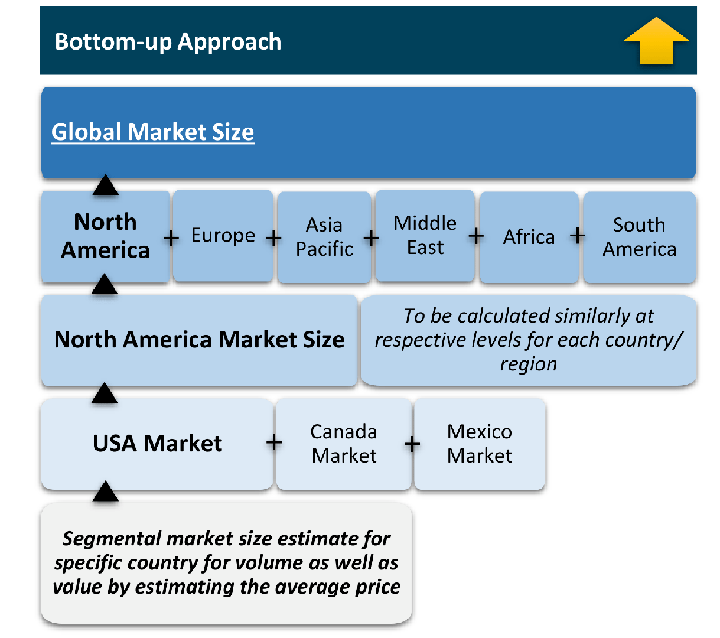
The bottom-up approach builds market estimates by starting with the smallest addressable market units and systematically aggregating them to create comprehensive market size projections.
This method begins with specific, granular data points and builds upward to create the complete market landscape.
Customer Analysis → Segmental Analysis → Geographical Analysis
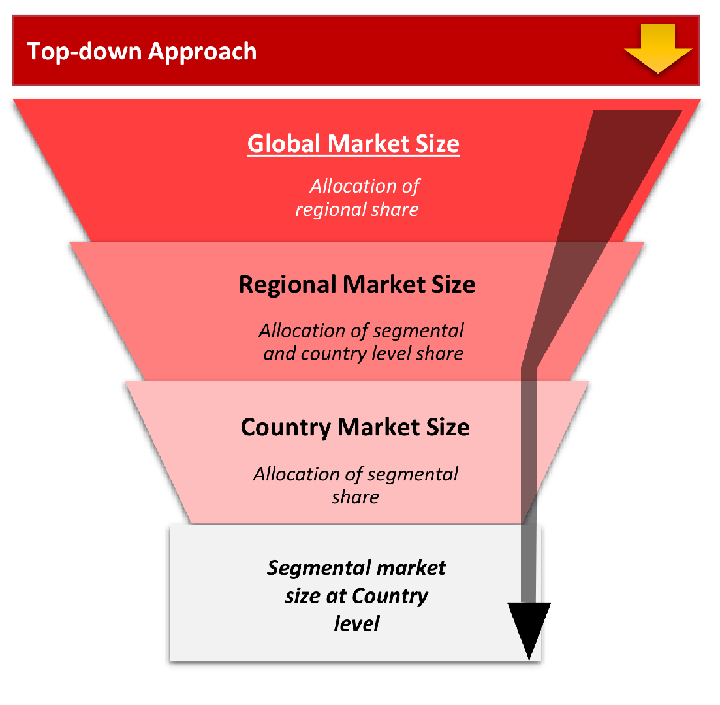
The top-down approach starts with the broadest possible market data and systematically narrows it down through a series of filters and assumptions to arrive at specific market segments or opportunities.
This method begins with the big picture and works downward to increasingly specific market slices.
TAM → SAM → SOM
Research Methods
Desk / Secondary Research
While analysing the market, we extensively study secondary sources, directories, and databases to identify and collect information useful for this technical, market-oriented, and commercial report. Secondary sources that we utilize are not only the public sources, but it is a combination of Open Source, Associations, Paid Databases, MG Repository & Knowledgebase, and others.
- Company websites, annual reports, financial reports, broker reports, and investor presentations
- National government documents, statistical databases and reports
- News articles, press releases and web-casts specific to the companies operating in the market, Magazines, reports, and others
- We gather information from commercial data sources for deriving company specific data such as segmental revenue, share for geography, product revenue, and others
- Internal and external proprietary databases (industry-specific), relevant patent, and regulatory databases
- Governing Bodies, Government Organizations
- Relevant Authorities, Country-specific Associations for Industries
We also employ the model mapping approach to estimate the product level market data through the players' product portfolio
Primary Research
Primary research/ interviews is vital in analyzing the market. Most of the cases involves paid primary interviews. Primary sources include primary interviews through e-mail interactions, telephonic interviews, surveys as well as face-to-face interviews with the different stakeholders across the value chain including several industry experts.
| Type of Respondents | Number of Primaries |
|---|---|
| Tier 2/3 Suppliers | ~20 |
| Tier 1 Suppliers | ~25 |
| End-users | ~25 |
| Industry Expert/ Panel/ Consultant | ~30 |
| Total | ~100 |
MG Knowledgebase
• Repository of industry blog, newsletter and case studies
• Online platform covering detailed market reports, and company profiles
Forecasting Factors and Models
Forecasting Factors
- Historical Trends – Past market patterns, cycles, and major events that shaped how markets behave over time. Understanding past trends helps predict future behavior.
- Industry Factors – Specific characteristics of the industry like structure, regulations, and innovation cycles that affect market dynamics.
- Macroeconomic Factors – Economic conditions like GDP growth, inflation, and employment rates that affect how much money people have to spend.
- Demographic Factors – Population characteristics like age, income, and location that determine who can buy your product.
- Technology Factors – How quickly people adopt new technology and how much technology infrastructure exists.
- Regulatory Factors – Government rules, laws, and policies that can help or restrict market growth.
- Competitive Factors – Analyzing competition structure such as degree of competition and bargaining power of buyers and suppliers.
Forecasting Models / Techniques
Multiple Regression Analysis
- Identify and quantify factors that drive market changes
- Statistical modeling to establish relationships between market drivers and outcomes
Time Series Analysis – Seasonal Patterns
- Understand regular cyclical patterns in market demand
- Advanced statistical techniques to separate trend, seasonal, and irregular components
Time Series Analysis – Trend Analysis
- Identify underlying market growth patterns and momentum
- Statistical analysis of historical data to project future trends
Expert Opinion – Expert Interviews
- Gather deep industry insights and contextual understanding
- In-depth interviews with key industry stakeholders
Multi-Scenario Development
- Prepare for uncertainty by modeling different possible futures
- Creating optimistic, pessimistic, and most likely scenarios
Time Series Analysis – Moving Averages
- Sophisticated forecasting for complex time series data
- Auto-regressive integrated moving average models with seasonal components
Econometric Models
- Apply economic theory to market forecasting
- Sophisticated economic models that account for market interactions
Expert Opinion – Delphi Method
- Harness collective wisdom of industry experts
- Structured, multi-round expert consultation process
Monte Carlo Simulation
- Quantify uncertainty and probability distributions
- Thousands of simulations with varying input parameters
Research Analysis
Our research framework is built upon the fundamental principle of validating market intelligence from both demand and supply perspectives. This dual-sided approach ensures comprehensive market understanding and reduces the risk of single-source bias.
Demand-Side Analysis: We understand end-user/application behavior, preferences, and market needs along with the penetration of the product for specific application.
Supply-Side Analysis: We estimate overall market revenue, analyze the segmental share along with industry capacity, competitive landscape, and market structure.
Validation & Evaluation
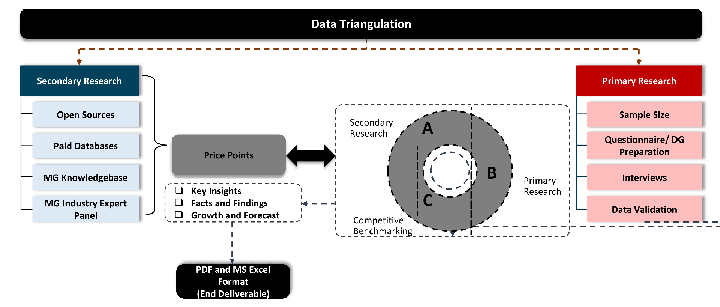
Data triangulation is a validation technique that uses multiple methods, sources, or perspectives to examine the same research question, thereby increasing the credibility and reliability of research findings. In market research, triangulation serves as a quality assurance mechanism that helps identify and minimize bias, validate assumptions, and ensure accuracy in market estimates.
- Data Source Triangulation – Using multiple data sources to examine the same phenomenon
- Methodological Triangulation – Using multiple research methods to study the same research question
- Investigator Triangulation – Using multiple researchers or analysts to examine the same data
- Theoretical Triangulation – Using multiple theoretical perspectives to interpret the same data
Custom Market Research Services
We will customise the research for you, in case the report listed above does not meet your requirements.
Get 10% Free Customisation