Natural Food Colorants and Dyes Market Size, Share & Trends Analysis Report by Source Type (Plant-Based Colorants, Animal-Based Colorants, Mineral-Based Colorants, Microbial-Based Colorants), Product Type, Form, Solubility, Application Method, Stability Type, Processing Technology, End-Use Industry, and Geography (North America, Europe, Asia Pacific, Middle East, Africa, and South America) – Global Industry Data, Trends, and Forecasts, 2026–2035
|
|
|
Segmental Data Insights |
|
|
Demand Trends |
|
|
Competitive Landscape |
|
|
Strategic Development |
|
|
Future Outlook & Opportunities |
|
Natural-Food-Colorants-and-Dyes-Market Size, Share, and Growth
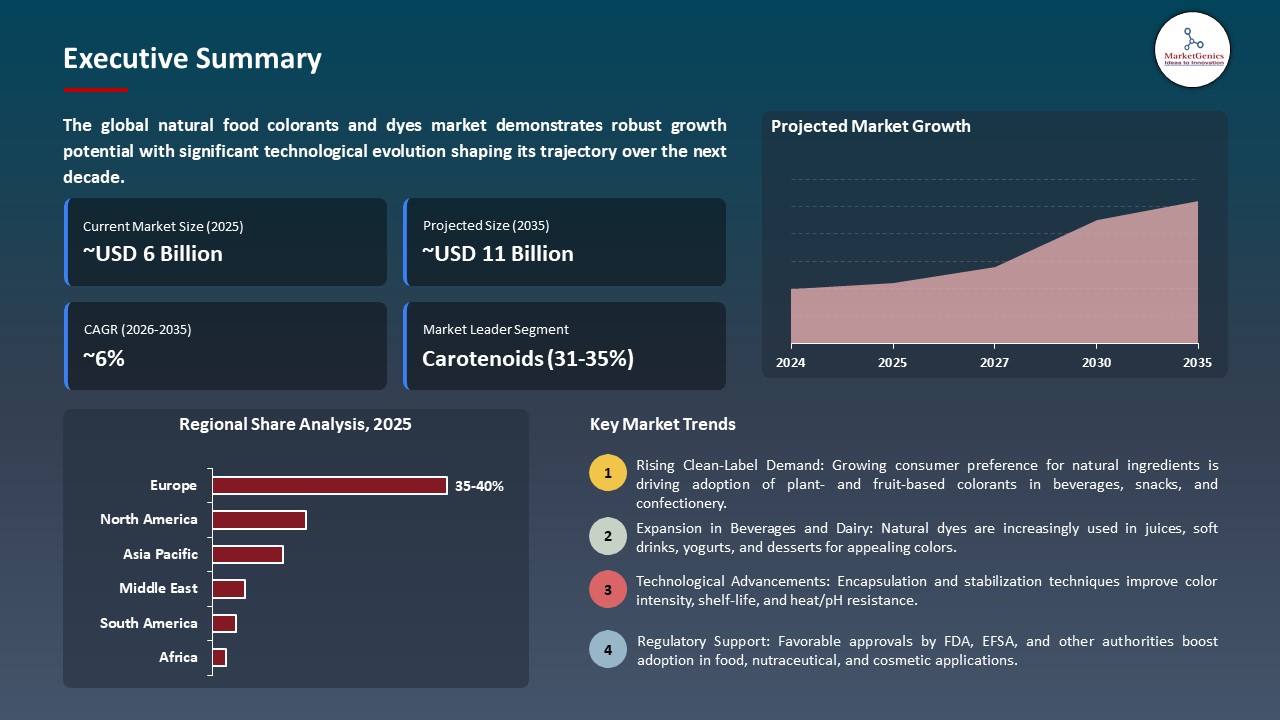
The global natural food colorants and dyes market is experiencing robust growth, with its estimated value of USD 6.2 billion in the year 2025 and USD 11.2 billion by the period 2035, registering a CAGR of 6.1%, during the forecast period. The global natural food colorants and dyes market is growing with an increase in the safety, stability, and traceability concerns of the products making the companies and regulators seek secure, stable, and non-degradable and contamination-free formulations. Coupled with the use of uniform extraction and encapsulation procedures, compatibility-oriented delivery systems and controlled stability parameters will maintain color integrity of food, beverage, nutraceutical and personal-care products all the way through the processing, distribution and retail channels.
Frank Engel, product manager at GNT Group, said: Carotenes offer a natural way to achieve vibrant shades while supporting natural ingredient declarations, but finding the right option can be challenging. Our Exberry algal carotenes offer a consumer-friendly option that delivers strong performance.
Natural food colorants and dyes market is shifting away to being a compliance-oriented market to offering strategic, brand conscious enabling in food, beverage, nutraceutical and personal care industries. The increasing consumer interest in clean-label, allergen-free, and plant-based, as well as strict food safety and labeling standards are forcing manufacturers to implement high-performance natural dyes that are stable, retain color effects and functionality in a variety of applications. The integration of microencapsulated, powdered, and water-soluble colorants is being promoted by premiumization and differentiation strategies to improve the product appeal and shelf-life as well as ingredient transparency.
The need to balance product performance and sustainability requirement is making innovation in product formulation and packaging. To achieve the objectives of the circular-economy, brands are capitalizing on environmental-friendly extraction methods, biodegradable delivery systems, and dismantled encapsulation systems. Further stabilized and light- and heat-resistant delivery formats enable processors to reduce degradation, waste, and enhance consistency, creating a competitive advantage in the products of high value.
Adjacent market opportunities to the natural food colorants and dyes market include clean-label beverage formulations, plant-based meat and dairy alternatives, nutraceuticals and functional foods, natural cosmetics and personal care products, and pharmaceutical excipients using bio-based pigments. These adjacent opportunities collectively accelerate demand diversification, strengthen value-chain integration, and enhance long-term growth resilience for the natural food colorants and dyes market.
Natural Food Colorants and Dyes Market Dynamics and Trends
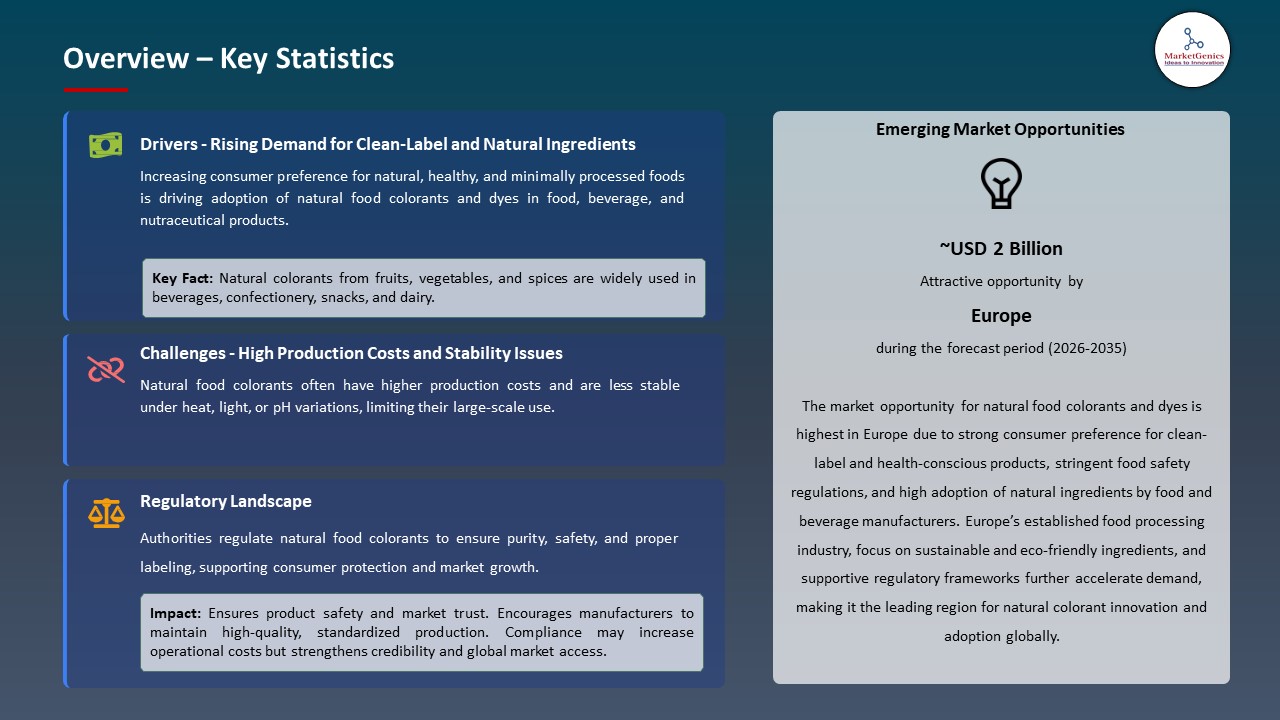
Driver: Surging Demand for Clean‑Label & Health‑Conscious Products
-
The global natural food colorants and dyes market are highly growing due to increasing consumer demand in natural, plant-based and allergen-free products. Synthetic dyes are being substituted by certified natural colorants by food, beverage, and personal-care producers to satisfy clean-label requirements, improve product visibility, and respond to the health-conscious market trends, especially in bakery, dairy, confectionery, and beverage sectors.
- New natural coloring systems are aiding this transition. For instance, in June 2025, Kraft Heinz promised to eliminate FD&C synthetic colors in its U.S. product line by the end of 2027 and use natural colorants wherever they are possible. This action underscores the use of natural dyes by the large brands in an effort to satisfy the demands of the consumers to use healthier and clean-label products.
- Increased regulatory forces to remove artificial colorants, heightened health consciousness and clean label claims are all converting natural food colorants to be a significant force, increasing adoption and market expansion in all global food and beverage sectors.
Restraint: High Production Costs and Raw‑Material Supply Variability
-
The global natural food colorants and dyes market experiences a very high cost pressure because of the high cost and seasonal fluctuation of such raw materials as annatto seeds, beetroot, turmeric, and fruits rich in carotenoids. Shifts in harvest quality, weather patterns in the region, and performance of extraction have the immediate effect of increasing the cost of production and the reliability of supply to the manufacturer.
- Complexation of processing needs also adds to costs. Stabilization, encapsulation and microencapsulation methods necessary to improve colour stability, shelf-life and heat/pH resistance are energy-consuming and need special apparatus, and the small and mid-scale manufacturers are dependent on outside plants and incur indirect operational expenditure.
- Also, inadequate batches of raw-materials may influence the intensity of colour, solubility, and functionality which may result in the introduction of a new formulation, rejection of the batch, or recall. Such cumulative factors hamper mass adoption and inhibit the growth of the market, especially in the cost-sensitive segments and developing markets.
Opportunity: Innovation in Stabilization and Encapsulation Technologies
-
The natural food colorants and dyes market is experiencing huge growth prospects as the companies and the ingredient providers concentrate on greener, stable, and hazy solutions. Increased consumer demand of clean-label, organic, and sustainably sourced ingredients is igniting research on natural colorant formulations to improve functionality, shelf-life, and processing efficiency.
- Manufacturers are coming up with sustainable and performance solutions. For instance, in June 2025, GNT Group added to its EXBERRY Organics brand the introduction of Brilliant Pink, a natural, plant-based, certified-organic colorant made out of purple sweet potatoes. The new shade provides both heat- and pH-stable functionality in beverages, dairy, and confectionery to allow manufacturers to fulfill clean-label, organic, and process-stable desires and to increase product attractiveness.
- The advent of the circular supply chain and the demand of environmentally-friendly ingredients make natural food colorants and dyes one of the major growth opportunities in the global natural food colorants and dyes market.
Key Trend: Regulatory Pressure & Clean‑Label Regulations Driving Shift from Synthetic to Natural Dyes
-
The global natural food colorants and dyes market is becoming more driven by regulatory forces and consumerism, which requires clean-label products, thus manufacturers are slowly replacing synthetic dye with natural ones. The brands are working on ingredient-openness, allergen-free and adherence of food-safety laws to address the changing market demands.
- Manufacturers are re-engineering products to increase stability, color consistency and processing efficiency of natural dyes. For instance, in September 2025, Mondelez international declared that it would change its Swedish fish confectionary range with natural dyes instead of synthetic ones, as the market trends are moving towards natural and consumer-friendly ingredients. These efforts are an indication that regulatory as well as consumer pressures are increasing the pace of moving to natural colorants throughout the supply chain.
- The use of natural dyes in companies will also have the advantage of traceability, alignment of sustainability and enhanced consumer engagement, and the strategic value of this trend.
Natural-Food-Colorants-and-Dyes-Market Analysis and Segmental Data
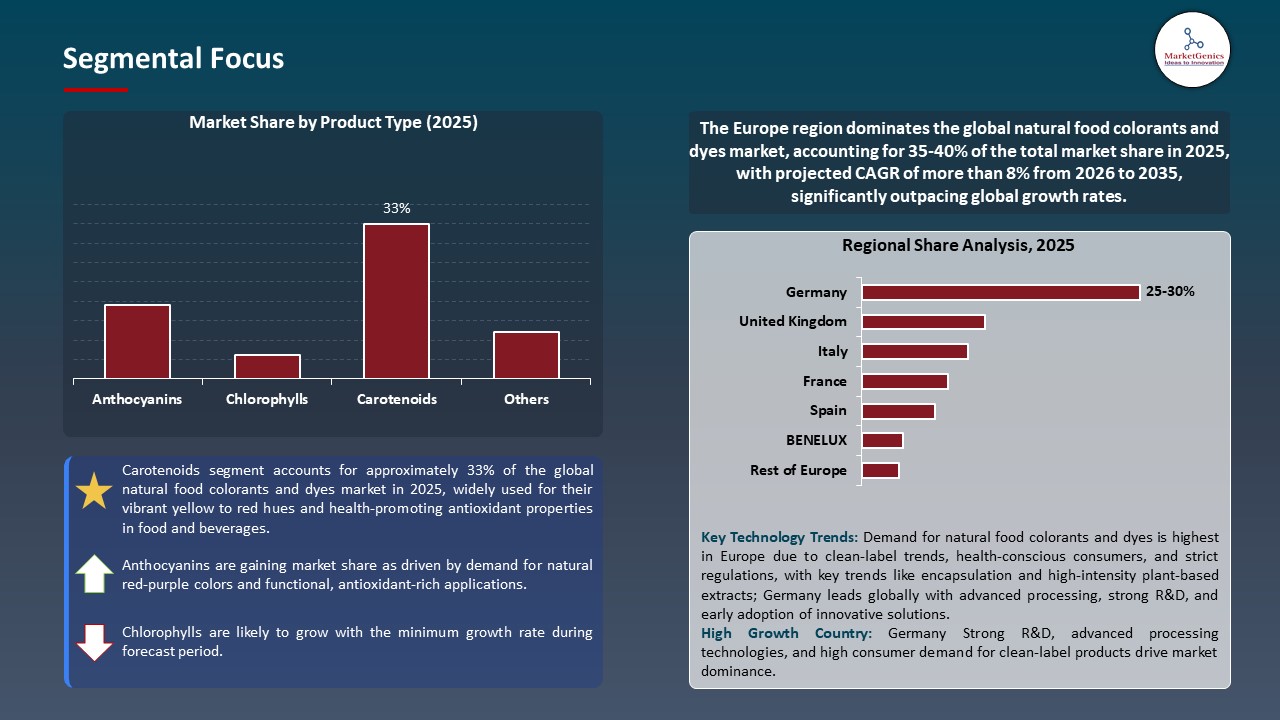
Carotenoids Dominate Global Natural Food Colorants and Dyes Market
-
Carotenoids dominate the global natural food colorants/dyes market because of its colorful color selection, antioxidant properties and its ability to be used in food, beverage and nutraceutical products. They are more stable in a wide range of pH and temperatures and have been proven to work in bakery, dairy, confectionery, and beverages; thus, manufacturers are finding them the choice of a natural color with health-seeking interests.
- Carotenoid delivery and packaging are increasingly being innovative. For instance, high-tech encapsulation systems provide increased solubility, oxidative stability and ease of inclusion in liquid, powder, and emulsed products. In September 2025, GNT Group released its algae-based EXBERRY Carotenes in natural yellow shades, which is a clean-label, plant-based alternative to use in bakery, dairy, and beverages.
- Microencapsulated carotenoids, such as EXBerry variants, enhance shelf-life, color integrity and functional retention, satisfying both clean-label and processing efficiency criteria. Specialized bottles and dosing systems of carotenoid color solutions provide safety in handling, regulatory and reduced degradation.
- Their recyclable structures are ergonomic and this aspect strengthens the carotenoid as reliable, scalable and sustainable ingredient in the global natural food colorants and dyes market.
Europe Leads Global Natural Food Colorants and Dyes Market Demand
-
Europe leads the global natural food colorants and dyes market, as more consumers tend to choose clean-label, plant-based and allergen-free products. Increasing consciousness of food safety, ingredients openness, and traceability is compelling food manufacturers to shift to natural colorants to synthetic ones in bakery, dairy, confectionery, and beverage applications. There is also the existing food processing infrastructure and strict regulatory framework in the region that leads to faster adoption of certified natural ingredients.
- The ingredient suppliers and manufacturers are developing to address the functionality and sustainability requirements. For instance, in 2025, new technology developed by California Natural Color (CNC) called Crystal Color that debuted at Fi Europe in Paris, promising extremely stable natural fruit and vegetable-based colors that meet the requirements of the European regulations and clean-label demands. Water soluble, powdered and encapsulated colorants also enhance stability, shelf-life, and processing efficiency, and the eco-friendly package lowers energy consumption and wastage.
- Supply chains are reinforced by strategic investment in research and development, environmentally friendly sourcing of botanical extracts, and manufacturing prepared to be automated. Through these contributions, Europe is able to dominate the natural food colorants and dyes market with safe, scalable and regulation acceptable solutions that act as benchmarks to be followed internationally.
Natural-Food-Colorants-and-Dyes-Market Ecosystem
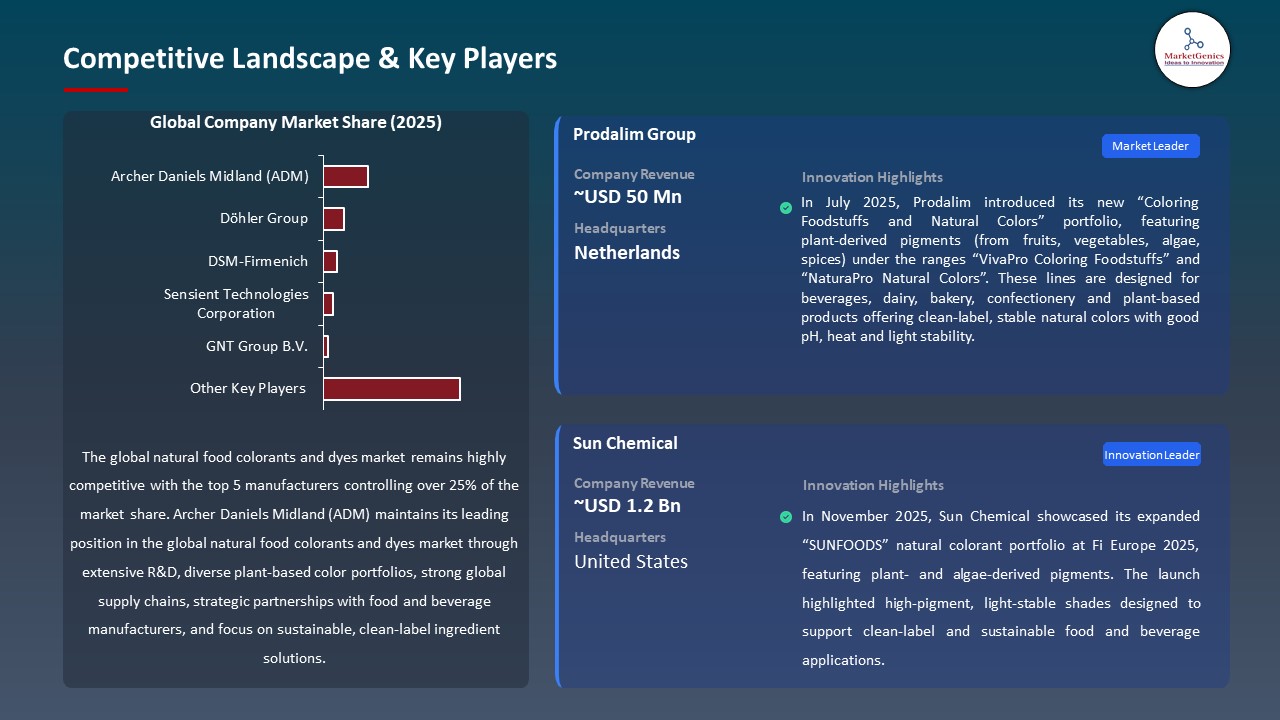
The global natural food colorants and dyes market is moderately fragmented, led by multinational ingredient innovators. Tier 1 leaders such as ADM and DSM-Firmenich dominate production, while Tier 2 and Tier 3 players focus on regional and niche formulations globally.
These companies leverage R&D, global manufacturing, and regulatory expertise to ensure scalable, cost-effective supply. The value chain spans raw material sourcing, extraction, formulation, and downstream manufacturing, while sustainable extraction, microencapsulation, monitoring, and vertical integration enhance product stability, compliance, and accessibility.
Recent Development and Strategic Overview
-
In July 2025, Prodalim presented its new portfolio of coloring foodstuffs and natural colors, with plant-based pigments (e.g., fruits, vegetables, algae, spices) in its “VivaPro Coloring Foodstuffs” and NuraPro Natural Colours. These are beverage, dairy, bakery, confectionery, and plant-based lines that to be provided with clean-labeled and stable natural colors that have high heat and light stability and good pH.
- In November 2025, Sun Chemical showcased its expanded “SUNFOODS” natural colorant portfolio at Fi Europe 2025, featuring plant- and algae-derived pigments. The launch highlighted high-pigment, light-stable shades designed to support clean-label and sustainable food and beverage applications.
Report Scope
|
Detail |
|
|
Market Size in 2025 |
USD 6.2 Bn |
|
Market Forecast Value in 2035 |
USD 11.2 Bn |
|
Growth Rate (CAGR) |
6.1% |
|
Forecast Period |
2026 – 2035 |
|
Historical Data Available for |
2021 – 2024 |
|
Market Size Units |
US$ Billion for Value Metric Tons for Volume |
|
Report Format |
Electronic (PDF) + Excel |
|
North America |
Europe |
Asia Pacific |
Middle East |
Africa |
South America |
|
|
|
|
|
|
|
Companies Covered |
|||||
|
|
|
|
|
|
Natural-Food-Colorants-and-Dyes-Market Segmentation and Highlights
|
Segment |
Sub-segment |
|
Natural Food Colorants and Dyes Market, By Source Type |
|
|
Natural Food Colorants and Dyes Market, By Product Type |
|
|
Natural Food Colorants and Dyes Market, By Form |
|
|
Natural Food Colorants and Dyes Market, By Solubility |
|
|
Natural Food Colorants and Dyes Market, By Application Method |
|
|
Natural Food Colorants and Dyes Market, By Stability Type |
|
|
Natural Food Colorants and Dyes Market, By Processing Technology |
|
|
Natural Food Colorants and Dyes Market, By End-Use Industry |
|
Frequently Asked Questions
Table of Contents
- 1. Research Methodology and Assumptions
- 1.1. Definitions
- 1.2. Research Design and Approach
- 1.3. Data Collection Methods
- 1.4. Base Estimates and Calculations
- 1.5. Forecasting ModelsNatural Food Colorants and Dyes Market
- 1.5.1. Key Forecast Factors & Impact Analysis
- 1.6. Secondary Research
- 1.6.1. Open Sources
- 1.6.2. Paid Databases
- 1.6.3. Associations
- 1.7. Primary Research
- 1.7.1. Primary Sources
- 1.7.2. Primary Interviews with Stakeholders across Ecosystem
- 2. Executive Summary
- 2.1. Global Natural Food Colorants and Dyes Market Outlook
- 2.1.1. Natural Food Colorants and Dyes Market Size Volume (Metric Tons) and Value (US$ Bn), and Forecasts, 2021-2035
- 2.1.2. Compounded Annual Growth Rate Analysis
- 2.1.3. Growth Opportunity Analysis
- 2.1.4. Segmental Share Analysis
- 2.1.5. Geographical Share Analysis
- 2.2. Market Analysis and Facts
- 2.3. Supply-Demand Analysis
- 2.4. Competitive Benchmarking
- 2.5. Go-to- Market Strategy
- 2.5.1. Customer/ End-use Industry Assessment
- 2.5.2. Growth Opportunity Data, 2026-2035
- 2.5.2.1. Regional Data
- 2.5.2.2. Country Data
- 2.5.2.3. Segmental Data
- 2.5.3. Identification of Potential Market Spaces
- 2.5.4. GAP Analysis
- 2.5.5. Potential Attractive Price Points
- 2.5.6. Prevailing Market Risks & Challenges
- 2.5.7. Preferred Sales & Marketing Strategies
- 2.5.8. Key Recommendations and Analysis
- 2.5.9. A Way Forward
- 2.1. Global Natural Food Colorants and Dyes Market Outlook
- 3. Industry Data and Premium Insights
- 3.1. Global Food & Beverages Industry Overview, 2025
- 3.1.1. Industry Ecosystem Analysis
- 3.1.2. Key Trends for Food & Beverages Industry
- 3.1.3. Regional Distribution for Food & Beverages Industry
- 3.2. Supplier Customer Data
- 3.3. Technology Roadmap and Developments
- 3.4. Trade Analysis
- 3.4.1. Import & Export Analysis, 2025
- 3.4.2. Top Importing Countries
- 3.4.3. Top Exporting Countries
- 3.5. Trump Tariff Impact Analysis
- 3.5.1. Manufacturer
- 3.5.1.1. Based on the component & Raw material
- 3.5.2. Supply Chain
- 3.5.3. End Consumer
- 3.5.1. Manufacturer
- 3.6. Raw Material Analysis
- 3.1. Global Food & Beverages Industry Overview, 2025
- 4. Market Overview
- 4.1. Market Dynamics
- 4.1.1. Drivers
- 4.1.1.1. Growing global demand for clean-label, plant-based, and naturally derived ingredients.
- 4.1.1.2. Regulatory restrictions on synthetic dyes encouraging reformulation toward natural alternatives.
- 4.1.1.3. Rising adoption of biotechnology, fermentation, and advanced extraction methods improving color stability and availability.
- 4.1.2. Restraints
- 4.1.2.1. Higher production and processing costs of natural colorants compared to synthetic options.
- 4.1.2.2. Heat, light, and pH sensitivity leading to stability and shelf-life challenges in food and beverage applications.
- 4.1.1. Drivers
- 4.2. Key Trend Analysis
- 4.3. Regulatory Framework
- 4.3.1. Key Regulations, Norms, and Subsidies, by Key Countries
- 4.3.2. Tariffs and Standards
- 4.3.3. Impact Analysis of Regulations on the Market
- 4.4. Value Chain Analysis
- 4.4.1. Raw Material Suppliers
- 4.4.2. Manufacturers
- 4.4.3. Dealers/ Distributors
- 4.4.4. End-Users/ Customers
- 4.5. Cost Structure Analysis
- 4.5.1. Parameter’s Share for Cost Associated
- 4.5.2. COGP vs COGS
- 4.5.3. Profit Margin Analysis
- 4.6. Pricing Analysis
- 4.6.1. Regional Pricing Analysis
- 4.6.2. Segmental Pricing Trends
- 4.6.3. Factors Influencing Pricing
- 4.7. Porter’s Five Forces Analysis
- 4.8. PESTEL Analysis
- 4.9. Global Natural Food Colorants and Dyes Market Demand
- 4.9.1. Historical Market Size – Volume (Metric Tons) and Value (US$ Bn), 2020-2024
- 4.9.2. Current and Future Market Size – Volume (Metric Tons) and Value (US$ Bn), 2026–2035
- 4.9.2.1. Y-o-Y Growth Trends
- 4.9.2.2. Absolute $ Opportunity Assessment
- 4.1. Market Dynamics
- 5. Competition Landscape
- 5.1. Competition structure
- 5.1.1. Fragmented v/s consolidated
- 5.2. Company Share Analysis, 2025
- 5.2.1. Global Company Market Share
- 5.2.2. By Region
- 5.2.2.1. North America
- 5.2.2.2. Europe
- 5.2.2.3. Asia Pacific
- 5.2.2.4. Middle East
- 5.2.2.5. Africa
- 5.2.2.6. South America
- 5.3. Product Comparison Matrix
- 5.3.1. Specifications
- 5.3.2. Market Positioning
- 5.3.3. Pricing
- 5.1. Competition structure
- 6. Global Natural Food Colorants and Dyes Market Analysis, by Source Type
- 6.1. Key Segment Analysis
- 6.2. Natural Food Colorants and Dyes Market Size Volume (Metric Tons) and Value (US$ Bn), Analysis, and Forecasts, by Source Type, 2021-2035
- 6.2.1. Plant-Based Colorants
- 6.2.1.1. Fruit & Vegetable Extracts
- 6.2.1.2. Flower Extracts
- 6.2.1.3. Root & Tuber Extracts
- 6.2.1.4. Leaf Extracts
- 6.2.1.5. Bark & Wood Extracts
- 6.2.1.6. Others
- 6.2.2. Animal-Based Colorants
- 6.2.2.1. Carmine/Cochineal
- 6.2.2.2. Other Animal Derivatives
- 6.2.3. Mineral-Based Colorants
- 6.2.3.1. Iron Oxides
- 6.2.3.2. Titanium Dioxide
- 6.2.3.3. Other Mineral Sources
- 6.2.4. Microbial-Based Colorants
- 6.2.4.1. Bacterial Fermentation
- 6.2.4.2. Algae & Spirulina
- 6.2.4.3. Fungi-Based
- 6.2.4.4. Others
- 6.2.1. Plant-Based Colorants
- 7. Global Natural Food Colorants and Dyes Market Analysis, by Product Type
- 7.1. Key Segment Analysis
- 7.2. Natural Food Colorants and Dyes Market Size Volume (Metric Tons) and Value (US$ Bn), Analysis, and Forecasts, by Product Type, 2021-2035
- 7.2.1. Carotenoids
- 7.2.1.1. Beta-Carotene
- 7.2.1.2. Lycopene
- 7.2.1.3. Astaxanthin
- 7.2.1.4. Lutein
- 7.2.1.5. Annatto
- 7.2.1.6. Others
- 7.2.2. Anthocyanins
- 7.2.2.1. Red Cabbage Extract
- 7.2.2.2. Grape Skin Extract
- 7.2.2.3. Elderberry Extract
- 7.2.2.4. Black Carrot Extract
- 7.2.2.5. Others
- 7.2.3. Chlorophylls
- 7.2.3.1. Chlorophyll A
- 7.2.3.2. Chlorophyll B
- 7.2.3.3. Chlorophyllin Copper Complex
- 7.2.3.4. Others
- 7.2.4. Curcuminoids
- 7.2.4.1. Turmeric Extract
- 7.2.4.2. Curcumin Derivatives
- 7.2.4.3. Others
- 7.2.5. Betalains
- 7.2.5.1. Beetroot Red
- 7.2.5.2. Betacyanins
- 7.2.5.3. Betaxanthins
- 7.2.5.4. Others
- 7.2.6. Caramel Colors
- 7.2.6.1. Class I Caramel
- 7.2.6.2. Class II Caramel
- 7.2.6.3. Class III Caramel
- 7.2.6.4. Class IV Caramel
- 7.2.6.5. Others
- 7.2.7. Other Product Type
- 7.2.7.1. Paprika Extract
- 7.2.7.2. Saffron
- 7.2.7.3. Spirulina Extract
- 7.2.7.4. Others
- 7.2.1. Carotenoids
- 8. Global Natural Food Colorants and Dyes Market Analysis, by Form
- 8.1. Key Segment Analysis
- 8.2. Natural Food Colorants and Dyes Market Size Volume (Metric Tons) and Value (US$ Bn), Analysis, and Forecasts, by Form, 2021-2035
- 8.2.1. Liquid/Solution
- 8.2.2. Powder
- 8.2.3. Paste/Gel
- 8.2.4. Granules
- 8.2.5. Encapsulated
- 9. Global Natural Food Colorants and Dyes Market Analysis, by Solubility
- 9.1. Key Segment Analysis
- 9.2. Natural Food Colorants and Dyes Market Size Volume (Metric Tons) and Value (US$ Bn), Analysis, and Forecasts, by Solubility, 2021-2035
- 9.2.1. Water-Soluble Colorants
- 9.2.2. Oil-Soluble Colorants
- 9.2.3. Dual-Soluble (Amphiphilic)
- 9.2.4. Dispersion-Based
- 10. Global Natural Food Colorants and Dyes Market Analysis, by Application Method
- 10.1. Key Segment Analysis
- 10.2. Natural Food Colorants and Dyes Market Size Volume (Metric Tons) and Value (US$ Bn), Analysis, and Forecasts, by Application Method, 2021-2035
- 10.2.1. Direct Addition
- 10.2.2. Emulsion Systems
- 10.2.3. Spray Application
- 10.2.4. Coating & Glazing
- 10.2.5. Injection Systems
- 10.2.6. Dipping & Soaking
- 11. Global Natural Food Colorants and Dyes Market Analysis, by Stability Type
- 11.1. Key Segment Analysis
- 11.2. Natural Food Colorants and Dyes Market Size Volume (Metric Tons) and Value (US$ Bn), Analysis, and Forecasts, by Stability Type, 2021-2035
- 11.2.1. Heat-Stable Colorants
- 11.2.2. Light-Stable Colorants
- 11.2.3. pH-Stable Colorants
- 11.2.4. Oxidation-Resistant Colorants
- 11.2.5. Multi-Stable (Combined Stability)
- 12. Global Natural Food Colorants and Dyes Market Analysis, by Processing Technology
- 12.1. Key Segment Analysis
- 12.2. Natural Food Colorants and Dyes Market Size Volume (Metric Tons) and Value (US$ Bn), Analysis, and Forecasts, by Processing Technology, 2021-2035
- 12.2.1. Traditional Extraction
- 12.2.1.1. Solvent Extraction
- 12.2.1.2. Cold Press Extraction
- 12.2.2. Advanced Processing
- 12.2.2.1. Supercritical CO2 Extraction
- 12.2.2.2. Ultrasound-Assisted Extraction
- 12.2.2.3. Microwave-Assisted Extraction
- 12.2.2.4. Enzyme-Assisted Extraction
- 12.2.2.5. Others
- 12.2.3. Fermentation Technology
- 12.2.4. Membrane Filtration
- 12.2.5. Spray Drying Technology
- 12.2.1. Traditional Extraction
- 13. Global Natural Food Colorants and Dyes Market Analysis, by End-Use Industry
- 13.1. Key Segment Analysis
- 13.2. Natural Food Colorants and Dyes Market Size Volume (Metric Tons) and Value (US$ Bn), Analysis, and Forecasts, by End-Use Industry, 2021-2035
- 13.2.1. Food & Beverages
- 13.2.2. Pharmaceutical
- 13.2.3. Cosmetics & Personal Care
- 13.2.4. Animal Feed
- 13.2.5. Other Industries
- 14. Global Natural Food Colorants and Dyes Market Analysis and Forecasts, by Region
- 14.1. Key Findings
- 14.2. Natural Food Colorants and Dyes Market Size Volume (Metric Tons) and Value (US$ Bn), Analysis, and Forecasts, by Region, 2021-2035
- 14.2.1. North America
- 14.2.2. Europe
- 14.2.3. Asia Pacific
- 14.2.4. Middle East
- 14.2.5. Africa
- 14.2.6. South America
- 15. North America Natural Food Colorants and Dyes Market Analysis
- 15.1. Key Segment Analysis
- 15.2. Regional Snapshot
- 15.3. North America Natural Food Colorants and Dyes Market Size- Volume (Metric Tons) and Value (US$ Bn), Analysis, and Forecasts, 2021-2035
- 15.3.1. Source Type
- 15.3.2. Product Type
- 15.3.3. Form
- 15.3.4. Solubility
- 15.3.5. Application Method
- 15.3.6. Stability Type
- 15.3.7. Processing Technology
- 15.3.8. End-Use Industry
- 15.3.9. Country
- 15.3.9.1. USA
- 15.3.9.2. Canada
- 15.3.9.3. Mexico
- 15.4. USA Natural Food Colorants and Dyes Market
- 15.4.1. Country Segmental Analysis
- 15.4.2. Source Type
- 15.4.3. Product Type
- 15.4.4. Form
- 15.4.5. Solubility
- 15.4.6. Application Method
- 15.4.7. Stability Type
- 15.4.8. Processing Technology
- 15.4.9. End-Use Industry
- 15.5. Canada Natural Food Colorants and Dyes Market
- 15.5.1. Country Segmental Analysis
- 15.5.2. Source Type
- 15.5.3. Product Type
- 15.5.4. Form
- 15.5.5. Solubility
- 15.5.6. Application Method
- 15.5.7. Stability Type
- 15.5.8. Processing Technology
- 15.5.9. End-Use Industry
- 15.6. Mexico Natural Food Colorants and Dyes Market
- 15.6.1. Country Segmental Analysis
- 15.6.2. Source Type
- 15.6.3. Product Type
- 15.6.4. Form
- 15.6.5. Solubility
- 15.6.6. Application Method
- 15.6.7. Stability Type
- 15.6.8. Processing Technology
- 15.6.9. End-Use Industry
- 16. Europe Natural Food Colorants and Dyes Market Analysis
- 16.1. Key Segment Analysis
- 16.2. Regional Snapshot
- 16.3. Europe Natural Food Colorants and Dyes Market Size Volume (Metric Tons) and Value (US$ Bn), Analysis, and Forecasts, 2021-2035
- 16.3.1. Source Type
- 16.3.2. Product Type
- 16.3.3. Form
- 16.3.4. Solubility
- 16.3.5. Application Method
- 16.3.6. Stability Type
- 16.3.7. Processing Technology
- 16.3.8. End-Use Industry
- 16.3.9. Country
- 16.3.9.1. Germany
- 16.3.9.2. United Kingdom
- 16.3.9.3. France
- 16.3.9.4. Italy
- 16.3.9.5. Spain
- 16.3.9.6. Netherlands
- 16.3.9.7. Nordic Countries
- 16.3.9.8. Poland
- 16.3.9.9. Russia & CIS
- 16.3.9.10. Rest of Europe
- 16.4. Germany Natural Food Colorants and Dyes Market
- 16.4.1. Country Segmental Analysis
- 16.4.2. Source Type
- 16.4.3. Product Type
- 16.4.4. Form
- 16.4.5. Solubility
- 16.4.6. Application Method
- 16.4.7. Stability Type
- 16.4.8. Processing Technology
- 16.4.9. End-Use Industry
- 16.5. United Kingdom Natural Food Colorants and Dyes Market
- 16.5.1. Country Segmental Analysis
- 16.5.2. Source Type
- 16.5.3. Product Type
- 16.5.4. Form
- 16.5.5. Solubility
- 16.5.6. Application Method
- 16.5.7. Stability Type
- 16.5.8. Processing Technology
- 16.5.9. End-Use Industry
- 16.6. France Natural Food Colorants and Dyes Market
- 16.6.1. Country Segmental Analysis
- 16.6.2. Source Type
- 16.6.3. Product Type
- 16.6.4. Form
- 16.6.5. Solubility
- 16.6.6. Application Method
- 16.6.7. Stability Type
- 16.6.8. Processing Technology
- 16.6.9. End-Use Industry
- 16.7. Italy Natural Food Colorants and Dyes Market
- 16.7.1. Country Segmental Analysis
- 16.7.2. Source Type
- 16.7.3. Product Type
- 16.7.4. Form
- 16.7.5. Solubility
- 16.7.6. Application Method
- 16.7.7. Stability Type
- 16.7.8. Processing Technology
- 16.7.9. End-Use Industry
- 16.8. Spain Natural Food Colorants and Dyes Market
- 16.8.1. Country Segmental Analysis
- 16.8.2. Source Type
- 16.8.3. Product Type
- 16.8.4. Form
- 16.8.5. Solubility
- 16.8.6. Application Method
- 16.8.7. Stability Type
- 16.8.8. Processing Technology
- 16.8.9. End-Use Industry
- 16.9. Netherlands Natural Food Colorants and Dyes Market
- 16.9.1. Country Segmental Analysis
- 16.9.2. Source Type
- 16.9.3. Product Type
- 16.9.4. Form
- 16.9.5. Solubility
- 16.9.6. Application Method
- 16.9.7. Stability Type
- 16.9.8. Processing Technology
- 16.9.9. End-Use Industry
- 16.10. Nordic Countries Natural Food Colorants and Dyes Market
- 16.10.1. Country Segmental Analysis
- 16.10.2. Source Type
- 16.10.3. Product Type
- 16.10.4. Form
- 16.10.5. Solubility
- 16.10.6. Application Method
- 16.10.7. Stability Type
- 16.10.8. Processing Technology
- 16.10.9. End-Use Industry
- 16.11. Poland Natural Food Colorants and Dyes Market
- 16.11.1. Country Segmental Analysis
- 16.11.2. Source Type
- 16.11.3. Product Type
- 16.11.4. Form
- 16.11.5. Solubility
- 16.11.6. Application Method
- 16.11.7. Stability Type
- 16.11.8. Processing Technology
- 16.11.9. End-Use Industry
- 16.12. Russia & CIS Natural Food Colorants and Dyes Market
- 16.12.1. Country Segmental Analysis
- 16.12.2. Source Type
- 16.12.3. Product Type
- 16.12.4. Form
- 16.12.5. Solubility
- 16.12.6. Application Method
- 16.12.7. Stability Type
- 16.12.8. Processing Technology
- 16.12.9. End-Use Industry
- 16.13. Rest of Europe Natural Food Colorants and Dyes Market
- 16.13.1. Country Segmental Analysis
- 16.13.2. Source Type
- 16.13.3. Product Type
- 16.13.4. Form
- 16.13.5. Solubility
- 16.13.6. Application Method
- 16.13.7. Stability Type
- 16.13.8. Processing Technology
- 16.13.9. End-Use Industry
- 17. Asia Pacific Natural Food Colorants and Dyes Market Analysis
- 17.1. Key Segment Analysis
- 17.2. Regional Snapshot
- 17.3. Asia Pacific Natural Food Colorants and Dyes Market Size Volume (Metric Tons) and Value (US$ Bn), Analysis, and Forecasts, 2021-2035
- 17.3.1. Source Type
- 17.3.2. Product Type
- 17.3.3. Form
- 17.3.4. Solubility
- 17.3.5. Application Method
- 17.3.6. Stability Type
- 17.3.7. Processing Technology
- 17.3.8. End-Use Industry
- 17.3.9. Country
- 17.3.9.1. China
- 17.3.9.2. India
- 17.3.9.3. Japan
- 17.3.9.4. South Korea
- 17.3.9.5. Australia and New Zealand
- 17.3.9.6. Indonesia
- 17.3.9.7. Malaysia
- 17.3.9.8. Thailand
- 17.3.9.9. Vietnam
- 17.3.9.10. Rest of Asia Pacific
- 17.4. China Natural Food Colorants and Dyes Market
- 17.4.1. Country Segmental Analysis
- 17.4.2. Source Type
- 17.4.3. Product Type
- 17.4.4. Form
- 17.4.5. Solubility
- 17.4.6. Application Method
- 17.4.7. Stability Type
- 17.4.8. Processing Technology
- 17.4.9. End-Use Industry
- 17.5. India Natural Food Colorants and Dyes Market
- 17.5.1. Country Segmental Analysis
- 17.5.2. Source Type
- 17.5.3. Product Type
- 17.5.4. Form
- 17.5.5. Solubility
- 17.5.6. Application Method
- 17.5.7. Stability Type
- 17.5.8. Processing Technology
- 17.5.9. End-Use Industry
- 17.6. Japan Natural Food Colorants and Dyes Market
- 17.6.1. Country Segmental Analysis
- 17.6.2. Source Type
- 17.6.3. Product Type
- 17.6.4. Form
- 17.6.5. Solubility
- 17.6.6. Application Method
- 17.6.7. Stability Type
- 17.6.8. Processing Technology
- 17.6.9. End-Use Industry
- 17.7. South Korea Natural Food Colorants and Dyes Market
- 17.7.1. Country Segmental Analysis
- 17.7.2. Source Type
- 17.7.3. Product Type
- 17.7.4. Form
- 17.7.5. Solubility
- 17.7.6. Application Method
- 17.7.7. Stability Type
- 17.7.8. Processing Technology
- 17.7.9. End-Use Industry
- 17.8. Australia and New Zealand Natural Food Colorants and Dyes Market
- 17.8.1. Country Segmental Analysis
- 17.8.2. Source Type
- 17.8.3. Product Type
- 17.8.4. Form
- 17.8.5. Solubility
- 17.8.6. Application Method
- 17.8.7. Stability Type
- 17.8.8. Processing Technology
- 17.8.9. End-Use Industry
- 17.9. Indonesia Natural Food Colorants and Dyes Market
- 17.9.1. Country Segmental Analysis
- 17.9.2. Source Type
- 17.9.3. Product Type
- 17.9.4. Form
- 17.9.5. Solubility
- 17.9.6. Application Method
- 17.9.7. Stability Type
- 17.9.8. Processing Technology
- 17.9.9. End-Use Industry
- 17.10. Malaysia Natural Food Colorants and Dyes Market
- 17.10.1. Country Segmental Analysis
- 17.10.2. Source Type
- 17.10.3. Product Type
- 17.10.4. Form
- 17.10.5. Solubility
- 17.10.6. Application Method
- 17.10.7. Stability Type
- 17.10.8. Processing Technology
- 17.10.9. End-Use Industry
- 17.11. Thailand Natural Food Colorants and Dyes Market
- 17.11.1. Country Segmental Analysis
- 17.11.2. Source Type
- 17.11.3. Product Type
- 17.11.4. Form
- 17.11.5. Solubility
- 17.11.6. Application Method
- 17.11.7. Stability Type
- 17.11.8. Processing Technology
- 17.11.9. End-Use Industry
- 17.12. Vietnam Natural Food Colorants and Dyes Market
- 17.12.1. Country Segmental Analysis
- 17.12.2. Source Type
- 17.12.3. Product Type
- 17.12.4. Form
- 17.12.5. Solubility
- 17.12.6. Application Method
- 17.12.7. Stability Type
- 17.12.8. Processing Technology
- 17.12.9. End-Use Industry
- 17.13. Rest of Asia Pacific Natural Food Colorants and Dyes Market
- 17.13.1. Country Segmental Analysis
- 17.13.2. Source Type
- 17.13.3. Product Type
- 17.13.4. Form
- 17.13.5. Solubility
- 17.13.6. Application Method
- 17.13.7. Stability Type
- 17.13.8. Processing Technology
- 17.13.9. End-Use Industry
- 18. Middle East Natural Food Colorants and Dyes Market Analysis
- 18.1. Key Segment Analysis
- 18.2. Regional Snapshot
- 18.3. Middle East Natural Food Colorants and Dyes Market Size Volume (Metric Tons) and Value (US$ Bn), Analysis, and Forecasts, 2021-2035
- 18.3.1. Source Type
- 18.3.2. Product Type
- 18.3.3. Form
- 18.3.4. Solubility
- 18.3.5. Application Method
- 18.3.6. Stability Type
- 18.3.7. Processing Technology
- 18.3.8. End-Use Industry
- 18.3.9. Country
- 18.3.9.1. Turkey
- 18.3.9.2. UAE
- 18.3.9.3. Saudi Arabia
- 18.3.9.4. Israel
- 18.3.9.5. Rest of Middle East
- 18.4. Turkey Natural Food Colorants and Dyes Market
- 18.4.1. Country Segmental Analysis
- 18.4.2. Source Type
- 18.4.3. Product Type
- 18.4.4. Form
- 18.4.5. Solubility
- 18.4.6. Application Method
- 18.4.7. Stability Type
- 18.4.8. Processing Technology
- 18.4.9. End-Use Industry
- 18.5. UAE Natural Food Colorants and Dyes Market
- 18.5.1. Country Segmental Analysis
- 18.5.2. Source Type
- 18.5.3. Product Type
- 18.5.4. Form
- 18.5.5. Solubility
- 18.5.6. Application Method
- 18.5.7. Stability Type
- 18.5.8. Processing Technology
- 18.5.9. End-Use Industry
- 18.6. Saudi Arabia Natural Food Colorants and Dyes Market
- 18.6.1. Country Segmental Analysis
- 18.6.2. Source Type
- 18.6.3. Product Type
- 18.6.4. Form
- 18.6.5. Solubility
- 18.6.6. Application Method
- 18.6.7. Stability Type
- 18.6.8. Processing Technology
- 18.6.9. End-Use Industry
- 18.7. Israel Natural Food Colorants and Dyes Market
- 18.7.1. Country Segmental Analysis
- 18.7.2. Source Type
- 18.7.3. Product Type
- 18.7.4. Form
- 18.7.5. Solubility
- 18.7.6. Application Method
- 18.7.7. Stability Type
- 18.7.8. Processing Technology
- 18.7.9. End-Use Industry
- 18.8. Rest of Middle East Natural Food Colorants and Dyes Market
- 18.8.1. Country Segmental Analysis
- 18.8.2. Source Type
- 18.8.3. Product Type
- 18.8.4. Form
- 18.8.5. Solubility
- 18.8.6. Application Method
- 18.8.7. Stability Type
- 18.8.8. Processing Technology
- 18.8.9. End-Use Industry
- 19. Africa Natural Food Colorants and Dyes Market Analysis
- 19.1. Key Segment Analysis
- 19.2. Regional Snapshot
- 19.3. Africa Natural Food Colorants and Dyes Market Size Volume (Metric Tons) and Value (US$ Bn), Analysis, and Forecasts, 2021-2035
- 19.3.1. Source Type
- 19.3.2. Product Type
- 19.3.3. Form
- 19.3.4. Solubility
- 19.3.5. Application Method
- 19.3.6. Stability Type
- 19.3.7. Processing Technology
- 19.3.8. End-Use Industry
- 19.3.9. country
- 19.3.9.1. South Africa
- 19.3.9.2. Egypt
- 19.3.9.3. Nigeria
- 19.3.9.4. Algeria
- 19.3.9.5. Rest of Africa
- 19.4. South Africa Natural Food Colorants and Dyes Market
- 19.4.1. Country Segmental Analysis
- 19.4.2. Source Type
- 19.4.3. Product Type
- 19.4.4. Form
- 19.4.5. Solubility
- 19.4.6. Application Method
- 19.4.7. Stability Type
- 19.4.8. Processing Technology
- 19.4.9. End-Use Industry
- 19.5. Egypt Natural Food Colorants and Dyes Market
- 19.5.1. Country Segmental Analysis
- 19.5.2. Source Type
- 19.5.3. Product Type
- 19.5.4. Form
- 19.5.5. Solubility
- 19.5.6. Application Method
- 19.5.7. Stability Type
- 19.5.8. Processing Technology
- 19.5.9. End-Use Industry
- 19.6. Nigeria Natural Food Colorants and Dyes Market
- 19.6.1. Country Segmental Analysis
- 19.6.2. Source Type
- 19.6.3. Product Type
- 19.6.4. Form
- 19.6.5. Solubility
- 19.6.6. Application Method
- 19.6.7. Stability Type
- 19.6.8. Processing Technology
- 19.6.9. End-Use Industry
- 19.7. Algeria Natural Food Colorants and Dyes Market
- 19.7.1. Country Segmental Analysis
- 19.7.2. Source Type
- 19.7.3. Product Type
- 19.7.4. Form
- 19.7.5. Solubility
- 19.7.6. Application Method
- 19.7.7. Stability Type
- 19.7.8. Processing Technology
- 19.7.9. End-Use Industry
- 19.8. Rest of Africa Natural Food Colorants and Dyes Market
- 19.8.1. Country Segmental Analysis
- 19.8.2. Source Type
- 19.8.3. Product Type
- 19.8.4. Form
- 19.8.5. Solubility
- 19.8.6. Application Method
- 19.8.7. Stability Type
- 19.8.8. Processing Technology
- 19.8.9. End-Use Industry
- 20. South America Natural Food Colorants and Dyes Market Analysis
- 20.1. Key Segment Analysis
- 20.2. Regional Snapshot
- 20.3. South America Natural Food Colorants and Dyes Market Size Volume (Metric Tons) and Value (US$ Bn), Analysis, and Forecasts, 2021-2035
- 20.3.1. Source Type
- 20.3.2. Product Type
- 20.3.3. Form
- 20.3.4. Solubility
- 20.3.5. Application Method
- 20.3.6. Stability Type
- 20.3.7. Processing Technology
- 20.3.8. End-Use Industry
- 20.3.9. Country
- 20.3.9.1. Brazil
- 20.3.9.2. Argentina
- 20.3.9.3. Rest of South America
- 20.4. Brazil Natural Food Colorants and Dyes Market
- 20.4.1. Country Segmental Analysis
- 20.4.2. Source Type
- 20.4.3. Product Type
- 20.4.4. Form
- 20.4.5. Solubility
- 20.4.6. Application Method
- 20.4.7. Stability Type
- 20.4.8. Processing Technology
- 20.4.9. End-Use Industry
- 20.5. Argentina Natural Food Colorants and Dyes Market
- 20.5.1. Country Segmental Analysis
- 20.5.2. Source Type
- 20.5.3. Product Type
- 20.5.4. Form
- 20.5.5. Solubility
- 20.5.6. Application Method
- 20.5.7. Stability Type
- 20.5.8. Processing Technology
- 20.5.9. End-Use Industry
- 20.6. Rest of South America Natural Food Colorants and Dyes Market
- 20.6.1. Country Segmental Analysis
- 20.6.2. Source Type
- 20.6.3. Product Type
- 20.6.4. Form
- 20.6.5. Solubility
- 20.6.6. Application Method
- 20.6.7. Stability Type
- 20.6.8. Processing Technology
- 20.6.9. End-Use Industry
- 21. Key Players/ Company Profile
- 21.1. Aarkay Food Products Ltd.
- 21.1.1. Company Details/ Overview
- 21.1.2. Company Financials
- 21.1.3. Key Customers and Competitors
- 21.1.4. Business/ Industry Portfolio
- 21.1.5. Product Portfolio/ Specification Details
- 21.1.6. Pricing Data
- 21.1.7. Strategic Overview
- 21.1.8. Recent Developments
- 21.2. Allied Biotech Corporation
- 21.3. Archer Daniels Midland Company (ADM)
- 21.4. Chr. Hansen Holding A/S
- 21.5. DDW The Color House
- 21.6. Döhler Group
- 21.7. DSM-Firmenich
- 21.8. DyStar Group
- 21.9. FMC Corporation (BioPolymer Division)
- 21.10. GNT Group B.V.
- 21.11. International Flavors & Fragrances Inc. (IFF)
- 21.12. Kalsec Inc.
- 21.13. Kanegrade Ltd.
- 21.14. Lycored Corp.
- 21.15. Naturex S.A. (Givaudan)
- 21.16. Phytone Ltd.
- 21.17. Roha Dyechem Pvt. Ltd.
- 21.18. San-Ei Gen F.F.I., Inc.
- 21.19. Sensient Technologies Corporation
- 21.20. Symrise AG
- 21.21. Vinayak Ingredients India Pvt. Ltd.
- 21.22. Other Key Players
- 21.1. Aarkay Food Products Ltd.
Note* - This is just tentative list of players. While providing the report, we will cover more number of players based on their revenue and share for each geography
Research Design
Our research design integrates both demand-side and supply-side analysis through a balanced combination of primary and secondary research methodologies. By utilizing both bottom-up and top-down approaches alongside rigorous data triangulation methods, we deliver robust market intelligence that supports strategic decision-making.
MarketGenics' comprehensive research design framework ensures the delivery of accurate, reliable, and actionable market intelligence. Through the integration of multiple research approaches, rigorous validation processes, and expert analysis, we provide our clients with the insights needed to make informed strategic decisions and capitalize on market opportunities.

MarketGenics leverages a dedicated industry panel of experts and a comprehensive suite of paid databases to effectively collect, consolidate, and analyze market intelligence.
Our approach has consistently proven to be reliable and effective in generating accurate market insights, identifying key industry trends, and uncovering emerging business opportunities.
Through both primary and secondary research, we capture and analyze critical company-level data such as manufacturing footprints, including technical centers, R&D facilities, sales offices, and headquarters.
Our expert panel further enhances our ability to estimate market size for specific brands based on validated field-level intelligence.
Our data mining techniques incorporate both parametric and non-parametric methods, allowing for structured data collection, sorting, processing, and cleaning.
Demand projections are derived from large-scale data sets analyzed through proprietary algorithms, culminating in robust and reliable market sizing.
Research Approach
The bottom-up approach builds market estimates by starting with the smallest addressable market units and systematically aggregating them to create comprehensive market size projections.
This method begins with specific, granular data points and builds upward to create the complete market landscape.
Customer Analysis → Segmental Analysis → Geographical Analysis
The top-down approach starts with the broadest possible market data and systematically narrows it down through a series of filters and assumptions to arrive at specific market segments or opportunities.
This method begins with the big picture and works downward to increasingly specific market slices.
TAM → SAM → SOM


Research Methods
Desk / Secondary Research
While analysing the market, we extensively study secondary sources, directories, and databases to identify and collect information useful for this technical, market-oriented, and commercial report. Secondary sources that we utilize are not only the public sources, but it is a combination of Open Source, Associations, Paid Databases, MG Repository & Knowledgebase, and others.
- Company websites, annual reports, financial reports, broker reports, and investor presentations
- National government documents, statistical databases and reports
- News articles, press releases and web-casts specific to the companies operating in the market, Magazines, reports, and others
- We gather information from commercial data sources for deriving company specific data such as segmental revenue, share for geography, product revenue, and others
- Internal and external proprietary databases (industry-specific), relevant patent, and regulatory databases
- Governing Bodies, Government Organizations
- Relevant Authorities, Country-specific Associations for Industries
We also employ the model mapping approach to estimate the product level market data through the players' product portfolio
Primary Research
Primary research/ interviews is vital in analyzing the market. Most of the cases involves paid primary interviews. Primary sources include primary interviews through e-mail interactions, telephonic interviews, surveys as well as face-to-face interviews with the different stakeholders across the value chain including several industry experts.
| Type of Respondents | Number of Primaries |
|---|---|
| Tier 2/3 Suppliers | ~20 |
| Tier 1 Suppliers | ~25 |
| End-users | ~25 |
| Industry Expert/ Panel/ Consultant | ~30 |
| Total | ~100 |
MG Knowledgebase
• Repository of industry blog, newsletter and case studies
• Online platform covering detailed market reports, and company profiles
Forecasting Factors and Models
Forecasting Factors
- Historical Trends – Past market patterns, cycles, and major events that shaped how markets behave over time. Understanding past trends helps predict future behavior.
- Industry Factors – Specific characteristics of the industry like structure, regulations, and innovation cycles that affect market dynamics.
- Macroeconomic Factors – Economic conditions like GDP growth, inflation, and employment rates that affect how much money people have to spend.
- Demographic Factors – Population characteristics like age, income, and location that determine who can buy your product.
- Technology Factors – How quickly people adopt new technology and how much technology infrastructure exists.
- Regulatory Factors – Government rules, laws, and policies that can help or restrict market growth.
- Competitive Factors – Analyzing competition structure such as degree of competition and bargaining power of buyers and suppliers.
Forecasting Models / Techniques
Multiple Regression Analysis
- Identify and quantify factors that drive market changes
- Statistical modeling to establish relationships between market drivers and outcomes
Time Series Analysis – Seasonal Patterns
- Understand regular cyclical patterns in market demand
- Advanced statistical techniques to separate trend, seasonal, and irregular components
Time Series Analysis – Trend Analysis
- Identify underlying market growth patterns and momentum
- Statistical analysis of historical data to project future trends
Expert Opinion – Expert Interviews
- Gather deep industry insights and contextual understanding
- In-depth interviews with key industry stakeholders
Multi-Scenario Development
- Prepare for uncertainty by modeling different possible futures
- Creating optimistic, pessimistic, and most likely scenarios
Time Series Analysis – Moving Averages
- Sophisticated forecasting for complex time series data
- Auto-regressive integrated moving average models with seasonal components
Econometric Models
- Apply economic theory to market forecasting
- Sophisticated economic models that account for market interactions
Expert Opinion – Delphi Method
- Harness collective wisdom of industry experts
- Structured, multi-round expert consultation process
Monte Carlo Simulation
- Quantify uncertainty and probability distributions
- Thousands of simulations with varying input parameters
Research Analysis
Our research framework is built upon the fundamental principle of validating market intelligence from both demand and supply perspectives. This dual-sided approach ensures comprehensive market understanding and reduces the risk of single-source bias.
Demand-Side Analysis: We understand end-user/application behavior, preferences, and market needs along with the penetration of the product for specific application.
Supply-Side Analysis: We estimate overall market revenue, analyze the segmental share along with industry capacity, competitive landscape, and market structure.
Validation & Evaluation
Data triangulation is a validation technique that uses multiple methods, sources, or perspectives to examine the same research question, thereby increasing the credibility and reliability of research findings. In market research, triangulation serves as a quality assurance mechanism that helps identify and minimize bias, validate assumptions, and ensure accuracy in market estimates.
- Data Source Triangulation – Using multiple data sources to examine the same phenomenon
- Methodological Triangulation – Using multiple research methods to study the same research question
- Investigator Triangulation – Using multiple researchers or analysts to examine the same data
- Theoretical Triangulation – Using multiple theoretical perspectives to interpret the same data

Custom Market Research Services
We will customise the research for you, in case the report listed above does not meet your requirements.
Get 10% Free Customisation