Personalized Jewelry Market Size, Share & Trends Analysis Report by Product Type (Necklaces & Pendants, Rings, Bracelets, Earrings, Anklets, Brooches & Pins, Cufflinks, Other Product Types), Material Type, Gemstone Type, Personalization Technique, Distribution Channel, End-use, and Geography (North America, Europe, Asia Pacific, Middle East, Africa, and South America) – Global Industry Data, Trends, and Forecasts, 2026–2035
|
|
|
Segmental Data Insights |
|
|
Demand Trends |
|
|
Competitive Landscape |
|
|
Strategic Development |
|
|
Future Outlook & Opportunities |
|
Personalized-Jewelry-Market Size, Share, and Growth
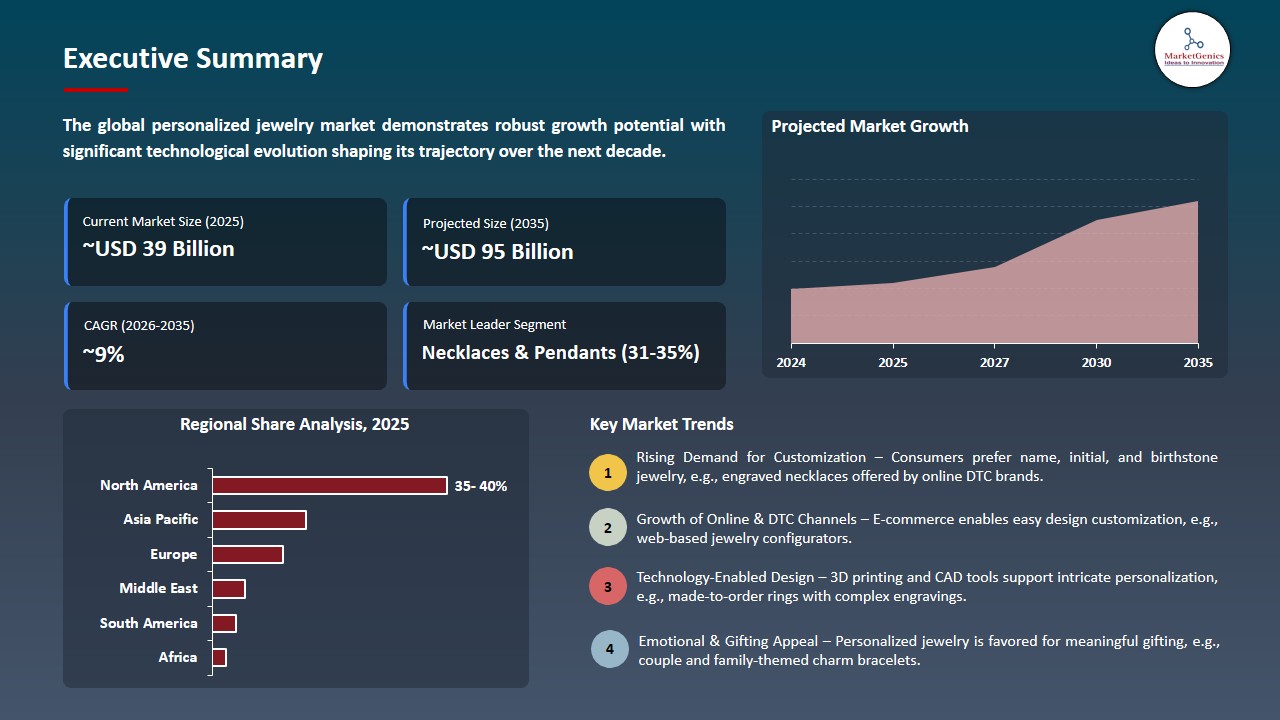
The global personalized jewelry market is experiencing robust growth, with its estimated value of USD 38.6 billion in the year 2025 and USD 94.8 billion by the period 2035, registering a CAGR of 9.4%, during the forecast period. The customization-driven design, ethical sourcing and responsible manufacturing that adds emotional value and craftsmanship to their jewelry designs are becoming the most successful forces in the global personalized jewelry market through which brands, designers, and platforms grow and expand their market segment.
Sanket Madhavjibhai Nakrani, Founder & CEO of CustomDiamJewel, stated, every pendant tells a story your story. Our goal is to let people wear their memories, values, and identity as jewelry. From iced-out portraits to name chains, each piece becomes a symbol of pride, creativity, and confidence.
The global personalised jewellery market is evolving into a high-growth lifestyle category, where individuals seek hyper-personalised pieces that tell a story and reflect their identity, milestones, and cultural affiliations. In addition to classic gifting, customizable motifs, limited-run collaborations, and interactivity on social media have become a medium to tell a story, use jewelry as a way to express oneself, and build social connections, so brands are revisiting the idea of customizable jewelry designs and designs.
The latest manufacturing technologies, including AI-aided gemstone selection, virtual try-on using AR, and micro-engraving with high precision, allow customization to be scaled without affecting the craftsmanship. For instance, in May 2025, Pandora collaborated with music artist Tyla as a launch of a self-expression and meaningful connection product range of personalized jewelry with charms, necklaces, and bracelets as part of the cultural partnership and personalization that is leading to consumer engagement. Subscriptions and direct-to-consumer e-commerce websites enable the brands to target the global market within a short period and gather data to make improvements to the designs and predict trends.
The next-generation personalized jewelry is aligning itself with a status and identity symbol, combining fashion/technology/culture. The segment is developing brand loyalty, high prices, and a reputation as a source of innovation in the global jewelry industry by providing distinct experiences, exclusivity, and merchandise that appeal to the emotions of the consumer.
Personalized Jewelry Market Dynamics and Trends
Driver: Growing Demand for Customization and Emotional Gifting
-
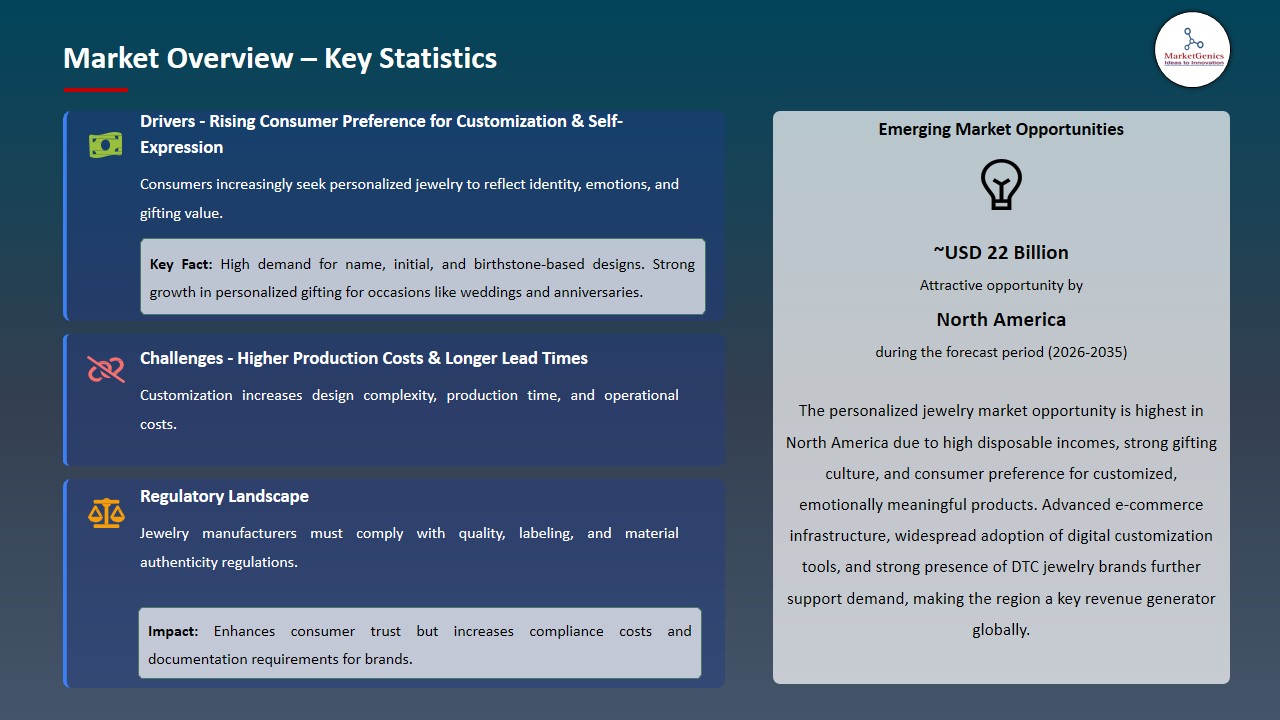
The personalized jewelry market is experiencing a push due to increasing consumer desire of unique, special, and personalized jewelry. Consumers are demanding more and more personalized jewelry like engraved rings, name necklaces, birthstone necklaces, and custom-made bracelets and other engraved jewelry that represents personal identity, connections, milestones, and this has forced the brands to expand the range of personalized jewelry and designs.
- Jewelry brands are using digital solutions, AR/VR try-on experiences, and online customization applications to produce products that are both aesthetically and emotionally valuable. For instance, in June 2025, Nicky Hilton unveiled Theo Grace, a custom jewelry collection with name necklaces, initial pendants, and birthstone pieces, reflecting the use of emotionally charged jewelry as a key necklace and other customizable designs.
- The growing need to have emotive, unique, jewels is affecting product creation and uptake thereby creating a continuous growth in the personalized jewelry market worldwide.
Restraint: High Production and Licensing Costs
-
A significant hurdle in the global personalized jewelry market lies in high cost of production and licensing as compared to a mass-produced or unbranded jewelry. Officially licensed work, an engraved, high-quality piece, and a custom design means a lot of investment in IP rights, high-quality material and craftsmanship, which makes these products more expensive to retail and restrict access to those with price-sensitive purchasing power.
- The reasons include: high labor content in production, low automatization, and expensive machinery to engrave, set stones and finish. Strict design authenticity and quality standards also increase the per-unit costs and, therefore, small players would find it hard to compete successfully.
- Additional costs associated with international logistics, high-end shipping, and insurance for premium and limited-edition jewelry restrict adoption in emerging markets and generally slow market penetration.
Opportunity: Expansion into Digital and AR-Enabled Personalization
-
The emerging trend of consumers seeking unique and one-of-a-kind jewelry is opening the door to opportunities of the brands adopting digital and AR-enabled personalization. To enable customers to design custom rings, necklaces, and bracelets and preview them in real-time, jewelry manufacturers are utilizing 3D design tools, AI-based customization, and AR try-on.
- Such digital services are being proliferated with e-commerce portal, and mobile applications. For instance, Perfect Corp. introduced a more sophisticated AI-powered AR virtual try-on platform on 3D necklaces, which allows customers to see and virtually try on tailored pieces of jewelry on themselves online in real-time, increasing the level of interaction and positively affecting the level of trust in their buying choices. Online collections that are limited edition and include interactive customizing are becoming more engaged particularly to the younger tech-savvy consumer.
- AR and digital personalization solutions allow differentiation of the product, customer loyalty and new sources of revenues, and increase the market coverage in both developed and developed markets through product promotion in the global online and mobile market.
Key Trend: Collaborations with Celebrities and Lifestyle Brands
-
The boom in the global personalized jewelry offerings, and many co-branded collections have seen jewelry designers collaborate with celebrities, fashion houses, and lifestyle influencers to create limited-edition, story-based collections. Such partnerships allow to increase the attractiveness to the non-traditional collectors, reach the fashionable and social media-friendly audience.
- This applies to events in which brands are turning to celebrity collaborations to introduce exclusive collections, basic promotions of limited-time drops, and pop-up events. For instance, the Tiffany Lock ROSÉ Edition in 2025, a collection of capsule jewelry that was created in connection with the collaboration of the world-known singer ROSÉ, and where its 18k rose gold and pink sapphire designs were designed around how a celebrity-driven partnership increases the value of personalized jewellery and motivates premium market participation all over the globe.
- The collaborations increase brand awareness, enhance premiumization, and create repurchases, classifying personalized jewelry as aspirational products.
Personalized-Jewelry-Market Analysis and Segmental Data
Necklaces & Pendants Dominate Global Personalized Jewelry Market
-
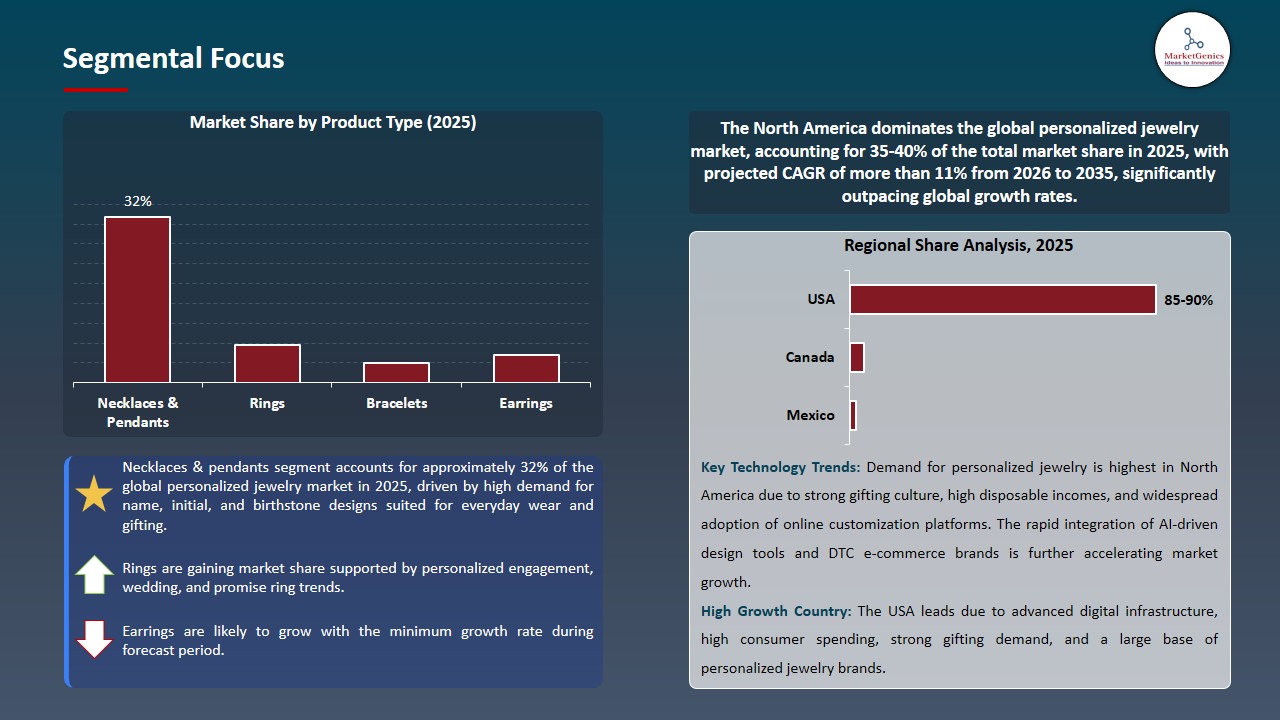
Necklaces and pendants dominate the global personalized jewelry market because of the high customer preference to the high quality personalized jewelry, which can demonstrate the personal identity, relationships and milestones. Their multifunction and utilitarian purpose in terms of gifts, everyday accessories, and collectibles contribute to their extensive adoption in the e-commerce and specialty shops and luxury retail space.
- There is accelerated growth of the market by innovation and digital personalization programs. Real-time customization is being introduced through AI-driven design tools, AR/VR virtual try-on features, and laser engraving that are being incorporated by brands. For instance, in August 2025 Brilliant Earth enlisted tennis star Madison Keys to release a limited-edition necklace with diamonds and personalized motifs as a medallion, marking the trend of high-end, narrative, and personal-necklace and personal-pendant jewelry.
- The premium is being taken over by customizable necklaces and pendants in the standard jewelry category, whose emotional connection, processability, and multichannel presence help to strengthen its dominance.
North America Leads Global Personalized Jewelry Market Demand
-
North America dominates the personalized jewelry market with an overlays of both a large consumer expenditure in fashion and luxury items, heavy gifting traditions, and extensive use of online and omnichannel retail technologies. Both the United States and Canada are experiencing growth due to high per-capita demand due to the digitalization of personalization features of rings, necklaces, and bracelets and the ability to produce them quickly.
- The area is also experiencing an accelerated innovation of personalization technologies, such as AI-enhanced design sites, AR/VR try-on, and laser engraving systems enabling the customer to design their own, personalized jewelry designs. For instances, in October 2025, Pandora introduced the co-branded and customizable jewelry item, the limited-edition Tyla Tyger Charm, with singer Tyla, that they could only get online in North America, which indicates that the region has high expectations of co-branded and personalized jewelry items.
- Well-developed logistical systems, developed e-commerce infrastructure, and robust IP protection guarantee the authenticity of jewelry and its delivery in time, which will additionally support the dominance of North America in the global market share and increase in revenues.
Personalized-Jewelry-Market Ecosystem
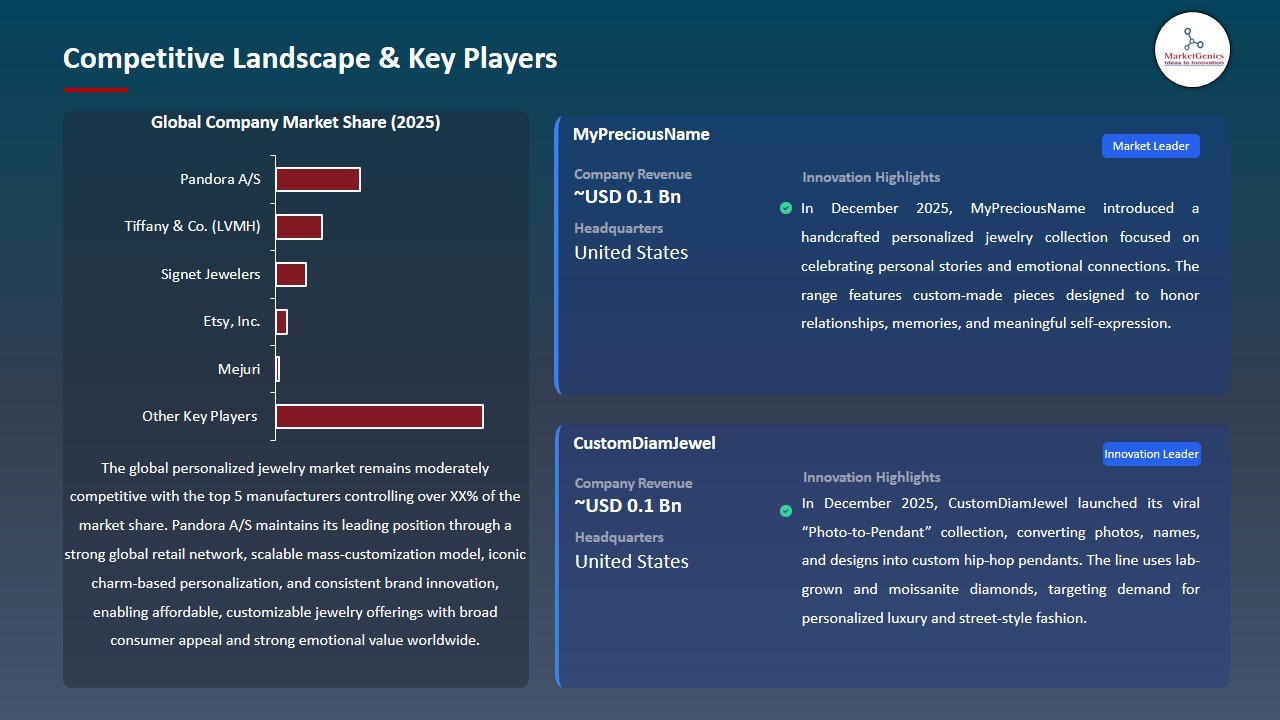
The global personalized jewelry market is moderately consolidated, with the Tier-1 industry players dominating it because of the strong brand awareness, extensive IP licensing, as well as distribution systems, whereas Tier-2 and Tier-3 market participants concentrate on niche products, crafted jewellery and digital-first customization services.
Tier-1 players like Pandora A/S, Tiffany a Co. (LVMH) and Signet Jewelers have a large market share due to their worldwide known brands, vertically integrated supply chain and long-term relationships with designers and suppliers of luxury materials. These companies use their size, brand affections, and large retail and e-commerce networks to bring jewelry of high quality, tailored to customer needs, to the world.
Tier 2 players, such as Etsy, Inc., serve regional and online customers with handcrafted and customized products with a focus on distinctive design, customization, and sustainability in sourcing. Tier-3 players, including Mejuri, directly-to-consumer, digitally-native micro-collections, limited-editions, small-batch production. The competitiveness in these levels is driven by investment in technology of customization, sustainable materials and social media engagement that have assisted in creating differentiated values propositions to the various consumer groups.
Recent Development and Strategic Overview
-
In December 2025, MyPreciousName introduced a new range of customized and handmade jewelry with the purpose to personalize the stories and bond the emotions. The collection includes tailor-made products celebrating relationships and loved ones, with a focus on substantial design and emotional content in each product.
- In October 2025, CustomDiamJewel introduced its viral Photo-to-Pendant Collection, a new personalized jewelry line that turns any photo, name or design into custom iced-out hip-hop pendants made with lab-grown and moissanite diamonds, exploiting the growing global demand to personalized luxury and street-style fashion.
Report Scope
|
Detail |
|
|
Market Size in 2025 |
USD 38.6 Bn |
|
Market Forecast Value in 2035 |
USD 94.8 Bn |
|
Growth Rate (CAGR) |
9.4% |
|
Forecast Period |
2026 – 2035 |
|
Historical Data Available for |
2021 – 2024 |
|
Market Size Units |
US$ Billion for Value |
|
Report Format |
Electronic (PDF) + Excel |
|
North America |
Europe |
Asia Pacific |
Middle East |
Africa |
South America |
|
|
|
|
|
|
|
Companies Covered |
|||||
|
|
|
|
|
|
Personalized-Jewelry-Market Segmentation and Highlights
|
Segment |
Sub-segment |
|
Personalized Jewelry Market, By Product Type |
|
|
Personalized Jewelry Market, By Material Type |
|
|
Personalized Jewelry Market, By Gemstone Type |
|
|
Personalized Jewelry Market, By Personalization Technique |
|
|
Personalized Jewelry Market, By Distribution Channel |
|
|
Personalized Jewelry Market, By End-use |
|
Frequently Asked Questions
Table of Contents
- 1. Research Methodology and Assumptions
- 1.1. Definitions
- 1.2. Research Design and Approach
- 1.3. Data Collection Methods
- 1.4. Base Estimates and Calculations
- 1.5. Forecasting Models
- 1.5.1. Key Forecast Factors & Impact Analysis
- 1.6. Secondary Research
- 1.6.1. Open Sources
- 1.6.2. Paid Databases
- 1.6.3. Associations
- 1.7. Primary Research
- 1.7.1. Primary Sources
- 1.7.2. Primary Interviews with Stakeholders across Ecosystem
- 2. Executive Summary
- 2.1. Global Personalized Jewelry Market Outlook
- 2.1.1. Personalized Jewelry Market Size (Value - US$ Bn), and Forecasts, 2021-2035
- 2.1.2. Compounded Annual Growth Rate Analysis
- 2.1.3. Growth Opportunity Analysis
- 2.1.4. Segmental Share Analysis
- 2.1.5. Geographical Share Analysis
- 2.2. Market Analysis and Facts
- 2.3. Supply-Demand Analysis
- 2.4. Competitive Benchmarking
- 2.5. Go-to- Market Strategy
- 2.5.1. Customer/ End-use Industry Assessment
- 2.5.2. Growth Opportunity Data, 2026-2035
- 2.5.2.1. Regional Data
- 2.5.2.2. Country Data
- 2.5.2.3. Segmental Data
- 2.5.3. Identification of Potential Market Spaces
- 2.5.4. GAP Analysis
- 2.5.5. Potential Attractive Price Points
- 2.5.6. Prevailing Market Risks & Challenges
- 2.5.7. Preferred Sales & Marketing Strategies
- 2.5.8. Key Recommendations and Analysis
- 2.5.9. A Way Forward
- 2.1. Global Personalized Jewelry Market Outlook
- 3. Industry Data and Premium Insights
- 3.1. Global Consumer Goods & Services Industry Overview, 2025
- 3.1.1. Consumer Goods & Services Industry Ecosystem Analysis
- 3.1.2. Key Trends for Consumer Goods & Services Industry
- 3.1.3. Regional Distribution for Consumer Goods & Services Industry
- 3.2. Supplier Customer Data
- 3.3. Technology Roadmap and Developments
- 3.4. Trade Analysis
- 3.4.1. Import & Export Analysis, 2025
- 3.4.2. Top Importing Countries
- 3.4.3. Top Exporting Countries
- 3.5. Trump Tariff Impact Analysis
- 3.5.1. Manufacturer
- 3.5.1.1. Based on the component & Raw material
- 3.5.2. Supply Chain
- 3.5.3. End Consumer
- 3.5.1. Manufacturer
- 3.6. Raw Material Analysis
- 3.1. Global Consumer Goods & Services Industry Overview, 2025
- 4. Market Overview
- 4.1. Market Dynamics
- 4.1.1. Drivers
- 4.1.1.1. Increasing consumer preference for customized and unique jewelry pieces.
- 4.1.1.2. Growth of online retail channels enhancing access to personalized options.
- 4.1.1.3. Rising disposable income and gifting demand for personalized items.
- 4.1.2. Restraints
- 4.1.2.1. Higher production costs for customization compared to standard jewelry.
- 4.1.2.2. Challenges in scaling personalization technology and fulfillment processes.
- 4.1.1. Drivers
- 4.2. Key Trend Analysis
- 4.3. Regulatory Framework
- 4.3.1. Key Regulations, Norms, and Subsidies, by Key Countries
- 4.3.2. Tariffs and Standards
- 4.3.3. Impact Analysis of Regulations on the Market
- 4.4. Value Chain Analysis
- 4.4.1. Raw Material Suppliers
- 4.4.2. Manufacturers
- 4.4.3. Dealers/ Distributors
- 4.4.4. End-Users/ Customers
- 4.5. Porter’s Five Forces Analysis
- 4.6. PESTEL Analysis
- 4.7. Global Personalized Jewelry Market Demand
- 4.7.1. Historical Market Size – Value (US$ Bn), 2020-2024
- 4.7.2. Current and Future Market Size – Value (US$ Bn), 2026–2035
- 4.7.2.1. Y-o-Y Growth Trends
- 4.7.2.2. Absolute $ Opportunity Assessment
- 4.1. Market Dynamics
- 5. Competition Landscape
- 5.1. Competition structure
- 5.1.1. Fragmented v/s consolidated
- 5.2. Company Share Analysis, 2025
- 5.2.1. Global Company Market Share
- 5.2.2. By Region
- 5.2.2.1. North America
- 5.2.2.2. Europe
- 5.2.2.3. Asia Pacific
- 5.2.2.4. Middle East
- 5.2.2.5. Africa
- 5.2.2.6. South America
- 5.3. Product Comparison Matrix
- 5.3.1. Specifications
- 5.3.2. Market Positioning
- 5.3.3. Pricing
- 5.1. Competition structure
- 6. Global Personalized Jewelry Market Analysis, by Product Type
- 6.1. Key Segment Analysis
- 6.2. Personalized Jewelry Market Size (Value - US$ Bn), Analysis, and Forecasts, by Product Type, 2021-2035
- 6.2.1. Necklaces & Pendants
- 6.2.1.1. Name Necklaces
- 6.2.1.2. Initial Pendants
- 6.2.1.3. Birthstone Necklaces
- 6.2.1.4. Others
- 6.2.2. Rings
- 6.2.2.1. Name Rings
- 6.2.2.2. Engraved Bands
- 6.2.2.3. Birthstone Rings
- 6.2.2.4. Others
- 6.2.3. Bracelets
- 6.2.4. Earrings
- 6.2.4.1. Stud Earrings
- 6.2.4.2. Drop Earrings
- 6.2.4.3. Hoop Earrings
- 6.2.4.4. Others
- 6.2.5. Anklets
- 6.2.6. Brooches & Pins
- 6.2.7. Cufflinks
- 6.2.8. Other Product Types
- 6.2.1. Necklaces & Pendants
- 7. Global Personalized Jewelry Market Analysis, by Material Type
- 7.1. Key Segment Analysis
- 7.2. Personalized Jewelry Market Size (Value - US$ Bn), Analysis, and Forecasts, by Material Type, 2021-2035
- 7.2.1. Precious Metals
- 7.2.2. Gold (24K, 22K, 18K, 14K, 10K)
- 7.2.2.1. Silver (Sterling Silver, Fine Silver)
- 7.2.2.2. Platinum
- 7.2.2.3. Palladium
- 7.2.2.4. Others
- 7.2.3. Base Metals
- 7.2.3.1. Stainless Steel
- 7.2.3.2. Brass
- 7.2.3.3. Copper
- 7.2.3.4. Titanium
- 7.2.3.5. Aluminum
- 7.2.3.6. Others
- 7.2.4. Mixed Materials
- 7.2.4.1. Gold-Plated
- 7.2.4.2. Rose Gold-Plated
- 7.2.4.3. Silver-Plated
- 7.2.4.4. Rhodium-Plated
- 7.2.4.5. Others
- 8. Global Personalized Jewelry Market Analysis, by Gemstone Type
- 8.1. Key Segment Analysis
- 8.2. Personalized Jewelry Market Size (Value - US$ Bn), Analysis, and Forecasts, by Gemstone Type, 2021-2035
- 8.2.1. Precious Stones
- 8.2.1.1. Diamonds
- 8.2.1.2. Rubies
- 8.2.1.3. Sapphires
- 8.2.1.4. Emeralds
- 8.2.2. Semi-Precious Stones
- 8.2.3. Synthetic/Lab-Created Stones
- 8.2.4. Birthstones
- 8.2.5. No Gemstone
- 8.2.1. Precious Stones
- 9. Global Personalized Jewelry Market Analysis, by Personalization Technique
- 9.1. Key Segment Analysis
- 9.2. Personalized Jewelry Market Size (Value - US$ Bn), Analysis, and Forecasts, by Personalization Technique, 2021-2035
- 9.2.1. Engraving
- 9.2.2. Embossing
- 9.2.3. Stamping
- 9.2.4. 3D Printing/Additive Manufacturing
- 9.2.5. Casting (Custom Molds)
- 9.2.6. Stone Setting
- 9.2.7. Others
- 10. Global Personalized Jewelry Market Analysis, by Distribution Channel
- 10.1. Key Segment Analysis
- 10.2. Personalized Jewelry Market Size (Value - US$ Bn), Analysis, and Forecasts, by Distribution Channel, 2021-2035
- 10.2.1. Online
- 10.2.1.1. E-commerce Websites
- 10.2.1.2. Company-Owned Websites
- 10.2.1.3. Others
- 10.2.2. Offline
- 10.2.2.1. Specialty Jewelry Stores
- 10.2.2.2. Department Stores
- 10.2.2.3. Boutiques
- 10.2.2.4. Others
- 10.2.1. Online
- 11. Global Personalized Jewelry Market Analysis, by End-use
- 11.1. Key Segment Analysis
- 11.2. Personalized Jewelry Market Size (Value - US$ Bn), Analysis, and Forecasts, by End-use, 2021-2035
- 11.2.1. Fashion & Apparel
- 11.2.2. Wedding & Events
- 11.2.3. Corporate & Promotional
- 11.2.4. Healthcare & Wellness
- 11.2.5. Entertainment & Media
- 11.2.6. Sports & Fitness
- 11.2.7. Religious & Spiritual
- 11.2.8. Retail & E-commerce`
- 11.2.9. Others
- 12. Global Personalized Jewelry Market Analysis and Forecasts, by Region
- 12.1. Key Findings
- 12.2. Personalized Jewelry Market Size (Value - US$ Bn), Analysis, and Forecasts, by Region, 2021-2035
- 12.2.1. North America
- 12.2.2. Europe
- 12.2.3. Asia Pacific
- 12.2.4. Middle East
- 12.2.5. Africa
- 12.2.6. South America
- 13. North America Personalized Jewelry Market Analysis
- 13.1. Key Segment Analysis
- 13.2. Regional Snapshot
- 13.3. North America Personalized Jewelry Market Size (Value - US$ Bn), Analysis, and Forecasts, 2021-2035
- 13.3.1. Product Type
- 13.3.2. Material Type
- 13.3.3. Gemstone Type
- 13.3.4. Personalization Technique
- 13.3.5. Distribution Channel
- 13.3.6. End-use
- 13.3.7. Country
- 13.3.7.1. USA
- 13.3.7.2. Canada
- 13.3.7.3. Mexico
- 13.4. USA Personalized Jewelry Market
- 13.4.1. Country Segmental Analysis
- 13.4.2. Product Type
- 13.4.3. Material Type
- 13.4.4. Gemstone Type
- 13.4.5. Personalization Technique
- 13.4.6. Distribution Channel
- 13.4.7. End-use
- 13.5. Canada Personalized Jewelry Market
- 13.5.1. Country Segmental Analysis
- 13.5.2. Product Type
- 13.5.3. Material Type
- 13.5.4. Gemstone Type
- 13.5.5. Personalization Technique
- 13.5.6. Distribution Channel
- 13.5.7. End-use
- 13.6. Mexico Personalized Jewelry Market
- 13.6.1. Country Segmental Analysis
- 13.6.2. Product Type
- 13.6.3. Material Type
- 13.6.4. Gemstone Type
- 13.6.5. Personalization Technique
- 13.6.6. Distribution Channel
- 13.6.7. End-use
- 14. Europe Personalized Jewelry Market Analysis
- 14.1. Key Segment Analysis
- 14.2. Regional Snapshot
- 14.3. Europe Personalized Jewelry Market Size (Value - US$ Bn), Analysis, and Forecasts, 2021-2035
- 14.3.1. Product Type
- 14.3.2. Material Type
- 14.3.3. Gemstone Type
- 14.3.4. Personalization Technique
- 14.3.5. Distribution Channel
- 14.3.6. End-use
- 14.3.7. Country
- 14.3.7.1. Germany
- 14.3.7.2. United Kingdom
- 14.3.7.3. France
- 14.3.7.4. Italy
- 14.3.7.5. Spain
- 14.3.7.6. Netherlands
- 14.3.7.7. Nordic Countries
- 14.3.7.8. Poland
- 14.3.7.9. Russia & CIS
- 14.3.7.10. Rest of Europe
- 14.4. Germany Personalized Jewelry Market
- 14.4.1. Country Segmental Analysis
- 14.4.2. Product Type
- 14.4.3. Material Type
- 14.4.4. Gemstone Type
- 14.4.5. Personalization Technique
- 14.4.6. Distribution Channel
- 14.4.7. End-use
- 14.5. United Kingdom Personalized Jewelry Market
- 14.5.1. Country Segmental Analysis
- 14.5.2. Product Type
- 14.5.3. Material Type
- 14.5.4. Gemstone Type
- 14.5.5. Personalization Technique
- 14.5.6. Distribution Channel
- 14.5.7. End-use
- 14.6. France Personalized Jewelry Market
- 14.6.1. Country Segmental Analysis
- 14.6.2. Product Type
- 14.6.3. Material Type
- 14.6.4. Gemstone Type
- 14.6.5. Personalization Technique
- 14.6.6. Distribution Channel
- 14.6.7. End-use
- 14.7. Italy Personalized Jewelry Market
- 14.7.1. Country Segmental Analysis
- 14.7.2. Product Type
- 14.7.3. Material Type
- 14.7.4. Gemstone Type
- 14.7.5. Personalization Technique
- 14.7.6. Distribution Channel
- 14.7.7. End-use
- 14.8. Spain Personalized Jewelry Market
- 14.8.1. Country Segmental Analysis
- 14.8.2. Product Type
- 14.8.3. Material Type
- 14.8.4. Gemstone Type
- 14.8.5. Personalization Technique
- 14.8.6. Distribution Channel
- 14.8.7. End-use
- 14.9. Netherlands Personalized Jewelry Market
- 14.9.1. Country Segmental Analysis
- 14.9.2. Product Type
- 14.9.3. Material Type
- 14.9.4. Gemstone Type
- 14.9.5. Personalization Technique
- 14.9.6. Distribution Channel
- 14.9.7. End-use
- 14.10. Nordic Countries Personalized Jewelry Market
- 14.10.1. Country Segmental Analysis
- 14.10.2. Product Type
- 14.10.3. Material Type
- 14.10.4. Gemstone Type
- 14.10.5. Personalization Technique
- 14.10.6. Distribution Channel
- 14.10.7. End-use
- 14.11. Poland Personalized Jewelry Market
- 14.11.1. Country Segmental Analysis
- 14.11.2. Product Type
- 14.11.3. Material Type
- 14.11.4. Gemstone Type
- 14.11.5. Personalization Technique
- 14.11.6. Distribution Channel
- 14.11.7. End-use
- 14.12. Russia & CIS Personalized Jewelry Market
- 14.12.1. Country Segmental Analysis
- 14.12.2. Product Type
- 14.12.3. Material Type
- 14.12.4. Gemstone Type
- 14.12.5. Personalization Technique
- 14.12.6. Distribution Channel
- 14.12.7. End-use
- 14.13. Rest of Europe Personalized Jewelry Market
- 14.13.1. Country Segmental Analysis
- 14.13.2. Product Type
- 14.13.3. Material Type
- 14.13.4. Gemstone Type
- 14.13.5. Personalization Technique
- 14.13.6. Distribution Channel
- 14.13.7. End-use
- 15. Asia Pacific Personalized Jewelry Market Analysis
- 15.1. Key Segment Analysis
- 15.2. Regional Snapshot
- 15.3. Asia Pacific Personalized Jewelry Market Size (Value - US$ Bn), Analysis, and Forecasts, 2021-2035
- 15.3.1. Product Type
- 15.3.2. Material Type
- 15.3.3. Gemstone Type
- 15.3.4. Personalization Technique
- 15.3.5. Distribution Channel
- 15.3.6. End-use
- 15.3.7. Country
- 15.3.7.1. China
- 15.3.7.2. India
- 15.3.7.3. Japan
- 15.3.7.4. South Korea
- 15.3.7.5. Australia and New Zealand
- 15.3.7.6. Indonesia
- 15.3.7.7. Malaysia
- 15.3.7.8. Thailand
- 15.3.7.9. Vietnam
- 15.3.7.10. Rest of Asia Pacific
- 15.4. China Personalized Jewelry Market
- 15.4.1. Country Segmental Analysis
- 15.4.2. Product Type
- 15.4.3. Material Type
- 15.4.4. Gemstone Type
- 15.4.5. Personalization Technique
- 15.4.6. Distribution Channel
- 15.4.7. End-use
- 15.5. India Personalized Jewelry Market
- 15.5.1. Country Segmental Analysis
- 15.5.2. Product Type
- 15.5.3. Material Type
- 15.5.4. Gemstone Type
- 15.5.5. Personalization Technique
- 15.5.6. Distribution Channel
- 15.5.7. End-use
- 15.6. Japan Personalized Jewelry Market
- 15.6.1. Country Segmental Analysis
- 15.6.2. Product Type
- 15.6.3. Material Type
- 15.6.4. Gemstone Type
- 15.6.5. Personalization Technique
- 15.6.6. Distribution Channel
- 15.6.7. End-use
- 15.7. South Korea Personalized Jewelry Market
- 15.7.1. Country Segmental Analysis
- 15.7.2. Product Type
- 15.7.3. Material Type
- 15.7.4. Gemstone Type
- 15.7.5. Personalization Technique
- 15.7.6. Distribution Channel
- 15.7.7. End-use
- 15.8. Australia and New Zealand Personalized Jewelry Market
- 15.8.1. Country Segmental Analysis
- 15.8.2. Product Type
- 15.8.3. Material Type
- 15.8.4. Gemstone Type
- 15.8.5. Personalization Technique
- 15.8.6. Distribution Channel
- 15.8.7. End-use
- 15.9. Indonesia Personalized Jewelry Market
- 15.9.1. Country Segmental Analysis
- 15.9.2. Product Type
- 15.9.3. Material Type
- 15.9.4. Gemstone Type
- 15.9.5. Personalization Technique
- 15.9.6. Distribution Channel
- 15.9.7. End-use
- 15.10. Malaysia Personalized Jewelry Market
- 15.10.1. Country Segmental Analysis
- 15.10.2. Product Type
- 15.10.3. Material Type
- 15.10.4. Gemstone Type
- 15.10.5. Personalization Technique
- 15.10.6. Distribution Channel
- 15.10.7. End-use
- 15.11. Thailand Personalized Jewelry Market
- 15.11.1. Country Segmental Analysis
- 15.11.2. Product Type
- 15.11.3. Material Type
- 15.11.4. Gemstone Type
- 15.11.5. Personalization Technique
- 15.11.6. Distribution Channel
- 15.11.7. End-use
- 15.12. Vietnam Personalized Jewelry Market
- 15.12.1. Country Segmental Analysis
- 15.12.2. Product Type
- 15.12.3. Material Type
- 15.12.4. Gemstone Type
- 15.12.5. Personalization Technique
- 15.12.6. Distribution Channel
- 15.12.7. End-use
- 15.13. Rest of Asia Pacific Personalized Jewelry Market
- 15.13.1. Country Segmental Analysis
- 15.13.2. Product Type
- 15.13.3. Material Type
- 15.13.4. Gemstone Type
- 15.13.5. Personalization Technique
- 15.13.6. Distribution Channel
- 15.13.7. End-use
- 16. Middle East Personalized Jewelry Market Analysis
- 16.1. Key Segment Analysis
- 16.2. Regional Snapshot
- 16.3. Middle East Personalized Jewelry Market Size (Value - US$ Bn), Analysis, and Forecasts, 2021-2035
- 16.3.1. Product Type
- 16.3.2. Material Type
- 16.3.3. Gemstone Type
- 16.3.4. Personalization Technique
- 16.3.5. Distribution Channel
- 16.3.6. End-use
- 16.3.7. Country
- 16.3.7.1. Turkey
- 16.3.7.2. UAE
- 16.3.7.3. Saudi Arabia
- 16.3.7.4. Israel
- 16.3.7.5. Rest of Middle East
- 16.4. Turkey Personalized Jewelry Market
- 16.4.1. Country Segmental Analysis
- 16.4.2. Product Type
- 16.4.3. Material Type
- 16.4.4. Gemstone Type
- 16.4.5. Personalization Technique
- 16.4.6. Distribution Channel
- 16.4.7. End-use
- 16.5. UAE Personalized Jewelry Market
- 16.5.1. Country Segmental Analysis
- 16.5.2. Product Type
- 16.5.3. Material Type
- 16.5.4. Gemstone Type
- 16.5.5. Personalization Technique
- 16.5.6. Distribution Channel
- 16.5.7. End-use
- 16.6. Saudi Arabia Personalized Jewelry Market
- 16.6.1. Country Segmental Analysis
- 16.6.2. Product Type
- 16.6.3. Material Type
- 16.6.4. Gemstone Type
- 16.6.5. Personalization Technique
- 16.6.6. Distribution Channel
- 16.6.7. End-use
- 16.7. Israel Personalized Jewelry Market
- 16.7.1. Country Segmental Analysis
- 16.7.2. Product Type
- 16.7.3. Material Type
- 16.7.4. Gemstone Type
- 16.7.5. Personalization Technique
- 16.7.6. Distribution Channel
- 16.7.7. End-use
- 16.8. Rest of Middle East Personalized Jewelry Market
- 16.8.1. Country Segmental Analysis
- 16.8.2. Product Type
- 16.8.3. Material Type
- 16.8.4. Gemstone Type
- 16.8.5. Personalization Technique
- 16.8.6. Distribution Channel
- 16.8.7. End-use
- 17. Africa Personalized Jewelry Market Analysis
- 17.1. Key Segment Analysis
- 17.2. Regional Snapshot
- 17.3. Africa Personalized Jewelry Market Size (Value - US$ Bn), Analysis, and Forecasts, 2021-2035
- 17.3.1. Product Type
- 17.3.2. Material Type
- 17.3.3. Gemstone Type
- 17.3.4. Personalization Technique
- 17.3.5. Distribution Channel
- 17.3.6. End-use
- 17.3.7. Country
- 17.3.7.1. South Africa
- 17.3.7.2. Egypt
- 17.3.7.3. Nigeria
- 17.3.7.4. Algeria
- 17.3.7.5. Rest of Africa
- 17.4. South Africa Personalized Jewelry Market
- 17.4.1. Country Segmental Analysis
- 17.4.2. Product Type
- 17.4.3. Material Type
- 17.4.4. Gemstone Type
- 17.4.5. Personalization Technique
- 17.4.6. Distribution Channel
- 17.4.7. End-use
- 17.5. Egypt Personalized Jewelry Market
- 17.5.1. Country Segmental Analysis
- 17.5.2. Product Type
- 17.5.3. Material Type
- 17.5.4. Gemstone Type
- 17.5.5. Personalization Technique
- 17.5.6. Distribution Channel
- 17.5.7. End-use
- 17.6. Nigeria Personalized Jewelry Market
- 17.6.1. Country Segmental Analysis
- 17.6.2. Product Type
- 17.6.3. Material Type
- 17.6.4. Gemstone Type
- 17.6.5. Personalization Technique
- 17.6.6. Distribution Channel
- 17.6.7. End-use
- 17.7. Algeria Personalized Jewelry Market
- 17.7.1. Country Segmental Analysis
- 17.7.2. Product Type
- 17.7.3. Material Type
- 17.7.4. Gemstone Type
- 17.7.5. Personalization Technique
- 17.7.6. Distribution Channel
- 17.7.7. End-use
- 17.8. Rest of Africa Personalized Jewelry Market
- 17.8.1. Country Segmental Analysis
- 17.8.2. Product Type
- 17.8.3. Material Type
- 17.8.4. Gemstone Type
- 17.8.5. Personalization Technique
- 17.8.6. Distribution Channel
- 17.8.7. End-use
- 18. South America Personalized Jewelry Market Analysis
- 18.1. Key Segment Analysis
- 18.2. Regional Snapshot
- 18.3. South America Personalized Jewelry Market Size (Value - US$ Bn), Analysis, and Forecasts, 2021-2035
- 18.3.1. Product Type
- 18.3.2. Material Type
- 18.3.3. Gemstone Type
- 18.3.4. Personalization Technique
- 18.3.5. Distribution Channel
- 18.3.6. End-use
- 18.3.7. Country
- 18.3.7.1. Brazil
- 18.3.7.2. Argentina
- 18.3.7.3. Rest of South America
- 18.4. Brazil Personalized Jewelry Market
- 18.4.1. Country Segmental Analysis
- 18.4.2. Product Type
- 18.4.3. Material Type
- 18.4.4. Gemstone Type
- 18.4.5. Personalization Technique
- 18.4.6. Distribution Channel
- 18.4.7. End-use
- 18.5. Argentina Personalized Jewelry Market
- 18.5.1. Country Segmental Analysis
- 18.5.2. Product Type
- 18.5.3. Material Type
- 18.5.4. Gemstone Type
- 18.5.5. Personalization Technique
- 18.5.6. Distribution Channel
- 18.5.7. End-use
- 18.6. Rest of South America Personalized Jewelry Market
- 18.6.1. Country Segmental Analysis
- 18.6.2. Product Type
- 18.6.3. Material Type
- 18.6.4. Gemstone Type
- 18.6.5. Personalization Technique
- 18.6.6. Distribution Channel
- 18.6.7. End-use
- 19. Key Players/ Company Profile
- 19.1. Alex and Ani LLC
- 19.1.1. Company Details/ Overview
- 19.1.2. Company Financials
- 19.1.3. Key Customers and Competitors
- 19.1.4. Business/ Industry Portfolio
- 19.1.5. Product Portfolio/ Specification Details
- 19.1.6. Pricing Data
- 19.1.7. Strategic Overview
- 19.1.8. Recent Developments
- 19.2. BaubleBar
- 19.3. Blue Nile Inc.
- 19.4. Catbird NYC
- 19.5. Clogau Gold of Wales
- 19.6. Etsy Inc.
- 19.7. Gemvara
- 19.8. James Avery Craftsman Inc.
- 19.9. Mejuri
- 19.10. Missoma
- 19.11. Monica Vinader
- 19.12. Pandora A/S
- 19.13. Richemont (Cartier)
- 19.14. Ross-Simons
- 19.15. Shutterfly Inc.
- 19.16. Signet Jewelers Limited
- 19.17. Swarovski AG
- 19.18. Things Remembered
- 19.19. Tiffany & Co. (LVMH)
- 19.20. Uno de 50
- 19.21. Other Key Players
- 19.1. Alex and Ani LLC
Note* - This is just tentative list of players. While providing the report, we will cover more number of players based on their revenue and share for each geography
Research Design
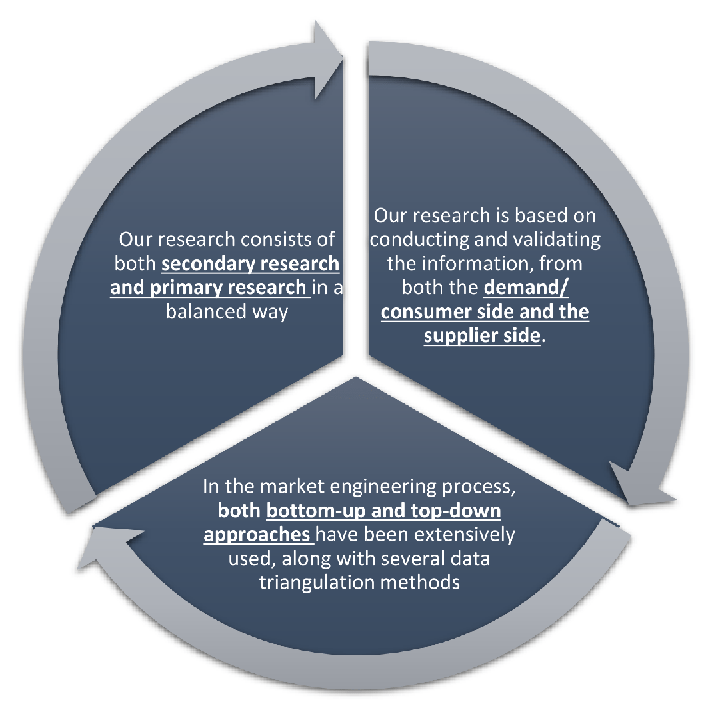
Our research design integrates both demand-side and supply-side analysis through a balanced combination of primary and secondary research methodologies. By utilizing both bottom-up and top-down approaches alongside rigorous data triangulation methods, we deliver robust market intelligence that supports strategic decision-making.
MarketGenics' comprehensive research design framework ensures the delivery of accurate, reliable, and actionable market intelligence. Through the integration of multiple research approaches, rigorous validation processes, and expert analysis, we provide our clients with the insights needed to make informed strategic decisions and capitalize on market opportunities.
MarketGenics leverages a dedicated industry panel of experts and a comprehensive suite of paid databases to effectively collect, consolidate, and analyze market intelligence.
Our approach has consistently proven to be reliable and effective in generating accurate market insights, identifying key industry trends, and uncovering emerging business opportunities.
Through both primary and secondary research, we capture and analyze critical company-level data such as manufacturing footprints, including technical centers, R&D facilities, sales offices, and headquarters.
Our expert panel further enhances our ability to estimate market size for specific brands based on validated field-level intelligence.
Our data mining techniques incorporate both parametric and non-parametric methods, allowing for structured data collection, sorting, processing, and cleaning.
Demand projections are derived from large-scale data sets analyzed through proprietary algorithms, culminating in robust and reliable market sizing.
Research Approach
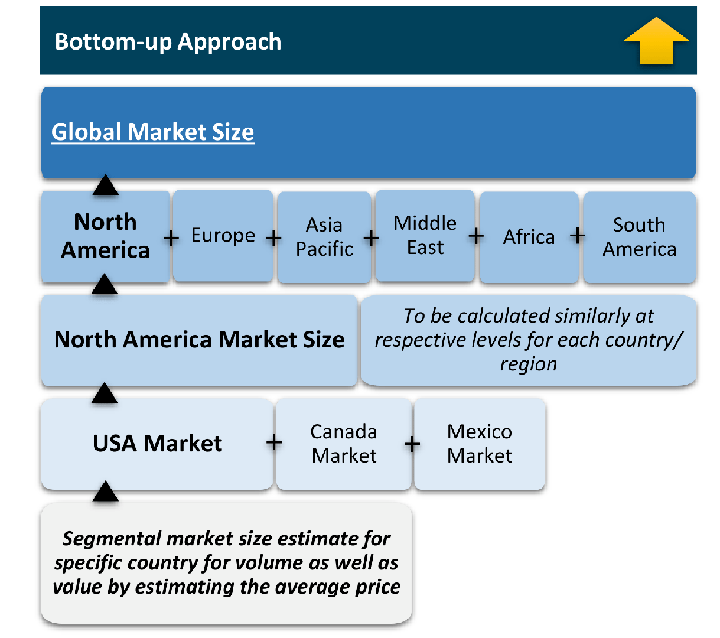
The bottom-up approach builds market estimates by starting with the smallest addressable market units and systematically aggregating them to create comprehensive market size projections.
This method begins with specific, granular data points and builds upward to create the complete market landscape.
Customer Analysis → Segmental Analysis → Geographical Analysis
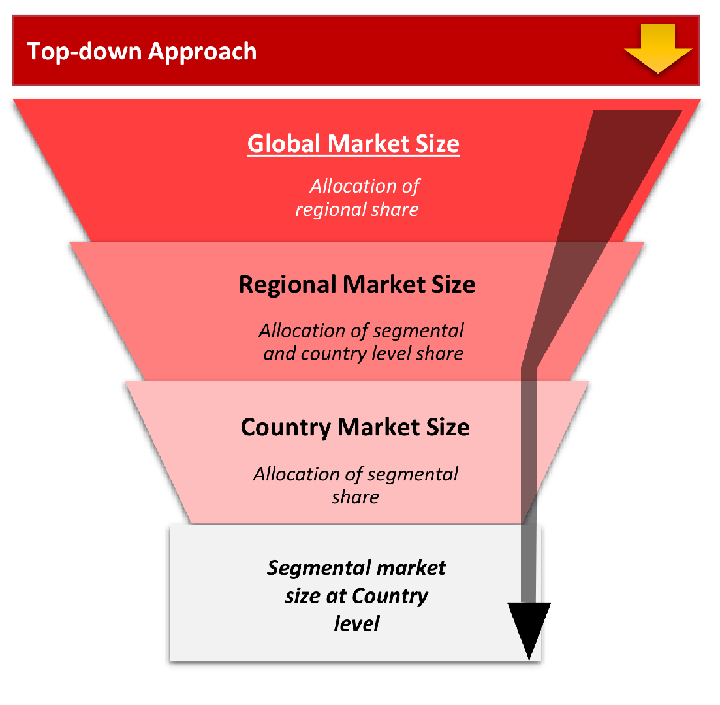
The top-down approach starts with the broadest possible market data and systematically narrows it down through a series of filters and assumptions to arrive at specific market segments or opportunities.
This method begins with the big picture and works downward to increasingly specific market slices.
TAM → SAM → SOM
Research Methods
Desk / Secondary Research
While analysing the market, we extensively study secondary sources, directories, and databases to identify and collect information useful for this technical, market-oriented, and commercial report. Secondary sources that we utilize are not only the public sources, but it is a combination of Open Source, Associations, Paid Databases, MG Repository & Knowledgebase, and others.
- Company websites, annual reports, financial reports, broker reports, and investor presentations
- National government documents, statistical databases and reports
- News articles, press releases and web-casts specific to the companies operating in the market, Magazines, reports, and others
- We gather information from commercial data sources for deriving company specific data such as segmental revenue, share for geography, product revenue, and others
- Internal and external proprietary databases (industry-specific), relevant patent, and regulatory databases
- Governing Bodies, Government Organizations
- Relevant Authorities, Country-specific Associations for Industries
We also employ the model mapping approach to estimate the product level market data through the players' product portfolio
Primary Research
Primary research/ interviews is vital in analyzing the market. Most of the cases involves paid primary interviews. Primary sources include primary interviews through e-mail interactions, telephonic interviews, surveys as well as face-to-face interviews with the different stakeholders across the value chain including several industry experts.
| Type of Respondents | Number of Primaries |
|---|---|
| Tier 2/3 Suppliers | ~20 |
| Tier 1 Suppliers | ~25 |
| End-users | ~25 |
| Industry Expert/ Panel/ Consultant | ~30 |
| Total | ~100 |
MG Knowledgebase
• Repository of industry blog, newsletter and case studies
• Online platform covering detailed market reports, and company profiles
Forecasting Factors and Models
Forecasting Factors
- Historical Trends – Past market patterns, cycles, and major events that shaped how markets behave over time. Understanding past trends helps predict future behavior.
- Industry Factors – Specific characteristics of the industry like structure, regulations, and innovation cycles that affect market dynamics.
- Macroeconomic Factors – Economic conditions like GDP growth, inflation, and employment rates that affect how much money people have to spend.
- Demographic Factors – Population characteristics like age, income, and location that determine who can buy your product.
- Technology Factors – How quickly people adopt new technology and how much technology infrastructure exists.
- Regulatory Factors – Government rules, laws, and policies that can help or restrict market growth.
- Competitive Factors – Analyzing competition structure such as degree of competition and bargaining power of buyers and suppliers.
Forecasting Models / Techniques
Multiple Regression Analysis
- Identify and quantify factors that drive market changes
- Statistical modeling to establish relationships between market drivers and outcomes
Time Series Analysis – Seasonal Patterns
- Understand regular cyclical patterns in market demand
- Advanced statistical techniques to separate trend, seasonal, and irregular components
Time Series Analysis – Trend Analysis
- Identify underlying market growth patterns and momentum
- Statistical analysis of historical data to project future trends
Expert Opinion – Expert Interviews
- Gather deep industry insights and contextual understanding
- In-depth interviews with key industry stakeholders
Multi-Scenario Development
- Prepare for uncertainty by modeling different possible futures
- Creating optimistic, pessimistic, and most likely scenarios
Time Series Analysis – Moving Averages
- Sophisticated forecasting for complex time series data
- Auto-regressive integrated moving average models with seasonal components
Econometric Models
- Apply economic theory to market forecasting
- Sophisticated economic models that account for market interactions
Expert Opinion – Delphi Method
- Harness collective wisdom of industry experts
- Structured, multi-round expert consultation process
Monte Carlo Simulation
- Quantify uncertainty and probability distributions
- Thousands of simulations with varying input parameters
Research Analysis
Our research framework is built upon the fundamental principle of validating market intelligence from both demand and supply perspectives. This dual-sided approach ensures comprehensive market understanding and reduces the risk of single-source bias.
Demand-Side Analysis: We understand end-user/application behavior, preferences, and market needs along with the penetration of the product for specific application.
Supply-Side Analysis: We estimate overall market revenue, analyze the segmental share along with industry capacity, competitive landscape, and market structure.
Validation & Evaluation
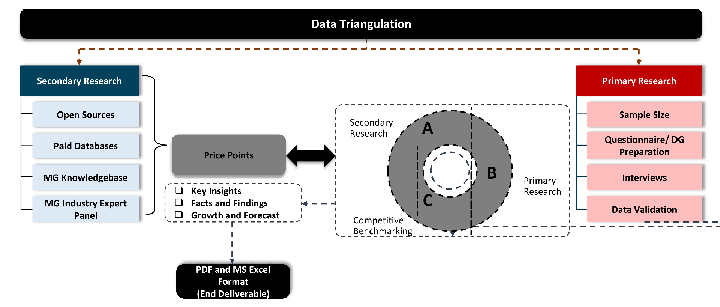
Data triangulation is a validation technique that uses multiple methods, sources, or perspectives to examine the same research question, thereby increasing the credibility and reliability of research findings. In market research, triangulation serves as a quality assurance mechanism that helps identify and minimize bias, validate assumptions, and ensure accuracy in market estimates.
- Data Source Triangulation – Using multiple data sources to examine the same phenomenon
- Methodological Triangulation – Using multiple research methods to study the same research question
- Investigator Triangulation – Using multiple researchers or analysts to examine the same data
- Theoretical Triangulation – Using multiple theoretical perspectives to interpret the same data
Custom Market Research Services
We will customise the research for you, in case the report listed above does not meet your requirements.
Get 10% Free Customisation