Professional Hair Care Products Market Size, Share & Trends Analysis Report by Product Type (Shampoos, Conditioners, Hair Colorants, Hair Styling Products, Hair Treatments, Others), Formulation, Ingredient Type, Consumer Demographics, Distribution Channel, Packaging Type, and Geography (North America, Europe, Asia Pacific, Middle East, Africa, and South America) – Global Industry Data, Trends, and Forecasts, 2026–2035
Market Overview:
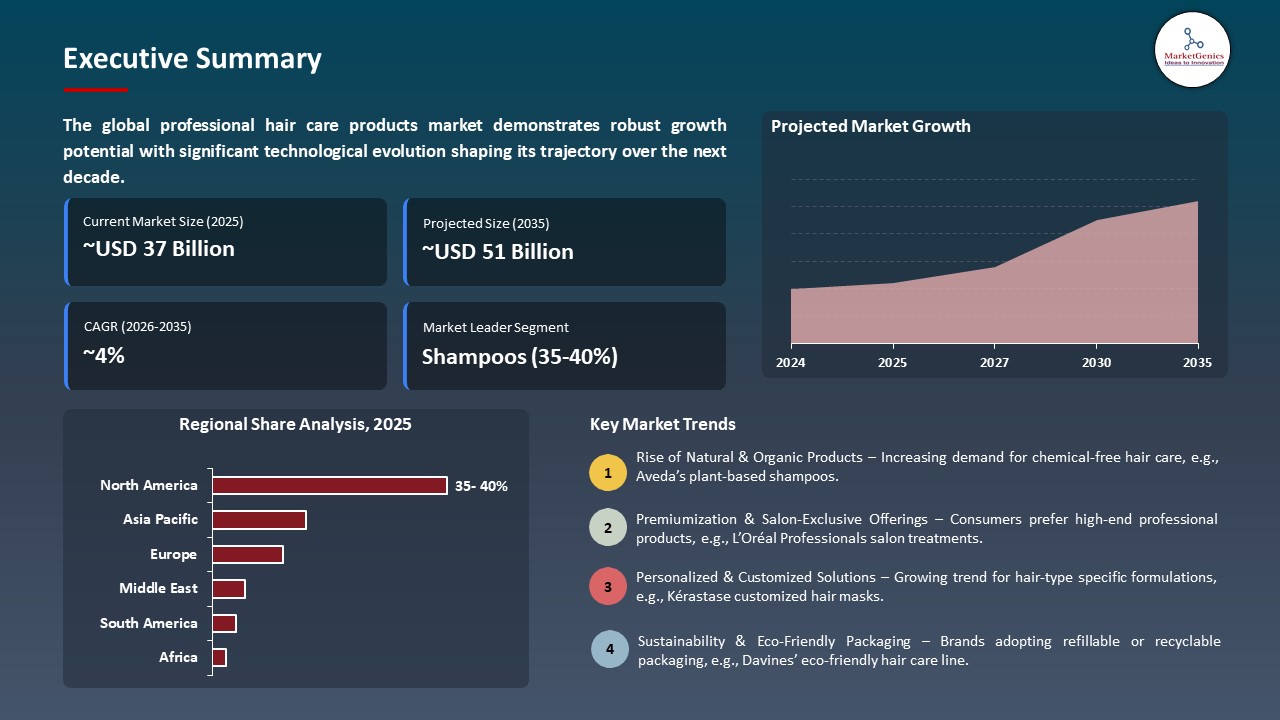
As per MarketGenics analysis, the global Professional Hair Care Products market is projected to grow from USD 37.2 billion in 2025 to approximately USD 51.3 billion by 2035, registering a CAGR of 4.1% during the forecast period.
|
|
|
Segmental Data Insights |
|
|
Demand Trends |
|
|
Competitive Landscape |
|
|
Strategic Development |
|
|
Future Outlook & Opportunities |
|
Professional-Hair-Care-Products-Market Size, Share, and Growth
The performance-based formulations, customized treatment plans, and innovation supported by science that provides a quantifiable benefit to the hair and scalp are becoming the most effective drivers in the global professional hair care products market, allowing the brand, the salon, and online platforms to increase their market share and consumer loyalty.
Eric Han, Unilever Head of R&D, Beauty & Wellbeing, North Asia and Global Scalp Innovation Lead, explains, We know consumers are increasingly seeking holistic care that provides proven dermatological efficacy while also offering indulgent textures and fragrances as well as stylish packaging.
The global professional hair care products market is turning into a high-performance, high-growth, and consumer-focused category whereby individuals are more seeking customized, scientifically-supported category of products that appeal to the particular hair type as well as scalp circumstances and styling requirements. In addition to fundamental cleansing and conditioning, advanced hair strengthening, color retention, repair of bonds and scalp health care is becoming a necessity in both beauty salons and the at-home care treatments.
The newest formulation technologies and digital solutions, such as AI-based diagnostics, virtual appointments, and treatment monitors embedded into salons, will enable the brands to offer highly personalized solutions on large scale while preserving the professional effectiveness of the solutions. As an example, the Iqonic start-up based in Berlin. AI collaborated with the professional hair brand Shyne to unveil a live AI hair analysis platform that will allow hairdressers to offer insights about hair density, scalp health, and product suggestions in real time, based on the data. The innovations can be used to provide real-time personalization, predictive hair care prescriptions, and quantifiable performance, which satisfies a consumer segment that values performance and professional quality.
Adjacent opportunities to the professional hair care products market include salon-exclusive shampoos and conditioners, scalp treatments and serums, color-protecting and styling products, hair growth and repair formulations, and premium organic or vegan hair care lines, leveraging rising consumer demand for specialized, high-performance hair solutions, thereby expanding salon and retail adoption, enhancing brand loyalty, and driving innovation across the personal care segment.
 Professional Hair Care Products Market Dynamics and Trends
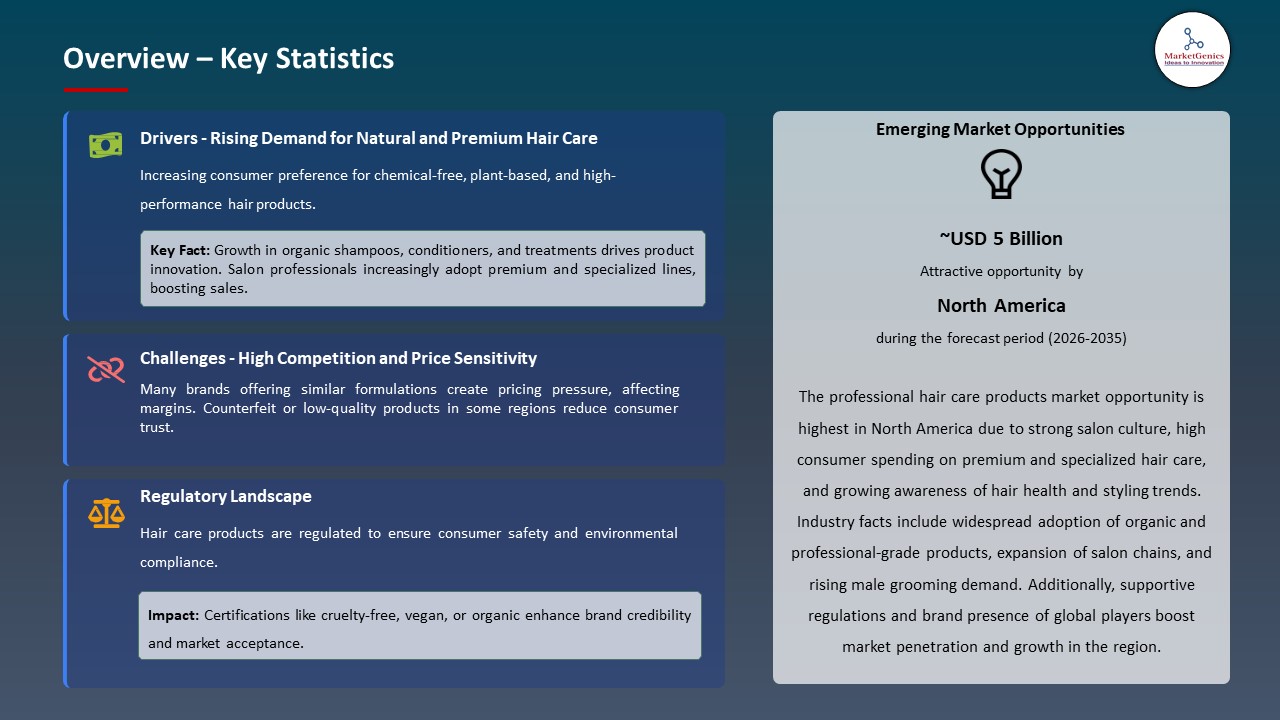
Driver: Rising demand for advanced salon-grade solutions
-
The consumer demand in the professional hair care products market is influenced by the emerging taste towards high-performance, salon-grade solutions that deliver the professional performance at home or within the salon. Hair strengthening, bond repair, scalp health, color protection and anti-frizz benefits products are being adopted more by style conscious and health conscious consumers.
- Brands are capitalizing on the use of scientifically created, ingredient-based, professional products as well as salon-only collections and online consultation services to maximize the product performance and interactivity. For instance, Olaplex introduced its No.0 Intensive Bond Building Treatment and No.3 Hair Perfector in professional salon backbars, where stylists can offer high-performance, multi-step treatments that both repair and strengthen hair as the need to have clinical validity of professional solutions has increased.
- The increasing demand of professionally-leveled, scientifically supported hair treatments is serving as the source of innovation, adoption and repeat purchases, which results in steady expansion of the international, professional hair care products industry.
Restraint: High cost of premium professional products
-
One of the challenges facing the global market of professional hair care products is the expensive nature of formulations of the high-end salon category in contrast to those of mass-market or drugstore offerings. The use of advanced actives, ingredients that have been clinically tested, and special bond-repair or scalp-focused technologies cost more to produce and therefore are not accessible to price-sensitive consumers.
- Some of the contributing factors would be high R and D, intricate manufacture, and high quality standards needed to be applicable to the salon efficacy. The lack of automation in the production process, the specific equipment to combine the ingredients and test the stability contribute to per-unit costs, and smaller brands may not compete with the premium segment well.
- Costs related to shipping, adherence to regulations, and high-end packaging limit usage even in emerging markets and impede entry into global markets.
Opportunity: Expansion of digital personalization and tech-enabled services
-
The increased need in the individualized care of hair is providing chances to the brands to take advantage of digital technologies and AI-based personalization. With the help of AI algorithms and interactive online diagnostics, professional hair care companies allow consumers and salon professionals to create a specific shampoo, conditioner, and treatment regimen depending on the type of hair, the condition of the scalp, and the required style using these tools.
- Such tech-based services are also becoming more and more embedded in the kiosks of salons, on mobile apps and in the e-commerce site. For instance, Kérastase launched its AI K-SCAN Camera in a small number of its salons to scan hair and scalp health, providing them with a customized professional care routine and products they should use, increasing their level of engagement and purchase interest.
- Digital customization increases the differentiation, customer loyalty, new revenue and global market penetration of customized professional hair care products.
Key Trend: Shift toward scalp-focused and science-backed formulations
-
The professional hair care products market is in the midst of a major trend toward a scalp-centric and science-based formula with brands positioning scalp health as the basis of overall hair performance. The professional offer has been focused on the area of advanced dermatological science, customized treatment systems, microbiome-compatible actives, and bond-repair technology.
- The individualized, evidence-based scalp treatments emphasize innovation. For instance, in April 2025, Prose introduced its first-ever Custom Scalp Serum, formulated with more than 85 personalized factors and application of science-verified, microbiome-friendly ingredients to make scalp-specific formulas, due to the increasing need of scalp-specific, professional-level serums.
- Attention to scalp-specific solutions with a clinical basis increases the effect of differentiation, strengthens the credibility of stylists, and leads to the long-term use, and science-supported products are one of the major trends in the global market.
Professional-Hair-Care-Products-Market Analysis and Segmental Data
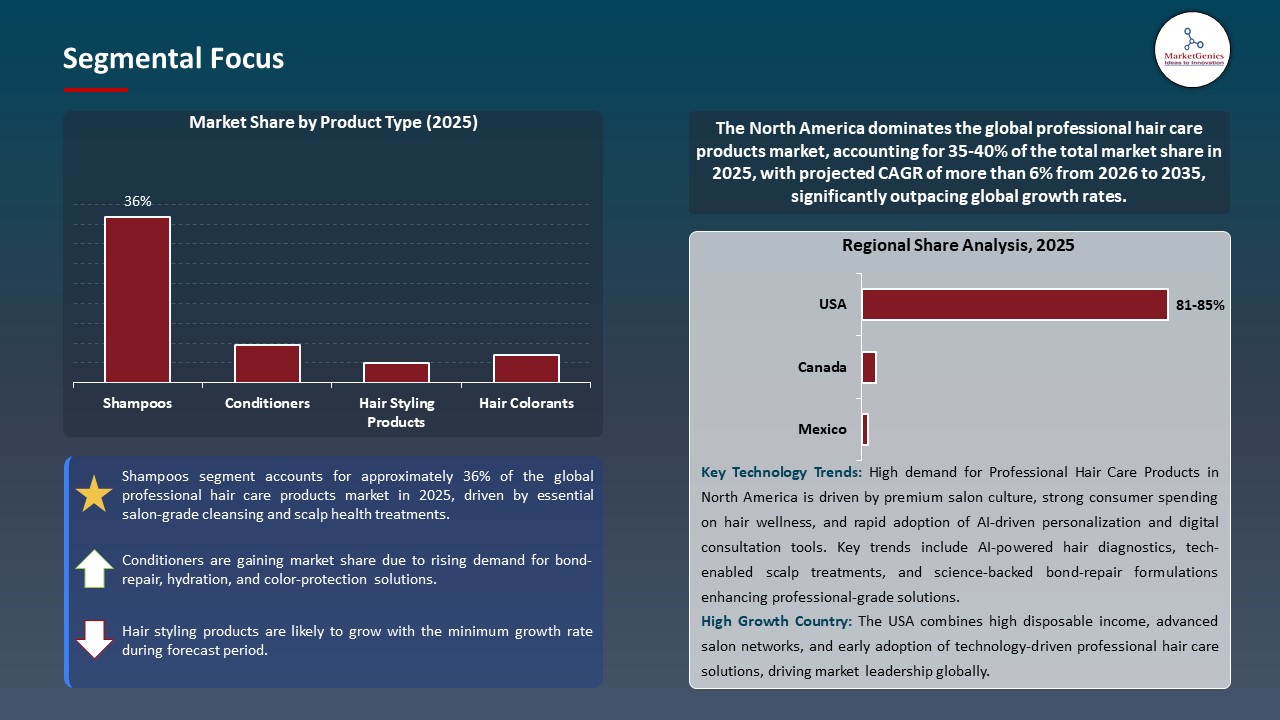
Shampoos Dominate Global Professional Hair Care Products Market
-
The shampoos segment dominates the global professional hair care products market as it is fundamental to salon haircare routines, addressing various concerns such as scalp health, color preservation, damage repair, and hair fall control. The frequency of high repeat purchases, regular visits to the salon, increased adoption of at-home professional care are major factors in volume and value leadership in salons and specialty channels.
- Innovation in formulation science and scalp-oriented technologies, such as bond-building actives and the microbiome support system, also contribute to increasing the market. For instance, in December 2024, Nutrafol entered the salon professional backbar segment with professional-size of Root Purifier Shampoo and Strand Defender Conditioner to enable stylists to offer clinically proven scalp health to clients at salons as the growth of advanced professional shampoos with specialized benefits.
- Overall, professional shampoos hold market dominance due to their stylist endorsement, high frequency of use as well as salon integration in the world market.
North America Leads Global Professional Hair Care Products Market Demand
- The global professional hair care products market leads by north America, because of great consumption of premium hair care products, salon culture, and greater acceptance of advanced professional hair care solutions. The U.S and Canada have a high level of consumption per capita due to the level of innovative hair science, performance based formulations and frequent visits to the professional salons.
- The area is also characterized by the fast distribution and innovation adoption in the professional channels. For instance, in January 2025, the Beauty Systems Group declared a big mass distribution affiliation to distribute K18 new biotech hair care products in all stores and online stores in the United States and Canada, and in the displays of salons and stylistic services, which will raise the offer of high-end repair solutions and reflect strong demand in the country to utilize professional products based on scientific principles.
- The region's leadership in the global market share and revenue generation of professional hair care products is further promoted by well-established logistics, advanced e-commerce, strong stylist education programs, and outstanding protection of intellectual property.
Professional-Hair-Care-Products-Market Ecosystem
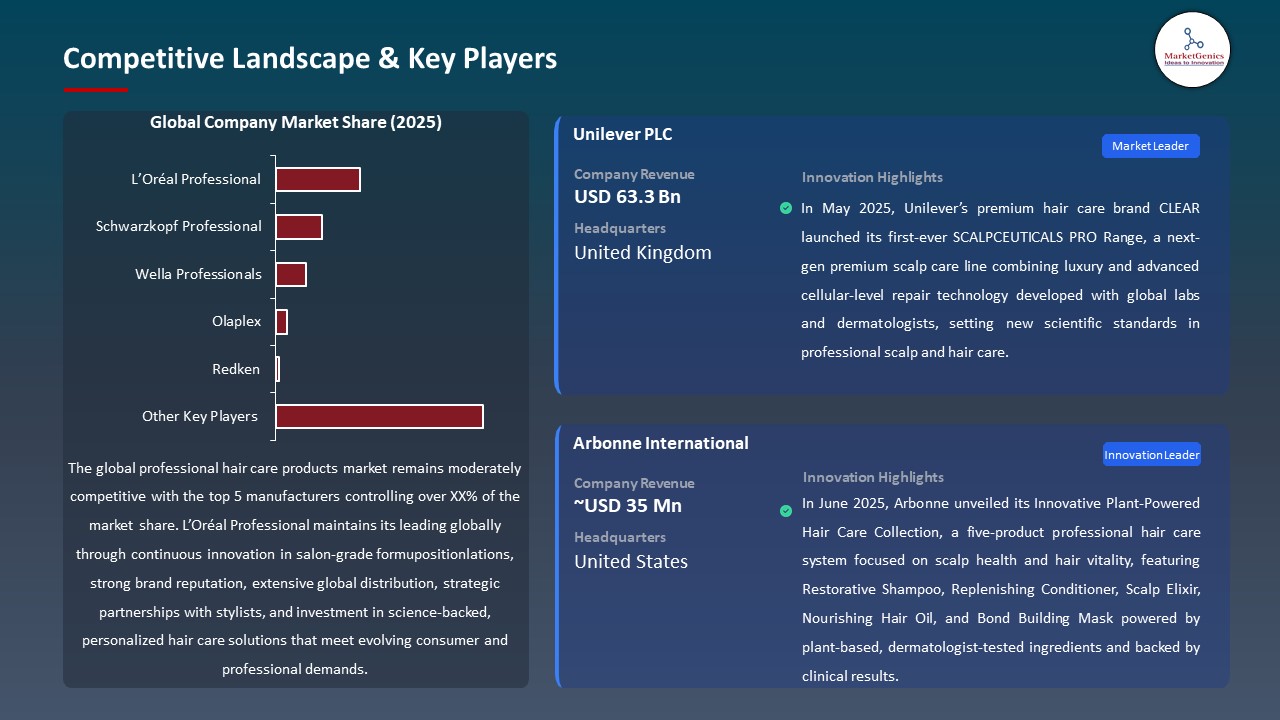
The global professional hair care products market is moderately concentrated with intense presence of Tier-1 multinational brands with good penetration in professional salons, superior research and development facilities and well established international distribution channels. Concentration in the market is medium-high, where the major players possess a large portion by brand loyalty and professional endorsement.
L’Oréal Professional, Schwarzkopf Professional, Wella Professionals, Redken, and Olaplex are known as tier-1 players, as they hold the market because of their globally established names, formulas supported by science, constant product development, and strong association with professional salons. These companies use powerful education systems of stylists, premium positioning, and omnichannel distribution in salons, specialty shops, and online shops.
The Tier-2 includes regional professional brands, along with niche experts such as clean beauty, scalp health, or texture-specific. They compete by differentiation, targeted salon relationships and selective presence based on geographic factors. The third tier consists of new digital-first and indie professional brands with a focus on sustainability, customerization, and influencer-based marketing. Innovation in hair science, individualization technologies, sustainability and the creation of broader professional salon ecosystems contribute to competition at tiers.
 Recent Development and Strategic Overview
- In May 2025, Unilever launched its high-end hair care label CLEAR with its first-ever SCALPCEUTicals PRO Range, a next-generation advanced scalp and hair care line that combines luxury and a new level of repairing technology at a cellular level, developed by the global labs and dermatologists, and establishing new scientific standards in professional scalp and hair care.
- In June 2025, Arbonne has launched Innovative Plant-Powered Hair Care Collection, a 5-product line of professional scalp health and hair-vitality hair care, using plant-based, dermatologist-tested ingredients and supported by clinical outcomes.
Report Scope
|
Detail |
|
|
Market Size in 2025 |
USD 37.2 Bn |
|
Market Forecast Value in 2035 |
USD 51.3 Bn |
|
Growth Rate (CAGR) |
4.1% |
|
Forecast Period |
2026 – 2035 |
|
Historical Data Available for |
2021 – 2024 |
|
Market Size Units |
US$ Billion for Value Thousand Units for Volume |
|
Report Format |
Electronic (PDF) + Excel |
|
North America |
Europe |
Asia Pacific |
Middle East |
Africa |
South America |
|
|
|
|
|
|
|
Companies Covered |
|||||
|
|
|
|
|
|
Professional-Hair-Care-Products-Market Segmentation and Highlights
|
Segment |
Sub-segment |
|
Professional Hair Care Products Market, By Product Type |
|
|
Professional Hair Care Products Market, By Formulation |
|
|
Professional Hair Care Products Market, By Ingredient Type |
|
|
Professional Hair Care Products Market, By Consumer Demographics |
|
|
Professional Hair Care Products Market, By Distribution Channel |
|
|
Professional Hair Care Products Market, By Packaging Type |
|
Frequently Asked Questions
Table of Contents
- 1. Research Methodology and Assumptions
- 1.1. Definitions
- 1.2. Research Design and Approach
- 1.3. Data Collection Methods
- 1.4. Base Estimates and Calculations
- 1.5. Forecasting Models
- 1.5.1. Key Forecast Factors & Impact Analysis
- 1.6. Secondary Research
- 1.6.1. Open Sources
- 1.6.2. Paid Databases
- 1.6.3. Associations
- 1.7. Primary Research
- 1.7.1. Primary Sources
- 1.7.2. Primary Interviews with Stakeholders across Ecosystem
- 2. Executive Summary
- 2.1. Global Professional Hair Care Products Market Outlook
- 2.1.1. Professional Hair Care Products Market Size Volume (Thousand Units) and Value (US$ Bn), and Forecasts, 2021-2035
- 2.1.2. Compounded Annual Growth Rate Analysis
- 2.1.3. Growth Opportunity Analysis
- 2.1.4. Segmental Share Analysis
- 2.1.5. Geographical Share Analysis
- 2.2. Market Analysis and Facts
- 2.3. Supply-Demand Analysis
- 2.4. Competitive Benchmarking
- 2.5. Go-to- Market Strategy
- 2.5.1. Customer/ End-use Industry Assessment
- 2.5.2. Growth Opportunity Data, 2026-2035
- 2.5.2.1. Regional Data
- 2.5.2.2. Country Data
- 2.5.2.3. Segmental Data
- 2.5.3. Identification of Potential Market Spaces
- 2.5.4. GAP Analysis
- 2.5.5. Potential Attractive Price Points
- 2.5.6. Prevailing Market Risks & Challenges
- 2.5.7. Preferred Sales & Marketing Strategies
- 2.5.8. Key Recommendations and Analysis
- 2.5.9. A Way Forward
- 2.1. Global Professional Hair Care Products Market Outlook
- 3. Industry Data and Premium Insights
- 3.1. Global Consumer Goods & Services Industry Overview, 2025
- 3.1.1. Industry Ecosystem Analysis
- 3.1.2. Key Trends for Consumer Goods & Services Industry
- 3.1.3. Regional Distribution for Consumer Goods & Services Industry
- 3.2. Supplier Customer Data
- 3.3. Technology Roadmap and Developments
- 3.4. Trade Analysis
- 3.4.1. Import & Export Analysis, 2025
- 3.4.2. Top Importing Countries
- 3.4.3. Top Exporting Countries
- 3.5. Trump Tariff Impact Analysis
- 3.5.1. Manufacturer
- 3.5.1.1. Based on the component & Raw material
- 3.5.2. Supply Chain
- 3.5.3. End Consumer
- 3.5.1. Manufacturer
- 3.6. Raw Material Analysis
- 3.1. Global Consumer Goods & Services Industry Overview, 2025
- 4. Market Overview
- 4.1. Market Dynamics
- 4.1.1. Drivers
- 4.1.1.1. Increasing demand for premium and salon-grade hair care solutions.
- 4.1.1.2. Growing awareness of hair health and influence of beauty trends/social media.
- 4.1.1.3. Expansion of professional salons and beauty services in emerging markets.
- 4.1.2. Restraints
- 4.1.2.1. High product prices limiting adoption in price-sensitive regions.
- 4.1.2.2. Intense competition and counterfeit/low-quality alternatives affecting market share.
- 4.1.1. Drivers
- 4.2. Key Trend Analysis
- 4.3. Regulatory Framework
- 4.3.1. Key Regulations, Norms, and Subsidies, by Key Countries
- 4.3.2. Tariffs and Standards
- 4.3.3. Impact Analysis of Regulations on the Market
- 4.4. Value Chain Analysis
- 4.4.1. Raw Material Suppliers
- 4.4.2. Manufacturers
- 4.4.3. Distributors
- 4.4.4. End-Users/ Customers
- 4.5. Cost Structure Analysis
- 4.5.1. Parameter’s Share for Cost Associated
- 4.5.2. COGP vs COGS
- 4.5.3. Profit Margin Analysis
- 4.6. Pricing Analysis
- 4.6.1. Regional Pricing Analysis
- 4.6.2. Segmental Pricing Trends
- 4.6.3. Factors Influencing Pricing
- 4.7. Porter’s Five Forces Analysis
- 4.8. PESTEL Analysis
- 4.9. Global Professional Hair Care Products Market Demand
- 4.9.1. Historical Market Size – Volume (Thousand Units) and Value (US$ Bn), 2020-2024
- 4.9.2. Current and Future Market Size – Volume (Thousand Units) and Value (US$ Bn), 2026–2035
- 4.9.2.1. Y-o-Y Growth Trends
- 4.9.2.2. Absolute $ Opportunity Assessment
- 4.1. Market Dynamics
- 5. Competition Landscape
- 5.1. Competition structure
- 5.1.1. Fragmented v/s consolidated
- 5.2. Company Share Analysis, 2025
- 5.2.1. Global Company Market Share
- 5.2.2. By Region
- 5.2.2.1. North America
- 5.2.2.2. Europe
- 5.2.2.3. Asia Pacific
- 5.2.2.4. Middle East
- 5.2.2.5. Africa
- 5.2.2.6. South America
- 5.3. Product Comparison Matrix
- 5.3.1. Specifications
- 5.3.2. Market Positioning
- 5.3.3. Pricing
- 5.1. Competition structure
- 6. Global Professional Hair Care Products Market Analysis, by Product Type
- 6.1. Key Segment Analysis
- 6.2. Professional Hair Care Products Market Size Volume (Thousand Units) and Value (US$ Bn), Analysis, and Forecasts, by Product Type, 2021-2035
- 6.2.1. Shampoos
- 6.2.2. Conditioners
- 6.2.3. Hair Colorants
- 6.2.4. Hair Styling Products
- 6.2.4.1. Hair Sprays & Gels
- 6.2.4.2. Hair Serums
- 6.2.4.3. Others
- 6.2.5. Hair Treatments
- 6.2.6. Others
- 7. Global Professional Hair Care Products Market Analysis, by Formulation
- 7.1. Key Segment Analysis
- 7.2. Professional Hair Care Products Market Size Volume (Thousand Units) and Value (US$ Bn), Analysis, and Forecasts, by Formulation, 2021-2035
- 7.2.1. Cream-Based
- 7.2.2. Gel-Based
- 7.2.3. Liquid
- 7.2.4. Powder
- 7.2.5. Oil-Based
- 7.2.6. Serum
- 8. Global Professional Hair Care Products Market Analysis, by Ingredient Type
- 8.1. Key Segment Analysis
- 8.2. Professional Hair Care Products Market Size Volume (Thousand Units) and Value (US$ Bn), Analysis, and Forecasts, by Ingredient Type, 2021-2035
- 8.2.1. Synthetic
- 8.2.2. Natural/Organic
- 8.2.3. Vegan
- 9. Global Professional Hair Care Products Market Analysis, by Consumer Demographics
- 9.1. Key Segment Analysis
- 9.2. Professional Hair Care Products Market Size Volume (Thousand Units) and Value (US$ Bn), Analysis, and Forecasts, by Consumer Demographics, 2021-2035
- 9.2.1. Gender
- 9.2.1.1. Women
- 9.2.1.2. Men
- 9.2.1.3. Unisex
- 9.2.2. Age Group
- 9.2.2.1. 18-25 Years
- 9.2.2.2. 26-35 Years
- 9.2.2.3. 36-45 Years
- 9.2.2.4. Above 45 Years
- 9.2.1. Gender
- 10. Global Professional Hair Care Products Market Analysis, by Distribution Channel
- 10.1. Key Segment Analysis
- 10.2. Professional Hair Care Products Market Size Volume (Thousand Units) and Value (US$ Bn), Analysis, and Forecasts, by Distribution Channel, 2021-2035
- 10.2.1. Professional Salons & Spas
- 10.2.2. Specialty Stores
- 10.2.3. Online Retail
- 10.2.3.1. Company-Owned Websites
- 10.2.3.2. Third-Party E-commerce Platforms
- 10.2.4. Hypermarkets/Supermarkets
- 10.2.5. Department Stores
- 10.2.6. Others
- 11. Global Professional Hair Care Products Market Analysis, by Packaging Type
- 11.1. Key Segment Analysis
- 11.2. Professional Hair Care Products Market Size Volume (Thousand Units) and Value (US$ Bn), Analysis, and Forecasts, by Packaging Type, 2021-2035
- 11.2.1. Bottles
- 11.2.1.1. Plastic Bottles
- 11.2.1.2. Glass Bottles
- 11.2.2. Tubes
- 11.2.3. Jars
- 11.2.4. Pumps/Dispensers
- 11.2.5. Sachets/Pouches
- 11.2.6. Aerosol Cans
- 11.2.1. Bottles
- 12. Global Professional Hair Care Products Market Analysis and Forecasts, by Region
- 12.1. Key Findings
- 12.2. Professional Hair Care Products Market Size Volume (Thousand Units) and Value (US$ Bn), Analysis, and Forecasts, by Region, 2021-2035
- 12.2.1. North America
- 12.2.2. Europe
- 12.2.3. Asia Pacific
- 12.2.4. Middle East
- 12.2.5. Africa
- 12.2.6. South America
- 13. North America Professional Hair Care Products Market Analysis
- 13.1. Key Segment Analysis
- 13.2. Regional Snapshot
- 13.3. North America Professional Hair Care Products Market Size Volume (Thousand Units) and Value (US$ Bn), Analysis, and Forecasts, 2021-2035
- 13.3.1. Product Type
- 13.3.2. Formulation
- 13.3.3. Ingredient Type
- 13.3.4. Consumer Demographics
- 13.3.5. Distribution Channel
- 13.3.6. Packaging Type
- 13.3.7. Country
- 13.3.7.1. USA
- 13.3.7.2. Canada
- 13.3.7.3. Mexico
- 13.4. USA Professional Hair Care Products Market
- 13.4.1. Country Segmental Analysis
- 13.4.2. Product Type
- 13.4.3. Formulation
- 13.4.4. Ingredient Type
- 13.4.5. Consumer Demographics
- 13.4.6. Distribution Channel
- 13.4.7. Packaging Type
- 13.5. Canada Professional Hair Care Products Market
- 13.5.1. Country Segmental Analysis
- 13.5.2. Product Type
- 13.5.3. Formulation
- 13.5.4. Ingredient Type
- 13.5.5. Consumer Demographics
- 13.5.6. Distribution Channel
- 13.5.7. Packaging Type
- 13.6. Mexico Professional Hair Care Products Market
- 13.6.1. Country Segmental Analysis
- 13.6.2. Product Type
- 13.6.3. Formulation
- 13.6.4. Ingredient Type
- 13.6.5. Consumer Demographics
- 13.6.6. Distribution Channel
- 13.6.7. Packaging Type
- 14. Europe Professional Hair Care Products Market Analysis
- 14.1. Key Segment Analysis
- 14.2. Regional Snapshot
- 14.3. Europe Professional Hair Care Products Market Size Volume (Thousand Units) and Value (US$ Bn), Analysis, and Forecasts, 2021-2035
- 14.3.1. Product Type
- 14.3.2. Formulation
- 14.3.3. Ingredient Type
- 14.3.4. Consumer Demographics
- 14.3.5. Distribution Channel
- 14.3.6. Packaging Type
- 14.3.7. Country
- 14.3.7.1. Germany
- 14.3.7.2. United Kingdom
- 14.3.7.3. France
- 14.3.7.4. Italy
- 14.3.7.5. Spain
- 14.3.7.6. Netherlands
- 14.3.7.7. Nordic Countries
- 14.3.7.8. Poland
- 14.3.7.9. Russia & CIS
- 14.3.7.10. Rest of Europe
- 14.4. Germany Professional Hair Care Products Market
- 14.4.1. Country Segmental Analysis
- 14.4.2. Product Type
- 14.4.3. Formulation
- 14.4.4. Ingredient Type
- 14.4.5. Consumer Demographics
- 14.4.6. Distribution Channel
- 14.4.7. Packaging Type
- 14.5. United Kingdom Professional Hair Care Products Market
- 14.5.1. Country Segmental Analysis
- 14.5.2. Product Type
- 14.5.3. Formulation
- 14.5.4. Ingredient Type
- 14.5.5. Consumer Demographics
- 14.5.6. Distribution Channel
- 14.5.7. Packaging Type
- 14.6. France Professional Hair Care Products Market
- 14.6.1. Country Segmental Analysis
- 14.6.2. Product Type
- 14.6.3. Formulation
- 14.6.4. Ingredient Type
- 14.6.5. Consumer Demographics
- 14.6.6. Distribution Channel
- 14.6.7. Packaging Type
- 14.7. Italy Professional Hair Care Products Market
- 14.7.1. Country Segmental Analysis
- 14.7.2. Product Type
- 14.7.3. Formulation
- 14.7.4. Ingredient Type
- 14.7.5. Consumer Demographics
- 14.7.6. Distribution Channel
- 14.7.7. Packaging Type
- 14.8. Spain Professional Hair Care Products Market
- 14.8.1. Country Segmental Analysis
- 14.8.2. Product Type
- 14.8.3. Formulation
- 14.8.4. Ingredient Type
- 14.8.5. Consumer Demographics
- 14.8.6. Distribution Channel
- 14.8.7. Packaging Type
- 14.9. Netherlands Professional Hair Care Products Market
- 14.9.1. Country Segmental Analysis
- 14.9.2. Product Type
- 14.9.3. Formulation
- 14.9.4. Ingredient Type
- 14.9.5. Consumer Demographics
- 14.9.6. Distribution Channel
- 14.9.7. Packaging Type
- 14.10. Nordic Countries Professional Hair Care Products Market
- 14.10.1. Country Segmental Analysis
- 14.10.2. Product Type
- 14.10.3. Formulation
- 14.10.4. Ingredient Type
- 14.10.5. Consumer Demographics
- 14.10.6. Distribution Channel
- 14.10.7. Packaging Type
- 14.11. Poland Professional Hair Care Products Market
- 14.11.1. Country Segmental Analysis
- 14.11.2. Product Type
- 14.11.3. Formulation
- 14.11.4. Ingredient Type
- 14.11.5. Consumer Demographics
- 14.11.6. Distribution Channel
- 14.11.7. Packaging Type
- 14.12. Russia & CIS Professional Hair Care Products Market
- 14.12.1. Country Segmental Analysis
- 14.12.2. Product Type
- 14.12.3. Formulation
- 14.12.4. Ingredient Type
- 14.12.5. Consumer Demographics
- 14.12.6. Distribution Channel
- 14.12.7. Packaging Type
- 14.13. Rest of Europe Professional Hair Care Products Market
- 14.13.1. Country Segmental Analysis
- 14.13.2. Product Type
- 14.13.3. Formulation
- 14.13.4. Ingredient Type
- 14.13.5. Consumer Demographics
- 14.13.6. Distribution Channel
- 14.13.7. Packaging Type
- 15. Asia Pacific Professional Hair Care Products Market Analysis
- 15.1. Key Segment Analysis
- 15.2. Regional Snapshot
- 15.3. Asia Pacific Professional Hair Care Products Market Size Volume (Thousand Units) and Value (US$ Bn), Analysis, and Forecasts, 2021-2035
- 15.3.1. Product Type
- 15.3.2. Formulation
- 15.3.3. Ingredient Type
- 15.3.4. Consumer Demographics
- 15.3.5. Distribution Channel
- 15.3.6. Packaging Type
- 15.3.7. Country
- 15.3.7.1. China
- 15.3.7.2. India
- 15.3.7.3. Japan
- 15.3.7.4. South Korea
- 15.3.7.5. Australia and New Zealand
- 15.3.7.6. Indonesia
- 15.3.7.7. Malaysia
- 15.3.7.8. Thailand
- 15.3.7.9. Vietnam
- 15.3.7.10. Rest of Asia Pacific
- 15.4. China Professional Hair Care Products Market
- 15.4.1. Country Segmental Analysis
- 15.4.2. Product Type
- 15.4.3. Formulation
- 15.4.4. Ingredient Type
- 15.4.5. Consumer Demographics
- 15.4.6. Distribution Channel
- 15.4.7. Packaging Type
- 15.5. India Professional Hair Care Products Market
- 15.5.1. Country Segmental Analysis
- 15.5.2. Product Type
- 15.5.3. Formulation
- 15.5.4. Ingredient Type
- 15.5.5. Consumer Demographics
- 15.5.6. Distribution Channel
- 15.5.7. Packaging Type
- 15.6. Japan Professional Hair Care Products Market
- 15.6.1. Country Segmental Analysis
- 15.6.2. Product Type
- 15.6.3. Formulation
- 15.6.4. Ingredient Type
- 15.6.5. Consumer Demographics
- 15.6.6. Distribution Channel
- 15.6.7. Packaging Type
- 15.7. South Korea Professional Hair Care Products Market
- 15.7.1. Country Segmental Analysis
- 15.7.2. Product Type
- 15.7.3. Formulation
- 15.7.4. Ingredient Type
- 15.7.5. Consumer Demographics
- 15.7.6. Distribution Channel
- 15.7.7. Packaging Type
- 15.8. Australia and New Zealand Professional Hair Care Products Market
- 15.8.1. Country Segmental Analysis
- 15.8.2. Product Type
- 15.8.3. Formulation
- 15.8.4. Ingredient Type
- 15.8.5. Consumer Demographics
- 15.8.6. Distribution Channel
- 15.8.7. Packaging Type
- 15.9. Indonesia Professional Hair Care Products Market
- 15.9.1. Country Segmental Analysis
- 15.9.2. Product Type
- 15.9.3. Formulation
- 15.9.4. Ingredient Type
- 15.9.5. Consumer Demographics
- 15.9.6. Distribution Channel
- 15.9.7. Packaging Type
- 15.10. Malaysia Professional Hair Care Products Market
- 15.10.1. Country Segmental Analysis
- 15.10.2. Product Type
- 15.10.3. Formulation
- 15.10.4. Ingredient Type
- 15.10.5. Consumer Demographics
- 15.10.6. Distribution Channel
- 15.10.7. Packaging Type
- 15.11. Thailand Professional Hair Care Products Market
- 15.11.1. Country Segmental Analysis
- 15.11.2. Product Type
- 15.11.3. Formulation
- 15.11.4. Ingredient Type
- 15.11.5. Consumer Demographics
- 15.11.6. Distribution Channel
- 15.11.7. Packaging Type
- 15.12. Vietnam Professional Hair Care Products Market
- 15.12.1. Country Segmental Analysis
- 15.12.2. Product Type
- 15.12.3. Formulation
- 15.12.4. Ingredient Type
- 15.12.5. Consumer Demographics
- 15.12.6. Distribution Channel
- 15.12.7. Packaging Type
- 15.13. Rest of Asia Pacific Professional Hair Care Products Market
- 15.13.1. Country Segmental Analysis
- 15.13.2. Product Type
- 15.13.3. Formulation
- 15.13.4. Ingredient Type
- 15.13.5. Consumer Demographics
- 15.13.6. Distribution Channel
- 15.13.7. Packaging Type
- 16. Middle East Professional Hair Care Products Market Analysis
- 16.1. Key Segment Analysis
- 16.2. Regional Snapshot
- 16.3. Middle East Professional Hair Care Products Market Size Volume (Thousand Units) and Value (US$ Bn), Analysis, and Forecasts, 2021-2035
- 16.3.1. Product Type
- 16.3.2. Formulation
- 16.3.3. Ingredient Type
- 16.3.4. Consumer Demographics
- 16.3.5. Distribution Channel
- 16.3.6. Packaging Type
- 16.3.7. Country
- 16.3.7.1. Turkey
- 16.3.7.2. UAE
- 16.3.7.3. Saudi Arabia
- 16.3.7.4. Israel
- 16.3.7.5. Rest of Middle East
- 16.4. Turkey Professional Hair Care Products Market
- 16.4.1. Country Segmental Analysis
- 16.4.2. Product Type
- 16.4.3. Formulation
- 16.4.4. Ingredient Type
- 16.4.5. Consumer Demographics
- 16.4.6. Distribution Channel
- 16.4.7. Packaging Type
- 16.5. UAE Professional Hair Care Products Market
- 16.5.1. Country Segmental Analysis
- 16.5.2. Product Type
- 16.5.3. Formulation
- 16.5.4. Ingredient Type
- 16.5.5. Consumer Demographics
- 16.5.6. Distribution Channel
- 16.5.7. Packaging Type
- 16.6. Saudi Arabia Professional Hair Care Products Market
- 16.6.1. Country Segmental Analysis
- 16.6.2. Product Type
- 16.6.3. Formulation
- 16.6.4. Ingredient Type
- 16.6.5. Consumer Demographics
- 16.6.6. Distribution Channel
- 16.6.7. Packaging Type
- 16.7. Israel Professional Hair Care Products Market
- 16.7.1. Country Segmental Analysis
- 16.7.2. Product Type
- 16.7.3. Formulation
- 16.7.4. Ingredient Type
- 16.7.5. Consumer Demographics
- 16.7.6. Distribution Channel
- 16.7.7. Packaging Type
- 16.8. Rest of Middle East Professional Hair Care Products Market
- 16.8.1. Country Segmental Analysis
- 16.8.2. Product Type
- 16.8.3. Formulation
- 16.8.4. Ingredient Type
- 16.8.5. Consumer Demographics
- 16.8.6. Distribution Channel
- 16.8.7. Packaging Type
- 17. Africa Professional Hair Care Products Market Analysis
- 17.1. Key Segment Analysis
- 17.2. Regional Snapshot
- 17.3. Africa Professional Hair Care Products Market Size Volume (Thousand Units) and Value (US$ Bn), Analysis, and Forecasts, 2021-2035
- 17.3.1. Product Type
- 17.3.2. Formulation
- 17.3.3. Ingredient Type
- 17.3.4. Consumer Demographics
- 17.3.5. Distribution Channel
- 17.3.6. Packaging Type
- 17.3.7. country
- 17.3.7.1. South Africa
- 17.3.7.2. Egypt
- 17.3.7.3. Nigeria
- 17.3.7.4. Algeria
- 17.3.7.5. Rest of Africa
- 17.4. South Africa Professional Hair Care Products Market
- 17.4.1. Country Segmental Analysis
- 17.4.2. Product Type
- 17.4.3. Formulation
- 17.4.4. Ingredient Type
- 17.4.5. Consumer Demographics
- 17.4.6. Distribution Channel
- 17.4.7. Packaging Type
- 17.5. Egypt Professional Hair Care Products Market
- 17.5.1. Country Segmental Analysis
- 17.5.2. Product Type
- 17.5.3. Formulation
- 17.5.4. Ingredient Type
- 17.5.5. Consumer Demographics
- 17.5.6. Distribution Channel
- 17.5.7. Packaging Type
- 17.6. Nigeria Professional Hair Care Products Market
- 17.6.1. Country Segmental Analysis
- 17.6.2. Product Type
- 17.6.3. Formulation
- 17.6.4. Ingredient Type
- 17.6.5. Consumer Demographics
- 17.6.6. Distribution Channel
- 17.6.7. Packaging Type
- 17.7. Algeria Professional Hair Care Products Market
- 17.7.1. Country Segmental Analysis
- 17.7.2. Product Type
- 17.7.3. Formulation
- 17.7.4. Ingredient Type
- 17.7.5. Consumer Demographics
- 17.7.6. Distribution Channel
- 17.7.7. Packaging Type
- 17.8. Rest of Africa Professional Hair Care Products Market
- 17.8.1. Country Segmental Analysis
- 17.8.2. Product Type
- 17.8.3. Formulation
- 17.8.4. Ingredient Type
- 17.8.5. Consumer Demographics
- 17.8.6. Distribution Channel
- 17.8.7. Packaging Type
- 18. South America Professional Hair Care Products Market Analysis
- 18.1. Key Segment Analysis
- 18.2. Regional Snapshot
- 18.3. South America Professional Hair Care Products Market Size Volume (Thousand Units) and Value (US$ Bn), Analysis, and Forecasts, 2021-2035
- 18.3.1. Product Type
- 18.3.2. Formulation
- 18.3.3. Ingredient Type
- 18.3.4. Consumer Demographics
- 18.3.5. Distribution Channel
- 18.3.6. Packaging Type
- 18.3.7. Country
- 18.3.7.1. Brazil
- 18.3.7.2. Argentina
- 18.3.7.3. Rest of South America
- 18.4. Brazil Professional Hair Care Products Market
- 18.4.1. Country Segmental Analysis
- 18.4.2. Product Type
- 18.4.3. Formulation
- 18.4.4. Ingredient Type
- 18.4.5. Consumer Demographics
- 18.4.6. Distribution Channel
- 18.4.7. Packaging Type
- 18.5. Argentina Professional Hair Care Products Market
- 18.5.1. Country Segmental Analysis
- 18.5.2. Product Type
- 18.5.3. Formulation
- 18.5.4. Ingredient Type
- 18.5.5. Consumer Demographics
- 18.5.6. Distribution Channel
- 18.5.7. Packaging Type
- 18.6. Rest of South America Professional Hair Care Products Market
- 18.6.1. Country Segmental Analysis
- 18.6.2. Product Type
- 18.6.3. Formulation
- 18.6.4. Ingredient Type
- 18.6.5. Consumer Demographics
- 18.6.6. Distribution Channel
- 18.6.7. Packaging Type
- 19. Key Players/ Company Profile
- 19.1. Aveda
- 19.1.1. Company Details/ Overview
- 19.1.2. Company Financials
- 19.1.3. Key Customers and Competitors
- 19.1.4. Business/ Industry Portfolio
- 19.1.5. Product Portfolio/ Specification Details
- 19.1.6. Pricing Data
- 19.1.7. Strategic Overview
- 19.1.8. Recent Developments
- 19.2. Bumble and bumble Products, LLC
- 19.3. Davines
- 19.4. Goldwell
- 19.5. Joico
- 19.6. Kenra Professional
- 19.7. Kerastase
- 19.8. Living Proof
- 19.9. L'Oréal Professional
- 19.10. Matrix
- 19.11. Moroccanoil
- 19.12. Olaplex
- 19.13. Oribe
- 19.14. Paul Mitchell
- 19.15. Pureology
- 19.16. R+Co
- 19.17. Redken
- 19.18. Schwarzkopf Professional
- 19.19. Sebastian Professional
- 19.20. Wella Professionals
- 19.21. Other Key Players
- 19.1. Aveda
Note* - This is just tentative list of players. While providing the report, we will cover more number of players based on their revenue and share for each geography
Research Design
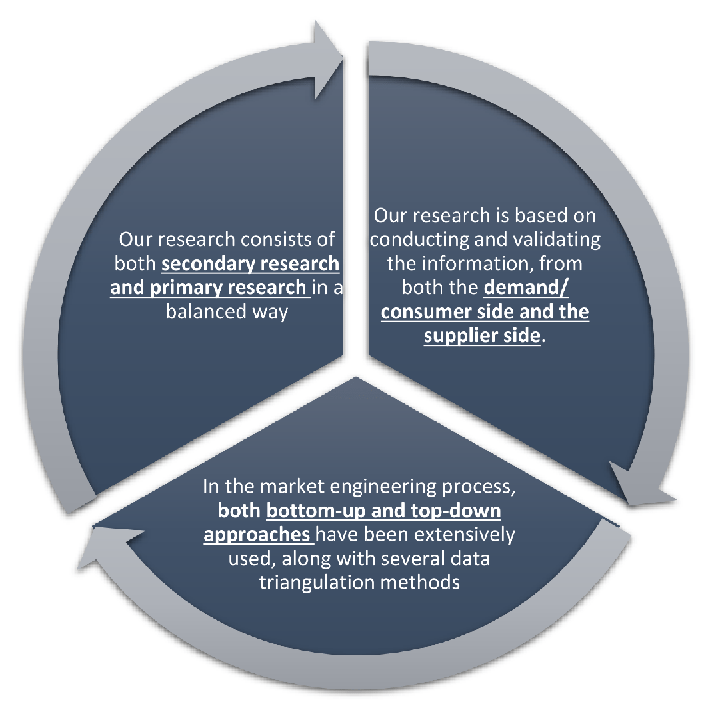
Our research design integrates both demand-side and supply-side analysis through a balanced combination of primary and secondary research methodologies. By utilizing both bottom-up and top-down approaches alongside rigorous data triangulation methods, we deliver robust market intelligence that supports strategic decision-making.
MarketGenics' comprehensive research design framework ensures the delivery of accurate, reliable, and actionable market intelligence. Through the integration of multiple research approaches, rigorous validation processes, and expert analysis, we provide our clients with the insights needed to make informed strategic decisions and capitalize on market opportunities.
MarketGenics leverages a dedicated industry panel of experts and a comprehensive suite of paid databases to effectively collect, consolidate, and analyze market intelligence.
Our approach has consistently proven to be reliable and effective in generating accurate market insights, identifying key industry trends, and uncovering emerging business opportunities.
Through both primary and secondary research, we capture and analyze critical company-level data such as manufacturing footprints, including technical centers, R&D facilities, sales offices, and headquarters.
Our expert panel further enhances our ability to estimate market size for specific brands based on validated field-level intelligence.
Our data mining techniques incorporate both parametric and non-parametric methods, allowing for structured data collection, sorting, processing, and cleaning.
Demand projections are derived from large-scale data sets analyzed through proprietary algorithms, culminating in robust and reliable market sizing.
Research Approach
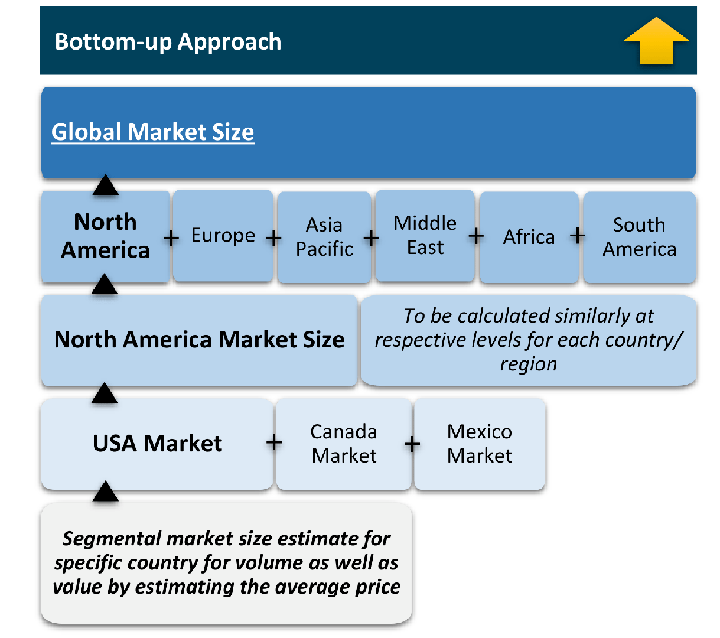
The bottom-up approach builds market estimates by starting with the smallest addressable market units and systematically aggregating them to create comprehensive market size projections.
This method begins with specific, granular data points and builds upward to create the complete market landscape.
Customer Analysis → Segmental Analysis → Geographical Analysis
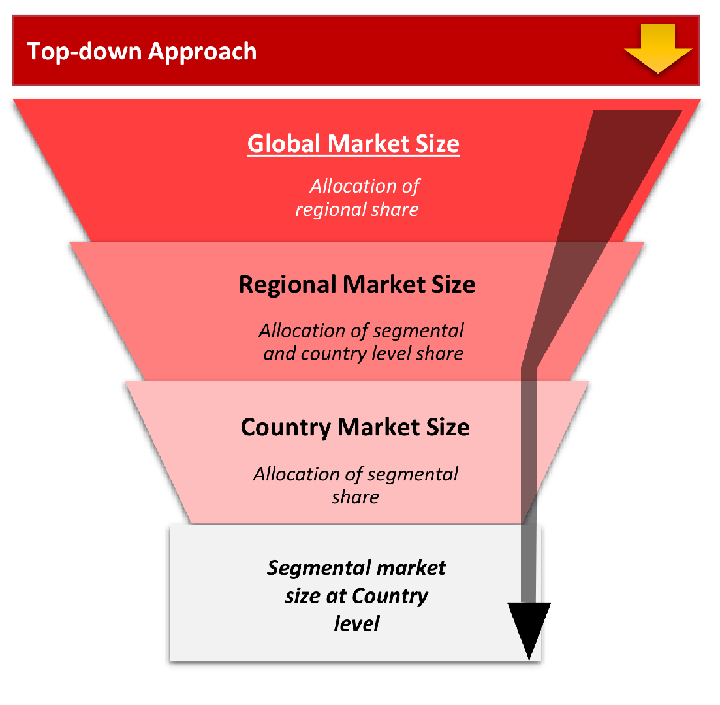
The top-down approach starts with the broadest possible market data and systematically narrows it down through a series of filters and assumptions to arrive at specific market segments or opportunities.
This method begins with the big picture and works downward to increasingly specific market slices.
TAM → SAM → SOM
Research Methods
Desk / Secondary Research
While analysing the market, we extensively study secondary sources, directories, and databases to identify and collect information useful for this technical, market-oriented, and commercial report. Secondary sources that we utilize are not only the public sources, but it is a combination of Open Source, Associations, Paid Databases, MG Repository & Knowledgebase, and others.
- Company websites, annual reports, financial reports, broker reports, and investor presentations
- National government documents, statistical databases and reports
- News articles, press releases and web-casts specific to the companies operating in the market, Magazines, reports, and others
- We gather information from commercial data sources for deriving company specific data such as segmental revenue, share for geography, product revenue, and others
- Internal and external proprietary databases (industry-specific), relevant patent, and regulatory databases
- Governing Bodies, Government Organizations
- Relevant Authorities, Country-specific Associations for Industries
We also employ the model mapping approach to estimate the product level market data through the players' product portfolio
Primary Research
Primary research/ interviews is vital in analyzing the market. Most of the cases involves paid primary interviews. Primary sources include primary interviews through e-mail interactions, telephonic interviews, surveys as well as face-to-face interviews with the different stakeholders across the value chain including several industry experts.
| Type of Respondents | Number of Primaries |
|---|---|
| Tier 2/3 Suppliers | ~20 |
| Tier 1 Suppliers | ~25 |
| End-users | ~25 |
| Industry Expert/ Panel/ Consultant | ~30 |
| Total | ~100 |
MG Knowledgebase
• Repository of industry blog, newsletter and case studies
• Online platform covering detailed market reports, and company profiles
Forecasting Factors and Models
Forecasting Factors
- Historical Trends – Past market patterns, cycles, and major events that shaped how markets behave over time. Understanding past trends helps predict future behavior.
- Industry Factors – Specific characteristics of the industry like structure, regulations, and innovation cycles that affect market dynamics.
- Macroeconomic Factors – Economic conditions like GDP growth, inflation, and employment rates that affect how much money people have to spend.
- Demographic Factors – Population characteristics like age, income, and location that determine who can buy your product.
- Technology Factors – How quickly people adopt new technology and how much technology infrastructure exists.
- Regulatory Factors – Government rules, laws, and policies that can help or restrict market growth.
- Competitive Factors – Analyzing competition structure such as degree of competition and bargaining power of buyers and suppliers.
Forecasting Models / Techniques
Multiple Regression Analysis
- Identify and quantify factors that drive market changes
- Statistical modeling to establish relationships between market drivers and outcomes
Time Series Analysis – Seasonal Patterns
- Understand regular cyclical patterns in market demand
- Advanced statistical techniques to separate trend, seasonal, and irregular components
Time Series Analysis – Trend Analysis
- Identify underlying market growth patterns and momentum
- Statistical analysis of historical data to project future trends
Expert Opinion – Expert Interviews
- Gather deep industry insights and contextual understanding
- In-depth interviews with key industry stakeholders
Multi-Scenario Development
- Prepare for uncertainty by modeling different possible futures
- Creating optimistic, pessimistic, and most likely scenarios
Time Series Analysis – Moving Averages
- Sophisticated forecasting for complex time series data
- Auto-regressive integrated moving average models with seasonal components
Econometric Models
- Apply economic theory to market forecasting
- Sophisticated economic models that account for market interactions
Expert Opinion – Delphi Method
- Harness collective wisdom of industry experts
- Structured, multi-round expert consultation process
Monte Carlo Simulation
- Quantify uncertainty and probability distributions
- Thousands of simulations with varying input parameters
Research Analysis
Our research framework is built upon the fundamental principle of validating market intelligence from both demand and supply perspectives. This dual-sided approach ensures comprehensive market understanding and reduces the risk of single-source bias.
Demand-Side Analysis: We understand end-user/application behavior, preferences, and market needs along with the penetration of the product for specific application.
Supply-Side Analysis: We estimate overall market revenue, analyze the segmental share along with industry capacity, competitive landscape, and market structure.
Validation & Evaluation
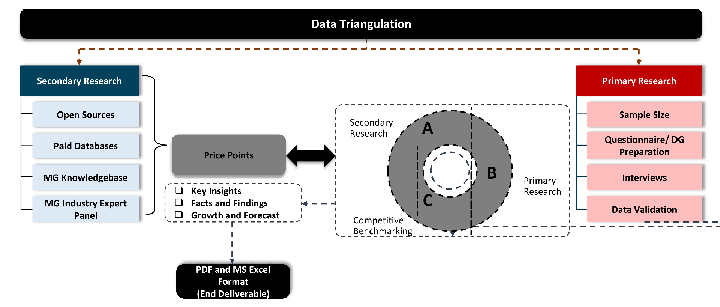
Data triangulation is a validation technique that uses multiple methods, sources, or perspectives to examine the same research question, thereby increasing the credibility and reliability of research findings. In market research, triangulation serves as a quality assurance mechanism that helps identify and minimize bias, validate assumptions, and ensure accuracy in market estimates.
- Data Source Triangulation – Using multiple data sources to examine the same phenomenon
- Methodological Triangulation – Using multiple research methods to study the same research question
- Investigator Triangulation – Using multiple researchers or analysts to examine the same data
- Theoretical Triangulation – Using multiple theoretical perspectives to interpret the same data
Custom Market Research Services
We will customise the research for you, in case the report listed above does not meet your requirements.
Get 10% Free Customisation