Savory Yogurt Market Size, Share & Trends Analysis Report by Product Type (Plain Savory Yogurt, Herb-infused Savory Yogurt, Spiced Savory Yogurt, Vegetable-based Savory Yogurt, Others), Source/Base, Packaging Type, Distribution Channel, End-use, and Geography (North America, Europe, Asia Pacific, Middle East, Africa, and South America) – Global Industry Data, Trends, and Forecasts, 2026–2035
|
|
|
Segmental Data Insights |
|
|
Demand Trends |
|
|
Competitive Landscape |
|
|
Strategic Development |
|
|
Future Outlook & Opportunities |
|
Savory-Yogurt-Market Size, Share, and Growth
The global savory yogurt market is experiencing robust growth, with its estimated value of USD 1.4 billion in the year 2025 and USD 2.6 billion by 2035, registering a CAGR of 6.3%, during the forecast period. The savory yogurt market is growing fast with brands being innovative to provide convenient, high protein and high nutrient savory yogurts. The new products including spoonable cups, snackable bites, layered dips, and drinkable yogurts are designed to meet the busy needs of health conscious consumers who demand on-the-go, functional and flavor-focused snacking options.
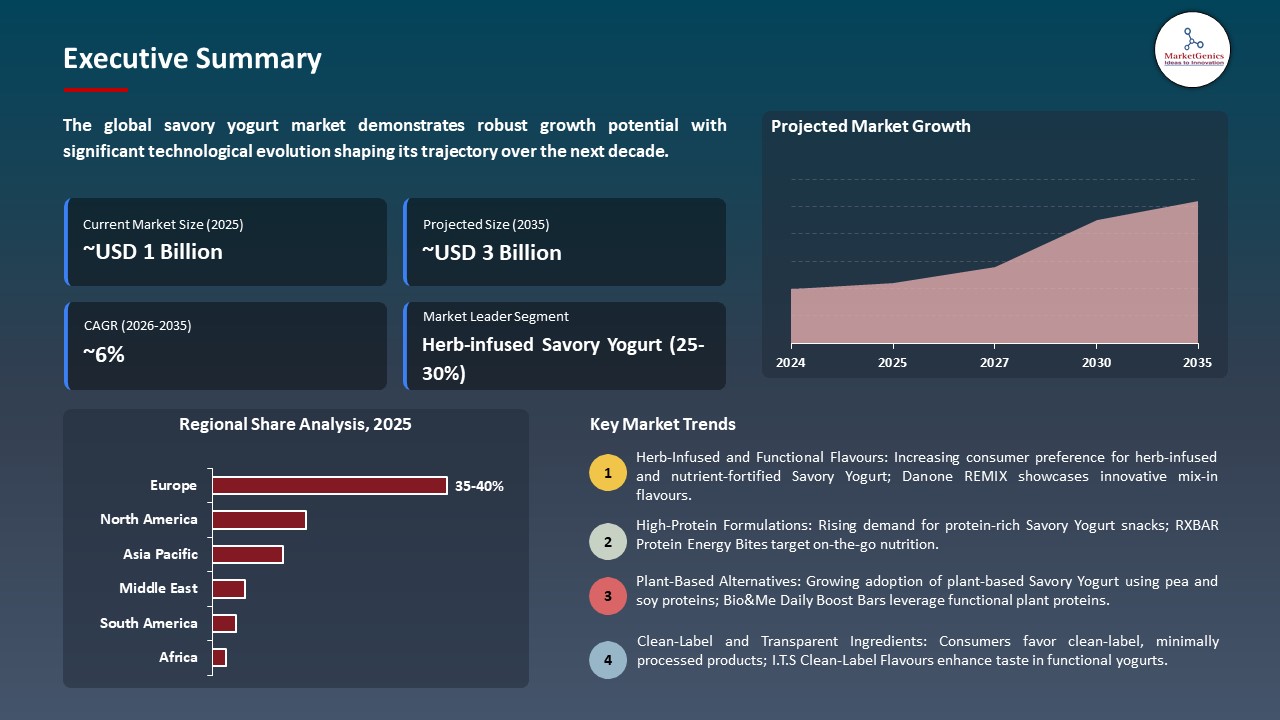
Rafael Acevedo, President/GM at Danone North America, said: "It's no secret that snacking is increasing for busy Americans, and we've taken notice. We want snacking to feel anything but routine, and at Danone we are positioned to give consumers yogurt options that work for them on all fronts – for their tastebuds, their nutrition goals and their schedules. That's why we created Oikos, Light & Fit and Too Good REMIX, to shake up the mix-in space with options that not only have compelling nutritional profiles, but that taste insanely good, too. All nine varieties and topping combinations are fantastic, but my personal favorite is Too Good - Banana Dark Chocolate Honey.
The savoury yogurt market is a promising development in the global dairy industry, as a convergence of healthy living and culinary exploration is developing as an emerging growth sector in the functional segment of the dairy industry. The growing interest of consumers in consuming protein-based, more nutrient-dense and flavorful snacks is offering novel savory options like Mediterranean herbs, roasted vegetables, and worldly spice blends as ways in which yogurt can be taken as a snack and addition to meals.
The manufacturers are exploiting multi-textures and hybridized serving provisions, such as layer-able cups, crisp toppings, and on-the-go squeezable pouches, to take sensorial experiences to the next level and addressing the convenience needs. Bioactive active ingredients, prebiotics, and plant-based proteins are also on the rise to functional benefits in addition to the standard dairy nutrition, which has been attractive to wellness-conscious and flexitarian customers worldwide.
Adjacent opportunities to the savory yogurt market include functional dairy snacks with probiotics, meal replacement or high-protein yogurt options, ethnic and spice-infused yogurt varieties, ready-to-eat dips and spreads, and plant-based savory yogurt alternatives, leveraging growing consumer demand for health-focused, convenient, and flavor-diverse products, thereby expanding market reach, driving innovation, and increasing adoption across snacking and functional food segments.
Savory Yogurt Market Dynamics and Trends
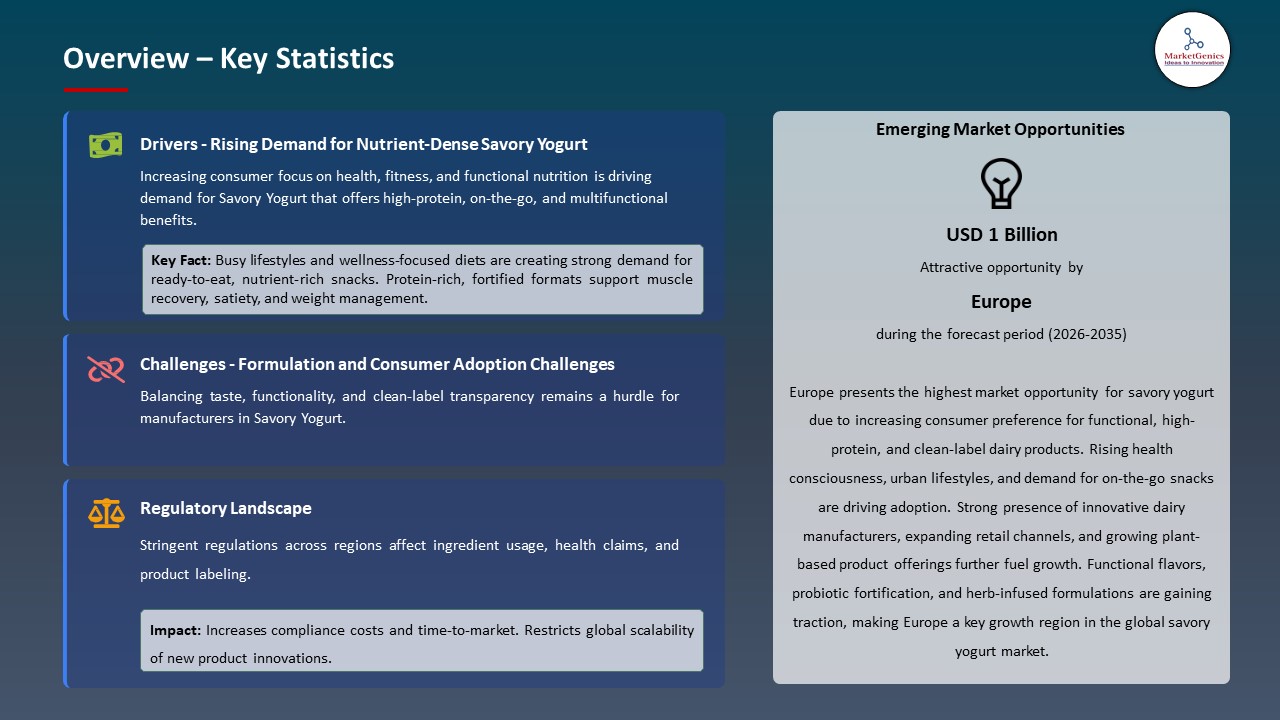
Driver: Shift toward Savory, Nutrient-Dense Dairy Consumption
-
The global savory yogurt market is driven by the increasing demand on the part of consumers to consume functional, nutrient-dense products with regard to gut health, immunity and satiety. The growing interest in healthy eating, flexitarian diets, and exemption of high-protein, low-sugar dairy products is hopeful to engage consumers in the habit of consuming savory yogurt as part of their daytime meals and snacking habits.
- Manufacturers are also developing herb- and vegetable-infused yogurts, fortified protein blends, and probiotic-enhanced forms to target on-the-go, as meal accompaniment, and culinary uses. Savory cups can be served in advanced packaging, including spoonable cups, snackable yogurt bites, and layered dips, which are designed to satisfy the changing global tastes with the combination of the taste, texture, and functional value.
- Diversification and premiumisation of products in response to increasing demand of customised and multi-purpose dairy products is putting savoury yogurt in a position where it can be used in place of breakfast, lunch and snack in multiple locations across the globe.
Restraint: Slow Consumer Transition from Sweet to Savory Yogurt Profiles
-
Consumer preference inertia is a major threat to the worldwide market in savoury yogurt since most of the regions are used to the traditional sweet flavours of yogurt. Trial and repeat buying of the savory variants are restricted by habitual expectations of taste particularly among younger and price sensitive consumers.
- Adoption is also impeded by the presence of perceived complexity in the flavor, cooking unfamiliarity as the flavor of herbs, spices, and vegetables demand consumers to palate readjustment and integrate yogurt into new meal moments, which is a barrier to mass adoption.
- Few promotional training and sensory sampling are also a hindrance to expansion, with brands having to make investments in campaigns and in-store tasting to break the reluctance. Combined with taste preferences in the region, all these make the product slow in replacing sweet with savory yogurt format and limits the swift entry in the market in different parts of the world.
Opportunity: Integration of Savory Yogurt into Everyday Meal Occasions
-
The increasing demand of convenient and nutrient-rich foods provide a great opportunity to the savory yogurt market to grow beyond the traditional application of snack or breakfast. Savory yogurts can be placed as an addition to meals, lunchbox products, or even ingredients in cooking, which enables brands to have them as part of everyday food habits, and also emphasize protein, probiotic, and functional advantages.
- New city markets and health conscious consumers are a good opportunity to innovate, on portion-controlled, ready to eat savory yogurt formations. The layered flavored products, spice-herb products, and fortified products have the potential to attract interest in the retail, on-the-go and foodservice products, to suit the changing lifestyle demands and busy meal events.
- Savory yogurts have the capability to be used in many different ways in culinary applications, as a dip, dressing, and spread, as well as a meal topper, which allows brands to capitalize on the cross-occasion consumption opportunity and remains and continues to attract more adoption in mainstream and premium retail outlets across all parts of the world.
Key Trend: Formulation-Led Differentiation through Clean-Label and Functional Enhancements
-
The global savory yogurt market is seeing faster innovation in clean label and functional formulations with emphasis on natural ingredients, minimum processing and additional nutritional values. There is an opportunity to find products that have added probiotics, prebiotics, fiber, plant-based proteins, vitamins, and bioactive compounds and that address digestive well-being, immunity, and lasting energy whilst having genuine savoury flavours.
- The manufacturers are experimenting with new herb and vegetable infusions, blended dairy-plant protein, and enriched savory blends with advanced formats including ready-to-eat savory cups, protein-seeking dips, and meal-companions spoonable yogurts, all incorporating a specific functional advantage. Customization of flavors regionally and layering of nutrients are the new differentiation strategies.
- Functional and clean-label savory yogurts are becoming popular among health-conscious customers, providing them with nutrition, taste, and convenience, not to mention enhancing the premium position in the international market.
Savory-Yogurt-Market Analysis and Segmental Data
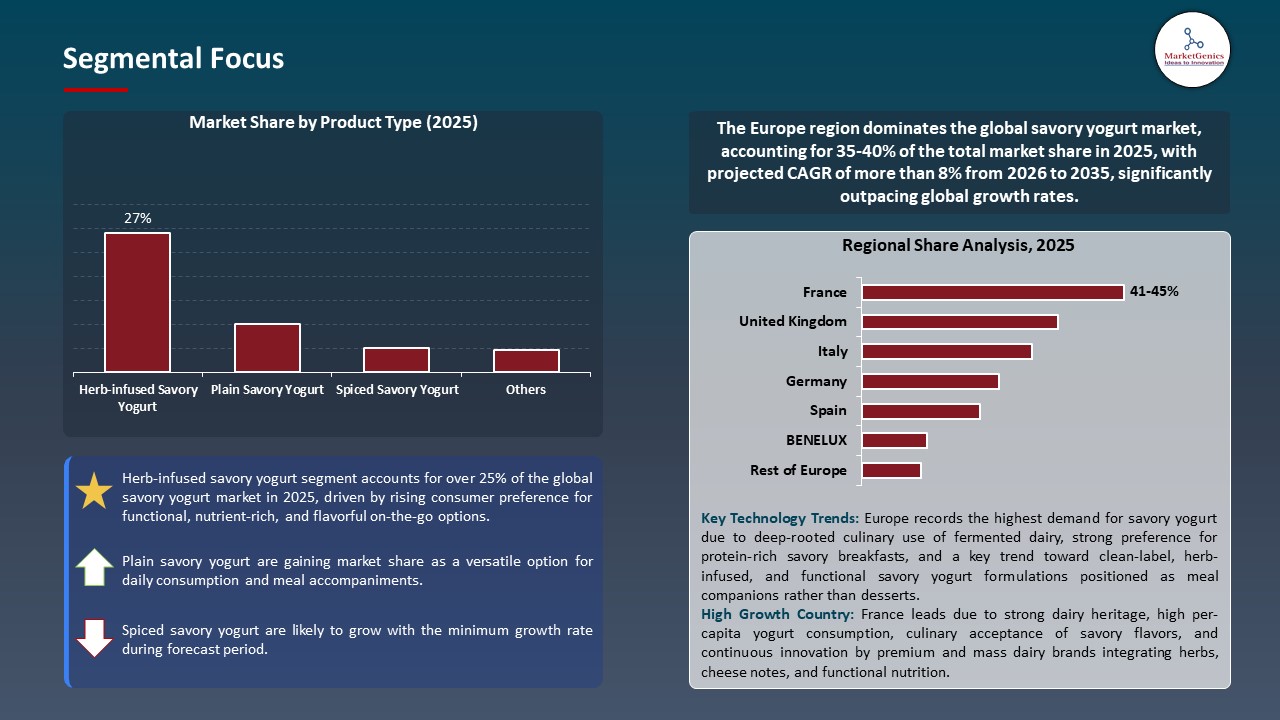
Herb-infused Savory Yogurt Dominate Global Savory Yogurt Market
-
The global savoury yogurt market is turning towards herb varieties as most consumers are adopting the trend of using natural flavouring, culinary genuineness coupled with reduced dependence on artificial additives. Profiles like dill, basil, chives, mint and mixed Mediterranean herbs are all herbs and will be a good fit into the clean-label expectations and help savory yogurt maintain its position as a meal companion, dip or cooking ingredient.
- The world is rapidly gaining innovation in herb infused savory yogurt recipes with manufacturers focusing on regionally inspired herb blends, low sodium recipes, and high protein bases to improve the flavor and nutritional profile. These products are being more often placed in daily consumption instances such as lunch companions, savory snacking, and foodservice uses.
- Herb-flavored savory yogurts provide a high level of versatility and shelf life, and encourage extensive retail and foodservice usage. Their clean label and high flavor profiles support market leadership.
Europe Leads Global Savory Yogurt Market Demand
-
Europe is the demand centre of savoury yogurt, which is fuelled by the established yogurt consumption habits in everyday meals, the significant culinary acceptability of dairy based on herbs, spices and vegetables and the consumer accustom to unsweetened yogurt products. Savory yogurt has been extensively marketed as a meal supplement, cooking ingredient, and snack instead of a substitute desert.
- Functional and lifestyle nutritional trends are becoming the leading way of product development in the region, with an emphasis on high-protein, low-sugar, and probiotic-contained formulations based on the needs of digestive health, satiety, and flexitarian dietary habits. European customers are more willing to embrace savory complexity in flavors, which endorses premiumization and flavor-based differentiation.
- Strong dairy ecosystems and developed fermentation know-how in addition to high density of retail channels and own label penetration make Europe lead in terms of commercialization and cross-border scalability, strengthening its role in dominating the global trends in the consumption of savory yogurt and future trends of innovation.
Savory-Yogurt-Market Ecosystem
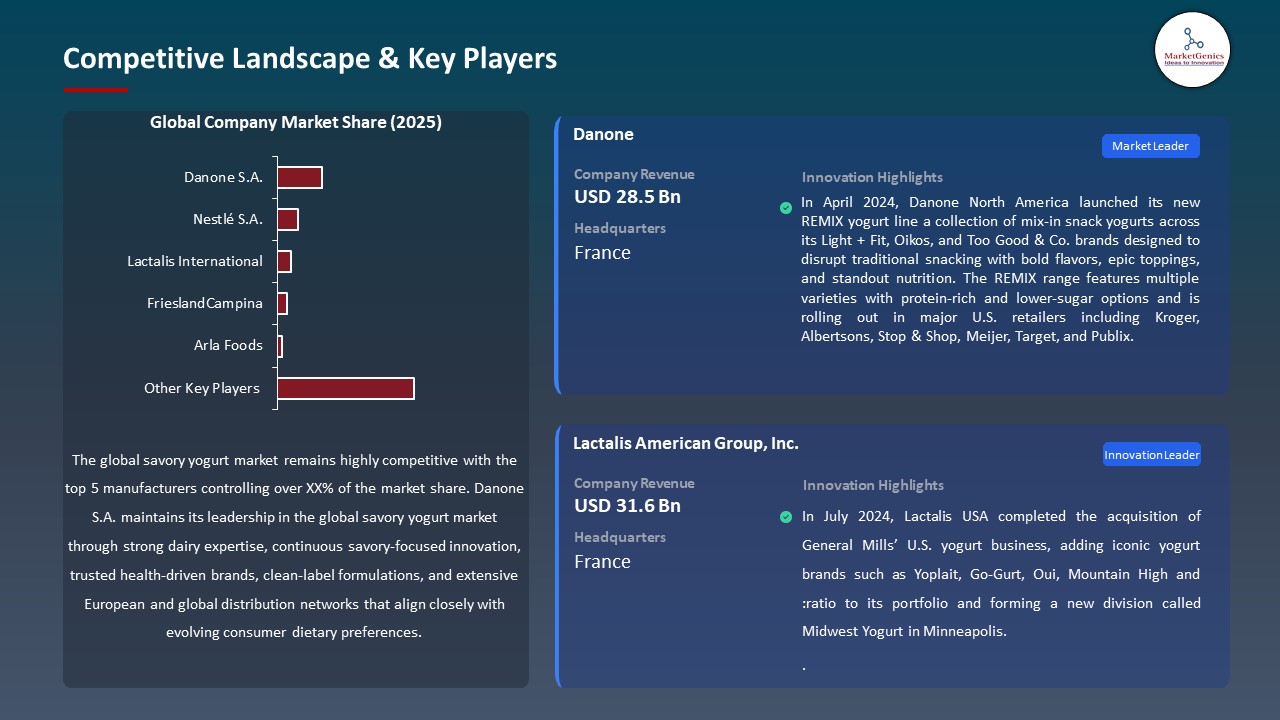
The global savoury yogurt market is relatively consolidated with a medium-high degree of concentration at the Tier-1 level led by multinational dairy giants with robust brand depository, economies of scale and international distribution options. The market structure is an indication of a balance between the already established dairy majors and the new regional innovators where the competition is based on flavor innovation, functional nutrition, and clean label positioning.
The ecosystem is dominated by tier-1 players who have massive dairy expertise, vertically integrated supply chains, as well as, extensive retail penetration, such as Danone S.A., Nestle S.A., Lactalis International, FrieslandCampina, and Arla Foods. These businesses capitalize on the use of modern fermentation technology, probiotic preparations, culinary-inspired savory flavor systems, and more to diversify the use of yogurt beyond the customary breakfast and dessert skills to snacking and meal-related purposes.
The regional dairy brands and the premium yogurt manufacturers that specialize in differentiated savoury recipes, organic sourcing and localised taste preferences form the Tier-2 players. They enhance rapid innovation cycles and consumer-focused behavior, which is enabled by their agility.
Tier-3 players are ingredient manufacturers, cultures and probiotics manufacturers, and contract manufacturers that facilitate formulation, fortification and scalable production. The ecosystem, in general, focuses on functional differentiation, portfolio premiumization, and expansion on the levels of Omni channel to maintain a long-term competitive edge.
Recent Development and Strategic Overview
-
In April 2024, Danone North America introduced its new REMIX yogurt collection a range of mix-in snack yogurts to its Light + Fit, Oikos, and Too Good and Co. brands under the name of disrupting traditional snacking with daring flavors, gigantic toppings, and exceptional nutrition. The REMIX line has a variety of different choices, protein enriched and less sugar levels, and is being launched in large American retailers such as Kroger, Albertsons, Stop and Shop, Meijers, Target and Publix.
- In July 2024, Lactalis USA acquired the U.S. yogurt business of General Mills, and as part of the arrangement, iconic yogurt brands, including Yoplait, Go-Gurt, Oui, Mountain High and:ratio, joined Lactalis USA and established a new department called Midwest Yogurt in Minneapolis.
Report Scope
|
Detail |
|
|
Market Size in 2025 |
USD 1.4 Bn |
|
Market Forecast Value in 2035 |
USD 2.6 Bn |
|
Growth Rate (CAGR) |
6.3% |
|
Forecast Period |
2026 – 2035 |
|
Historical Data Available for |
2021 – 2024 |
|
Market Size Units |
US$ Billion for Value |
|
Report Format |
Electronic (PDF) + Excel |
|
North America |
Europe |
Asia Pacific |
Middle East |
Africa |
South America |
|
|
|
|
|
|
|
Companies Covered |
|||||
|
|
|
|
|
|
Savory-Yogurt-Market Segmentation and Highlights
|
Segment |
Sub-segment |
|
Savory Yogurt Market, By Product Type |
|
|
Savory Yogurt Market, By Source/Base |
|
|
Savory Yogurt Market, By Packaging Type |
|
|
Savory Yogurt Market, By Distribution Channel |
|
|
Savory Yogurt Market, By End-use |
|
Frequently Asked Questions
Table of Contents
- 1. Research Methodology and Assumptions
- 1.1. Definitions
- 1.2. Research Design and Approach
- 1.3. Data Collection Methods
- 1.4. Base Estimates and Calculations
- 1.5. Forecasting Models
- 1.5.1. Key Forecast Factors & Impact Analysis
- 1.6. Secondary Research
- 1.6.1. Open Sources
- 1.6.2. Paid Databases
- 1.6.3. Associations
- 1.7. Primary Research
- 1.7.1. Primary Sources
- 1.7.2. Primary Interviews with Stakeholders across Ecosystem
- 2. Executive Summary
- 2.1. Global Savory Yogurt Market Outlook
- 2.1.1. Savory Yogurt Market Size (Value - US$ Bn), and Forecasts, 2021-2035
- 2.1.2. Compounded Annual Growth Rate Analysis
- 2.1.3. Growth Opportunity Analysis
- 2.1.4. Segmental Share Analysis
- 2.1.5. Geographical Share Analysis
- 2.2. Market Analysis and Facts
- 2.3. Supply-Demand Analysis
- 2.4. Competitive Benchmarking
- 2.5. Go-to- Market Strategy
- 2.5.1. Customer/ End-use Industry Assessment
- 2.5.2. Growth Opportunity Data, 2026-2035
- 2.5.2.1. Regional Data
- 2.5.2.2. Country Data
- 2.5.2.3. Segmental Data
- 2.5.3. Identification of Potential Market Spaces
- 2.5.4. GAP Analysis
- 2.5.5. Potential Attractive Price Points
- 2.5.6. Prevailing Market Risks & Challenges
- 2.5.7. Preferred Sales & Marketing Strategies
- 2.5.8. Key Recommendations and Analysis
- 2.5.9. A Way Forward
- 2.1. Global Savory Yogurt Market Outlook
- 3. Industry Data and Premium Insights
- 3.1. Global Food & Beverages Industry Overview, 2025
- 3.1.1. Food & Beverages Industry Ecosystem Analysis
- 3.1.2. Key Trends for Food & Beverages Industry
- 3.1.3. Regional Distribution for Food & Beverages Industry
- 3.2. Supplier Customer Data
- 3.3. Technology Roadmap and Developments
- 3.4. Trade Analysis
- 3.4.1. Import & Export Analysis, 2025
- 3.4.2. Top Importing Countries
- 3.4.3. Top Exporting Countries
- 3.5. Trump Tariff Impact Analysis
- 3.5.1. Manufacturer
- 3.5.1.1. Based on the component & Raw material
- 3.5.2. Supply Chain
- 3.5.3. End Consumer
- 3.5.1. Manufacturer
- 3.6. Raw Material Analysis
- 3.1. Global Food & Beverages Industry Overview, 2025
- 4. Market Overview
- 4.1. Market Dynamics
- 4.1.1. Drivers
- 4.1.1.1. Rising consumer preference for high-protein, gut-health, and functional dairy products.
- 4.1.1.2. Increasing demand for convenient, savory snack and meal-replacement dairy formats.
- 4.1.1.3. Product innovation in flavors, textures, and probiotic formulations by major dairy brands.
- 4.1.2. Restraints
- 4.1.2.1. Short shelf life and cold-chain dependency increasing distribution costs.
- 4.1.2.2. Limited consumer awareness and acceptance in traditionally sweet-yogurt-dominant markets.
- 4.1.1. Drivers
- 4.2. Key Trend Analysis
- 4.3. Regulatory Framework
- 4.3.1. Key Regulations, Norms, and Subsidies, by Key Countries
- 4.3.2. Tariffs and Standards
- 4.3.3. Impact Analysis of Regulations on the Market
- 4.4. Value Chain Analysis
- 4.4.1. Raw Material Suppliers
- 4.4.2. Manufacturers
- 4.4.3. Dealers/ Distributors
- 4.4.4. End-Users/ Customers
- 4.5. Porter’s Five Forces Analysis
- 4.6. PESTEL Analysis
- 4.7. Global Savory Yogurt Market Demand
- 4.7.1. Historical Market Size – Value (US$ Bn), 2020-2024
- 4.7.2. Current and Future Market Size – Value (US$ Bn), 2026–2035
- 4.7.2.1. Y-o-Y Growth Trends
- 4.7.2.2. Absolute $ Opportunity Assessment
- 4.1. Market Dynamics
- 5. Competition Landscape
- 5.1. Competition structure
- 5.1.1. Fragmented v/s consolidated
- 5.2. Company Share Analysis, 2025
- 5.2.1. Global Company Market Share
- 5.2.2. By Region
- 5.2.2.1. North America
- 5.2.2.2. Europe
- 5.2.2.3. Asia Pacific
- 5.2.2.4. Middle East
- 5.2.2.5. Africa
- 5.2.2.6. South America
- 5.3. Product Comparison Matrix
- 5.3.1. Specifications
- 5.3.2. Market Positioning
- 5.3.3. Pricing
- 5.1. Competition structure
- 6. Global Savory Yogurt Market Analysis, by Product Type
- 6.1. Key Segment Analysis
- 6.2. Savory Yogurt Market Size (Value - US$ Bn), Analysis, and Forecasts, by Product Type, 2021-2035
- 6.2.1. Plain Savory Yogurt
- 6.2.2. Herb-infused Savory Yogurt
- 6.2.3. Spiced Savory Yogurt
- 6.2.4. Vegetable-based Savory Yogurt
- 6.2.5. Others
- 7. Global Savory Yogurt Market Analysis, by Source/Base
- 7.1. Key Segment Analysis
- 7.2. Savory Yogurt Market Size (Value - US$ Bn), Analysis, and Forecasts, by Source/Base, 2021-2035
- 7.2.1. Cow Milk
- 7.2.2. Goat Milk
- 7.2.3. Sheep Milk
- 7.2.4. Plant-based
- 7.2.4.1. Soy-based
- 7.2.4.2. Almond-based
- 7.2.4.3. Coconut-based
- 7.2.4.4. Others
- 8. Global Savory Yogurt Market Analysis, by Packaging Type
- 8.1. Key Segment Analysis
- 8.2. Savory Yogurt Market Size (Value - US$ Bn), Analysis, and Forecasts, by Packaging Type, 2021-2035
- 8.2.1. Cups/Tubs
- 8.2.1.1. Single-serve (100-200g)
- 8.2.1.2. Multi-serve (250-500g)
- 8.2.1.3. Family pack (500g+)
- 8.2.2. Bottles
- 8.2.3. Pouches
- 8.2.3.1. Stand-up pouches
- 8.2.3.2. Squeeze pouches
- 8.2.4. Jars
- 8.2.1. Cups/Tubs
- 9. Global Savory Yogurt Market Analysis, by Distribution Channel
- 9.1. Key Segment Analysis
- 9.2. Savory Yogurt Market Size (Value - US$ Bn), Analysis, and Forecasts, by Distribution Channel, 2021-2035
- 9.2.1. Online Retail
- 9.2.2. Offline Retail
- 9.2.3. Supermarkets/Hypermarkets
- 9.2.3.1. Convenience stores
- 9.2.3.2. Specialty stores
- 9.2.3.3. Health food stores
- 9.2.3.4. Others
- 10. Global Savory Yogurt Market Analysis, by End-use
- 10.1. Key Segment Analysis
- 10.2. Savory Yogurt Market Size (Value - US$ Bn), Analysis, and Forecasts, by End-use, 2021-2035
- 10.2.1. Food Service
- 10.2.1.1. Restaurant & Cafés
- 10.2.1.2. Hotels & Catering
- 10.2.1.3. Quick Service Restaurants (QSR)
- 10.2.1.4. Others
- 10.2.2. Retail/Household
- 10.2.3. Food Processing
- 10.2.4. Healthcare & Wellness
- 10.2.5. Other End-use
- 10.2.1. Food Service
- 11. Global Savory Yogurt Market Analysis and Forecasts, by Region
- 11.1. Key Findings
- 11.2. Savory Yogurt Market Size (Value - US$ Bn), Analysis, and Forecasts, by Region, 2021-2035
- 11.2.1. North America
- 11.2.2. Europe
- 11.2.3. Asia Pacific
- 11.2.4. Middle East
- 11.2.5. Africa
- 11.2.6. South America
- 12. North America Savory Yogurt Market Analysis
- 12.1. Key Segment Analysis
- 12.2. Regional Snapshot
- 12.3. North America Savory Yogurt Market Size (Value - US$ Bn), Analysis, and Forecasts, 2021-2035
- 12.3.1. Product Type
- 12.3.2. Source/Base
- 12.3.3. Packaging Type
- 12.3.4. Distribution Channel
- 12.3.5. End-use
- 12.3.6. Country
- 12.3.6.1. USA
- 12.3.6.2. Canada
- 12.3.6.3. Mexico
- 12.4. USA Savory Yogurt Market
- 12.4.1. Country Segmental Analysis
- 12.4.2. Product Type
- 12.4.3. Source/Base
- 12.4.4. Packaging Type
- 12.4.5. Distribution Channel
- 12.4.6. End-use
- 12.5. Canada Savory Yogurt Market
- 12.5.1. Country Segmental Analysis
- 12.5.2. Product Type
- 12.5.3. Source/Base
- 12.5.4. Packaging Type
- 12.5.5. Distribution Channel
- 12.5.6. End-use
- 12.6. Mexico Savory Yogurt Market
- 12.6.1. Country Segmental Analysis
- 12.6.2. Product Type
- 12.6.3. Source/Base
- 12.6.4. Packaging Type
- 12.6.5. Distribution Channel
- 12.6.6. End-use
- 13. Europe Savory Yogurt Market Analysis
- 13.1. Key Segment Analysis
- 13.2. Regional Snapshot
- 13.3. Europe Savory Yogurt Market Size (Value - US$ Bn), Analysis, and Forecasts, 2021-2035
- 13.3.1. Product Type
- 13.3.2. Source/Base
- 13.3.3. Packaging Type
- 13.3.4. Distribution Channel
- 13.3.5. End-use
- 13.3.6. Country
- 13.3.6.1. Germany
- 13.3.6.2. United Kingdom
- 13.3.6.3. France
- 13.3.6.4. Italy
- 13.3.6.5. Spain
- 13.3.6.6. Netherlands
- 13.3.6.7. Nordic Countries
- 13.3.6.8. Poland
- 13.3.6.9. Russia & CIS
- 13.3.6.10. Rest of Europe
- 13.4. Germany Savory Yogurt Market
- 13.4.1. Country Segmental Analysis
- 13.4.2. Product Type
- 13.4.3. Source/Base
- 13.4.4. Packaging Type
- 13.4.5. Distribution Channel
- 13.4.6. End-use
- 13.5. United Kingdom Savory Yogurt Market
- 13.5.1. Country Segmental Analysis
- 13.5.2. Product Type
- 13.5.3. Source/Base
- 13.5.4. Packaging Type
- 13.5.5. Distribution Channel
- 13.5.6. End-use
- 13.6. France Savory Yogurt Market
- 13.6.1. Country Segmental Analysis
- 13.6.2. Product Type
- 13.6.3. Source/Base
- 13.6.4. Packaging Type
- 13.6.5. Distribution Channel
- 13.6.6. End-use
- 13.7. Italy Savory Yogurt Market
- 13.7.1. Country Segmental Analysis
- 13.7.2. Product Type
- 13.7.3. Source/Base
- 13.7.4. Packaging Type
- 13.7.5. Distribution Channel
- 13.7.6. End-use
- 13.8. Spain Savory Yogurt Market
- 13.8.1. Country Segmental Analysis
- 13.8.2. Product Type
- 13.8.3. Source/Base
- 13.8.4. Packaging Type
- 13.8.5. Distribution Channel
- 13.8.6. End-use
- 13.9. Netherlands Savory Yogurt Market
- 13.9.1. Country Segmental Analysis
- 13.9.2. Product Type
- 13.9.3. Source/Base
- 13.9.4. Packaging Type
- 13.9.5. Distribution Channel
- 13.9.6. End-use
- 13.10. Nordic Countries Savory Yogurt Market
- 13.10.1. Country Segmental Analysis
- 13.10.2. Product Type
- 13.10.3. Source/Base
- 13.10.4. Packaging Type
- 13.10.5. Distribution Channel
- 13.10.6. End-use
- 13.11. Poland Savory Yogurt Market
- 13.11.1. Country Segmental Analysis
- 13.11.2. Product Type
- 13.11.3. Source/Base
- 13.11.4. Packaging Type
- 13.11.5. Distribution Channel
- 13.11.6. End-use
- 13.12. Russia & CIS Savory Yogurt Market
- 13.12.1. Country Segmental Analysis
- 13.12.2. Product Type
- 13.12.3. Source/Base
- 13.12.4. Packaging Type
- 13.12.5. Distribution Channel
- 13.12.6. End-use
- 13.13. Rest of Europe Savory Yogurt Market
- 13.13.1. Country Segmental Analysis
- 13.13.2. Product Type
- 13.13.3. Source/Base
- 13.13.4. Packaging Type
- 13.13.5. Distribution Channel
- 13.13.6. End-use
- 14. Asia Pacific Savory Yogurt Market Analysis
- 14.1. Key Segment Analysis
- 14.2. Regional Snapshot
- 14.3. Asia Pacific Savory Yogurt Market Size (Value - US$ Bn), Analysis, and Forecasts, 2021-2035
- 14.3.1. Product Type
- 14.3.2. Source/Base
- 14.3.3. Packaging Type
- 14.3.4. Distribution Channel
- 14.3.5. End-use
- 14.3.6. Country
- 14.3.6.1. China
- 14.3.6.2. India
- 14.3.6.3. Japan
- 14.3.6.4. South Korea
- 14.3.6.5. Australia and New Zealand
- 14.3.6.6. Indonesia
- 14.3.6.7. Malaysia
- 14.3.6.8. Thailand
- 14.3.6.9. Vietnam
- 14.3.6.10. Rest of Asia Pacific
- 14.4. China Savory Yogurt Market
- 14.4.1. Country Segmental Analysis
- 14.4.2. Product Type
- 14.4.3. Source/Base
- 14.4.4. Packaging Type
- 14.4.5. Distribution Channel
- 14.4.6. End-use
- 14.5. India Savory Yogurt Market
- 14.5.1. Country Segmental Analysis
- 14.5.2. Product Type
- 14.5.3. Source/Base
- 14.5.4. Packaging Type
- 14.5.5. Distribution Channel
- 14.5.6. End-use
- 14.6. Japan Savory Yogurt Market
- 14.6.1. Country Segmental Analysis
- 14.6.2. Product Type
- 14.6.3. Source/Base
- 14.6.4. Packaging Type
- 14.6.5. Distribution Channel
- 14.6.6. End-use
- 14.7. South Korea Savory Yogurt Market
- 14.7.1. Country Segmental Analysis
- 14.7.2. Product Type
- 14.7.3. Source/Base
- 14.7.4. Packaging Type
- 14.7.5. Distribution Channel
- 14.7.6. End-use
- 14.8. Australia and New Zealand Savory Yogurt Market
- 14.8.1. Country Segmental Analysis
- 14.8.2. Product Type
- 14.8.3. Source/Base
- 14.8.4. Packaging Type
- 14.8.5. Distribution Channel
- 14.8.6. End-use
- 14.9. Indonesia Savory Yogurt Market
- 14.9.1. Country Segmental Analysis
- 14.9.2. Product Type
- 14.9.3. Source/Base
- 14.9.4. Packaging Type
- 14.9.5. Distribution Channel
- 14.9.6. End-use
- 14.10. Malaysia Savory Yogurt Market
- 14.10.1. Country Segmental Analysis
- 14.10.2. Product Type
- 14.10.3. Source/Base
- 14.10.4. Packaging Type
- 14.10.5. Distribution Channel
- 14.10.6. End-use
- 14.11. Thailand Savory Yogurt Market
- 14.11.1. Country Segmental Analysis
- 14.11.2. Product Type
- 14.11.3. Source/Base
- 14.11.4. Packaging Type
- 14.11.5. Distribution Channel
- 14.11.6. End-use
- 14.12. Vietnam Savory Yogurt Market
- 14.12.1. Country Segmental Analysis
- 14.12.2. Product Type
- 14.12.3. Source/Base
- 14.12.4. Packaging Type
- 14.12.5. Distribution Channel
- 14.12.6. End-use
- 14.13. Rest of Asia Pacific Savory Yogurt Market
- 14.13.1. Country Segmental Analysis
- 14.13.2. Product Type
- 14.13.3. Source/Base
- 14.13.4. Packaging Type
- 14.13.5. Distribution Channel
- 14.13.6. End-use
- 15. Middle East Savory Yogurt Market Analysis
- 15.1. Key Segment Analysis
- 15.2. Regional Snapshot
- 15.3. Middle East Savory Yogurt Market Size (Value - US$ Bn), Analysis, and Forecasts, 2021-2035
- 15.3.1. Product Type
- 15.3.2. Source/Base
- 15.3.3. Packaging Type
- 15.3.4. Distribution Channel
- 15.3.5. End-use
- 15.3.6. Country
- 15.3.6.1. Turkey
- 15.3.6.2. UAE
- 15.3.6.3. Saudi Arabia
- 15.3.6.4. Israel
- 15.3.6.5. Rest of Middle East
- 15.4. Turkey Savory Yogurt Market
- 15.4.1. Country Segmental Analysis
- 15.4.2. Product Type
- 15.4.3. Source/Base
- 15.4.4. Packaging Type
- 15.4.5. Distribution Channel
- 15.4.6. End-use
- 15.5. UAE Savory Yogurt Market
- 15.5.1. Country Segmental Analysis
- 15.5.2. Product Type
- 15.5.3. Source/Base
- 15.5.4. Packaging Type
- 15.5.5. Distribution Channel
- 15.5.6. End-use
- 15.6. Saudi Arabia Savory Yogurt Market
- 15.6.1. Country Segmental Analysis
- 15.6.2. Product Type
- 15.6.3. Source/Base
- 15.6.4. Packaging Type
- 15.6.5. Distribution Channel
- 15.6.6. End-use
- 15.7. Israel Savory Yogurt Market
- 15.7.1. Country Segmental Analysis
- 15.7.2. Product Type
- 15.7.3. Source/Base
- 15.7.4. Packaging Type
- 15.7.5. Distribution Channel
- 15.7.6. End-use
- 15.8. Rest of Middle East Savory Yogurt Market
- 15.8.1. Country Segmental Analysis
- 15.8.2. Product Type
- 15.8.3. Source/Base
- 15.8.4. Packaging Type
- 15.8.5. Distribution Channel
- 15.8.6. End-use
- 16. Africa Savory Yogurt Market Analysis
- 16.1. Key Segment Analysis
- 16.2. Regional Snapshot
- 16.3. Africa Savory Yogurt Market Size (Value - US$ Bn), Analysis, and Forecasts, 2021-2035
- 16.3.1. Product Type
- 16.3.2. Source/Base
- 16.3.3. Packaging Type
- 16.3.4. Distribution Channel
- 16.3.5. End-use
- 16.3.6. Country
- 16.3.6.1. South Africa
- 16.3.6.2. Egypt
- 16.3.6.3. Nigeria
- 16.3.6.4. Algeria
- 16.3.6.5. Rest of Africa
- 16.4. South Africa Savory Yogurt Market
- 16.4.1. Country Segmental Analysis
- 16.4.2. Product Type
- 16.4.3. Source/Base
- 16.4.4. Packaging Type
- 16.4.5. Distribution Channel
- 16.4.6. End-use
- 16.5. Egypt Savory Yogurt Market
- 16.5.1. Country Segmental Analysis
- 16.5.2. Product Type
- 16.5.3. Source/Base
- 16.5.4. Packaging Type
- 16.5.5. Distribution Channel
- 16.5.6. End-use
- 16.6. Nigeria Savory Yogurt Market
- 16.6.1. Country Segmental Analysis
- 16.6.2. Product Type
- 16.6.3. Source/Base
- 16.6.4. Packaging Type
- 16.6.5. Distribution Channel
- 16.6.6. End-use
- 16.7. Algeria Savory Yogurt Market
- 16.7.1. Country Segmental Analysis
- 16.7.2. Product Type
- 16.7.3. Source/Base
- 16.7.4. Packaging Type
- 16.7.5. Distribution Channel
- 16.7.6. End-use
- 16.8. Rest of Africa Savory Yogurt Market
- 16.8.1. Country Segmental Analysis
- 16.8.2. Product Type
- 16.8.3. Source/Base
- 16.8.4. Packaging Type
- 16.8.5. Distribution Channel
- 16.8.6. End-use
- 17. South America Savory Yogurt Market Analysis
- 17.1. Key Segment Analysis
- 17.2. Regional Snapshot
- 17.3. South America Savory Yogurt Market Size (Value - US$ Bn), Analysis, and Forecasts, 2021-2035
- 17.3.1. Product Type
- 17.3.2. Source/Base
- 17.3.3. Packaging Type
- 17.3.4. Distribution Channel
- 17.3.5. End-use
- 17.3.6. Country
- 17.3.6.1. Brazil
- 17.3.6.2. Argentina
- 17.3.6.3. Rest of South America
- 17.4. Brazil Savory Yogurt Market
- 17.4.1. Country Segmental Analysis
- 17.4.2. Product Type
- 17.4.3. Source/Base
- 17.4.4. Packaging Type
- 17.4.5. Distribution Channel
- 17.4.6. End-use
- 17.5. Argentina Savory Yogurt Market
- 17.5.1. Country Segmental Analysis
- 17.5.2. Product Type
- 17.5.3. Source/Base
- 17.5.4. Packaging Type
- 17.5.5. Distribution Channel
- 17.5.6. End-use
- 17.6. Rest of South America Savory Yogurt Market
- 17.6.1. Country Segmental Analysis
- 17.6.2. Product Type
- 17.6.3. Source/Base
- 17.6.4. Packaging Type
- 17.6.5. Distribution Channel
- 17.6.6. End-use
- 18. Key Players/ Company Profile
- 18.1. Arla Foods
- 18.1.1. Company Details/ Overview
- 18.1.2. Company Financials
- 18.1.3. Key Customers and Competitors
- 18.1.4. Business/ Industry Portfolio
- 18.1.5. Product Portfolio/ Specification Details
- 18.1.6. Pricing Data
- 18.1.7. Strategic Overview
- 18.1.8. Recent Developments
- 18.2. Blue Hill Yogurt
- 18.3. Chobani LLC
- 18.4. Danone S.A.
- 18.5. Ehrmann AG
- 18.6. Emmi Group
- 18.7. FAGE International S.A.
- 18.8. FrieslandCampina
- 18.9. General Mills Inc.
- 18.10. Icelandic Provisions
- 18.11. Lactalis International
- 18.12. Maple Hill Creamery
- 18.13. Müller Group
- 18.14. Nestlé S.A.
- 18.15. Noosa Yoghurt
- 18.16. Savencia Fromage & Dairy
- 18.17. Schreiber Foods
- 18.18. Siggi's Dairy
- 18.19. The Kraft Heinz Company
- 18.20. Wallaby Yogurt Company
- 18.21. Yoplait (Sodiaal)
- 18.22. Other Key Players
- 18.1. Arla Foods
Note* - This is just tentative list of players. While providing the report, we will cover more number of players based on their revenue and share for each geography
Research Design
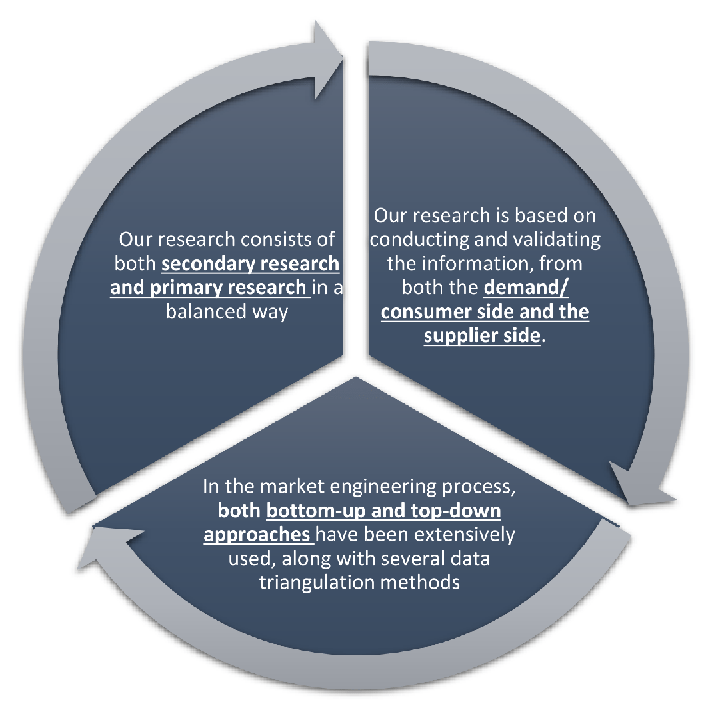
Our research design integrates both demand-side and supply-side analysis through a balanced combination of primary and secondary research methodologies. By utilizing both bottom-up and top-down approaches alongside rigorous data triangulation methods, we deliver robust market intelligence that supports strategic decision-making.
MarketGenics' comprehensive research design framework ensures the delivery of accurate, reliable, and actionable market intelligence. Through the integration of multiple research approaches, rigorous validation processes, and expert analysis, we provide our clients with the insights needed to make informed strategic decisions and capitalize on market opportunities.
MarketGenics leverages a dedicated industry panel of experts and a comprehensive suite of paid databases to effectively collect, consolidate, and analyze market intelligence.
Our approach has consistently proven to be reliable and effective in generating accurate market insights, identifying key industry trends, and uncovering emerging business opportunities.
Through both primary and secondary research, we capture and analyze critical company-level data such as manufacturing footprints, including technical centers, R&D facilities, sales offices, and headquarters.
Our expert panel further enhances our ability to estimate market size for specific brands based on validated field-level intelligence.
Our data mining techniques incorporate both parametric and non-parametric methods, allowing for structured data collection, sorting, processing, and cleaning.
Demand projections are derived from large-scale data sets analyzed through proprietary algorithms, culminating in robust and reliable market sizing.
Research Approach
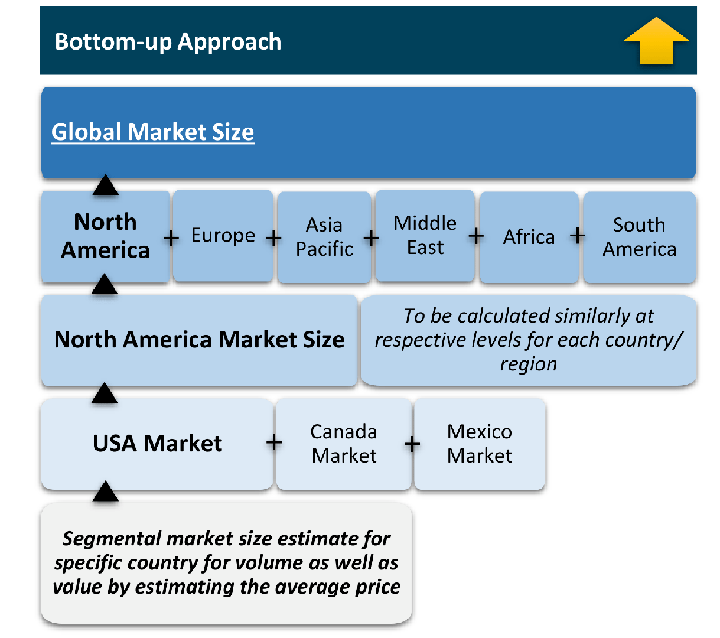
The bottom-up approach builds market estimates by starting with the smallest addressable market units and systematically aggregating them to create comprehensive market size projections.
This method begins with specific, granular data points and builds upward to create the complete market landscape.
Customer Analysis → Segmental Analysis → Geographical Analysis
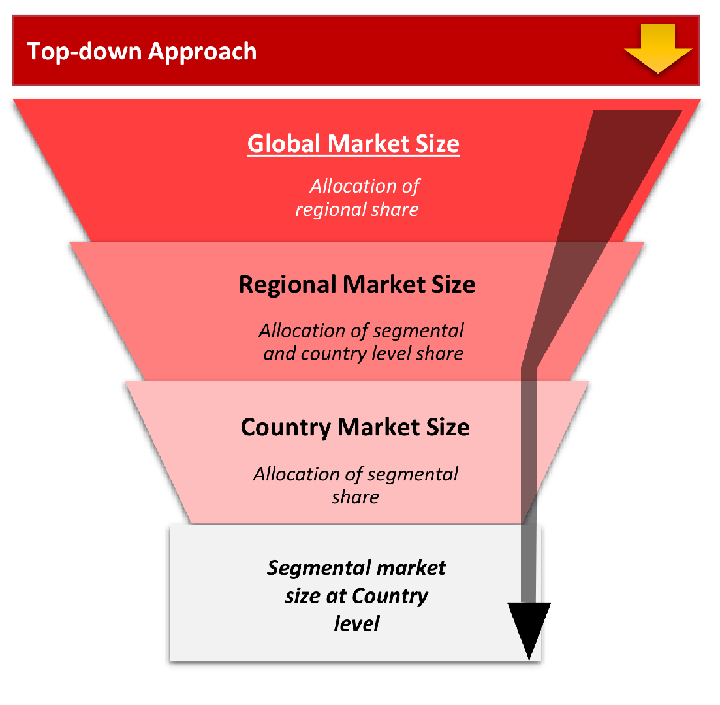
The top-down approach starts with the broadest possible market data and systematically narrows it down through a series of filters and assumptions to arrive at specific market segments or opportunities.
This method begins with the big picture and works downward to increasingly specific market slices.
TAM → SAM → SOM
Research Methods
Desk / Secondary Research
While analysing the market, we extensively study secondary sources, directories, and databases to identify and collect information useful for this technical, market-oriented, and commercial report. Secondary sources that we utilize are not only the public sources, but it is a combination of Open Source, Associations, Paid Databases, MG Repository & Knowledgebase, and others.
- Company websites, annual reports, financial reports, broker reports, and investor presentations
- National government documents, statistical databases and reports
- News articles, press releases and web-casts specific to the companies operating in the market, Magazines, reports, and others
- We gather information from commercial data sources for deriving company specific data such as segmental revenue, share for geography, product revenue, and others
- Internal and external proprietary databases (industry-specific), relevant patent, and regulatory databases
- Governing Bodies, Government Organizations
- Relevant Authorities, Country-specific Associations for Industries
We also employ the model mapping approach to estimate the product level market data through the players' product portfolio
Primary Research
Primary research/ interviews is vital in analyzing the market. Most of the cases involves paid primary interviews. Primary sources include primary interviews through e-mail interactions, telephonic interviews, surveys as well as face-to-face interviews with the different stakeholders across the value chain including several industry experts.
| Type of Respondents | Number of Primaries |
|---|---|
| Tier 2/3 Suppliers | ~20 |
| Tier 1 Suppliers | ~25 |
| End-users | ~25 |
| Industry Expert/ Panel/ Consultant | ~30 |
| Total | ~100 |
MG Knowledgebase
• Repository of industry blog, newsletter and case studies
• Online platform covering detailed market reports, and company profiles
Forecasting Factors and Models
Forecasting Factors
- Historical Trends – Past market patterns, cycles, and major events that shaped how markets behave over time. Understanding past trends helps predict future behavior.
- Industry Factors – Specific characteristics of the industry like structure, regulations, and innovation cycles that affect market dynamics.
- Macroeconomic Factors – Economic conditions like GDP growth, inflation, and employment rates that affect how much money people have to spend.
- Demographic Factors – Population characteristics like age, income, and location that determine who can buy your product.
- Technology Factors – How quickly people adopt new technology and how much technology infrastructure exists.
- Regulatory Factors – Government rules, laws, and policies that can help or restrict market growth.
- Competitive Factors – Analyzing competition structure such as degree of competition and bargaining power of buyers and suppliers.
Forecasting Models / Techniques
Multiple Regression Analysis
- Identify and quantify factors that drive market changes
- Statistical modeling to establish relationships between market drivers and outcomes
Time Series Analysis – Seasonal Patterns
- Understand regular cyclical patterns in market demand
- Advanced statistical techniques to separate trend, seasonal, and irregular components
Time Series Analysis – Trend Analysis
- Identify underlying market growth patterns and momentum
- Statistical analysis of historical data to project future trends
Expert Opinion – Expert Interviews
- Gather deep industry insights and contextual understanding
- In-depth interviews with key industry stakeholders
Multi-Scenario Development
- Prepare for uncertainty by modeling different possible futures
- Creating optimistic, pessimistic, and most likely scenarios
Time Series Analysis – Moving Averages
- Sophisticated forecasting for complex time series data
- Auto-regressive integrated moving average models with seasonal components
Econometric Models
- Apply economic theory to market forecasting
- Sophisticated economic models that account for market interactions
Expert Opinion – Delphi Method
- Harness collective wisdom of industry experts
- Structured, multi-round expert consultation process
Monte Carlo Simulation
- Quantify uncertainty and probability distributions
- Thousands of simulations with varying input parameters
Research Analysis
Our research framework is built upon the fundamental principle of validating market intelligence from both demand and supply perspectives. This dual-sided approach ensures comprehensive market understanding and reduces the risk of single-source bias.
Demand-Side Analysis: We understand end-user/application behavior, preferences, and market needs along with the penetration of the product for specific application.
Supply-Side Analysis: We estimate overall market revenue, analyze the segmental share along with industry capacity, competitive landscape, and market structure.
Validation & Evaluation
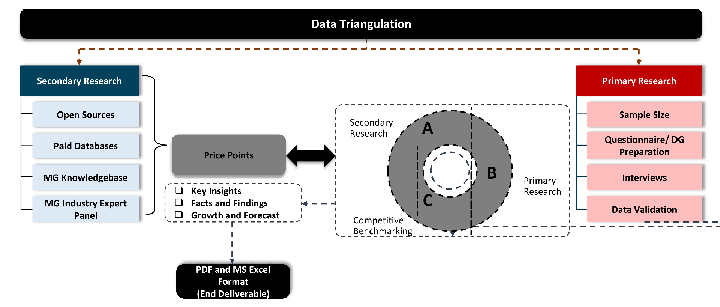
Data triangulation is a validation technique that uses multiple methods, sources, or perspectives to examine the same research question, thereby increasing the credibility and reliability of research findings. In market research, triangulation serves as a quality assurance mechanism that helps identify and minimize bias, validate assumptions, and ensure accuracy in market estimates.
- Data Source Triangulation – Using multiple data sources to examine the same phenomenon
- Methodological Triangulation – Using multiple research methods to study the same research question
- Investigator Triangulation – Using multiple researchers or analysts to examine the same data
- Theoretical Triangulation – Using multiple theoretical perspectives to interpret the same data
Custom Market Research Services
We will customise the research for you, in case the report listed above does not meet your requirements.
Get 10% Free Customisation