Women’s Wrist Watch Market Size, Share & Trends Analysis Report by Product Type (Analog Watches, Digital Watches, Hybrid Watches), Price Range, Material Type, Technology/Features, Distribution Channel, Target Age Group, End-Users, and Geography (North America, Europe, Asia Pacific, Middle East, Africa, and South America) – Global Industry Data, Trends, and Forecasts, 2026–2035
|
|
|
Segmental Data Insights |
|
|
Demand Trends |
|
|
Competitive Landscape |
|
|
Strategic Development |
|
|
Future Outlook & Opportunities |
|
Women’s-Wrist-Watch-Market Size, Share, and Growth
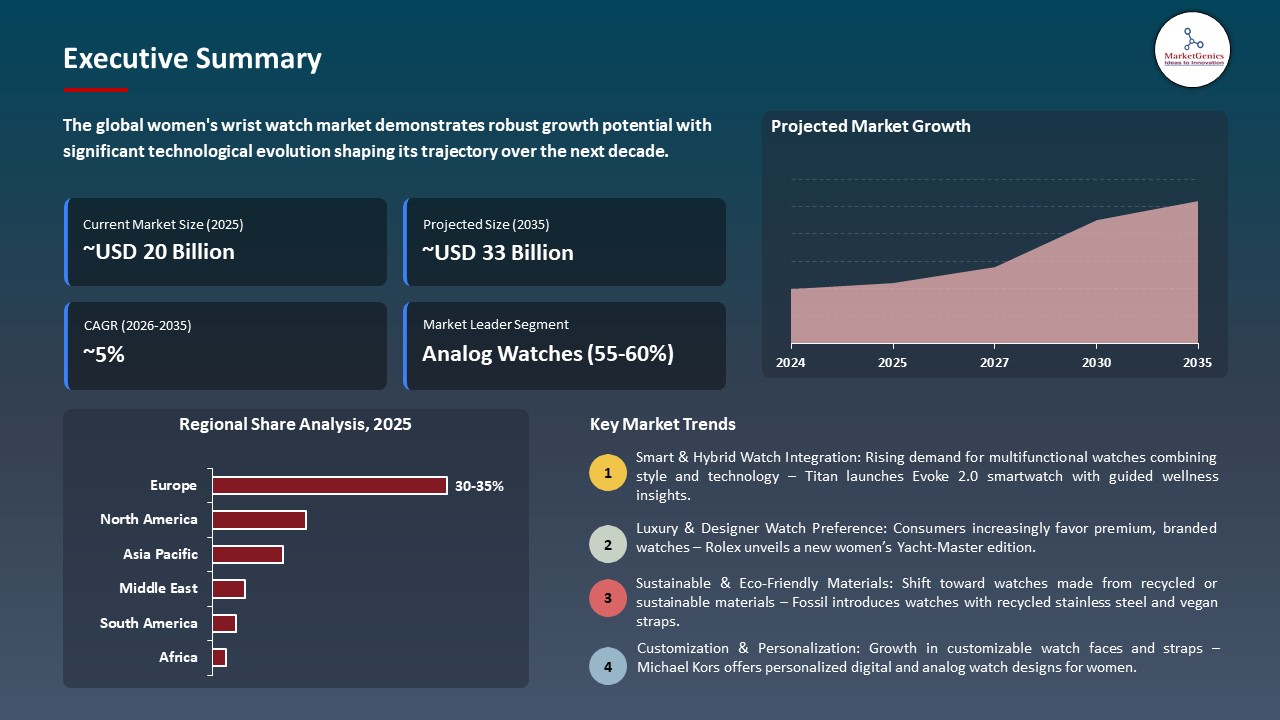
The global women’s wrist watch market is witnessing strong growth, valued at USD 19.5 billion in 2025 and projected to reach ~USD 33 billion by 2035, expanding at a CAGR of 5.4% during the forecast period. Asia Pacific is the fastest-growing region in the women’s wrist watch market due to rising disposable incomes, rapid urbanization, and an expanding population of working women with increasing fashion awareness.
Mr. Seenivasan Krishnamurthy, Business Head, Smart Wearables, Titan Company Limited, said, “With Evoke 2.0, Titan Smart reaffirms its vision of creating smartwatches that seamlessly merge premium fashion with the latest technology. Evoke 2.0 is a versatile addition to our growing portfolio of premium smartwatches, designed for lifestyle-focused, tech-enabled consumers who value both elegance and intelligence. This launch reinforces Titan Smart’s commitment to creating meaningful, user-centered experiences, as wearables become an integral part of everyday life”.
Wrist watches were initially developed as a basic time telling gadgets, and have become necessities; fashion accessories, especially in the women wrist watch market. Models are wearing watches as a means of personal style, identity and social status which is suitable with various outfits and events. The constant design, color, material and aesthetic innovations drive the repeat buying process and build the demand in fashion, premium and luxury markets.
The increased awareness of environmental responsibility is providing a good opportunity in the female wrist watch market. The growing demand towards materials that are eco-friendly, including recycled metals, vegan leather straps, and biodegradable components will enable brands to be aligned with ethically conscious consumers. Responsible packaging, responsible production, and sustainable sourcing can add value to the brand, control the appeal to younger consumers, assist in the premium positioning, and promote customer loyalty.
Adjacent opportunities in the women’s wrist watch market include smart wearables, luxury jewelry, fashion accessories, health and fitness trackers, and personalized gifting products. These segments complement watches by offering style, functionality, or personalization, driving cross-selling and bundling opportunities.
 Women’s Wrist Watch Market Dynamics and Trends
Driver: Female Workforce Expansion
- The increased involvements of the women in the workforce is a powerful force in the women wrist watch market. With the growth of the number of women getting into the workforce they find that accessories, which are not just classy but also functional, are in demand to accompany the work clothes as well as offer convenient time keeping. Watches have become indispensable fashion accessories that show work ethics, individual preference and social prestige.
- The trend promotes use of universal designs that can be used both in office, formal and casual occasions. Moreover, since working ladies tend to invest in durable, reliable and low-maintenance timepieces, this enhances the demand of high end, mid-end, and smart watches.
- Armitron also gave back to the community in 2025 by donating 50 watches to Dress for Success Worldwide to empower unemployed and underemployed women with career readiness and confidence. This is a campaign under the 50th-year corporate social responsibility promise by Armitron to give back to the community, emphasizing its concern about empowering hard-working individuals, especially women, and matching its products with professional lifestyles.
- The increasing number of women in the labor force also encourages gifting behavior and returning buying, which only perpetuates market growth in various segments.
Restraint: Escalating Competition from Connected Wearables Reducing Traditional Watch Demand
- The increasing competition of connected wearable devices is deeming a major limitation of the women wrist watch market. Technological watches such as smartwatches and hybrid watches that can provide a higher level of services such as fitness, heart rate, smartphone alerts, GPS positioning, and user-friendly interfaces are appealing to the technologically inclined consumers who do not view traditional time watches as viable options. This has changed especially among the younger age groups who appreciate connectivity and convenience which makes the traditional analog and quartz watches less adopted.
- The traditional watch manufacturers cannot afford to take ages to create new products or they must diversify to stay relevant in the market. Diversified brands already have a history of introducing smart capabilities into traditional designs but the challenges are the high price and lack of awareness of the hybrid products by the consumers. Consequently, the increasing popularity of wearable technology is also disrupting the market, forcing the traditional watchmakers to compete with them in term of pricing, design, and functionality.
- This restraint constrains the growth in traditional watches, and compels the innovation and digital integration to keep pace with the changing market.
Opportunity: Strategic Expansion via Direct‑to‑Consumer Online Platforms and Digital Retail Reach
- The growth of the direct-to-consumer online business is a good growth prospect of the women wrist watch market. Digital retail platforms enable the brands to access a greater number of people, without depending on the traditional distribution channels, which increases the margins and brand control.
- The consumer experience and confidence in making a purchase are improved by use of features like virtual try-ons, personalized recommendations and interactive product storytelling. Moreover, online channels allow launching products more quickly, discovering consumer insights with the help of data analytics, and organizing marketing campaigns.
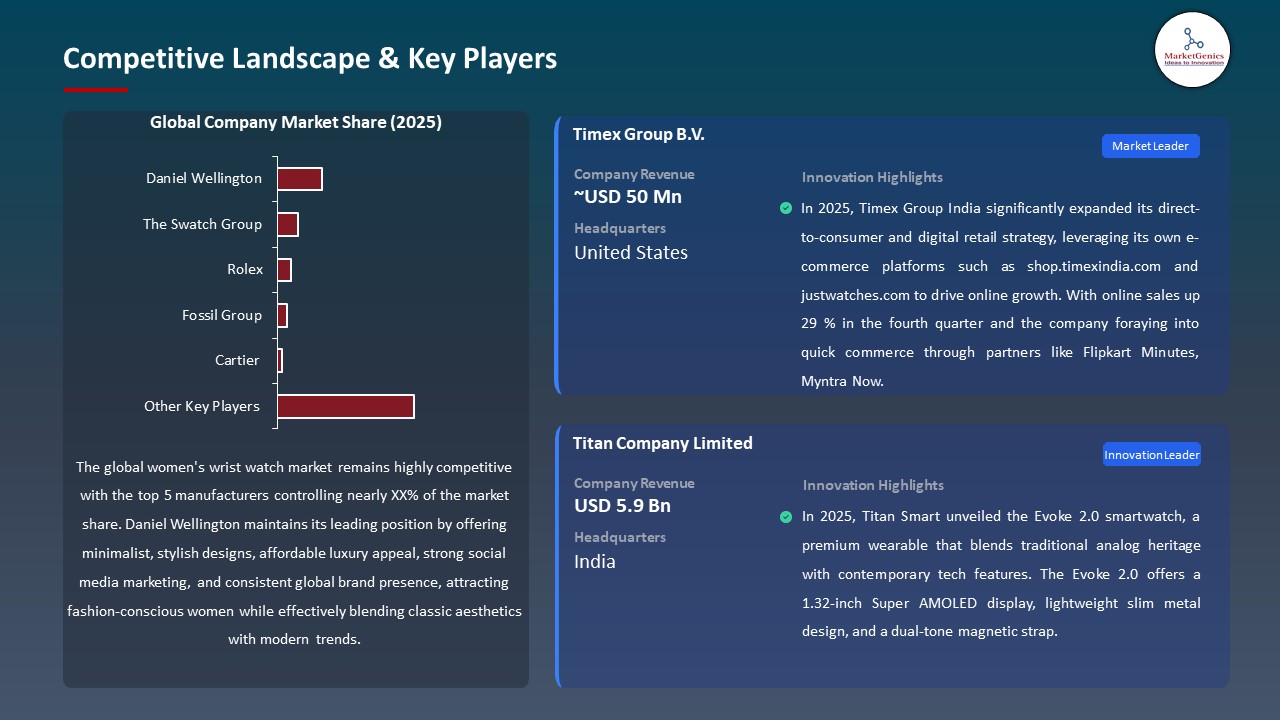
- Timex Group India has expanded its direct-to-consumer and digital retail strategy in 2025 by taking advantage of its own online stores, which include shop.timexindia.com and justwatches.com as key channels to grow online. Timex is accessing faster delivery streams and urban impulse purchasing even as online sales have risen by 29% in the fourth quarter and the company opens its hands to quick commerce through collaborators such as Flipkart Minutes, Myntra Now, and Swiggy Instamart.
- This is an especially successful method of reaching younger, technology-focused consumers and fostering brand loyalty over time.
Key Trend: Integration of Smart and Hybrid Watch Technologies
- The adaptation of smart and hybrid technologies to the wrist watches worn by women is becoming one of the essential trends, which involves a blend of classic design-based watches with the new digital-based capabilities. Hybrid watches are traditional analog watches that have features like fitness apps, health apps, notifications, and phone connectivity.
- The convergence is based on the fact that there is increasing demand on multifunctional accessories that facilitate active lifestyles and are not compromised on the aspect of elegance or wearability. Seamless integration of design, better battery life, and usability are becoming more common concerns of manufacturers in increasing the everyday usability of products.
- Titan Smart in 2025 released a product, Evoke 2.0 smartwatch, a high end wearable product that has a blend of the old-fashioned analog legacy with modern technology. The Evoke 2.0 has a 1.32 inch Super AMOLED display and lightweight slim metal face with a magnetic strap, with all round health track features including 24X7 heart-rate tracking, SpO 2 tracking, sleep tracking, guided wellness tips and 3D watch faces.
- The trend increases the consumer base, widens the gap between the fashion and technological, and enhances the competitiveness in the market by innovating and offering differentiated products.
Women’s-Wrist-Watch-Market Analysis and Segmental Data
Analog Watches Dominate Global Women’s Wrist Watch Market
-
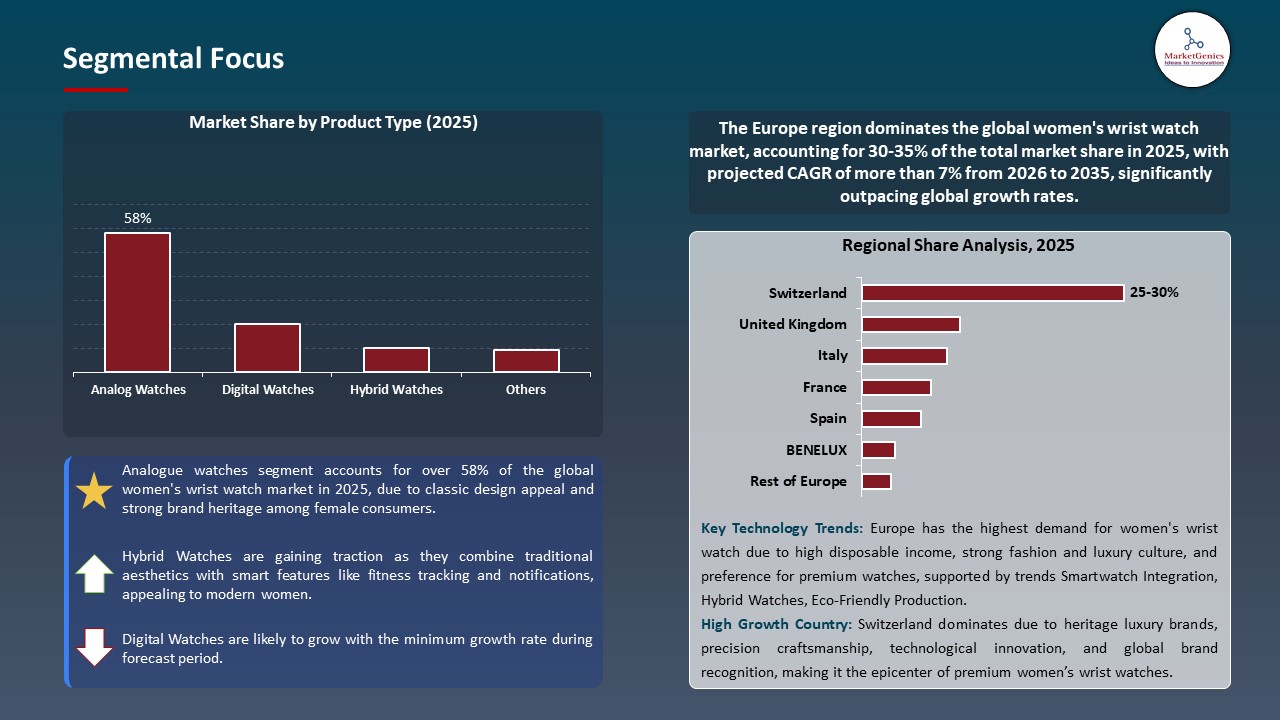
The analog watches segment holds a dominant position in the global women’s wrist watch market due to its timeless design, wide consumer appeal, and versatility across fashion and professional settings. Analog watches are perceived as classic, elegant, and status-reflecting accessories, making them highly preferred for both casual and formal occasions.
- Their ease of use in comparison to digital or smart watches is a strength of their technology, as it is reliable, has a longer battery life, and has a lower maintenance cost, which captures a wide demographic. Also, the presence of numerous designs, materials, and price ranges between the cheap fashion watches and more expensive mechanical watches consolidates the market share of the segment.
- In 2025, Seiko released the Presage Classic Series Enamel Tonneau: the case is made of stainless steel in a barrel shape, the dial is made of white enamel with Roman numerals, and is powered by a 6R5H automatic mechanical movement. This fine analog watch demonstrates the timeless nature of the classic designs in the female wrist watch industry.
- Most of the manufacturers are still innovating in the analog line adding complex designs, luxurious materials and limited editions collections, and this further solidifies the analog watches as the most preferred among women worldwide.
Europe Leads Global Women’s Wrist Watch Market Demand
-
Europe holds a leading position in the global women’s wrist watch market due to a combination of high consumer purchasing power, strong fashion consciousness, and a long-standing culture of luxury and craftsmanship.
- The region has several noteworthy watch producing centers, especially in Switzerland, Germany, and Italy, that have built a reputation of accuracy, quality and classic design. European customers appreciate high-quality materials, elaborate designs and vintage brands, thus the luxury and mid-end watches have high demand.
- Additionally, with the development of e-commerce and direct-to-consumer solutions in Europe, women can now easily find a great variety of brands and styles, including both traditional analog items and modern smartwatches, which further contributes to the growth of the market. The gifting culture, corporate gifting and seasonal promotions are also involved in maintaining the demand especially during festivals and holidays.
- Europe’s combination of purchasing power, fashion awareness, and strong brand heritage cements its leadership in the global women’s wrist watch market.
Women’s-Wrist-Watch-Market Ecosystem
The global women’s wrist watch market is fragmented, with leading players including Daniel Wellington, The Swatch Group, Rolex, Fossil Group, and Cartier. These companies maintain strong competitive positions through extensive design and manufacturing capabilities, broad product portfolios across luxury, premium, and fashion segments, and the ability to deliver stylish, high-quality timepieces that cater to diverse consumer preferences. Their strengths are reinforced by established global distribution networks, collaborations with retailers and fashion brands, integrated supply chains, and adherence to strict quality and sustainability standards.
The women’s wrist watch market value chain includes design conceptualization, precision movement manufacturing, dial and case assembly, quality inspection and certification, branding, global distribution, retail and e-commerce sales, and post-purchase services such as maintenance, battery replacement, and warranty support. These stages ensure product reliability, consumer satisfaction, and brand loyalty.
High entry barriers persist due to premium brand positioning, advanced craftsmanship requirements, complex international regulations, and the need for innovation in design, materials, and smart or hybrid watch technologies. Continuous innovation including smart connectivity, limited-edition collections, personalized designs, and sustainable materials is enhancing market differentiation, supporting growth, and reinforcing leadership positions for key players in the global women’s wrist watch market.
 Recent Development and Strategic Overview:
- In September 2025, OMEGA expanded its Constellation collection with refined 25 mm and 28 mm women’s models, featuring fully polished steel cases and bracelets, Aventurine, lacquered, and sun-brushed dials, diamond-set or polished bezels, and the iconic Geneva Observatory eight-star medallion, combining elegance, precision, and modern design.
- In November 2024, Jaipur Watch Company expanded its women’s lineup with the Filigree III Wristwear collection, blending intricate filigree jewelry techniques with watchmaking, featuring 316L stainless steel cases, vintage 1 Anna coins, and Miyota 2033 movements, highlighting craftsmanship and heritage-inspired design for female collectors.
Report Scope
|
Detail |
|
|
Market Size in 2025 |
USD 19.5 Bn |
|
Market Forecast Value in 2035 |
~USD 33 Bn |
|
Growth Rate (CAGR) |
5.4% |
|
Forecast Period |
2026 – 2035 |
|
Historical Data Available for |
2021 – 2024 |
|
Market Size Units |
US$ Billion for Value Thousand Units for Volume |
|
Report Format |
Electronic (PDF) + Excel |
|
North America |
Europe |
Asia Pacific |
Middle East |
Africa |
South America |
|
|
|
|
|
|
|
Companies Covered |
|||||
|
|
|
|
|
|
Women’s-Wrist-Watch-Market Segmentation and Highlights
|
Segment |
Sub-segment |
|
Women’s Wrist Watch Market, By Product Type |
|
|
Women’s Wrist Watch Market, By Price Range |
|
|
Women’s Wrist Watch Market, By Material Type |
|
|
Women’s Wrist Watch Market, By Technology/Features |
|
|
Women’s Wrist Watch Market, By Distribution Channel |
|
|
Women’s Wrist Watch Market, By Target Age Group |
|
|
Women’s Wrist Watch Market, By End-Users |
|
Frequently Asked Questions
Table of Contents
- 1. Research Methodology and Assumptions
- 1.1. Definitions
- 1.2. Research Design and Approach
- 1.3. Data Collection Methods
- 1.4. Base Estimates and Calculations
- 1.5. Forecasting Models
- 1.5.1. Key Forecast Factors & Impact Analysis
- 1.6. Secondary Research
- 1.6.1. Open Sources
- 1.6.2. Paid Databases
- 1.6.3. Associations
- 1.7. Primary Research
- 1.7.1. Primary Sources
- 1.7.2. Primary Interviews with Stakeholders across Ecosystem
- 2. Executive Summary
- 2.1. Global Women’s Wrist Watch Market Outlook
- 2.1.1. Women’s Wrist Watch Market Size Volume (Thousand Units) and Value (US$ Bn), and Forecasts, 2021-2035
- 2.1.2. Compounded Annual Growth Rate Analysis
- 2.1.3. Growth Opportunity Analysis
- 2.1.4. Segmental Share Analysis
- 2.1.5. Geographical Share Analysis
- 2.2. Market Analysis and Facts
- 2.3. Supply-Demand Analysis
- 2.4. Competitive Benchmarking
- 2.5. Go-to- Market Strategy
- 2.5.1. Customer/ End-use Industry Assessment
- 2.5.2. Growth Opportunity Data, 2026-2035
- 2.5.2.1. Regional Data
- 2.5.2.2. Country Data
- 2.5.2.3. Segmental Data
- 2.5.3. Identification of Potential Market Spaces
- 2.5.4. GAP Analysis
- 2.5.5. Potential Attractive Price Points
- 2.5.6. Prevailing Market Risks & Challenges
- 2.5.7. Preferred Sales & Marketing Strategies
- 2.5.8. Key Recommendations and Analysis
- 2.5.9. A Way Forward
- 2.1. Global Women’s Wrist Watch Market Outlook
- 3. Industry Data and Premium Insights
- 3.1. Global Consumer Goods & Services Industry Overview, 2025
- 3.1.1. Consumer Goods & Services Industry Ecosystem Analysis
- 3.1.2. Key Trends for Consumer Goods & Services Industry
- 3.1.3. Regional Distribution for Consumer Goods & Services Industry
- 3.2. Supplier Customer Data
- 3.3. Technology Roadmap and Developments
- 3.4. Trade Analysis
- 3.4.1. Import & Export Analysis, 2025
- 3.4.2. Top Importing Countries
- 3.4.3. Top Exporting Countries
- 3.5. Trump Tariff Impact Analysis
- 3.5.1. Manufacturer
- 3.5.1.1. Based on the component & Raw material
- 3.5.2. Supply Chain
- 3.5.3. End Consumer
- 3.5.1. Manufacturer
- 3.6. Raw Material Analysis
- 3.1. Global Consumer Goods & Services Industry Overview, 2025
- 4. Market Overview
- 4.1. Market Dynamics
- 4.1.1. Drivers
- 4.1.1.1. Growing fashion consciousness and demand for stylish, premium, and customizable women’s watches.
- 4.1.1.2. Rising adoption of smart and hybrid watches offering health, fitness, and connectivity features.
- 4.1.1.3. Expansion of e-commerce and digital marketing increasing product visibility and accessibility.
- 4.1.2. Restraints
- 4.1.2.1. Intense competition from multifunctional smart wearables reducing demand for traditional watches.
- 4.1.2.2. Availability of counterfeit and low-cost alternatives impacting brand value and pricing power.
- 4.1.1. Drivers
- 4.2. Key Trend Analysis
- 4.3. Regulatory Framework
- 4.3.1. Key Regulations, Norms, and Subsidies, by Key Countries
- 4.3.2. Tariffs and Standards
- 4.3.3. Impact Analysis of Regulations on the Market
- 4.4. Value Chain Analysis
- 4.4.1. Raw Material & Component Suppliers
- 4.4.2. Watch Brand Owners & Assemblers
- 4.4.3. Distributors & Wholesalers
- 4.4.4. End Use
- 4.5. Cost Structure Analysis
- 4.6. Pricing Analysis
- 4.7. Porter’s Five Forces Analysis
- 4.8. PESTEL Analysis
- 4.9. Global Women’s Wrist Watch Market Demand
- 4.9.1. Historical Market Size – Volume (Thousand Units) and Value (US$ Bn), 2020-2024
- 4.9.2. Current and Future Market Size – Volume (Thousand Units) and Value (US$ Bn), 2026–2035
- 4.9.2.1. Y-o-Y Growth Trends
- 4.9.2.2. Absolute $ Opportunity Assessment
- 4.1. Market Dynamics
- 5. Competition Landscape
- 5.1. Competition structure
- 5.1.1. Fragmented v/s consolidated
- 5.2. Company Share Analysis, 2025
- 5.2.1. Global Company Market Share
- 5.2.2. By Region
- 5.2.2.1. North America
- 5.2.2.2. Europe
- 5.2.2.3. Asia Pacific
- 5.2.2.4. Middle East
- 5.2.2.5. Africa
- 5.2.2.6. South America
- 5.3. Product Comparison Matrix
- 5.3.1. Specifications
- 5.3.2. Market Positioning
- 5.3.3. Pricing
- 5.1. Competition structure
- 6. Global Women’s Wrist Watch Market Analysis, by Product Type
- 6.1. Key Segment Analysis
- 6.2. Women’s Wrist Watch Market Size Volume (Thousand Units) and Value (US$ Bn), Analysis, and Forecasts, by Product Type, 2021-2035
- 6.2.1. Analog Watches
- 6.2.1.1. Mechanical
- 6.2.1.1.1. Manual Winding
- 6.2.1.1.2. Automatic/Self-Winding
- 6.2.1.2. Quartz
- 6.2.1.2.1. Battery-Powered
- 6.2.1.2.2. Solar-Powered
- 6.2.1.1. Mechanical
- 6.2.2. Digital Watches
- 6.2.2.1. LCD Display
- 6.2.2.2. LED Display
- 6.2.3. Hybrid Watches
- 6.2.3.1. Analog-Digital Combination
- 6.2.3.2. Connected Analog
- 6.2.1. Analog Watches
- 7. Global Women’s Wrist Watch Market Analysis, by Price Range
- 7.1. Key Segment Analysis
- 7.2. Women’s Wrist Watch Market Size Volume (Thousand Units) and Value (US$ Bn), Analysis, and Forecasts, by Price Range, 2021-2035
- 7.2.1. Luxury/Premium (Above $10,000)
- 7.2.2. Mid-Range ($10,000 - $500)
- 7.2.3. Mass/Economy (Below $500)
- 8. Global Women’s Wrist Watch Market Analysis, by Material Type
- 8.1. Key Segment Analysis
- 8.2. Women’s Wrist Watch Market Size Volume (Thousand Units) and Value (US$ Bn), Analysis, and Forecasts, by Material Type, 2021-2035
- 8.2.1. Case Material
- 8.2.1.1. Precious Metals
- 8.2.1.1.1. Gold (Yellow, White, Rose)
- 8.2.1.1.2. Platinum
- 8.2.1.1.3. Silver
- 8.2.1.1.4. Others
- 8.2.1.2. Stainless Steel
- 8.2.1.3. Titanium
- 8.2.1.4. Ceramic
- 8.2.1.5. Plastic/Resin
- 8.2.1.6. Carbon Fiber
- 8.2.1.7. Wood
- 8.2.1.8. Others
- 8.2.1.1. Precious Metals
- 8.2.2. Strap/Bracelet Material
- 8.2.2.1. Leather
- 8.2.2.1.1. Genuine Leather
- 8.2.2.1.2. Exotic Leather
- 8.2.2.2. Metal
- 8.2.2.2.1. Stainless Steel
- 8.2.2.2.2. Gold
- 8.2.2.2.3. Titanium
- 8.2.2.3. Rubber/Silicone
- 8.2.2.4. Fabric/Textile
- 8.2.2.5. Ceramic
- 8.2.2.6. Synthetic Materials
- 8.2.2.1. Leather
- 8.2.1. Case Material
- 9. Global Women’s Wrist Watch Market Analysis, by Technology/Features
- 9.1. Key Segment Analysis
- 9.2. Women’s Wrist Watch Market Size Volume (Thousand Units) and Value (US$ Bn), Analysis, and Forecasts, by Technology/Features, 2021-2035
- 9.2.1. Basic Time Display
- 9.2.2. Chronograph/Stopwatch
- 9.2.3. Water Resistance
- 9.2.3.1. Water-resistant (30-50m)
- 9.2.3.2. Swim-proof (100-200m)
- 9.2.3.3. Dive Watches (200m+)
- 9.2.4. GPS Enabled
- 9.2.5. Fitness Tracking
- 9.2.5.1. Heart Rate Monitor
- 9.2.5.2. Step Counter
- 9.2.5.3. Calorie Tracker
- 9.2.5.4. Sleep Tracker
- 9.2.5.5. Others
- 9.2.6. Smart Features
- 9.2.6.1. Bluetooth Connectivity
- 9.2.6.2. NFC/Payment Features
- 9.2.6.3. Notification Alerts
- 9.2.6.4. Voice Assistant
- 9.2.7. Moon Phase
- 9.2.8. Date/Day Display
- 9.2.9. Alarm Function
- 9.2.10. Backlight/Illumination
- 9.2.11. Others
- 10. Global Women’s Wrist Watch Market Analysis, by Distribution Channel
- 10.1. Key Segment Analysis
- 10.2. Women’s Wrist Watch Market Size Volume (Thousand Units) and Value (US$ Bn), Analysis, and Forecasts, by Distribution Channel, 2021-2035
- 10.2.1. Online Channels
- 10.2.1.1. Company-Owned E-commerce Websites
- 10.2.1.2. Third-Party E-commerce Platforms
- 10.2.2. Offline Channels
- 10.2.2.1. Brand Boutiques/Exclusive Stores
- 10.2.2.2. Multi-Brand Watch Retailers
- 10.2.2.3. Department Stores
- 10.2.2.4. Others
- 10.2.1. Online Channels
- 11. Global Women’s Wrist Watch Market Analysis, by Target Age Group
- 11.1. Key Segment Analysis
- 11.2. Women’s Wrist Watch Market Size Volume (Thousand Units) and Value (US$ Bn), Analysis, and Forecasts, by Target Age Group, 2021-2035
- 11.2.1. Teenagers (13-19 years)
- 11.2.2. Young Adults (20-35 years)
- 11.2.3. Middle-Aged (36-55 years)
- 11.2.4. Seniors (Above 55 years)
- 12. Global Women’s Wrist Watch Market Analysis and Forecasts, by End-Users
- 12.1. Key Findings
- 12.2. Women’s Wrist Watch Market Size Volume (Thousand Units) and Value (US$ Bn), Analysis, and Forecasts, by End-Users, 2021-2035
- 12.2.1. Individual Consumers (Personal Use)
- 12.2.2. Corporate/Business Sector
- 12.2.3. Retail & Fashion
- 12.2.4. Sports & Fitness
- 12.2.5. Healthcare Sector
- 12.2.6. Hospitality & Tourism
- 12.2.7. Others
- 13. Global Women’s Wrist Watch Market Analysis and Forecasts, by Region
- 13.1. Key Findings
- 13.2. Women’s Wrist Watch Market Size Volume (Thousand Units) and Value (US$ Bn), Analysis, and Forecasts, by Region, 2021-2035
- 13.2.1. North America
- 13.2.2. Europe
- 13.2.3. Asia Pacific
- 13.2.4. Middle East
- 13.2.5. Africa
- 13.2.6. South America
- 14. North America Women’s Wrist Watch Market Analysis
- 14.1. Key Segment Analysis
- 14.2. Regional Snapshot
- 14.3. North America Women’s Wrist Watch Market Size Volume (Thousand Units) and Value (US$ Bn), Analysis, and Forecasts, 2021-2035
- 14.3.1. Product Type
- 14.3.2. Price Range
- 14.3.3. Material Type
- 14.3.4. Technology/Features
- 14.3.5. Distribution Channel
- 14.3.6. Target Age Group
- 14.3.7. End-Users
- 14.3.8. Country
- 14.3.8.1. USA
- 14.3.8.2. Canada
- 14.3.8.3. Mexico
- 14.4. USA Women’s Wrist Watch Market
- 14.4.1. Country Segmental Analysis
- 14.4.2. Product Type
- 14.4.3. Price Range
- 14.4.4. Material Type
- 14.4.5. Technology/Features
- 14.4.6. Distribution Channel
- 14.4.7. Target Age Group
- 14.4.8. End-Users
- 14.5. Canada Women’s Wrist Watch Market
- 14.5.1. Country Segmental Analysis
- 14.5.2. Product Type
- 14.5.3. Price Range
- 14.5.4. Material Type
- 14.5.5. Technology/Features
- 14.5.6. Distribution Channel
- 14.5.7. Target Age Group
- 14.5.8. End-Users
- 14.6. Mexico Women’s Wrist Watch Market
- 14.6.1. Country Segmental Analysis
- 14.6.2. Product Type
- 14.6.3. Price Range
- 14.6.4. Material Type
- 14.6.5. Technology/Features
- 14.6.6. Distribution Channel
- 14.6.7. Target Age Group
- 14.6.8. End-Users
- 15. Europe Women’s Wrist Watch Market Analysis
- 15.1. Key Segment Analysis
- 15.2. Regional Snapshot
- 15.3. Europe Women’s Wrist Watch Market Size Volume (Thousand Units) and Value (US$ Bn), Analysis, and Forecasts, 2021-2035
- 15.3.1. Product Type
- 15.3.2. Price Range
- 15.3.3. Material Type
- 15.3.4. Technology/Features
- 15.3.5. Distribution Channel
- 15.3.6. Target Age Group
- 15.3.7. End-Users
- 15.3.8. Country
- 15.3.8.1. Germany
- 15.3.8.2. United Kingdom
- 15.3.8.3. France
- 15.3.8.4. Italy
- 15.3.8.5. Spain
- 15.3.8.6. Netherlands
- 15.3.8.7. Nordic Countries
- 15.3.8.8. Poland
- 15.3.8.9. Russia & CIS
- 15.3.8.10. Rest of Europe
- 15.4. Germany Women’s Wrist Watch Market
- 15.4.1. Country Segmental Analysis
- 15.4.2. Product Type
- 15.4.3. Price Range
- 15.4.4. Material Type
- 15.4.5. Technology/Features
- 15.4.6. Distribution Channel
- 15.4.7. Target Age Group
- 15.4.8. End-Users
- 15.5. United Kingdom Women’s Wrist Watch Market
- 15.5.1. Country Segmental Analysis
- 15.5.2. Product Type
- 15.5.3. Price Range
- 15.5.4. Material Type
- 15.5.5. Technology/Features
- 15.5.6. Distribution Channel
- 15.5.7. Target Age Group
- 15.5.8. End-Users
- 15.6. France Women’s Wrist Watch Market
- 15.6.1. Country Segmental Analysis
- 15.6.2. Product Type
- 15.6.3. Price Range
- 15.6.4. Material Type
- 15.6.5. Technology/Features
- 15.6.6. Distribution Channel
- 15.6.7. Target Age Group
- 15.6.8. End-Users
- 15.7. Italy Women’s Wrist Watch Market
- 15.7.1. Country Segmental Analysis
- 15.7.2. Product Type
- 15.7.3. Price Range
- 15.7.4. Material Type
- 15.7.5. Technology/Features
- 15.7.6. Distribution Channel
- 15.7.7. Target Age Group
- 15.7.8. End-Users
- 15.8. Spain Women’s Wrist Watch Market
- 15.8.1. Country Segmental Analysis
- 15.8.2. Product Type
- 15.8.3. Price Range
- 15.8.4. Material Type
- 15.8.5. Technology/Features
- 15.8.6. Distribution Channel
- 15.8.7. Target Age Group
- 15.8.8. End-Users
- 15.9. Netherlands Women’s Wrist Watch Market
- 15.9.1. Country Segmental Analysis
- 15.9.2. Product Type
- 15.9.3. Price Range
- 15.9.4. Material Type
- 15.9.5. Technology/Features
- 15.9.6. Distribution Channel
- 15.9.7. Target Age Group
- 15.9.8. End-Users
- 15.10. Nordic Countries Women’s Wrist Watch Market
- 15.10.1. Country Segmental Analysis
- 15.10.2. Product Type
- 15.10.3. Price Range
- 15.10.4. Material Type
- 15.10.5. Technology/Features
- 15.10.6. Distribution Channel
- 15.10.7. Target Age Group
- 15.10.8. End-Users
- 15.11. Poland Women’s Wrist Watch Market
- 15.11.1. Country Segmental Analysis
- 15.11.2. Product Type
- 15.11.3. Price Range
- 15.11.4. Material Type
- 15.11.5. Technology/Features
- 15.11.6. Distribution Channel
- 15.11.7. Target Age Group
- 15.11.8. End-Users
- 15.12. Russia & CIS Women’s Wrist Watch Market
- 15.12.1. Country Segmental Analysis
- 15.12.2. Product Type
- 15.12.3. Price Range
- 15.12.4. Material Type
- 15.12.5. Technology/Features
- 15.12.6. Distribution Channel
- 15.12.7. Target Age Group
- 15.12.8. End-Users
- 15.13. Rest of Europe Women’s Wrist Watch Market
- 15.13.1. Country Segmental Analysis
- 15.13.2. Product Type
- 15.13.3. Price Range
- 15.13.4. Material Type
- 15.13.5. Technology/Features
- 15.13.6. Distribution Channel
- 15.13.7. Target Age Group
- 15.13.8. End-Users
- 16. Asia Pacific Women’s Wrist Watch Market Analysis
- 16.1. Key Segment Analysis
- 16.2. Regional Snapshot
- 16.3. Asia Pacific Women’s Wrist Watch Market Size Volume (Thousand Units) and Value (US$ Bn), Analysis, and Forecasts, 2021-2035
- 16.3.1. Product Type
- 16.3.2. Price Range
- 16.3.3. Material Type
- 16.3.4. Technology/Features
- 16.3.5. Distribution Channel
- 16.3.6. Target Age Group
- 16.3.7. End-Users
- 16.3.8. Country
- 16.3.8.1. China
- 16.3.8.2. India
- 16.3.8.3. Japan
- 16.3.8.4. South Korea
- 16.3.8.5. Australia and New Zealand
- 16.3.8.6. Indonesia
- 16.3.8.7. Malaysia
- 16.3.8.8. Thailand
- 16.3.8.9. Vietnam
- 16.3.8.10. Rest of Asia Pacific
- 16.4. China Women’s Wrist Watch Market
- 16.4.1. Country Segmental Analysis
- 16.4.2. Product Type
- 16.4.3. Price Range
- 16.4.4. Material Type
- 16.4.5. Technology/Features
- 16.4.6. Distribution Channel
- 16.4.7. Target Age Group
- 16.4.8. End-Users
- 16.5. India Women’s Wrist Watch Market
- 16.5.1. Country Segmental Analysis
- 16.5.2. Product Type
- 16.5.3. Price Range
- 16.5.4. Material Type
- 16.5.5. Technology/Features
- 16.5.6. Distribution Channel
- 16.5.7. Target Age Group
- 16.5.8. End-Users
- 16.6. Japan Women’s Wrist Watch Market
- 16.6.1. Country Segmental Analysis
- 16.6.2. Product Type
- 16.6.3. Price Range
- 16.6.4. Material Type
- 16.6.5. Technology/Features
- 16.6.6. Distribution Channel
- 16.6.7. Target Age Group
- 16.6.8. End-Users
- 16.7. South Korea Women’s Wrist Watch Market
- 16.7.1. Country Segmental Analysis
- 16.7.2. Product Type
- 16.7.3. Price Range
- 16.7.4. Material Type
- 16.7.5. Technology/Features
- 16.7.6. Distribution Channel
- 16.7.7. Target Age Group
- 16.7.8. End-Users
- 16.8. Australia and New Zealand Women’s Wrist Watch Market
- 16.8.1. Country Segmental Analysis
- 16.8.2. Product Type
- 16.8.3. Price Range
- 16.8.4. Material Type
- 16.8.5. Technology/Features
- 16.8.6. Distribution Channel
- 16.8.7. Target Age Group
- 16.8.8. End-Users
- 16.9. Indonesia Women’s Wrist Watch Market
- 16.9.1. Country Segmental Analysis
- 16.9.2. Product Type
- 16.9.3. Price Range
- 16.9.4. Material Type
- 16.9.5. Technology/Features
- 16.9.6. Distribution Channel
- 16.9.7. Target Age Group
- 16.9.8. End-Users
- 16.10. Malaysia Women’s Wrist Watch Market
- 16.10.1. Country Segmental Analysis
- 16.10.2. Product Type
- 16.10.3. Price Range
- 16.10.4. Material Type
- 16.10.5. Technology/Features
- 16.10.6. Distribution Channel
- 16.10.7. Target Age Group
- 16.10.8. End-Users
- 16.11. Thailand Women’s Wrist Watch Market
- 16.11.1. Country Segmental Analysis
- 16.11.2. Product Type
- 16.11.3. Price Range
- 16.11.4. Material Type
- 16.11.5. Technology/Features
- 16.11.6. Distribution Channel
- 16.11.7. Target Age Group
- 16.11.8. End-Users
- 16.12. Vietnam Women’s Wrist Watch Market
- 16.12.1. Country Segmental Analysis
- 16.12.2. Product Type
- 16.12.3. Price Range
- 16.12.4. Material Type
- 16.12.5. Technology/Features
- 16.12.6. Distribution Channel
- 16.12.7. Target Age Group
- 16.12.8. End-Users
- 16.13. Rest of Asia Pacific Women’s Wrist Watch Market
- 16.13.1. Country Segmental Analysis
- 16.13.2. Product Type
- 16.13.3. Price Range
- 16.13.4. Material Type
- 16.13.5. Technology/Features
- 16.13.6. Distribution Channel
- 16.13.7. Target Age Group
- 16.13.8. End-Users
- 17. Middle East Women’s Wrist Watch Market Analysis
- 17.1. Key Segment Analysis
- 17.2. Regional Snapshot
- 17.3. Middle East Women’s Wrist Watch Market Size Volume (Thousand Units) and Value (US$ Bn), Analysis, and Forecasts, 2021-2035
- 17.3.1. Product Type
- 17.3.2. Price Range
- 17.3.3. Material Type
- 17.3.4. Technology/Features
- 17.3.5. Distribution Channel
- 17.3.6. Target Age Group
- 17.3.7. End-Users
- 17.3.8. Country
- 17.3.8.1. Turkey
- 17.3.8.2. UAE
- 17.3.8.3. Saudi Arabia
- 17.3.8.4. Israel
- 17.3.8.5. Rest of Middle East
- 17.4. Turkey Women’s Wrist Watch Market
- 17.4.1. Country Segmental Analysis
- 17.4.2. Product Type
- 17.4.3. Price Range
- 17.4.4. Material Type
- 17.4.5. Technology/Features
- 17.4.6. Distribution Channel
- 17.4.7. Target Age Group
- 17.4.8. End-Users
- 17.5. UAE Women’s Wrist Watch Market
- 17.5.1. Country Segmental Analysis
- 17.5.2. Product Type
- 17.5.3. Price Range
- 17.5.4. Material Type
- 17.5.5. Technology/Features
- 17.5.6. Distribution Channel
- 17.5.7. Target Age Group
- 17.5.8. End-Users
- 17.6. Saudi Arabia Women’s Wrist Watch Market
- 17.6.1. Country Segmental Analysis
- 17.6.2. Product Type
- 17.6.3. Price Range
- 17.6.4. Material Type
- 17.6.5. Technology/Features
- 17.6.6. Distribution Channel
- 17.6.7. Target Age Group
- 17.6.8. End-Users
- 17.7. Israel Women’s Wrist Watch Market
- 17.7.1. Country Segmental Analysis
- 17.7.2. Product Type
- 17.7.3. Price Range
- 17.7.4. Material Type
- 17.7.5. Technology/Features
- 17.7.6. Distribution Channel
- 17.7.7. Target Age Group
- 17.7.8. End-Users
- 17.8. Rest of Middle East Women’s Wrist Watch Market
- 17.8.1. Country Segmental Analysis
- 17.8.2. Product Type
- 17.8.3. Price Range
- 17.8.4. Material Type
- 17.8.5. Technology/Features
- 17.8.6. Distribution Channel
- 17.8.7. Target Age Group
- 17.8.8. End-Users
- 18. Africa Women’s Wrist Watch Market Analysis
- 18.1. Key Segment Analysis
- 18.2. Regional Snapshot
- 18.3. Africa Women’s Wrist Watch Market Size Volume (Thousand Units) and Value (US$ Bn), Analysis, and Forecasts, 2021-2035
- 18.3.1. Product Type
- 18.3.2. Price Range
- 18.3.3. Material Type
- 18.3.4. Technology/Features
- 18.3.5. Distribution Channel
- 18.3.6. Target Age Group
- 18.3.7. End-Users
- 18.3.8. Country
- 18.3.8.1. South Africa
- 18.3.8.2. Egypt
- 18.3.8.3. Nigeria
- 18.3.8.4. Algeria
- 18.3.8.5. Rest of Africa
- 18.4. South Africa Women’s Wrist Watch Market
- 18.4.1. Country Segmental Analysis
- 18.4.2. Product Type
- 18.4.3. Price Range
- 18.4.4. Material Type
- 18.4.5. Technology/Features
- 18.4.6. Distribution Channel
- 18.4.7. Target Age Group
- 18.4.8. End-Users
- 18.5. Egypt Women’s Wrist Watch Market
- 18.5.1. Country Segmental Analysis
- 18.5.2. Product Type
- 18.5.3. Price Range
- 18.5.4. Material Type
- 18.5.5. Technology/Features
- 18.5.6. Distribution Channel
- 18.5.7. Target Age Group
- 18.5.8. End-Users
- 18.6. Nigeria Women’s Wrist Watch Market
- 18.6.1. Country Segmental Analysis
- 18.6.2. Product Type
- 18.6.3. Price Range
- 18.6.4. Material Type
- 18.6.5. Technology/Features
- 18.6.6. Distribution Channel
- 18.6.7. Target Age Group
- 18.6.8. End-Users
- 18.7. Algeria Women’s Wrist Watch Market
- 18.7.1. Country Segmental Analysis
- 18.7.2. Product Type
- 18.7.3. Price Range
- 18.7.4. Material Type
- 18.7.5. Technology/Features
- 18.7.6. Distribution Channel
- 18.7.7. Target Age Group
- 18.7.8. End-Users
- 18.8. Rest of Africa Women’s Wrist Watch Market
- 18.8.1. Country Segmental Analysis
- 18.8.2. Product Type
- 18.8.3. Price Range
- 18.8.4. Material Type
- 18.8.5. Technology/Features
- 18.8.6. Distribution Channel
- 18.8.7. Target Age Group
- 18.8.8. End-Users
- 19. South America Women’s Wrist Watch Market Analysis
- 19.1. Key Segment Analysis
- 19.2. Regional Snapshot
- 19.3. South America Women’s Wrist Watch Market Size Volume (Thousand Units) and Value (US$ Bn), Analysis, and Forecasts, 2021-2035
- 19.3.1. Product Type
- 19.3.2. Price Range
- 19.3.3. Material Type
- 19.3.4. Technology/Features
- 19.3.5. Distribution Channel
- 19.3.6. Target Age Group
- 19.3.7. End-Users
- 19.3.8. Country
- 19.3.8.1. Brazil
- 19.3.8.2. Argentina
- 19.3.8.3. Rest of South America
- 19.4. Brazil Women’s Wrist Watch Market
- 19.4.1. Country Segmental Analysis
- 19.4.2. Product Type
- 19.4.3. Price Range
- 19.4.4. Material Type
- 19.4.5. Technology/Features
- 19.4.6. Distribution Channel
- 19.4.7. Target Age Group
- 19.4.8. End-Users
- 19.5. Argentina Women’s Wrist Watch Market
- 19.5.1. Country Segmental Analysis
- 19.5.2. Product Type
- 19.5.3. Price Range
- 19.5.4. Material Type
- 19.5.5. Technology/Features
- 19.5.6. Distribution Channel
- 19.5.7. Target Age Group
- 19.5.8. End-Users
- 19.6. Rest of South America Women’s Wrist Watch Market
- 19.6.1. Country Segmental Analysis
- 19.6.2. Product Type
- 19.6.3. Price Range
- 19.6.4. Material Type
- 19.6.5. Technology/Features
- 19.6.6. Distribution Channel
- 19.6.7. Target Age Group
- 19.6.8. End-Users
- 20. Key Players/ Company Profile
- 20.1. Apple Inc.
- 20.1.1. Company Details/ Overview
- 20.1.2. Company Financials
- 20.1.3. Key Customers and Competitors
- 20.1.4. Business/ Industry Portfolio
- 20.1.5. Product Portfolio/ Specification Details
- 20.1.6. Pricing Data
- 20.1.7. Strategic Overview
- 20.1.8. Recent Developments
- 20.2. Audemars Piguet
- 20.3. Bulgari
- 20.4. Cartier
- 20.5. Casio
- 20.6. Chopard
- 20.7. Citizen Watch
- 20.8. Daniel Wellington
- 20.9. Fitbit (Google)
- 20.10. Fossil Group
- 20.11. Guess
- 20.12. Michael Kors
- 20.13. Movado Group
- 20.14. Omega
- 20.15. Patek Philippe
- 20.16. Rado
- 20.17. Rolex
- 20.18. Samsung Electronics
- 20.19. Seiko
- 20.20. Swatch Group
- 20.21. Tiffany & Co.
- 20.22. Timex Group
- 20.23. Tissot
- 20.24. Titan Company
- 20.25. Other Key Players
- 20.1. Apple Inc.
Note* - This is just tentative list of players. While providing the report, we will cover more number of players based on their revenue and share for each geography
Research Design
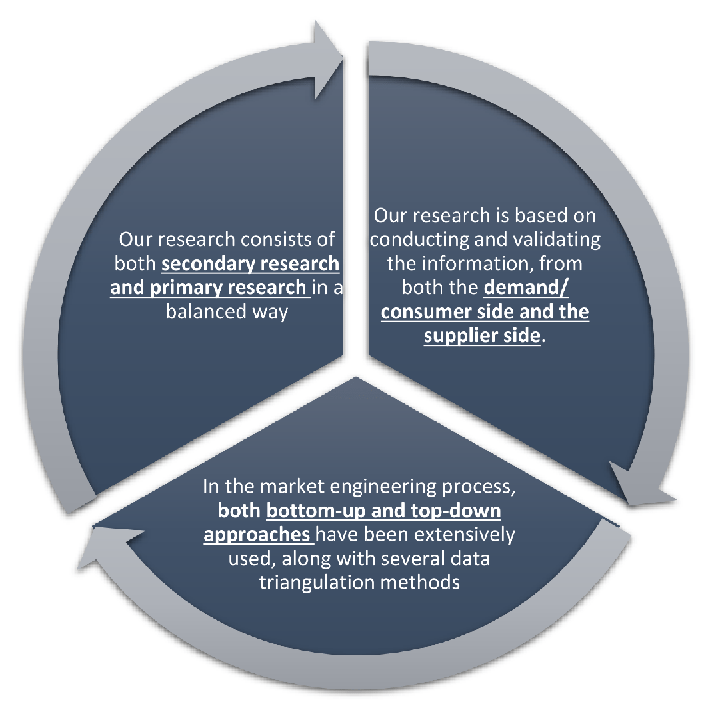
Our research design integrates both demand-side and supply-side analysis through a balanced combination of primary and secondary research methodologies. By utilizing both bottom-up and top-down approaches alongside rigorous data triangulation methods, we deliver robust market intelligence that supports strategic decision-making.
MarketGenics' comprehensive research design framework ensures the delivery of accurate, reliable, and actionable market intelligence. Through the integration of multiple research approaches, rigorous validation processes, and expert analysis, we provide our clients with the insights needed to make informed strategic decisions and capitalize on market opportunities.
MarketGenics leverages a dedicated industry panel of experts and a comprehensive suite of paid databases to effectively collect, consolidate, and analyze market intelligence.
Our approach has consistently proven to be reliable and effective in generating accurate market insights, identifying key industry trends, and uncovering emerging business opportunities.
Through both primary and secondary research, we capture and analyze critical company-level data such as manufacturing footprints, including technical centers, R&D facilities, sales offices, and headquarters.
Our expert panel further enhances our ability to estimate market size for specific brands based on validated field-level intelligence.
Our data mining techniques incorporate both parametric and non-parametric methods, allowing for structured data collection, sorting, processing, and cleaning.
Demand projections are derived from large-scale data sets analyzed through proprietary algorithms, culminating in robust and reliable market sizing.
Research Approach
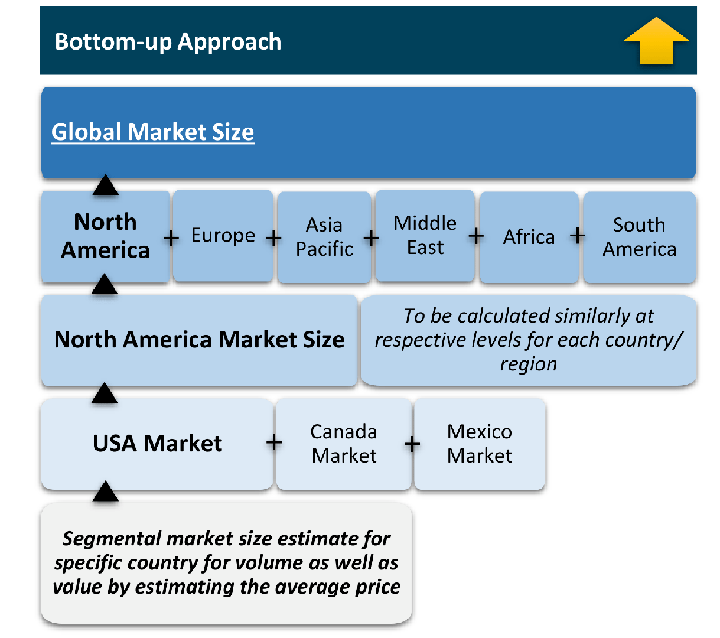
The bottom-up approach builds market estimates by starting with the smallest addressable market units and systematically aggregating them to create comprehensive market size projections.
This method begins with specific, granular data points and builds upward to create the complete market landscape.
Customer Analysis → Segmental Analysis → Geographical Analysis
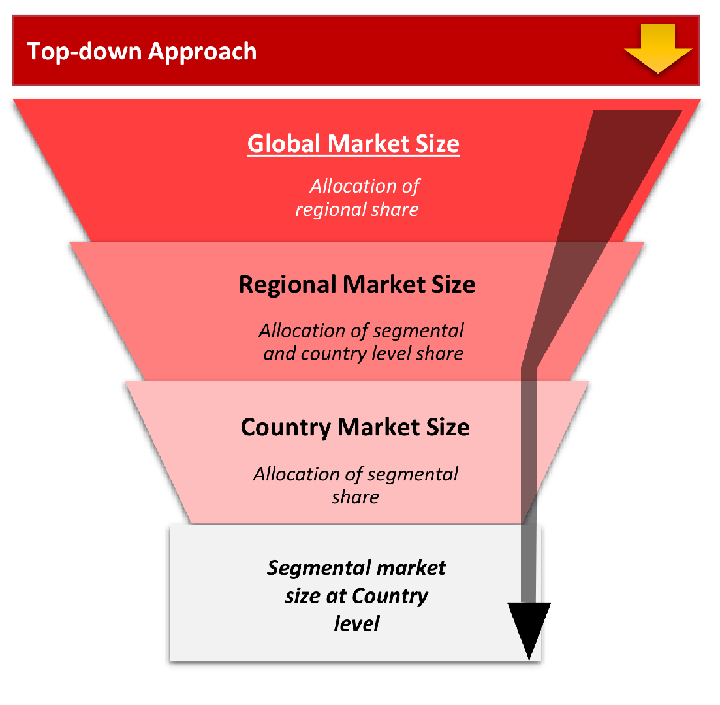
The top-down approach starts with the broadest possible market data and systematically narrows it down through a series of filters and assumptions to arrive at specific market segments or opportunities.
This method begins with the big picture and works downward to increasingly specific market slices.
TAM → SAM → SOM
Research Methods
Desk / Secondary Research
While analysing the market, we extensively study secondary sources, directories, and databases to identify and collect information useful for this technical, market-oriented, and commercial report. Secondary sources that we utilize are not only the public sources, but it is a combination of Open Source, Associations, Paid Databases, MG Repository & Knowledgebase, and others.
- Company websites, annual reports, financial reports, broker reports, and investor presentations
- National government documents, statistical databases and reports
- News articles, press releases and web-casts specific to the companies operating in the market, Magazines, reports, and others
- We gather information from commercial data sources for deriving company specific data such as segmental revenue, share for geography, product revenue, and others
- Internal and external proprietary databases (industry-specific), relevant patent, and regulatory databases
- Governing Bodies, Government Organizations
- Relevant Authorities, Country-specific Associations for Industries
We also employ the model mapping approach to estimate the product level market data through the players' product portfolio
Primary Research
Primary research/ interviews is vital in analyzing the market. Most of the cases involves paid primary interviews. Primary sources include primary interviews through e-mail interactions, telephonic interviews, surveys as well as face-to-face interviews with the different stakeholders across the value chain including several industry experts.
| Type of Respondents | Number of Primaries |
|---|---|
| Tier 2/3 Suppliers | ~20 |
| Tier 1 Suppliers | ~25 |
| End-users | ~25 |
| Industry Expert/ Panel/ Consultant | ~30 |
| Total | ~100 |
MG Knowledgebase
• Repository of industry blog, newsletter and case studies
• Online platform covering detailed market reports, and company profiles
Forecasting Factors and Models
Forecasting Factors
- Historical Trends – Past market patterns, cycles, and major events that shaped how markets behave over time. Understanding past trends helps predict future behavior.
- Industry Factors – Specific characteristics of the industry like structure, regulations, and innovation cycles that affect market dynamics.
- Macroeconomic Factors – Economic conditions like GDP growth, inflation, and employment rates that affect how much money people have to spend.
- Demographic Factors – Population characteristics like age, income, and location that determine who can buy your product.
- Technology Factors – How quickly people adopt new technology and how much technology infrastructure exists.
- Regulatory Factors – Government rules, laws, and policies that can help or restrict market growth.
- Competitive Factors – Analyzing competition structure such as degree of competition and bargaining power of buyers and suppliers.
Forecasting Models / Techniques
Multiple Regression Analysis
- Identify and quantify factors that drive market changes
- Statistical modeling to establish relationships between market drivers and outcomes
Time Series Analysis – Seasonal Patterns
- Understand regular cyclical patterns in market demand
- Advanced statistical techniques to separate trend, seasonal, and irregular components
Time Series Analysis – Trend Analysis
- Identify underlying market growth patterns and momentum
- Statistical analysis of historical data to project future trends
Expert Opinion – Expert Interviews
- Gather deep industry insights and contextual understanding
- In-depth interviews with key industry stakeholders
Multi-Scenario Development
- Prepare for uncertainty by modeling different possible futures
- Creating optimistic, pessimistic, and most likely scenarios
Time Series Analysis – Moving Averages
- Sophisticated forecasting for complex time series data
- Auto-regressive integrated moving average models with seasonal components
Econometric Models
- Apply economic theory to market forecasting
- Sophisticated economic models that account for market interactions
Expert Opinion – Delphi Method
- Harness collective wisdom of industry experts
- Structured, multi-round expert consultation process
Monte Carlo Simulation
- Quantify uncertainty and probability distributions
- Thousands of simulations with varying input parameters
Research Analysis
Our research framework is built upon the fundamental principle of validating market intelligence from both demand and supply perspectives. This dual-sided approach ensures comprehensive market understanding and reduces the risk of single-source bias.
Demand-Side Analysis: We understand end-user/application behavior, preferences, and market needs along with the penetration of the product for specific application.
Supply-Side Analysis: We estimate overall market revenue, analyze the segmental share along with industry capacity, competitive landscape, and market structure.
Validation & Evaluation
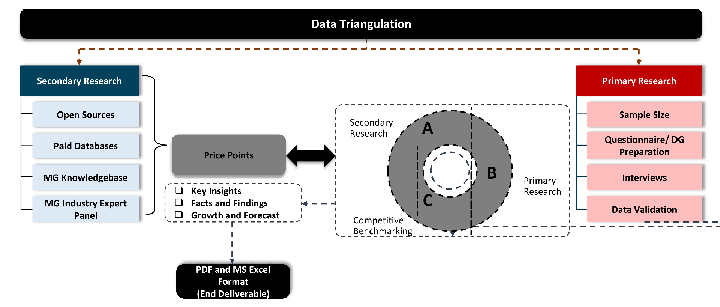
Data triangulation is a validation technique that uses multiple methods, sources, or perspectives to examine the same research question, thereby increasing the credibility and reliability of research findings. In market research, triangulation serves as a quality assurance mechanism that helps identify and minimize bias, validate assumptions, and ensure accuracy in market estimates.
- Data Source Triangulation – Using multiple data sources to examine the same phenomenon
- Methodological Triangulation – Using multiple research methods to study the same research question
- Investigator Triangulation – Using multiple researchers or analysts to examine the same data
- Theoretical Triangulation – Using multiple theoretical perspectives to interpret the same data
Custom Market Research Services
We will customise the research for you, in case the report listed above does not meet your requirements.
Get 10% Free Customisation