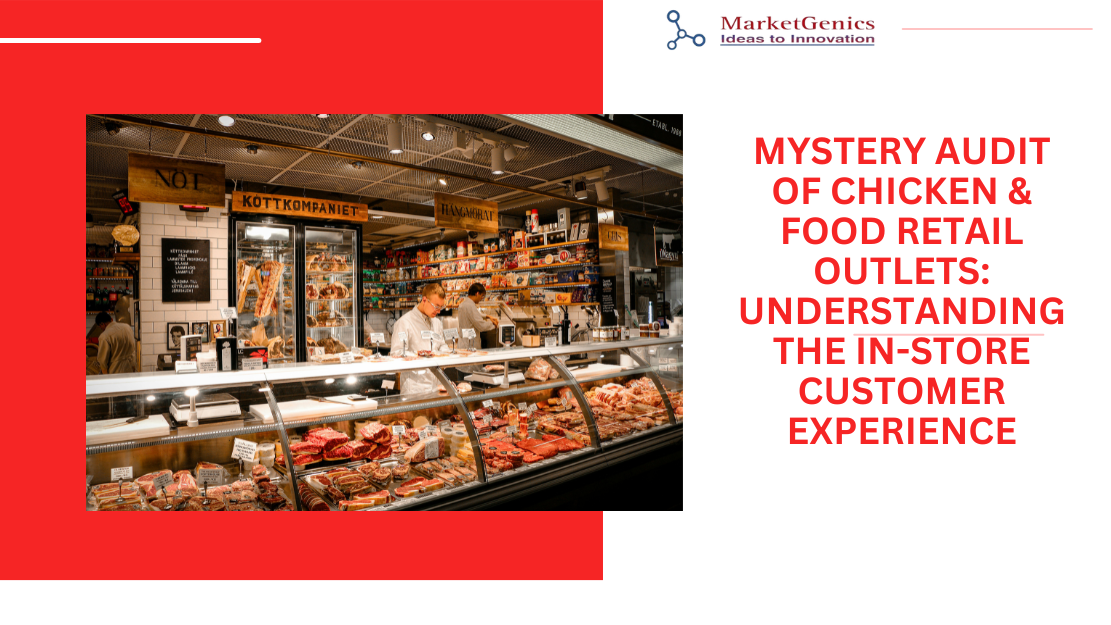
In the modern competitive food retail environment, product quality is just one aspect of customer experience. But the issues of store hygiene, interactions with staff, handling of products, presentation, and the shopping experience are equally important in influencing customer perception and loyalty.
A big growing chain associated with Food Retailing Sector of Punjab (FRP), which has presence in various cities like Amritsar and Ludhiana, conducted a Mystery Audit to gain insights into its in-store performance and to compare the customer experience with its key competitors. The study conducted by MarketGenics aimed to deliver a snapshot of the customer's shopping journey with the brand and to pinpoint certain facts to strengthen the brand.
Objective
The objective of this study is to uncover the in-store customer experience of the chicken and food retail outlets, as well as the reasons behind it.This case study aims to identify and explain the in-store customer experience of chicken and food retail outlets.
Why is a Mystery Audit necessary?
With the continued growth of the brand, it is vital to have consistency throughout outlets. The actual customer journey can be assessed by performing a mystery audit rather than just internally.
The study included the brand outlets as well as three competing brands – fish and meat outlet, mutton and chicken outlet, and local pizzeria. This competitive mix allowed for the research to understand not only gaps in the category, but also practices of other food retail categories that may help to improve the customer experience.
Research Approach
This study was exploratory research and was based on the mystery audit methodology. A competitive benchmarking was performed on four outlets and visits were conducted in an anonymous manner so that the observations would represent the 'real-life experience' of the customer.
Two visits were made at each outlet, once a weekday and once a weekend, to observe any variation in services, customer traffic and/or way of operating.
The following parameters were evaluated:
- Freezer temperature and product storage
- The setting of the product and how it is handled.
- The cleanliness and care of the product.
- Staff behaviour and customer interaction
- Service quality
- The design and appearance of the product.The presentation and the looks of the product.
- Utilising space and customers' comfort.
- How visible is branding and promotional communication?
The Mystery Audit was conducted as follows:
- The process started with verification and finalization of addresses of all selected outlets. A group of mystery auditors was then recruited and trained to fulfil the aims of the study, the observations to be made and questions to be asked during the mystery audit.
- The auditors were asked to act as normal customers to ensure an honest and natural experience. They had to actually buy something at each outlet, enabling the study to measure the entire customer experience, from entering the store and dealing with the staff, to product selection and purchase and exit.
- As far as possible auditors also took snapshots in real time to help with their observations.
- The auditors immediately recorded their experience after their departure from each outlet and recorded the data in a structured online data collection link. This reduced recall bias and allowed observations to be systematically and promptly made.
What Did the Audit Reveal : Key Takeaways
- The brand was seen as having a strong product proposition and service by staff based on freshness. A sense of fresh products and a generally responsive and helpful staff are likely to be of value to customers.
- However, the audit also revealed that the physical store experience is not keeping up with the brand's growth goals.
- The greatest potential is in the area of store layout, space management, seating, storage optimisation and customer comfort. The elements which appear to be functioning can have a significant effect on the customer's perception of the quality of a food retail brand.
- There are also learning curves from competitive benchmarking. The improvement in ambience, infrastructure and visible hygiene practices at competing outlets reflect the importance of the physical environment in building customer confidence and increasing the overall customer experience.
From Product Quality to Experience Quality
The results emphasize an important lesson for all food retail operations: A good product tends to get customers through the door and a good experience will get them into the store again. Consistency is even more critical for an expanding network of retail stores. The customer should have the same standards of cleanliness, service, product presentation and brand experience no matter where they shop.
The mystery audit, therefore, is not only an evaluation exercise, but a plan for operational improvement.
Conclusion
The mystery audit demonstrates that the brand audited has a very high level of product quality and service from its employees perceived. The freshness-centric proposition and approach to their customers are positive attributes to build on.
Meanwhile, the marketing of products and services, seating, store layout, in-store branding, storage and space management, and hygiene infrastructure can all significantly raise the level of the customer experience.
By tackling these challenges, the brand can build a more cohesive and welcoming retail environment, enhance its competitive edge, and pave the way for sustainable growth and success.