In an era where pet owners are increasingly discerning about what they feed their companions, product palatability has emerged as a decisive factor in purchase decisions. A prominent Indian pet food brand committed to raising the standard of pet nutrition across the country, partnered with Marketgenics.co to conduct a rigorous, on-ground palatability study of four new product samples.
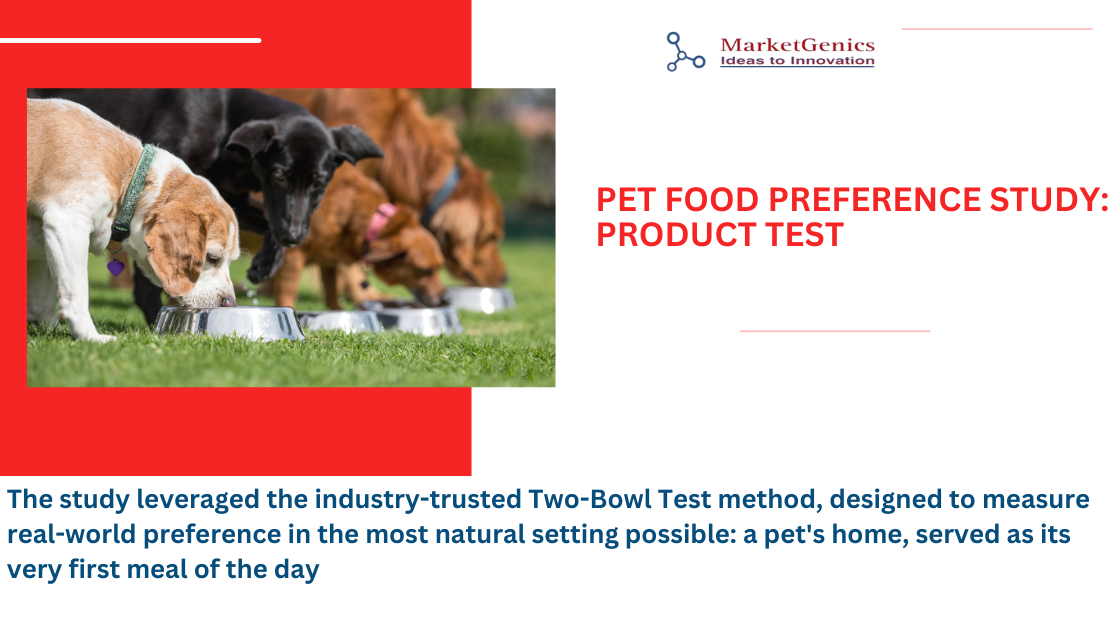
The study leveraged the industry-trusted Two-Bowl Test method, designed to measure real-world preference in the most natural setting possible: a pet's home, served as its very first meal of the day.
Objective
The brand's mission is to raise the standard of pet nutrition in India and make quality pet food accessible to a wider audience. By focusing on scientific formulation, natural ingredients, and transparency, the objective of the study is to enhance the lives of pets and strengthen the bond between pets and their owners by bringing out the best products in the market. The client wanted to test their new samples A,B & C,D in a two bowl test method and take the feedback on the same with the pets owners in Hyderabad and Bangalore.
Study Design & Methodology
The Two-Bowl Test Method
The Two-Bowl Test is a widely accepted palatability evaluation method in the pet food industry. It presents two product variants simultaneously, allowing the test subject — in this case, dogs — to make an uninfluenced, instinct-driven choice. This method eliminates sequential bias and captures genuine preference behavior in a controlled yet natural environment.
Test Structure
Four product samples — A, B, C, and D — were evaluated across two test rounds:
- Round 1: Samples A and B were served simultaneously in two bowls.
- Round 2 (after a 2-day interval): Samples C and D were served simultaneously in two bowls.
All meals were administered as the pet's FIRST MEAL of the day, ensuring maximum appetite engagement and unbiased response. A two-day gap between rounds prevented sensory fatigue and cross-sample influence.
Participant Profile
The study enrolled 30 dogs across Hyderabad and Bangalore, with the following profile:
|
Age Band |
1 to 8 years — covering juvenile, adult, and mature life stages |
|
Gender Mix |
Both male and female dogs included |
|
Breed Mix |
Diverse mix of breeds, body weights, and size categories |
|
Locations |
Hyderabad and Bangalore — two major metro markets |
Ethical Protocol
Prior to every test session, explicit consent was obtained from pet owners. The process was fully transparent, and owners were present during feeding. Samples were served in identical bowls to eliminate environmental bias, and no flavoring or additives were introduced to influence outcomes.
Key Findings
Round 1 — Samples A vs. B
When presented simultaneously, Sample B emerged as the preferred choice across the majority of participants. Medium and large weight class dogs demonstrated noticeably higher acceptance and consumption levels for Product B, indicating stronger palatability among larger breeds.
However, a clear preference for Product A was observed among small breeds and low-weight pets, suggesting that Product A's sensory profile — likely its texture, aroma, or density — is better aligned with the physiological and behavioral preferences of smaller dogs.
Round 1 Preference Summary:
|
Pet Segment |
Preferred Product |
Observation |
|
Medium & Large Breeds |
Product B |
Higher consumption & acceptance |
|
Small Breeds / Low Weight |
Product A |
Stronger palatability preference |
Round 2 — Samples C vs. D
In the second round, Product D emerged as the standout performer and the overall study favorite. Its acceptance was widespread, particularly strong among medium and large weight classes — mirroring the pattern seen with Product B, but with even broader appeal.
Small breeds and lighter-weight dogs displayed a preference for Product C, reinforcing the finding that this segment has distinctive palatability preferences that differ from their larger counterparts. Product C's profile may be well-suited for a smaller breed-specific product line.
Round 2 Preference Summary:
|
Pet Segment |
Preferred Product |
Observation |
|
Medium & Large Breeds |
Product D |
Widespread acceptance, highest overall |
|
Small Breeds / Low Weight |
Product C |
Consistent preference, segment-specific appeal |
Strategic Insights
The findings from this palatability study yield clear and actionable intelligence for product development and go-to-market strategy. The two-city testing across Hyderabad and Bangalore provides multi-market validation, lending confidence to national launch planning.
Conclusion
The Marketgenics.co Two-Bowl Test study successfully validated the pet food brand's new product formulations against real pets in real homes. The structured, ethically conducted methodology — complete with owner consent, first-meal serving, and multi-city execution — provides a high degree of reliability and commercial relevance to the findings.