Introduction
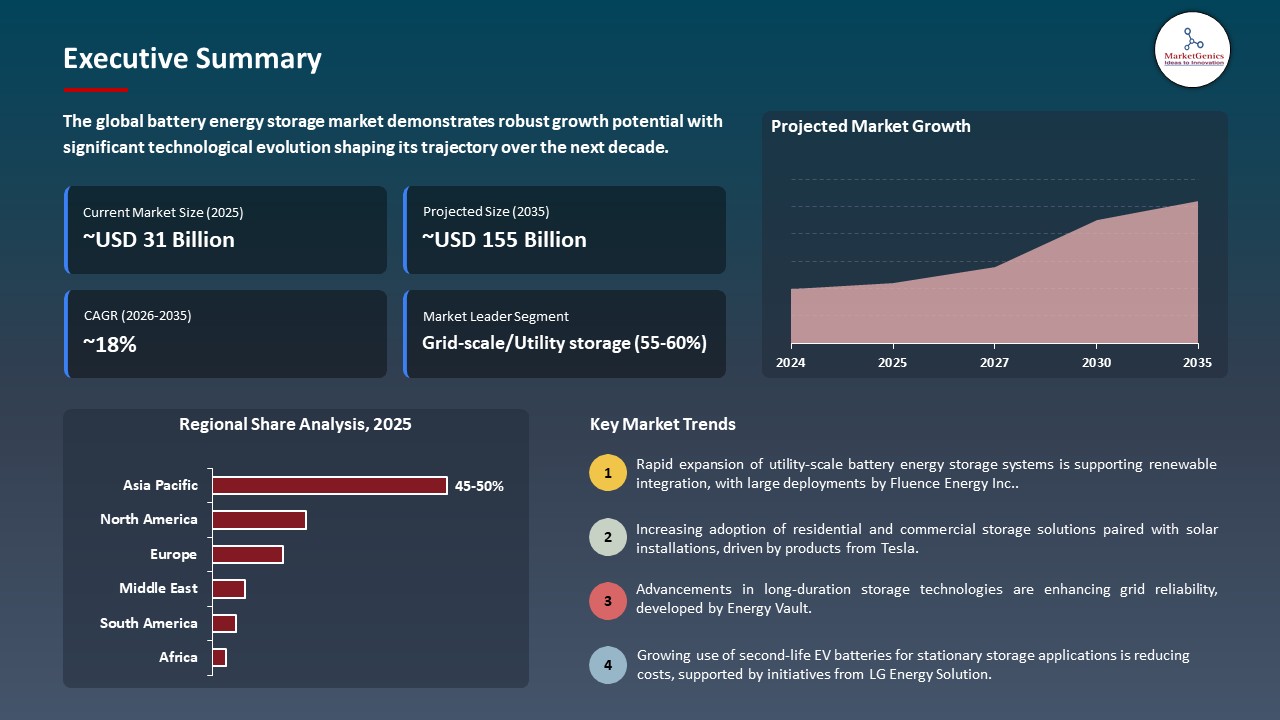
The global Battery Energy Storage Market is experiencing strong growth as renewable energy deployment, grid modernization, electrification, and increasing electricity demand accelerate the need for flexible power infrastructure. The global Grid-Scale Energy Storage Market was valued at USD 30.7 billion in 2025 and is projected to reach USD 155.3 billion by 2035, expanding at a CAGR of 17.6% during the forecast period. The growing adoption of Battery Energy Storage Systems (BESS), utility-scale battery storage, grid-scale energy storage, renewable energy storage, lithium-ion batteries, and smart energy storage solutions is transforming modern electricity infrastructure. Battery storage enables utilities, renewable energy developers, commercial and industrial facilities, and grid operators to store electricity during periods of low demand or high renewable generation and deploy it when required. As solar and wind power capacity expands, demand for grid flexibility, energy storage infrastructure, peak demand management, energy arbitrage, frequency regulation, and renewable energy integration is expected to increase significantly.
Demand Trends
Renewable Energy Integration: The rapid expansion of solar and wind power is increasing demand for battery energy storage systems capable of balancing intermittent renewable generation and improving grid reliability.
Grid Flexibility: Utilities are increasingly deploying grid-scale battery storage to manage fluctuations in electricity supply and demand, support frequency regulation, and improve overall grid stability.
Peak Demand Management: Battery storage systems can discharge electricity during periods of high demand, helping utilities and businesses reduce peak loads and optimize electricity consumption.
AI and Data Center Power Demand: The rapid growth of AI infrastructure and data centers is increasing electricity demand and creating new opportunities for battery storage, backup power, energy management systems, and flexible grid infrastructure.
Market Intelligence
The Battery Energy Storage Market is benefiting from increasing investments in renewable energy, grid modernization, energy security, and electrification. Battery energy storage systems are increasingly being deployed alongside solar and wind projects to improve power availability and reduce the impact of intermittent generation.
Lithium-ion technology continues to play a significant role in the market because of its high efficiency, scalability, declining costs, and established manufacturing ecosystem. At the same time, increasing investment in long-duration energy storage (LDES) is creating opportunities for technologies capable of providing storage over extended periods.
The market is also being transformed by digital technologies. Artificial intelligence, machine learning, IoT sensors, predictive analytics, battery management systems, and energy management platforms are increasingly being integrated into BESS projects to improve battery performance, monitor equipment health, optimize charging and discharging, and reduce maintenance requirements.
Increasing demand for reliable electricity from manufacturing facilities, electric vehicles, data centers, and other energy-intensive industries is further supporting investment in battery storage infrastructure and smart grid solutions.
Industry Trends Shaping the Market
Smart and Connected Battery Storage
The integration of IoT sensors, AI, cloud-based monitoring, and advanced analytics is transforming conventional battery storage systems into intelligent energy assets.
Connected BESS platforms can monitor battery temperature, voltage, state of charge, energy consumption, and equipment health in real time, enabling operators to improve system performance and identify potential problems earlier.
Utility-Scale BESS Deployment
Large-scale battery energy storage projects are becoming increasingly important for utilities and renewable energy developers. Utility-scale BESS can provide grid balancing, frequency regulation, peak shaving, reserve capacity, and energy arbitrage.
The expansion of utility-scale battery storage projects is creating opportunities for battery manufacturers, system integrators, renewable energy developers, power electronics companies, and energy management technology providers.
Long-Duration Energy Storage
As renewable energy penetration increases, the industry is moving toward storage technologies capable of supplying electricity for longer periods.
The growing focus on long-duration energy storage, grid-scale storage, renewable-plus-storage projects, and energy resilience is expected to create new opportunities beyond conventional short-duration lithium-ion battery systems.
AI-Powered Energy Management
Artificial intelligence is increasingly being applied to battery storage optimization. AI-based systems can analyze electricity demand, renewable generation, weather conditions, electricity prices, and battery performance to optimize charging and discharging decisions.
The combination of AI-powered energy management, battery analytics, smart grids, and predictive maintenance is expected to become increasingly important as BESS deployments scale.
Battery Safety and Lifecycle Management
As battery storage deployments expand, safety, thermal management, monitoring, recycling, and lifecycle management are becoming important priorities.
Manufacturers and system integrators are focusing on advanced battery management systems, thermal management, fire safety, battery recycling, and energy storage monitoring technologies.
Battery Energy Storage Market Ecosystem
Key players operating across the global battery energy storage ecosystem include:
- Tesla
- CATL
- BYD
- LG Energy Solution
- Samsung SDI
- Panasonic Energy
- Fluence
- Wärtsilä
- Sungrow
- Schneider Electric
- ABB
- Siemens Energy
- GE Vernova
- Honeywell
- Mitsubishi Power
The competitive environment is increasingly focused on battery efficiency, safety, energy density, lifecycle performance, software capabilities, system integration, and project economics.
Companies are also developing partnerships across battery manufacturing, renewable energy generation, grid infrastructure, energy management software, and project development to strengthen their positions in the rapidly expanding energy storage ecosystem.
Regional Outlook
Asia Pacific is emerging as a major market for battery energy storage, supported by rapid renewable energy deployment, industrialization, electricity demand, battery manufacturing capabilities, and government initiatives. China, India, Japan, South Korea, and Australia are investing significantly in BESS projects, grid-scale energy storage, renewable energy integration, and smart grid infrastructure.
North America remains an important market due to increasing renewable energy capacity, grid modernization, electricity demand, and investments in utility-scale battery storage. The rapid expansion of AI and data center infrastructure is also creating additional demand for flexible power and energy storage solutions.
Europe is witnessing increasing adoption of battery storage as countries focus on renewable energy integration, grid flexibility, energy security, and decarbonization. Investments in renewable-plus-storage projects, grid balancing, and energy storage infrastructure are supporting market development.
Middle East & Africa present emerging opportunities due to investments in renewable energy, utility infrastructure, solar power, and energy diversification. Battery storage can support renewable integration and improve electricity reliability in developing power systems.
South America is supported by renewable energy expansion and investments in electricity infrastructure, creating opportunities for grid-scale storage and renewable energy storage solutions.
Competitive Landscape
Competition in the Battery Energy Storage Market is increasingly centered on energy efficiency, battery safety, system reliability, digital connectivity, lifecycle performance, and cost optimization.
Leading companies are investing in advanced lithium-ion batteries, battery management systems, power conversion systems, energy management software, thermal management, and integrated renewable-plus-storage solutions.
The market is also witnessing increasing partnerships between battery manufacturers, utilities, renewable energy companies, technology providers, and infrastructure developers. These collaborations are helping accelerate the deployment of large-scale BESS projects and integrated energy storage infrastructure.
Conclusion
The Battery Energy Storage Market is evolving from a supporting technology into a critical component of modern electricity infrastructure. Increasing renewable energy deployment, grid modernization, electrification, rising electricity consumption, and growing demand from AI and data centers are creating strong opportunities for battery storage technologies.
With the global Grid-Scale Energy Storage Market projected to increase from USD 30.7 billion in 2025 to USD 155.3 billion by 2035 at a CAGR of 17.6%, the market is expected to offer significant opportunities across battery manufacturing, utility-scale BESS, renewable energy integration, energy management software, grid infrastructure, and long-duration energy storage.
The continued adoption of Battery Energy Storage Systems, utility-scale battery storage, grid-scale energy storage, renewable energy storage, lithium-ion batteries, long-duration energy storage, smart grid solutions, and AI-powered energy management will play a crucial role in building a more flexible, reliable, and sustainable global power system.
Recent Development and Strategic Overview
The battery energy storage industry is increasingly moving toward larger utility-scale projects, integrated renewable-plus-storage systems, and digitally managed energy infrastructure. The growing electricity requirements of AI data centers are also creating new opportunities for battery storage as businesses and utilities seek reliable and flexible power solutions.
At the same time, investments in renewable energy, transmission infrastructure, grid modernization, and energy storage are accelerating across major markets. This combination of renewable energy growth, AI infrastructure, electrification, and grid flexibility is expected to remain a major driver of the Battery Energy Storage Market over the coming years.
Find More Information on the Battery Energy Storage Market with expert analysis, market forecasts, competitive insights, regional analysis, segmentation, and strategic insights from MarketGenics