Introduction
Recent developments, including AI-driven data centres with significant cooling-water requirements, stricter PFAS regulations, circular economy initiatives and digital water management platforms, are reshaping purchasing decisions. These trends are creating new opportunities for manufacturers, technology providers and investors while increasing demand for high-quality market intelligence.
Executive Summary
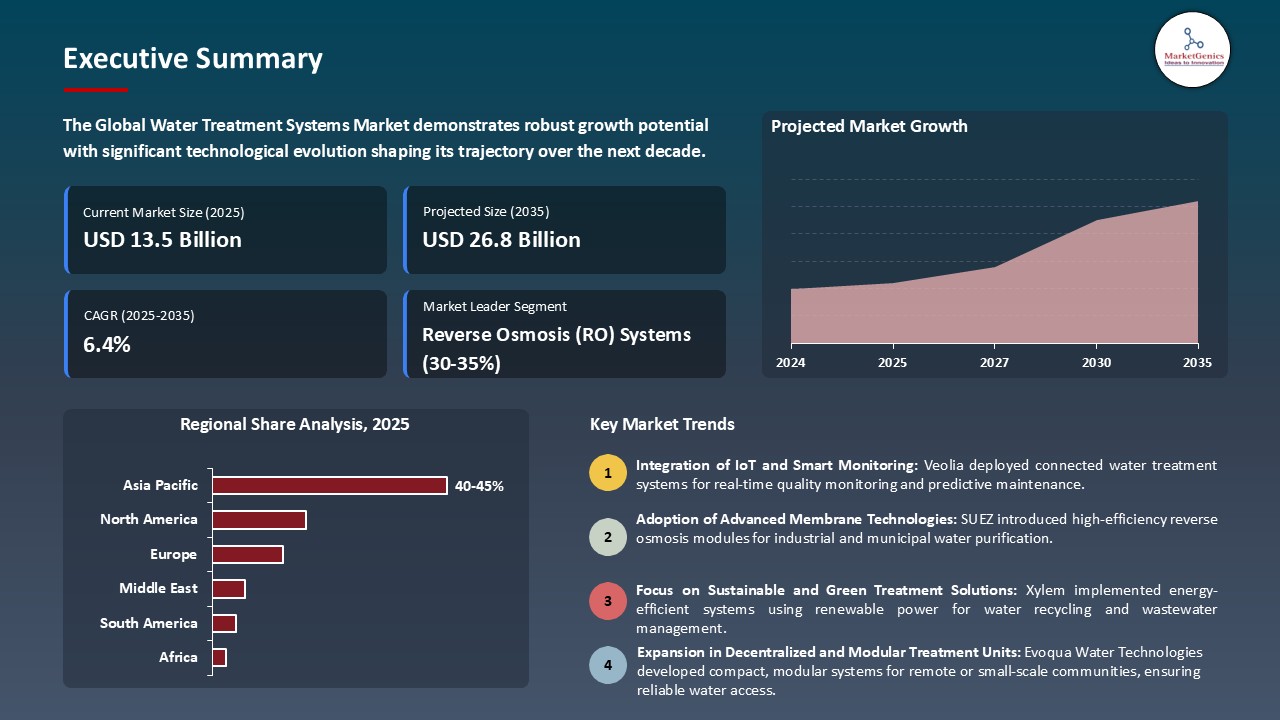
The global Water Treatment Systems Market is entering a new phase of innovation driven by sustainability, digitalisation and regulatory compliance. Reverse osmosis, membrane filtration, ultraviolet disinfection, smart sensors and AI-enabled monitoring are becoming core technologies. Industries including pharmaceuticals, food and beverage, chemicals, mining, power generation and semiconductors continue to invest in efficient water treatment solutions to improve operational performance and environmental compliance.
Key Market Drivers
Major growth drivers include increasing freshwater scarcity, rising industrial wastewater generation, urban population growth, ageing municipal infrastructure, investments in desalination, corporate ESG commitments, stricter discharge regulations and increased focus on water reuse. Emerging economies are expanding treatment infrastructure while developed markets are upgrading existing facilities with smart technologies.
Technology Trends
Technology-Trends demand covers Filtration Systems (Sand, Cartridge, Activated Carbon), Reverse Osmosis (RO), UV Disinfection, Chlorination, Distillation, Electrodeionization (EDI), Ion Exchange, and Ozonation Systems.
RO systems hold the largest share at approximately 31% of the market in 2025.
Digital twins, IoT-enabled sensors and predictive maintenance platforms allow operators to optimise energy consumption, improve membrane life and reduce downtime. Artificial intelligence is increasingly being used for process optimisation and anomaly detection.
Regional Insights
Asia Pacific is the most attractive and dominant demand region in 2025 and beyond, led by heavy infrastructure investment from China and India. Among individual countries, the UAE is the fastest-growing market.
North America is a major market due to strict environmental standards and replacement of ageing infrastructure. Europe focuses on sustainability, circular economy initiatives and wastewater reuse.
Asia-Pacific is the fastest-growing region, supported by industrialisation, urbanisation and government investment in water infrastructure. The Middle East continues investing in desalination and water reuse due to water scarcity, while Latin America is expanding municipal treatment capacity.
Competitive Landscape
The Water Treatment Systems Market remains highly competitive with global participants investing in acquisitions, strategic partnerships, product innovation and digital capabilities. Leading companies continue expanding membrane technologies, smart monitoring platforms and integrated treatment solutions. Competition increasingly centres on lifecycle cost, automation, energy efficiency and sustainability rather than equipment alone.
Challenges
High capital and operating costs are rated a Very High impact restraint.
RO and membrane systems are expensive to install, maintain, and power for small and mid-scale users. Infrastructure limitations and skilled-workforce shortages in developing regions are a second, high impact restraint.
Despite strong growth prospects, the industry faces challenges including high capital expenditure, energy-intensive treatment processes, membrane fouling, complex regulatory requirements, skilled workforce shortages and cybersecurity risks associated with connected infrastructure. Companies that innovate around operational efficiency and lifecycle cost are likely to gain competitive advantage.
Future Outlook
Over the next decade, investment is expected to increase in decentralised treatment systems, industrial water recycling, zero liquid discharge, smart water networks and AI-assisted plant management. Water security will remain a strategic priority for governments and industries, supporting long-term demand for advanced treatment technologies and consulting services. Organisations will increasingly seek independent market intelligence to evaluate investment opportunities, identify emerging technologies and benchmark competitive strategies.
Market Intelligence
The global Water Treatment Systems Market is entering a period of accelerated transformation as water security becomes a strategic priority for governments, utilities, and industrial operators. Increasing freshwater scarcity, climate change, stricter environmental regulations, and the rapid expansion of water-intensive industries are driving investments in advanced treatment technologies. At the same time, organisations are shifting from conventional water treatment infrastructure to intelligent, digitally connected systems capable of improving operational efficiency, reducing water losses, and enabling wastewater reuse. These developments are redefining capital allocation across municipal and industrial water infrastructure, creating sustained demand for membrane filtration, reverse osmosis, ultraviolet disinfection, advanced oxidation processes, and AI-enabled monitoring solutions.
A major catalyst reshaping the industry is the rapid expansion of artificial intelligence (AI) infrastructure. According to Reuters, the growing deployment of hyperscale data centres is significantly increasing global demand for water used in cooling and thermal management. Researchers affiliated with the United Nations have warned that, without improvements in water efficiency, AI-driven data centres could double their power and water consumption by 2030, placing additional pressure on already stressed water resources. This trend is accelerating investments in advanced water recycling, closed-loop cooling systems, and industrial water treatment technologies capable of reducing freshwater dependence while maintaining operational reliability.
Strategic Developments
One of the most significant developments in 2026 came from Xylem, which raised its full-year profit forecast following stronger-than-expected quarterly results. The company attributed its improved outlook to growing demand for advanced water treatment solutions, particularly from the rapid expansion of AI-powered data centres that require sophisticated water cooling, recycling, and treatment infrastructure. This announcement highlights an emerging demand segment where digital infrastructure and water technology are becoming increasingly interconnected.
Meanwhile, Veolia continues to strengthen its global leadership by expanding investments in PFAS treatment technologies and industrial water reuse solutions. The company has identified water scarcity, environmental protection, and AI-driven data centre infrastructure as long-term growth opportunities. Veolia has also announced collaborations aimed at reducing water consumption in hyperscale data centres, reinforcing the growing importance of sustainable water management in the digital economy.
In June 2025, Pentair plc launched its new Everpure H2Optimo Series, a smart commercial water filtration system designed for foodservice and hospitality sectors. The system integrates IoT-enabled monitoring for real-time water quality and predictive maintenance. John L. Stauch, President and CEO of Pentair, emphasized the move as part of their strategy to deliver “smarter, more sustainable water solutions” to meet evolving customer needs globally. This innovation enhances operational efficiency and expands Pentair’s footprint in the commercial water treatment segment.
Conclusion
The water treatment systems market represents one of the most resilient infrastructure opportunities globally. Businesses that understand evolving regulations, technological advancements and regional investment trends will be better positioned to capture growth. Comprehensive market research enables decision-makers to identify high-growth segments, assess competitive dynamics and develop informed expansion strategies. For organisations seeking reliable insights into market size, forecasts, competitive intelligence and emerging opportunities, professionally researched industry reports provide a strong foundation for strategic decision-making.