Building Materials Market Size, Share & Trends Analysis Report by Product Type (Structural Materials, Finishing Materials, Insulation Materials, Roofing Materials, Waterproofing & Sealants, Doors, Windows & Glazing, Prefabricated & Modular Components, Adhesives, Mortars & Grouts, Aggregate Materials, Other Product Types), Material Type, Construction Type, Technology, End Use, Sales Channel, and Geography (North America, Europe, Asia Pacific, Middle East, Africa, and South America) – Global Industry Data, Trends, and Forecasts, 2026–2035
Building Materials Market Summary:
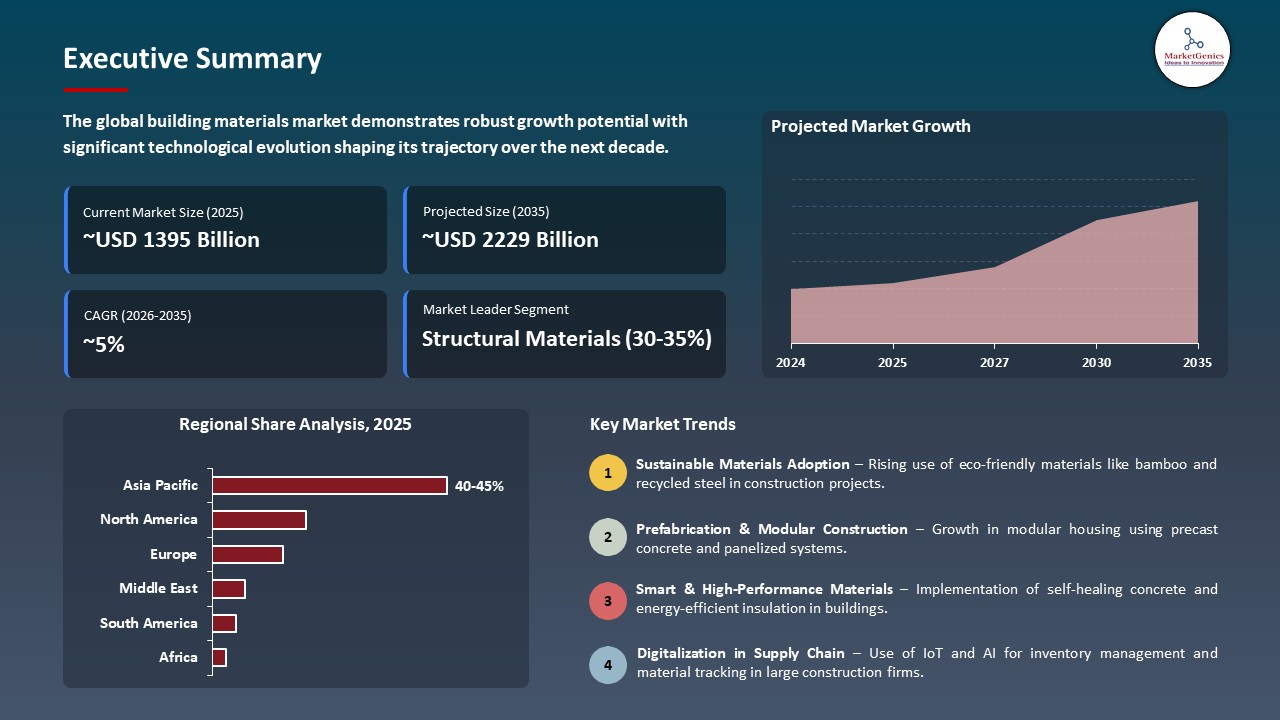
The global building materials market is exhibiting strong growth, with an estimated value of USD 1394.6 billion in 2025 and USD 2228.8 billion by 2035, achieving a CAGR of 4.8%, during the forecast period.
|
|
|
Segmental Data Insights |
|
|
Demand Trends |
|
|
Competitive Landscape |
|
|
Strategic Development |
|
|
Future Outlook & Opportunities |
|
Building-Materials-Market Size, Share, and Growth
The building materials market is driven by rapid urbanization, rising infrastructure and residential construction activities, increasing adoption of sustainable and energy-efficient materials, government investments in smart cities, and growing consumer preference for durable, low-carbon, and technologically advanced construction solutions.
Speaking on the occasion, Sreedhar N., Senior Vice-President and CEO – Asia Pacific and India, said, “Saint-Gobain is uniquely positioned to serve the Indian construction market with a comprehensive portfolio of solutions that are both light and sustainable. Our commitment to local manufacturing, coupled with state-of-the-art facilities, including a dedicated R&D centre, empowers us to adapt our solutions to the evolving needs of our customers. The two new investments, leveraging advanced engineering and industry 4.0 technologies, will further enhance our ability to deliver high-performance and differentiated solutions to our customers, aligning seamlessly with our commitment to innovation and excellence.”
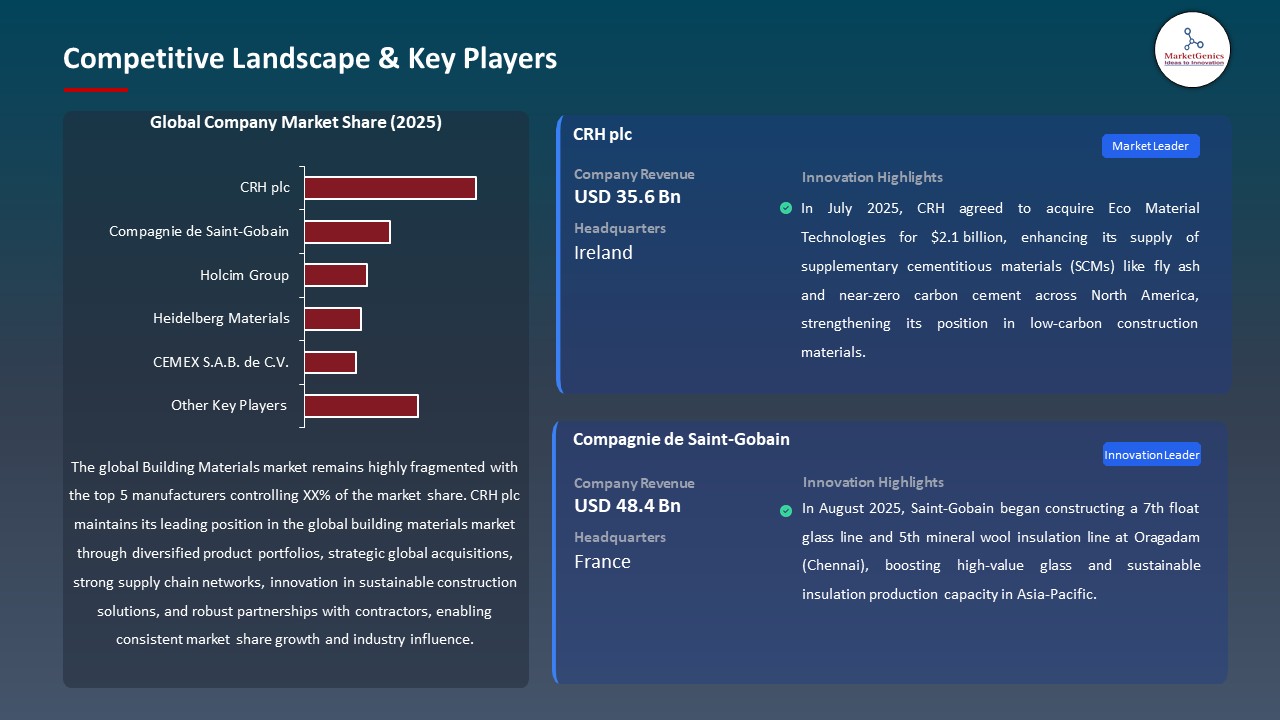
The growing construction activities in emerging and advanced markets globally are driving the global demand of building materials due to the rapid rate of urbanization and the rapid growth of large-scale infrastructure projects. For instance, in July 2025, CRH plc bought Eco Material Technologies, a near zero carbon cement manufacturer, to increase capacity and guarantee long-term supply to the upcoming increase in infrastructure and construction demand in North America. The trend is propelling a strong market growth and innovation that is strengthening the strategic nature of sustainable and scalable building material solutions to global construction works.
Additionally, the increased pace of adopting sophisticated sustainable and digital technologies, which improve operational efficiency, decrease emissions, and meet changing regulatory and customer demands drive the building materials market. For instance, Holcim is scaling its ECOCycle recycled materials and low carbon products like ECOPact and ECOPlanet, while investing in digital, energy-efficient operations to advance decarbonization and circular construction. This trend towards sustainability and digitalization is leading to market expansion and the competitiveness of manufacturers in environmentally friendly construction solutions.
Key adjacent opportunities to the global building materials market encompass prefabricated and modular construction, smart building technologies, low‑carbon and sustainable insulation materials, recycled and circular construction products, and AI-driven construction project management solutions. These sectors complement traditional building materials, fostering innovation, operational efficiency, and sustainable market expansion. Capitalizing on these adjacent markets can enhance revenue diversification and accelerate adoption of technologically advanced, environmentally sustainable construction solutions worldwide.
Building Materials Market Dynamics and Trends
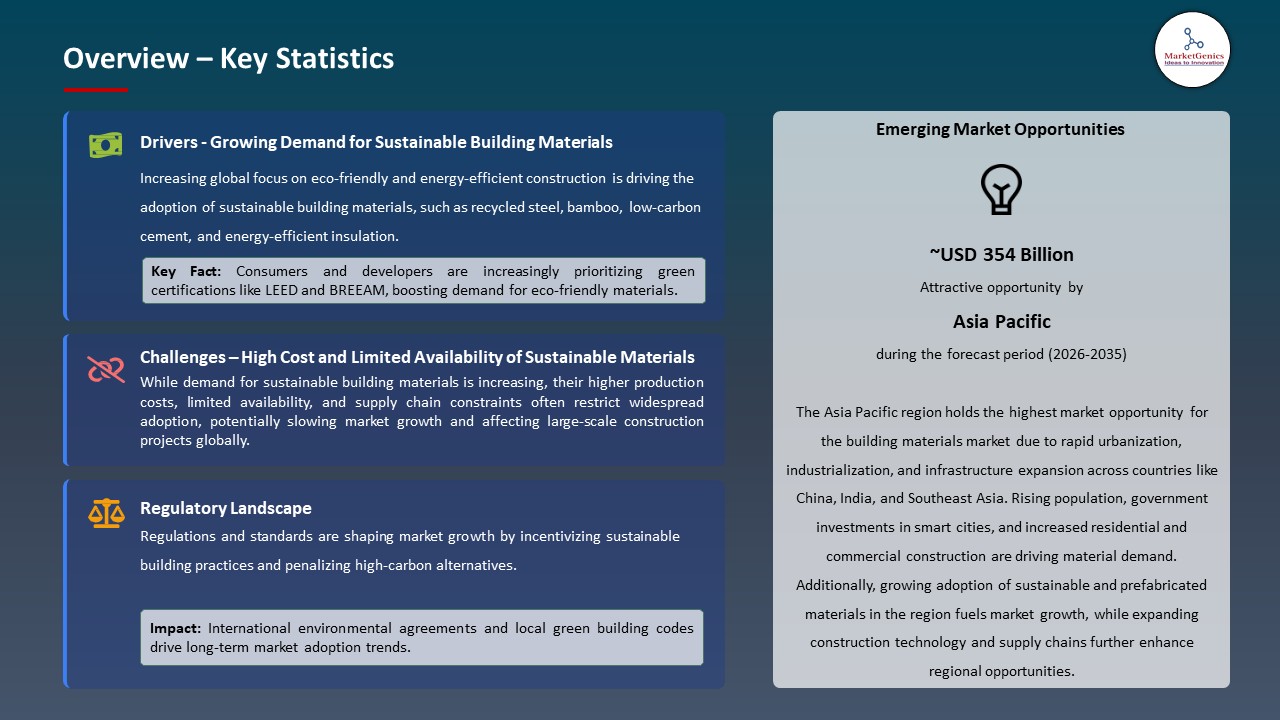
Driver: Strategic Expansion Through Sustainable Product Portfolio and Acquisitions
- The manufacturers are driving the building materials market by consciously extending its sustainable product and high-value product propositions with specific acquisitions and innovation programs. The strategy will help businesses to reach wider market penetration and be in line with global decarbonization and sustainability goals.
- For example, Holcim recently acquired Xella, a leading European provider of sustainable and innovative walling systems with projected net sales of approximately €1 billion in 2025. This purchase will diversify the offerings of Holcim in terms of high-quality low-carbon products and digitally powered construction solutions, which will help the company to address the demands of the customers and sustain high regulatory standards that are becoming more rigorous.
- This new strategic development of the portfolio strengthens the competitive edge and will speed up the implementation of sustainable and low-carbon building solutions in the international marketplace.
Restraint: Volatility in Construction Demand and Cost Pressures
- The building materials market is limited by the changes in the construction demand and the rising input prices that may restrict the investments in new projects and squeeze the profit margins of manufacturers. This volatility poses a challenge to strategic planning and stability in operations in the sector.
- For example, in 2025, LafargeHolcim Bangladesh recorded a booming growth in profits, but the overall construction sector experienced headwinds with low investment in the public sector and constrained financing by the private sector, showing how macroeconomic and market factors can slow demand of building materials.
- These market and economic pressures have the potential to limit growth and tame capital spending, reducing overall growth in the building materials industry.
Opportunity: Development and Commercialization of Carbon-Free Cement Technologies
- The development and commercialization of carbon-free cement and clinker production methods is a major opportunity in the building materials market. These innovations will help solve the high emissions of the traditional cement production and allow producing sustainable product segments to satisfy the increased demand of environmentally responsible construction products.
- For instance, Holcim has enhanced its relation with SaltX Technology to co-design the first fully electrified cement clinker process in the world. The program is expected to achieve a pilot-scale demonstration by 2028 and is expected to make a strong step forward in terms of reducing the use of fossil fuels in core materials production, proving the sustainability and innovation efforts of the company.
- The use of carbon-free cement technologies means new sources of revenue and guarantees the adherence to even stricter global climate expectations, making manufacturers the pioneers of sustainable construction solutions.
Key Trend: Adoption of Circular Construction Practices Through Material Recycling
- The increasing use of circular construction techniques, which prioritize recycling and reusing demolition and industrial waste materials, is a significant trend in the global building materials market. These strategies increase sustainability, maximize the use of resources, and help to decrease the environmental impact of the construction value chain.
- For example, CRH plc announced using more than 51 million tonnes of recycled material in 2025 and realized a quantifiable decrease in carbon emission per tonne of cementitious product. This is an indication of how circularity in construction is being woven into core operations and supply chains to enhance efficiency and sustainability.
- The integration of circular construction practices mitigates environmental impact, strengthens long-term supply chain resilience, and ensures compliance with evolving regulatory standards.
Building Materials Market Analysis and Segmental Data
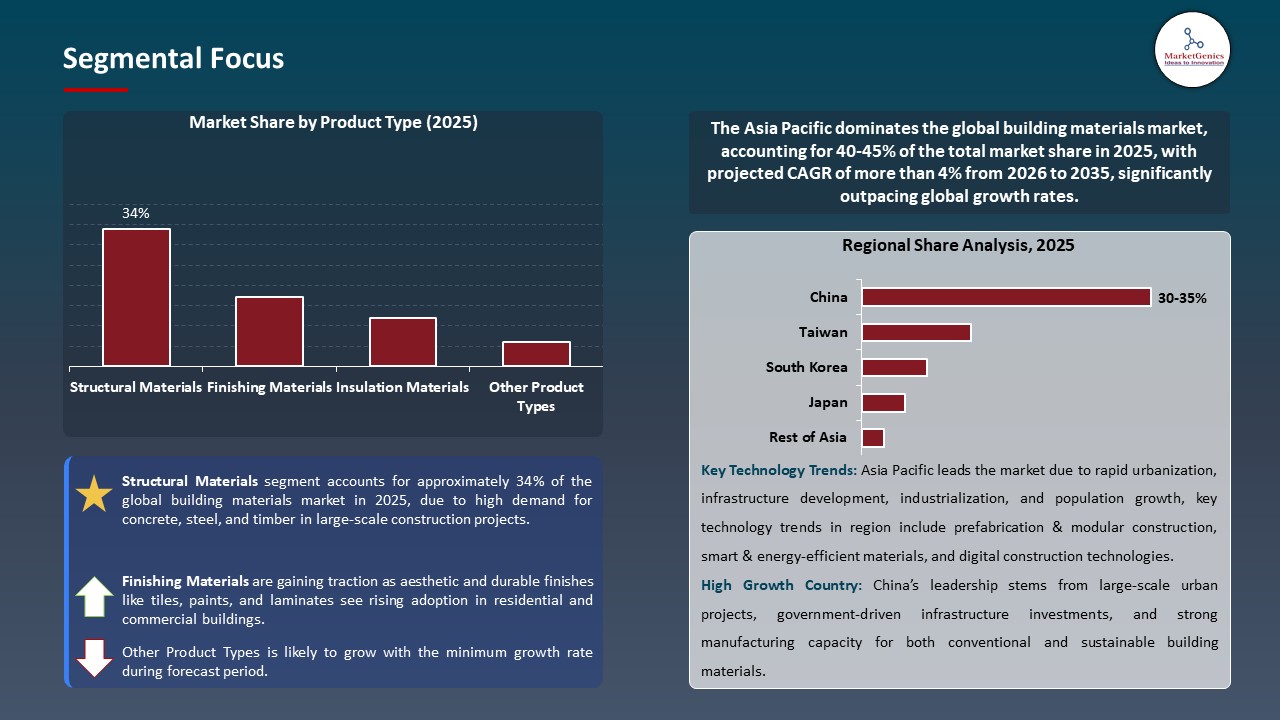
Structural Materials Dominate Global Building Materials Market
- The structural materials segment dominates the global building materials market as they offer load bearing capacity, resistance, fire resistance and durability to residential, commercial and infrastructure projects. These materials continue to contribute highest revenue percentage, because they play a fundamental role in foundations, structural structures, bridges, and high-rise buildings, making them meet high building codes and safety standards in the face of increasing urbanization.
- For instance, Holcim emphasizes its high-performance cement, aggregates, and ready-mix concrete in its global portfolio. The company supplied over 1.2 million m³ of concrete, including low-carbon mixes, for major infrastructure projects such as the Curzon Street and Old Oak Common metro works in the UK, demonstrating its leadership in delivering reliable, sustainable structural solutions.
- The dominance of structural materials perpetuates market expansion, as there is continued need to have strong and high-quality building solutions across the globe.
Asia Pacific Leads Global Building Materials Market Demand
- Asia Pacific leads the building materials is because of the robust urbanization and the massive construction of infrastructure in Asia Pacific is becoming a major demand of building materials. Indicatively, UltraTech Cement Ltd. India, the largest cement manufacturer, recently invested another round of capital expenditure amounting to Rs10,255crore in capacity expansion due to the increasing regional cement demand, which was occasioned by the growth in infrastructure and housing.
- Additionally, the introduction of new construction methods like modular and engineered building materials is also increasing the demand of materials in the region. Major players are increasing their supply of engineered wood and prefabricated constructions that can facilitate efficient construction activities in the rapidly urbanizing cities of Asia Pacific.
- These forces are contributing to a strong market growth in Asia Pacific, which is making the region a major center of high-demand, innovative and sustainable building material.
Building Materials Market Ecosystem
The global building materials market is highly fragmented, with leading players such as CRH plc, Compagnie de Saint‑Gobain, Holcim Group, Heidelberg Materials, and CEMEX S.A.B. de C.V. dominating through scale, integration, and deployment of advanced technologies that enhance product performance, sustainability, and supply chain efficiency. Major incumbents leverage digital platforms, automated manufacturing, and innovation ecosystems to maintain competitive advantage and global reach.
These key players increasingly focus on niche or specialized solutions that drive innovation and market development. For example, Holcim’s digitally optimized ECOCycle circular technologies and low‑carbon ECOPact concrete range showcase specialized sustainable products tailored to energy‑efficient and low‑emission construction processes. Heidelberg Materials’ evoBuild portfolio unifies low‑carbon and circular products to support climate‑friendly construction requirements, while Saint‑Gobain pushes high‑performance insulation and façades that meet evolving building standards.
These specialized solutions accelerate the adoption of sustainable construction practices, reduce carbon emissions, and improve overall energy efficiency across global building projects.
Recent Development and Strategic Overview:
- In December 2025, Holcim strategically enhanced its circular construction capabilities through the acquisition of three recycling enterprises across the UK, France, and Germany, enabling the conversion of demolition waste into high-quality recycled building materials and increasing its annual recycling capacity by approximately 1.3 million tons.
- In July 2025, Holcim strengthened its market position by expanding its high-value sustainable materials portfolio, including low‑carbon ECOPact and ECOPlanet products, while strategically acquiring key aggregates and ready‑mix businesses across Europe and other regions.
Report Scope
|
Detail |
|
|
Market Size in 2025 |
USD 1394.6 Bn |
|
Market Forecast Value in 2035 |
USD 2228.8 Bn |
|
Growth Rate (CAGR) |
4.8% |
|
Forecast Period |
2026 – 2035 |
|
Historical Data Available for |
2021 – 2024 |
|
Market Size Units |
US$ Billion for Value |
|
Report Format |
Electronic (PDF) + Excel |
|
North America |
Europe |
Asia Pacific |
Middle East |
Africa |
South America |
|
|
|
|
|
|
|
Companies Covered |
|||||
|
|
|
|
|
|
Building Materials Market Segmentation and Highlights
|
Segment |
Sub-segment |
|
Building Materials Market, By Product Type |
|
|
Building Materials Market, By Material Type |
|
|
Building Materials Market, By Construction Type |
|
|
Building Materials Market, By Technology |
|
|
Building Materials Market, By End Use |
|
|
Building Materials Market, By Sales Channels |
|
Frequently Asked Questions
Table of Contents
- 1. Research Methodology and Assumptions
- 1.1. Definitions
- 1.2. Research Design and Approach
- 1.3. Data Collection Methods
- 1.4. Base Estimates and Calculations
- 1.5. Forecasting Models
- 1.5.1. Key Forecast Factors & Impact Analysis
- 1.6. Secondary Research
- 1.6.1. Open Sources
- 1.6.2. Paid Databases
- 1.6.3. Associations
- 1.7. Primary Research
- 1.7.1. Primary Sources
- 1.7.2. Primary Interviews with Stakeholders across Ecosystem
- 2. Executive Summary
- 2.1. Global Building Materials Market Outlook
- 2.1.1. Building Materials Market Size (Value - US$ Bn), and Forecasts, 2021-2035
- 2.1.2. Compounded Annual Growth Rate Analysis
- 2.1.3. Growth Opportunity Analysis
- 2.1.4. Segmental Share Analysis
- 2.1.5. Geographical Share Analysis
- 2.2. Market Analysis and Facts
- 2.3. Supply-Demand Analysis
- 2.4. Competitive Benchmarking
- 2.5. Go-to- Market Strategy
- 2.5.1. Customer/ End-use Industry Assessment
- 2.5.2. Growth Opportunity Data, 2026-2035
- 2.5.2.1. Regional Data
- 2.5.2.2. Country Data
- 2.5.2.3. Segmental Data
- 2.5.3. Identification of Potential Market Spaces
- 2.5.4. GAP Analysis
- 2.5.5. Potential Attractive Price Points
- 2.5.6. Prevailing Market Risks & Challenges
- 2.5.7. Preferred Sales & Marketing Strategies
- 2.5.8. Key Recommendations and Analysis
- 2.5.9. A Way Forward
- 2.1. Global Building Materials Market Outlook
- 3. Industry Data and Premium Insights
- 3.1. Global Chemicals & Materials Industry Overview, 2025
- 3.1.1. Chemicals & Materials Ecosystem Analysis
- 3.1.2. Key Trends for Chemicals & Materials Industry
- 3.1.3. Regional Distribution for Chemicals & Materials Industry
- 3.2. Supplier Customer Data
- 3.3. Technology Roadmap and Developments
- 3.1. Global Chemicals & Materials Industry Overview, 2025
- 4. Market Overview
- 4.1. Market Dynamics
- 4.1.1. Drivers
- 4.1.1.1. Rapid growth in global construction, including residential, commercial, and infrastructure development
- 4.1.1.2. Increasing demand for sustainable and green building materials
- 4.1.1.3. Urbanization and rising global population fueling material demand
- 4.1.2. Restraints
- 4.1.2.1. Volatility and fluctuations in raw material prices (cement, steel, etc.)
- 4.1.2.2. Supply chain disruptions and material availability challenges
- 4.1.1. Drivers
- 4.2. Key Trend Analysis
- 4.3. Regulatory Framework
- 4.3.1. Key Regulations, Norms, and Subsidies, by Key Countries
- 4.3.2. Tariffs and Standards
- 4.3.3. Impact Analysis of Regulations on the Market
- 4.4. Value Chain Analysis
- 4.4.1. Raw Material Suppliers
- 4.4.2. Building Material Manufacturers
- 4.4.3. Distributors
- 4.4.4. End Users/ Consumers
- 4.5. Porter’s Five Forces Analysis
- 4.6. PESTEL Analysis
- 4.7. Global Building Materials Market Demand
- 4.7.1. Historical Market Size – in Value (US$ Bn), 2020-2024
- 4.7.2. Current and Future Market Size – in Value (US$ Bn), 2026–2035
- 4.7.2.1. Y-o-Y Growth Trends
- 4.7.2.2. Absolute $ Opportunity Assessment
- 4.1. Market Dynamics
- 5. Competition Landscape
- 5.1. Competition structure
- 5.1.1. Fragmented v/s consolidated
- 5.2. Company Share Analysis, 2025
- 5.2.1. Global Company Market Share
- 5.2.2. By Region
- 5.2.2.1. North America
- 5.2.2.2. Europe
- 5.2.2.3. Asia Pacific
- 5.2.2.4. Middle East
- 5.2.2.5. Africa
- 5.2.2.6. South America
- 5.3. Product Comparison Matrix
- 5.3.1. Specifications
- 5.3.2. Market Positioning
- 5.3.3. Pricing
- 5.1. Competition structure
- 6. Global Building Materials Market Analysis, by Product Type
- 6.1. Key Segment Analysis
- 6.2. Building Materials Market Size (Value - US$ Bn), Analysis, and Forecasts, by Product Type, 2021-2035
- 6.2.1. Structural Materials
- 6.2.1.1. Cement & Concrete
- 6.2.1.2. Steel & Metal Framing
- 6.2.1.3. Timber & Engineered Wood
- 6.2.1.4. Bricks & Masonry Units
- 6.2.1.5. Others
- 6.2.2. Finishing Materials
- 6.2.2.1. Paints & Coatings
- 6.2.2.2. Flooring (Tiles, Hardwood, Vinyl, Carpet)
- 6.2.2.3. Wall Coverings & Cladding
- 6.2.2.4. Ceiling Systems
- 6.2.2.5. Others
- 6.2.3. Insulation Materials
- 6.2.3.1. Thermal Insulation (Mineral Wool, EPS, XPS, PIR)
- 6.2.3.2. Acoustic Insulation
- 6.2.3.3. Fire-Resistant Insulation
- 6.2.3.4. Others
- 6.2.4. Roofing Materials
- 6.2.4.1. Asphalt Shingles
- 6.2.4.2. Metal Roofing
- 6.2.4.3. Clay & Concrete Tiles
- 6.2.4.4. Green / Cool Roofing Membranes
- 6.2.4.5. Others
- 6.2.5. Waterproofing & Sealants
- 6.2.5.1. Liquid-Applied Membranes
- 6.2.5.2. Sheet Membranes
- 6.2.5.3. Cementitious Waterproofing
- 6.2.5.4. Sealants & Joint Fillers
- 6.2.5.5. Others
- 6.2.6. Doors, Windows & Glazing
- 6.2.6.1. uPVC / Aluminum / Wooden Frames
- 6.2.6.2. Single, Double & Triple Glazing
- 6.2.6.3. Smart / Electrochromic Glass
- 6.2.6.4. Others
- 6.2.7. Prefabricated & Modular Components
- 6.2.7.1. Precast Concrete Panels
- 6.2.7.2. Structural Insulated Panels (SIPs)
- 6.2.7.3. Modular Wall & Floor Cassettes
- 6.2.7.4. Others
- 6.2.8. Adhesives, Mortars & Grouts
- 6.2.8.1. Tile Adhesives
- 6.2.8.2. Construction Adhesives
- 6.2.8.3. Ready-Mix Mortars
- 6.2.8.4. Others
- 6.2.9. Aggregate Materials
- 6.2.10. Other Product Types
- 6.2.1. Structural Materials
- 7. Global Building Materials Market Analysis, by Material Type
- 7.1. Key Segment Analysis
- 7.2. Building Materials Market Size (Value - US$ Bn), Analysis, and Forecasts, by Material Type, 2021-2035
- 7.2.1. Cementitious Materials
- 7.2.2. Metallic Materials
- 7.2.2.1. Ferrous (Steel, Cast Iron)
- 7.2.2.2. Non-Ferrous (Aluminum, Copper)
- 7.2.3. Wood & Wood-Based Composites
- 7.2.3.1. Solid Timber
- 7.2.3.2. Plywood, MDF, OSB, LVL
- 7.2.3.3. Cross-Laminated Timber (CLT)
- 7.2.4. Polymeric / Plastic-Based Materials
- 7.2.4.1. PVC, HDPE, Polystyrene
- 7.2.4.2. Fiber-Reinforced Polymers (FRP)
- 7.2.5. Ceramic & Glass Materials
- 7.2.5.1. Fired Clay Bricks & Tiles
- 7.2.5.2. Technical & Architectural Glass
- 7.2.6. Natural Stone
- 7.2.6.1. Granite, Marble, Limestone, Sandstone
- 7.2.7. Composite & Hybrid Materials
- 7.2.7.1. Fiber Cement
- 7.2.7.2. Glass Fiber Reinforced Concrete (GFRC)
- 7.2.7.3. Carbon Fiber Composites
- 7.2.8. Bio-Based & Sustainable Materials
- 7.2.8.1. Bamboo, Hemp, Mycelium-Based Boards
- 7.2.8.2. Recycled Aggregate Concrete
- 8. Global Building Materials Market Analysis, by Construction Type
- 8.1. Key Segment Analysis
- 8.2. Building Materials Market Size (Value - US$ Bn), Analysis, and Forecasts, by Construction Type, 2021-2035
- 8.2.1. New Construction
- 8.2.2. Renovation & Retrofitting
- 8.2.3. Maintenance & Repair
- 9. Global Building Materials Market Analysis, by Technology
- 9.1. Key Segment Analysis
- 9.2. Building Materials Market Size (Value - US$ Bn), Analysis, and Forecasts, by Technology, 2021-2035
- 9.2.1. Conventional / Site-Built
- 9.2.2. Offsite / Factory-Built (Prefab & Modular)
- 9.2.3. 3D-Printed Construction Materials
- 9.2.4. Smart / Intelligent Building Material
- 9.2.4.1. Self-Healing Concrete
- 9.2.4.2. Phase Change Materials (PCM)
- 9.2.4.3. Electrochromic & Thermochromic Glass
- 10. Global Building Materials Market Analysis, by End Use
- 10.1. Key Segment Analysis
- 10.2. Building Materials Market Size (Value - US$ Bn), Analysis, and Forecasts, by End Use, 2021-2035
- 10.2.1. Residential Construction
- 10.2.1.1. Single-Family Housing
- 10.2.1.2. Multi-Family / Apartment Buildings
- 10.2.1.3. Luxury Residential
- 10.2.1.4. Affordable / Social Housing
- 10.2.1.5. Others
- 10.2.2. Commercial Construction
- 10.2.2.1. Office Spaces
- 10.2.2.2. Retail & Shopping Centers
- 10.2.2.3. Hospitality (Hotels, Resorts)
- 10.2.2.4. Mixed-Use Developments
- 10.2.2.5. Others
- 10.2.3. Industrial Construction
- 10.2.3.1. Manufacturing & Processing Plants
- 10.2.3.2. Warehouses & Distribution Centers
- 10.2.3.3. Factories & Assembly Units
- 10.2.3.4. Others
- 10.2.4. Infrastructure & Civil Construction
- 10.2.4.1. Roads, Highways & Expressways
- 10.2.4.2. Bridges & Flyovers
- 10.2.4.3. Tunnels & Underground Structures
- 10.2.4.4. Airports, Ports & Rail Terminals
- 10.2.4.5. Others
- 10.2.5. Institutional Construction
- 10.2.5.1. Healthcare (Hospitals, Clinics, Labs)
- 10.2.5.2. Education (Schools, Universities)
- 10.2.5.3. Government & Public Buildings
- 10.2.5.4. Religious & Cultural Structures
- 10.2.5.5. Others
- 10.2.6. Energy & Utilities
- 10.2.6.1. Renewable Energy Infrastructure
- 10.2.6.2. Oil, Gas & Petrochemical Facilities
- 10.2.6.3. Power Transmission & Distribution
- 10.2.6.4. Others
- 10.2.7. Recreational & Sporting Facilities
- 10.2.7.1. Stadiums & Arenas
- 10.2.7.2. Theme Parks & Entertainment Venues
- 10.2.7.3. Sports & Fitness Complexes
- 10.2.7.4. Others
- 10.2.1. Residential Construction
- 11. Global Building Materials Market Analysis, by Sales Channels
- 11.1. Key Segment Analysis
- 11.2. Building Materials Market Size (Value - US$ Bn), Analysis, and Forecasts, by Sales Channels, 2021-2035
- 11.2.1. Direct Sales
- 11.2.2. Distributors & Wholesalers
- 11.2.3. Retail & Home Improvement Stores
- 11.2.4. E-Commerce / Online Platforms
- 12. Global Building Materials Market Analysis, by Region
- 12.1. Key Findings
- 12.2. Building Materials Market Size (Value - US$ Mn), Analysis, and Forecasts, by Region, 2021-2035
- 12.2.1. North America
- 12.2.2. Europe
- 12.2.3. Asia Pacific
- 12.2.4. Middle East
- 12.2.5. Africa
- 12.2.6. South America
- 13. North America Building Materials Market Analysis
- 13.1. Key Segment Analysis
- 13.2. Regional Snapshot
- 13.3. North America Building Materials Market Size Value - US$ Bn), Analysis, and Forecasts, 2021-2035
- 13.3.1. Product Type
- 13.3.2. Material Type
- 13.3.3. Construction Type
- 13.3.4. Technology
- 13.3.5. End Use
- 13.3.6. Sales Channels
- 13.3.7. Country
- 13.3.7.1. USA
- 13.3.7.2. Canada
- 13.3.7.3. Mexico
- 13.4. USA Building Materials Market
- 13.4.1. Country Segmental Analysis
- 13.4.2. Product Type
- 13.4.3. Material Type
- 13.4.4. Construction Type
- 13.4.5. Technology
- 13.4.6. End Use
- 13.4.7. Sales Channels
- 13.5. Canada Building Materials Market
- 13.5.1. Country Segmental Analysis
- 13.5.2. Product Type
- 13.5.3. Material Type
- 13.5.4. Construction Type
- 13.5.5. Technology
- 13.5.6. End Use
- 13.5.7. Sales Channels
- 13.6. Mexico Building Materials Market
- 13.6.1. Country Segmental Analysis
- 13.6.2. Product Type
- 13.6.3. Material Type
- 13.6.4. Construction Type
- 13.6.5. Technology
- 13.6.6. End Use
- 13.6.7. Sales Channels
- 14. Europe Building Materials Market Analysis
- 14.1. Key Segment Analysis
- 14.2. Regional Snapshot
- 14.3. Europe Building Materials Market Size (Value - US$ Bn), Analysis, and Forecasts, 2021-2035
- 14.3.1. Product Type
- 14.3.2. Material Type
- 14.3.3. Construction Type
- 14.3.4. Technology
- 14.3.5. End Use
- 14.3.6. Sales Channels
- 14.3.7. Country
- 14.3.7.1. Germany
- 14.3.7.2. United Kingdom
- 14.3.7.3. France
- 14.3.7.4. Italy
- 14.3.7.5. Spain
- 14.3.7.6. Netherlands
- 14.3.7.7. Nordic Countries
- 14.3.7.8. Poland
- 14.3.7.9. Russia & CIS
- 14.3.7.10. Rest of Europe
- 14.4. Germany Building Materials Market
- 14.4.1. Country Segmental Analysis
- 14.4.2. Product Type
- 14.4.3. Material Type
- 14.4.4. Construction Type
- 14.4.5. Technology
- 14.4.6. End Use
- 14.4.7. Sales Channels
- 14.5. United Kingdom Building Materials Market
- 14.5.1. Country Segmental Analysis
- 14.5.2. Product Type
- 14.5.3. Material Type
- 14.5.4. Construction Type
- 14.5.5. Technology
- 14.5.6. End Use
- 14.5.7. Sales Channels
- 14.6. France Building Materials Market
- 14.6.1. Country Segmental Analysis
- 14.6.2. Product Type
- 14.6.3. Material Type
- 14.6.4. Construction Type
- 14.6.5. Technology
- 14.6.6. End Use
- 14.6.7. Sales Channels
- 14.7. Italy Building Materials Market
- 14.7.1. Country Segmental Analysis
- 14.7.2. Product Type
- 14.7.3. Material Type
- 14.7.4. Construction Type
- 14.7.5. Technology
- 14.7.6. End Use
- 14.7.7. Sales Channels
- 14.8. Spain Building Materials Market
- 14.8.1. Country Segmental Analysis
- 14.8.2. Product Type
- 14.8.3. Material Type
- 14.8.4. Construction Type
- 14.8.5. Technology
- 14.8.6. End Use
- 14.8.7. Sales Channels
- 14.9. Netherlands Building Materials Market
- 14.9.1. Country Segmental Analysis
- 14.9.2. Product Type
- 14.9.3. Material Type
- 14.9.4. Construction Type
- 14.9.5. Technology
- 14.9.6. End Use
- 14.9.7. Sales Channels
- 14.10. Nordic Countries Building Materials Market
- 14.10.1. Country Segmental Analysis
- 14.10.2. Product Type
- 14.10.3. Material Type
- 14.10.4. Construction Type
- 14.10.5. Technology
- 14.10.6. End Use
- 14.10.7. Sales Channels
- 14.11. Poland Building Materials Market
- 14.11.1. Country Segmental Analysis
- 14.11.2. Product Type
- 14.11.3. Material Type
- 14.11.4. Construction Type
- 14.11.5. Technology
- 14.11.6. End Use
- 14.11.7. Sales Channels
- 14.12. Russia & CIS Building Materials Market
- 14.12.1. Country Segmental Analysis
- 14.12.2. Product Type
- 14.12.3. Material Type
- 14.12.4. Construction Type
- 14.12.5. Technology
- 14.12.6. End Use
- 14.12.7. Sales Channels
- 14.13. Rest of Europe Building Materials Market
- 14.13.1. Country Segmental Analysis
- 14.13.2. Product Type
- 14.13.3. Material Type
- 14.13.4. Construction Type
- 14.13.5. Technology
- 14.13.6. End Use
- 14.13.7. Sales Channels
- 15. Asia Pacific Building Materials Market Analysis
- 15.1. Key Segment Analysis
- 15.2. Regional Snapshot
- 15.3. Asia Pacific Building Materials Market Size (Value - US$ Bn), Analysis, and Forecasts, 2021-2035
- 15.3.1. Product Type
- 15.3.2. Material Type
- 15.3.3. Construction Type
- 15.3.4. Technology
- 15.3.5. End Use
- 15.3.6. Sales Channels
- 15.3.7. Country
- 15.3.7.1. China
- 15.3.7.2. India
- 15.3.7.3. Japan
- 15.3.7.4. South Korea
- 15.3.7.5. Australia and New Zealand
- 15.3.7.6. Indonesia
- 15.3.7.7. Malaysia
- 15.3.7.8. Thailand
- 15.3.7.9. Vietnam
- 15.3.7.10. Rest of Asia Pacific
- 15.4. China Building Materials Market
- 15.4.1. Country Segmental Analysis
- 15.4.2. Product Type
- 15.4.3. Material Type
- 15.4.4. Construction Type
- 15.4.5. Technology
- 15.4.6. End Use
- 15.4.7. Sales Channels
- 15.5. India Building Materials Market
- 15.5.1. Country Segmental Analysis
- 15.5.2. Product Type
- 15.5.3. Material Type
- 15.5.4. Construction Type
- 15.5.5. Technology
- 15.5.6. End Use
- 15.5.7. Sales Channels
- 15.6. Japan Building Materials Market
- 15.6.1. Country Segmental Analysis
- 15.6.2. Product Type
- 15.6.3. Material Type
- 15.6.4. Construction Type
- 15.6.5. Technology
- 15.6.6. End Use
- 15.6.7. Sales Channels
- 15.7. South Korea Building Materials Market
- 15.7.1. Country Segmental Analysis
- 15.7.2. Product Type
- 15.7.3. Material Type
- 15.7.4. Construction Type
- 15.7.5. Technology
- 15.7.6. End Use
- 15.7.7. Sales Channels
- 15.8. Australia and New Zealand Building Materials Market
- 15.8.1. Country Segmental Analysis
- 15.8.2. Product Type
- 15.8.3. Material Type
- 15.8.4. Construction Type
- 15.8.5. Technology
- 15.8.6. End Use
- 15.8.7. Sales Channels
- 15.9. Indonesia Building Materials Market
- 15.9.1. Country Segmental Analysis
- 15.9.2. Product Type
- 15.9.3. Material Type
- 15.9.4. Construction Type
- 15.9.5. Technology
- 15.9.6. End Use
- 15.9.7. Sales Channels
- 15.10. Malaysia Building Materials Market
- 15.10.1. Country Segmental Analysis
- 15.10.2. Product Type
- 15.10.3. Material Type
- 15.10.4. Construction Type
- 15.10.5. Technology
- 15.10.6. End Use
- 15.10.7. Sales Channels
- 15.11. Thailand Building Materials Market
- 15.11.1. Country Segmental Analysis
- 15.11.2. Product Type
- 15.11.3. Material Type
- 15.11.4. Construction Type
- 15.11.5. Technology
- 15.11.6. End Use
- 15.11.7. Sales Channels
- 15.12. Vietnam Building Materials Market
- 15.12.1. Country Segmental Analysis
- 15.12.2. Product Type
- 15.12.3. Material Type
- 15.12.4. Construction Type
- 15.12.5. Technology
- 15.12.6. End Use
- 15.12.7. Sales Channels
- 15.13. Rest of Asia Pacific Building Materials Market
- 15.13.1. Country Segmental Analysis
- 15.13.2. Product Type
- 15.13.3. Material Type
- 15.13.4. Construction Type
- 15.13.5. Technology
- 15.13.6. End Use
- 15.13.7. Sales Channels
- 16. Middle East Building Materials Market Analysis
- 16.1. Key Segment Analysis
- 16.2. Regional Snapshot
- 16.3. Middle East Building Materials Market Size (Value - US$ Bn), Analysis, and Forecasts, 2021-2035
- 16.3.1. Product Type
- 16.3.2. Material Type
- 16.3.3. Construction Type
- 16.3.4. Technology
- 16.3.5. End Use
- 16.3.6. Sales Channels
- 16.3.7. Country
- 16.3.7.1. Turkey
- 16.3.7.2. UAE
- 16.3.7.3. Saudi Arabia
- 16.3.7.4. Israel
- 16.3.7.5. Rest of Middle East
- 16.4. Turkey Building Materials Market
- 16.4.1. Country Segmental Analysis
- 16.4.2. Product Type
- 16.4.3. Material Type
- 16.4.4. Construction Type
- 16.4.5. Technology
- 16.4.6. End Use
- 16.4.7. Sales Channels
- 16.5. UAE Building Materials Market
- 16.5.1. Country Segmental Analysis
- 16.5.2. Product Type
- 16.5.3. Material Type
- 16.5.4. Construction Type
- 16.5.5. Technology
- 16.5.6. End Use
- 16.5.7. Sales Channels
- 16.6. Saudi Arabia Building Materials Market
- 16.6.1. Country Segmental Analysis
- 16.6.2. Product Type
- 16.6.3. Material Type
- 16.6.4. Construction Type
- 16.6.5. Technology
- 16.6.6. End Use
- 16.6.7. Sales Channels
- 16.7. Israel Building Materials Market
- 16.7.1. Country Segmental Analysis
- 16.7.2. Product Type
- 16.7.3. Material Type
- 16.7.4. Construction Type
- 16.7.5. Technology
- 16.7.6. End Use
- 16.7.7. Sales Channels
- 16.8. Rest of Middle East Building Materials Market
- 16.8.1. Country Segmental Analysis
- 16.8.2. Product Type
- 16.8.3. Material Type
- 16.8.4. Construction Type
- 16.8.5. Technology
- 16.8.6. End Use
- 16.8.7. Sales Channels
- 17. Africa Building Materials Market Analysis
- 17.1. Key Segment Analysis
- 17.2. Regional Snapshot
- 17.3. Africa Building Materials Market Size (Value - US$ Bn), Analysis, and Forecasts, 2021-2035
- 17.3.1. Product Type
- 17.3.2. Material Type
- 17.3.3. Construction Type
- 17.3.4. Technology
- 17.3.5. End Use
- 17.3.6. Sales Channels
- 17.3.7. Country
- 17.3.7.1. South Africa
- 17.3.7.2. Egypt
- 17.3.7.3. Nigeria
- 17.3.7.4. Algeria
- 17.3.7.5. Rest of Africa
- 17.4. South Africa Building Materials Market
- 17.4.1. Country Segmental Analysis
- 17.4.2. Product Type
- 17.4.3. Material Type
- 17.4.4. Construction Type
- 17.4.5. Technology
- 17.4.6. End Use
- 17.4.7. Sales Channels
- 17.5. Egypt Building Materials Market
- 17.5.1. Country Segmental Analysis
- 17.5.2. Product Type
- 17.5.3. Material Type
- 17.5.4. Construction Type
- 17.5.5. Technology
- 17.5.6. End Use
- 17.5.7. Sales Channels
- 17.6. Nigeria Building Materials Market
- 17.6.1. Country Segmental Analysis
- 17.6.2. Product Type
- 17.6.3. Material Type
- 17.6.4. Construction Type
- 17.6.5. Technology
- 17.6.6. End Use
- 17.6.7. Sales Channels
- 17.7. Algeria Building Materials Market
- 17.7.1. Country Segmental Analysis
- 17.7.2. Product Type
- 17.7.3. Material Type
- 17.7.4. Construction Type
- 17.7.5. Technology
- 17.7.6. End Use
- 17.7.7. Sales Channels
- 17.8. Rest of Africa Building Materials Market
- 17.8.1. Country Segmental Analysis
- 17.8.2. Product Type
- 17.8.3. Material Type
- 17.8.4. Construction Type
- 17.8.5. Technology
- 17.8.6. End Use
- 17.8.7. Sales Channels
- 18. South America Building Materials Market Analysis
- 18.1. Key Segment Analysis
- 18.2. Regional Snapshot
- 18.3. South America Building Materials Market Size (Value - US$ Bn), Analysis, and Forecasts, 2021-2035
- 18.3.1. Product Type
- 18.3.2. Material Type
- 18.3.3. Construction Type
- 18.3.4. Technology
- 18.3.5. End Use
- 18.3.6. Sales Channels
- 18.3.7. Country
- 18.3.7.1. Brazil
- 18.3.7.2. Argentina
- 18.3.7.3. Rest of South America
- 18.4. Brazil Building Materials Market
- 18.4.1. Country Segmental Analysis
- 18.4.2. Product Type
- 18.4.3. Material Type
- 18.4.4. Construction Type
- 18.4.5. Technology
- 18.4.6. End Use
- 18.4.7. Sales Channels
- 18.5. Argentina Building Materials Market
- 18.5.1. Country Segmental Analysis
- 18.5.2. Product Type
- 18.5.3. Material Type
- 18.5.4. Construction Type
- 18.5.5. Technology
- 18.5.6. End Use
- 18.5.7. Sales Channels
- 18.6. Rest of South America Building Materials Market
- 18.6.1. Country Segmental Analysis
- 18.6.2. Product Type
- 18.6.3. Material Type
- 18.6.4. Construction Type
- 18.6.5. Technology
- 18.6.6. End Use
- 18.6.7. Sales Channels
- 19. Key Players/ Company Profile
- 19.1. 3M Company
- 19.1.1. Company Details/ Overview
- 19.1.2. Company Financials
- 19.1.3. Key Customers and Competitors
- 19.1.4. Business/ Industry Portfolio
- 19.1.5. Product Portfolio/ Specification Details
- 19.1.6. Pricing Data
- 19.1.7. Strategic Overview
- 19.1.8. Recent Developments
- 19.2. AGC Inc.
- 19.3. Armstrong World Industries
- 19.4. BASF Construction Chemicals
- 19.5. Boral Limited
- 19.6. CEMEX S.A.B. de C.V.
- 19.7. Compagnie de Saint-Gobain
- 19.8. CRH plc
- 19.9. Dow Inc.
- 19.10. Etex Group
- 19.11. Heidelberg Materials
- 19.12. James Hardie Industries
- 19.13. Kingspan Group
- 19.14. Knauf Group
- 19.15. LafargeHolcim
- 19.16. Martin Marietta Materials
- 19.17. Owens Corning
- 19.18. PPG Industries
- 19.19. Rockwool International
- 19.20. RPM International
- 19.21. Sherwin-Williams
- 19.22. Sika AG
- 19.23. Vulcan Materials Company
- 19.24. Wienerberger AG
- 19.25. Other Key Players
- 19.1. 3M Company
Note* - This is just tentative list of players. While providing the report, we will cover more number of players based on their revenue and share for each geography
Research Design
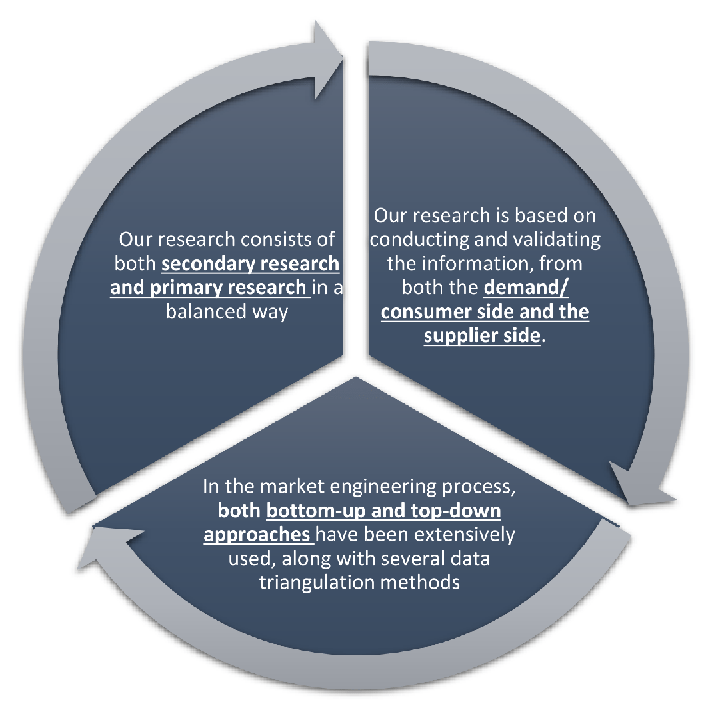
Our research design integrates both demand-side and supply-side analysis through a balanced combination of primary and secondary research methodologies. By utilizing both bottom-up and top-down approaches alongside rigorous data triangulation methods, we deliver robust market intelligence that supports strategic decision-making.
MarketGenics' comprehensive research design framework ensures the delivery of accurate, reliable, and actionable market intelligence. Through the integration of multiple research approaches, rigorous validation processes, and expert analysis, we provide our clients with the insights needed to make informed strategic decisions and capitalize on market opportunities.
MarketGenics leverages a dedicated industry panel of experts and a comprehensive suite of paid databases to effectively collect, consolidate, and analyze market intelligence.
Our approach has consistently proven to be reliable and effective in generating accurate market insights, identifying key industry trends, and uncovering emerging business opportunities.
Through both primary and secondary research, we capture and analyze critical company-level data such as manufacturing footprints, including technical centers, R&D facilities, sales offices, and headquarters.
Our expert panel further enhances our ability to estimate market size for specific brands based on validated field-level intelligence.
Our data mining techniques incorporate both parametric and non-parametric methods, allowing for structured data collection, sorting, processing, and cleaning.
Demand projections are derived from large-scale data sets analyzed through proprietary algorithms, culminating in robust and reliable market sizing.
Research Approach
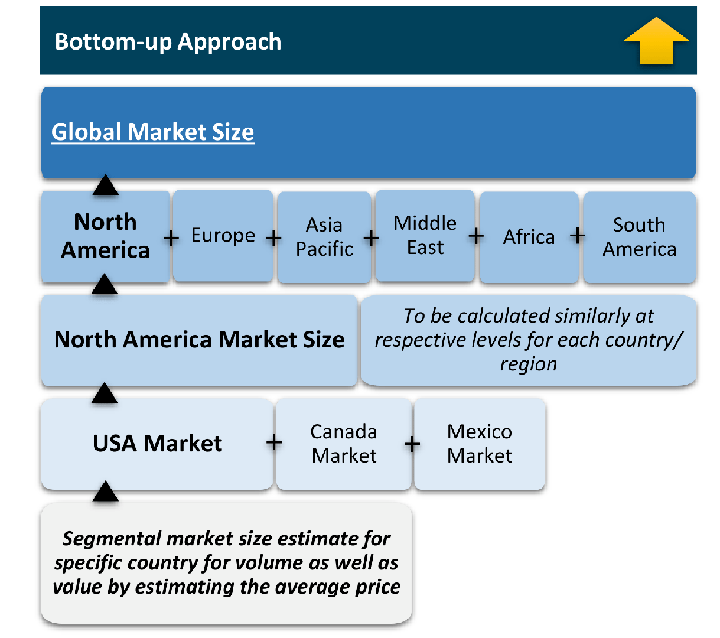
The bottom-up approach builds market estimates by starting with the smallest addressable market units and systematically aggregating them to create comprehensive market size projections.
This method begins with specific, granular data points and builds upward to create the complete market landscape.
Customer Analysis → Segmental Analysis → Geographical Analysis
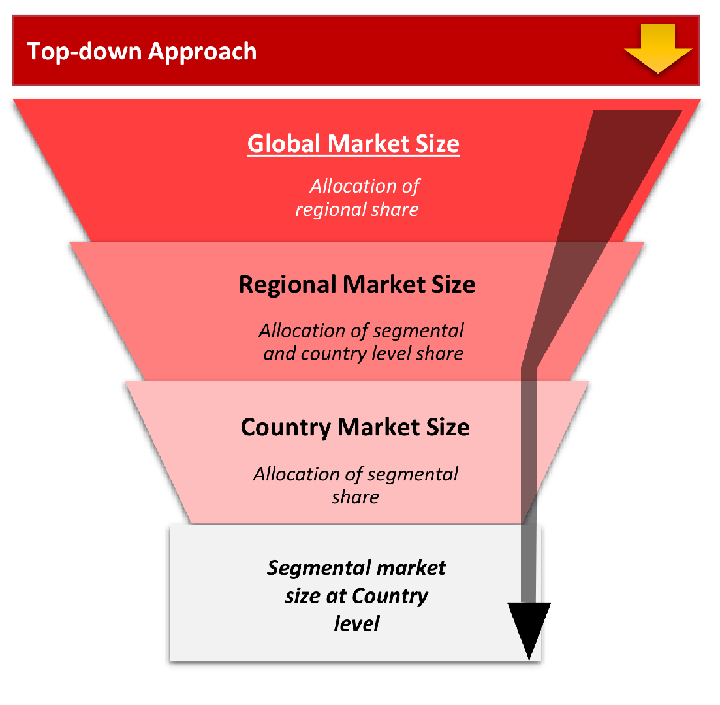
The top-down approach starts with the broadest possible market data and systematically narrows it down through a series of filters and assumptions to arrive at specific market segments or opportunities.
This method begins with the big picture and works downward to increasingly specific market slices.
TAM → SAM → SOM
Research Methods
Desk / Secondary Research
While analysing the market, we extensively study secondary sources, directories, and databases to identify and collect information useful for this technical, market-oriented, and commercial report. Secondary sources that we utilize are not only the public sources, but it is a combination of Open Source, Associations, Paid Databases, MG Repository & Knowledgebase, and others.
- Company websites, annual reports, financial reports, broker reports, and investor presentations
- National government documents, statistical databases and reports
- News articles, press releases and web-casts specific to the companies operating in the market, Magazines, reports, and others
- We gather information from commercial data sources for deriving company specific data such as segmental revenue, share for geography, product revenue, and others
- Internal and external proprietary databases (industry-specific), relevant patent, and regulatory databases
- Governing Bodies, Government Organizations
- Relevant Authorities, Country-specific Associations for Industries
We also employ the model mapping approach to estimate the product level market data through the players' product portfolio
Primary Research
Primary research/ interviews is vital in analyzing the market. Most of the cases involves paid primary interviews. Primary sources include primary interviews through e-mail interactions, telephonic interviews, surveys as well as face-to-face interviews with the different stakeholders across the value chain including several industry experts.
| Type of Respondents | Number of Primaries |
|---|---|
| Tier 2/3 Suppliers | ~20 |
| Tier 1 Suppliers | ~25 |
| End-users | ~25 |
| Industry Expert/ Panel/ Consultant | ~30 |
| Total | ~100 |
MG Knowledgebase
• Repository of industry blog, newsletter and case studies
• Online platform covering detailed market reports, and company profiles
Forecasting Factors and Models
Forecasting Factors
- Historical Trends – Past market patterns, cycles, and major events that shaped how markets behave over time. Understanding past trends helps predict future behavior.
- Industry Factors – Specific characteristics of the industry like structure, regulations, and innovation cycles that affect market dynamics.
- Macroeconomic Factors – Economic conditions like GDP growth, inflation, and employment rates that affect how much money people have to spend.
- Demographic Factors – Population characteristics like age, income, and location that determine who can buy your product.
- Technology Factors – How quickly people adopt new technology and how much technology infrastructure exists.
- Regulatory Factors – Government rules, laws, and policies that can help or restrict market growth.
- Competitive Factors – Analyzing competition structure such as degree of competition and bargaining power of buyers and suppliers.
Forecasting Models / Techniques
Multiple Regression Analysis
- Identify and quantify factors that drive market changes
- Statistical modeling to establish relationships between market drivers and outcomes
Time Series Analysis – Seasonal Patterns
- Understand regular cyclical patterns in market demand
- Advanced statistical techniques to separate trend, seasonal, and irregular components
Time Series Analysis – Trend Analysis
- Identify underlying market growth patterns and momentum
- Statistical analysis of historical data to project future trends
Expert Opinion – Expert Interviews
- Gather deep industry insights and contextual understanding
- In-depth interviews with key industry stakeholders
Multi-Scenario Development
- Prepare for uncertainty by modeling different possible futures
- Creating optimistic, pessimistic, and most likely scenarios
Time Series Analysis – Moving Averages
- Sophisticated forecasting for complex time series data
- Auto-regressive integrated moving average models with seasonal components
Econometric Models
- Apply economic theory to market forecasting
- Sophisticated economic models that account for market interactions
Expert Opinion – Delphi Method
- Harness collective wisdom of industry experts
- Structured, multi-round expert consultation process
Monte Carlo Simulation
- Quantify uncertainty and probability distributions
- Thousands of simulations with varying input parameters
Research Analysis
Our research framework is built upon the fundamental principle of validating market intelligence from both demand and supply perspectives. This dual-sided approach ensures comprehensive market understanding and reduces the risk of single-source bias.
Demand-Side Analysis: We understand end-user/application behavior, preferences, and market needs along with the penetration of the product for specific application.
Supply-Side Analysis: We estimate overall market revenue, analyze the segmental share along with industry capacity, competitive landscape, and market structure.
Validation & Evaluation
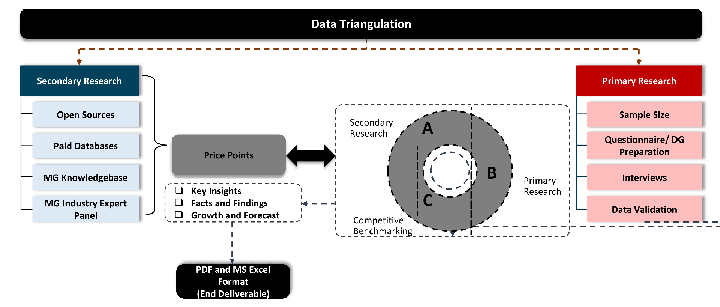
Data triangulation is a validation technique that uses multiple methods, sources, or perspectives to examine the same research question, thereby increasing the credibility and reliability of research findings. In market research, triangulation serves as a quality assurance mechanism that helps identify and minimize bias, validate assumptions, and ensure accuracy in market estimates.
- Data Source Triangulation – Using multiple data sources to examine the same phenomenon
- Methodological Triangulation – Using multiple research methods to study the same research question
- Investigator Triangulation – Using multiple researchers or analysts to examine the same data
- Theoretical Triangulation – Using multiple theoretical perspectives to interpret the same data
Custom Market Research Services
We will customise the research for you, in case the report listed above does not meet your requirements.
Get 10% Free Customisation