Gut Microbiome Market Size, Share & Trends Analysis Product Type (Probiotics, Prebiotics, Synbiotics, Postbiotics, Live Biotherapeutic Products, Fecal Microbiota Transplantation Products, Microbiome Diagnostics, Microbiome-Based Medical Foods, Gut Health Supplements), Technology, Application, Route of Administration, Age Group, End User, and Geography (North America, Europe, Asia Pacific, Middle East, Africa, and South America) – Global Industry Data, Trends, and Forecasts, 2026–2035
|
|
|
Segmental Data Insights |
|
|
Demand Trends |
|
|
Competitive Landscape |
|
|
Strategic Development |
|
|
Future Outlook & Opportunities |
|
Gut-Microbiome-Market Size, Share, and Growth
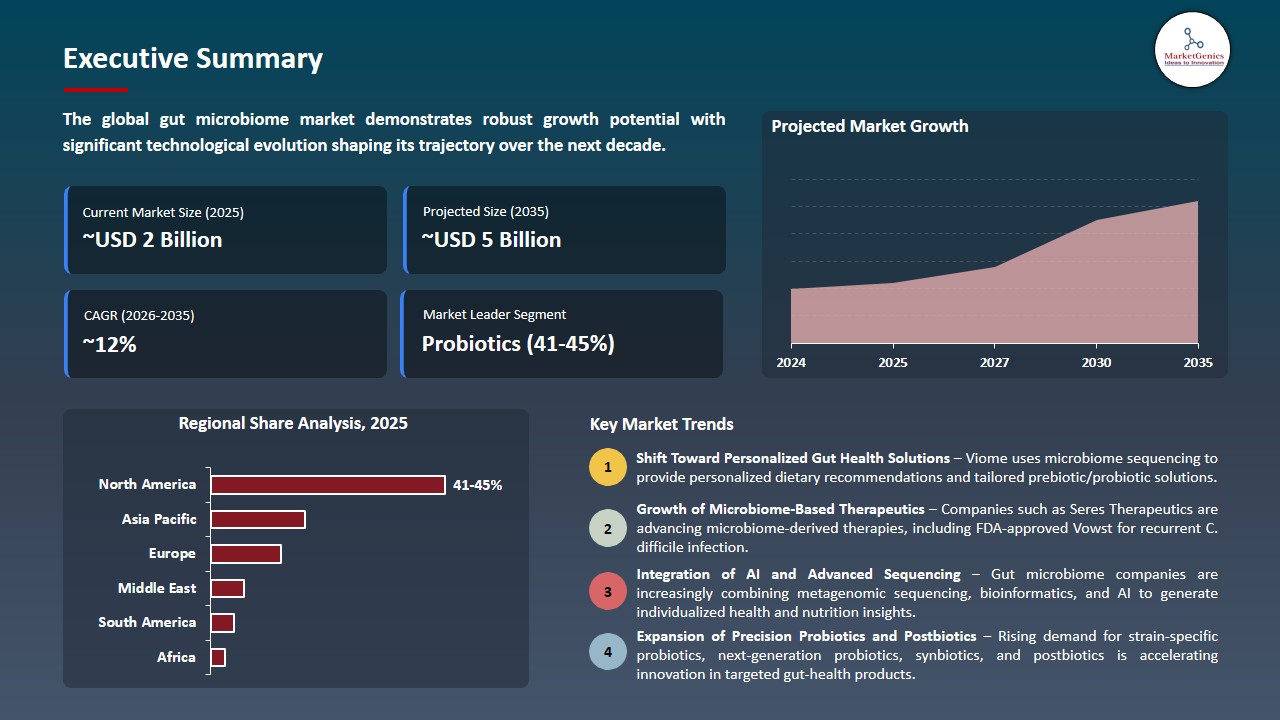
The global gut microbiome market is witnessing strong growth, valued at USD 1.7 billion in 2025 and projected to reach USD 5.1 billion by 2035, expanding at a CAGR of 11.6% during the forecast period.
Anil K.C., Founder & CEO of LONGENY, said, India is in the middle of a health crisis that most people don’t recognise. Gut dysfunction is driving everything from low energy to hormonal instability to severe metabolic disease, yet it remains invisible in routine check-ups. truGut360 makes the invisible visible. When individuals understand what’s happening inside their gut, they finally get the clarity and direction needed to take control of their health today, not years later.
The gut microbiome market is transitioning from digestive health products to a more advanced, microbial makeup, host–microbe interaction, and measurable biological outcome-based ecosystem. Beyond probiotics, microbial solutions are being developed to address specific problems, microbial metabolites, microbial biomarkers, live biotherapeutics and precision nutrition platforms are being developed to address digestive, metabolic, immune, and preventive healthcare problems.
Market participants are increasingly exploring the gut microbiome as a foundation for targeted health innovation, with development expanding across strain-specific probiotics, postbiotics, live biotherapeutics, microbial biomarkers, microbiome testing, and personalized nutrition. Firms are leveraging genomic sequencing, metabolomics, and computational analysis alongside microbial research to gain insights into the specific health outcomes and create targeted interventions. It is paving the way for widespread use and new opportunities for differentiation and commercial growth in digestive, metabolic, immunologic and prevention health, all while remaining as safe and effective as possible.
Adjacent opportunities are being formed by microbiome sequencing, the discovery of microbial biomarkers, defined bacterial consortia, an AI-assisted interpretation, the development of microbiota derived therapeutics, and personalized dietary intervention. The incorporation of microbiome information into clinical research and digital health applications is also expanding the market's reach, making the gut microbiome industry a cross-section of precision healthcare, biotechnology, nutrition science and preventive medicine.
Gut Microbiome market Dynamics and Trends
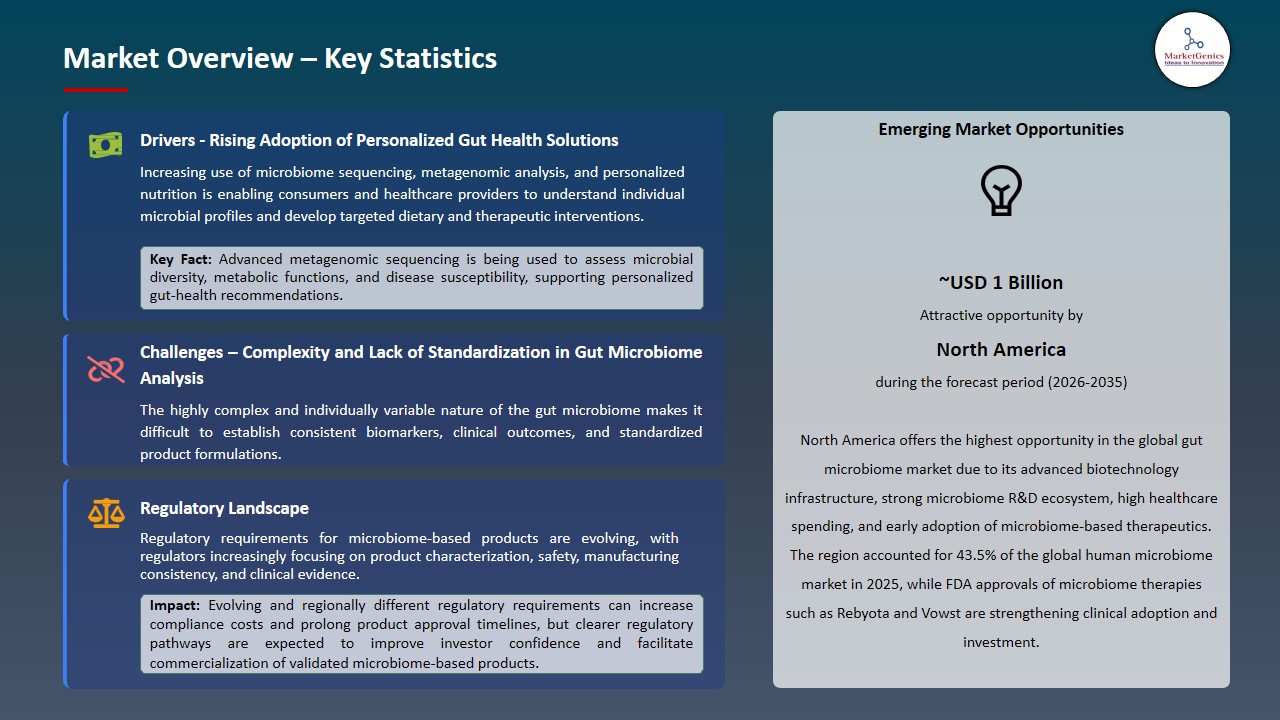
Driver: Growing Clinical Translation of Microbiome Science
- The global microbiome market is expanding due to the translation of microbiome discoveries to clinically validated diagnostics, therapeutics and targeted nutritional interventions, as pharmaceutical and biotechnology companies look to transform microbial biomarkers and host–microbial relationships into commercially viable healthcare applications.
- Companies are moving microbiome-based candidates into clinical development for specific disease indications. For instance, in May 2026, Osel Inc., Imperial College London, and March of Dimes launched the Phase 2b FLIP-2 trial to evaluate LACTIN-V, a live biotherapeutic product containing Lactobacillus crispatus designed to restore the microbiome and prevent preterm birth, demonstrating the advancement of microbiome science toward targeted clinical therapies.
- Clinical validation, regulatory pathway advancement, disease-specific microbiome research, and investment in live therapeutics are driving the commercialization of microbiome science and advancing beyond the traditional probiotics/functional food arena.
Restraint: Limited Standardization of Microbiome Analysis
- Lack of universally agreed standards for sample collection, sequencing techniques, microbial classification, and interpretation of microbiome data are limiting the gut microbiome market. Variations in methods used in analysis can yield different results for the same biological sample, which can create a challenge for companies and health care providers to set consistent standards in the field of microbiome-based products and services.
- The abundance and identification of microbes may differ due to laboratory procedures, sequencing platforms, reference databases and bioinformatics pipelines. This poses problems in comparing clinical studies, validating diagnostic platforms and to illustrate uniform effectiveness within populations and to develop microbial biomarkers that are universally applicable, since gut microbiota is so individualistic.
- Limited standardization increases validation costs, development timelines, regulatory complexity, and uncertainty in microbiome-based product performance, restricting broader commercialization.
Opportunity: Expansion of Personalized Microbiome-Based Healthcare
- The growing availability of individual microbiome profiling, metagenomic sequencing, and AI-powered interpretation is creating opportunities for personalized gut-health solutions tailored to individual microbial composition, dietary patterns, and health objectives. This change allows companies to go beyond generic probiotic offerings to data-driven nutrition and microbiome-targeted interventions.
- AI is being paired with microbiome data to create more tailored health applications for companies. In April 2026, AMILI and Google announced the development of AMILI Optimise, a personalised nutrition app that uses gut microbiome data, diet input, and blood-glucose response to AI to provide individual nutrition recommendations.
- Personalized nutrition, microbiome diagnostics, AI-powered health analytics, personalized probiotics recommendations, and individual therapeutic approaches represent significant growth areas in the global microbiome market, allowing companies to build more valuable products in preventive health, nutrition, wellness, and clinical applications.
Key Trend: Shift toward Next-Generation Microbiome Therapeutics
- The gut microbiome market is transforming from the traditional probiotic supplement approach to precision therapeutics that target specific microbial communities, metabolic pathways and disease associated microbial functions. Developers are working on the use of defined microbial consortia, live biotherapeutic products and engineered bacterial strains to generate more predictable and tailored therapeutic effects.
- The increasing clinical evidence and the ability to characterize the microbiome are helping pharmaceutical and biotechnology companies progress towards therapeutic candidates from the microbiome for gastrointestinal, inflammatory, metabolic and immune-related diseases. In April 2026, Vedanta Biosciences announced that it plans to proceed with its Phase 3 RESTORATiVE303 study of its defined eight-strain bacterial consortium against the prevention of recurrent C. difficile infection following an interim analysis.
- Clinically differentiated treatment is made possible by precision strain selection, defined microbial consortia, live biotherapeutics, engineered microbes, and targeted microbiome restoration, all of which are major trends.
Gut Microbiome Market Analysis and Segmental Data
Probiotics Dominate Global Gut Microbiome Market
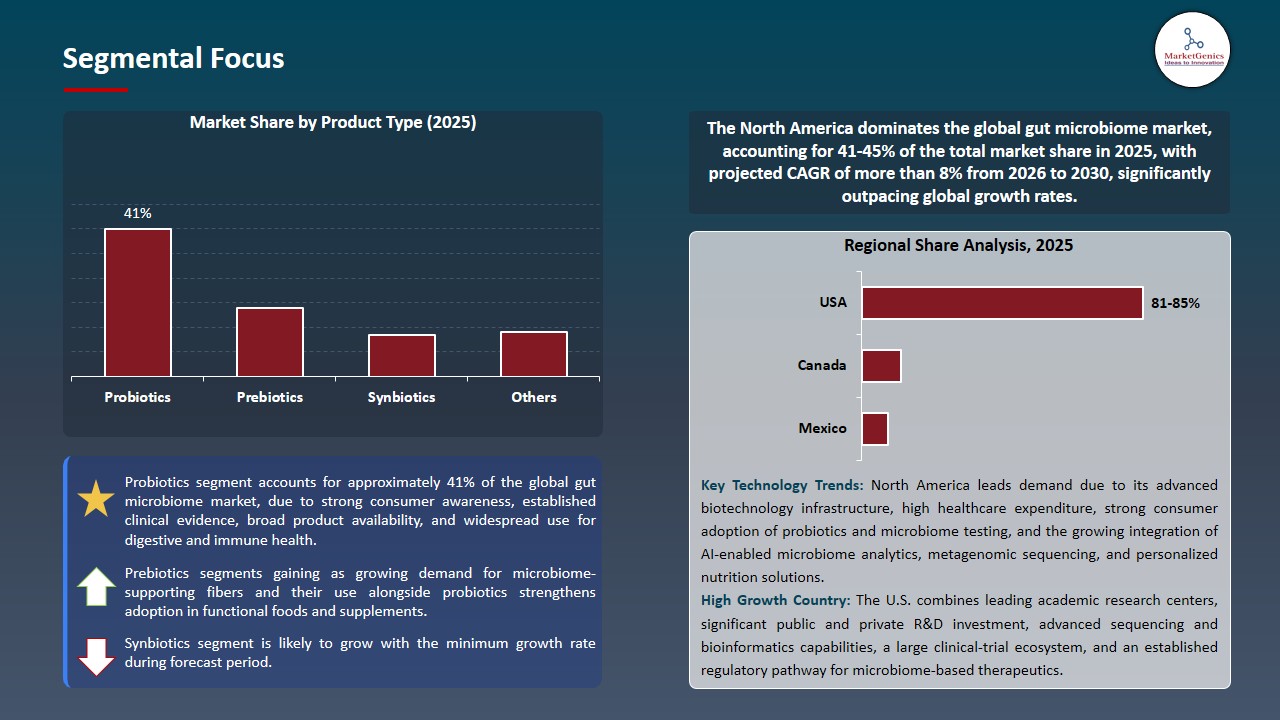
- Probiotics leads the global gut microbiome market, with well-established applications in supporting the microbial balance and wide-spreading incorporation into the functional foods, fermented foods, dietary supplements, and targeted gut-health products.
- Companies are making tailored microbiome solutions, with probiotic–prebiotic combinations helping to strengthen the commercial position of the segment. For instance, in September 2025, Novonesis and Novo Nordisk entered a research partnership to develop and test synbiotic food supplements combining probiotics and prebiotics, while investigating the gut microbiome's role in metabolic health and related biomarkers.
- The global gut microbiome market is poised to remain in the forefront, with growing applications in nutrition, preventive wellness, and metabolic health, backed by clinical research and strain development.
North America Leads Global Gut Microbiome Market Demand
- North America leads the global gut microbiome market, with the presence of a large number of companies in the field of biotechnology, robust genomic research infrastructure, and the growing significance of microbial analysis within precision nutrition and healthcare. The area has also gained a number of clinical research networks to help translate microbiome discoveries into diagnostics, nutrition and therapeutics.
- Regional demand is bolstered by clinical commercialization and personalized microbiome testing. In May 2026, resbiotic introduced its at-home Gut Health Test, for which detailed microbiome analysis and specific recommendations are created based on shotgun metagenomic sequencing, which is processed in CLIA and CAP certified laboratory facilities, in the U.S.
- Advanced metagenomic sequencing, bioinformatics, and personalized microbiome platforms continue to drive North America's lead in advancing targeted gut health testing and solutions to microbiome data.
Gut Microbiome Market Ecosystem
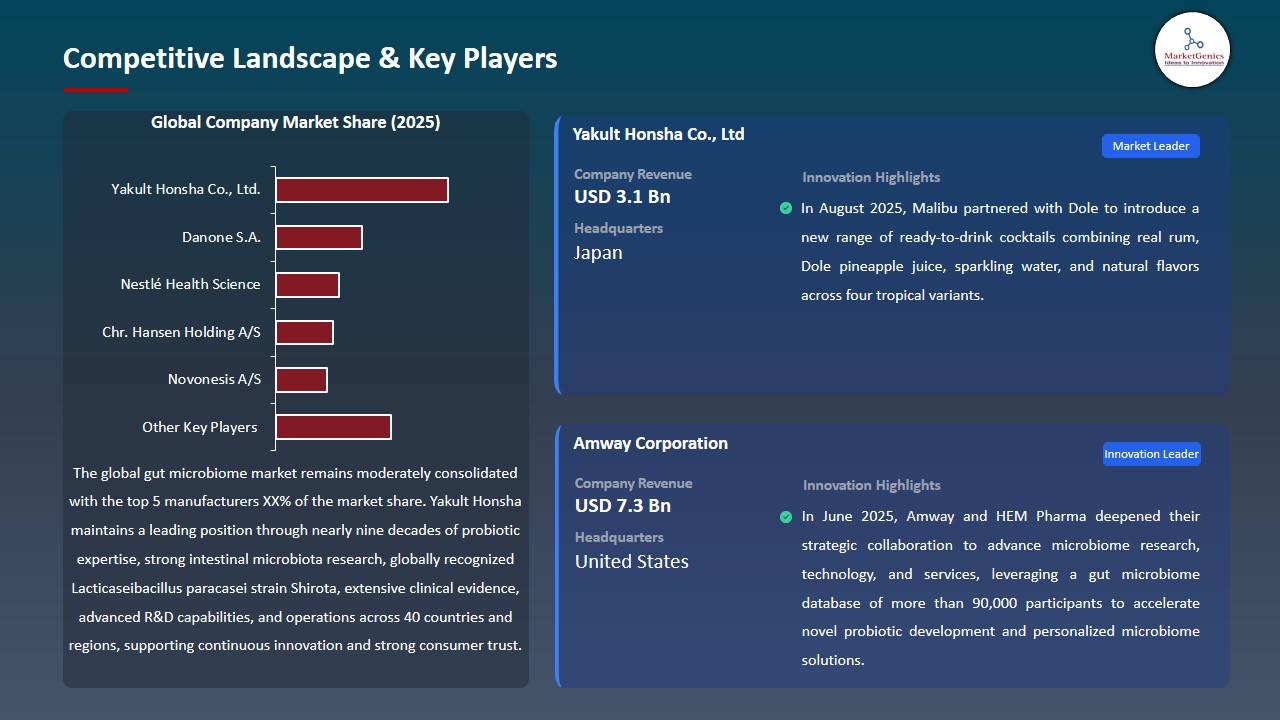
The gut microbiome market is moderately consolidated, with market participants expanding their portfolios across probiotics, prebiotics, synbiotics, postbiotics, microbiome testing, and targeted nutritional solutions. As scientific knowledge of microbial diversity and its relationship to digestive, immune, metabolic and general health continues to evolve, companies are increasingly investing in developing new strains, conducting clinical trials, formulating new products and innovating in the realm of the microbiome.
Key players in the market are Yakult Honsha Co., Ltd., Danone S.A., Nestlé Health Science, Chr., among others. Hansen Holding A/S and Novonesis A/S, which are engaged in probiotics products, fermented food, microbial strains, nutritional solutions, and microbiome related technologies. There is a growing focus on clinically proven strains, active formulations, digestive health products and unique microbial solutions to meet changing consumer and health-care needs.
Microbiome research, strain-specific product development, clinical validation, fermentation technologies, personalized nutrition, and strategic research collaborations are additional strengths that help shape the competitive environment. Leading companies are expanding their portfolio to address emerging applications in the microbiome, including daily probiotic and fermented food products, microbial ingredients and precision gut health solutions, opening up potential market access across food and nutrition, healthcare, and consumer wellness channels.
Recent Development and Strategic Overview
- In June 2025, Amway and HEM Pharma expanded their strategic collaboration to expedite microbiome research, technologies, and services, using a microbiome database with over 90,000 participants to support the development of new probiotics and personalized microbiome therapeutics.
- In December 2025, LONGENY launched truGut360, an at-home gut microbiome testing solution developed with Austria-based MyBioma, providing personalized microbiome insights and supporting the expansion of precision gut-health diagnostics in India.
Report Scope
|
Detail |
|
|
Market Size in 2025 |
USD 1.7 Bn |
|
Market Forecast Value in 2035 |
USD 5.1 Bn |
|
Growth Rate (CAGR) |
11.6% |
|
Forecast Period |
2026 – 2035 |
|
Historical Data Available for |
2021 – 2024 |
|
Market Size Units |
US$ Billion for Value |
|
Report Format |
Electronic (PDF) + Excel |
|
North America |
Europe |
Asia Pacific |
Middle East |
Africa |
South America |
|
|
|
|
|
|
|
Companies Covered |
|||||
|
|
|
||||
Gut Microbiome Market Segmentation and Highlights
|
Segment |
Sub-segment |
|
Gut Microbiome Market, By Product Type |
|
|
Gut Microbiome Market, By Technology |
|
|
Gut Microbiome Market, By Application |
|
|
Gut Microbiome Market, By Route of Administration |
|
|
Gut Microbiome Market, By Age Group |
|
|
Gut Microbiome Market, By End User |
|
Frequently Asked Questions
Table of Contents
- 1. Research Methodology and Assumptions
- 1.1. Definitions
- 1.2. Research Design and Approach
- 1.3. Data Collection Methods
- 1.4. Base Estimates and Calculations
- 1.5. Forecasting Models
- 1.5.1. Key Forecast Factors & Impact Analysis
- 1.6. Secondary Research
- 1.6.1. Open Sources
- 1.6.2. Paid Databases
- 1.6.3. Associations
- 1.7. Primary Research
- 1.7.1. Primary Sources
- 1.7.2. Primary Interviews with Stakeholders across Ecosystem
- 2. Executive Summary
- 2.1. Global Gut Microbiome Market Outlook
- 2.1.1. Gut Microbiome Market Size (Value - US$ Bn), and Forecasts, 2021-2035
- 2.1.2. Compounded Annual Growth Rate Analysis
- 2.1.3. Growth Opportunity Analysis
- 2.1.4. Segmental Share Analysis
- 2.1.5. Geographical Share Analysis
- 2.2. Market Analysis and Facts
- 2.3. Supply-Demand Analysis
- 2.4. Competitive Benchmarking
- 2.5. Go-to- Market Strategy
- 2.5.1. Customer/ End-use Industry Assessment
- 2.5.2. Growth Opportunity Data, 2026-2035
- 2.5.2.1. Regional Data
- 2.5.2.2. Country Data
- 2.5.2.3. Segmental Data
- 2.5.3. Identification of Potential Market Spaces
- 2.5.4. GAP Analysis
- 2.5.5. Potential Attractive Price Points
- 2.5.6. Prevailing Market Risks & Challenges
- 2.5.7. Preferred Sales & Marketing Strategies
- 2.5.8. Key Recommendations and Analysis
- 2.5.9. A Way Forward
- 2.1. Global Gut Microbiome Market Outlook
- 3. Industry Data and Premium Insights
- 3.1. Global Food & Beverages Industry Overview, 2025
- 3.1.1. Food & Beverages Industry Ecosystem Analysis
- 3.1.2. Key Trends for Food & Beverages Industry
- 3.1.3. Regional Distribution for Food & Beverages Industry
- 3.2. Supplier Customer Data
- 3.3. Technology Roadmap and Developments
- 3.1. Global Food & Beverages Industry Overview, 2025
- 4. Market Overview
- 4.1. Market Dynamics
- 4.1.1. Drivers
- 4.1.1.1. Rising Awareness of Gut Health and Preventive Healthcare
- 4.1.1.2. Increasing Prevalence of Gastrointestinal, Metabolic, and Chronic Diseases
- 4.1.1.3. Growing Adoption of Personalized Nutrition and Microbiome-Based Therapies
- 4.1.2. Restraints
- 4.1.2.1. Regulatory Complexity and Lack of Harmonized Microbiome-Specific Guidelines
- 4.1.2.2. High R&D and Clinical Validation Costs for Microbiome-Based Products
- 4.1.1. Drivers
- 4.2. Key Trend Analysis
- 4.3. Regulatory Framework
- 4.3.1. Key Regulations, Norms, and Subsidies, by Key Countries
- 4.3.2. Tariffs and Standards
- 4.3.3. Impact Analysis of Regulations on the Market
- 4.4. Ecosystem Analysis
- 4.5. Porter’s Five Forces Analysis
- 4.6. PESTEL Analysis
- 4.7. Global Gut Microbiome Market Demand
- 4.7.1. Historical Market Size – Value (US$ Bn), 2020-2024
- 4.7.2. Current and Future Market Size – Value (US$ Bn), 2026–2035
- 4.7.2.1. Y-o-Y Growth Trends
- 4.7.2.2. Absolute $ Opportunity Assessment
- 4.1. Market Dynamics
- 5. Competition Landscape
- 5.1. Competition structure
- 5.1.1. Fragmented v/s consolidated
- 5.2. Company Share Analysis, 2025
- 5.2.1. Global Company Market Share
- 5.2.2. By Region
- 5.2.2.1. North America
- 5.2.2.2. Europe
- 5.2.2.3. Asia Pacific
- 5.2.2.4. Middle East
- 5.2.2.5. Africa
- 5.2.2.6. South America
- 5.3. Product Comparison Matrix
- 5.3.1. Specifications
- 5.3.2. Market Positioning
- 5.3.3. Pricing
- 5.1. Competition structure
- 6. Global Gut Microbiome Market Analysis, by Product Type
- 6.1. Key Segment Analysis
- 6.2. Gut Microbiome Market Size (Value - US$ Bn), Analysis, and Forecasts, by Product Type, 2021-2035
- 6.2.1. Probiotics
- 6.2.2. Prebiotics
- 6.2.3. Synbiotics
- 6.2.4. Postbiotics
- 6.2.5. Live Biotherapeutic Products
- 6.2.6. Fecal Microbiota Transplantation Products
- 6.2.7. Microbiome Diagnostics
- 6.2.7.1. Sequencing-based Diagnostics
- 6.2.7.2. PCR-based Diagnostics
- 6.2.7.3. Other Diagnostic Kits
- 6.2.8. Microbiome-Based Medical Foods
- 6.2.9. Gut Health Supplements
- 7. Global Gut Microbiome Market Analysis, by Technology
- 7.1. Key Segment Analysis
- 7.2. Gut Microbiome Market Size (Value - US$ Bn), Analysis, and Forecasts, by Technology, 2021-2035
- 7.2.1. Next-Generation Sequencing (NGS)
- 7.2.2. Polymerase Chain Reaction (PCR)
- 7.2.3. Spectroscopy
- 7.2.4. Chromatography
- 7.2.5. Flow Cytometry
- 7.2.6. Microarray Technology
- 7.2.7. Others (Metabolomics, Culturomics, etc.)
- 8. Global Gut Microbiome Market Analysis, by Application
- 8.1. Key Segment Analysis
- 8.2. Gut Microbiome Market Size (Value - US$ Bn), Analysis, and Forecasts, by Application, 2021-2035
- 8.2.1. Obesity & Metabolic Disorders
- 8.2.2. Diabetes
- 8.2.3. Inflammatory Bowel Disease
- 8.2.4. Cancer
- 8.2.5. Autoimmune Diseases
- 8.2.6. Neurological Disorders (Gut-Brain Axis)
- 8.2.7. Cardiovascular Diseases
- 8.2.8. Skin Diseases
- 8.2.9. Others (Allergies, Infections, etc.)
- 9. Global Gut Microbiome Market Analysis, by Route of Administration
- 9.1. Key Segment Analysis
- 9.2. Gut Microbiome Market Size (Value - US$ Bn), Analysis, and Forecasts, by Route of Administration, 2021-2035
- 9.2.1. Oral
- 9.2.2. Topical
- 9.2.3. Others (Rectal/Fecal Transplant-based)
- 10. Global Gut Microbiome Market Analysis, by Age Group
- 10.1. Key Segment Analysis
- 10.2. Gut Microbiome Market Size (Value - US$ Bn), Analysis, and Forecasts, by Age Group, 2021-2035
- 10.2.1. Pediatric
- 10.2.2. Adult
- 10.2.3. Geriatric
- 11. Global Gut Microbiome Market Analysis, by End User
- 11.1. Key Segment Analysis
- 11.2. Gut Microbiome Market Size (Value - US$ Bn), Analysis, and Forecasts, by End User, 2021-2035
- 11.2.1. Hospitals & Clinics
- 11.2.2. Diagnostic & Reference Laboratories
- 11.2.3. Academic & Research Institutes
- 11.2.4. Pharmaceutical & Biotechnology Companies
- 11.2.5. Contract Research Organizations (CROs)
- 11.2.6. Home Care Settings
- 12. Global Gut Microbiome Market Analysis and Forecasts, by Region
- 12.1. Key Findings
- 12.2. Gut Microbiome Market Size (Value - US$ Bn), Analysis, and Forecasts, by Region, 2021-2035
- 12.2.1. North America
- 12.2.2. Europe
- 12.2.3. Asia Pacific
- 12.2.4. Middle East
- 12.2.5. Africa
- 12.2.6. South America
- 13. North America Gut Microbiome Market Analysis
- 13.1. Key Segment Analysis
- 13.2. Regional Snapshot
- 13.3. North America Gut Microbiome Market Size (Value - US$ Bn), Analysis, and Forecasts, 2021-2035
- 13.3.1. Product Type
- 13.3.2. Technology
- 13.3.3. Application
- 13.3.4. Route of Administration
- 13.3.5. Age Group
- 13.3.6. End User
- 13.3.7. Country
- 13.3.7.1. USA
- 13.3.7.2. Canada
- 13.3.7.3. Mexico
- 13.4. USA Gut Microbiome Market
- 13.4.1. Country Segmental Analysis
- 13.4.2. Product Type
- 13.4.3. Technology
- 13.4.4. Application
- 13.4.5. Route of Administration
- 13.4.6. Age Group
- 13.4.7. End User
- 13.5. Canada Gut Microbiome Market
- 13.5.1. Country Segmental Analysis
- 13.5.2. Product Type
- 13.5.3. Technology
- 13.5.4. Application
- 13.5.5. Route of Administration
- 13.5.6. Age Group
- 13.5.7. End User
- 13.6. Mexico Gut Microbiome Market
- 13.6.1. Country Segmental Analysis
- 13.6.2. Product Type
- 13.6.3. Technology
- 13.6.4. Application
- 13.6.5. Route of Administration
- 13.6.6. Age Group
- 13.6.7. End User
- 14. Europe Gut Microbiome Market Analysis
- 14.1. Key Segment Analysis
- 14.2. Regional Snapshot
- 14.3. Europe Gut Microbiome Market Size (Value - US$ Bn), Analysis, and Forecasts, 2021-2035
- 14.3.1. Product Type
- 14.3.2. Technology
- 14.3.3. Application
- 14.3.4. Route of Administration
- 14.3.5. Age Group
- 14.3.6. End User
- 14.3.7. Country
- 14.3.7.1. Germany
- 14.3.7.2. United Kingdom
- 14.3.7.3. France
- 14.3.7.4. Italy
- 14.3.7.5. Spain
- 14.3.7.6. Netherlands
- 14.3.7.7. Nordic Countries
- 14.3.7.8. Poland
- 14.3.7.9. Russia & CIS
- 14.3.7.10. Rest of Europe
- 14.4. Germany Gut Microbiome Market
- 14.4.1. Country Segmental Analysis
- 14.4.2. Product Type
- 14.4.3. Technology
- 14.4.4. Application
- 14.4.5. Route of Administration
- 14.4.6. Age Group
- 14.4.7. End User
- 14.5. United Kingdom Gut Microbiome Market
- 14.5.1. Country Segmental Analysis
- 14.5.2. Product Type
- 14.5.3. Technology
- 14.5.4. Application
- 14.5.5. Route of Administration
- 14.5.6. Age Group
- 14.5.7. End User
- 14.6. France Gut Microbiome Market
- 14.6.1. Country Segmental Analysis
- 14.6.2. Product Type
- 14.6.3. Technology
- 14.6.4. Application
- 14.6.5. Route of Administration
- 14.6.6. Age Group
- 14.6.7. End User
- 14.7. Italy Gut Microbiome Market
- 14.7.1. Country Segmental Analysis
- 14.7.2. Product Type
- 14.7.3. Technology
- 14.7.4. Application
- 14.7.5. Route of Administration
- 14.7.6. Age Group
- 14.7.7. End User
- 14.8. Spain Gut Microbiome Market
- 14.8.1. Country Segmental Analysis
- 14.8.2. Product Type
- 14.8.3. Technology
- 14.8.4. Application
- 14.8.5. Route of Administration
- 14.8.6. Age Group
- 14.8.7. End User
- 14.9. Netherlands Gut Microbiome Market
- 14.9.1. Country Segmental Analysis
- 14.9.2. Product Type
- 14.9.3. Technology
- 14.9.4. Application
- 14.9.5. Route of Administration
- 14.9.6. Age Group
- 14.9.7. End User
- 14.10. Nordic Countries Gut Microbiome Market
- 14.10.1. Country Segmental Analysis
- 14.10.2. Product Type
- 14.10.3. Technology
- 14.10.4. Application
- 14.10.5. Route of Administration
- 14.10.6. Age Group
- 14.10.7. End User
- 14.11. Poland Gut Microbiome Market
- 14.11.1. Country Segmental Analysis
- 14.11.2. Product Type
- 14.11.3. Technology
- 14.11.4. Application
- 14.11.5. Route of Administration
- 14.11.6. Age Group
- 14.11.7. End User
- 14.12. Russia & CIS Gut Microbiome Market
- 14.12.1. Country Segmental Analysis
- 14.12.2. Product Type
- 14.12.3. Technology
- 14.12.4. Application
- 14.12.5. Route of Administration
- 14.12.6. Age Group
- 14.12.7. End User
- 14.13. Rest of Europe Gut Microbiome Market
- 14.13.1. Country Segmental Analysis
- 14.13.2. Product Type
- 14.13.3. Technology
- 14.13.4. Application
- 14.13.5. Route of Administration
- 14.13.6. Age Group
- 14.13.7. End User
- 15. Asia Pacific Gut Microbiome Market Analysis
- 15.1. Key Segment Analysis
- 15.2. Regional Snapshot
- 15.3. Asia Pacific Gut Microbiome Market Size (Value - US$ Bn), Analysis, and Forecasts, 2021-2035
- 15.3.1. Product Type
- 15.3.2. Technology
- 15.3.3. Application
- 15.3.4. Route of Administration
- 15.3.5. Age Group
- 15.3.6. End User
- 15.3.7. Country
- 15.3.7.1. China
- 15.3.7.2. India
- 15.3.7.3. Japan
- 15.3.7.4. South Korea
- 15.3.7.5. Australia and New Zealand
- 15.3.7.6. Indonesia
- 15.3.7.7. Malaysia
- 15.3.7.8. Thailand
- 15.3.7.9. Vietnam
- 15.3.7.10. Rest of Asia Pacific
- 15.4. China Gut Microbiome Market
- 15.4.1. Country Segmental Analysis
- 15.4.2. Product Type
- 15.4.3. Technology
- 15.4.4. Application
- 15.4.5. Route of Administration
- 15.4.6. Age Group
- 15.4.7. End User
- 15.5. India Gut Microbiome Market
- 15.5.1. Country Segmental Analysis
- 15.5.2. Product Type
- 15.5.3. Technology
- 15.5.4. Application
- 15.5.5. Route of Administration
- 15.5.6. Age Group
- 15.5.7. End User
- 15.6. Japan Gut Microbiome Market
- 15.6.1. Country Segmental Analysis
- 15.6.2. Product Type
- 15.6.3. Technology
- 15.6.4. Application
- 15.6.5. Route of Administration
- 15.6.6. Age Group
- 15.6.7. End User
- 15.7. South Korea Gut Microbiome Market
- 15.7.1. Country Segmental Analysis
- 15.7.2. Product Type
- 15.7.3. Technology
- 15.7.4. Application
- 15.7.5. Route of Administration
- 15.7.6. Age Group
- 15.7.7. End User
- 15.8. Australia and New Zealand Gut Microbiome Market
- 15.8.1. Country Segmental Analysis
- 15.8.2. Product Type
- 15.8.3. Technology
- 15.8.4. Application
- 15.8.5. Route of Administration
- 15.8.6. Age Group
- 15.8.7. End User
- 15.9. Indonesia Gut Microbiome Market
- 15.9.1. Country Segmental Analysis
- 15.9.2. Product Type
- 15.9.3. Technology
- 15.9.4. Application
- 15.9.5. Route of Administration
- 15.9.6. Age Group
- 15.9.7. End User
- 15.10. Malaysia Gut Microbiome Market
- 15.10.1. Country Segmental Analysis
- 15.10.2. Product Type
- 15.10.3. Technology
- 15.10.4. Application
- 15.10.5. Route of Administration
- 15.10.6. Age Group
- 15.10.7. End User
- 15.11. Thailand Gut Microbiome Market
- 15.11.1. Country Segmental Analysis
- 15.11.2. Product Type
- 15.11.3. Technology
- 15.11.4. Application
- 15.11.5. Route of Administration
- 15.11.6. Age Group
- 15.11.7. End User
- 15.12. Vietnam Gut Microbiome Market
- 15.12.1. Country Segmental Analysis
- 15.12.2. Product Type
- 15.12.3. Technology
- 15.12.4. Application
- 15.12.5. Route of Administration
- 15.12.6. Age Group
- 15.12.7. End User
- 15.13. Rest of Asia Pacific Gut Microbiome Market
- 15.13.1. Country Segmental Analysis
- 15.13.2. Product Type
- 15.13.3. Technology
- 15.13.4. Application
- 15.13.5. Route of Administration
- 15.13.6. Age Group
- 15.13.7. End User
- 16. Middle East Gut Microbiome Market Analysis
- 16.1. Key Segment Analysis
- 16.2. Regional Snapshot
- 16.3. Middle East Gut Microbiome Market Size (Value - US$ Bn), Analysis, and Forecasts, 2021-2035
- 16.3.1. Product Type
- 16.3.2. Technology
- 16.3.3. Application
- 16.3.4. Route of Administration
- 16.3.5. Age Group
- 16.3.6. End User
- 16.3.7. Country
- 16.3.7.1. Turkey
- 16.3.7.2. UAE
- 16.3.7.3. Saudi Arabia
- 16.3.7.4. Israel
- 16.3.7.5. Rest of Middle East
- 16.4. Turkey Gut Microbiome Market
- 16.4.1. Country Segmental Analysis
- 16.4.2. Product Type
- 16.4.3. Technology
- 16.4.4. Application
- 16.4.5. Route of Administration
- 16.4.6. Age Group
- 16.4.7. End User
- 16.5. UAE Gut Microbiome Market
- 16.5.1. Country Segmental Analysis
- 16.5.2. Product Type
- 16.5.3. Technology
- 16.5.4. Application
- 16.5.5. Route of Administration
- 16.5.6. Age Group
- 16.5.7. End User
- 16.6. Saudi Arabia Gut Microbiome Market
- 16.6.1. Country Segmental Analysis
- 16.6.2. Product Type
- 16.6.3. Technology
- 16.6.4. Application
- 16.6.5. Route of Administration
- 16.6.6. Age Group
- 16.6.7. End User
- 16.7. Israel Gut Microbiome Market
- 16.7.1. Country Segmental Analysis
- 16.7.2. Product Type
- 16.7.3. Technology
- 16.7.4. Application
- 16.7.5. Route of Administration
- 16.7.6. Age Group
- 16.7.7. End User
- 16.8. Rest of Middle East Gut Microbiome Market
- 16.8.1. Country Segmental Analysis
- 16.8.2. Product Type
- 16.8.3. Technology
- 16.8.4. Application
- 16.8.5. Route of Administration
- 16.8.6. Age Group
- 16.8.7. End User
- 17. Africa Gut Microbiome Market Analysis
- 17.1. Key Segment Analysis
- 17.2. Regional Snapshot
- 17.3. Africa Gut Microbiome Market Size (Value - US$ Bn), Analysis, and Forecasts, 2021-2035
- 17.3.1. Product Type
- 17.3.2. Technology
- 17.3.3. Application
- 17.3.4. Route of Administration
- 17.3.5. Age Group
- 17.3.6. End User
- 17.3.7. Country
- 17.3.7.1. South Africa
- 17.3.7.2. Egypt
- 17.3.7.3. Nigeria
- 17.3.7.4. Algeria
- 17.3.7.5. Rest of Africa
- 17.4. South Africa Gut Microbiome Market
- 17.4.1. Country Segmental Analysis
- 17.4.2. Product Type
- 17.4.3. Technology
- 17.4.4. Application
- 17.4.5. Route of Administration
- 17.4.6. Age Group
- 17.4.7. End User
- 17.5. Egypt Gut Microbiome Market
- 17.5.1. Country Segmental Analysis
- 17.5.2. Product Type
- 17.5.3. Technology
- 17.5.4. Application
- 17.5.5. Route of Administration
- 17.5.6. Age Group
- 17.5.7. End User
- 17.6. Nigeria Gut Microbiome Market
- 17.6.1. Country Segmental Analysis
- 17.6.2. Product Type
- 17.6.3. Technology
- 17.6.4. Application
- 17.6.5. Route of Administration
- 17.6.6. Age Group
- 17.6.7. End User
- 17.7. Algeria Gut Microbiome Market
- 17.7.1. Country Segmental Analysis
- 17.7.2. Product Type
- 17.7.3. Technology
- 17.7.4. Application
- 17.7.5. Route of Administration
- 17.7.6. Age Group
- 17.7.7. End User
- 17.8. Rest of Africa Gut Microbiome Market
- 17.8.1. Country Segmental Analysis
- 17.8.2. Product Type
- 17.8.3. Technology
- 17.8.4. Application
- 17.8.5. Route of Administration
- 17.8.6. Age Group
- 17.8.7. End User
- 18. South America Gut Microbiome Market Analysis
- 18.1. Key Segment Analysis
- 18.2. Regional Snapshot
- 18.3. South America Gut Microbiome Market Size (Value - US$ Bn), Analysis, and Forecasts, 2021-2035
- 18.3.1. Product Type
- 18.3.2. Technology
- 18.3.3. Application
- 18.3.4. Route of Administration
- 18.3.5. Age Group
- 18.3.6. End User
- 18.3.7. Country
- 18.3.7.1. Brazil
- 18.3.7.2. Argentina
- 18.3.7.3. Rest of South America
- 18.4. Brazil Gut Microbiome Market
- 18.4.1. Country Segmental Analysis
- 18.4.2. Product Type
- 18.4.3. Technology
- 18.4.4. Application
- 18.4.5. Route of Administration
- 18.4.6. Age Group
- 18.4.7. End User
- 18.5. Argentina Gut Microbiome Market
- 18.5.1. Country Segmental Analysis
- 18.5.2. Product Type
- 18.5.3. Technology
- 18.5.4. Application
- 18.5.5. Route of Administration
- 18.5.6. Age Group
- 18.5.7. End User
- 18.6. Rest of South America Gut Microbiome Market
- 18.6.1. Country Segmental Analysis
- 18.6.2. Product Type
- 18.6.3. Technology
- 18.6.4. Application
- 18.6.5. Route of Administration
- 18.6.6. Age Group
- 18.6.7. End User
- 19. Key Players/ Company Profile
- 19.1. Assembly Biosciences, Inc.
- 19.1.1. Company Details/ Overview
- 19.1.2. Company Financials
- 19.1.3. Key Customers and Competitors
- 19.1.4. Business/ Industry Portfolio
- 19.1.5. Product Portfolio/ Specification Details
- 19.1.6. Pricing Data
- 19.1.7. Strategic Overview
- 19.1.8. Recent Developments
- 19.2. Chr. Hansen Holding A/S
- 19.3. Danone S.A.
- 19.4. Enterome
- 19.5. Finch Therapeutics Group, Inc.
- 19.6. MaaT Pharma
- 19.7. Microbiotica Ltd.
- 19.8. Nestlé Health Science
- 19.9. Novonesis A/S
- 19.10. Rebiotix Inc. (a Ferring Company)
- 19.11. Second Genome, Inc.
- 19.12. Seres Therapeutics, Inc.
- 19.13. Synlogic, Inc.
- 19.14. Vedanta Biosciences, Inc.
- 19.15. Yakult Honsha Co., Ltd.
- 19.16. Other Key Players
- 19.1. Assembly Biosciences, Inc.
Note* - This is just tentative list of players. While providing the report, we will cover more number of players based on their revenue and share for each geography
Research Design
Our research design integrates both demand-side and supply-side analysis through a balanced combination of primary and secondary research methodologies. By utilizing both bottom-up and top-down approaches alongside rigorous data triangulation methods, we deliver robust market intelligence that supports strategic decision-making.
MarketGenics' comprehensive research design framework ensures the delivery of accurate, reliable, and actionable market intelligence. Through the integration of multiple research approaches, rigorous validation processes, and expert analysis, we provide our clients with the insights needed to make informed strategic decisions and capitalize on market opportunities.

MarketGenics leverages a dedicated industry panel of experts and a comprehensive suite of paid databases to effectively collect, consolidate, and analyze market intelligence.
Our approach has consistently proven to be reliable and effective in generating accurate market insights, identifying key industry trends, and uncovering emerging business opportunities.
Through both primary and secondary research, we capture and analyze critical company-level data such as manufacturing footprints, including technical centers, R&D facilities, sales offices, and headquarters.
Our expert panel further enhances our ability to estimate market size for specific brands based on validated field-level intelligence.
Our data mining techniques incorporate both parametric and non-parametric methods, allowing for structured data collection, sorting, processing, and cleaning.
Demand projections are derived from large-scale data sets analyzed through proprietary algorithms, culminating in robust and reliable market sizing.
Research Approach
The bottom-up approach builds market estimates by starting with the smallest addressable market units and systematically aggregating them to create comprehensive market size projections.
This method begins with specific, granular data points and builds upward to create the complete market landscape.
Customer Analysis → Segmental Analysis → Geographical Analysis
The top-down approach starts with the broadest possible market data and systematically narrows it down through a series of filters and assumptions to arrive at specific market segments or opportunities.
This method begins with the big picture and works downward to increasingly specific market slices.
TAM → SAM → SOM


Research Methods
Desk / Secondary Research
While analysing the market, we extensively study secondary sources, directories, and databases to identify and collect information useful for this technical, market-oriented, and commercial report. Secondary sources that we utilize are not only the public sources, but it is a combination of Open Source, Associations, Paid Databases, MG Repository & Knowledgebase, and others.
- Company websites, annual reports, financial reports, broker reports, and investor presentations
- National government documents, statistical databases and reports
- News articles, press releases and web-casts specific to the companies operating in the market, Magazines, reports, and others
- We gather information from commercial data sources for deriving company specific data such as segmental revenue, share for geography, product revenue, and others
- Internal and external proprietary databases (industry-specific), relevant patent, and regulatory databases
- Governing Bodies, Government Organizations
- Relevant Authorities, Country-specific Associations for Industries
We also employ the model mapping approach to estimate the product level market data through the players' product portfolio
Primary Research
Primary research/ interviews is vital in analyzing the market. Most of the cases involves paid primary interviews. Primary sources include primary interviews through e-mail interactions, telephonic interviews, surveys as well as face-to-face interviews with the different stakeholders across the value chain including several industry experts.
| Type of Respondents | Number of Primaries |
|---|---|
| Tier 2/3 Suppliers | ~20 |
| Tier 1 Suppliers | ~25 |
| End-users | ~25 |
| Industry Expert/ Panel/ Consultant | ~30 |
| Total | ~100 |
MG Knowledgebase
• Repository of industry blog, newsletter and case studies
• Online platform covering detailed market reports, and company profiles
Forecasting Factors and Models
Forecasting Factors
- Historical Trends – Past market patterns, cycles, and major events that shaped how markets behave over time. Understanding past trends helps predict future behavior.
- Industry Factors – Specific characteristics of the industry like structure, regulations, and innovation cycles that affect market dynamics.
- Macroeconomic Factors – Economic conditions like GDP growth, inflation, and employment rates that affect how much money people have to spend.
- Demographic Factors – Population characteristics like age, income, and location that determine who can buy your product.
- Technology Factors – How quickly people adopt new technology and how much technology infrastructure exists.
- Regulatory Factors – Government rules, laws, and policies that can help or restrict market growth.
- Competitive Factors – Analyzing competition structure such as degree of competition and bargaining power of buyers and suppliers.
Forecasting Models / Techniques
Multiple Regression Analysis
- Identify and quantify factors that drive market changes
- Statistical modeling to establish relationships between market drivers and outcomes
Time Series Analysis – Seasonal Patterns
- Understand regular cyclical patterns in market demand
- Advanced statistical techniques to separate trend, seasonal, and irregular components
Time Series Analysis – Trend Analysis
- Identify underlying market growth patterns and momentum
- Statistical analysis of historical data to project future trends
Expert Opinion – Expert Interviews
- Gather deep industry insights and contextual understanding
- In-depth interviews with key industry stakeholders
Multi-Scenario Development
- Prepare for uncertainty by modeling different possible futures
- Creating optimistic, pessimistic, and most likely scenarios
Time Series Analysis – Moving Averages
- Sophisticated forecasting for complex time series data
- Auto-regressive integrated moving average models with seasonal components
Econometric Models
- Apply economic theory to market forecasting
- Sophisticated economic models that account for market interactions
Expert Opinion – Delphi Method
- Harness collective wisdom of industry experts
- Structured, multi-round expert consultation process
Monte Carlo Simulation
- Quantify uncertainty and probability distributions
- Thousands of simulations with varying input parameters
Research Analysis
Our research framework is built upon the fundamental principle of validating market intelligence from both demand and supply perspectives. This dual-sided approach ensures comprehensive market understanding and reduces the risk of single-source bias.
Demand-Side Analysis: We understand end-user/application behavior, preferences, and market needs along with the penetration of the product for specific application.
Supply-Side Analysis: We estimate overall market revenue, analyze the segmental share along with industry capacity, competitive landscape, and market structure.
Validation & Evaluation
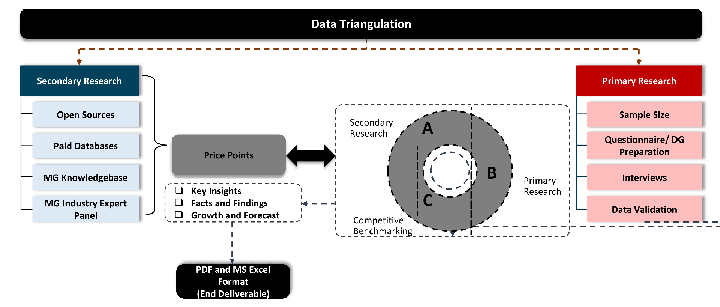
Data triangulation is a validation technique that uses multiple methods, sources, or perspectives to examine the same research question, thereby increasing the credibility and reliability of research findings. In market research, triangulation serves as a quality assurance mechanism that helps identify and minimize bias, validate assumptions, and ensure accuracy in market estimates.
- Data Source Triangulation – Using multiple data sources to examine the same phenomenon
- Methodological Triangulation – Using multiple research methods to study the same research question
- Investigator Triangulation – Using multiple researchers or analysts to examine the same data
- Theoretical Triangulation – Using multiple theoretical perspectives to interpret the same data
Custom Market Research Services
We will customise the research for you, in case the report listed above does not meet your requirements.
Get 10% Free Customisation