Healthcare Chatbots Market Size, Share & Trends Analysis Report by Component (Software, Services), Type, Deployment Mode, Interaction Channel, Integration Type, Technology, User Type, Business Model, Application, End User and Geography (North America, Europe, Asia Pacific, Middle East, Africa, and South America) – Global Industry Data, Trends, and Forecasts, 2026–2035
|
Market Structure & Evolution |
|
|
Segmental Data Insights |
|
|
Demand Trends |
|
|
Competitive Landscape |
|
|
Strategic Development |
|
|
Future Outlook & Opportunities |
|
Healthcare Chatbots Market Size, Share, and Growth
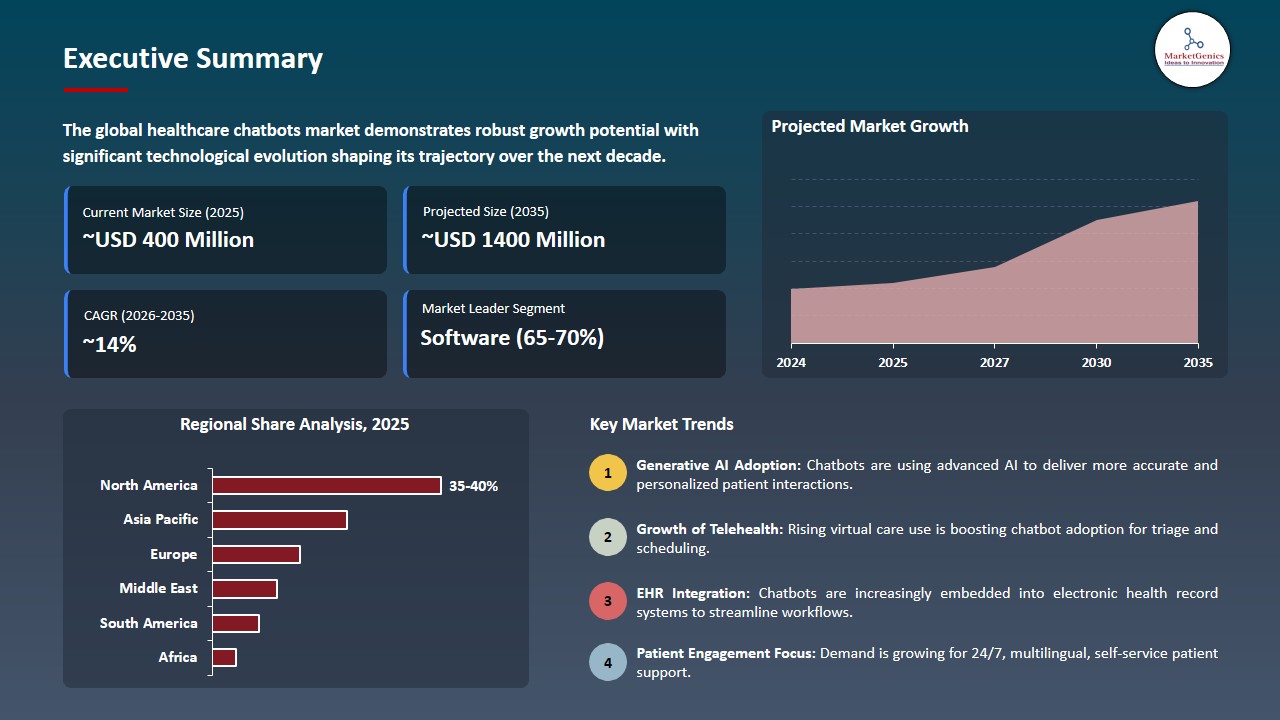
The global healthcare chatbots market is experiencing robust growth, with its estimated value of USD 0.4 billion in the year 2025 and USD 1.4 billion by 2035, registering a CAGR of 14.2% during the forecast period. The global healthcare chatbots market has been rapidly growing, with AI, natural language processing, and cloud computing rapidly advancing technologies driving innovative evolution in conversational tools to automate healthcare interaction for consumers, clinicians and hospitals.
Dr. Shivang Shukla who is the surgical oncologist responsible for the newly launched AI, powered oncology chatbot at SSG Hospital, Vadodara, said, "Our digital chatbot gives instant, reliable advice on the treatment options, post, care instructions, and follow, up support in various languages that help cancer patients and their caregivers to get essential information quickly and with confidence."
Recent advancements include the fast expansion of clinical and administrative chatbots powered by AIs in large technology and healthcare IT companies, like Microsoft’s Nuance offerings and Google’s generative AI models specific to the healthcare sector, which are now integrated with hospitals' existing workflows, including: triaging patients, supporting clinical documentation, and assisting patients. These innovations facilitate quicker response times for healthcare providers, decrease the number of hours of administrative work, and improve patient engagement across multiple care settings.
Simultaneously to this development, with increases in patient volumes, a decrease in the number of healthcare professionals, and additional adoption of telehealth services, there is an increasing demand for the use of virtual assistants to automate many of the processes involved in the delivery of care. The support by government and other regulatory agencies for the adoption of digital health solutions, as well as significant investments by hospitals, payers and other agencies in the infrastructure required to support digital healthcare services, has been a major driver.
The worldwide healthcare chatbots market has various neighboring opportunities. These include virtual nursing assistants, mental health support chatbots, chronic disease management platforms, appointment scheduling systems, remote patient monitoring integration, and AI driven patient education tools. By exploring these adjacent areas, vendors can grow the digital care ecosystems and at the same time increase their revenue potential in different healthcare delivery models.
Healthcare Chatbots Market Dynamics and Trends
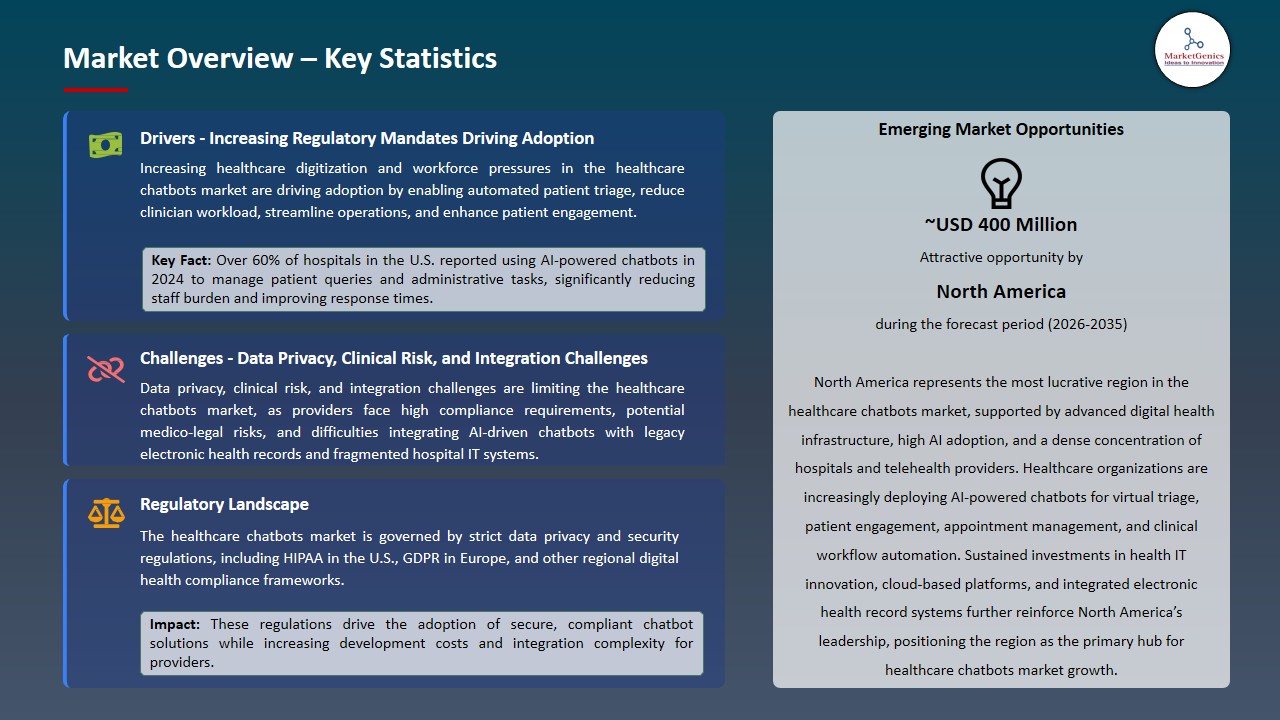
Driver: Increasing Healthcare Digitization and Workforce Pressures Driving Adoption of Healthcare Chatbots
-
The increase in digitization of healthcare and the number of patients and lack of clinical staff in hospitals and primary care facilities across the world is the major key driver in healthcare chatbots market growth. Further, governments and healthcare systems are encouraging the use of digital front doors to facilitate access to services, reduce time taken to see a health care professional, and manage demand in an efficient manner.
- The regulatory clarification for the use of telehealth, remote patient engagement and digital therapeutics in North America, Europe, and some Regions within Asia-Pacific has helped to legitimize the use of Chatbots to assist with non-diagnostic applications such as triaging patients, scheduling appointments, and educating patients on their health.
- The emergence of conversational AI capabilities has allowed providers of healthcare IT to create chatbot applications that can be integrated with electronic health records to support clinicians in documenting patient care, facilitating patients throughout their care journey, and following up with patients for appropriate care.
- This shift to the use of AI technology in healthcare has the potential to increase efficiency, decrease administrative burden, and improve the patient experience across care paths. All these factors are likely to boost the growth of the healthcare chatbots market.
Restraint: Data Privacy, Clinical Risk, and Integration Challenges Limiting Widespread Adoption
-
The growth in usage of healthcare chatbot is definitely going to be assisted by these new features and capabilities but it will also be hindered by data privacy, clinical safety concerns, and integration complexity issues. Chatbots that are used in healthcare have to adhere to very strict data protection laws such as HIPAA in the U.S. and GDPR in Europe, thus, vendor development and compliance costs are going to be raised.
- Moreover, errors in symptom evaluation or patient instructions could have serious legal consequences in medicine and hence healthcare providers would restrict using chatbot only for administrative and low risk clinical interactions. Integration characterizes the systems of an old hospital information system and the fragmented electronic health records is at the heart of the major technical challenge, thus, it usually entails very costly customization and workflow redesign.
- Providers of smaller healthcare and clinics may not have the financial and technical capabilities to implement and operate AI powered chatbot systems at scale. The continued balance of conversational accuracy, regulatory compliance, and operational reliability is the major reason behind the slow full-scale deployment in many healthcare sectors. All these elements are expected to restrict the expansion of the healthcare chatbots market.
Opportunity: Expansion in Emerging Markets and Public Health–Focused Digital Care Programs
-
Healthcare chatbots in the emerging economies in Asia Pacific, Latin America, and Middle East can benefit heavily from the growth potential unlocked by the local governments investing in digital health infrastructure to increase care access and population health management. National digital health missions and public health platforms are at the forefront of utilizing AI powered virtual assistants for creating health awareness, managing long term illnesses, and spurring preventive care.
- The spread of smartphones and messaging platforms has provided a tool for deploying chatbots at a very low cost even in those areas where local clinical workforce is minimal. Along those lines, international agencies and public health institutions are also turning to chatbots to raise awareness on diseases, conduct vaccination drives, and provide maternal health services.
- Such efforts drive the demand for chatbot developers who can provide solutions in multiple languages, are cloud based, and scalable, which is what characterizes public health systems and the needs of developing economies. And thus, is expected to create more opportunities in future for healthcare chatbots market.
Key Trend: Integration of Generative AI, Multimodal Interfaces, and Clinical Workflow Automation
-
A major trend witnessed in the healthcare chatbots market is the incorporation of generative AI, sophisticated natural language comprehension, and multimodal interfaces like voice, text, and image-based interactions. These features allow chatbots to become more accurate, understand context better, and offer more personality in patient engagement as well as clinical support situations.
- Moreover, healthcare chatbots nowadays are more and more aligned with clinical workflows in general, thus they are able to help tasks such as pre visit data collection, post discharge follow ups, medication reminders, and patient education. Vendors place great emphasis on explainability, human in the loop models, and guardrails to ensure safety and compliance with regulations.
- This development is a sign that there is a move from standalone chatbots toward fully integrated virtual care assistants which not only increase the efficiency of care delivery but also retain clinical oversight. All these elements are expected to influence significant trends in the healthcare chatbots market.
Healthcare Chatbots Market Analysis and Segmental Data
Software Segment Dominates the Global Healthcare Chatbots Market amid Growing Demand for AI-Driven Patient Engagement
-
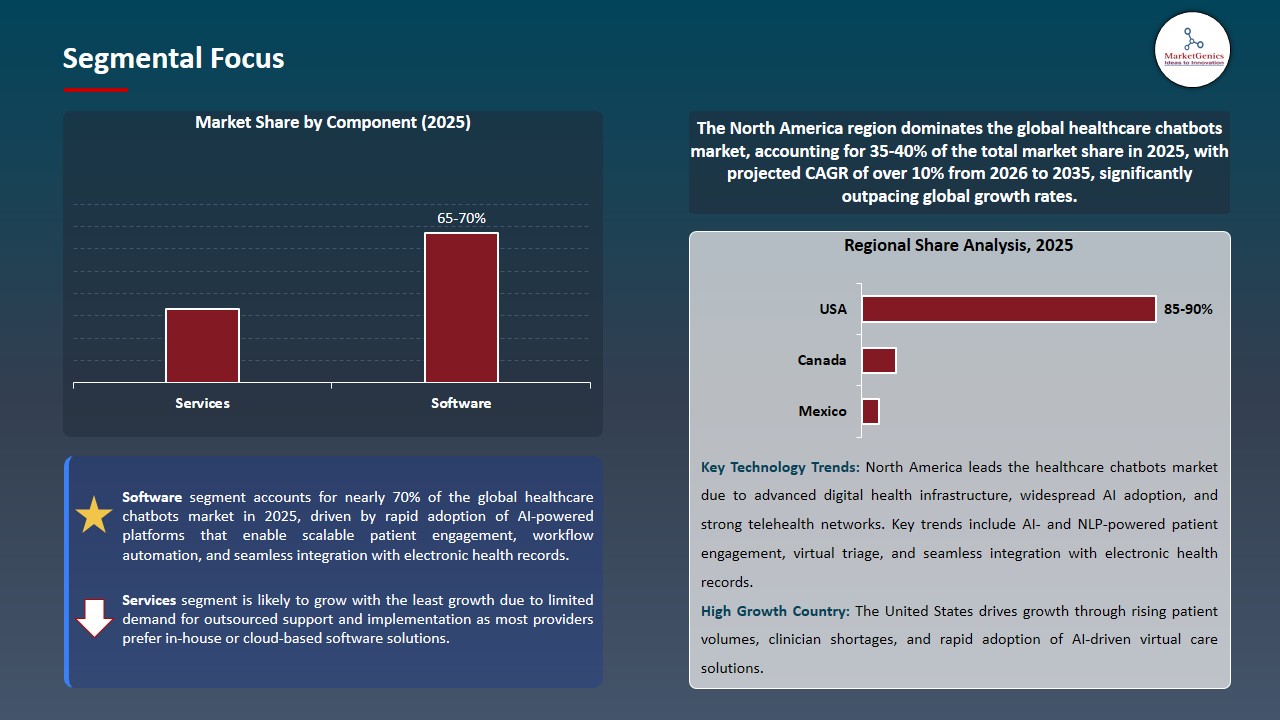
The software segment of the global healthcare chatbots market will continue to dominate because of the increase in the demand for scalable and artificial intelligence-based technologies to deliver on-demand patient engagement and to deploy quickly across hospitals, clinics, and digital health sites without requiring significant hardware investments.
- Cloud-based chatbots can provide the flexibility, scalable capabilities, multilingual support, and seamless integration into electronic health records, telehealth systems, patient portals, and other clinical applications. For instance, because of their costs, chatbots are able to deliver effective patient engagement solutions to both large health systems and small providers.
- Additionally, owing to the increased interest in patient self-service, the management of appointments, reminders for medications, and follow-up calls after receiving treatment or services, software adoption among healthcare providers will continue to grow. Recent product development activities support this fact. For example, in 2024, Epic Systems introduced new functional capabilities for its MyChart portal, including conversational and generative AI functionalities.
- Thus, healthcare organizations can benefit from automated communication with their patients through an automated system or the "digital front door." Therefore, these developments show how software-centric solutions for chatbots will be the key to increasing access, demonstrating the leadership of this segment in the healthcare chatbots market.
North America Dominates the Healthcare Chatbots Market amid Advanced Digital Health Infrastructure and High AI Adoption
-
Healthcare chatbots market in North America leads the world primarily because of the availability of an advanced digital health infrastructure, extensive use of electronic health records, and deep embedding of artificial intelligence in healthcare delivery systems. In the U.S. and Canada, healthcare providers are turning to chatbots to take care of patient inquiries, virtual triage, appointment scheduling, and navigation of care, because of high patient volumes and low number of clinicians.
- Besides that, continued and improved reimbursement mechanisms for digital health services, as well as strong investments by private and public stakeholders, are already creating a more suitable market environment for the adoption of such technologies. In 2024, CVS Health extended its AI enabled virtual assistant functionalities across its digital platforms to significantly enhance patient support, prescription management, and access to care services.
- Further, the presence of large healthcare IT vendors, a mature cloud ecosystem, and a strict patient experience focus still serve as the major factors that continue to support North Americas dominance in the healthcare chatbots market.
Healthcare Chatbots Market Ecosystem
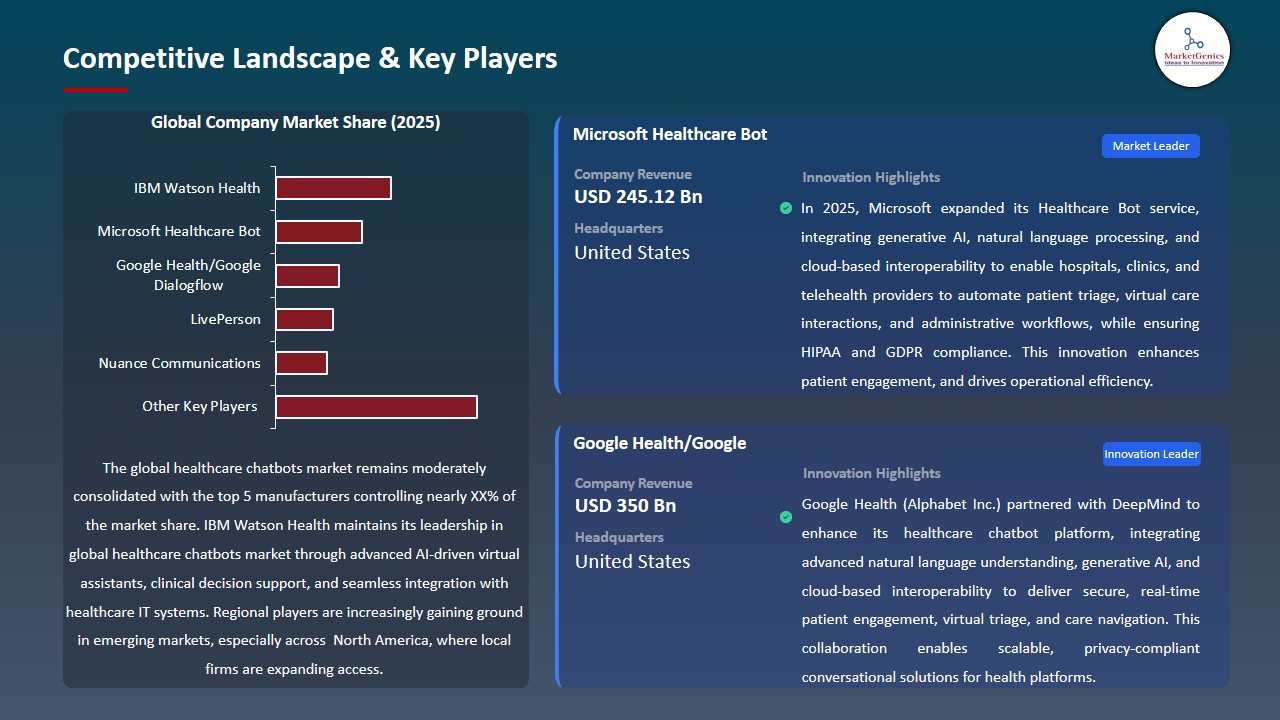
Globally, the healthcare chatbots market shows moderate consolidation of several major companies providing healthcare solutions through advanced AI and Cloud connected conversational technology. The top players are Microsoft (Nuance Communications), Google Health (Dialogflow), IBM Watson Healthcare, Amazon Web Services (AWS) Healthcare Solutions, Babylon Health and Ada Health. These companies utilize NLU, ML and cloud-based scalable solutions to provide enterprise-ready chatbot platforms which organizations use to support all types of healthcare organizations.
The major players are also focusing on niche and specialties to bring new innovations to market. Examples include symptom assessments (Ada Health, Infermedica), virtual triage and care navigation (Buoy Health, GYANT), automating the revenue cycle and patient engagement (Conversa Health, Kasisto) and voice enabled clinical documentation and patient interaction tools (Nuance Communications, Sensely). This focus has created an opportunity for IT solutions companies to build chatbot solutions with a greater chance of acceptance and use across a variety of healthcare settings.
Market leaders are also stressing on product diversification and integrated platforms, blending chatbots with electronic health records, telehealth, and analytics to increase operational efficiency and care continuity. Notably, in March 2024, Google Health disclosed breakthroughs in AI powered medical conversation models, showing enhanced response accuracy and better contextual understanding, thus confirming that advanced AI is set to play a major role in patient engagement and the overall productivity of healthcare.
Recent Development and Strategic Overview:
-
In July 2025, Infermedica rolled out its AI powered Symptom Checker API enriched with more clinical language support and live risk scoring. This API gives healthcare providers and telemedicine platforms the ability to offer accurate patient triage services. The technology elevates the precision of symptom checking in various languages, spotlights critical conditions at an early stage, and cuts down on unnecessary clinicians' overload.
- In September 2025, LivePerson introduced its conversational AI suite for the healthcare industry, based on deep learning and secured cloud infrastructure. This release enables healthcare organizations to leverage automation for complex patient cases via higher contextual comprehension and privacy compliance. The software features live communication, individualized care directions, and smooth transformations with electronic health records that significantly uplift patient conversation accuracy and virtual care operational performance.
Report Scope
|
Attribute |
Detail |
|
Market Size in 2025 |
USD 0.4 Bn |
|
Market Forecast Value in 2035 |
USD 1.4 Bn |
|
Growth Rate (CAGR) |
14.2% |
|
Forecast Period |
2026 – 2035 |
|
Historical Data Available for |
2021 – 2024 |
|
Market Size Units |
USD Bn for Value |
|
Report Format |
Electronic (PDF) + Excel |
|
Regions and Countries Covered |
|||||
|
North America |
Europe |
Asia Pacific |
Middle East |
Africa |
South America |
|
|
|
|
|
|
|
Companies Covered |
|||||
|
|
|
|
|
|
Healthcare Chatbots Market Segmentation and Highlights
|
Segment |
Sub-segment |
|
Healthcare Chatbots Market, By Component |
|
|
Healthcare Chatbots Market, By Type |
|
|
Healthcare Chatbots Market, By Deployment Mode |
|
|
Healthcare Chatbots Market, By Interaction Channel |
|
|
Healthcare Chatbots Market, By Integration Type |
|
|
Healthcare Chatbots Market, By Technology |
|
|
Healthcare Chatbots Market, By User Type |
|
|
Healthcare Chatbots Market, By Business Model |
|
|
Healthcare Chatbots Market, By Application |
|
|
Healthcare Chatbots Market, By End User |
|
Frequently Asked Questions
Table of Contents
- 1. Research Methodology and Assumptions
- 1.1. Definitions
- 1.2. Research Design and Approach
- 1.3. Data Collection Methods
- 1.4. Base Estimates and Calculations
- 1.5. Forecasting Models
- 1.5.1. Key Forecast Factors & Impact Analysis
- 1.6. Secondary Research
- 1.6.1. Open Sources
- 1.6.2. Paid Databases
- 1.6.3. Associations
- 1.7. Primary Research
- 1.7.1. Primary Sources
- 1.7.2. Primary Interviews with Stakeholders across Ecosystem
- 2. Executive Summary
- 2.1. Global Healthcare Chatbots Market Outlook
- 2.1.1. Healthcare Chatbots Market Size (Value - US$ Bn), and Forecasts, 2021-2035
- 2.1.2. Compounded Annual Growth Rate Analysis
- 2.1.3. Growth Opportunity Analysis
- 2.1.4. Segmental Share Analysis
- 2.1.5. Geographical Share Analysis
- 2.2. Market Analysis and Facts
- 2.3. Supply-Demand Analysis
- 2.4. Competitive Benchmarking
- 2.5. Go-to- Market Strategy
- 2.5.1. Customer/ End-use Industry Assessment
- 2.5.2. Growth Opportunity Data, 2026-2035
- 2.5.2.1. Regional Data
- 2.5.2.2. Country Data
- 2.5.2.3. Segmental Data
- 2.5.3. Identification of Potential Market Spaces
- 2.5.4. GAP Analysis
- 2.5.5. Potential Attractive Price Points
- 2.5.6. Prevailing Market Risks & Challenges
- 2.5.7. Preferred Sales & Marketing Strategies
- 2.5.8. Key Recommendations and Analysis
- 2.5.9. A Way Forward
- 2.1. Global Healthcare Chatbots Market Outlook
- 3. Industry Data and Premium Insights
- 3.1. Global Healthcare & Pharmaceutical Industry Overview, 2025
- 3.1.1. Healthcare & Pharmaceutical Industry Analysis
- 3.1.2. Key Trends for Healthcare & Pharmaceutical Industry
- 3.1.3. Regional Distribution for Healthcare & Pharmaceutical Industry
- 3.2. Supplier Customer Data
- 3.3. Technology Roadmap and Developments
- 3.1. Global Healthcare & Pharmaceutical Industry Overview, 2025
- 4. Market Overview
- 4.1. Market Dynamics
- 4.1.1. Drivers
- 4.1.1.1. Growing telemedicine adoption and digital health transformation are accelerating chatbot demand for automated patient engagement and virtual care.
- 4.1.1.2. Advancements in artificial intelligence and natural language processing are improving chatbot accuracy, scalability, and clinical usability.
- 4.1.1.3. Healthcare workforce shortages are driving adoption to reduce administrative burden and operational costs.
- 4.1.2. Restraints
- 4.1.2.1. Data privacy and regulatory compliance concerns limit widespread deployment.
- 4.1.2.2. Clinical accuracy limitations restrict use in complex medical scenarios.
- 4.1.1. Drivers
- 4.2. Key Trend Analysis
- 4.3. Regulatory Framework
- 4.3.1. Key Regulations, Norms, and Subsidies, by Key Countries
- 4.3.2. Tariffs and Standards
- 4.3.3. Impact Analysis of Regulations on the Market
- 4.4. Value Chain Analysis
- 4.5. Cost Structure Analysis
- 4.6. Porter’s Five Forces Analysis
- 4.7. PESTEL Analysis
- 4.8. Global Healthcare Chatbots Market Demand
- 4.8.1. Historical Market Size –Value (US$ Bn), 2020-2024
- 4.8.2. Current and Future Market Size –Value (US$ Bn), 2026–2035
- 4.8.2.1. Y-o-Y Growth Trends
- 4.8.2.2. Absolute $ Opportunity Assessment
- 4.1. Market Dynamics
- 5. Competition Landscape
- 5.1. Competition structure
- 5.1.1. Fragmented v/s consolidated
- 5.2. Company Share Analysis, 2025
- 5.2.1. Global Company Market Share
- 5.2.2. By Region
- 5.2.2.1. North America
- 5.2.2.2. Europe
- 5.2.2.3. Asia Pacific
- 5.2.2.4. Middle East
- 5.2.2.5. Africa
- 5.2.2.6. South America
- 5.3. Product Comparison Matrix
- 5.3.1. Specifications
- 5.3.2. Market Positioning
- 5.3.3. Pricing
- 5.1. Competition structure
- 6. Global Healthcare Chatbots Market Analysis, by Component
- 6.1. Key Segment Analysis
- 6.2. Healthcare Chatbots Market Size (Value - US$ Bn), Analysis, and Forecasts, by Component, 2021-2035
- 6.2.1. Software
- 6.2.1.1. Core Chatbot Engine
- 6.2.1.1.1. Natural Language Processing (NLP) Module
- 6.2.1.1.2. Dialogue Management Module
- 6.2.1.1.3. Response Generation Module
- 6.2.1.1.4. Intent Recognition Module
- 6.2.1.1.5. Sentiment Analysis Module
- 6.2.1.1.6. Others
- 6.2.1.2. User Interface Layer
- 6.2.1.2.1. Mobile App Chat Interface
- 6.2.1.2.2. Web Chat Interface
- 6.2.1.2.3. Social Media/Platform Chat Interface
- 6.2.1.2.4. Voice/Virtual Assistant Interface
- 6.2.1.2.5. Others
- 6.2.1.3. Integration & Connectivity
- 6.2.1.3.1. EHR/EMR Integration Module
- 6.2.1.3.2. Telehealth/Telemedicine Integration
- 6.2.1.3.3. Appointment & Scheduling API
- 6.2.1.3.4. Billing & Insurance System Integration
- 6.2.1.3.5. Others
- 6.2.1.4. Analytics & Reporting
- 6.2.1.4.1. Usage Analytics Dashboard
- 6.2.1.4.2. Performance & Accuracy Metrics
- 6.2.1.4.3. Patient Engagement Reports
- 6.2.1.4.4. Predictive Insights Module
- 6.2.1.4.5. Others
- 6.2.1.5. Security & Compliance
- 6.2.1.5.1. Data Encryption Module
- 6.2.1.5.2. HIPAA/Healthcare Compliance Module
- 6.2.1.5.3. Authentication & Access Control
- 6.2.1.5.4. Audit Logging & Monitoring
- 6.2.1.5.5. Others
- 6.2.1.1. Core Chatbot Engine
- 6.2.2. Services
- 6.2.2.1. Implementation & Deployment
- 6.2.2.1.1. Custom Configuration Services
- 6.2.2.1.2. Platform Setup & Integration
- 6.2.2.1.3. Data Migration Services
- 6.2.2.1.4. Others
- 6.2.2.2. Training & Support
- 6.2.2.2.1. User Training (Clinicians/Admins)
- 6.2.2.2.2. Technical Support (Helpdesk/On-Demand)
- 6.2.2.2.3. Software Updates & Maintenance
- 6.2.2.2.4. Others
- 6.2.2.3. Consulting Services
- 6.2.2.3.1. Workflow & Use-Case Consulting
- 6.2.2.3.2. Compliance & Regulatory Advisory
- 6.2.2.3.3. Chatbot Strategy & Optimization
- 6.2.2.3.4. Others
- 6.2.2.4. Managed Services
- 6.2.2.4.1. Hosted Chatbot Management
- 6.2.2.4.2. Remote Monitoring & Performance Tuning
- 6.2.2.4.3. Managed Security Services
- 6.2.2.4.4. Others
- 6.2.2.5. Content Development
- 6.2.2.5.1. Conversational Script Design
- 6.2.2.5.2. Medical Knowledge Base Curation
- 6.2.2.5.3. Multilingual Content Support
- 6.2.2.5.4. Others
- 6.2.2.1. Implementation & Deployment
- 6.2.1. Software
- 7. Global Healthcare Chatbots Market Analysis, by Type
- 7.1. Key Segment Analysis
- 7.2. Healthcare Chatbots Market Size (Value - US$ Bn), Analysis, and Forecasts, by Type, 2021-2035
- 7.2.1. AI-Based Chatbots
- 7.2.2. Rule-Based Chatbots
- 7.2.3. Hybrid Chatbots
- 8. Global Healthcare Chatbots Market Analysis, by Deployment Mode
- 8.1. Key Segment Analysis
- 8.2. Healthcare Chatbots Market Size (Value - US$ Bn), Analysis, and Forecasts, by Deployment Mode, 2021-2035
- 8.2.1. Cloud-Based
- 8.2.2. On-Premise
- 9. Global Healthcare Chatbots Market Analysis, by Interaction Channel
- 9.1. Key Segment Analysis
- 9.2. Healthcare Chatbots Market Size (Value - US$ Bn), Analysis, and Forecasts, by Interaction Channel, 2021-2035
- 9.2.1. Mobile Apps
- 9.2.2. Web/Browser
- 9.2.3. Social Media Platforms
- 9.2.4. SMS/Text
- 9.2.5. Voice-Enabled Chatbots
- 9.2.6. Others
- 10. Global Healthcare Chatbots Market Analysis, by Integration Type
- 10.1. Key Segment Analysis
- 10.2. Healthcare Chatbots Market Size (Value - US$ Bn), Analysis, and Forecasts, by Integration Type, 2021-2035
- 10.2.1. Integrated with EHR/EMR Systems
- 10.2.2. Stand-alone Systems
- 10.2.3. Integrated with Telehealth Platforms
- 10.2.4. Integrated with Patient Portals
- 10.2.5. Others
- 11. Global Healthcare Chatbots Market Analysis, by Technology
- 11.1. Key Segment Analysis
- 11.2. Healthcare Chatbots Market Size (Value - US$ Bn), Analysis, and Forecasts, by Technology, 2021-2035
- 11.2.1. Natural Language Processing (NLP)
- 11.2.2. Machine Learning (ML) Enabled
- 11.2.3. Speech Recognition Enabled
- 11.2.4. Rule Engine Based
- 11.2.5. Others
- 12. Global Healthcare Chatbots Market Analysis, by User Type
- 12.1. Key Segment Analysis
- 12.2. Healthcare Chatbots Market Size (Value - US$ Bn), Analysis, and Forecasts, by User Type, 2021-2035
- 12.2.1. Patients
- 12.2.2. Caregivers
- 12.2.3. Healthcare Professionals
- 12.2.4. Administrative Staff
- 12.2.5. Others
- 13. Global Healthcare Chatbots Market Analysis, by Business Model
- 13.1. Key Segment Analysis
- 13.2. Healthcare Chatbots Market Size (Value - US$ Bn), Analysis, and Forecasts, by Business Model, 2021-2035
- 13.2.1. Subscription Licensing
- 13.2.2. Pay-Per-Use
- 13.2.3. Freemium
- 13.2.4. Enterprise Licensing
- 13.2.5. Others
- 14. Global Healthcare Chatbots Market Analysis, by Application
- 14.1. Key Segment Analysis
- 14.2. Healthcare Chatbots Market Size (Value - US$ Bn), Analysis, and Forecasts, by Application, 2021-2035
- 14.2.1. Patient Engagement & Support
- 14.2.2. Appointment Scheduling
- 14.2.3. Symptom Checking & Triage
- 14.2.4. Medication Reminders
- 14.2.5. Mental Health Support
- 14.2.6. Chronic Disease Management
- 14.2.7. Insurance Assistance
- 14.2.8. Healthcare Information/FAQs
- 14.2.9. Others
- 15. Global Healthcare Chatbots Market Analysis, by End User
- 15.1. Key Segment Analysis
- 15.2. Healthcare Chatbots Market Size (Value - US$ Bn), Analysis, and Forecasts, by End User, 2021-2035
- 15.2.1. Hospitals & Health Systems
- 15.2.2. Clinics & Physician Offices
- 15.2.3. Diagnostic Laboratories
- 15.2.4. Pharmacies
- 15.2.5. Payers/ Insurance Providers
- 15.2.6. Telehealth/ Telemedicine Providers
- 15.2.7. Home Healthcare Providers
- 15.2.8. Others
- 16. Global Healthcare Chatbots Market Analysis and Forecasts, by Region
- 16.1. Key Findings
- 16.2. Healthcare Chatbots Market Size (Value - US$ Bn), Analysis, and Forecasts, by Region, 2021-2035
- 16.2.1. North America
- 16.2.2. Europe
- 16.2.3. Asia Pacific
- 16.2.4. Middle East
- 16.2.5. Africa
- 16.2.6. South America
- 17. North America Healthcare Chatbots Market Analysis
- 17.1. Key Segment Analysis
- 17.2. Regional Snapshot
- 17.3. North America Healthcare Chatbots Market Size (Value - US$ Bn), Analysis, and Forecasts, 2021-2035
- 17.3.1. Component
- 17.3.2. Type
- 17.3.3. Deployment Mode
- 17.3.4. Interaction Channel
- 17.3.5. Integration Type
- 17.3.6. Technology
- 17.3.7. User Type
- 17.3.8. Business Model
- 17.3.9. Application
- 17.3.10. End User
- 17.3.11. Country
- 17.3.11.1. USA
- 17.3.11.2. Canada
- 17.3.11.3. Mexico
- 17.4. USA Healthcare Chatbots Market
- 17.4.1. Country Segmental Analysis
- 17.4.2. Component
- 17.4.3. Type
- 17.4.4. Deployment Mode
- 17.4.5. Interaction Channel
- 17.4.6. Integration Type
- 17.4.7. Technology
- 17.4.8. User Type
- 17.4.9. Business Model
- 17.4.10. Application
- 17.4.11. End User
- 17.5. Canada Healthcare Chatbots Market
- 17.5.1. Country Segmental Analysis
- 17.5.2. Component
- 17.5.3. Type
- 17.5.4. Deployment Mode
- 17.5.5. Interaction Channel
- 17.5.6. Integration Type
- 17.5.7. Technology
- 17.5.8. User Type
- 17.5.9. Business Model
- 17.5.10. Application
- 17.5.11. End User
- 17.6. Mexico Healthcare Chatbots Market
- 17.6.1. Country Segmental Analysis
- 17.6.2. Component
- 17.6.3. Type
- 17.6.4. Deployment Mode
- 17.6.5. Interaction Channel
- 17.6.6. Integration Type
- 17.6.7. Technology
- 17.6.8. User Type
- 17.6.9. Business Model
- 17.6.10. Application
- 17.6.11. End User
- 18. Europe Healthcare Chatbots Market Analysis
- 18.1. Key Segment Analysis
- 18.2. Regional Snapshot
- 18.3. Europe Healthcare Chatbots Market Size (Value - US$ Bn), Analysis, and Forecasts, 2021-2035
- 18.3.1. Component
- 18.3.2. Type
- 18.3.3. Deployment Mode
- 18.3.4. Interaction Channel
- 18.3.5. Integration Type
- 18.3.6. Technology
- 18.3.7. User Type
- 18.3.8. Business Model
- 18.3.9. Application
- 18.3.10. End User
- 18.3.11. Country
- 18.3.11.1. Germany
- 18.3.11.2. United Kingdom
- 18.3.11.3. France
- 18.3.11.4. Italy
- 18.3.11.5. Spain
- 18.3.11.6. Netherlands
- 18.3.11.7. Nordic Countries
- 18.3.11.8. Poland
- 18.3.11.9. Russia & CIS
- 18.3.11.10. Rest of Europe
- 18.4. Germany Healthcare Chatbots Market
- 18.4.1. Country Segmental Analysis
- 18.4.2. Component
- 18.4.3. Type
- 18.4.4. Deployment Mode
- 18.4.5. Interaction Channel
- 18.4.6. Integration Type
- 18.4.7. Technology
- 18.4.8. User Type
- 18.4.9. Business Model
- 18.4.10. Application
- 18.4.11. End User
- 18.5. United Kingdom Healthcare Chatbots Market
- 18.5.1. Country Segmental Analysis
- 18.5.2. Component
- 18.5.3. Type
- 18.5.4. Deployment Mode
- 18.5.5. Interaction Channel
- 18.5.6. Integration Type
- 18.5.7. Technology
- 18.5.8. User Type
- 18.5.9. Business Model
- 18.5.10. Application
- 18.5.11. End User
- 18.6. France Healthcare Chatbots Market
- 18.6.1. Country Segmental Analysis
- 18.6.2. Component
- 18.6.3. Type
- 18.6.4. Deployment Mode
- 18.6.5. Interaction Channel
- 18.6.6. Integration Type
- 18.6.7. Technology
- 18.6.8. User Type
- 18.6.9. Business Model
- 18.6.10. Application
- 18.6.11. End User
- 18.7. Italy Healthcare Chatbots Market
- 18.7.1. Country Segmental Analysis
- 18.7.2. Component
- 18.7.3. Type
- 18.7.4. Deployment Mode
- 18.7.5. Interaction Channel
- 18.7.6. Integration Type
- 18.7.7. Technology
- 18.7.8. User Type
- 18.7.9. Business Model
- 18.7.10. Application
- 18.7.11. End User
- 18.8. Spain Healthcare Chatbots Market
- 18.8.1. Country Segmental Analysis
- 18.8.2. Component
- 18.8.3. Type
- 18.8.4. Deployment Mode
- 18.8.5. Interaction Channel
- 18.8.6. Integration Type
- 18.8.7. Technology
- 18.8.8. User Type
- 18.8.9. Business Model
- 18.8.10. Application
- 18.8.11. End User
- 18.9. Netherlands Healthcare Chatbots Market
- 18.9.1. Country Segmental Analysis
- 18.9.2. Component
- 18.9.3. Type
- 18.9.4. Deployment Mode
- 18.9.5. Interaction Channel
- 18.9.6. Integration Type
- 18.9.7. Technology
- 18.9.8. User Type
- 18.9.9. Business Model
- 18.9.10. Application
- 18.9.11. End User
- 18.10. Nordic Countries Healthcare Chatbots Market
- 18.10.1. Country Segmental Analysis
- 18.10.2. Component
- 18.10.3. Type
- 18.10.4. Deployment Mode
- 18.10.5. Interaction Channel
- 18.10.6. Integration Type
- 18.10.7. Technology
- 18.10.8. User Type
- 18.10.9. Business Model
- 18.10.10. Application
- 18.10.11. End User
- 18.11. Poland Healthcare Chatbots Market
- 18.11.1. Country Segmental Analysis
- 18.11.2. Component
- 18.11.3. Type
- 18.11.4. Deployment Mode
- 18.11.5. Interaction Channel
- 18.11.6. Integration Type
- 18.11.7. Technology
- 18.11.8. User Type
- 18.11.9. Business Model
- 18.11.10. Application
- 18.11.11. End User
- 18.12. Russia & CIS Healthcare Chatbots Market
- 18.12.1. Country Segmental Analysis
- 18.12.2. Component
- 18.12.3. Type
- 18.12.4. Deployment Mode
- 18.12.5. Interaction Channel
- 18.12.6. Integration Type
- 18.12.7. Technology
- 18.12.8. User Type
- 18.12.9. Business Model
- 18.12.10. Application
- 18.12.11. End User
- 18.13. Rest of Europe Healthcare Chatbots Market
- 18.13.1. Country Segmental Analysis
- 18.13.2. Component
- 18.13.3. Type
- 18.13.4. Deployment Mode
- 18.13.5. Interaction Channel
- 18.13.6. Integration Type
- 18.13.7. Technology
- 18.13.8. User Type
- 18.13.9. Business Model
- 18.13.10. Application
- 18.13.11. End User
- 19. Asia Pacific Healthcare Chatbots Market Analysis
- 19.1. Key Segment Analysis
- 19.2. Regional Snapshot
- 19.3. Asia Pacific Healthcare Chatbots Market Size (Value - US$ Bn), Analysis, and Forecasts, 2021-2035
- 19.3.1. Component
- 19.3.2. Type
- 19.3.3. Deployment Mode
- 19.3.4. Interaction Channel
- 19.3.5. Integration Type
- 19.3.6. Technology
- 19.3.7. User Type
- 19.3.8. Business Model
- 19.3.9. Application
- 19.3.10. End User
- 19.3.11. Country
- 19.3.11.1. China
- 19.3.11.2. India
- 19.3.11.3. Japan
- 19.3.11.4. South Korea
- 19.3.11.5. Australia and New Zealand
- 19.3.11.6. Indonesia
- 19.3.11.7. Malaysia
- 19.3.11.8. Thailand
- 19.3.11.9. Vietnam
- 19.3.11.10. Rest of Asia Pacific
- 19.4. China Healthcare Chatbots Market
- 19.4.1. Country Segmental Analysis
- 19.4.2. Component
- 19.4.3. Type
- 19.4.4. Deployment Mode
- 19.4.5. Interaction Channel
- 19.4.6. Integration Type
- 19.4.7. Technology
- 19.4.8. User Type
- 19.4.9. Business Model
- 19.4.10. Application
- 19.4.11. End User
- 19.5. India Healthcare Chatbots Market
- 19.5.1. Country Segmental Analysis
- 19.5.2. Component
- 19.5.3. Type
- 19.5.4. Deployment Mode
- 19.5.5. Interaction Channel
- 19.5.6. Integration Type
- 19.5.7. Technology
- 19.5.8. User Type
- 19.5.9. Business Model
- 19.5.10. Application
- 19.5.11. End User
- 19.6. Japan Healthcare Chatbots Market
- 19.6.1. Country Segmental Analysis
- 19.6.2. Component
- 19.6.3. Type
- 19.6.4. Deployment Mode
- 19.6.5. Interaction Channel
- 19.6.6. Integration Type
- 19.6.7. Technology
- 19.6.8. User Type
- 19.6.9. Business Model
- 19.6.10. Application
- 19.6.11. End User
- 19.7. South Korea Healthcare Chatbots Market
- 19.7.1. Country Segmental Analysis
- 19.7.2. Component
- 19.7.3. Type
- 19.7.4. Deployment Mode
- 19.7.5. Interaction Channel
- 19.7.6. Integration Type
- 19.7.7. Technology
- 19.7.8. User Type
- 19.7.9. Business Model
- 19.7.10. Application
- 19.7.11. End User
- 19.8. Australia and New Zealand Healthcare Chatbots Market
- 19.8.1. Country Segmental Analysis
- 19.8.2. Component
- 19.8.3. Type
- 19.8.4. Deployment Mode
- 19.8.5. Interaction Channel
- 19.8.6. Integration Type
- 19.8.7. Technology
- 19.8.8. User Type
- 19.8.9. Business Model
- 19.8.10. Application
- 19.8.11. End User
- 19.9. Indonesia Healthcare Chatbots Market
- 19.9.1. Country Segmental Analysis
- 19.9.2. Component
- 19.9.3. Type
- 19.9.4. Deployment Mode
- 19.9.5. Interaction Channel
- 19.9.6. Integration Type
- 19.9.7. Technology
- 19.9.8. User Type
- 19.9.9. Business Model
- 19.9.10. Application
- 19.9.11. End User
- 19.10. Malaysia Healthcare Chatbots Market
- 19.10.1. Country Segmental Analysis
- 19.10.2. Component
- 19.10.3. Type
- 19.10.4. Deployment Mode
- 19.10.5. Interaction Channel
- 19.10.6. Integration Type
- 19.10.7. Technology
- 19.10.8. User Type
- 19.10.9. Business Model
- 19.10.10. Application
- 19.10.11. End User
- 19.11. Thailand Healthcare Chatbots Market
- 19.11.1. Country Segmental Analysis
- 19.11.2. Component
- 19.11.3. Type
- 19.11.4. Deployment Mode
- 19.11.5. Interaction Channel
- 19.11.6. Integration Type
- 19.11.7. Technology
- 19.11.8. User Type
- 19.11.9. Business Model
- 19.11.10. Application
- 19.11.11. End User
- 19.12. Vietnam Healthcare Chatbots Market
- 19.12.1. Country Segmental Analysis
- 19.12.2. Component
- 19.12.3. Type
- 19.12.4. Deployment Mode
- 19.12.5. Interaction Channel
- 19.12.6. Integration Type
- 19.12.7. Technology
- 19.12.8. User Type
- 19.12.9. Business Model
- 19.12.10. Application
- 19.12.11. End User
- 19.13. Rest of Asia Pacific Healthcare Chatbots Market
- 19.13.1. Country Segmental Analysis
- 19.13.2. Component
- 19.13.3. Type
- 19.13.4. Deployment Mode
- 19.13.5. Interaction Channel
- 19.13.6. Integration Type
- 19.13.7. Technology
- 19.13.8. User Type
- 19.13.9. Business Model
- 19.13.10. Application
- 19.13.11. End User
- 20. Middle East Healthcare Chatbots Market Analysis
- 20.1. Key Segment Analysis
- 20.2. Regional Snapshot
- 20.3. Middle East Healthcare Chatbots Market Size (Value - US$ Bn), Analysis, and Forecasts, 2021-2035
- 20.3.1. Component
- 20.3.2. Type
- 20.3.3. Deployment Mode
- 20.3.4. Interaction Channel
- 20.3.5. Integration Type
- 20.3.6. Technology
- 20.3.7. User Type
- 20.3.8. Business Model
- 20.3.9. Application
- 20.3.10. End User
- 20.3.11. Country
- 20.3.11.1. Turkey
- 20.3.11.2. UAE
- 20.3.11.3. Saudi Arabia
- 20.3.11.4. Israel
- 20.3.11.5. Rest of Middle East
- 20.4. Turkey Healthcare Chatbots Market
- 20.4.1. Country Segmental Analysis
- 20.4.2. Component
- 20.4.3. Type
- 20.4.4. Deployment Mode
- 20.4.5. Interaction Channel
- 20.4.6. Integration Type
- 20.4.7. Technology
- 20.4.8. User Type
- 20.4.9. Business Model
- 20.4.10. Application
- 20.4.11. End User
- 20.5. UAE Healthcare Chatbots Market
- 20.5.1. Country Segmental Analysis
- 20.5.2. Component
- 20.5.3. Type
- 20.5.4. Deployment Mode
- 20.5.5. Interaction Channel
- 20.5.6. Integration Type
- 20.5.7. Technology
- 20.5.8. User Type
- 20.5.9. Business Model
- 20.5.10. Application
- 20.5.11. End User
- 20.6. Saudi Arabia Healthcare Chatbots Market
- 20.6.1. Country Segmental Analysis
- 20.6.2. Component
- 20.6.3. Type
- 20.6.4. Deployment Mode
- 20.6.5. Interaction Channel
- 20.6.6. Integration Type
- 20.6.7. Technology
- 20.6.8. User Type
- 20.6.9. Business Model
- 20.6.10. Application
- 20.6.11. End User
- 20.7. Israel Healthcare Chatbots Market
- 20.7.1. Country Segmental Analysis
- 20.7.2. Component
- 20.7.3. Type
- 20.7.4. Deployment Mode
- 20.7.5. Interaction Channel
- 20.7.6. Integration Type
- 20.7.7. Technology
- 20.7.8. User Type
- 20.7.9. Business Model
- 20.7.10. Application
- 20.7.11. End User
- 20.8. Rest of Middle East Healthcare Chatbots Market
- 20.8.1. Country Segmental Analysis
- 20.8.2. Component
- 20.8.3. Type
- 20.8.4. Deployment Mode
- 20.8.5. Interaction Channel
- 20.8.6. Integration Type
- 20.8.7. Technology
- 20.8.8. User Type
- 20.8.9. Business Model
- 20.8.10. Application
- 20.8.11. End User
- 21. Africa Healthcare Chatbots Market Analysis
- 21.1. Key Segment Analysis
- 21.2. Regional Snapshot
- 21.3. Africa Healthcare Chatbots Market Size (Value - US$ Bn), Analysis, and Forecasts, 2021-2035
- 21.3.1. Component
- 21.3.2. Type
- 21.3.3. Deployment Mode
- 21.3.4. Interaction Channel
- 21.3.5. Integration Type
- 21.3.6. Technology
- 21.3.7. User Type
- 21.3.8. Business Model
- 21.3.9. Application
- 21.3.10. End User
- 21.3.11. Country
- 21.3.11.1. South Africa
- 21.3.11.2. Egypt
- 21.3.11.3. Nigeria
- 21.3.11.4. Algeria
- 21.3.11.5. Rest of Africa
- 21.4. South Africa Healthcare Chatbots Market
- 21.4.1. Country Segmental Analysis
- 21.4.2. Component
- 21.4.3. Type
- 21.4.4. Deployment Mode
- 21.4.5. Interaction Channel
- 21.4.6. Integration Type
- 21.4.7. Technology
- 21.4.8. User Type
- 21.4.9. Business Model
- 21.4.10. Application
- 21.4.11. End User
- 21.5. Egypt Healthcare Chatbots Market
- 21.5.1. Country Segmental Analysis
- 21.5.2. Component
- 21.5.3. Type
- 21.5.4. Deployment Mode
- 21.5.5. Interaction Channel
- 21.5.6. Integration Type
- 21.5.7. Technology
- 21.5.8. User Type
- 21.5.9. Business Model
- 21.5.10. Application
- 21.5.11. End User
- 21.6. Nigeria Healthcare Chatbots Market
- 21.6.1. Country Segmental Analysis
- 21.6.2. Component
- 21.6.3. Type
- 21.6.4. Deployment Mode
- 21.6.5. Interaction Channel
- 21.6.6. Integration Type
- 21.6.7. Technology
- 21.6.8. User Type
- 21.6.9. Business Model
- 21.6.10. Application
- 21.6.11. End User
- 21.7. Algeria Healthcare Chatbots Market
- 21.7.1. Country Segmental Analysis
- 21.7.2. Component
- 21.7.3. Type
- 21.7.4. Deployment Mode
- 21.7.5. Interaction Channel
- 21.7.6. Integration Type
- 21.7.7. Technology
- 21.7.8. User Type
- 21.7.9. Business Model
- 21.7.10. Application
- 21.7.11. End User
- 21.8. Rest of Africa Healthcare Chatbots Market
- 21.8.1. Country Segmental Analysis
- 21.8.2. Component
- 21.8.3. Type
- 21.8.4. Deployment Mode
- 21.8.5. Interaction Channel
- 21.8.6. Integration Type
- 21.8.7. Technology
- 21.8.8. User Type
- 21.8.9. Business Model
- 21.8.10. Application
- 21.8.11. End User
- 22. South America Healthcare Chatbots Market Analysis
- 22.1. Key Segment Analysis
- 22.2. Regional Snapshot
- 22.3. South America Healthcare Chatbots Market Size (Value - US$ Bn), Analysis, and Forecasts, 2021-2035
- 22.3.1. Component
- 22.3.2. Type
- 22.3.3. Deployment Mode
- 22.3.4. Interaction Channel
- 22.3.5. Integration Type
- 22.3.6. Technology
- 22.3.7. User Type
- 22.3.8. Business Model
- 22.3.9. Application
- 22.3.10. End User
- 22.3.11. Country
- 22.3.11.1. Brazil
- 22.3.11.2. Argentina
- 22.3.11.3. Rest of South America
- 22.4. Brazil Healthcare Chatbots Market
- 22.4.1. Country Segmental Analysis
- 22.4.2. Component
- 22.4.3. Type
- 22.4.4. Deployment Mode
- 22.4.5. Interaction Channel
- 22.4.6. Integration Type
- 22.4.7. Technology
- 22.4.8. User Type
- 22.4.9. Business Model
- 22.4.10. Application
- 22.4.11. End User
- 22.5. Argentina Healthcare Chatbots Market
- 22.5.1. Country Segmental Analysis
- 22.5.2. Component
- 22.5.3. Type
- 22.5.4. Deployment Mode
- 22.5.5. Interaction Channel
- 22.5.6. Integration Type
- 22.5.7. Technology
- 22.5.8. User Type
- 22.5.9. Business Model
- 22.5.10. Application
- 22.5.11. End User
- 22.6. Rest of South America Healthcare Chatbots Market
- 22.6.1. Country Segmental Analysis
- 22.6.2. Component
- 22.6.3. Type
- 22.6.4. Deployment Mode
- 22.6.5. Interaction Channel
- 22.6.6. Integration Type
- 22.6.7. Technology
- 22.6.8. User Type
- 22.6.9. Business Model
- 22.6.10. Application
- 22.6.11. End User
- 23. Key Players/ Company Profile
- 23.1. 1upHealth
- 23.1.1. Company Details/ Overview
- 23.1.2. Company Financials
- 23.1.3. Key Customers and Competitors
- 23.1.4. Business/ Industry Portfolio
- 23.1.5. Product Portfolio/ Specification Details
- 23.1.6. Pricing Data
- 23.1.7. Strategic Overview
- 23.1.8. Recent Developments
- 23.2. Ada Health
- 23.3. Amazon Web Services (AWS) — Healthcare Solutions
- 23.4. Babylon Health
- 23.5. Buoy Health
- 23.6. Conversa Health
- 23.7. Google Health/Google Dialogflow
- 23.8. GYANT
- 23.9. HealthTap
- 23.10. IBM Watson Health
- 23.11. Infermedica
- 23.12. Kasisto
- 23.13. LivePerson
- 23.14. Microsoft Healthcare Bot
- 23.15. Nuance Communications
- 23.16. Orbita
- 23.17. Rasa Technologies
- 23.18. Sensely
- 23.19. Tetra
- 23.20. XcelPros Healthcare AI
- 23.21. Other Key Players
- 23.1. 1upHealth
Note* - This is just tentative list of players. While providing the report, we will cover more number of players based on their revenue and share for each geography
Research Design
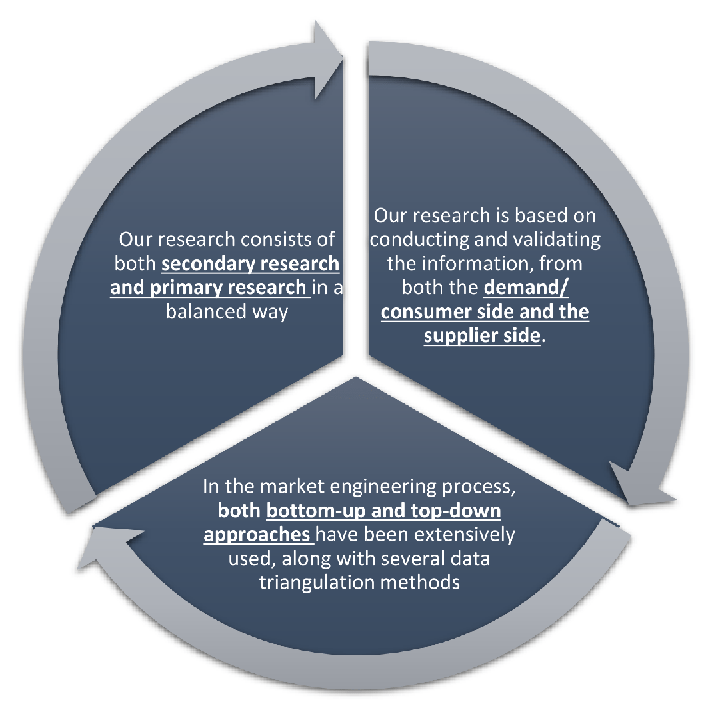
Our research design integrates both demand-side and supply-side analysis through a balanced combination of primary and secondary research methodologies. By utilizing both bottom-up and top-down approaches alongside rigorous data triangulation methods, we deliver robust market intelligence that supports strategic decision-making.
MarketGenics' comprehensive research design framework ensures the delivery of accurate, reliable, and actionable market intelligence. Through the integration of multiple research approaches, rigorous validation processes, and expert analysis, we provide our clients with the insights needed to make informed strategic decisions and capitalize on market opportunities.
MarketGenics leverages a dedicated industry panel of experts and a comprehensive suite of paid databases to effectively collect, consolidate, and analyze market intelligence.
Our approach has consistently proven to be reliable and effective in generating accurate market insights, identifying key industry trends, and uncovering emerging business opportunities.
Through both primary and secondary research, we capture and analyze critical company-level data such as manufacturing footprints, including technical centers, R&D facilities, sales offices, and headquarters.
Our expert panel further enhances our ability to estimate market size for specific brands based on validated field-level intelligence.
Our data mining techniques incorporate both parametric and non-parametric methods, allowing for structured data collection, sorting, processing, and cleaning.
Demand projections are derived from large-scale data sets analyzed through proprietary algorithms, culminating in robust and reliable market sizing.
Research Approach
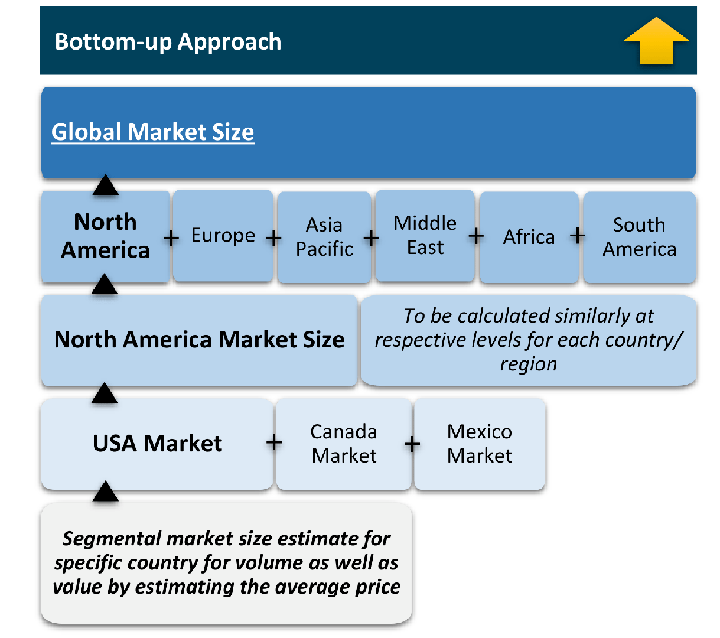
The bottom-up approach builds market estimates by starting with the smallest addressable market units and systematically aggregating them to create comprehensive market size projections.
This method begins with specific, granular data points and builds upward to create the complete market landscape.
Customer Analysis → Segmental Analysis → Geographical Analysis
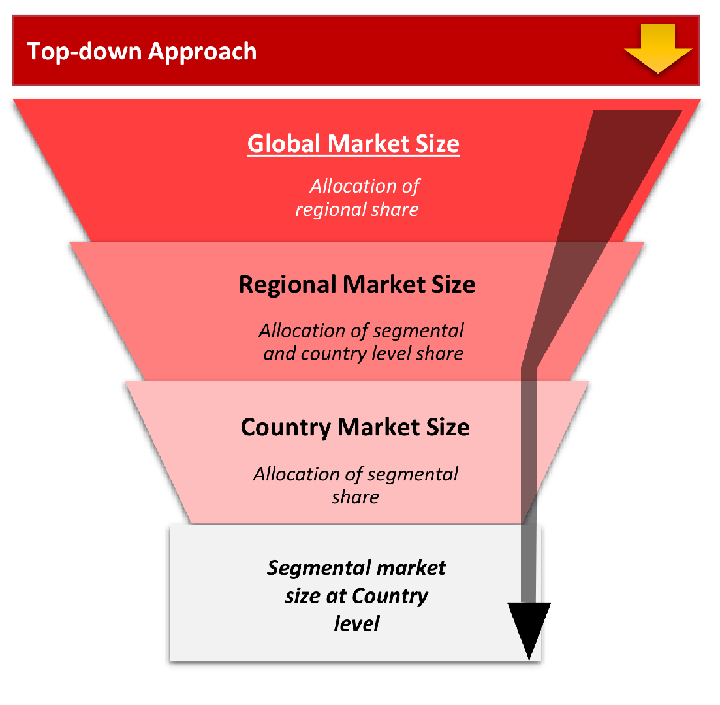
The top-down approach starts with the broadest possible market data and systematically narrows it down through a series of filters and assumptions to arrive at specific market segments or opportunities.
This method begins with the big picture and works downward to increasingly specific market slices.
TAM → SAM → SOM
Research Methods
Desk / Secondary Research
While analysing the market, we extensively study secondary sources, directories, and databases to identify and collect information useful for this technical, market-oriented, and commercial report. Secondary sources that we utilize are not only the public sources, but it is a combination of Open Source, Associations, Paid Databases, MG Repository & Knowledgebase, and others.
- Company websites, annual reports, financial reports, broker reports, and investor presentations
- National government documents, statistical databases and reports
- News articles, press releases and web-casts specific to the companies operating in the market, Magazines, reports, and others
- We gather information from commercial data sources for deriving company specific data such as segmental revenue, share for geography, product revenue, and others
- Internal and external proprietary databases (industry-specific), relevant patent, and regulatory databases
- Governing Bodies, Government Organizations
- Relevant Authorities, Country-specific Associations for Industries
We also employ the model mapping approach to estimate the product level market data through the players' product portfolio
Primary Research
Primary research/ interviews is vital in analyzing the market. Most of the cases involves paid primary interviews. Primary sources include primary interviews through e-mail interactions, telephonic interviews, surveys as well as face-to-face interviews with the different stakeholders across the value chain including several industry experts.
| Type of Respondents | Number of Primaries |
|---|---|
| Tier 2/3 Suppliers | ~20 |
| Tier 1 Suppliers | ~25 |
| End-users | ~25 |
| Industry Expert/ Panel/ Consultant | ~30 |
| Total | ~100 |
MG Knowledgebase
• Repository of industry blog, newsletter and case studies
• Online platform covering detailed market reports, and company profiles
Forecasting Factors and Models
Forecasting Factors
- Historical Trends – Past market patterns, cycles, and major events that shaped how markets behave over time. Understanding past trends helps predict future behavior.
- Industry Factors – Specific characteristics of the industry like structure, regulations, and innovation cycles that affect market dynamics.
- Macroeconomic Factors – Economic conditions like GDP growth, inflation, and employment rates that affect how much money people have to spend.
- Demographic Factors – Population characteristics like age, income, and location that determine who can buy your product.
- Technology Factors – How quickly people adopt new technology and how much technology infrastructure exists.
- Regulatory Factors – Government rules, laws, and policies that can help or restrict market growth.
- Competitive Factors – Analyzing competition structure such as degree of competition and bargaining power of buyers and suppliers.
Forecasting Models / Techniques
Multiple Regression Analysis
- Identify and quantify factors that drive market changes
- Statistical modeling to establish relationships between market drivers and outcomes
Time Series Analysis – Seasonal Patterns
- Understand regular cyclical patterns in market demand
- Advanced statistical techniques to separate trend, seasonal, and irregular components
Time Series Analysis – Trend Analysis
- Identify underlying market growth patterns and momentum
- Statistical analysis of historical data to project future trends
Expert Opinion – Expert Interviews
- Gather deep industry insights and contextual understanding
- In-depth interviews with key industry stakeholders
Multi-Scenario Development
- Prepare for uncertainty by modeling different possible futures
- Creating optimistic, pessimistic, and most likely scenarios
Time Series Analysis – Moving Averages
- Sophisticated forecasting for complex time series data
- Auto-regressive integrated moving average models with seasonal components
Econometric Models
- Apply economic theory to market forecasting
- Sophisticated economic models that account for market interactions
Expert Opinion – Delphi Method
- Harness collective wisdom of industry experts
- Structured, multi-round expert consultation process
Monte Carlo Simulation
- Quantify uncertainty and probability distributions
- Thousands of simulations with varying input parameters
Research Analysis
Our research framework is built upon the fundamental principle of validating market intelligence from both demand and supply perspectives. This dual-sided approach ensures comprehensive market understanding and reduces the risk of single-source bias.
Demand-Side Analysis: We understand end-user/application behavior, preferences, and market needs along with the penetration of the product for specific application.
Supply-Side Analysis: We estimate overall market revenue, analyze the segmental share along with industry capacity, competitive landscape, and market structure.
Validation & Evaluation
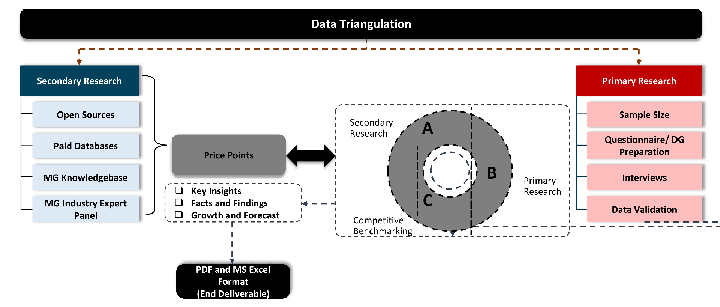
Data triangulation is a validation technique that uses multiple methods, sources, or perspectives to examine the same research question, thereby increasing the credibility and reliability of research findings. In market research, triangulation serves as a quality assurance mechanism that helps identify and minimize bias, validate assumptions, and ensure accuracy in market estimates.
- Data Source Triangulation – Using multiple data sources to examine the same phenomenon
- Methodological Triangulation – Using multiple research methods to study the same research question
- Investigator Triangulation – Using multiple researchers or analysts to examine the same data
- Theoretical Triangulation – Using multiple theoretical perspectives to interpret the same data
Custom Market Research Services
We will customise the research for you, in case the report listed above does not meet your requirements.
Get 10% Free Customisation