Outdoor Furniture Market Size, Share & Trends Analysis Report by Product Type (Seating, Tables, Storage & Accessories, Shade & Shelter Structures, Outdoor Beds & Daybeds, Sets & Collections), Material Type, Style/ Design Aesthetic, End-User Type, Price Range, Sales Channel and Geography (North America, Europe, Asia Pacific, Middle East, Africa, and South America) – Global Industry Data, Trends, and Forecasts, 2026–2035
|
|
|
Segmental Data Insights |
|
|
Demand Trends |
|
|
Competitive Landscape |
|
|
Strategic Development |
|
|
Future Outlook & Opportunities |
|
Outdoor-Furniture-Market Size, Share, and Growth
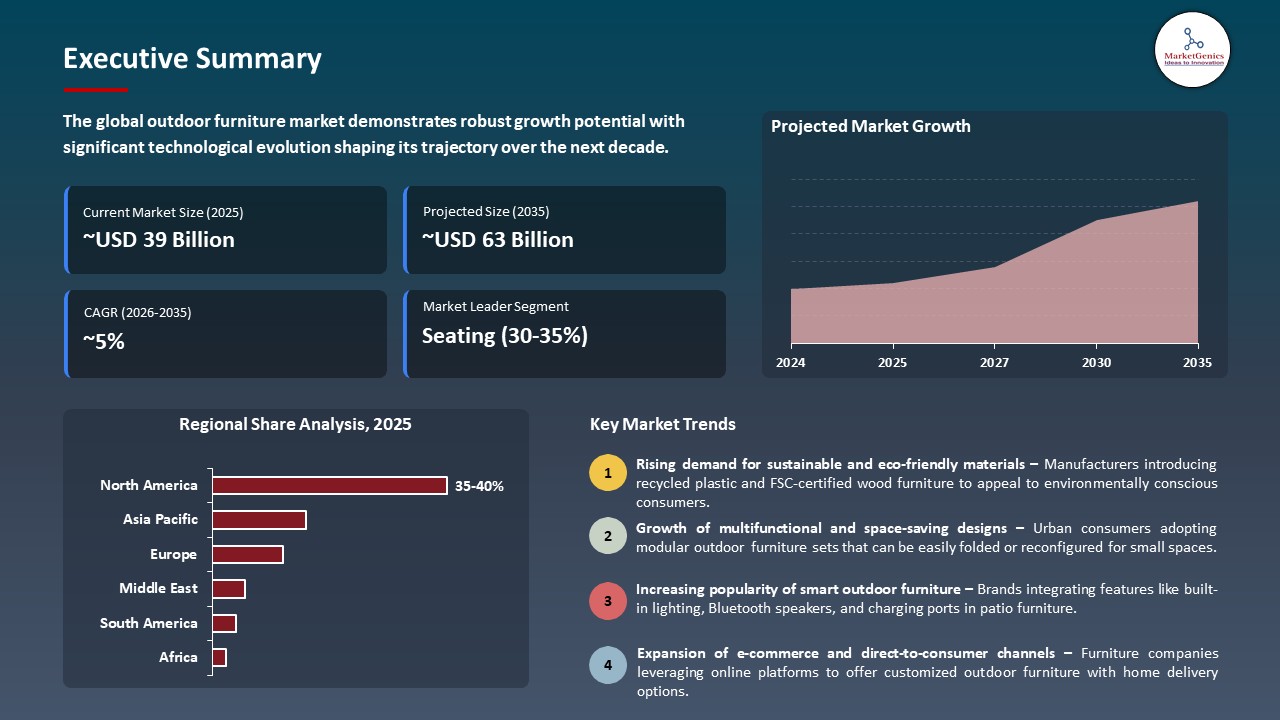
The global outdoor furniture market is exhibiting strong growth, with an estimated value of USD 39.2 billion in 2025 and USD 63.2 billion by 2035, achieving a CAGR of 4.9%, during the forecast period. The global outdoor furniture market is driven by growing demand for outdoor living spaces, rising home improvement activities, increasing hospitality sector demand, higher disposable incomes, and consumer preference for durable, aesthetic, and weather-resistant furniture, supported by expanding e-commerce and customization options.
“Our 2024 Outdoor Collection blurs the lines between indoor and outdoor living, presenting a level of design, quality, taste and style unrivaled in today’s market,” said RH Chairman and CEO Gary Friedman. “We are proud to introduce our latest Sourcebook, and the innovative global designers and artisan manufacturers we have partnered with. Together, we are pushing boundaries and imagining a new and inspiring way to live outdoors.”
The strategic brand partnerships that combine unique design with improved product appeal are driving the outdoor furniture market, improving customer engagement and market awareness. For instance, in February 2025, lifestyle brand Draper James partnered with POLYWOOD to launch the Savannah Collection, an exclusive outdoor furniture line combining Southern‑inspired design with POLYWOOD’s all‑weather, infinitely recyclable lumber and backed by a 20‑year warranty. Such collaborations elevate brand differentiation and stimulate consumer demand, driving market growth.
Additionally, the outdoor furniture market is being driven by established furniture makers' deliberate expansion of product portfolios into outdoor segments, allowing them to serve a broader range of use cases and appeal to a larger client base. For instance, in January 2026, KI launched the Outspan Outdoor Collection, featuring durable, weather-resistant seating and tables that extend the company’s design standards to outdoor spaces in workplaces, campuses, and hospitality settings. This strategic portfolio expansion enhances market reach and drives sustained growth in the outdoor furniture sector.
The global outdoor furniture market presents opportunities in smart outdoor furniture, eco-friendly and sustainable materials, commercial and hospitality landscaping, modular and multi-functional furniture solutions, and outdoor décor and accessories integration. These adjacent markets enable manufacturers to diversify offerings, enhance customer experience, and drive sustained growth in both residential and commercial outdoor segments.
Outdoor Furniture Market Dynamics and Trends
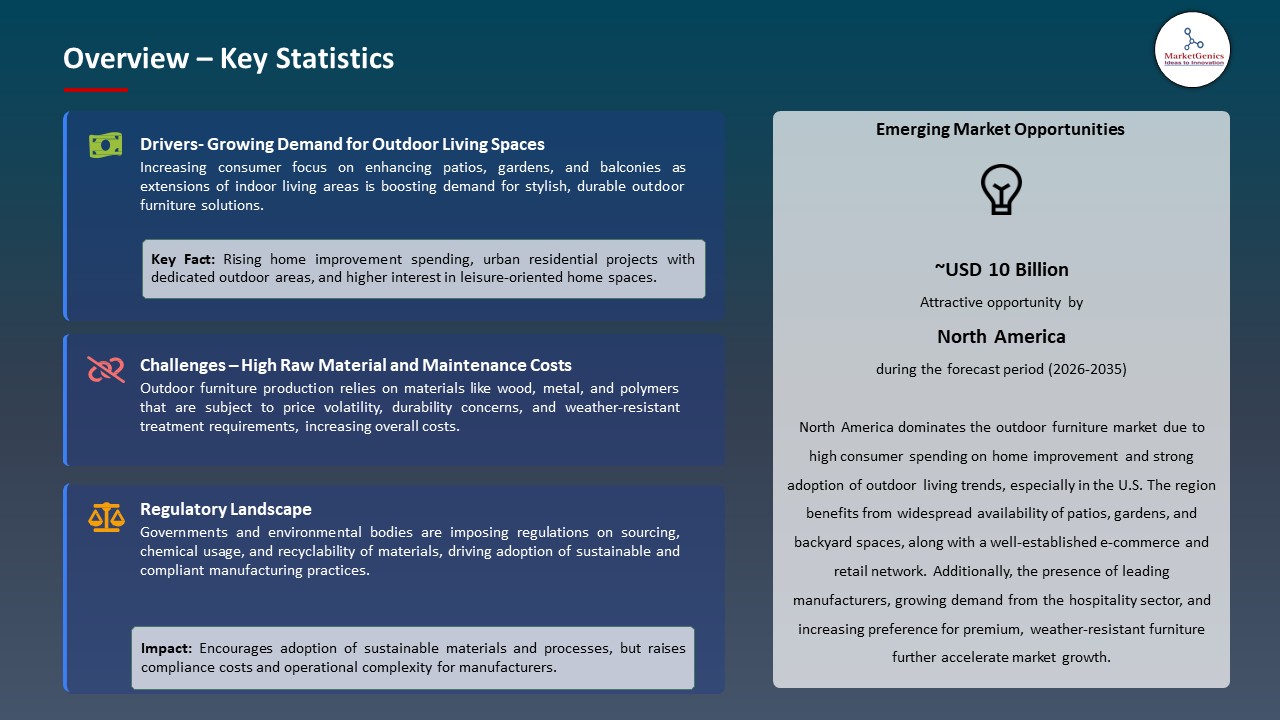
Driver: Growth Enabled by Expansion of Premium Outdoor Collections into High‑End Residential Segments
- Premium, design-focused collections that portray outdoor areas as sophisticated extensions of high-end living surroundings are a key growth driver in the global outdoor furniture market. These offerings not only enhance aesthetic appeal but also emphasize durability, functionality, and sustainability, reflecting the increasing consumer preference for outdoor spaces that mirror the comfort and style of interior living areas.
- The superior materials and meticulous design elevate outdoor living experiences, appealing to affluent consumers who value both performance and architectural elegance. For instance, in 2026, Molteni & C unveiled its 2026 outdoor collection, the Soleva range, featuring armchairs, chaise lounges, and modular seating crafted from powder-coated aluminum and marine plywood with recyclable, water-resistant cushions.
- Such premium, design-led expansions reinforce market segmentation, encourage higher-value purchases, and drive long-term growth in the luxury outdoor furniture sector.
Restraint: Fluctuating Raw Material Costs and Extended Lead Times Pressuring Production
- The volatility of raw material prices, combined with persistent supply chain delays, is a key impediment to the outdoor furniture market, increasing manufacturing costs and presenting operational issues. Key materials, including aluminum, steel, high-performance polymers, and weather-resistant fabrics, have experienced significant price fluctuations due to global commodity shifts, trade restrictions, and transportation bottlenecks.
- These factors often compel manufacturers to raise product prices or accept lower profit margins, affecting competitiveness in price-sensitive segments. Moreover, prolonged lead times can delay new product launches, disrupt inventory planning, and reduce the ability to respond promptly to seasonal demand peaks.
- Continued material price volatility and supply chain constraints limit operational efficiency and slow market expansion, particularly impacting mid-range and cost-conscious consumer segments.
Opportunity: Advancements in Product Design and Expanded Outdoor Applications
- The continued development of innovative, application-focused items that extend usage beyond standard patios into specialized and environment-specific outdoor settings is a key growth driver in the outdoor furniture market. Consumers increasingly seek outdoor furniture that not only provides comfort but also enhances functionality, aesthetic appeal, and adaptability for diverse spaces such as poolside areas, terraces, gardens, and hospitality venues.
- In April 2026, POLYWOOD launched its Laguna in‑Pool Collection, featuring marine-grade, UV-resistant chaise lounges, chairs, and side tables designed specifically for partially submerged pool environments. The collection demonstrates superior durability, weather resistance, and multifunctional design, catering to both residential and commercial applications.
- By introducing innovative, versatile products, manufacturers can expand market reach, strengthen consumer engagement, and drive sustained growth across both residential and hospitality outdoor furniture segments.
Key Trend: Seamless Indoor‑Outdoor Design Convergence in Outdoor Furniture Collections
- The increasing focus on collections that blur the lines between indoor and outdoor life, resulting in unified design continuity and functional flow between indoor and outdoor areas, is a major trend influencing the global outdoor furniture market. Leading manufacturers are responding by crafting outdoor pieces that reflect the aesthetic, comfort, and material sophistication typical of indoor furniture, enabling consumers to curate unified living environments rather than disjointed patio setups.
- For instance, Molteni & C’s 2026 Outdoor Collection is specifically presented as a continuation of contemporary home living, with designs that “seamlessly bridge indoor and outdoor realms” and are crafted to integrate refined materials, architectural coherence, and durable performance for exterior spaces effectively positioning outdoor settings as extensions of the interior lifestyle.
- This design convergence enhances consumer perception of outdoor furniture as integral lifestyle investments, driving higher engagement and expanding market demand for versatile, design‑forward products.
Outdoor Furniture Market Analysis and Segmental Data
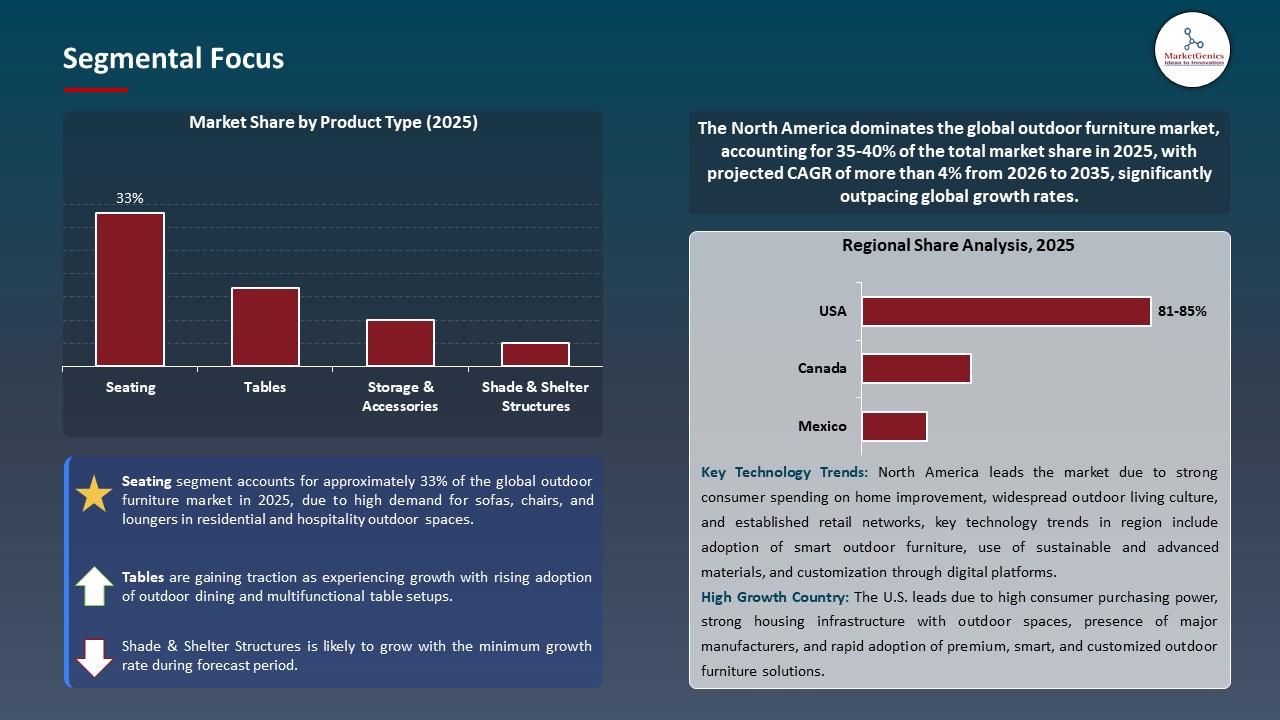
Seating Dominate Global Outdoor Furniture Market
- The seating segment dominates the global outdoor furniture market due to its fundamental role in facilitating comfortable, social, and leisure-focused outdoor experiences. Configured as individual chairs, sofas, benches, or modular lounge arrangements, seating products are indispensable across residential patios, commercial terraces, resorts, and hospitality settings, generating higher purchase frequency and wider adoption compared to other outdoor furniture categories.
- Manufacturers such as IKEA prominently feature extensive outdoor seating collections from armchairs and benches to sofas and modular combinations on their official product sites, highlighting seating as a cornerstone of their outdoor offering.
- The continued dominance of seating reinforces its strategic importance for product development and revenue generation across outdoor furniture portfolios.
North America Leads Global Outdoor Furniture Market Demand
- North America leads the outdoor furniture market is strongly supported by well-established retail and distribution networks, which ensure broad product availability and facilitate high consumer penetration. For instance, Ashley Furniture offers a comprehensive portfolio of outdoor products including weather-resistant patio seating, dining sets, and modular arrangements, reflecting a strategic emphasis on meeting the robust demand across the U.S. and Canadian markets.
- Additionally, North America’s market leadership is reinforced by established outdoor furniture manufacturers with long-standing design expertise and premium product offerings tailored to regional consumer preferences. Brown Jordan, a U.S.-based luxury outdoor furniture brand, showcases its high-end residential and commercial collections.
- The presence of legacy brands with specialized outdoor expertise strengthens regional demand and consolidates North America’s leading position in the global market.
Outdoor Furniture Market Ecosystem
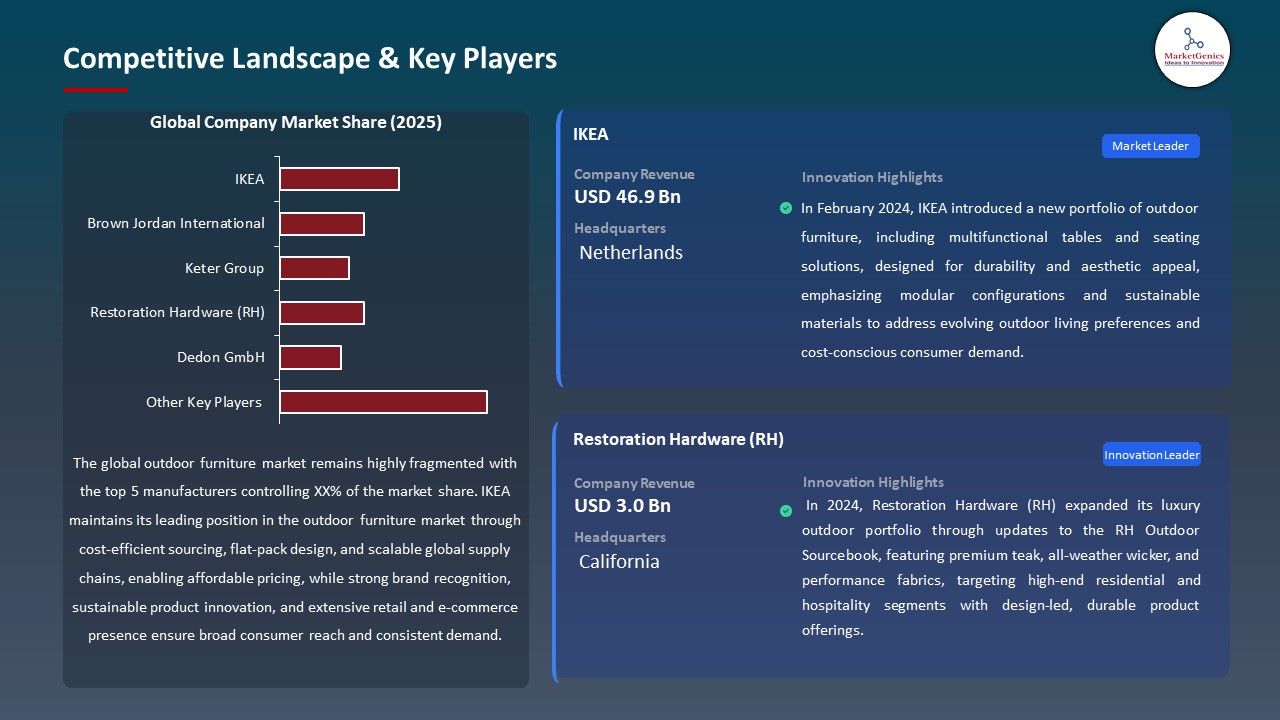
The global outdoor furniture market is highly fragmented, with leading players such as IKEA, Brown Jordan International, Keter Group, Restoration Hardware (RH), and Dedon GmbH dominating through strong global presence, scalable manufacturing, and the adoption of advanced materials and design technologies that enhance durability, weather resistance, and product aesthetics.
These companies increasingly focus on specialized and niche solutions, such as modular outdoor furniture systems, high-performance synthetic fibers, recycled resin-based products, and premium teak collections, enabling enhanced customization, sustainability, and long-term performance. For instance, innovations in all-weather wicker, UV-resistant coatings, and ergonomic outdoor seating are driving product differentiation and consumer appeal.
This strategic focus on innovation and specialized offerings accelerates market growth by enhancing product value, attracting premium consumer segments, strengthening brand positioning, and driving higher adoption across both residential and commercial outdoor spaces.
Recent Development and Strategic Overview:
- In April 2025, IKEA launched the STOCKHOLM 2025 collection, its largest premium range comprising 96 products, emphasizing high-quality materials and Scandinavian design, thereby strengthening its premium positioning across indoor and outdoor segments while maintaining affordability through scalable design and production capabilities.
- In February 2025, Restoration Hardware (RH) expanded its RH Outdoor portfolio through the introduction of upgraded collections incorporating weather-resistant materials, premium teak, and high-performance fabrics, strategically targeting high-end residential and hospitality segments with integrated design aesthetics and enhanced durability-focused product innovations.
Report Scope
|
Detail |
|
|
Market Size in 2025 |
USD 39.2 Bn |
|
Market Forecast Value in 2035 |
USD 63.2 Bn |
|
Growth Rate (CAGR) |
4.9% |
|
Forecast Period |
2026 – 2035 |
|
Historical Data Available for |
2021 – 2024 |
|
Market Size Units |
US$ Billion for Value Million Units for Volume |
|
Report Format |
Electronic (PDF) + Excel |
|
North America |
Europe |
Asia Pacific |
Middle East |
Africa |
South America |
|
|
|
|
|
|
|
Companies Covered |
|||||
|
|
|
|
|
|
Outdoor Furniture Market Segmentation and Highlights
|
Segment |
Sub-segment |
|
Outdoor Furniture Market, By Product Type |
|
|
Outdoor Furniture Market, By Material Type |
|
|
Outdoor Furniture Market, By Style / Design Aesthetic |
|
|
Outdoor Furniture Market, By End-User Type |
|
|
Outdoor Furniture Market, By Price Range |
|
|
Outdoor Furniture Market, By Sales Channel |
|
Frequently Asked Questions
Table of Contents
- 1. Research Methodology and Assumptions
- 1.1. Definitions
- 1.2. Research Design and Approach
- 1.3. Data Collection Methods
- 1.4. Base Estimates and Calculations
- 1.5. Forecasting Models
- 1.5.1. Key Forecast Factors & Impact Analysis
- 1.6. Secondary Research
- 1.6.1. Open Sources
- 1.6.2. Paid Databases
- 1.6.3. Associations
- 1.7. Primary Research
- 1.7.1. Primary Sources
- 1.7.2. Primary Interviews with Stakeholders across Ecosystem
- 2. Executive Summary
- 2.1. Global Outdoor Furniture Market Outlook
- 2.1.1. Outdoor Furniture Market Size (Volume - Million Units and Value - US$ Bn), and Forecasts, 2021-2035
- 2.1.2. Compounded Annual Growth Rate Analysis
- 2.1.3. Growth Opportunity Analysis
- 2.1.4. Segmental Share Analysis
- 2.1.5. Geographical Share Analysis
- 2.2. Market Analysis and Facts
- 2.3. Supply-Demand Analysis
- 2.4. Competitive Benchmarking
- 2.5. Go-to- Market Strategy
- 2.5.1. Customer/ End-use Industry Assessment
- 2.5.2. Growth Opportunity Data, 2026-2035
- 2.5.2.1. Regional Data
- 2.5.2.2. Country Data
- 2.5.2.3. Segmental Data
- 2.5.3. Identification of Potential Market Spaces
- 2.5.4. GAP Analysis
- 2.5.5. Potential Attractive Price Points
- 2.5.6. Prevailing Market Risks & Challenges
- 2.5.7. Preferred Sales & Marketing Strategies
- 2.5.8. Key Recommendations and Analysis
- 2.5.9. A Way Forward
- 2.1. Global Outdoor Furniture Market Outlook
- 3. Industry Data and Premium Insights
- 3.1. Global Consumer Goods & Services Industry Overview, 2025
- 3.1.1. Consumer Goods & Services Ecosystem Analysis
- 3.1.2. Key Trends for Consumer Goods & Services Industry
- 3.1.3. Regional Distribution for Consumer Goods & Services Industry
- 3.2. Supplier Customer Data
- 3.3. Technology Roadmap and Developments
- 3.4. Trade Analysis
- 3.4.1. Import & Export Analysis, 2025
- 3.4.2. Top Importing Countries
- 3.4.3. Top Exporting Countries
- 3.5. Trump Tariff Impact Analysis
- 3.5.1. Manufacturer
- 3.5.1.1. Based on the component & Raw material
- 3.5.2. Supply Chain
- 3.5.3. End Consumer
- 3.5.1. Manufacturer
- 3.6. Raw Material Analysis
- 3.1. Global Consumer Goods & Services Industry Overview, 2025
- 4. Market Overview
- 4.1. Market Dynamics
- 4.1.1. Drivers
- 4.1.1.1. Rising demand for outdoor living spaces and home improvement activities
- 4.1.1.2. Growth of hospitality and tourism sectors increasing commercial demand
- 4.1.1.3. Increasing disposable income and preference for premium, aesthetic outdoor furniture
- 4.1.2. Restraints
- 4.1.2.1. Fluctuating raw material costs impacting pricing and margins
- 4.1.2.2. Seasonal demand and weather dependency limiting year-round sales
- 4.1.1. Drivers
- 4.2. Key Trend Analysis
- 4.3. Regulatory Framework
- 4.3.1. Key Regulations, Norms, and Subsidies, by Key Countries
- 4.3.2. Tariffs and Standards
- 4.3.3. Impact Analysis of Regulations on the Market
- 4.4. Value Chain Analysis
- 4.5. Cost Structure Analysis
- 4.5.1. Parameter’s Share for Cost Associated
- 4.5.2. COGP vs COGS
- 4.5.3. Profit Margin Analysis
- 4.6. Pricing Analysis
- 4.6.1. Regional Pricing Analysis
- 4.6.2. Segmental Pricing Trends
- 4.6.3. Factors Influencing Pricing
- 4.7. Porter’s Five Forces Analysis
- 4.8. PESTEL Analysis
- 4.9. Global Outdoor Furniture Market Demand
- 4.9.1. Historical Market Size – in Volume (Million Units) and Value (US$ Bn), 2020-2024
- 4.9.2. Current and Future Market Size – in Volume (Million Units) and Value (US$ Bn), 2026–2035
- 4.9.2.1. Y-o-Y Growth Trends
- 4.9.2.2. Absolute $ Opportunity Assessment
- 4.1. Market Dynamics
- 5. Competition Landscape
- 5.1. Competition structure
- 5.1.1. Fragmented v/s consolidated
- 5.2. Company Share Analysis, 2025
- 5.2.1. Global Company Market Share
- 5.2.2. By Region
- 5.2.2.1. North America
- 5.2.2.2. Europe
- 5.2.2.3. Asia Pacific
- 5.2.2.4. Middle East
- 5.2.2.5. Africa
- 5.2.2.6. South America
- 5.3. Product Comparison Matrix
- 5.3.1. Specifications
- 5.3.2. Market Positioning
- 5.3.3. Pricing
- 5.1. Competition structure
- 6. Global Outdoor Furniture Market Analysis, by Product Type
- 6.1. Key Segment Analysis
- 6.2. Outdoor Furniture Market Size (Volume - Million Units and Value - US$ Bn), Analysis, and Forecasts, by Product Type, 2021-2035
- 6.2.1. Seating
- 6.2.1.1. Chairs (Adirondack, Rocking, Folding, Lounge)
- 6.2.1.2. Benches
- 6.2.1.3. Hammocks & Swings
- 6.2.1.4. Bar Stools
- 6.2.1.5. Others
- 6.2.2. Tables
- 6.2.2.1. Dining Tables
- 6.2.2.2. Coffee Tables
- 6.2.2.3. Side/End Tables
- 6.2.2.4. Picnic Tables
- 6.2.2.5. Bar-Height Tables
- 6.2.2.6. Others
- 6.2.3. Storage & Accessories
- 6.2.3.1. Deck Boxes
- 6.2.3.2. Outdoor Cabinets
- 6.2.3.3. Ottomans with Storage
- 6.2.3.4. Others
- 6.2.4. Shade & Shelter Structures
- 6.2.4.1. Umbrellas (Cantilever, Market, Offset)
- 6.2.4.2. Pergolas
- 6.2.4.3. Gazebos
- 6.2.4.4. Awnings
- 6.2.4.5. Canopies
- 6.2.4.6. Others
- 6.2.5. Outdoor Beds & Daybeds
- 6.2.5.1. Sets & Collections
- 6.2.5.2. Dining Sets
- 6.2.5.3. Conversation Sets
- 6.2.5.4. Bistro Sets
- 6.2.5.5. Deep Seating Sets
- 6.2.5.6. Others
- 6.2.1. Seating
- 7. Global Outdoor Furniture Market Analysis, by Material Type
- 7.1. Key Segment Analysis
- 7.2. Outdoor Furniture Market Size (Volume - Million Units and Value - US$ Bn), Analysis, and Forecasts, by Material Type, 2021-2035
- 7.2.1. Wood
- 7.2.1.1. Teak
- 7.2.1.2. Eucalyptus
- 7.2.1.3. Acacia
- 7.2.1.4. Cedar
- 7.2.1.5. Pine
- 7.2.1.6. Bamboo
- 7.2.1.7. Others
- 7.2.2. Metal
- 7.2.2.1. Aluminum
- 7.2.2.2. Wrought Iron
- 7.2.2.3. Stainless Steel
- 7.2.2.4. Galvanized Steel
- 7.2.2.5. Powder-Coated Steel
- 7.2.2.6. Others
- 7.2.3. Plastic & Resin
- 7.2.3.1. HDPE (High-Density Polyethylene)
- 7.2.3.2. Polypropylene
- 7.2.3.3. PVC
- 7.2.3.4. Recycled Plastic Lumber
- 7.2.3.5. Others
- 7.2.4. Wicker & Rattan
- 7.2.4.1. Natural Rattan
- 7.2.4.2. Synthetic Wicker (PE/PVC)
- 7.2.5. Fabric & Textile (Upholstered/Sling)
- 7.2.5.1. Sunbrella & Solution-Dyed Acrylic
- 7.2.5.2. Olefin
- 7.2.5.3. Polyester
- 7.2.5.4. Textilene/PVC Mesh
- 7.2.5.5. Others
- 7.2.6. Concrete & Stone
- 7.2.6.1. Cast Concrete
- 7.2.6.2. Granite
- 7.2.6.3. Marble
- 7.2.6.4. Others
- 7.2.7. Composite & Hybrid Materials
- 7.2.7.1. Wood-Plastic Composite (WPC)
- 7.2.7.2. Fiber-Reinforced Polymer
- 7.2.1. Wood
- 8. Global Outdoor Furniture Market Analysis, by Style / Design Aesthetic
- 8.1. Key Segment Analysis
- 8.2. Outdoor Furniture Market Size (Volume - Million Units and Value - US$ Bn), Analysis, and Forecasts, by Style / Design Aesthetic, 2021-2035
- 8.2.1. Contemporary / Modern
- 8.2.2. Traditional / Classic
- 8.2.3. Rustic / Farmhouse
- 8.2.4. Coastal / Tropical
- 8.2.5. Industrial / Urban
- 8.2.6. Bohemian / Eclectic
- 8.2.7. Minimalist / Scandinavian
- 9. Global Outdoor Furniture Market Analysis, by End-User Type
- 9.1. Key Segment Analysis
- 9.2. Outdoor Furniture Market Size (Volume - Million Units and Value - US$ Bn), Analysis, and Forecasts, by End-User Type, 2021-2035
- 9.2.1. Residential Consumers
- 9.2.1.1. Homeowners
- 9.2.1.2. Renters / Apartment Dwellers
- 9.2.1.3. Second-Home / Vacation Property Owners
- 9.2.1.4. Others
- 9.2.2. Commercial Buyers
- 9.2.2.1. Hospitality & Hotels
- 9.2.2.2. Restaurants & Cafes
- 9.2.2.3. Offices & Corporate Campuses
- 9.2.2.4. Educational Institutions
- 9.2.2.5. Healthcare & Wellness Facilities
- 9.2.2.6. Retail & Shopping Centers
- 9.2.2.7. Event & Venue Management Companies
- 9.2.2.8. Government & Municipal Bodies
- 9.2.2.9. Others
- 9.2.1. Residential Consumers
- 10. Global Outdoor Furniture Market Analysis, by Price Range
- 10.1. Key Segment Analysis
- 10.2. Outdoor Furniture Market Size (Volume - Million Units and Value - US$ Bn), Analysis, and Forecasts, by Price Range, 2021-2035
- 10.2.1. Below $200
- 10.2.2. $200–$800
- 10.2.3. $800–$2,000
- 10.2.4. Above $2,000
- 11. Global Outdoor Furniture Market Analysis, by Sales Channel
- 11.1. Key Segment Analysis
- 11.2. Outdoor Furniture Market Size (Volume - Million Units and Value - US$ Bn), Analysis, and Forecasts, by Sales Channel, 2021-2035
- 11.2.1. Online
- 11.2.2. Offline
- 12. Global Outdoor Furniture Market Analysis, by Region
- 12.1. Key Findings
- 12.2. Outdoor Furniture Market Size (Volume - Million Units and Value - US$ Bn), Analysis, and Forecasts, by Region, 2021-2035
- 12.2.1. North America
- 12.2.2. Europe
- 12.2.3. Asia Pacific
- 12.2.4. Middle East
- 12.2.5. Africa
- 12.2.6. South America
- 13. North America Outdoor Furniture Market Analysis
- 13.1. Key Segment Analysis
- 13.2. Regional Snapshot
- 13.3. North America Outdoor Furniture Market Size (Volume - Million Units and Value - US$ Bn), Analysis, and Forecasts, 2021-2035
- 13.3.1. Product Type
- 13.3.2. Material Type
- 13.3.3. Style / Design Aesthetic
- 13.3.4. End-User Type
- 13.3.5. Price Range
- 13.3.6. Sales Channel
- 13.3.7. Country
- 13.3.7.1. USA
- 13.3.7.2. Canada
- 13.3.7.3. Mexico
- 13.4. USA Outdoor Furniture Market
- 13.4.1. Country Segmental Analysis
- 13.4.2. Product Type
- 13.4.3. Material Type
- 13.4.4. Style / Design Aesthetic
- 13.4.5. End-User Type
- 13.4.6. Price Range
- 13.4.7. Sales Channel
- 13.5. Canada Outdoor Furniture Market
- 13.5.1. Country Segmental Analysis
- 13.5.2. Product Type
- 13.5.3. Material Type
- 13.5.4. Style / Design Aesthetic
- 13.5.5. End-User Type
- 13.5.6. Price Range
- 13.5.7. Sales Channel
- 13.6. Mexico Outdoor Furniture Market
- 13.6.1. Country Segmental Analysis
- 13.6.2. Product Type
- 13.6.3. Material Type
- 13.6.4. Style / Design Aesthetic
- 13.6.5. End-User Type
- 13.6.6. Price Range
- 13.6.7. Sales Channel
- 14. Europe Outdoor Furniture Market Analysis
- 14.1. Key Segment Analysis
- 14.2. Regional Snapshot
- 14.3. Europe Outdoor Furniture Market Size (Volume - Million Units and Value - US$ Bn), Analysis, and Forecasts, 2021-2035
- 14.3.1. Product Type
- 14.3.2. Material Type
- 14.3.3. Style / Design Aesthetic
- 14.3.4. End-User Type
- 14.3.5. Price Range
- 14.3.6. Sales Channel
- 14.3.7. Country
- 14.3.7.1. Germany
- 14.3.7.2. United Kingdom
- 14.3.7.3. France
- 14.3.7.4. Italy
- 14.3.7.5. Spain
- 14.3.7.6. Netherlands
- 14.3.7.7. Nordic Countries
- 14.3.7.8. Poland
- 14.3.7.9. Russia & CIS
- 14.3.7.10. Rest of Europe
- 14.4. Germany Outdoor Furniture Market
- 14.4.1. Country Segmental Analysis
- 14.4.2. Product Type
- 14.4.3. Material Type
- 14.4.4. Style / Design Aesthetic
- 14.4.5. End-User Type
- 14.4.6. Price Range
- 14.4.7. Sales Channel
- 14.5. United Kingdom Outdoor Furniture Market
- 14.5.1. Country Segmental Analysis
- 14.5.2. Product Type
- 14.5.3. Material Type
- 14.5.4. Style / Design Aesthetic
- 14.5.5. End-User Type
- 14.5.6. Price Range
- 14.5.7. Sales Channel
- 14.6. France Outdoor Furniture Market
- 14.6.1. Country Segmental Analysis
- 14.6.2. Product Type
- 14.6.3. Material Type
- 14.6.4. Style / Design Aesthetic
- 14.6.5. End-User Type
- 14.6.6. Price Range
- 14.6.7. Sales Channel
- 14.7. Italy Outdoor Furniture Market
- 14.7.1. Country Segmental Analysis
- 14.7.2. Product Type
- 14.7.3. Material Type
- 14.7.4. Style / Design Aesthetic
- 14.7.5. End-User Type
- 14.7.6. Price Range
- 14.7.7. Sales Channel
- 14.8. Spain Outdoor Furniture Market
- 14.8.1. Country Segmental Analysis
- 14.8.2. Product Type
- 14.8.3. Material Type
- 14.8.4. Style / Design Aesthetic
- 14.8.5. End-User Type
- 14.8.6. Price Range
- 14.8.7. Sales Channel
- 14.9. Netherlands Outdoor Furniture Market
- 14.9.1. Country Segmental Analysis
- 14.9.2. Product Type
- 14.9.3. Material Type
- 14.9.4. Style / Design Aesthetic
- 14.9.5. End-User Type
- 14.9.6. Price Range
- 14.9.7. Sales Channel
- 14.10. Nordic Countries Outdoor Furniture Market
- 14.10.1. Country Segmental Analysis
- 14.10.2. Product Type
- 14.10.3. Material Type
- 14.10.4. Style / Design Aesthetic
- 14.10.5. End-User Type
- 14.10.6. Price Range
- 14.10.7. Sales Channel
- 14.11. Poland Outdoor Furniture Market
- 14.11.1. Country Segmental Analysis
- 14.11.2. Product Type
- 14.11.3. Material Type
- 14.11.4. Style / Design Aesthetic
- 14.11.5. End-User Type
- 14.11.6. Price Range
- 14.11.7. Sales Channel
- 14.12. Russia & CIS Outdoor Furniture Market
- 14.12.1. Country Segmental Analysis
- 14.12.2. Product Type
- 14.12.3. Material Type
- 14.12.4. Style / Design Aesthetic
- 14.12.5. End-User Type
- 14.12.6. Price Range
- 14.12.7. Sales Channel
- 14.13. Rest of Europe Outdoor Furniture Market
- 14.13.1. Country Segmental Analysis
- 14.13.2. Product Type
- 14.13.3. Material Type
- 14.13.4. Style / Design Aesthetic
- 14.13.5. End-User Type
- 14.13.6. Price Range
- 14.13.7. Sales Channel
- 15. Asia Pacific Outdoor Furniture Market Analysis
- 15.1. Key Segment Analysis
- 15.2. Regional Snapshot
- 15.3. Asia Pacific Outdoor Furniture Market Size (Volume - Million Units and Value - US$ Bn), Analysis, and Forecasts, 2021-2035
- 15.3.1. Product Type
- 15.3.2. Material Type
- 15.3.3. Style / Design Aesthetic
- 15.3.4. End-User Type
- 15.3.5. Price Range
- 15.3.6. Sales Channel
- 15.3.7. Country
- 15.3.7.1. China
- 15.3.7.2. India
- 15.3.7.3. Japan
- 15.3.7.4. South Korea
- 15.3.7.5. Australia and New Zealand
- 15.3.7.6. Indonesia
- 15.3.7.7. Malaysia
- 15.3.7.8. Thailand
- 15.3.7.9. Vietnam
- 15.3.7.10. Rest of Asia Pacific
- 15.4. China Outdoor Furniture Market
- 15.4.1. Country Segmental Analysis
- 15.4.2. Product Type
- 15.4.3. Material Type
- 15.4.4. Style / Design Aesthetic
- 15.4.5. End-User Type
- 15.4.6. Price Range
- 15.4.7. Sales Channel
- 15.5. India Outdoor Furniture Market
- 15.5.1. Country Segmental Analysis
- 15.5.2. Product Type
- 15.5.3. Material Type
- 15.5.4. Style / Design Aesthetic
- 15.5.5. End-User Type
- 15.5.6. Price Range
- 15.5.7. Sales Channel
- 15.6. Japan Outdoor Furniture Market
- 15.6.1. Country Segmental Analysis
- 15.6.2. Product Type
- 15.6.3. Material Type
- 15.6.4. Style / Design Aesthetic
- 15.6.5. End-User Type
- 15.6.6. Price Range
- 15.6.7. Sales Channel
- 15.7. South Korea Outdoor Furniture Market
- 15.7.1. Country Segmental Analysis
- 15.7.2. Product Type
- 15.7.3. Material Type
- 15.7.4. Style / Design Aesthetic
- 15.7.5. End-User Type
- 15.7.6. Price Range
- 15.7.7. Sales Channel
- 15.8. Australia and New Zealand Outdoor Furniture Market
- 15.8.1. Country Segmental Analysis
- 15.8.2. Product Type
- 15.8.3. Material Type
- 15.8.4. Style / Design Aesthetic
- 15.8.5. End-User Type
- 15.8.6. Price Range
- 15.8.7. Sales Channel
- 15.9. Indonesia Outdoor Furniture Market
- 15.9.1. Country Segmental Analysis
- 15.9.2. Product Type
- 15.9.3. Material Type
- 15.9.4. Style / Design Aesthetic
- 15.9.5. End-User Type
- 15.9.6. Price Range
- 15.9.7. Sales Channel
- 15.10. Malaysia Outdoor Furniture Market
- 15.10.1. Country Segmental Analysis
- 15.10.2. Product Type
- 15.10.3. Material Type
- 15.10.4. Style / Design Aesthetic
- 15.10.5. End-User Type
- 15.10.6. Price Range
- 15.10.7. Sales Channel
- 15.11. Thailand Outdoor Furniture Market
- 15.11.1. Country Segmental Analysis
- 15.11.2. Product Type
- 15.11.3. Material Type
- 15.11.4. Style / Design Aesthetic
- 15.11.5. End-User Type
- 15.11.6. Price Range
- 15.11.7. Sales Channel
- 15.12. Vietnam Outdoor Furniture Market
- 15.12.1. Country Segmental Analysis
- 15.12.2. Product Type
- 15.12.3. Material Type
- 15.12.4. Style / Design Aesthetic
- 15.12.5. End-User Type
- 15.12.6. Price Range
- 15.12.7. Sales Channel
- 15.13. Rest of Asia Pacific Outdoor Furniture Market
- 15.13.1. Country Segmental Analysis
- 15.13.2. Product Type
- 15.13.3. Material Type
- 15.13.4. Style / Design Aesthetic
- 15.13.5. End-User Type
- 15.13.6. Price Range
- 15.13.7. Sales Channel
- 16. Middle East Outdoor Furniture Market Analysis
- 16.1. Key Segment Analysis
- 16.2. Regional Snapshot
- 16.3. Middle East Outdoor Furniture Market Size (Volume - Million Units and Value - US$ Bn), Analysis, and Forecasts, 2021-2035
- 16.3.1. Product Type
- 16.3.2. Material Type
- 16.3.3. Style / Design Aesthetic
- 16.3.4. End-User Type
- 16.3.5. Price Range
- 16.3.6. Sales Channel
- 16.3.7. Country
- 16.3.7.1. Turkey
- 16.3.7.2. UAE
- 16.3.7.3. Saudi Arabia
- 16.3.7.4. Israel
- 16.3.7.5. Rest of Middle East
- 16.4. Turkey Outdoor Furniture Market
- 16.4.1. Country Segmental Analysis
- 16.4.2. Product Type
- 16.4.3. Material Type
- 16.4.4. Style / Design Aesthetic
- 16.4.5. End-User Type
- 16.4.6. Price Range
- 16.4.7. Sales Channel
- 16.5. UAE Outdoor Furniture Market
- 16.5.1. Country Segmental Analysis
- 16.5.2. Product Type
- 16.5.3. Material Type
- 16.5.4. Style / Design Aesthetic
- 16.5.5. End-User Type
- 16.5.6. Price Range
- 16.5.7. Sales Channel
- 16.6. Saudi Arabia Outdoor Furniture Market
- 16.6.1. Country Segmental Analysis
- 16.6.2. Product Type
- 16.6.3. Material Type
- 16.6.4. Style / Design Aesthetic
- 16.6.5. End-User Type
- 16.6.6. Price Range
- 16.6.7. Sales Channel
- 16.7. Israel Outdoor Furniture Market
- 16.7.1. Country Segmental Analysis
- 16.7.2. Product Type
- 16.7.3. Material Type
- 16.7.4. Style / Design Aesthetic
- 16.7.5. End-User Type
- 16.7.6. Price Range
- 16.7.7. Sales Channel
- 16.8. Rest of Middle East Outdoor Furniture Market
- 16.8.1. Country Segmental Analysis
- 16.8.2. Product Type
- 16.8.3. Material Type
- 16.8.4. Style / Design Aesthetic
- 16.8.5. End-User Type
- 16.8.6. Price Range
- 16.8.7. Sales Channel
- 17. Africa Outdoor Furniture Market Analysis
- 17.1. Key Segment Analysis
- 17.2. Regional Snapshot
- 17.3. Africa Outdoor Furniture Market Size (Volume - Million Units and Value - US$ Bn), Analysis, and Forecasts, 2021-2035
- 17.3.1. Product Type
- 17.3.2. Material Type
- 17.3.3. Style / Design Aesthetic
- 17.3.4. End-User Type
- 17.3.5. Price Range
- 17.3.6. Sales Channel
- 17.3.7. Country
- 17.3.7.1. South Africa
- 17.3.7.2. Egypt
- 17.3.7.3. Nigeria
- 17.3.7.4. Algeria
- 17.3.7.5. Rest of Africa
- 17.4. South Africa Outdoor Furniture Market
- 17.4.1. Country Segmental Analysis
- 17.4.2. Product Type
- 17.4.3. Material Type
- 17.4.4. Style / Design Aesthetic
- 17.4.5. End-User Type
- 17.4.6. Price Range
- 17.4.7. Sales Channel
- 17.5. Egypt Outdoor Furniture Market
- 17.5.1. Country Segmental Analysis
- 17.5.2. Product Type
- 17.5.3. Material Type
- 17.5.4. Style / Design Aesthetic
- 17.5.5. End-User Type
- 17.5.6. Price Range
- 17.5.7. Sales Channel
- 17.6. Nigeria Outdoor Furniture Market
- 17.6.1. Country Segmental Analysis
- 17.6.2. Product Type
- 17.6.3. Material Type
- 17.6.4. Style / Design Aesthetic
- 17.6.5. End-User Type
- 17.6.6. Price Range
- 17.6.7. Sales Channel
- 17.7. Algeria Outdoor Furniture Market
- 17.7.1. Country Segmental Analysis
- 17.7.2. Product Type
- 17.7.3. Material Type
- 17.7.4. Style / Design Aesthetic
- 17.7.5. End-User Type
- 17.7.6. Price Range
- 17.7.7. Sales Channel
- 17.8. Rest of Africa Outdoor Furniture Market
- 17.8.1. Country Segmental Analysis
- 17.8.2. Product Type
- 17.8.3. Material Type
- 17.8.4. Style / Design Aesthetic
- 17.8.5. End-User Type
- 17.8.6. Price Range
- 17.8.7. Sales Channel
- 18. South America Outdoor Furniture Market Analysis
- 18.1. Key Segment Analysis
- 18.2. Regional Snapshot
- 18.3. South America Outdoor Furniture Market Size (Volume - Million Units and Value - US$ Bn), Analysis, and Forecasts, 2021-2035
- 18.3.1. Product Type
- 18.3.2. Material Type
- 18.3.3. Style / Design Aesthetic
- 18.3.4. End-User Type
- 18.3.5. Price Range
- 18.3.6. Sales Channel
- 18.3.7. Country
- 18.3.7.1. Brazil
- 18.3.7.2. Argentina
- 18.3.7.3. Rest of South America
- 18.4. Brazil Outdoor Furniture Market
- 18.4.1. Country Segmental Analysis
- 18.4.2. Product Type
- 18.4.3. Material Type
- 18.4.4. Style / Design Aesthetic
- 18.4.5. End-User Type
- 18.4.6. Price Range
- 18.4.7. Sales Channel
- 18.5. Argentina Outdoor Furniture Market
- 18.5.1. Country Segmental Analysis
- 18.5.2. Product Type
- 18.5.3. Material Type
- 18.5.4. Style / Design Aesthetic
- 18.5.5. End-User Type
- 18.5.6. Price Range
- 18.5.7. Sales Channel
- 18.6. Rest of South America Outdoor Furniture Market
- 18.6.1. Country Segmental Analysis
- 18.6.2. Product Type
- 18.6.3. Material Type
- 18.6.4. Style / Design Aesthetic
- 18.6.5. End-User Type
- 18.6.6. Price Range
- 18.6.7. Sales Channel
- 19. Key Players/ Company Profile
- 19.1. Arhaus Furniture
- 19.1.1. Company Details/ Overview
- 19.1.2. Company Financials
- 19.1.3. Key Customers and Competitors
- 19.1.4. Business/ Industry Portfolio
- 19.1.5. Product Portfolio/ Specification Details
- 19.1.6. Pricing Data
- 19.1.7. Strategic Overview
- 19.1.8. Recent Developments
- 19.2. Brown Jordan International
- 19.3. Dedon GmbH
- 19.4. Extremis
- 19.5. Fermob
- 19.6. Frontgate
- 19.7. Gloster Furniture
- 19.8. Homecrest Outdoor Living
- 19.9. IKEA
- 19.10. Janus et Cie
- 19.11. Keter Group
- 19.12. Kettal Group
- 19.13. Ledge Lounger
- 19.14. Lifetime Products Inc.
- 19.15. OW Lee Company
- 19.16. Pottery Barn
- 19.17. Restoration Hardware (RH)
- 19.18. Royal Botania
- 19.19. Steelcase Inc.
- 19.20. Telescope Casual Furniture
- 19.21. Triconfort
- 19.22. Tropitone Furniture Co.
- 19.23. Unopiù
- 19.24. Woodard Furniture
- 19.25. Yardbird Outdoor Living
- 19.26. Other Key Players
- 19.1. Arhaus Furniture
Note* - This is just tentative list of players. While providing the report, we will cover more number of players based on their revenue and share for each geography
Research Design
Our research design integrates both demand-side and supply-side analysis through a balanced combination of primary and secondary research methodologies. By utilizing both bottom-up and top-down approaches alongside rigorous data triangulation methods, we deliver robust market intelligence that supports strategic decision-making.
MarketGenics' comprehensive research design framework ensures the delivery of accurate, reliable, and actionable market intelligence. Through the integration of multiple research approaches, rigorous validation processes, and expert analysis, we provide our clients with the insights needed to make informed strategic decisions and capitalize on market opportunities.

MarketGenics leverages a dedicated industry panel of experts and a comprehensive suite of paid databases to effectively collect, consolidate, and analyze market intelligence.
Our approach has consistently proven to be reliable and effective in generating accurate market insights, identifying key industry trends, and uncovering emerging business opportunities.
Through both primary and secondary research, we capture and analyze critical company-level data such as manufacturing footprints, including technical centers, R&D facilities, sales offices, and headquarters.
Our expert panel further enhances our ability to estimate market size for specific brands based on validated field-level intelligence.
Our data mining techniques incorporate both parametric and non-parametric methods, allowing for structured data collection, sorting, processing, and cleaning.
Demand projections are derived from large-scale data sets analyzed through proprietary algorithms, culminating in robust and reliable market sizing.
Research Approach
The bottom-up approach builds market estimates by starting with the smallest addressable market units and systematically aggregating them to create comprehensive market size projections.
This method begins with specific, granular data points and builds upward to create the complete market landscape.
Customer Analysis → Segmental Analysis → Geographical Analysis
The top-down approach starts with the broadest possible market data and systematically narrows it down through a series of filters and assumptions to arrive at specific market segments or opportunities.
This method begins with the big picture and works downward to increasingly specific market slices.
TAM → SAM → SOM


Research Methods
Desk / Secondary Research
While analysing the market, we extensively study secondary sources, directories, and databases to identify and collect information useful for this technical, market-oriented, and commercial report. Secondary sources that we utilize are not only the public sources, but it is a combination of Open Source, Associations, Paid Databases, MG Repository & Knowledgebase, and others.
- Company websites, annual reports, financial reports, broker reports, and investor presentations
- National government documents, statistical databases and reports
- News articles, press releases and web-casts specific to the companies operating in the market, Magazines, reports, and others
- We gather information from commercial data sources for deriving company specific data such as segmental revenue, share for geography, product revenue, and others
- Internal and external proprietary databases (industry-specific), relevant patent, and regulatory databases
- Governing Bodies, Government Organizations
- Relevant Authorities, Country-specific Associations for Industries
We also employ the model mapping approach to estimate the product level market data through the players' product portfolio
Primary Research
Primary research/ interviews is vital in analyzing the market. Most of the cases involves paid primary interviews. Primary sources include primary interviews through e-mail interactions, telephonic interviews, surveys as well as face-to-face interviews with the different stakeholders across the value chain including several industry experts.
| Type of Respondents | Number of Primaries |
|---|---|
| Tier 2/3 Suppliers | ~20 |
| Tier 1 Suppliers | ~25 |
| End-users | ~25 |
| Industry Expert/ Panel/ Consultant | ~30 |
| Total | ~100 |
MG Knowledgebase
• Repository of industry blog, newsletter and case studies
• Online platform covering detailed market reports, and company profiles
Forecasting Factors and Models
Forecasting Factors
- Historical Trends – Past market patterns, cycles, and major events that shaped how markets behave over time. Understanding past trends helps predict future behavior.
- Industry Factors – Specific characteristics of the industry like structure, regulations, and innovation cycles that affect market dynamics.
- Macroeconomic Factors – Economic conditions like GDP growth, inflation, and employment rates that affect how much money people have to spend.
- Demographic Factors – Population characteristics like age, income, and location that determine who can buy your product.
- Technology Factors – How quickly people adopt new technology and how much technology infrastructure exists.
- Regulatory Factors – Government rules, laws, and policies that can help or restrict market growth.
- Competitive Factors – Analyzing competition structure such as degree of competition and bargaining power of buyers and suppliers.
Forecasting Models / Techniques
Multiple Regression Analysis
- Identify and quantify factors that drive market changes
- Statistical modeling to establish relationships between market drivers and outcomes
Time Series Analysis – Seasonal Patterns
- Understand regular cyclical patterns in market demand
- Advanced statistical techniques to separate trend, seasonal, and irregular components
Time Series Analysis – Trend Analysis
- Identify underlying market growth patterns and momentum
- Statistical analysis of historical data to project future trends
Expert Opinion – Expert Interviews
- Gather deep industry insights and contextual understanding
- In-depth interviews with key industry stakeholders
Multi-Scenario Development
- Prepare for uncertainty by modeling different possible futures
- Creating optimistic, pessimistic, and most likely scenarios
Time Series Analysis – Moving Averages
- Sophisticated forecasting for complex time series data
- Auto-regressive integrated moving average models with seasonal components
Econometric Models
- Apply economic theory to market forecasting
- Sophisticated economic models that account for market interactions
Expert Opinion – Delphi Method
- Harness collective wisdom of industry experts
- Structured, multi-round expert consultation process
Monte Carlo Simulation
- Quantify uncertainty and probability distributions
- Thousands of simulations with varying input parameters
Research Analysis
Our research framework is built upon the fundamental principle of validating market intelligence from both demand and supply perspectives. This dual-sided approach ensures comprehensive market understanding and reduces the risk of single-source bias.
Demand-Side Analysis: We understand end-user/application behavior, preferences, and market needs along with the penetration of the product for specific application.
Supply-Side Analysis: We estimate overall market revenue, analyze the segmental share along with industry capacity, competitive landscape, and market structure.
Validation & Evaluation
Data triangulation is a validation technique that uses multiple methods, sources, or perspectives to examine the same research question, thereby increasing the credibility and reliability of research findings. In market research, triangulation serves as a quality assurance mechanism that helps identify and minimize bias, validate assumptions, and ensure accuracy in market estimates.
- Data Source Triangulation – Using multiple data sources to examine the same phenomenon
- Methodological Triangulation – Using multiple research methods to study the same research question
- Investigator Triangulation – Using multiple researchers or analysts to examine the same data
- Theoretical Triangulation – Using multiple theoretical perspectives to interpret the same data

Custom Market Research Services
We will customise the research for you, in case the report listed above does not meet your requirements.
Get 10% Free Customisation