Anti-Migraine Drugs Market Size, Share & Trends Analysis Report by Drug Class (Triptans, Gepants (CGRP Receptor Antagonists), Ditans (5-HT1F Receptor Agonists), Ergot Alkaloids, Antidepressants (Prophylactic), Anti-CGRP Monoclonal Antibodies, NSAIDs & Analgesics, Combination Drugs), Treatment Type, Migraine Type, Route of Administration, Drug Type, Patient Demographics, End-users and Geography (North America, Europe, Asia Pacific, Middle East, Africa, and South America) – Global Industry Data, Trends, and Forecasts, 2026–2035
|
|
|
Segmental Data Insights |
|
|
Demand Trends |
|
|
Competitive Landscape |
|
|
Strategic Development |
|
|
Future Outlook & Opportunities |
|
Anti-Migraine-Drugs-Market Size, Share, and Growth
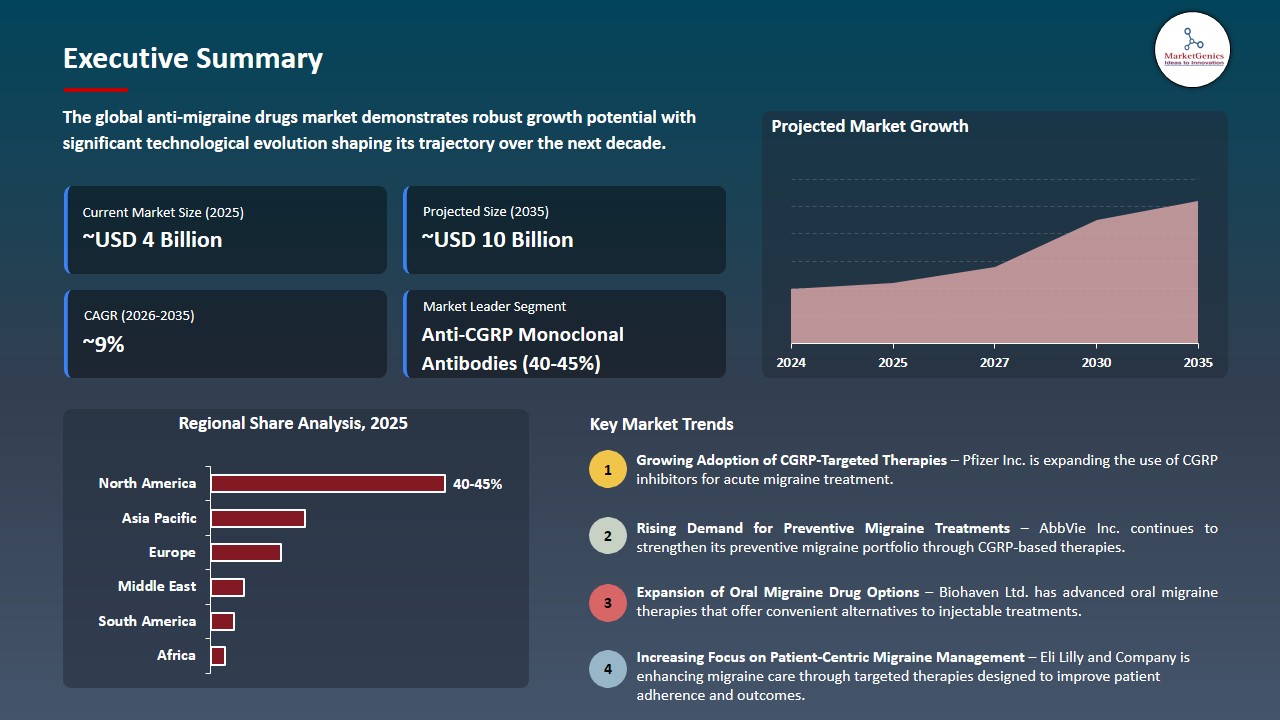
The global anti-migraine drugs market is exhibiting strong growth, with an estimated value of USD 4.3 billion in 2025 and USD 10.4 billion by 2035, achieving a CAGR of 9.2%, during the forecast period. The anti-migraine drugs market is rapidly growing in Asia Pacific due to increasing migraine awareness, improving healthcare access, expanding diagnosis rates, rising healthcare expenditure, and greater availability of advanced migraine therapies.
Jaclyn Duvall, M.D., neurologist and founder of Headache Specialists of Oklahoma, said, “Far too often, people living with migraine struggle with meeting their treatment goals despite available and accessible preventive options, The TEMPLE data provide a patient-centered measure of treatment effectiveness by capturing both efficacy and tolerability, representing a meaningful way to evaluate the real-world impact of treatment persistence in migraine prevention.”
The anti-migraine drugs market is growing well as the awareness of migraine as a neurological disorder is rising, along with its rising diagnosis rate and the availability of innovative acute and preventative drugs. Improved access to health care and awareness of physicians regarding migraine-related disability are driving earlier treatment initiation and long-term disease management. Pharmaceutical companies are always coming up with new and innovative formulations that enhance convenience and clinical results.
In January 2025, Axsome Therapeutics, Inc. was approved by the US Food and Drug Administration for SYMBRAVO, a novel, oral migraine treatment that is intended for rapid, sustained relief of acute migraine attacks. Amneal Pharmaceuticals, Inc. received FDA approval in May 2025 for BREKIYA, an auto-injector of dihydroergotamine (DHE) that will increase the convenience for patients to self-administer. These product innovations are augmenting treatment options and filling the treatment gaps for the migraine patient population who are looking for improved, convenient treatments.
Adjacent opportunities for the anti-migraine drugs market include CGRP-targeted neurological therapies, chronic pain management drugs, digital therapeutics for headache disorders, neurology-focused telemedicine services, and wearable migraine monitoring devices. These related markets leverage similar patient populations, treatment pathways, and healthcare providers, creating cross-commercialization and innovation opportunities.
Anti-Migraine Drugs Market Dynamics and Trends
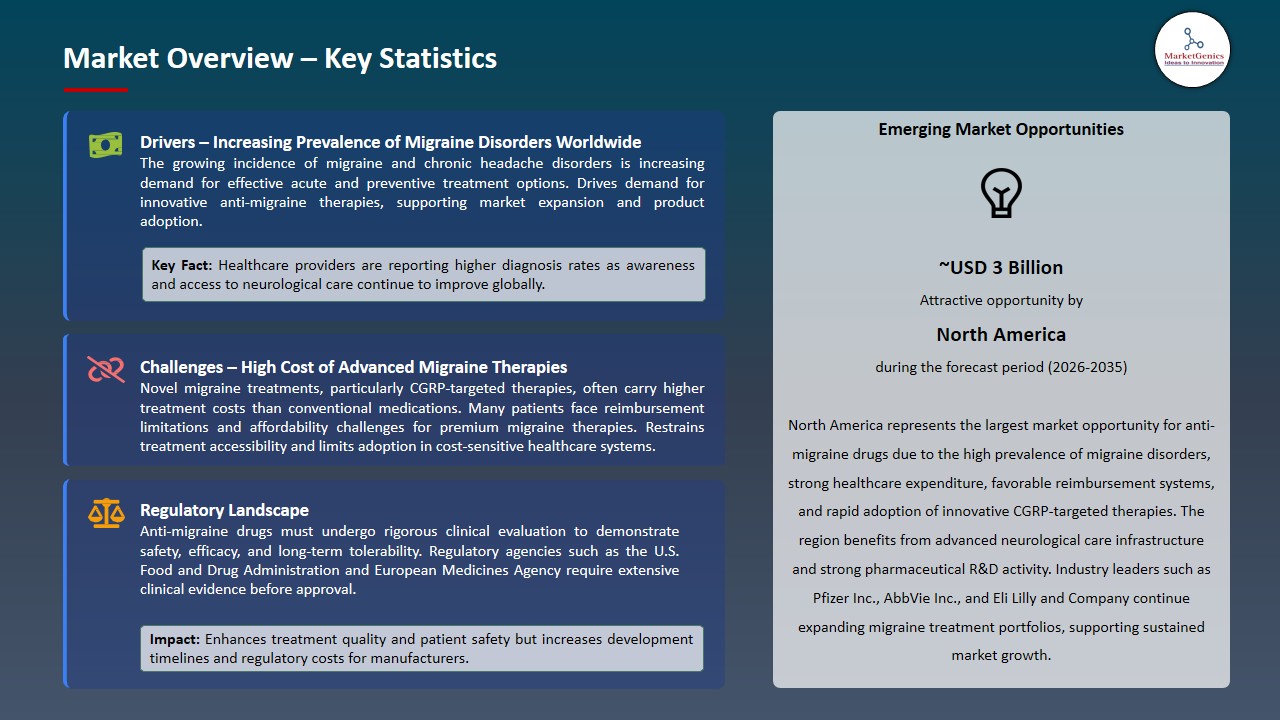
Driver: Rising Prevalence of Migraine and Chronic Headache Disorders
- Anti-migraine drugs market is growing with the rising occurrence of migraine and chronic headache disorders. An understanding of migraine as a disabling neurological disorder is resulting in increasing diagnoses and an increased demand for effective acute and preventive treatment.
- The use of advanced therapies has been growing as healthcare providers shift their attention to eliminating migraine-related disability and enhancing patient quality of life. Sustained demand for innovative anti-migraine drugs is growing across global healthcare as the patient burden increases.
- In October 2025, The World Health Organization revealed that 3.1 billion people worldwide suffer from headache disorders, and migraine is the third most important contributor to disease burden due to neurological conditions, demonstrating a rising need for effective anti-migraine treatments.
- The increasing prevalence of migraines is broadening the treatment options and fueling growth in the anti-migraine drugs market in the long term.
Restraint: Reimbursement Limitations Restricting Access to Premium Migraine Biologic Treatments
- Reimbursement restrictions on premium biologic drugs and new, innovative CGRP drugs are a major threat to the anti-migraine market. These drugs typically come with much greater price tags than conventional migraine medications and can be a barrier to access for patients. Many insurers will need preauthorization, step therapy, or documentation of the failure of lower-cost treatments to secure insurance coverage.
- These reimbursement limitations may delay the initiation of treatment and hinder the uptake of innovative therapies, especially for patients who need to take them over long periods of time as a preventive measure. It is particularly difficult to get limited coverage in developing healthcare systems, where there are underdeveloped specialty drug reimbursement systems.
- Access programs and payer negotiations remain a major focus for manufacturers, but reimbursement policies and restrictions are a significant barrier to increased market share.
- Reimbursement restrictions delay adoption of more advanced migraine medications and hinder overall market growth potential.
Opportunity: Expanding Pediatric and Adolescent Migraine Treatment Markets Globally
- Pediatric and adolescent population is a big growth opportunity for anti-migraine drugs market as the migraine is largely underdiagnosed and untreated in young patients. Healthcare providers and caregivers are becoming more aware of the need for safe and effective age-specific therapies. The demand for age-specific safe and effective treatments is being assisted by awareness among healthcare providers and caregivers.
- Regulatory incentives for pediatric clinical trials are fostering an expansion of treatment indications for drugs, and the development of targeted pediatric treatments. As additional approved treatments become available, the patient pool will become available and companies will be able to enhance long-term market growth.
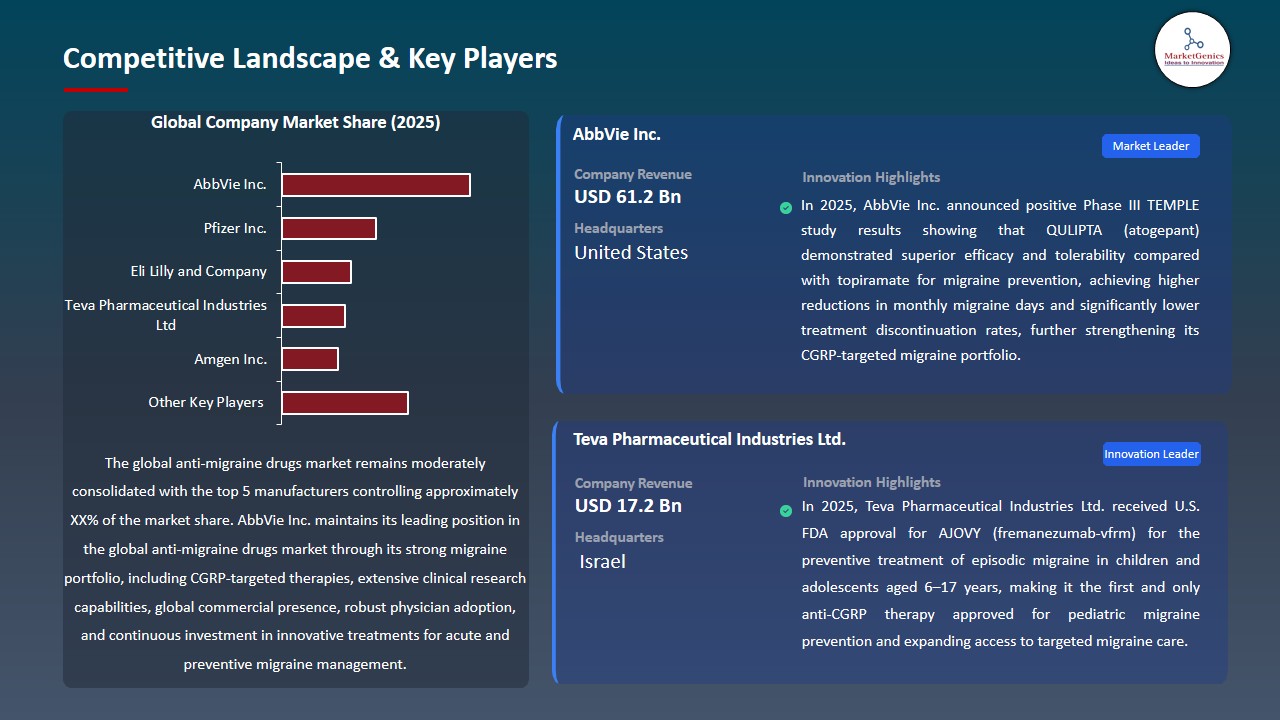
- In 2025, Teva Pharmaceutical Industries Ltd. received FDA approval for AJOVY to be the first anti-CGRP drug to treat episodic migraine in children and adolescents age 6–17, bringing targeted migraine treatment to the pediatric population.
- Growth into pediatric migraine treatment opens new opportunities for treatment and patient address.
Key Trend: Expansion of Next-Generation Mechanism-Based Migraine Therapies
- Investment is increasing in the anti-migraine drugs market for next-generation drugs targeting novel pathways beyond traditional drug targets. New mechanisms of action are being developed by pharmaceutical companies for better clinical effectiveness, to treat migraine patients who do not respond to therapy, and to increase therapeutic choices for migraine prevention.
- For instance, in July 2025, H. Lundbeck A/S announced positive Phase IIb PROCEED trial data for bocunebart (Lu AG09222), a PACAP-targeting monoclonal antibody, that showed substantial reductions in the number of monthly migraine days and a novel mechanism for migraine prevention.
- Innovation in anti-migraine drugs is expanding by the development of novel mechanism-based therapies, which are increasing the range of available treatment options.
Anti-Migraine Drugs Market Analysis and Segmental Data
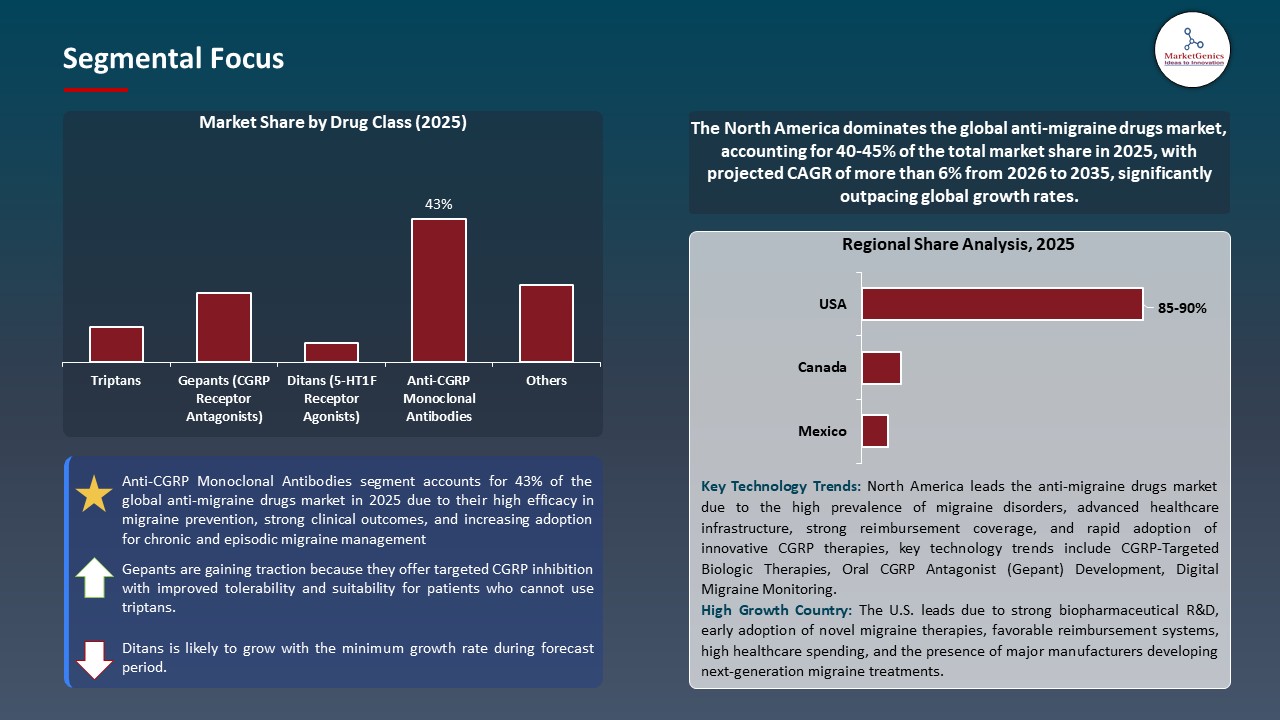
Anti-CGRP Monoclonal Antibodies Dominate Global Anti-Migraine Drugs Market
- Anti-CGRP monoclonal antibodies are the most dominant product class in the anti-migraine drugs market as these have a very specific mechanism of action, are more effective than other migraine prevention drugs, and can help patients with episodic and chronic migraine reduce the frequency of migraine attacks per month. These therapies have longer dosing schedules, high compliance and are well tolerated compared with many of the conventional preventive drugs.
- Dominance of the segment is fueled by rising physician preference for precision therapies, increasing patient awareness, and availability in large markets. They have excellent clinical results and are a preferred option for prevention, continuing to drive penetration globally.
- The American Headache Society revised its treatment guidelines to include CGRP-targeting drugs as first-line options for migraine prevention, establishing their increasing clinical acceptance and hastening their integration into migraine care.
- The anti-CGRP monoclonal antibody segment is expected to lead the market and positively contribute to the market growth due to the increasing adoption of anti-CGRP monoclonal antibody.
North America Leads Global Anti-Migraine Drugs Market Demand
- The North America anti-migraine drugs market is expected to witness the highest growth rate among all other regions as the healthcare infrastructure in the region is well established and it is characterized by a high prevalence of migraine disorders, as well as high levels of awareness of neurological health. A diverse healthcare network offers access to specialists, early diagnosis, and favorable reimbursement policies, all of which facilitate the implementation of innovative migraine treatments in the region.
- Presence of key pharma companies, frequent product launches, and swift regulatory approvals further support the regional market leadership. The prevalence of preventive migraine treatments, specifically CGRP-targeted therapies, continues to grow in the region, with the aim of delivering better patient outcomes and lower disease burden.
- The advanced migraine treatments are rapidly gaining market share in the region, which is attributed to the strong healthcare ecosystem and early adoption of advanced migraine medicines in North America.
Anti-Migraine Drugs Market Ecosystem
The anti-migraine drugs market is consolidated, with key players such as AbbVie Inc., Pfizer Inc., Eli Lilly and Company, Teva Pharmaceutical Industries Ltd., and Amgen Inc. driving innovation across CGRP-targeted therapies, monoclonal antibodies, gepants, and next-generation migraine treatment solutions.
They are continuing to reinforce their market positions by pursuing comprehensive clinical development initiatives, securing regulatory approvals, implementing lifecycle management strategies and adding to their targeted migraine portfolios. The competitive environment is increasingly focused on new products that deliver enhanced efficacy, tolerability, dosing convenience, and long-term preventive benefits for episodic and chronic migraine patients.
The market value chain includes API and biologics suppliers, drug manufacturers, contract research organizations (CROs), contract development and manufacturing organizations (CDMOs), distributors and specialty pharmacies, hospitals and neurology clinics and end patients. Strategic partnerships between the research, manufacturing, regulatory, and commercialization phases are helping speed up product development and greater access to patients.
Recent Development and Strategic Overview:
- In November 2025, Pfizer India launched Rimegepant, a CGRP receptor antagonist oral disintegrating tablet, for acute migraine treatment in adults with inadequate response to triptans, expanding access to advanced targeted migraine therapies for India's large migraine patient population.
- In May 2026, InMed Pharmaceuticals and Mentari Therapeutics announced a merger to advance next-generation migraine prevention therapies, including MT-001 (anti-PACAP monoclonal antibody) and MT-002 (anti-CGRP x PACAP bispecific antibody), highlighting growing industry investment in novel dual-pathway and mechanism-based migraine treatments.
Report Scope
|
Detail |
|
|
Market Size in 2025 |
USD 4.3 Bn |
|
Market Forecast Value in 2035 |
USD 10.4 Bn |
|
Growth Rate (CAGR) |
9.2% |
|
Forecast Period |
2026 – 2035 |
|
Historical Data Available for |
2021 – 2024 |
|
Market Size Units |
US$ Billion for Value |
|
Report Format |
Electronic (PDF) + Excel |
|
North America |
Europe |
Asia Pacific |
Middle East |
Africa |
South America |
|
|
|
|
|
|
|
Companies Covered |
|||||
|
|||||
Anti-Migraine Drugs Market Segmentation and Highlights
|
Segment |
Sub-segment |
|
Anti-Migraine Drugs Market, By Drug Class |
|
|
Anti-Migraine Drugs Market, By Treatment Type |
|
|
Anti-Migraine Drugs Market, By Migraine Type |
|
|
Anti-Migraine Drugs Market, By Route of Administration |
|
|
Anti-Migraine Drugs Market, By Drug Type |
|
|
Anti-Migraine Drugs Market, By Patient Demographics |
|
|
Anti-Migraine Drugs Market, By End-users |
|
Frequently Asked Questions
Table of Contents
- 1. Research Methodology and Assumptions
- 1.1. Definitions
- 1.2. Research Design and Approach
- 1.3. Data Collection Methods
- 1.4. Base Estimates and Calculations
- 1.5. Forecasting Models
- 1.5.1. Key Forecast Factors & Impact Analysis
- 1.6. Secondary Research
- 1.6.1. Open Sources
- 1.6.2. Paid Databases
- 1.6.3. Associations
- 1.7. Primary Research
- 1.7.1. Primary Sources
- 1.7.2. Primary Interviews with Stakeholders across Ecosystem
- 2. Executive Summary
- 2.1. Global Anti-Migraine Drugs Market Outlook
- 2.1.1. Anti-Migraine Drugs Market Size Value (US$ Bn), and Forecasts, 2021-2035
- 2.1.2. Compounded Annual Growth Rate Analysis
- 2.1.3. Growth Opportunity Analysis
- 2.1.4. Segmental Share Analysis
- 2.1.5. Geographical Share Analysis
- 2.2. Market Analysis and Facts
- 2.3. Supply-Demand Analysis
- 2.4. Competitive Benchmarking
- 2.5. Go-to- Market Strategy
- 2.5.1. Customer/ End-use Industry Assessment
- 2.5.2. Growth Opportunity Data, 2026-2035
- 2.5.2.1. Regional Data
- 2.5.2.2. Country Data
- 2.5.2.3. Segmental Data
- 2.5.3. Identification of Potential Market Spaces
- 2.5.4. GAP Analysis
- 2.5.5. Potential Attractive Price Points
- 2.5.6. Prevailing Market Risks & Challenges
- 2.5.7. Preferred Sales & Marketing Strategies
- 2.5.8. Key Recommendations and Analysis
- 2.5.9. A Way Forward
- 2.1. Global Anti-Migraine Drugs Market Outlook
- 3. Industry Data and Premium Insights
- 3.1. Global Healthcare & Pharmaceutical Industry Overview, 2025
- 3.1.1. Healthcare & Pharmaceutical Ecosystem Analysis
- 3.1.2. Key Trends for Healthcare & Pharmaceutical Industry
- 3.1.3. Regional Distribution for Healthcare & Pharmaceutical Industry
- 3.2. Supplier Customer Data
- 3.3. Technology Roadmap and Developments
- 3.4. Trade Analysis
- 3.4.1. Import & Export Analysis, 2025
- 3.4.2. Top Importing Countries
- 3.4.3. Top Exporting Countries
- 3.5. Trump Tariff Impact Analysis
- 3.5.1. Manufacturer
- 3.5.1.1. Based on the component & Raw material
- 3.5.2. Supply Chain
- 3.5.3. End Consumer
- 3.5.1. Manufacturer
- 3.6. Raw Material Analysis
- 3.1. Global Healthcare & Pharmaceutical Industry Overview, 2025
- 4. Market Overview
- 4.1. Market Dynamics
- 4.1.1. Drivers
- 4.1.1.1. Rising Global Prevalence of Migraine and Chronic Headache Disorders
- 4.1.1.2. Increasing Adoption of Novel CGRP-Targeted Migraine Therapies
- 4.1.1.3. Growing Awareness, Diagnosis Rates, and Access to Neurological Care
- 4.1.2. Restraints
- 4.1.2.1. High Cost of Advanced Biologic and Specialty Migraine Treatments
- 4.1.2.2. Side Effects and Limited Treatment Response in Some Patient Populations
- 4.1.1. Drivers
- 4.2. Key Trend Analysis
- 4.3. Regulatory Framework
- 4.3.1. Key Regulations, Norms, and Subsidies, by Key Countries
- 4.3.2. Tariffs and Standards
- 4.3.3. Impact Analysis of Regulations on the Market
- 4.4. Value Chain Analysis
- 4.5. Porter’s Five Forces Analysis
- 4.6. PESTEL Analysis
- 4.7. Global Anti-Migraine Drugs Market Demand
- 4.7.1. Historical Market Size – Value (US$ Bn), 2020-2024
- 4.7.2. Current and Future Market Size - Value (US$ Bn), 2026–2035
- 4.7.2.1. Y-o-Y Growth Trends
- 4.7.2.2. Absolute $ Opportunity Assessment
- 4.1. Market Dynamics
- 5. Competition Landscape
- 5.1. Competition structure
- 5.1.1. Fragmented v/s consolidated
- 5.2. Company Share Analysis, 2025
- 5.2.1. Global Company Market Share
- 5.2.2. By Region
- 5.2.2.1. North America
- 5.2.2.2. Europe
- 5.2.2.3. Asia Pacific
- 5.2.2.4. Middle East
- 5.2.2.5. Africa
- 5.2.2.6. South America
- 5.3. Product Comparison Matrix
- 5.3.1. Specifications
- 5.3.2. Market Positioning
- 5.3.3. Pricing
- 5.1. Competition structure
- 6. Global Anti-Migraine Drugs Market Analysis, by Drug Class
- 6.1. Key Segment Analysis
- 6.2. Anti-Migraine Drugs Market Size Value (US$ Bn), Analysis, and Forecasts, by Drug Class, 2021-2035
- 6.2.1. Triptans
- 6.2.2. Gepants (CGRP Receptor Antagonists)
- 6.2.3. Ditans (5-HT1F Receptor Agonists)
- 6.2.4. Ergot Alkaloids
- 6.2.5. Antidepressants (Prophylactic)
- 6.2.6. Anti-CGRP Monoclonal Antibodies
- 6.2.7. NSAIDs & Analgesics
- 6.2.8. Combination Drugs
- 7. Global Anti-Migraine Drugs Market Analysis, by Treatment Type
- 7.1. Key Segment Analysis
- 7.2. Anti-Migraine Drugs Market Size Value (US$ Bn), Analysis, and Forecasts, by Treatment Type, 2021-2035
- 7.2.1. Abortive Treatment
- 7.2.2. Prophylactic Treatment
- 7.2.3. Rescue Therapy
- 8. Global Anti-Migraine Drugs Market Analysis, by Migraine Type
- 8.1. Key Segment Analysis
- 8.2. Anti-Migraine Drugs Market Size Value (US$ Bn), Analysis, and Forecasts, by Migraine Type, 2021-2035
- 8.2.1. Migraine with Aura
- 8.2.2. Migraine without Aura
- 8.2.3. Chronic Migraine
- 8.2.4. Episodic Migraine
- 8.2.5. Hemiplegic Migraine
- 8.2.6. Vestibular Migraine
- 8.2.7. Hormonal Migraine
- 8.2.8. Others (Retinal Migraine, etc.)
- 9. Global Anti-Migraine Drugs Market Analysis, by Route of Administration
- 9.1. Key Segment Analysis
- 9.2. Anti-Migraine Drugs Market Size Value (US$ Bn), Analysis, and Forecasts, by Route of Administration, 2021-2035
- 9.2.1. Oral
- 9.2.2. Injectable
- 9.2.3. Intranasal
- 9.2.4. Transdermal
- 10. Global Anti-Migraine Drugs Market Analysis, by Drug Type
- 10.1. Key Segment Analysis
- 10.2. Anti-Migraine Drugs Market Size Value (US$ Bn), Analysis, and Forecasts, by Drug Type, 2021-2035
- 10.2.1. Innovator Drugs
- 10.2.2. Generic Drugs
- 10.2.3. Biosimilars
- 11. Global Anti-Migraine Drugs Market Analysis, by Patient Demographics
- 11.1. Key Segment Analysis
- 11.2. Anti-Migraine Drugs Market Size Value (US$ Bn), Analysis, and Forecasts, by Patient Demographics, 2021-2035
- 11.2.1. Pediatric (< 12 years)
- 11.2.2. Adolescent (12–17 years)
- 11.2.3. Adult (18–64 years)
- 11.2.4. Geriatric (≥ 65 years)
- 12. Global Anti-Migraine Drugs Market Analysis, by End-users
- 12.1. Key Segment Analysis
- 12.2. Anti-Migraine Drugs Market Size Value (US$ Bn), Analysis, and Forecasts, by End-users, 2021-2035
- 12.2.1. Hospital & Inpatient Care
- 12.2.2. Specialty Neurology & Headache Clinics
- 12.2.3. Pain Management Clinics
- 12.2.4. Ambulatory & Outpatient IV Infusion Centers
- 12.2.5. Others
- 13. Global Anti-Migraine Drugs Market Analysis and Forecasts, by Region
- 13.1. Key Findings
- 13.2. Anti-Migraine Drugs Market Size Value (US$ Bn), Analysis, and Forecasts, by Region, 2021-2035
- 13.2.1. North America
- 13.2.2. Europe
- 13.2.3. Asia Pacific
- 13.2.4. Middle East
- 13.2.5. Africa
- 13.2.6. South America
- 14. North America Anti-Migraine Drugs Market Analysis
- 14.1. Key Segment Analysis
- 14.2. Regional Snapshot
- 14.3. North America Anti-Migraine Drugs Market Size- Value (US$ Bn), Analysis, and Forecasts, 2021-2035
- 14.3.1. Drug Class
- 14.3.2. Treatment Type
- 14.3.3. Migraine Type
- 14.3.4. Packaging Type
- 14.3.5. Route of Administration
- 14.3.6. Drug Type
- 14.3.7. Patient Demographics
- 14.3.8. End-users
- 14.3.9. Country
- 14.3.9.1. USA
- 14.3.9.2. Canada
- 14.3.9.3. Mexico
- 14.4. USA Anti-Migraine Drugs Market
- 14.4.1. Country Segmental Analysis
- 14.4.2. Drug Class
- 14.4.3. Treatment Type
- 14.4.4. Migraine Type
- 14.4.5. Packaging Type
- 14.4.6. Route of Administration
- 14.4.7. Drug Type
- 14.4.8. Patient Demographics
- 14.4.9. End-users
- 14.5. Canada Anti-Migraine Drugs Market
- 14.5.1. Country Segmental Analysis
- 14.5.2. Drug Class
- 14.5.3. Treatment Type
- 14.5.4. Migraine Type
- 14.5.5. Packaging Type
- 14.5.6. Route of Administration
- 14.5.7. Drug Type
- 14.5.8. Patient Demographics
- 14.5.9. End-users
- 14.6. Mexico Anti-Migraine Drugs Market
- 14.6.1. Country Segmental Analysis
- 14.6.2. Drug Class
- 14.6.3. Treatment Type
- 14.6.4. Migraine Type
- 14.6.5. Packaging Type
- 14.6.6. Route of Administration
- 14.6.7. Drug Type
- 14.6.8. Patient Demographics
- 14.6.9. End-users
- 15. Europe Anti-Migraine Drugs Market Analysis
- 15.1. Key Segment Analysis
- 15.2. Regional Snapshot
- 15.3. Europe Anti-Migraine Drugs Market Size Value (US$ Bn), Analysis, and Forecasts, 2021-2035
- 15.3.1. Drug Class
- 15.3.2. Treatment Type
- 15.3.3. Migraine Type
- 15.3.4. Packaging Type
- 15.3.5. Route of Administration
- 15.3.6. Drug Type
- 15.3.7. Patient Demographics
- 15.3.8. End-users
- 15.3.9. Country
- 15.3.9.1. Germany
- 15.3.9.2. United Kingdom
- 15.3.9.3. France
- 15.3.9.4. Italy
- 15.3.9.5. Spain
- 15.3.9.6. Netherlands
- 15.3.9.7. Nordic Countries
- 15.3.9.8. Poland
- 15.3.9.9. Russia & CIS
- 15.3.9.10. Rest of Europe
- 15.4. Germany Anti-Migraine Drugs Market
- 15.4.1. Country Segmental Analysis
- 15.4.2. Drug Class
- 15.4.3. Treatment Type
- 15.4.4. Migraine Type
- 15.4.5. Packaging Type
- 15.4.6. Route of Administration
- 15.4.7. Drug Type
- 15.4.8. Patient Demographics
- 15.4.9. End-users
- 15.5. United Kingdom Anti-Migraine Drugs Market
- 15.5.1. Country Segmental Analysis
- 15.5.2. Drug Class
- 15.5.3. Treatment Type
- 15.5.4. Migraine Type
- 15.5.5. Packaging Type
- 15.5.6. Route of Administration
- 15.5.7. Drug Type
- 15.5.8. Patient Demographics
- 15.5.9. End-users
- 15.6. France Anti-Migraine Drugs Market
- 15.6.1. Country Segmental Analysis
- 15.6.2. Drug Class
- 15.6.3. Treatment Type
- 15.6.4. Migraine Type
- 15.6.5. Packaging Type
- 15.6.6. Route of Administration
- 15.6.7. Drug Type
- 15.6.8. Patient Demographics
- 15.6.9. End-users
- 15.7. Italy Anti-Migraine Drugs Market
- 15.7.1. Country Segmental Analysis
- 15.7.2. Drug Class
- 15.7.3. Treatment Type
- 15.7.4. Migraine Type
- 15.7.5. Packaging Type
- 15.7.6. Route of Administration
- 15.7.7. Drug Type
- 15.7.8. Patient Demographics
- 15.7.9. End-users
- 15.8. Spain Anti-Migraine Drugs Market
- 15.8.1. Country Segmental Analysis
- 15.8.2. Drug Class
- 15.8.3. Treatment Type
- 15.8.4. Migraine Type
- 15.8.5. Packaging Type
- 15.8.6. Route of Administration
- 15.8.7. Drug Type
- 15.8.8. Patient Demographics
- 15.8.9. End-users
- 15.9. Netherlands Anti-Migraine Drugs Market
- 15.9.1. Country Segmental Analysis
- 15.9.2. Drug Class
- 15.9.3. Treatment Type
- 15.9.4. Migraine Type
- 15.9.5. Packaging Type
- 15.9.6. Route of Administration
- 15.9.7. Drug Type
- 15.9.8. Patient Demographics
- 15.9.9. End-users
- 15.10. Nordic Countries Anti-Migraine Drugs Market
- 15.10.1. Country Segmental Analysis
- 15.10.2. Drug Class
- 15.10.3. Treatment Type
- 15.10.4. Migraine Type
- 15.10.5. Packaging Type
- 15.10.6. Route of Administration
- 15.10.7. Drug Type
- 15.10.8. Patient Demographics
- 15.10.9. End-users
- 15.11. Poland Anti-Migraine Drugs Market
- 15.11.1. Country Segmental Analysis
- 15.11.2. Drug Class
- 15.11.3. Treatment Type
- 15.11.4. Migraine Type
- 15.11.5. Packaging Type
- 15.11.6. Route of Administration
- 15.11.7. Drug Type
- 15.11.8. Patient Demographics
- 15.11.9. End-users
- 15.12. Russia & CIS Anti-Migraine Drugs Market
- 15.12.1. Country Segmental Analysis
- 15.12.2. Drug Class
- 15.12.3. Treatment Type
- 15.12.4. Migraine Type
- 15.12.5. Packaging Type
- 15.12.6. Route of Administration
- 15.12.7. Drug Type
- 15.12.8. Patient Demographics
- 15.12.9. End-users
- 15.13. Rest of Europe Anti-Migraine Drugs Market
- 15.13.1. Country Segmental Analysis
- 15.13.2. Drug Class
- 15.13.3. Treatment Type
- 15.13.4. Migraine Type
- 15.13.5. Packaging Type
- 15.13.6. Route of Administration
- 15.13.7. Drug Type
- 15.13.8. Patient Demographics
- 15.13.9. End-users
- 16. Asia Pacific Anti-Migraine Drugs Market Analysis
- 16.1. Key Segment Analysis
- 16.2. Regional Snapshot
- 16.3. Asia Pacific Anti-Migraine Drugs Market Size Value (US$ Bn), Analysis, and Forecasts, 2021-2035
- 16.3.1. Drug Class
- 16.3.2. Treatment Type
- 16.3.3. Migraine Type
- 16.3.4. Packaging Type
- 16.3.5. Route of Administration
- 16.3.6. Drug Type
- 16.3.7. Patient Demographics
- 16.3.8. End-users
- 16.3.9. Country
- 16.3.9.1. China
- 16.3.9.2. India
- 16.3.9.3. Japan
- 16.3.9.4. South Korea
- 16.3.9.5. Australia and New Zealand
- 16.3.9.6. Indonesia
- 16.3.9.7. Malaysia
- 16.3.9.8. Thailand
- 16.3.9.9. Vietnam
- 16.3.9.10. Rest of Asia Pacific
- 16.4. China Anti-Migraine Drugs Market
- 16.4.1. Country Segmental Analysis
- 16.4.2. Drug Class
- 16.4.3. Treatment Type
- 16.4.4. Migraine Type
- 16.4.5. Packaging Type
- 16.4.6. Route of Administration
- 16.4.7. Drug Type
- 16.4.8. Patient Demographics
- 16.4.9. End-users
- 16.5. India Anti-Migraine Drugs Market
- 16.5.1. Country Segmental Analysis
- 16.5.2. Drug Class
- 16.5.3. Treatment Type
- 16.5.4. Migraine Type
- 16.5.5. Packaging Type
- 16.5.6. Route of Administration
- 16.5.7. Drug Type
- 16.5.8. Patient Demographics
- 16.5.9. End-users
- 16.6. Japan Anti-Migraine Drugs Market
- 16.6.1. Country Segmental Analysis
- 16.6.2. Drug Class
- 16.6.3. Treatment Type
- 16.6.4. Migraine Type
- 16.6.5. Packaging Type
- 16.6.6. Route of Administration
- 16.6.7. Drug Type
- 16.6.8. Patient Demographics
- 16.6.9. End-users
- 16.7. South Korea Anti-Migraine Drugs Market
- 16.7.1. Country Segmental Analysis
- 16.7.2. Drug Class
- 16.7.3. Treatment Type
- 16.7.4. Migraine Type
- 16.7.5. Packaging Type
- 16.7.6. Route of Administration
- 16.7.7. Drug Type
- 16.7.8. Patient Demographics
- 16.7.9. End-users
- 16.8. Australia and New Zealand Anti-Migraine Drugs Market
- 16.8.1. Country Segmental Analysis
- 16.8.2. Drug Class
- 16.8.3. Treatment Type
- 16.8.4. Migraine Type
- 16.8.5. Packaging Type
- 16.8.6. Route of Administration
- 16.8.7. Drug Type
- 16.8.8. Patient Demographics
- 16.8.9. End-users
- 16.9. Indonesia Anti-Migraine Drugs Market
- 16.9.1. Country Segmental Analysis
- 16.9.2. Drug Class
- 16.9.3. Treatment Type
- 16.9.4. Migraine Type
- 16.9.5. Packaging Type
- 16.9.6. Route of Administration
- 16.9.7. Drug Type
- 16.9.8. Patient Demographics
- 16.9.9. End-users
- 16.10. Malaysia Anti-Migraine Drugs Market
- 16.10.1. Country Segmental Analysis
- 16.10.2. Drug Class
- 16.10.3. Treatment Type
- 16.10.4. Migraine Type
- 16.10.5. Packaging Type
- 16.10.6. Route of Administration
- 16.10.7. Drug Type
- 16.10.8. Patient Demographics
- 16.10.9. End-users
- 16.11. Thailand Anti-Migraine Drugs Market
- 16.11.1. Country Segmental Analysis
- 16.11.2. Drug Class
- 16.11.3. Treatment Type
- 16.11.4. Migraine Type
- 16.11.5. Packaging Type
- 16.11.6. Route of Administration
- 16.11.7. Drug Type
- 16.11.8. Patient Demographics
- 16.11.9. End-users
- 16.12. Vietnam Anti-Migraine Drugs Market
- 16.12.1. Country Segmental Analysis
- 16.12.2. Drug Class
- 16.12.3. Treatment Type
- 16.12.4. Migraine Type
- 16.12.5. Packaging Type
- 16.12.6. Route of Administration
- 16.12.7. Drug Type
- 16.12.8. Patient Demographics
- 16.12.9. End-users
- 16.13. Rest of Asia Pacific Anti-Migraine Drugs Market
- 16.13.1. Country Segmental Analysis
- 16.13.2. Drug Class
- 16.13.3. Treatment Type
- 16.13.4. Migraine Type
- 16.13.5. Packaging Type
- 16.13.6. Route of Administration
- 16.13.7. Drug Type
- 16.13.8. Patient Demographics
- 16.13.9. End-users
- 17. Middle East Anti-Migraine Drugs Market Analysis
- 17.1. Key Segment Analysis
- 17.2. Regional Snapshot
- 17.3. Middle East Anti-Migraine Drugs Market Size Value (US$ Bn), Analysis, and Forecasts, 2021-2035
- 17.3.1. Product Type
- 17.3.2. Drug Class
- 17.3.3. Treatment Type
- 17.3.4. Migraine Type
- 17.3.5. Packaging Type
- 17.3.6. Route of Administration
- 17.3.7. Drug Type
- 17.3.8. Patient Demographics
- 17.3.9. End-users
- 17.3.10. Country
- 17.3.10.1. Turkey
- 17.3.10.2. UAE
- 17.3.10.3. Saudi Arabia
- 17.3.10.4. Israel
- 17.3.10.5. Rest of Middle East
- 17.4. Turkey Anti-Migraine Drugs Market
- 17.4.1. Country Segmental Analysis
- 17.4.2. Drug Class
- 17.4.3. Treatment Type
- 17.4.4. Migraine Type
- 17.4.5. Packaging Type
- 17.4.6. Route of Administration
- 17.4.7. Drug Type
- 17.4.8. Patient Demographics
- 17.4.9. End-users
- 17.5. UAE Anti-Migraine Drugs Market
- 17.5.1. Country Segmental Analysis
- 17.5.2. Drug Class
- 17.5.3. Treatment Type
- 17.5.4. Migraine Type
- 17.5.5. Packaging Type
- 17.5.6. Route of Administration
- 17.5.7. Drug Type
- 17.5.8. Patient Demographics
- 17.5.9. End-users
- 17.6. Saudi Arabia Anti-Migraine Drugs Market
- 17.6.1. Country Segmental Analysis
- 17.6.2. Drug Class
- 17.6.3. Treatment Type
- 17.6.4. Migraine Type
- 17.6.5. Packaging Type
- 17.6.6. Route of Administration
- 17.6.7. Drug Type
- 17.6.8. Patient Demographics
- 17.6.9. End-users
- 17.7. Israel Anti-Migraine Drugs Market
- 17.7.1. Country Segmental Analysis
- 17.7.2. Drug Class
- 17.7.3. Treatment Type
- 17.7.4. Migraine Type
- 17.7.5. Packaging Type
- 17.7.6. Route of Administration
- 17.7.7. Drug Type
- 17.7.8. Patient Demographics
- 17.7.9. End-users
- 17.8. Rest of Middle East Anti-Migraine Drugs Market
- 17.8.1. Country Segmental Analysis
- 17.8.2. Drug Class
- 17.8.3. Treatment Type
- 17.8.4. Migraine Type
- 17.8.5. Packaging Type
- 17.8.6. Route of Administration
- 17.8.7. Drug Type
- 17.8.8. Patient Demographics
- 17.8.9. End-users
- 18. Africa Anti-Migraine Drugs Market Analysis
- 18.1. Key Segment Analysis
- 18.2. Regional Snapshot
- 18.3. Africa Anti-Migraine Drugs Market Size Value (US$ Bn), Analysis, and Forecasts, 2021-2035
- 18.3.1. Drug Class
- 18.3.2. Treatment Type
- 18.3.3. Migraine Type
- 18.3.4. Packaging Type
- 18.3.5. Route of Administration
- 18.3.6. Drug Type
- 18.3.7. Patient Demographics
- 18.3.8. End-users
- 18.3.9. Country
- 18.3.9.1. South Africa
- 18.3.9.2. Egypt
- 18.3.9.3. Nigeria
- 18.3.9.4. Algeria
- 18.3.9.5. Rest of Africa
- 18.4. South Africa Anti-Migraine Drugs Market
- 18.4.1. Country Segmental Analysis
- 18.4.2. Drug Class
- 18.4.3. Treatment Type
- 18.4.4. Migraine Type
- 18.4.5. Packaging Type
- 18.4.6. Route of Administration
- 18.4.7. Drug Type
- 18.4.8. Patient Demographics
- 18.4.9. End-users
- 18.5. Egypt Anti-Migraine Drugs Market
- 18.5.1. Country Segmental Analysis
- 18.5.2. Drug Class
- 18.5.3. Treatment Type
- 18.5.4. Migraine Type
- 18.5.5. Packaging Type
- 18.5.6. Route of Administration
- 18.5.7. Drug Type
- 18.5.8. Patient Demographics
- 18.5.9. End-users
- 18.6. Nigeria Anti-Migraine Drugs Market
- 18.6.1. Country Segmental Analysis
- 18.6.2. Drug Class
- 18.6.3. Treatment Type
- 18.6.4. Migraine Type
- 18.6.5. Packaging Type
- 18.6.6. Route of Administration
- 18.6.7. Drug Type
- 18.6.8. Patient Demographics
- 18.6.9. End-users
- 18.7. Algeria Anti-Migraine Drugs Market
- 18.7.1. Country Segmental Analysis
- 18.7.2. Drug Class
- 18.7.3. Treatment Type
- 18.7.4. Migraine Type
- 18.7.5. Packaging Type
- 18.7.6. Route of Administration
- 18.7.7. Drug Type
- 18.7.8. Patient Demographics
- 18.7.9. End-users
- 18.8. Rest of Africa Anti-Migraine Drugs Market
- 18.8.1. Country Segmental Analysis
- 18.8.2. Drug Class
- 18.8.3. Treatment Type
- 18.8.4. Migraine Type
- 18.8.5. Packaging Type
- 18.8.6. Route of Administration
- 18.8.7. Drug Type
- 18.8.8. Patient Demographics
- 18.8.9. End-users
- 19. South America Anti-Migraine Drugs Market Analysis
- 19.1. Key Segment Analysis
- 19.2. Regional Snapshot
- 19.3. South America Anti-Migraine Drugs Market Size Value (US$ Bn), Analysis, and Forecasts, 2021-2035
- 19.3.1. Drug Class
- 19.3.2. Treatment Type
- 19.3.3. Migraine Type
- 19.3.4. Packaging Type
- 19.3.5. Route of Administration
- 19.3.6. Drug Type
- 19.3.7. Patient Demographics
- 19.3.8. End-users
- 19.3.9. Country
- 19.3.9.1. Brazil
- 19.3.9.2. Argentina
- 19.3.9.3. Rest of South America
- 19.4. Brazil Anti-Migraine Drugs Market
- 19.4.1. Country Segmental Analysis
- 19.4.2. Drug Class
- 19.4.3. Treatment Type
- 19.4.4. Migraine Type
- 19.4.5. Packaging Type
- 19.4.6. Route of Administration
- 19.4.7. Drug Type
- 19.4.8. Patient Demographics
- 19.4.9. End-users
- 19.5. Argentina Anti-Migraine Drugs Market
- 19.5.1. Country Segmental Analysis
- 19.5.2. Drug Class
- 19.5.3. Treatment Type
- 19.5.4. Migraine Type
- 19.5.5. Packaging Type
- 19.5.6. Route of Administration
- 19.5.7. Drug Type
- 19.5.8. Patient Demographics
- 19.5.9. End-users
- 19.6. Rest of South America Anti-Migraine Drugs Market
- 19.6.1. Country Segmental Analysis
- 19.6.2. Drug Class
- 19.6.3. Treatment Type
- 19.6.4. Migraine Type
- 19.6.5. Packaging Type
- 19.6.6. Route of Administration
- 19.6.7. Drug Type
- 19.6.8. Patient Demographics
- 19.6.9. End-users
- 20. KeyPlayers/ Company Profile
- 20.1. AbbVie Inc.
- 20.1.1. Company Details/ Overview
- 20.1.2. Company Financials
- 20.1.3. Key Customers and Competitors
- 20.1.4. Business/ Industry Portfolio
- 20.1.5. Product Portfolio/ Specification Details
- 20.1.6. Pricing Data
- 20.1.7. Strategic Overview
- 20.1.8. Recent Developments
- 20.2. Amgen Inc. (Aimovig)
- 20.3. Cafergot (Advanz Pharma)
- 20.4. Eli Lilly and Company
- 20.5. GlaxoSmithKline plc
- 20.6. Grünenthal Group (Zomig)
- 20.7. H. Lundbeck A/S (Vyepti)
- 20.8. Novartis AG
- 20.9. Pfizer Inc. (Nurtec ODT)
- 20.10. Teva Pharmaceutical Industries Ltd. (AJOVY)
- 20.11. Other Key Players
- 20.1. AbbVie Inc.
Note* - This is just tentative list of players. While providing the report, we will cover more number of players based on their revenue and share for each geography
Research Design
Our research design integrates both demand-side and supply-side analysis through a balanced combination of primary and secondary research methodologies. By utilizing both bottom-up and top-down approaches alongside rigorous data triangulation methods, we deliver robust market intelligence that supports strategic decision-making.
MarketGenics' comprehensive research design framework ensures the delivery of accurate, reliable, and actionable market intelligence. Through the integration of multiple research approaches, rigorous validation processes, and expert analysis, we provide our clients with the insights needed to make informed strategic decisions and capitalize on market opportunities.
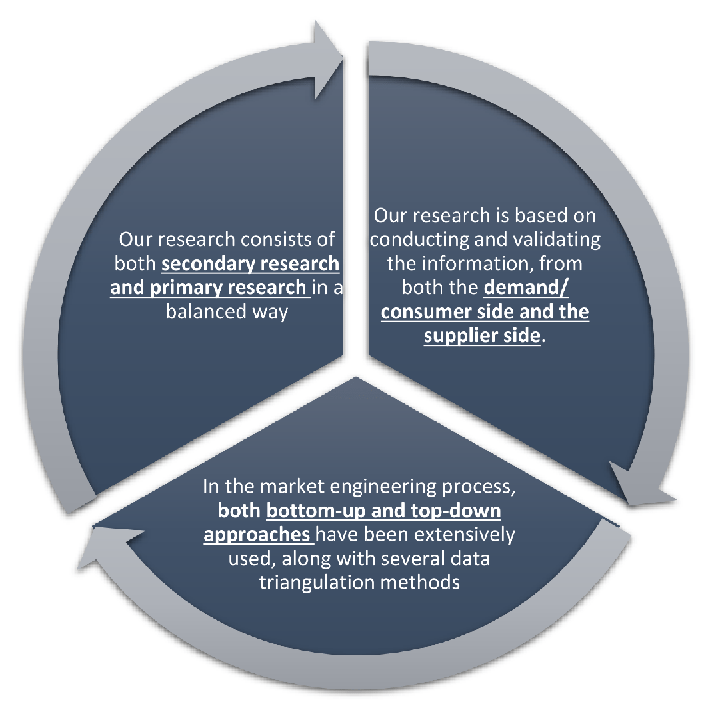
MarketGenics leverages a dedicated industry panel of experts and a comprehensive suite of paid databases to effectively collect, consolidate, and analyze market intelligence.
Our approach has consistently proven to be reliable and effective in generating accurate market insights, identifying key industry trends, and uncovering emerging business opportunities.
Through both primary and secondary research, we capture and analyze critical company-level data such as manufacturing footprints, including technical centers, R&D facilities, sales offices, and headquarters.
Our expert panel further enhances our ability to estimate market size for specific brands based on validated field-level intelligence.
Our data mining techniques incorporate both parametric and non-parametric methods, allowing for structured data collection, sorting, processing, and cleaning.
Demand projections are derived from large-scale data sets analyzed through proprietary algorithms, culminating in robust and reliable market sizing.
Research Approach
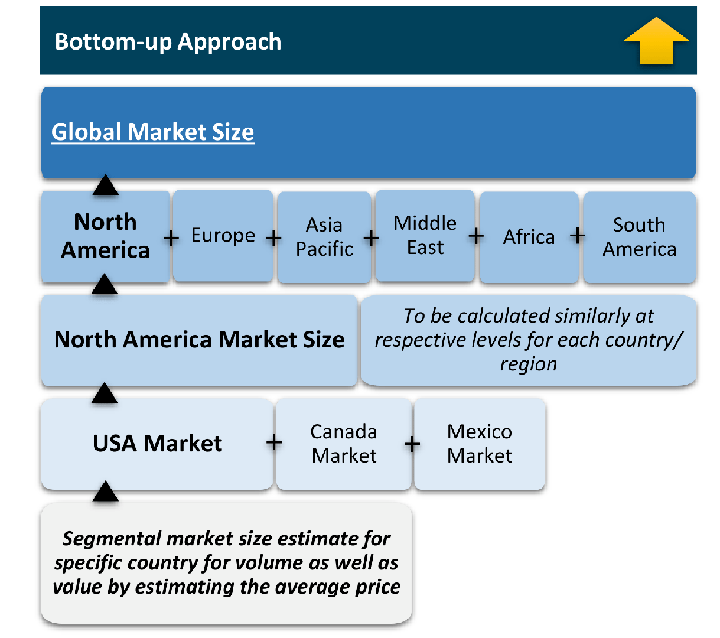
The bottom-up approach builds market estimates by starting with the smallest addressable market units and systematically aggregating them to create comprehensive market size projections.
This method begins with specific, granular data points and builds upward to create the complete market landscape.
Customer Analysis → Segmental Analysis → Geographical Analysis
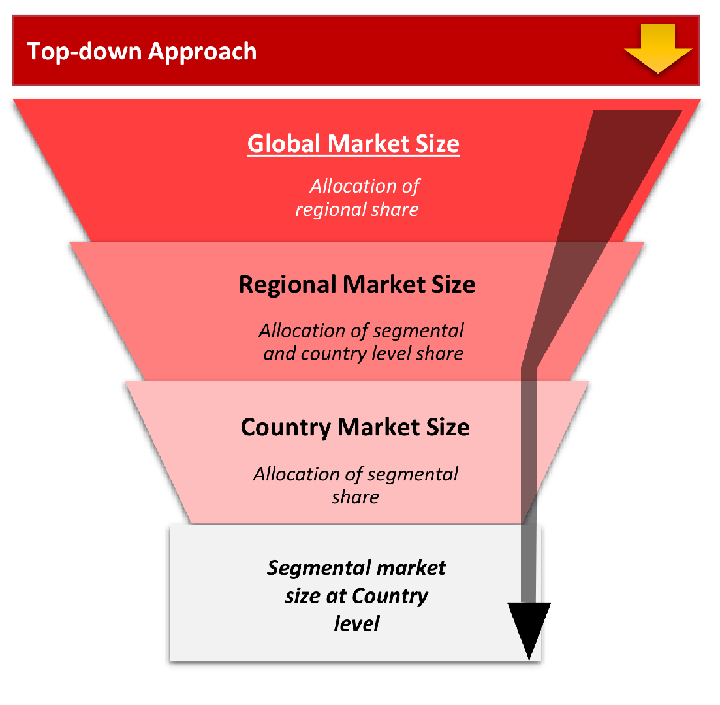
The top-down approach starts with the broadest possible market data and systematically narrows it down through a series of filters and assumptions to arrive at specific market segments or opportunities.
This method begins with the big picture and works downward to increasingly specific market slices.
TAM → SAM → SOM
Research Methods
Desk / Secondary Research
While analysing the market, we extensively study secondary sources, directories, and databases to identify and collect information useful for this technical, market-oriented, and commercial report. Secondary sources that we utilize are not only the public sources, but it is a combination of Open Source, Associations, Paid Databases, MG Repository & Knowledgebase, and others.
- Company websites, annual reports, financial reports, broker reports, and investor presentations
- National government documents, statistical databases and reports
- News articles, press releases and web-casts specific to the companies operating in the market, Magazines, reports, and others
- We gather information from commercial data sources for deriving company specific data such as segmental revenue, share for geography, product revenue, and others
- Internal and external proprietary databases (industry-specific), relevant patent, and regulatory databases
- Governing Bodies, Government Organizations
- Relevant Authorities, Country-specific Associations for Industries
We also employ the model mapping approach to estimate the product level market data through the players' product portfolio
Primary Research
Primary research/ interviews is vital in analyzing the market. Most of the cases involves paid primary interviews. Primary sources include primary interviews through e-mail interactions, telephonic interviews, surveys as well as face-to-face interviews with the different stakeholders across the value chain including several industry experts.
| Type of Respondents | Number of Primaries |
|---|---|
| Tier 2/3 Suppliers | ~20 |
| Tier 1 Suppliers | ~25 |
| End-users | ~25 |
| Industry Expert/ Panel/ Consultant | ~30 |
| Total | ~100 |
MG Knowledgebase
• Repository of industry blog, newsletter and case studies
• Online platform covering detailed market reports, and company profiles
Forecasting Factors and Models
Forecasting Factors
- Historical Trends – Past market patterns, cycles, and major events that shaped how markets behave over time. Understanding past trends helps predict future behavior.
- Industry Factors – Specific characteristics of the industry like structure, regulations, and innovation cycles that affect market dynamics.
- Macroeconomic Factors – Economic conditions like GDP growth, inflation, and employment rates that affect how much money people have to spend.
- Demographic Factors – Population characteristics like age, income, and location that determine who can buy your product.
- Technology Factors – How quickly people adopt new technology and how much technology infrastructure exists.
- Regulatory Factors – Government rules, laws, and policies that can help or restrict market growth.
- Competitive Factors – Analyzing competition structure such as degree of competition and bargaining power of buyers and suppliers.
Forecasting Models / Techniques
Multiple Regression Analysis
- Identify and quantify factors that drive market changes
- Statistical modeling to establish relationships between market drivers and outcomes
Time Series Analysis – Seasonal Patterns
- Understand regular cyclical patterns in market demand
- Advanced statistical techniques to separate trend, seasonal, and irregular components
Time Series Analysis – Trend Analysis
- Identify underlying market growth patterns and momentum
- Statistical analysis of historical data to project future trends
Expert Opinion – Expert Interviews
- Gather deep industry insights and contextual understanding
- In-depth interviews with key industry stakeholders
Multi-Scenario Development
- Prepare for uncertainty by modeling different possible futures
- Creating optimistic, pessimistic, and most likely scenarios
Time Series Analysis – Moving Averages
- Sophisticated forecasting for complex time series data
- Auto-regressive integrated moving average models with seasonal components
Econometric Models
- Apply economic theory to market forecasting
- Sophisticated economic models that account for market interactions
Expert Opinion – Delphi Method
- Harness collective wisdom of industry experts
- Structured, multi-round expert consultation process
Monte Carlo Simulation
- Quantify uncertainty and probability distributions
- Thousands of simulations with varying input parameters
Research Analysis
Our research framework is built upon the fundamental principle of validating market intelligence from both demand and supply perspectives. This dual-sided approach ensures comprehensive market understanding and reduces the risk of single-source bias.
Demand-Side Analysis: We understand end-user/application behavior, preferences, and market needs along with the penetration of the product for specific application.
Supply-Side Analysis: We estimate overall market revenue, analyze the segmental share along with industry capacity, competitive landscape, and market structure.
Validation & Evaluation
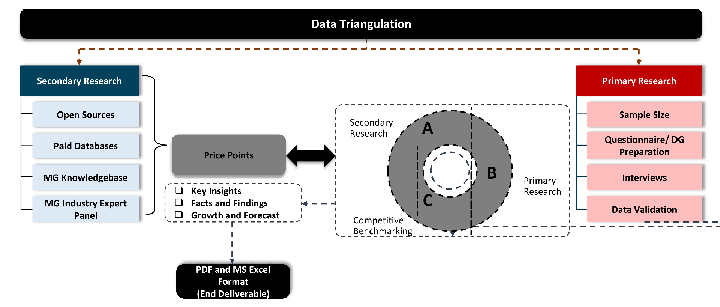
Data triangulation is a validation technique that uses multiple methods, sources, or perspectives to examine the same research question, thereby increasing the credibility and reliability of research findings. In market research, triangulation serves as a quality assurance mechanism that helps identify and minimize bias, validate assumptions, and ensure accuracy in market estimates.
- Data Source Triangulation – Using multiple data sources to examine the same phenomenon
- Methodological Triangulation – Using multiple research methods to study the same research question
- Investigator Triangulation – Using multiple researchers or analysts to examine the same data
- Theoretical Triangulation – Using multiple theoretical perspectives to interpret the same data
Custom Market Research Services
We will customise the research for you, in case the report listed above does not meet your requirements.
Get 10% Free Customisation