Peptide Stabilization Market Size, Share & Trends Analysis Report by Stabilization Technique (Lyophilization (Freeze-Drying), Spray Drying, Chemical Modification, Encapsulation Technologies, Formulation-Based Stabilization), Formulation Type, Stabilizer Type, Peptide Type, Delivery Route, Packaging Format, Stability Condition, Application, End-User, and Geography (North America, Europe, Asia Pacific, Middle East, Africa, and South America) – Global Industry Data, Trends, and Forecasts, 2026–2035
Market Overview:
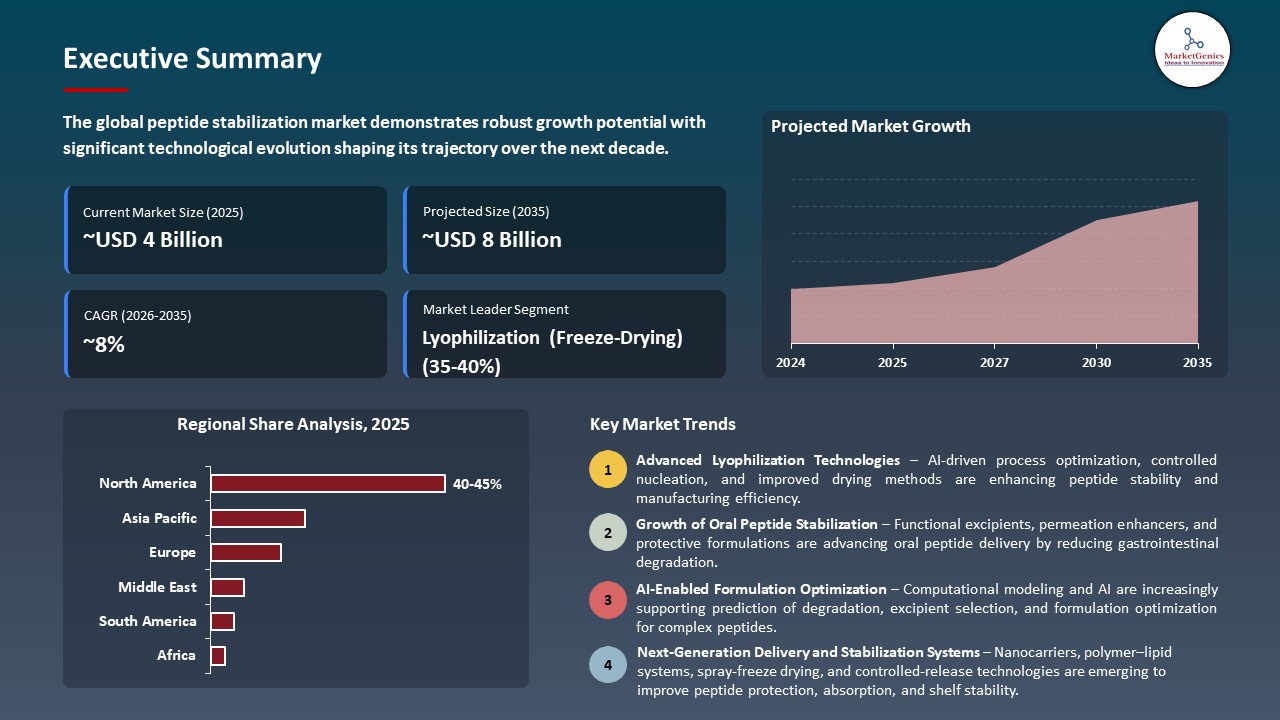
As per MarketGenics, the global Peptide Stabilization Market is experiencing significant growth, valued at USD 3.5 billion in 2025 and projected to reach USD 7.8 billion by 2035, registering a CAGR of 8.3% during the forecast period.
|
|
|
Segmental Data Insights |
|
|
Demand Trends |
|
|
Competitive Landscape |
|
|
Strategic Development |
|
|
Future Outlook & Opportunities |
|
Peptide Stabilization Market Size, Share, and Growth
Dr. Dean Y. Li, president, Merck Research Laboratories, said, “By harnessing the innovative science of PCSK9 inhibitors and novel macrocyclic peptide technology, LIPFENDRA was designed to significantly lower LDL-C in the form of a convenient once-daily pill, this is a pivotal moment as we bring the first U.S. FDA-approved oral PCSK9 inhibitor to adults with high LDL-C, offering patients an important new option. We’re proud of our work with regulators on this rigorous and efficient review process”
Peptide stabilization is fueled by the growing demand for long-acting peptide therapeutics, increased research and development activities on peptides, and developments in chemical modification, cyclization, formulation, and delivery technologies to increase resistance to enzymatic degradation and prolong therapeutic exposure. Incorporating stability into peptide design and manufacturing is becoming more commonplace in the pharmaceutical industry.
Novo Nordisk further developed engineered and long-acting peptide therapies such as zenagamtide, and Ascelis Peptides, part of Granules India, launched a peptide development and characterization center to boost its peptide development capabilities. The increasing demand for orally delivered peptides is also driving technologies for enhancing peptide stability, absorption and bioavailability.
Key adjacent opportunities include long-acting peptide formulations, peptide drug delivery systems, controlled-release technologies, peptide excipients and stabilizers, and oral peptide delivery platforms, driven by the need to overcome degradation, poor permeability, short circulation time, and frequent dosing requirements. Expansion of these adjacent markets can broaden demand for peptide stabilization technologies and accelerate development of more durable, convenient peptide therapeutics.
Peptide Stabilization Market Dynamics and Trends
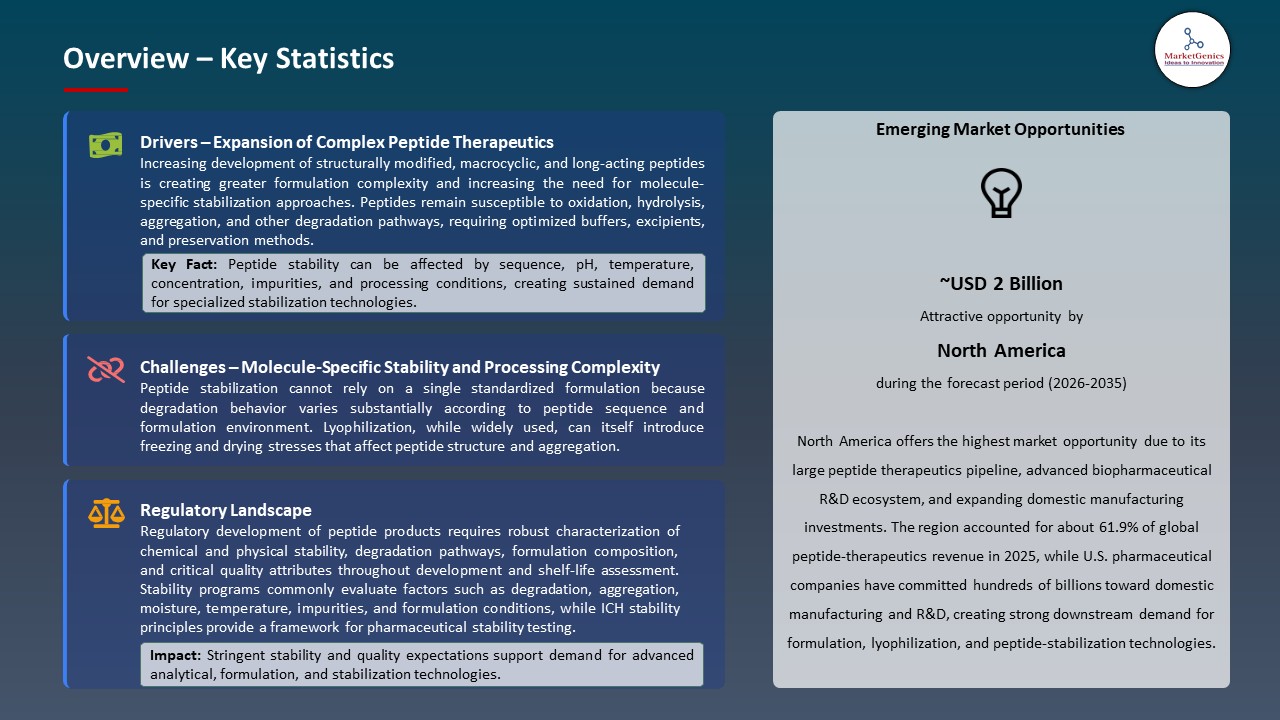
Driver: Expanding Peptide Therapeutics Pipeline Is Driving Stabilization Requirements
- The growing use of peptide-based medicines across metabolic, oncology, cardiovascular, and rare diseases is increasing demand for technologies that preserve peptide integrity, potency, and shelf life. Over 200 therapeutic peptides and proteins have been approved by FDA, and hundreds more are under development, highlighting the importance of effective stabilization and formulation strategies.
- The promise of peptide therapies and GLP-1 therapies is growing, and this growth is driving pharmaceutical companies to focus on optimizing molecular stability, formulation performance and storage.
- In 2026, Samsung Biologics announced their acquisition of PolyPeptide Group, valued at around $1.8 billion, which aims to significantly bolster their peptide manufacturing expertise as the global demand for peptide-based therapeutic drugs, particularly GLP-1 medications, escalates.
- The rising number of peptide therapeutics in development is driving increased demand for advanced stabilization, formulation and delivery technologies.
Restraint: Peptide Instability and Complex Manufacturing Requirements Remain Major Commercial Constraints
- The susceptibility of peptides to enzymatic degradation and other chemical and physical changes such as oxidation, deamidation and aggregation can lead to loss of potency, shelf life and product consistency.
- Special stabilizers and formulation optimization, analytical testing, temperature-controlled processing, lyophilization and other specialized processes must therefore be employed to improve the performance of the products in the market, thereby reducing the development complexity and production costs. The development timelines can further be extended as production of peptides is scaled up, while keeping the quality and stability of the product the same.
- These stability and manufacturing issues may lead to higher costs and slower commercialization, limiting uptake of advanced peptide stabilization technologies.
Opportunity: Expanding Macrocyclic Peptide Platforms for Enhanced Stability and Oral Delivery
- The peptide-stabilization-market is expected to benefit greatly from macrocyclic peptide platforms due to their high proteolytic stability, conformational rigidity, target selectivity and potential oral bioavailability, which are advantages over many linear peptides.
- The number of candidates under development is increasing and new approaches to stabilize these molecules are becoming necessary, such as structural modification, protective excipients, permeability enhancement, and optimization of the formulation to guarantee the peptide remains intact and therapeutic exposure.
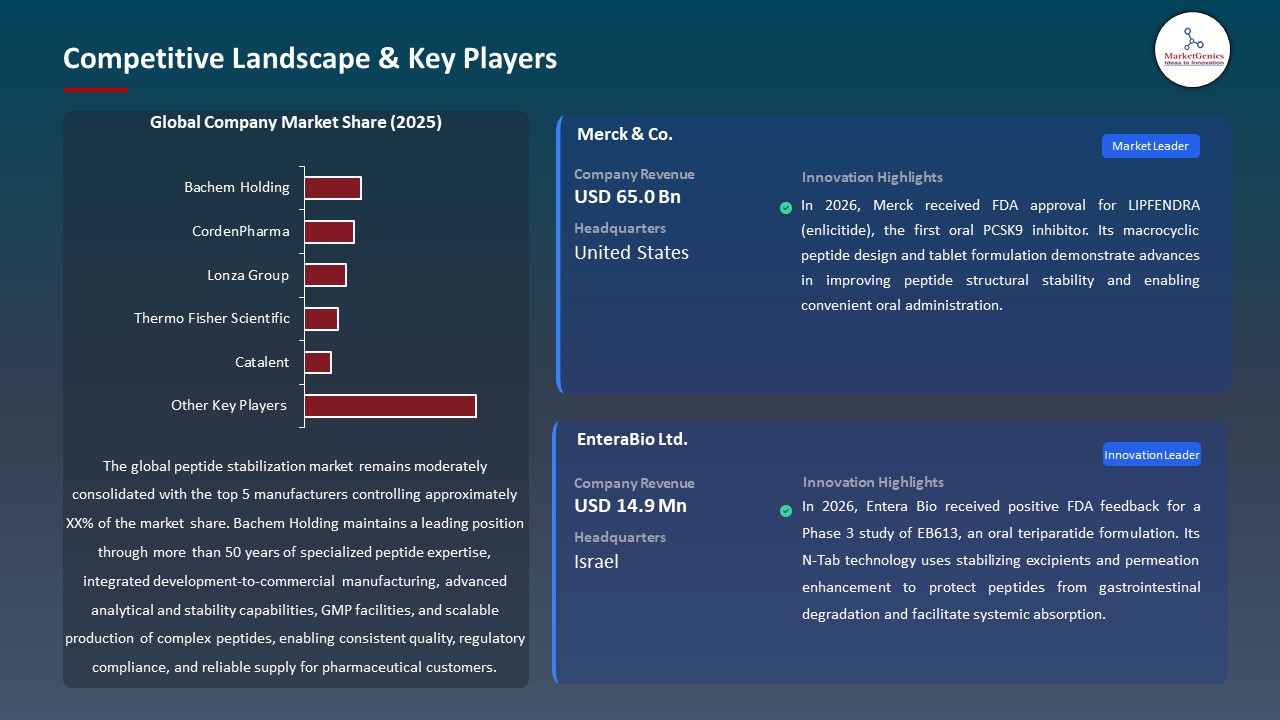
- Macrocyclic peptide technology offers a new approach to improved stability and oral delivery, and was proven to have commercial potential in July 2026 with the U.S. FDA approval of Merck's novel macrocyclic peptide and first once-daily oral PCSK9 inhibitor, LIPFENDRA.
- The growing development of macrocyclic peptides will drive a rise in the demand for advanced stabilization and formulation technologies.
Key Trend: Data-Driven Formulation and Lyophilization Are Reshaping Peptide Stability Development
- The use of AI-aided formulation design tools, predictive stability modeling, high throughput screening, and advanced analytical techniques is helping to identify peptide degradation pathways and streamline the selection of excipients and formulations.
- Peptides that require aqueous formulations should be lyophilized for longer shelf life, better storage stability and product consistency. Such methods are also helping manufacturers to achieve optimization of formulation earlier in the process and minimize development iterations.
- Neuland Laboratories announced in March 2026, that its new commercial peptide plant in Hyderabad will feature large-scale lyophilizers, advanced purification systems, digital operations, and automated batch-record systems to enhance the consistency and scalability of peptide manufacturing.
- The use of advanced formulation analytics and lyophilization technologies is resulting in greater peptide stability, faster development timelines, and increasing the need for specialized stabilization technologies.
Peptide Stabilization Market Analysis and Segmental Data
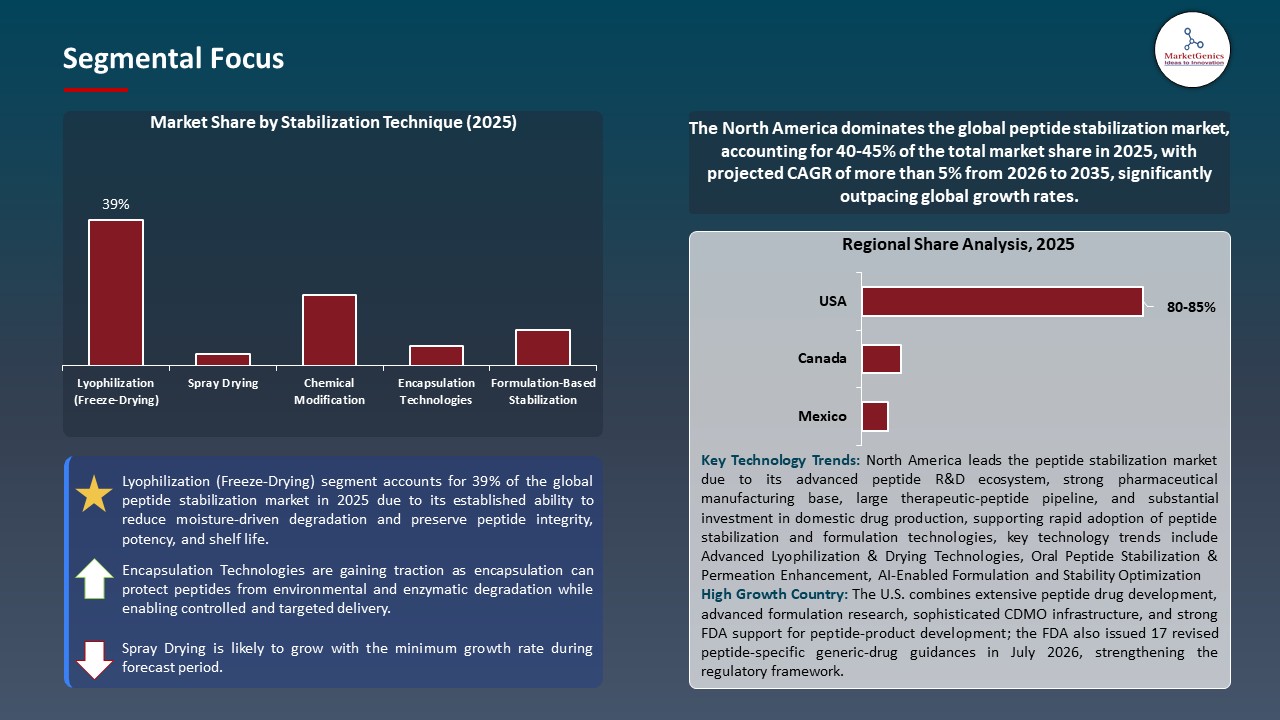
Lyophilization (Freeze-Drying) Dominate Global Peptide Stabilization Market
- Lyophilization is a major stabilization technology as in this process, the water is removed from the product under controlled freezing and vacuum conditions, which reduces hydrolysis, oxidation, aggregation and other degradation pathways, thereby enhancing the shelf life of the peptides and maintaining product integrity.
- Many applications in peptide development and manufacture have been demonstrated, and compatibility with stabilizing excipients and production of stable dry-state products drive wide-spread use.
- In June 2026, PharmaBlock Sciences commissioned its first peptide pilot-scale GMP plant in Zhejiang, which includes 600 L of SPPS capacity and integrated purification and drying along with fully automated sterile lyophilization.
- Lyophilization remains the most popular stabilization technology as there is continued global demand for stable, long shelf-life peptide formulations.
North America Leads Global Peptide Stabilization Market Demand
- North America dominates the peptide stabilization market as it has a well-established peptide drug-development ecosystem and advanced pharmaceutical manufacturing facilities, and is home to a large number of biotechnology and pharmaceutical firms. The U.S. FDA is also tightening regulatory pathways for peptide-products, such as the updated 2026 guidance on peptide structure, impurities and biological activity.
- Advanced formulation, stabilization and production technologies will continue to drive regional demand for higher investments in U.S. pharmaceutical manufacturing.
- North America continues to lead the peptide stabilization market, driven by robust innovation, manufacturing investment, and regulatory backing.
Peptide Stabilization Market Ecosystem
The peptide stabilization market is consolidated, led by Bachem Holding, CordenPharma, Lonza Group, Thermo Fisher Scientific, and Catalent. These companies compete through specialized peptide development and manufacturing, advanced formulation and stabilization technologies, lyophilization capabilities, analytical testing, GMP-compliant production, oral peptide delivery solutions, scalable CDMO services, and integrated drug-development platforms serving pharmaceutical and biotechnology customers.
The value chain includes peptide raw materials and building blocks, peptide synthesis, purification and characterization, formulation development, stabilization and excipient selection, lyophilization or other drying processes, analytical and stability testing, GMP manufacturing, packaging and storage, distribution, and pharmaceutical/biotechnology end-user applications.
The market has high entry barriers due to requirements for specialized peptide chemistry expertise, sophisticated formulation and stabilization technologies, GMP compliance, advanced analytical capabilities, validated manufacturing processes, lyophilization infrastructure, stringent quality controls, regulatory expertise, scalable production capacity, and established relationships with pharmaceutical and biotechnology companies.
Recent Development and Strategic Overview
- In July 2026, Precision Peptide Company began testing a Thymosin Alpha-1 transdermal patch, focusing on formulation stability and performance while targeting a portable, needle-free format that avoids cold storage, highlighting emerging peptide stabilization and delivery applications.
- In August 2026, Entera Bio advanced its oral teriparatide candidate EB613 toward Phase 3 after FDA agreement, using its N-Tab platform with stabilizing excipients and SNAC permeation enhancement to protect peptides from gastrointestinal degradation and improve systemic absorption.
Report Scope
|
Detail |
|
|
Market Size in 2025 |
USD 3.5 Bn |
|
Market Forecast Value in 2035 |
USD 7.8 Bn |
|
Growth Rate (CAGR) |
8.3% |
|
Forecast Period |
2026 – 2035 |
|
Historical Data Available for |
2021 – 2024 |
|
Market Size Units |
US$ Billion for Value |
|
Report Format |
Electronic (PDF) + Excel |
|
North America |
Europe |
Asia Pacific |
Middle East |
Africa |
South America |
|
|
|
|
|
|
|
Companies Covered |
|||||
|
|||||
Peptide Stabilization Market Segmentation and Highlights
|
Segment |
Sub-segment |
|
Peptide Stabilization Market, By Stabilization Technique |
|
|
Peptide Stabilization Market, By Formulation Type |
|
|
Peptide Stabilization Market, By Stabilizer Type |
|
|
Peptide Stabilization Market, By Peptide Type |
|
|
Peptide Stabilization Market, By Delivery Route |
|
|
Peptide Stabilization Market, By Packaging Format |
|
|
Peptide Stabilization Market, By Stability Condition |
|
|
Peptide Stabilization Market, By Application |
|
|
Peptide Stabilization Market, By End-User |
|
Frequently Asked Questions
Table of Contents
- 1. Research Methodology and Assumptions
- 1.1. Definitions
- 1.2. Research Design and Approach
- 1.3. Data Collection Methods
- 1.4. Base Estimates and Calculations
- 1.5. Forecasting Models
- 1.5.1. Key Forecast Factors & Impact Analysis
- 1.6. Secondary Research
- 1.6.1. Open Sources
- 1.6.2. Paid Databases
- 1.6.3. Associations
- 1.7. Primary Research
- 1.7.1. Primary Sources
- 1.7.2. Primary Interviews with Stakeholders across Ecosystem
- 2. Executive Summary
- 2.1. Global Peptide Stabilization Market Outlook
- 2.1.1. Peptide Stabilization Market Size Value (US$ Bn), and Forecasts, 2021-2035
- 2.1.2. Compounded Annual Growth Rate Analysis
- 2.1.3. Growth Opportunity Analysis
- 2.1.4. Segmental Share Analysis
- 2.1.5. Geographical Share Analysis
- 2.2. Market Analysis and Facts
- 2.3. Supply-Demand Analysis
- 2.4. Competitive Benchmarking
- 2.5. Go-to- Market Strategy
- 2.5.1. Customer/ End-use Industry Assessment
- 2.5.2. Growth Opportunity Data, 2026-2035
- 2.5.2.1. Regional Data
- 2.5.2.2. Country Data
- 2.5.2.3. Segmental Data
- 2.5.3. Identification of Potential Market Spaces
- 2.5.4. GAP Analysis
- 2.5.5. Potential Attractive Price Points
- 2.5.6. Prevailing Market Risks & Challenges
- 2.5.7. Preferred Sales & Marketing Strategies
- 2.5.8. Key Recommendations and Analysis
- 2.5.9. A Way Forward
- 2.1. Global Peptide Stabilization Market Outlook
- 3. Industry Data and Premium Insights
- 3.1. Global Healthcare & Pharmaceutical Industry Overview, 2025
- 3.1.1. Healthcare & Pharmaceutical Ecosystem Analysis
- 3.1.2. Key Trends for Healthcare & Pharmaceutical Industry
- 3.1.3. Regional Distribution for Healthcare & Pharmaceutical Industry
- 3.2. Supplier Customer Data
- 3.3. Technology Roadmap and Developments
- 3.1. Global Healthcare & Pharmaceutical Industry Overview, 2025
- 4. Market Overview
- 4.1. Market Dynamics
- 4.1.1. Drivers
- 4.1.1.1. Expanding development of therapeutic peptides across metabolic, oncology, cardiovascular, and rare diseases
- 4.1.1.2. Growing adoption of advanced lyophilization, stabilizing excipients, and formulation technologies
- 4.1.1.3. Rising demand for oral, long-acting, and patient-friendly peptide delivery systems
- 4.1.2. Restraints
- 4.1.2.1. High formulation complexity and molecule-specific stabilization requirements
- 4.1.2.2. Significant development costs and technical challenges associated with maintaining long-term peptide stability
- 4.1.1. Drivers
- 4.2. Key Trend Analysis
- 4.3. Regulatory Framework
- 4.3.1. Key Regulations, Norms, and Subsidies, by Key Countries
- 4.3.2. Tariffs and Standards
- 4.3.3. Impact Analysis of Regulations on the Market
- 4.4. Ecosystem Analysis
- 4.5. Porter’s Five Forces Analysis
- 4.6. PESTEL Analysis
- 4.7. Global Peptide Stabilization Market Demand
- 4.7.1. Historical Market Size – Value (US$ Bn), 2020-2024
- 4.7.2. Current and Future Market Size - Value (US$ Bn), 2026–2035
- 4.7.2.1. Y-o-Y Growth Trends
- 4.7.2.2. Absolute $ Opportunity Assessment
- 4.1. Market Dynamics
- 5. Competition Landscape
- 5.1. Competition structure
- 5.1.1. Fragmented v/s consolidated
- 5.2. Company Share Analysis, 2025
- 5.2.1. Global Company Market Share
- 5.2.2. By Region
- 5.2.2.1. North America
- 5.2.2.2. Europe
- 5.2.2.3. Asia Pacific
- 5.2.2.4. Middle East
- 5.2.2.5. Africa
- 5.2.2.6. South America
- 5.3. Product Comparison Matrix
- 5.3.1. Specifications
- 5.3.2. Market Positioning
- 5.3.3. Pricing
- 5.1. Competition structure
- 6. Global Peptide Stabilization Market Analysis, by Stabilization Technique
- 6.1. Key Segment Analysis
- 6.2. Peptide Stabilization Market Size Value (US$ Bn), Analysis, and Forecasts, by Stabilization Technique, 2021-2035
- 6.2.1. Lyophilization (Freeze-Drying)
- 6.2.1.1. Conventional shelf freeze-drying
- 6.2.1.2. Spin freeze-drying
- 6.2.2. Spray Drying
- 6.2.3. Chemical Modification
- 6.2.3.1. PEGylation
- 6.2.3.2. Amino acid substitution/cyclization
- 6.2.3.3. Glycosylation
- 6.2.4. Encapsulation Technologies
- 6.2.4.1. Liposomal encapsulation
- 6.2.4.2. Polymeric nanoparticle encapsulation
- 6.2.4.3. Microsphere encapsulation
- 6.2.5. Formulation-Based Stabilization
- 6.2.1. Lyophilization (Freeze-Drying)
- 7. Global Peptide Stabilization Market Analysis, by Formulation Type
- 7.1. Key Segment Analysis
- 7.2. Peptide Stabilization Market Size Value (US$ Bn), Analysis, and Forecasts, by Formulation Type, 2021-2035
- 7.2.1. Liquid Formulations
- 7.2.2. Lyophilized (Solid) Formulations
- 7.2.3. Semi-Solid Formulations
- 8. Global Peptide Stabilization Market Analysis, by Stabilizer Type
- 8.1. Key Segment Analysis
- 8.2. Peptide Stabilization Market Size Value (US$ Bn), Analysis, and Forecasts, by Stabilizer Type, 2021-2035
- 8.2.1. Sugars & Polyols
- 8.2.2. Surfactants
- 8.2.3. Amino Acids
- 8.2.4. Polymers
- 8.2.5. Antioxidants
- 8.2.6. Buffering Agents
- 8.2.7. Chelating Agents
- 9. Global Peptide Stabilization Market Analysis, by Peptide Type
- 9.1. Key Segment Analysis
- 9.2. Peptide Stabilization Market Size Value (US$ Bn), Analysis, and Forecasts, by Peptide Type, 2021-2035
- 9.2.1. Therapeutic Peptides
- 9.2.2. Diagnostic Peptides
- 9.2.3. Cosmetic Peptides
- 9.2.4. Research-Grade Peptides
- 10. Global Peptide Stabilization Market Analysis and Forecasts, by Delivery Route
- 10.1. Key Findings
- 10.2. Peptide Stabilization Market Size Value (US$ Bn), Analysis, and Forecasts, by Delivery Route, 2021-2035
- 10.2.1. Injectable (Parenteral)
- 10.2.2. Oral
- 10.2.3. Transdermal
- 10.2.4. Nasal
- 10.2.5. Pulmonary/Inhalation
- 11. Global Peptide Stabilization Market Analysis and Forecasts, by Packaging Format
- 11.1. Key Findings
- 11.2. Peptide Stabilization Market Size Value (US$ Bn), Analysis, and Forecasts, by Packaging Format, 2021-2035
- 11.2.1. Vials
- 11.2.2. Prefilled Syringes
- 11.2.3. Cartridges
- 11.2.4. Ampoules
- 12. Global Peptide Stabilization Market Analysis and Forecasts, by Stability Condition
- 12.1. Key Findings
- 12.2. Peptide Stabilization Market Size Value (US$ Bn), Analysis, and Forecasts, by Stability Condition, 2021-2035
- 12.2.1. Cold Chain Dependent
- 12.2.2. Ambient-Stable Formulations
- 12.2.3. Controlled Room Temperature (CRT) Stable
- 13. Global Peptide Stabilization Market Analysis and Forecasts, by Application
- 13.1. Key Findings
- 13.2. Peptide Stabilization Market Size Value (US$ Bn), Analysis, and Forecasts, by Application, 2021-2035
- 13.2.1. Therapeutic Use (disease treatment)
- 13.2.2. Diagnostic Use
- 13.2.3. Cosmetic & Dermatological Use
- 13.2.4. Research & Laboratory Use
- 14. Global Peptide Stabilization Market Analysis and Forecasts, by End-User
- 14.1. Key Findings
- 14.2. Peptide Stabilization Market Size Value (US$ Bn), Analysis, and Forecasts, by End-User, 2021-2035
- 14.2.1. Pharmaceutical Companies
- 14.2.2. Biotechnology Companies
- 14.2.3. Contract Development & Manufacturing Organizations
- 14.2.4. Cosmetics & Personal Care Industry
- 14.2.5. Academic & Research Institutes
- 14.2.6. Diagnostic Laboratories
- 15. Global Peptide Stabilization Market Analysis and Forecasts, by Region
- 15.1. Key Findings
- 15.2. Peptide Stabilization Market Size Value (US$ Bn), Analysis, and Forecasts, by Region, 2021-2035
- 15.2.1. North America
- 15.2.2. Europe
- 15.2.3. Asia Pacific
- 15.2.4. Middle East
- 15.2.5. Africa
- 15.2.6. South America
- 16. North America Peptide Stabilization Market Analysis
- 16.1. Key Segment Analysis
- 16.2. Regional Snapshot
- 16.3. North America Peptide Stabilization Market Size- Value (US$ Bn), Analysis, and Forecasts, 2021-2035
- 16.3.1. Stabilization Technique
- 16.3.2. Formulation Type
- 16.3.3. Stabilizer Type
- 16.3.4. Peptide Type
- 16.3.5. Delivery Route
- 16.3.6. Packaging Format
- 16.3.7. Stability Condition
- 16.3.8. Application
- 16.3.9. End-User
- 16.3.10. Country
- 16.3.10.1. USA
- 16.3.10.2. Canada
- 16.3.10.3. Mexico
- 16.4. USA Peptide Stabilization Market
- 16.4.1. Country Segmental Analysis
- 16.4.2. Stabilization Technique
- 16.4.3. Formulation Type
- 16.4.4. Stabilizer Type
- 16.4.5. Peptide Type
- 16.4.6. Delivery Route
- 16.4.7. Packaging Format
- 16.4.8. Stability Condition
- 16.4.9. Application
- 16.4.10. End-User
- 16.5. Canada Peptide Stabilization Market
- 16.5.1. Country Segmental Analysis
- 16.5.2. Stabilization Technique
- 16.5.3. Formulation Type
- 16.5.4. Stabilizer Type
- 16.5.5. Peptide Type
- 16.5.6. Delivery Route
- 16.5.7. Packaging Format
- 16.5.8. Stability Condition
- 16.5.9. Application
- 16.5.10. End-User
- 16.6. Mexico Peptide Stabilization Market
- 16.6.1. Country Segmental Analysis
- 16.6.2. Stabilization Technique
- 16.6.3. Formulation Type
- 16.6.4. Stabilizer Type
- 16.6.5. Peptide Type
- 16.6.6. Delivery Route
- 16.6.7. Packaging Format
- 16.6.8. Stability Condition
- 16.6.9. Application
- 16.6.10. End-User
- 17. Europe Peptide Stabilization Market Analysis
- 17.1. Key Segment Analysis
- 17.2. Regional Snapshot
- 17.3. Europe Peptide Stabilization Market Size Value (US$ Bn), Analysis, and Forecasts, 2021-2035
- 17.3.1. Stabilization Technique
- 17.3.2. Formulation Type
- 17.3.3. Stabilizer Type
- 17.3.4. Peptide Type
- 17.3.5. Delivery Route
- 17.3.6. Packaging Format
- 17.3.7. Stability Condition
- 17.3.8. Application
- 17.3.9. End-User
- 17.3.10. Country
- 17.3.10.1. Germany
- 17.3.10.2. United Kingdom
- 17.3.10.3. France
- 17.3.10.4. Italy
- 17.3.10.5. Spain
- 17.3.10.6. Netherlands
- 17.3.10.7. Nordic Countries
- 17.3.10.8. Poland
- 17.3.10.9. Russia & CIS
- 17.3.10.10. Rest of Europe
- 17.4. Germany Peptide Stabilization Market
- 17.4.1. Country Segmental Analysis
- 17.4.2. Stabilization Technique
- 17.4.3. Formulation Type
- 17.4.4. Stabilizer Type
- 17.4.5. Peptide Type
- 17.4.6. Delivery Route
- 17.4.7. Packaging Format
- 17.4.8. Stability Condition
- 17.4.9. Application
- 17.4.10. End-User
- 17.5. United Kingdom Peptide Stabilization Market
- 17.5.1. Country Segmental Analysis
- 17.5.2. Stabilization Technique
- 17.5.3. Formulation Type
- 17.5.4. Stabilizer Type
- 17.5.5. Peptide Type
- 17.5.6. Delivery Route
- 17.5.7. Packaging Format
- 17.5.8. Stability Condition
- 17.5.9. Application
- 17.5.10. End-User
- 17.6. France Peptide Stabilization Market
- 17.6.1. Country Segmental Analysis
- 17.6.2. Stabilization Technique
- 17.6.3. Formulation Type
- 17.6.4. Stabilizer Type
- 17.6.5. Peptide Type
- 17.6.6. Delivery Route
- 17.6.7. Packaging Format
- 17.6.8. Stability Condition
- 17.6.9. Application
- 17.6.10. End-User
- 17.7. Italy Peptide Stabilization Market
- 17.7.1. Country Segmental Analysis
- 17.7.2. Stabilization Technique
- 17.7.3. Formulation Type
- 17.7.4. Stabilizer Type
- 17.7.5. Peptide Type
- 17.7.6. Delivery Route
- 17.7.7. Packaging Format
- 17.7.8. Stability Condition
- 17.7.9. Application
- 17.7.10. End-User
- 17.8. Spain Peptide Stabilization Market
- 17.8.1. Country Segmental Analysis
- 17.8.2. Stabilization Technique
- 17.8.3. Formulation Type
- 17.8.4. Stabilizer Type
- 17.8.5. Peptide Type
- 17.8.6. Delivery Route
- 17.8.7. Packaging Format
- 17.8.8. Stability Condition
- 17.8.9. Application
- 17.8.10. End-User
- 17.9. Netherlands Peptide Stabilization Market
- 17.9.1. Country Segmental Analysis
- 17.9.2. Stabilization Technique
- 17.9.3. Formulation Type
- 17.9.4. Stabilizer Type
- 17.9.5. Peptide Type
- 17.9.6. Delivery Route
- 17.9.7. Packaging Format
- 17.9.8. Stability Condition
- 17.9.9. Application
- 17.9.10. End-User
- 17.10. Nordic Countries Peptide Stabilization Market
- 17.10.1. Country Segmental Analysis
- 17.10.2. Stabilization Technique
- 17.10.3. Formulation Type
- 17.10.4. Stabilizer Type
- 17.10.5. Peptide Type
- 17.10.6. Delivery Route
- 17.10.7. Packaging Format
- 17.10.8. Stability Condition
- 17.10.9. Application
- 17.10.10. End-User
- 17.11. Poland Peptide Stabilization Market
- 17.11.1. Country Segmental Analysis
- 17.11.2. Stabilization Technique
- 17.11.3. Formulation Type
- 17.11.4. Stabilizer Type
- 17.11.5. Peptide Type
- 17.11.6. Delivery Route
- 17.11.7. Packaging Format
- 17.11.8. Stability Condition
- 17.11.9. Application
- 17.11.10. End-User
- 17.12. Russia & CIS Peptide Stabilization Market
- 17.12.1. Country Segmental Analysis
- 17.12.2. Stabilization Technique
- 17.12.3. Formulation Type
- 17.12.4. Stabilizer Type
- 17.12.5. Peptide Type
- 17.12.6. Delivery Route
- 17.12.7. Packaging Format
- 17.12.8. Stability Condition
- 17.12.9. Application
- 17.12.10. End-User
- 17.13. Rest of Europe Peptide Stabilization Market
- 17.13.1. Country Segmental Analysis
- 17.13.2. Stabilization Technique
- 17.13.3. Formulation Type
- 17.13.4. Stabilizer Type
- 17.13.5. Peptide Type
- 17.13.6. Delivery Route
- 17.13.7. Packaging Format
- 17.13.8. Stability Condition
- 17.13.9. Application
- 17.13.10. End-User
- 18. Asia Pacific Peptide Stabilization Market Analysis
- 18.1. Key Segment Analysis
- 18.2. Regional Snapshot
- 18.3. Asia Pacific Peptide Stabilization Market Size Value (US$ Bn), Analysis, and Forecasts, 2021-2035
- 18.3.1. Stabilization Technique
- 18.3.2. Formulation Type
- 18.3.3. Stabilizer Type
- 18.3.4. Peptide Type
- 18.3.5. Delivery Route
- 18.3.6. Packaging Format
- 18.3.7. Stability Condition
- 18.3.8. Application
- 18.3.9. End-User
- 18.3.10. Country
- 18.3.10.1. China
- 18.3.10.2. India
- 18.3.10.3. Japan
- 18.3.10.4. South Korea
- 18.3.10.5. Australia and New Zealand
- 18.3.10.6. Indonesia
- 18.3.10.7. Malaysia
- 18.3.10.8. Thailand
- 18.3.10.9. Vietnam
- 18.3.10.10. Rest of Asia Pacific
- 18.4. China Peptide Stabilization Market
- 18.4.1. Country Segmental Analysis
- 18.4.2. Stabilization Technique
- 18.4.3. Formulation Type
- 18.4.4. Stabilizer Type
- 18.4.5. Peptide Type
- 18.4.6. Delivery Route
- 18.4.7. Packaging Format
- 18.4.8. Stability Condition
- 18.4.9. Application
- 18.4.10. End-User
- 18.5. India Peptide Stabilization Market
- 18.5.1. Country Segmental Analysis
- 18.5.2. Stabilization Technique
- 18.5.3. Formulation Type
- 18.5.4. Stabilizer Type
- 18.5.5. Peptide Type
- 18.5.6. Delivery Route
- 18.5.7. Packaging Format
- 18.5.8. Stability Condition
- 18.5.9. Application
- 18.5.10. End-User
- 18.6. Japan Peptide Stabilization Market
- 18.6.1. Country Segmental Analysis
- 18.6.2. Stabilization Technique
- 18.6.3. Formulation Type
- 18.6.4. Stabilizer Type
- 18.6.5. Peptide Type
- 18.6.6. Delivery Route
- 18.6.7. Packaging Format
- 18.6.8. Stability Condition
- 18.6.9. Application
- 18.6.10. End-User
- 18.7. South Korea Peptide Stabilization Market
- 18.7.1. Country Segmental Analysis
- 18.7.2. Stabilization Technique
- 18.7.3. Formulation Type
- 18.7.4. Stabilizer Type
- 18.7.5. Peptide Type
- 18.7.6. Delivery Route
- 18.7.7. Packaging Format
- 18.7.8. Stability Condition
- 18.7.9. Application
- 18.7.10. End-User
- 18.8. Australia and New Zealand Peptide Stabilization Market
- 18.8.1. Country Segmental Analysis
- 18.8.2. Stabilization Technique
- 18.8.3. Formulation Type
- 18.8.4. Stabilizer Type
- 18.8.5. Peptide Type
- 18.8.6. Delivery Route
- 18.8.7. Packaging Format
- 18.8.8. Stability Condition
- 18.8.9. Application
- 18.8.10. End-User
- 18.9. Indonesia Peptide Stabilization Market
- 18.9.1. Country Segmental Analysis
- 18.9.2. Stabilization Technique
- 18.9.3. Formulation Type
- 18.9.4. Stabilizer Type
- 18.9.5. Peptide Type
- 18.9.6. Delivery Route
- 18.9.7. Packaging Format
- 18.9.8. Stability Condition
- 18.9.9. Application
- 18.9.10. End-User
- 18.10. Malaysia Peptide Stabilization Market
- 18.10.1. Country Segmental Analysis
- 18.10.2. Stabilization Technique
- 18.10.3. Formulation Type
- 18.10.4. Stabilizer Type
- 18.10.5. Peptide Type
- 18.10.6. Delivery Route
- 18.10.7. Packaging Format
- 18.10.8. Stability Condition
- 18.10.9. Application
- 18.10.10. End-User
- 18.11. Thailand Peptide Stabilization Market
- 18.11.1. Country Segmental Analysis
- 18.11.2. Stabilization Technique
- 18.11.3. Formulation Type
- 18.11.4. Stabilizer Type
- 18.11.5. Peptide Type
- 18.11.6. Delivery Route
- 18.11.7. Packaging Format
- 18.11.8. Stability Condition
- 18.11.9. Application
- 18.11.10. End-User
- 18.12. Vietnam Peptide Stabilization Market
- 18.12.1. Country Segmental Analysis
- 18.12.2. Stabilization Technique
- 18.12.3. Formulation Type
- 18.12.4. Stabilizer Type
- 18.12.5. Peptide Type
- 18.12.6. Delivery Route
- 18.12.7. Packaging Format
- 18.12.8. Stability Condition
- 18.12.9. Application
- 18.12.10. End-User
- 18.13. Rest of Asia Pacific Peptide Stabilization Market
- 18.13.1. Country Segmental Analysis
- 18.13.2. Stabilization Technique
- 18.13.3. Formulation Type
- 18.13.4. Stabilizer Type
- 18.13.5. Peptide Type
- 18.13.6. Delivery Route
- 18.13.7. Packaging Format
- 18.13.8. Stability Condition
- 18.13.9. Application
- 18.13.10. End-User
- 19. Middle East Peptide Stabilization Market Analysis
- 19.1. Key Segment Analysis
- 19.2. Regional Snapshot
- 19.3. Middle East Peptide Stabilization Market Size Value (US$ Bn), Analysis, and Forecasts, 2021-2035
- 19.3.1. Stabilization Technique
- 19.3.2. Formulation Type
- 19.3.3. Stabilizer Type
- 19.3.4. Peptide Type
- 19.3.5. Delivery Route
- 19.3.6. Packaging Format
- 19.3.7. Stability Condition
- 19.3.8. Application
- 19.3.9. End-User
- 19.3.10. Country
- 19.3.10.1. Turkey
- 19.3.10.2. UAE
- 19.3.10.3. Saudi Arabia
- 19.3.10.4. Israel
- 19.3.10.5. Rest of Middle East
- 19.4. Turkey Peptide Stabilization Market
- 19.4.1. Country Segmental Analysis
- 19.4.2. Stabilization Technique
- 19.4.3. Formulation Type
- 19.4.4. Stabilizer Type
- 19.4.5. Peptide Type
- 19.4.6. Delivery Route
- 19.4.7. Packaging Format
- 19.4.8. Stability Condition
- 19.4.9. Application
- 19.4.10. End-User
- 19.5. UAE Peptide Stabilization Market
- 19.5.1. Country Segmental Analysis
- 19.5.2. Stabilization Technique
- 19.5.3. Formulation Type
- 19.5.4. Stabilizer Type
- 19.5.5. Peptide Type
- 19.5.6. Delivery Route
- 19.5.7. Packaging Format
- 19.5.8. Stability Condition
- 19.5.9. Application
- 19.5.10. End-User
- 19.6. Saudi Arabia Peptide Stabilization Market
- 19.6.1. Country Segmental Analysis
- 19.6.2. Stabilization Technique
- 19.6.3. Formulation Type
- 19.6.4. Stabilizer Type
- 19.6.5. Peptide Type
- 19.6.6. Delivery Route
- 19.6.7. Packaging Format
- 19.6.8. Stability Condition
- 19.6.9. Application
- 19.6.10. End-User
- 19.7. Israel Peptide Stabilization Market
- 19.7.1. Country Segmental Analysis
- 19.7.2. Stabilization Technique
- 19.7.3. Formulation Type
- 19.7.4. Stabilizer Type
- 19.7.5. Peptide Type
- 19.7.6. Delivery Route
- 19.7.7. Packaging Format
- 19.7.8. Stability Condition
- 19.7.9. Application
- 19.7.10. End-User
- 19.8. Rest of Middle East Peptide Stabilization Market
- 19.8.1. Country Segmental Analysis
- 19.8.2. Stabilization Technique
- 19.8.3. Formulation Type
- 19.8.4. Stabilizer Type
- 19.8.5. Peptide Type
- 19.8.6. Delivery Route
- 19.8.7. Packaging Format
- 19.8.8. Stability Condition
- 19.8.9. Application
- 19.8.10. End-User
- 20. Africa Peptide Stabilization Market Analysis
- 20.1. Key Segment Analysis
- 20.2. Regional Snapshot
- 20.3. Africa Peptide Stabilization Market Size Value (US$ Bn), Analysis, and Forecasts, 2021-2035
- 20.3.1. Stabilization Technique
- 20.3.2. Formulation Type
- 20.3.3. Stabilizer Type
- 20.3.4. Peptide Type
- 20.3.5. Delivery Route
- 20.3.6. Packaging Format
- 20.3.7. Stability Condition
- 20.3.8. Application
- 20.3.9. End-User
- 20.3.10. Country
- 20.3.10.1. South Africa
- 20.3.10.2. Egypt
- 20.3.10.3. Nigeria
- 20.3.10.4. Algeria
- 20.3.10.5. Rest of Africa
- 20.4. South Africa Peptide Stabilization Market
- 20.4.1. Country Segmental Analysis
- 20.4.2. Stabilization Technique
- 20.4.3. Formulation Type
- 20.4.4. Stabilizer Type
- 20.4.5. Peptide Type
- 20.4.6. Delivery Route
- 20.4.7. Packaging Format
- 20.4.8. Stability Condition
- 20.4.9. Application
- 20.4.10. End-User
- 20.5. Egypt Peptide Stabilization Market
- 20.5.1. Country Segmental Analysis
- 20.5.2. Stabilization Technique
- 20.5.3. Formulation Type
- 20.5.4. Stabilizer Type
- 20.5.5. Peptide Type
- 20.5.6. Delivery Route
- 20.5.7. Packaging Format
- 20.5.8. Stability Condition
- 20.5.9. Application
- 20.5.10. End-User
- 20.6. Nigeria Peptide Stabilization Market
- 20.6.1. Country Segmental Analysis
- 20.6.2. Stabilization Technique
- 20.6.3. Formulation Type
- 20.6.4. Stabilizer Type
- 20.6.5. Peptide Type
- 20.6.6. Delivery Route
- 20.6.7. Packaging Format
- 20.6.8. Stability Condition
- 20.6.9. Application
- 20.6.10. End-User
- 20.7. Algeria Peptide Stabilization Market
- 20.7.1. Country Segmental Analysis
- 20.7.2. Stabilization Technique
- 20.7.3. Formulation Type
- 20.7.4. Stabilizer Type
- 20.7.5. Peptide Type
- 20.7.6. Delivery Route
- 20.7.7. Packaging Format
- 20.7.8. Stability Condition
- 20.7.9. Application
- 20.7.10. End-User
- 20.8. Rest of Africa Peptide Stabilization Market
- 20.8.1. Country Segmental Analysis
- 20.8.2. Stabilization Technique
- 20.8.3. Formulation Type
- 20.8.4. Stabilizer Type
- 20.8.5. Peptide Type
- 20.8.6. Delivery Route
- 20.8.7. Packaging Format
- 20.8.8. Stability Condition
- 20.8.9. Application
- 20.8.10. End-User
- 21. South America Peptide Stabilization Market Analysis
- 21.1. Key Segment Analysis
- 21.2. Regional Snapshot
- 21.3. South America Peptide Stabilization Market Size Value (US$ Bn), Analysis, and Forecasts, 2021-2035
- 21.3.1. Stabilization Technique
- 21.3.2. Formulation Type
- 21.3.3. Stabilizer Type
- 21.3.4. Peptide Type
- 21.3.5. Delivery Route
- 21.3.6. Packaging Format
- 21.3.7. Stability Condition
- 21.3.8. Application
- 21.3.9. End-User
- 21.3.10. Country
- 21.3.10.1. Brazil
- 21.3.10.2. Argentina
- 21.3.10.3. Rest of South America
- 21.4. Brazil Peptide Stabilization Market
- 21.4.1. Country Segmental Analysis
- 21.4.2. Stabilization Technique
- 21.4.3. Formulation Type
- 21.4.4. Stabilizer Type
- 21.4.5. Peptide Type
- 21.4.6. Delivery Route
- 21.4.7. Packaging Format
- 21.4.8. Stability Condition
- 21.4.9. Application
- 21.4.10. End-User
- 21.5. Argentina Peptide Stabilization Market
- 21.5.1. Country Segmental Analysis
- 21.5.2. Stabilization Technique
- 21.5.3. Formulation Type
- 21.5.4. Stabilizer Type
- 21.5.5. Peptide Type
- 21.5.6. Delivery Route
- 21.5.7. Packaging Format
- 21.5.8. Stability Condition
- 21.5.9. Application
- 21.5.10. End-User
- 21.6. Rest of South America Peptide Stabilization Market
- 21.6.1. Country Segmental Analysis
- 21.6.2. Stabilization Technique
- 21.6.3. Formulation Type
- 21.6.4. Stabilizer Type
- 21.6.5. Peptide Type
- 21.6.6. Delivery Route
- 21.6.7. Packaging Format
- 21.6.8. Stability Condition
- 21.6.9. Application
- 21.6.10. End-User
- 22. Key Players/ Company Profile
- 22.1. Almac Group
- 22.1.1. Company Details/ Overview
- 22.1.2. Company Financials
- 22.1.3. Key Customers and Competitors
- 22.1.4. Business/ Industry Portfolio
- 22.1.5. Product Portfolio/ Specification Details
- 22.1.6. Pricing Data
- 22.1.7. Strategic Overview
- 22.1.8. Recent Developments
- 22.2. AmbioPharm
- 22.3. Bachem Holding
- 22.4. Baxter BioPharma Solutions
- 22.5. Catalent
- 22.6. CordenPharma
- 22.7. Ferring Pharmaceuticals
- 22.8. Fresenius Kabi
- 22.9. Lonza Group
- 22.10. Piramal Pharma Solutions
- 22.11. Recipharm
- 22.12. Siegfried Holding
- 22.13. Thermo Fisher Scientific
- 22.14. Vetter Pharma
- 22.15. Other Key Players
- 22.1. Almac Group
Note* - This is just tentative list of players. While providing the report, we will cover more number of players based on their revenue and share for each geography
Research Design
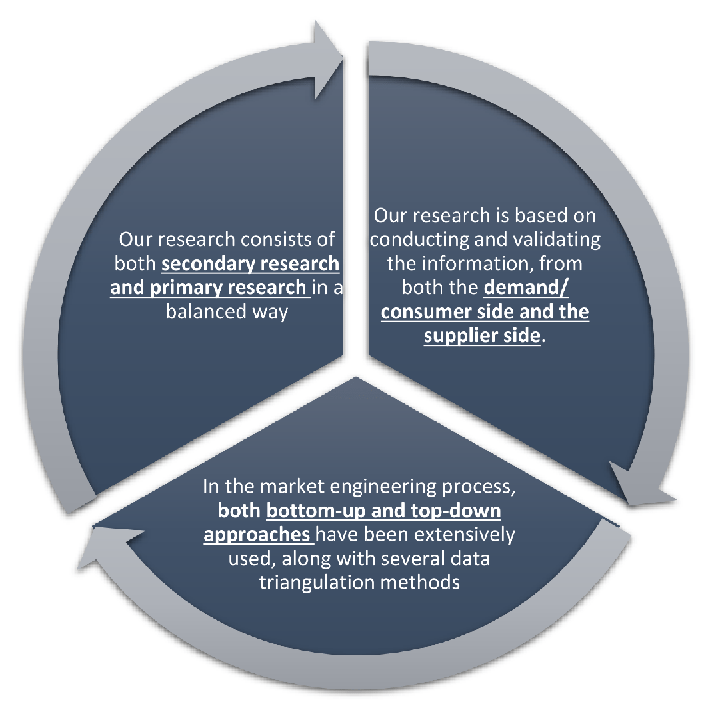
Our research design integrates both demand-side and supply-side analysis through a balanced combination of primary and secondary research methodologies. By utilizing both bottom-up and top-down approaches alongside rigorous data triangulation methods, we deliver robust market intelligence that supports strategic decision-making.
MarketGenics' comprehensive research design framework ensures the delivery of accurate, reliable, and actionable market intelligence. Through the integration of multiple research approaches, rigorous validation processes, and expert analysis, we provide our clients with the insights needed to make informed strategic decisions and capitalize on market opportunities.
MarketGenics leverages a dedicated industry panel of experts and a comprehensive suite of paid databases to effectively collect, consolidate, and analyze market intelligence.
Our approach has consistently proven to be reliable and effective in generating accurate market insights, identifying key industry trends, and uncovering emerging business opportunities.
Through both primary and secondary research, we capture and analyze critical company-level data such as manufacturing footprints, including technical centers, R&D facilities, sales offices, and headquarters.
Our expert panel further enhances our ability to estimate market size for specific brands based on validated field-level intelligence.
Our data mining techniques incorporate both parametric and non-parametric methods, allowing for structured data collection, sorting, processing, and cleaning.
Demand projections are derived from large-scale data sets analyzed through proprietary algorithms, culminating in robust and reliable market sizing.
Research Approach
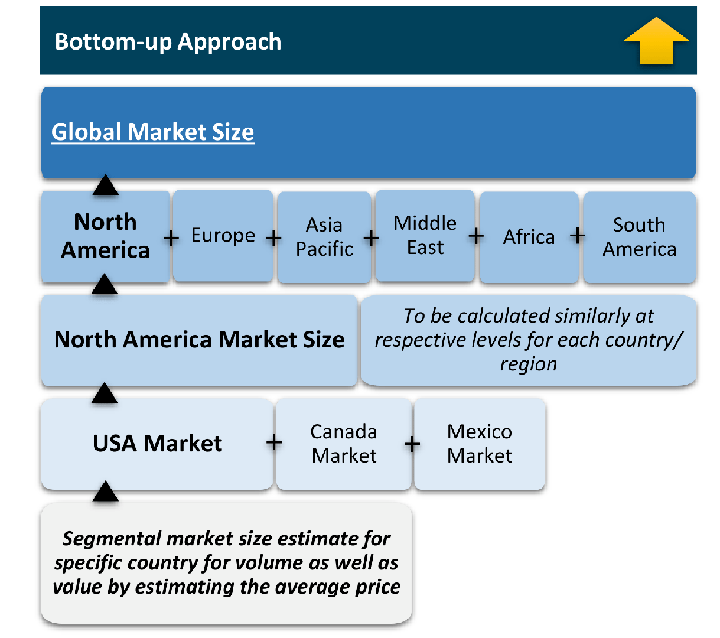
The bottom-up approach builds market estimates by starting with the smallest addressable market units and systematically aggregating them to create comprehensive market size projections.
This method begins with specific, granular data points and builds upward to create the complete market landscape.
Customer Analysis → Segmental Analysis → Geographical Analysis
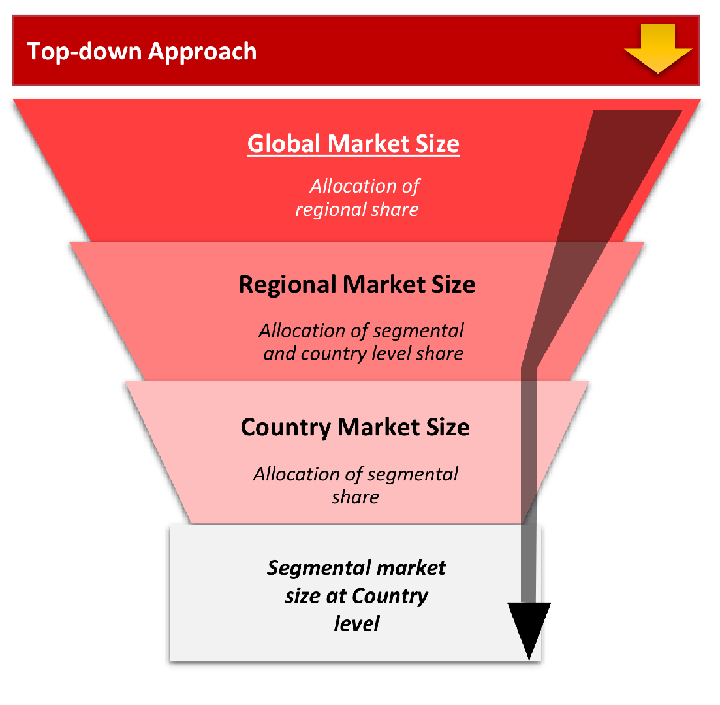
The top-down approach starts with the broadest possible market data and systematically narrows it down through a series of filters and assumptions to arrive at specific market segments or opportunities.
This method begins with the big picture and works downward to increasingly specific market slices.
TAM → SAM → SOM
Research Methods
Desk / Secondary Research
While analysing the market, we extensively study secondary sources, directories, and databases to identify and collect information useful for this technical, market-oriented, and commercial report. Secondary sources that we utilize are not only the public sources, but it is a combination of Open Source, Associations, Paid Databases, MG Repository & Knowledgebase, and others.
- Company websites, annual reports, financial reports, broker reports, and investor presentations
- National government documents, statistical databases and reports
- News articles, press releases and web-casts specific to the companies operating in the market, Magazines, reports, and others
- We gather information from commercial data sources for deriving company specific data such as segmental revenue, share for geography, product revenue, and others
- Internal and external proprietary databases (industry-specific), relevant patent, and regulatory databases
- Governing Bodies, Government Organizations
- Relevant Authorities, Country-specific Associations for Industries
We also employ the model mapping approach to estimate the product level market data through the players' product portfolio
Primary Research
Primary research/ interviews is vital in analyzing the market. Most of the cases involves paid primary interviews. Primary sources include primary interviews through e-mail interactions, telephonic interviews, surveys as well as face-to-face interviews with the different stakeholders across the value chain including several industry experts.
| Type of Respondents | Number of Primaries |
|---|---|
| Tier 2/3 Suppliers | ~20 |
| Tier 1 Suppliers | ~25 |
| End-users | ~25 |
| Industry Expert/ Panel/ Consultant | ~30 |
| Total | ~100 |
MG Knowledgebase
• Repository of industry blog, newsletter and case studies
• Online platform covering detailed market reports, and company profiles
Forecasting Factors and Models
Forecasting Factors
- Historical Trends – Past market patterns, cycles, and major events that shaped how markets behave over time. Understanding past trends helps predict future behavior.
- Industry Factors – Specific characteristics of the industry like structure, regulations, and innovation cycles that affect market dynamics.
- Macroeconomic Factors – Economic conditions like GDP growth, inflation, and employment rates that affect how much money people have to spend.
- Demographic Factors – Population characteristics like age, income, and location that determine who can buy your product.
- Technology Factors – How quickly people adopt new technology and how much technology infrastructure exists.
- Regulatory Factors – Government rules, laws, and policies that can help or restrict market growth.
- Competitive Factors – Analyzing competition structure such as degree of competition and bargaining power of buyers and suppliers.
Forecasting Models / Techniques
Multiple Regression Analysis
- Identify and quantify factors that drive market changes
- Statistical modeling to establish relationships between market drivers and outcomes
Time Series Analysis – Seasonal Patterns
- Understand regular cyclical patterns in market demand
- Advanced statistical techniques to separate trend, seasonal, and irregular components
Time Series Analysis – Trend Analysis
- Identify underlying market growth patterns and momentum
- Statistical analysis of historical data to project future trends
Expert Opinion – Expert Interviews
- Gather deep industry insights and contextual understanding
- In-depth interviews with key industry stakeholders
Multi-Scenario Development
- Prepare for uncertainty by modeling different possible futures
- Creating optimistic, pessimistic, and most likely scenarios
Time Series Analysis – Moving Averages
- Sophisticated forecasting for complex time series data
- Auto-regressive integrated moving average models with seasonal components
Econometric Models
- Apply economic theory to market forecasting
- Sophisticated economic models that account for market interactions
Expert Opinion – Delphi Method
- Harness collective wisdom of industry experts
- Structured, multi-round expert consultation process
Monte Carlo Simulation
- Quantify uncertainty and probability distributions
- Thousands of simulations with varying input parameters
Research Analysis
Our research framework is built upon the fundamental principle of validating market intelligence from both demand and supply perspectives. This dual-sided approach ensures comprehensive market understanding and reduces the risk of single-source bias.
Demand-Side Analysis: We understand end-user/application behavior, preferences, and market needs along with the penetration of the product for specific application.
Supply-Side Analysis: We estimate overall market revenue, analyze the segmental share along with industry capacity, competitive landscape, and market structure.
Validation & Evaluation
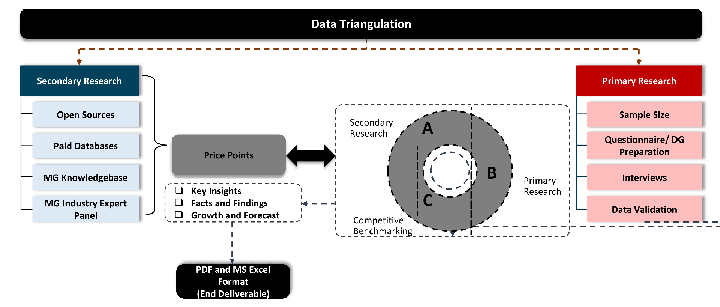
Data triangulation is a validation technique that uses multiple methods, sources, or perspectives to examine the same research question, thereby increasing the credibility and reliability of research findings. In market research, triangulation serves as a quality assurance mechanism that helps identify and minimize bias, validate assumptions, and ensure accuracy in market estimates.
- Data Source Triangulation – Using multiple data sources to examine the same phenomenon
- Methodological Triangulation – Using multiple research methods to study the same research question
- Investigator Triangulation – Using multiple researchers or analysts to examine the same data
- Theoretical Triangulation – Using multiple theoretical perspectives to interpret the same data
Custom Market Research Services
We will customise the research for you, in case the report listed above does not meet your requirements.
Get 10% Free Customisation