Functional Nanocoatings Market Size, Share & Trends Analysis Report by Product Type (Anti-Microbial Nanocoatings, Anti-Corrosion Nanocoatings, Self-Cleaning Nanocoatings, Anti-Fingerprint Nanocoatings, UV-Resistant Nanocoatings, Anti-Reflective Nanocoatings, Hydrophobic Nanocoatings, Conductive Nanocoatings, Others), Material Type, Technology, Functionality, Coating Method, Substrate Type, Application, and Geography (North America, Europe, Asia Pacific, Middle East, Africa, and South America) – Global Industry Data, Trends, and Forecasts, 2026–2035
|
|
|
Segmental Data Insights |
|
|
Demand Trends |
|
|
Competitive Landscape |
|
|
Strategic Development |
|
|
Future Outlook & Opportunities |
|
Functional Nanocoatings market Size, Share, and Growth
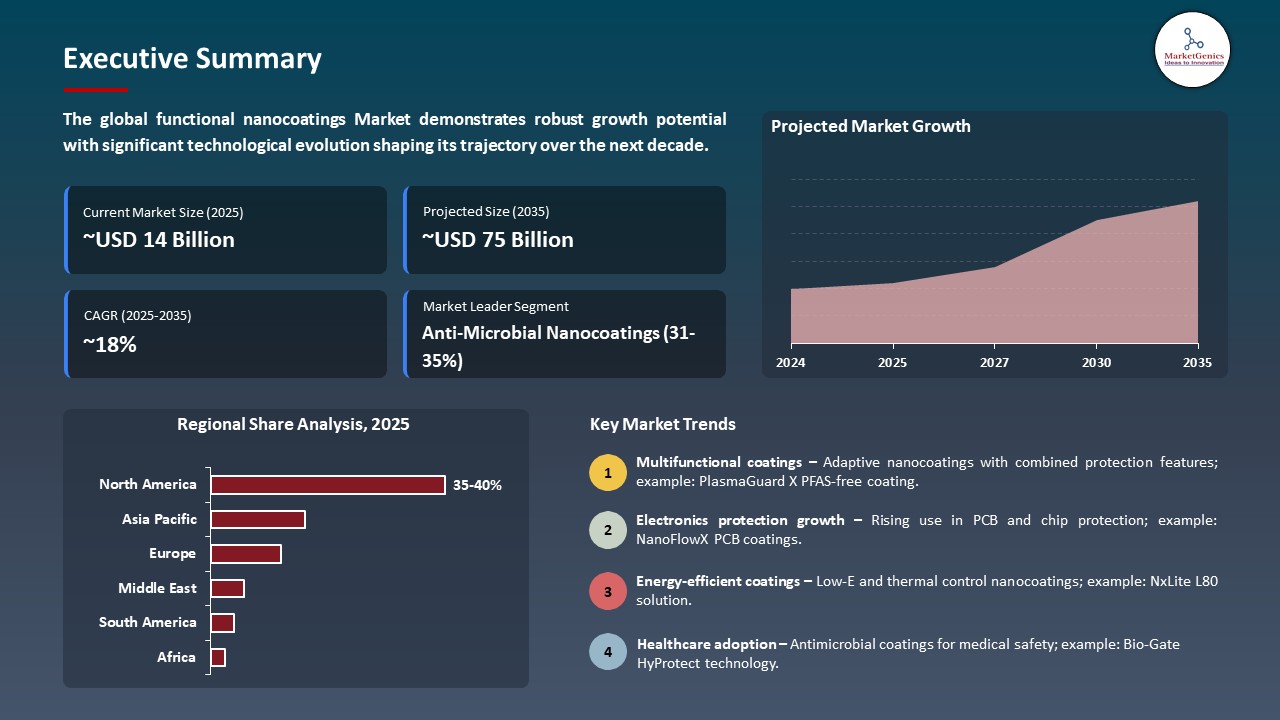
The global functional nanocoatings market is witnessing strong growth, valued at USD 13.8 billion in 2025 and projected to reach USD 74.6 billion by 2035, expanding at a CAGR of 18.4% during the forecast period. Functional nanocoatings can be integrated in advanced surface engineering applications, including electronics, automotive, healthcare, aerospace and energy, by combining advanced material design, precision deposition technology and multifunctional performance systems at the nanoscale level. The market is moving towards smart coating architectures, which combines corrosion protection, thermal stability, antimicrobial protection and self-healing in a single ultra-thin coating.
Rick Fung, CEO, NanoFlowX said, We are thrilled to partner with Bentec Ltd as we scale our presence across Europe and India. Bentec’s strong industry relationships and proven technical expertise make them the ideal partner to introduce our nanocoating technologies into these key regions. Together, we’re bringing a more sustainable, higher-performance coating solution to manufacturers searching for better ways to protect their electronics.
Functional nanocoatings are emerging as a critical enabler of next-generation surface engineering, combining nanoscale material science with multifunctional performance capabilities such as anti-corrosion, anti-microbial, anti-fouling, and self-healing properties. The market is quickly moving beyond the traditional protective coatings to smart, responsive, and application-specific surface systems that not only protect but also increase durability, efficiency, and operational reliability in high-value industries.
Rising demands for ultra-precision deposition technique, hybrid nano-architectures and plasma-assisted surface modification techniques for atomic level control of coating thickness and functionality are driving the increasingly changing ecosystem. It is aiding next-generation applications such as semiconductor packaging, EV thermal management systems, implantable medical devices, and aerospace systems, for which high-temperature performance is vital.
The adjacent opportunity sees nanocoatings becoming part of smart materials, flexible electronics and lightweight composites, opening new applications in autonomous mobility, wearable healthcare systems, as well as in smart surface functionality and long-life-lines in the intelligent infrastructure. The demand for multifunctional coatings in which the combination of protection, conductivity and environmental resistance is achieved in a single coating layer is further increased.
Functional Nanocoatings market Dynamics and Trends
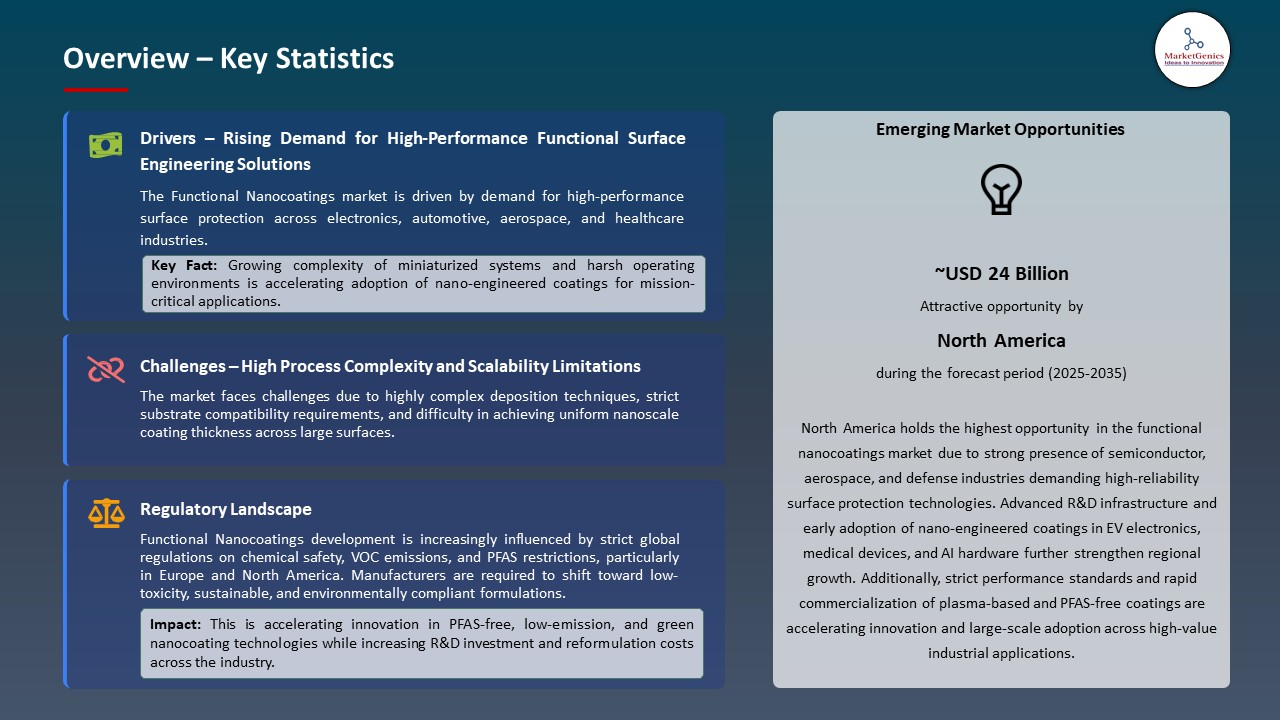
Driver: Growing Demand for High-Performance Surface Protection and Functional Enhancement Technologies
- The functional nanocoatings market is growing with the increasing demand for ultra-thin protective coatings in semiconductors, EV batteries, and aerospace components, where thermal stability, corrosion resistance, and dielectric performance are vital to enable advanced applications.
- As the miniaturization of electronics and the development of high-density circuit systems become increasingly complex, there is a growing demand for nano-engineered coatings that deliver superior performance in reliability, moisture protection, and operational efficiency over the life of the system in critical industrial applications.
- This is driving the global movement towards multifunctional surface engineering solutions and high-performance protective coating technologies.
Restraint: High Production Complexity and Cost Barriers in Nanocoating Manufacturing
- The high capital costs associated with vacuum plasma deposition systems, atomic-layer coating techniques, and precision nanoscale processes are driving up costs for the functional nanocoatings market, while also making many of these processes unreachable at larger scales.
- Increasing complexity of electronics and medical applications, along with demanding process controls, cleanroom environment and validation, places a burden on advanced coating developers.
- The high costs of the equipment and energy-intensive nano-fabrication processes are limiting large-scale commercialization globally.
Opportunity: Expansion of Smart and Multifunctional Nanocoating Applications in Emerging Industries
- The functional nanocoatings market is projected to generate strong growth opportunities due to the increased demand for nanocoatings in EV batteries, semiconductors, and medical devices for augmenting durability, efficiency, and performance.
- Sustainability and low carbon and circular coating value chain solutions. for instance, in September 2025, BASF, AkzoNobel, and Arkema advanced low-carbon and circular coating value chain solutions, supporting sustainable high-performance coating development for industrial applications.
- The opportunity spurs investments in sustainable coatings and multifunctional surface engineering around the world.
Key Trend: Shift Toward Sustainable, PFAS-Free, and Multifunctional Nanocoating Systems
- Functional nanocoatings are trending towards PFAS-free formulations, low-emission processes, and energy-efficient surface technologies, all designed to improve sustainability without compromising on performance and protection across various industry segments.
- For instance, in July 2025, NxLite entered the market with the L80 sputter coating for low-emission polycarbonate and acrylic substrates that allows for energy-efficient performance and wider application of lightweight solutions in the building sector and mobility.
- This is driving increased uptake of sustainable, multifunctional and energy-efficient nanocoating technologies in the world.
Functional Nanocoatings Market Analysis and Segmental Data
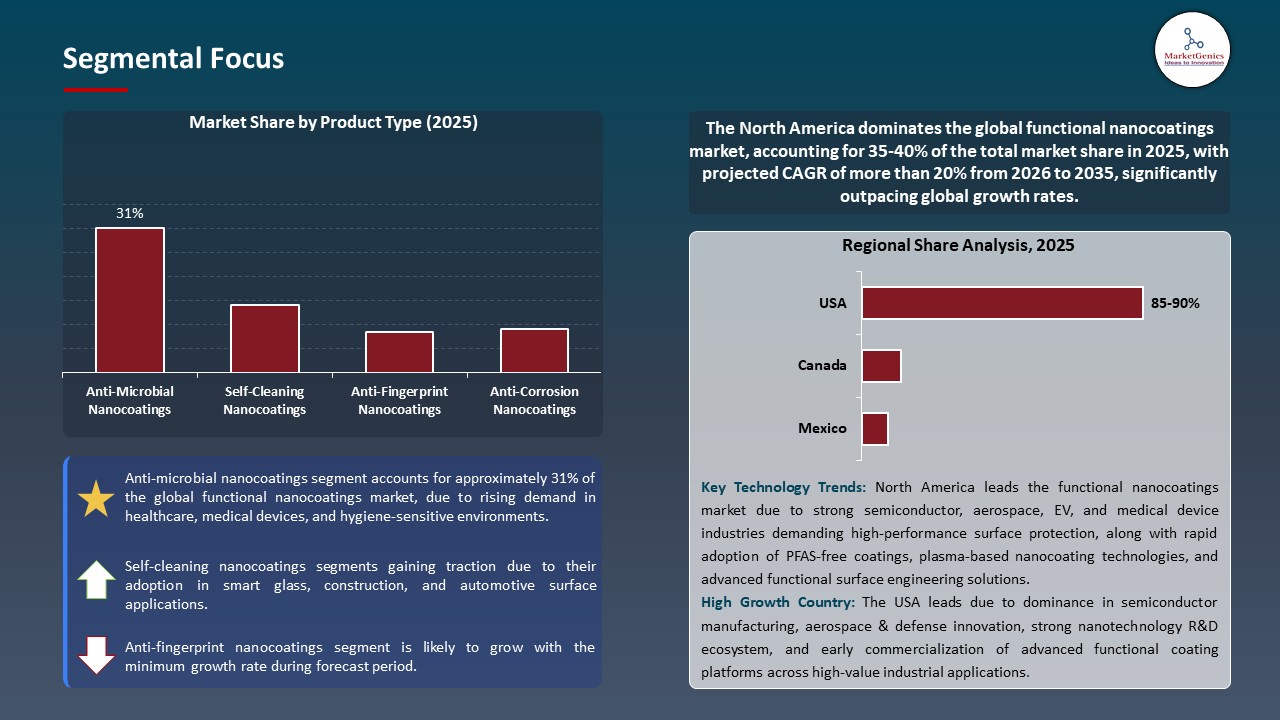
Anti-Microbial Nanocoatings Dominate Global Functional Nanocoatings Market
- Anti-microbial nanocoatings dominate the global functional nanocoatings market due to rising demand for infection-resistant surfaces, growing adoption in healthcare infrastructure, and increasing use in medical devices and high-touch applications.
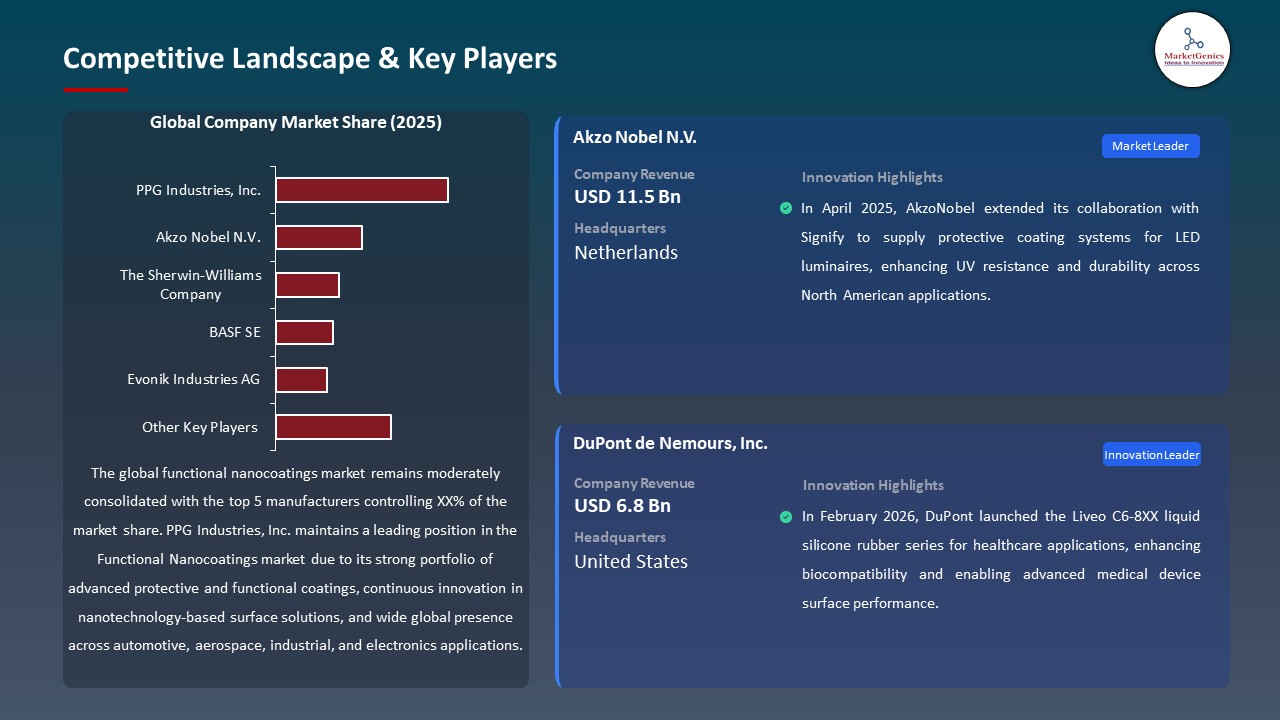
- Segment innovation is progressing in the development of healthcare materials, for instance, in February 2026, DuPont introduced the Liveo C6-8XX liquid silicone rubber series for healthcare applications, which supports advanced surface performance and biocompatibility for medical devices.
- The global demand for antimicrobial nanocoatings is rapidly increasing in hospitals, medical devices and wearable healthcare systems.
North America Leads Global Functional Nanocoatings Market Demand
- The functional nanocoatings market is led by North America, as the industry has seen high demand for coatings in the advanced electronics sector, increasing investment in semiconductors, and expanding use of nanotechnology in surface engineering in the medical devices, defense, and aerospace industries.
- For instance, in April 2025, AkzoNobel has announced the continuation of its partnership with Signify for the supply of protective coating systems to LED luminaires that provide high UV resistance and durability for applications in North America.
- Demand for the technology is growing rapidly in North America, particularly in EV electronics, 5G equipment, and medical devices.
Functional Nanocoatings Market Ecosystem
The functional nanocoatings market is moderately fragmented and is expected to grow at a fast pace, supported by the increased demand for high performance surface protection, corrosion protection, self-cleaning and advanced electronic grade coatings in the automotive, electronics, healthcare, energy and construction space. The promotion of nanocoating technologies that are PFAS-free, low VOC and sustainable is changing the way products are developed and driving innovation-based competition.
Key players like PPG Industries, Inc., Akzo Nobel N.V., The Sherwin-Williams Company, BASF SE, and Evonik Industries AG are investing in nano-engineered coatings, multifunctional surface technologies and sustainable formulation systems to strengthen their presence and application diversity in the world market.
The primary focus of PPG Industries, Inc., Akzo Nobel N.V., and The Sherwin-Williams Company is protective and industrial nanocoatings, which provide solutions for anti-corrosion, anti-fouling, UV protection and durability enhancement, commonly applied in automotive, aerospace, marine, infrastructure, and heavy industrial applications.
In parallel, BASF SE and Evonik Industries AG build upon the ecosystem by providing specialty chemicals, polymer innovations, nanomaterial additives, and surface modification technologies that allow for next generation coatings with enhanced adhesion, barrier properties, thermal resistance, and sustainability compliance, which will help pave the way to high performance green nanocoatings.
Recent Development and Strategic Overview
- In March 2025, Plasmalex launches PlasmaGuard X introduced a 100% PFAS-free ultra-thin conformal nanocoating designed for PCBAs, sensors, medical devices, and electronics, offering superior moisture, corrosion, and dielectric protection, advancing sustainable Functional Nanocoatings innovation.
- In December 2025, NanoFlowX partnered with Bentec Ltd to expand PCB protection nanocoating solutions across Europe and India, strengthening electronics reliability, scalability, and sustainable replacement of traditional conformal coatings in Functional Nanocoatings applications.
Report Scope
|
Detail |
|
|
Market Size in 2025 |
USD 13.8 Bn |
|
Market Forecast Value in 2035 |
USD 74.6 Bn |
|
Growth Rate (CAGR) |
18.4% |
|
Forecast Period |
2026 – 2035 |
|
Historical Data Available for |
2021 – 2024 |
|
Market Size Units |
US$ Billion for Value |
|
Report Format |
Electronic (PDF) + Excel |
|
North America |
Europe |
Asia Pacific |
Middle East |
Africa |
South America |
|
|
|
|
|
|
|
Companies Covered |
|||||
|
|
|
|
|
|
Functional Nanocoatings Market Segmentation and Highlights
|
Segment |
Sub-segment |
|
Functional Nanocoatings Market, By Product Type |
|
|
Functional Nanocoatings Market, By Material Type |
|
|
Functional Nanocoatings Market, By Technology |
|
|
Functional Nanocoatings Market, By Functionality |
|
|
Functional Nanocoatings Market, By Coating Method |
|
|
Functional Nanocoatings Market, By Substrate Type |
|
|
Functional Nanocoatings Market, By Application |
|
Frequently Asked Questions
Table of Contents
- 1. Research Methodology and Assumptions
- 1.1. Definitions
- 1.2. Research Design and Approach
- 1.3. Data Collection Methods
- 1.4. Base Estimates and Calculations
- 1.5. Forecasting Models
- 1.5.1. Key Forecast Factors & Impact Analysis
- 1.6. Secondary Research
- 1.6.1. Open Sources
- 1.6.2. Paid Databases
- 1.6.3. Associations
- 1.7. Primary Research
- 1.7.1. Primary Sources
- 1.7.2. Primary Interviews with Stakeholders across Ecosystem
- 2. Executive Summary
- 2.1. Global Functional Nanocoatings Market Outlook
- 2.1.1. Functional Nanocoatings Market Size (Value - US$ Bn), and Forecasts, 2021-2035
- 2.1.2. Compounded Annual Growth Rate Analysis
- 2.1.3. Growth Opportunity Analysis
- 2.1.4. Segmental Share Analysis
- 2.1.5. Geographical Share Analysis
- 2.2. Market Analysis and Facts
- 2.3. Supply-Demand Analysis
- 2.4. Competitive Benchmarking
- 2.5. Go-to- Market Strategy
- 2.5.1. Customer/ End-use Industry Assessment
- 2.5.2. Growth Opportunity Data, 2026-2035
- 2.5.2.1. Regional Data
- 2.5.2.2. Country Data
- 2.5.2.3. Segmental Data
- 2.5.3. Identification of Potential Market Spaces
- 2.5.4. GAP Analysis
- 2.5.5. Potential Attractive Price Points
- 2.5.6. Prevailing Market Risks & Challenges
- 2.5.7. Preferred Sales & Marketing Strategies
- 2.5.8. Key Recommendations and Analysis
- 2.5.9. A Way Forward
- 2.1. Global Functional Nanocoatings Market Outlook
- 3. Industry Data and Premium Insights
- 3.1. Global Chemicals & Materials Industry Overview, 2025
- 3.1.1. Chemicals & Materials Industry Ecosystem Analysis
- 3.1.2. Key Trends for Chemicals & Materials Industry
- 3.1.3. Regional Distribution for Chemicals & Materials Industry
- 3.2. Supplier Customer Data
- 3.3. Technology Roadmap and Developments
- 3.4. Trade Analysis
- 3.4.1. Import & Export Analysis, 2025
- 3.4.2. Top Importing Countries
- 3.4.3. Top Exporting Countries
- 3.5. Trump Tariff Impact Analysis
- 3.5.1. Manufacturer
- 3.5.1.1. Based on the component & Raw material
- 3.5.2. Supply Chain
- 3.5.3. End Consumer
- 3.5.1. Manufacturer
- 3.6. Raw Material Analysis
- 3.1. Global Chemicals & Materials Industry Overview, 2025
- 4. Market Overview
- 4.1. Market Dynamics
- 4.1.1. Drivers
- 4.1.1.1. Rising demand for corrosion-resistant, anti-microbial, and self-cleaning surfaces across healthcare, automotive, and construction industries
- 4.1.1.2. Increasing adoption of advanced nanotechnology-based coatings for improved durability and surface performance
- 4.1.1.3. Growing use in electronics and energy sectors for thermal management and protective applications
- 4.1.2. Restraints
- 4.1.2.1. High production and application costs of nanomaterial-based coating systems
- 4.1.2.2. Stringent environmental and health regulations regarding nanomaterial usage and disposal
- 4.1.1. Drivers
- 4.2. Key Trend Analysis
- 4.3. Regulatory Framework
- 4.3.1. Key Regulations, Norms, and Subsidies, by Key Countries
- 4.3.2. Tariffs and Standards
- 4.3.3. Impact Analysis of Regulations on the Market
- 4.4. Ecosystem Analysis
- 4.4.1. Raw Material Suppliers
- 4.4.2. Functional Nanomaterial Manufacturers
- 4.4.3. OEMs & End-use Product Manufacturers
- 4.5. Porter’s Five Forces Analysis
- 4.6. PESTEL Analysis
- 4.7. Global Functional Nanocoatings Market Demand
- 4.7.1. Historical Market Size – Value (US$ Bn), 2020-2024
- 4.7.2. Current and Future Market Size – Value (US$ Bn), 2026–2035
- 4.7.2.1. Y-o-Y Growth Trends
- 4.7.2.2. Absolute $ Opportunity Assessment
- 4.1. Market Dynamics
- 5. Competition Landscape
- 5.1. Competition structure
- 5.1.1. Fragmented v/s consolidated
- 5.2. Company Share Analysis, 2025
- 5.2.1. Global Company Market Share
- 5.2.2. By Region
- 5.2.2.1. North America
- 5.2.2.2. Europe
- 5.2.2.3. Asia Pacific
- 5.2.2.4. Middle East
- 5.2.2.5. Africa
- 5.2.2.6. South America
- 5.3. Product Comparison Matrix
- 5.3.1. Specifications
- 5.3.2. Market Positioning
- 5.3.3. Pricing
- 5.1. Competition structure
- 6. Global Functional Nanocoatings Market Analysis, by Product Type
- 6.1. Key Segment Analysis
- 6.2. Functional Nanocoatings Market Size (Value - US$ Bn), Analysis, and Forecasts, by Product Type, 2021-2035
- 6.2.1. Anti-Microbial Nanocoatings
- 6.2.2. Anti-Corrosion Nanocoatings
- 6.2.3. Self-Cleaning Nanocoatings
- 6.2.4. Anti-Fingerprint Nanocoatings
- 6.2.5. UV-Resistant Nanocoatings
- 6.2.6. Anti-Reflective Nanocoatings
- 6.2.7. Hydrophobic Nanocoatings
- 6.2.8. Conductive Nanocoatings
- 6.2.9. Others
- 7. Global Functional Nanocoatings Market Analysis, by Material Type
- 7.1. Key Segment Analysis
- 7.2. Functional Nanocoatings Market Size (Value - US$ Bn), Analysis, and Forecasts, by Material Type, 2021-2035
- 7.2.1. Metal Oxide Nanocoatings
- 7.2.2. Carbon-Based Nanocoatings
- 7.2.3. Polymer-Based Nanocoatings
- 7.2.4. Ceramic Nanocoatings
- 7.2.5. Silica-Based Nanocoatings
- 7.2.6. Titanium Dioxide Nanocoatings
- 7.2.7. Graphene-Based Nanocoatings
- 7.2.8. Hybrid Nanocomposite Coatings
- 7.2.9. Others
- 8. Global Functional Nanocoatings Market Analysis, by Technology
- 8.1. Key Segment Analysis
- 8.2. Functional Nanocoatings Market Size (Value - US$ Bn), Analysis, and Forecasts, by Technology, 2021-2035
- 8.2.1. Chemical Vapor Deposition (CVD)
- 8.2.2. Physical Vapor Deposition (PVD)
- 8.2.3. Sol-Gel Technology
- 8.2.4. Electrochemical Deposition
- 8.2.5. Spray Coating Technology
- 8.2.6. Dip Coating Technology
- 8.2.7. Layer-by-Layer Assembly
- 8.2.8. Plasma-Assisted Coating
- 8.2.9. Others
- 9. Global Functional Nanocoatings Market Analysis, by Functionality
- 9.1. Key Segment Analysis
- 9.2. Functional Nanocoatings Market Size (Value - US$ Bn), Analysis, and Forecasts, by Functionality, 2021-2035
- 9.2.1. Scratch Resistance
- 9.2.2. Water Repellency
- 9.2.3. Thermal Insulation
- 9.2.4. Electrical Conductivity
- 9.2.5. Optical Enhancement
- 9.2.6. Anti-Bacterial Protection
- 9.2.7. Wear Resistance
- 9.2.8. Chemical Resistance
- 9.2.9. Others
- 10. Global Functional Nanocoatings Market Analysis, by Coating Method
- 10.1. Key Segment Analysis
- 10.2. Functional Nanocoatings Market Size (Value - US$ Bn), Analysis, and Forecasts, by Coating Method, 2021-2035
- 10.2.1. Spray Coating
- 10.2.2. Roll-to-Roll Coating
- 10.2.3. Spin Coating
- 10.2.4. Brush Coating
- 10.2.5. Immersion Coating
- 10.2.6. Vacuum Deposition
- 10.2.7. Electrophoretic Coating
- 10.2.8. Printing-Based Coating
- 10.2.9. Others
- 11. Global Functional Nanocoatings Market Analysis, by Substrate Type
- 11.1. Key Segment Analysis
- 11.2. Functional Nanocoatings Market Size (Value - US$ Bn), Analysis, and Forecasts, by Substrate Type, 2021-2035
- 11.2.1. Glass
- 11.2.2. Metal
- 11.2.3. Plastic
- 11.2.4. Ceramics
- 11.2.5. Textiles
- 11.2.6. Composite Materials
- 11.2.7. Paper and Packaging Materials
- 11.2.8. Semiconductor Surfaces
- 11.2.9. Others
- 12. Global Functional Nanocoatings Market Analysis, by Application
- 12.1. Key Segment Analysis
- 12.2. Functional Nanocoatings Market Size (Value - US$ Bn), Analysis, and Forecasts, by Application, 2021-2035
- 12.2.1. Automotive Components
- 12.2.2. Electronics and Semiconductors
- 12.2.3. Medical Devices
- 12.2.4. Construction Materials
- 12.2.5. Aerospace Components
- 12.2.6. Packaging Solutions
- 12.2.7. Energy Storage Devices
- 12.2.8. Textile and Fabrics
- 12.2.9. Others
- 13. Global Functional Nanocoatings Market Analysis and Forecasts, by Region
- 13.1. Key Findings
- 13.2. Functional Nanocoatings Market Size (Value - US$ Bn), Analysis, and Forecasts, by Region, 2021-2035
- 13.2.1. North America
- 13.2.2. Europe
- 13.2.3. Asia Pacific
- 13.2.4. Middle East
- 13.2.5. Africa
- 13.2.6. South America
- 14. North America Functional Nanocoatings Market Analysis
- 14.1. Key Segment Analysis
- 14.2. Regional Snapshot
- 14.3. North America Functional Nanocoatings Market Size (Value - US$ Bn), Analysis, and Forecasts, 2021-2035
- 14.3.1. Product Type
- 14.3.2. Material Type
- 14.3.3. Technology
- 14.3.4. Functionality
- 14.3.5. Coating Method
- 14.3.6. Substrate Type
- 14.3.7. Application
- 14.3.8. Country
- 14.3.8.1. USA
- 14.3.8.2. Canada
- 14.3.8.3. Mexico
- 14.4. USA Functional Nanocoatings Market
- 14.4.1. Country Segmental Analysis
- 14.4.2. Product Type
- 14.4.3. Material Type
- 14.4.4. Technology
- 14.4.5. Functionality
- 14.4.6. Coating Method
- 14.4.7. Substrate Type
- 14.4.8. Application
- 14.5. Canada Functional Nanocoatings Market
- 14.5.1. Country Segmental Analysis
- 14.5.2. Product Type
- 14.5.3. Material Type
- 14.5.4. Technology
- 14.5.5. Functionality
- 14.5.6. Coating Method
- 14.5.7. Substrate Type
- 14.5.8. Application
- 14.6. Mexico Functional Nanocoatings Market
- 14.6.1. Country Segmental Analysis
- 14.6.2. Product Type
- 14.6.3. Material Type
- 14.6.4. Technology
- 14.6.5. Functionality
- 14.6.6. Coating Method
- 14.6.7. Substrate Type
- 14.6.8. Application
- 15. Europe Functional Nanocoatings Market Analysis
- 15.1. Key Segment Analysis
- 15.2. Regional Snapshot
- 15.3. Europe Functional Nanocoatings Market Size (Value - US$ Bn), Analysis, and Forecasts, 2021-2035
- 15.3.1. Product Type
- 15.3.2. Material Type
- 15.3.3. Technology
- 15.3.4. Functionality
- 15.3.5. Coating Method
- 15.3.6. Substrate Type
- 15.3.7. Application
- 15.3.8. Country
- 15.3.8.1. Germany
- 15.3.8.2. United Kingdom
- 15.3.8.3. France
- 15.3.8.4. Italy
- 15.3.8.5. Spain
- 15.3.8.6. Netherlands
- 15.3.8.7. Nordic Countries
- 15.3.8.8. Poland
- 15.3.8.9. Russia & CIS
- 15.3.8.10. Rest of Europe
- 15.4. Germany Functional Nanocoatings Market
- 15.4.1. Country Segmental Analysis
- 15.4.2. Product Type
- 15.4.3. Material Type
- 15.4.4. Technology
- 15.4.5. Functionality
- 15.4.6. Coating Method
- 15.4.7. Substrate Type
- 15.4.8. Application
- 15.5. United Kingdom Functional Nanocoatings Market
- 15.5.1. Country Segmental Analysis
- 15.5.2. Product Type
- 15.5.3. Material Type
- 15.5.4. Technology
- 15.5.5. Functionality
- 15.5.6. Coating Method
- 15.5.7. Substrate Type
- 15.5.8. Application
- 15.6. France Functional Nanocoatings Market
- 15.6.1. Country Segmental Analysis
- 15.6.2. Product Type
- 15.6.3. Material Type
- 15.6.4. Technology
- 15.6.5. Functionality
- 15.6.6. Coating Method
- 15.6.7. Substrate Type
- 15.6.8. Application
- 15.7. Italy Functional Nanocoatings Market
- 15.7.1. Country Segmental Analysis
- 15.7.2. Product Type
- 15.7.3. Material Type
- 15.7.4. Technology
- 15.7.5. Functionality
- 15.7.6. Coating Method
- 15.7.7. Substrate Type
- 15.7.8. Application
- 15.8. Spain Functional Nanocoatings Market
- 15.8.1. Country Segmental Analysis
- 15.8.2. Product Type
- 15.8.3. Material Type
- 15.8.4. Technology
- 15.8.5. Functionality
- 15.8.6. Coating Method
- 15.8.7. Substrate Type
- 15.8.8. Application
- 15.9. Netherlands Functional Nanocoatings Market
- 15.9.1. Country Segmental Analysis
- 15.9.2. Product Type
- 15.9.3. Material Type
- 15.9.4. Technology
- 15.9.5. Functionality
- 15.9.6. Coating Method
- 15.9.7. Substrate Type
- 15.9.8. Application
- 15.10. Nordic Countries Functional Nanocoatings Market
- 15.10.1. Country Segmental Analysis
- 15.10.2. Product Type
- 15.10.3. Material Type
- 15.10.4. Technology
- 15.10.5. Functionality
- 15.10.6. Coating Method
- 15.10.7. Substrate Type
- 15.10.8. Application
- 15.11. Poland Functional Nanocoatings Market
- 15.11.1. Country Segmental Analysis
- 15.11.2. Product Type
- 15.11.3. Material Type
- 15.11.4. Technology
- 15.11.5. Functionality
- 15.11.6. Coating Method
- 15.11.7. Substrate Type
- 15.11.8. Application
- 15.12. Russia & CIS Functional Nanocoatings Market
- 15.12.1. Country Segmental Analysis
- 15.12.2. Product Type
- 15.12.3. Material Type
- 15.12.4. Technology
- 15.12.5. Functionality
- 15.12.6. Coating Method
- 15.12.7. Substrate Type
- 15.12.8. Application
- 15.13. Rest of Europe Functional Nanocoatings Market
- 15.13.1. Country Segmental Analysis
- 15.13.2. Product Type
- 15.13.3. Material Type
- 15.13.4. Technology
- 15.13.5. Functionality
- 15.13.6. Coating Method
- 15.13.7. Substrate Type
- 15.13.8. Application
- 16. Asia Pacific Functional Nanocoatings Market Analysis
- 16.1. Key Segment Analysis
- 16.2. Regional Snapshot
- 16.3. Asia Pacific Functional Nanocoatings Market Size (Value - US$ Bn), Analysis, and Forecasts, 2021-2035
- 16.3.1. Product Type
- 16.3.2. Material Type
- 16.3.3. Technology
- 16.3.4. Functionality
- 16.3.5. Coating Method
- 16.3.6. Substrate Type
- 16.3.7. Application
- 16.3.8. Country
- 16.3.8.1. China
- 16.3.8.2. India
- 16.3.8.3. Japan
- 16.3.8.4. South Korea
- 16.3.8.5. Australia and New Zealand
- 16.3.8.6. Indonesia
- 16.3.8.7. Malaysia
- 16.3.8.8. Thailand
- 16.3.8.9. Vietnam
- 16.3.8.10. Rest of Asia Pacific
- 16.4. China Functional Nanocoatings Market
- 16.4.1. Country Segmental Analysis
- 16.4.2. Product Type
- 16.4.3. Material Type
- 16.4.4. Technology
- 16.4.5. Functionality
- 16.4.6. Coating Method
- 16.4.7. Substrate Type
- 16.4.8. Application
- 16.5. India Functional Nanocoatings Market
- 16.5.1. Country Segmental Analysis
- 16.5.2. Product Type
- 16.5.3. Material Type
- 16.5.4. Technology
- 16.5.5. Functionality
- 16.5.6. Coating Method
- 16.5.7. Substrate Type
- 16.5.8. Application
- 16.6. Japan Functional Nanocoatings Market
- 16.6.1. Country Segmental Analysis
- 16.6.2. Product Type
- 16.6.3. Material Type
- 16.6.4. Technology
- 16.6.5. Functionality
- 16.6.6. Coating Method
- 16.6.7. Substrate Type
- 16.6.8. Application
- 16.7. South Korea Functional Nanocoatings Market
- 16.7.1. Country Segmental Analysis
- 16.7.2. Product Type
- 16.7.3. Material Type
- 16.7.4. Technology
- 16.7.5. Functionality
- 16.7.6. Coating Method
- 16.7.7. Substrate Type
- 16.7.8. Application
- 16.8. Australia and New Zealand Functional Nanocoatings Market
- 16.8.1. Country Segmental Analysis
- 16.8.2. Product Type
- 16.8.3. Material Type
- 16.8.4. Technology
- 16.8.5. Functionality
- 16.8.6. Coating Method
- 16.8.7. Substrate Type
- 16.8.8. Application
- 16.9. Indonesia Functional Nanocoatings Market
- 16.9.1. Country Segmental Analysis
- 16.9.2. Product Type
- 16.9.3. Material Type
- 16.9.4. Technology
- 16.9.5. Functionality
- 16.9.6. Coating Method
- 16.9.7. Substrate Type
- 16.9.8. Application
- 16.10. Malaysia Functional Nanocoatings Market
- 16.10.1. Country Segmental Analysis
- 16.10.2. Product Type
- 16.10.3. Material Type
- 16.10.4. Technology
- 16.10.5. Functionality
- 16.10.6. Coating Method
- 16.10.7. Substrate Type
- 16.10.8. Application
- 16.11. Thailand Functional Nanocoatings Market
- 16.11.1. Country Segmental Analysis
- 16.11.2. Product Type
- 16.11.3. Material Type
- 16.11.4. Technology
- 16.11.5. Functionality
- 16.11.6. Coating Method
- 16.11.7. Substrate Type
- 16.11.8. Application
- 16.12. Vietnam Functional Nanocoatings Market
- 16.12.1. Country Segmental Analysis
- 16.12.2. Product Type
- 16.12.3. Material Type
- 16.12.4. Technology
- 16.12.5. Functionality
- 16.12.6. Coating Method
- 16.12.7. Substrate Type
- 16.12.8. Application
- 16.13. Rest of Asia Pacific Functional Nanocoatings Market
- 16.13.1. Country Segmental Analysis
- 16.13.2. Product Type
- 16.13.3. Material Type
- 16.13.4. Technology
- 16.13.5. Functionality
- 16.13.6. Coating Method
- 16.13.7. Substrate Type
- 16.13.8. Application
- 17. Middle East Functional Nanocoatings Market Analysis
- 17.1. Key Segment Analysis
- 17.2. Regional Snapshot
- 17.3. Middle East Functional Nanocoatings Market Size (Value - US$ Bn), Analysis, and Forecasts, 2021-2035
- 17.3.1. Product Type
- 17.3.2. Material Type
- 17.3.3. Technology
- 17.3.4. Functionality
- 17.3.5. Coating Method
- 17.3.6. Substrate Type
- 17.3.7. Application
- 17.3.8. Country
- 17.3.8.1. Turkey
- 17.3.8.2. UAE
- 17.3.8.3. Saudi Arabia
- 17.3.8.4. Israel
- 17.3.8.5. Rest of Middle East
- 17.4. Turkey Functional Nanocoatings Market
- 17.4.1. Country Segmental Analysis
- 17.4.2. Product Type
- 17.4.3. Material Type
- 17.4.4. Technology
- 17.4.5. Functionality
- 17.4.6. Coating Method
- 17.4.7. Substrate Type
- 17.4.8. Application
- 17.5. UAE Functional Nanocoatings Market
- 17.5.1. Country Segmental Analysis
- 17.5.2. Product Type
- 17.5.3. Material Type
- 17.5.4. Technology
- 17.5.5. Functionality
- 17.5.6. Coating Method
- 17.5.7. Substrate Type
- 17.5.8. Application
- 17.6. Saudi Arabia Functional Nanocoatings Market
- 17.6.1. Country Segmental Analysis
- 17.6.2. Product Type
- 17.6.3. Material Type
- 17.6.4. Technology
- 17.6.5. Functionality
- 17.6.6. Coating Method
- 17.6.7. Substrate Type
- 17.6.8. Application
- 17.7. Israel Functional Nanocoatings Market
- 17.7.1. Country Segmental Analysis
- 17.7.2. Product Type
- 17.7.3. Material Type
- 17.7.4. Technology
- 17.7.5. Functionality
- 17.7.6. Coating Method
- 17.7.7. Substrate Type
- 17.7.8. Application
- 17.8. Rest of Middle East Functional Nanocoatings Market
- 17.8.1. Country Segmental Analysis
- 17.8.2. Product Type
- 17.8.3. Material Type
- 17.8.4. Technology
- 17.8.5. Functionality
- 17.8.6. Coating Method
- 17.8.7. Substrate Type
- 17.8.8. Application
- 18. Africa Functional Nanocoatings Market Analysis
- 18.1. Key Segment Analysis
- 18.2. Regional Snapshot
- 18.3. Africa Functional Nanocoatings Market Size (Value - US$ Bn), Analysis, and Forecasts, 2021-2035
- 18.3.1. Product Type
- 18.3.2. Material Type
- 18.3.3. Technology
- 18.3.4. Functionality
- 18.3.5. Coating Method
- 18.3.6. Substrate Type
- 18.3.7. Application
- 18.3.8. Country
- 18.3.8.1. South Africa
- 18.3.8.2. Egypt
- 18.3.8.3. Nigeria
- 18.3.8.4. Algeria
- 18.3.8.5. Rest of Africa
- 18.4. South Africa Functional Nanocoatings Market
- 18.4.1. Country Segmental Analysis
- 18.4.2. Product Type
- 18.4.3. Material Type
- 18.4.4. Technology
- 18.4.5. Functionality
- 18.4.6. Coating Method
- 18.4.7. Substrate Type
- 18.4.8. Application
- 18.5. Egypt Functional Nanocoatings Market
- 18.5.1. Country Segmental Analysis
- 18.5.2. Product Type
- 18.5.3. Material Type
- 18.5.4. Technology
- 18.5.5. Functionality
- 18.5.6. Coating Method
- 18.5.7. Substrate Type
- 18.5.8. Application
- 18.6. Nigeria Functional Nanocoatings Market
- 18.6.1. Country Segmental Analysis
- 18.6.2. Product Type
- 18.6.3. Material Type
- 18.6.4. Technology
- 18.6.5. Functionality
- 18.6.6. Coating Method
- 18.6.7. Substrate Type
- 18.6.8. Application
- 18.7. Algeria Functional Nanocoatings Market
- 18.7.1. Country Segmental Analysis
- 18.7.2. Product Type
- 18.7.3. Material Type
- 18.7.4. Technology
- 18.7.5. Functionality
- 18.7.6. Coating Method
- 18.7.7. Substrate Type
- 18.7.8. Application
- 18.8. Rest of Africa Functional Nanocoatings Market
- 18.8.1. Country Segmental Analysis
- 18.8.2. Product Type
- 18.8.3. Material Type
- 18.8.4. Technology
- 18.8.5. Functionality
- 18.8.6. Coating Method
- 18.8.7. Substrate Type
- 18.8.8. Application
- 19. South America Functional Nanocoatings Market Analysis
- 19.1. Key Segment Analysis
- 19.2. Regional Snapshot
- 19.3. South America Functional Nanocoatings Market Size (Value - US$ Bn), Analysis, and Forecasts, 2021-2035
- 19.3.1. Product Type
- 19.3.2. Material Type
- 19.3.3. Technology
- 19.3.4. Functionality
- 19.3.5. Coating Method
- 19.3.6. Substrate Type
- 19.3.7. Application
- 19.3.8. Country
- 19.3.8.1. Brazil
- 19.3.8.2. Argentina
- 19.3.8.3. Rest of South America
- 19.4. Brazil Functional Nanocoatings Market
- 19.4.1. Country Segmental Analysis
- 19.4.2. Product Type
- 19.4.3. Material Type
- 19.4.4. Technology
- 19.4.5. Functionality
- 19.4.6. Coating Method
- 19.4.7. Substrate Type
- 19.4.8. Application
- 19.5. Argentina Functional Nanocoatings Market
- 19.5.1. Country Segmental Analysis
- 19.5.2. Product Type
- 19.5.3. Material Type
- 19.5.4. Technology
- 19.5.5. Functionality
- 19.5.6. Coating Method
- 19.5.7. Substrate Type
- 19.5.8. Application
- 19.6. Rest of South America Functional Nanocoatings Market
- 19.6.1. Country Segmental Analysis
- 19.6.2. Product Type
- 19.6.3. Material Type
- 19.6.4. Technology
- 19.6.5. Functionality
- 19.6.6. Coating Method
- 19.6.7. Substrate Type
- 19.6.8. Application
- 20. Key Players/ Company Profile
- 20.1. ACTnano, Inc.
- 20.1.1. Company Details/ Overview
- 20.1.2. Company Financials
- 20.1.3. Key Customers and Competitors
- 20.1.4. Business/ Industry Portfolio
- 20.1.5. Product Portfolio/ Specification Details
- 20.1.6. Pricing Data
- 20.1.7. Strategic Overview
- 20.1.8. Recent Developments
- 20.2. Advanced Nano Products Co., Ltd.
- 20.3. Akzo Nobel N.V.
- 20.4. Axalta Coating Systems Ltd.
- 20.5. BASF SE
- 20.6. Bio-Gate AG
- 20.7. Buhler AG
- 20.8. Cima NanoTech, Inc.
- 20.9. Integran Technologies Inc.
- 20.10. Jotun A/S
- 20.11. Kansai Paint Co., Ltd.
- 20.12. Nano-Care Deutschland AG
- 20.13. Nanogate SE
- 20.14. Nanophase Technologies Corporation
- 20.15. Nanovere Technologies, LLC
- 20.16. Nippon Paint Holdings Co., Ltd.
- 20.17. PPG Industries, Inc.
- 20.18. Surfix B.V.
- 20.19. Tesla NanoCoatings, Inc.
- 20.20. The Sherwin-Williams Company
- 20.21. Other Key Players
- 20.1. ACTnano, Inc.
Note* - This is just tentative list of players. While providing the report, we will cover more number of players based on their revenue and share for each geography
Research Design
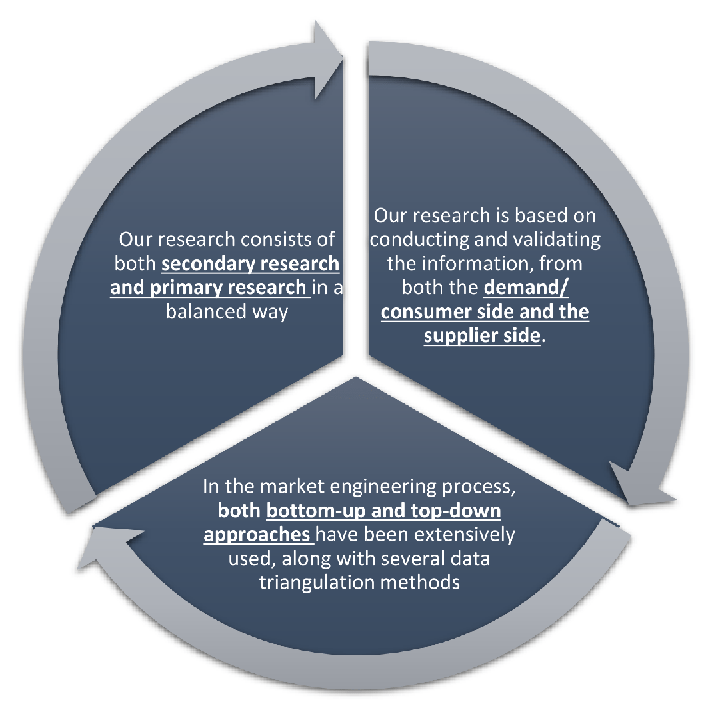
Our research design integrates both demand-side and supply-side analysis through a balanced combination of primary and secondary research methodologies. By utilizing both bottom-up and top-down approaches alongside rigorous data triangulation methods, we deliver robust market intelligence that supports strategic decision-making.
MarketGenics' comprehensive research design framework ensures the delivery of accurate, reliable, and actionable market intelligence. Through the integration of multiple research approaches, rigorous validation processes, and expert analysis, we provide our clients with the insights needed to make informed strategic decisions and capitalize on market opportunities.
MarketGenics leverages a dedicated industry panel of experts and a comprehensive suite of paid databases to effectively collect, consolidate, and analyze market intelligence.
Our approach has consistently proven to be reliable and effective in generating accurate market insights, identifying key industry trends, and uncovering emerging business opportunities.
Through both primary and secondary research, we capture and analyze critical company-level data such as manufacturing footprints, including technical centers, R&D facilities, sales offices, and headquarters.
Our expert panel further enhances our ability to estimate market size for specific brands based on validated field-level intelligence.
Our data mining techniques incorporate both parametric and non-parametric methods, allowing for structured data collection, sorting, processing, and cleaning.
Demand projections are derived from large-scale data sets analyzed through proprietary algorithms, culminating in robust and reliable market sizing.
Research Approach
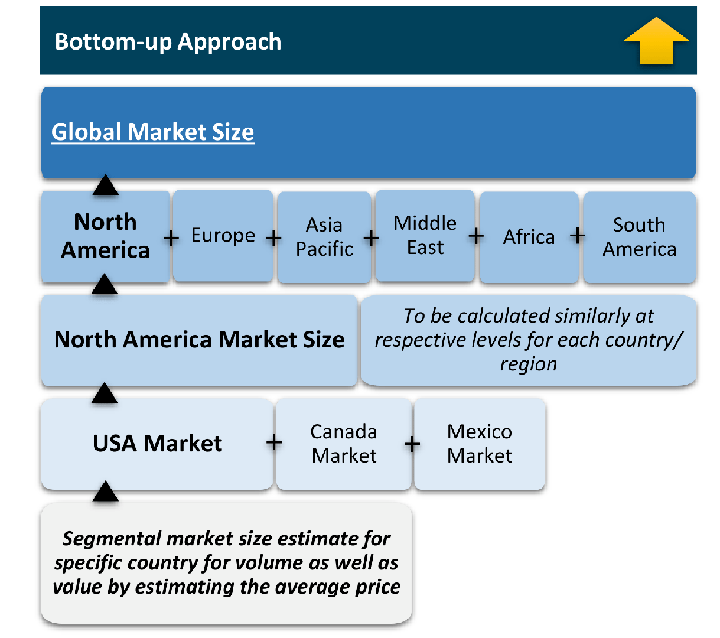
The bottom-up approach builds market estimates by starting with the smallest addressable market units and systematically aggregating them to create comprehensive market size projections.
This method begins with specific, granular data points and builds upward to create the complete market landscape.
Customer Analysis → Segmental Analysis → Geographical Analysis
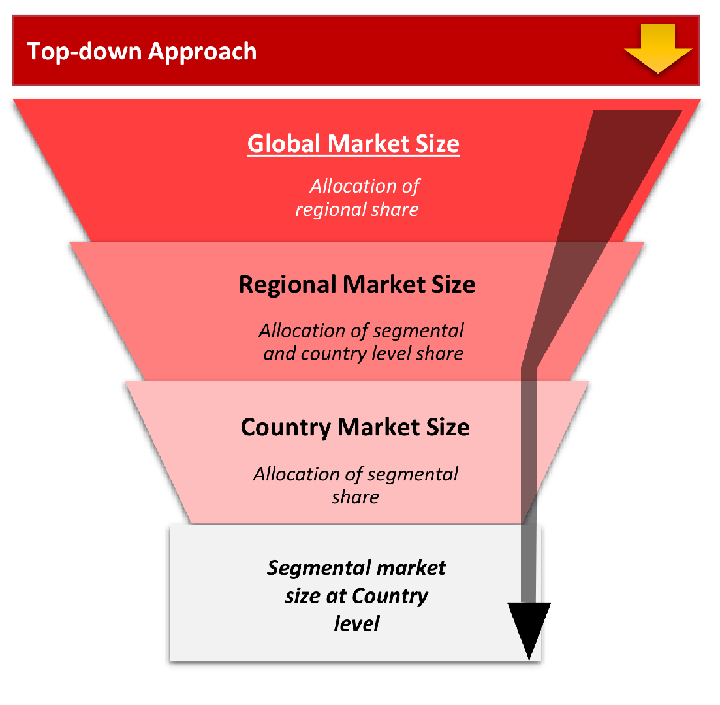
The top-down approach starts with the broadest possible market data and systematically narrows it down through a series of filters and assumptions to arrive at specific market segments or opportunities.
This method begins with the big picture and works downward to increasingly specific market slices.
TAM → SAM → SOM
Research Methods
Desk / Secondary Research
While analysing the market, we extensively study secondary sources, directories, and databases to identify and collect information useful for this technical, market-oriented, and commercial report. Secondary sources that we utilize are not only the public sources, but it is a combination of Open Source, Associations, Paid Databases, MG Repository & Knowledgebase, and others.
- Company websites, annual reports, financial reports, broker reports, and investor presentations
- National government documents, statistical databases and reports
- News articles, press releases and web-casts specific to the companies operating in the market, Magazines, reports, and others
- We gather information from commercial data sources for deriving company specific data such as segmental revenue, share for geography, product revenue, and others
- Internal and external proprietary databases (industry-specific), relevant patent, and regulatory databases
- Governing Bodies, Government Organizations
- Relevant Authorities, Country-specific Associations for Industries
We also employ the model mapping approach to estimate the product level market data through the players' product portfolio
Primary Research
Primary research/ interviews is vital in analyzing the market. Most of the cases involves paid primary interviews. Primary sources include primary interviews through e-mail interactions, telephonic interviews, surveys as well as face-to-face interviews with the different stakeholders across the value chain including several industry experts.
| Type of Respondents | Number of Primaries |
|---|---|
| Tier 2/3 Suppliers | ~20 |
| Tier 1 Suppliers | ~25 |
| End-users | ~25 |
| Industry Expert/ Panel/ Consultant | ~30 |
| Total | ~100 |
MG Knowledgebase
• Repository of industry blog, newsletter and case studies
• Online platform covering detailed market reports, and company profiles
Forecasting Factors and Models
Forecasting Factors
- Historical Trends – Past market patterns, cycles, and major events that shaped how markets behave over time. Understanding past trends helps predict future behavior.
- Industry Factors – Specific characteristics of the industry like structure, regulations, and innovation cycles that affect market dynamics.
- Macroeconomic Factors – Economic conditions like GDP growth, inflation, and employment rates that affect how much money people have to spend.
- Demographic Factors – Population characteristics like age, income, and location that determine who can buy your product.
- Technology Factors – How quickly people adopt new technology and how much technology infrastructure exists.
- Regulatory Factors – Government rules, laws, and policies that can help or restrict market growth.
- Competitive Factors – Analyzing competition structure such as degree of competition and bargaining power of buyers and suppliers.
Forecasting Models / Techniques
Multiple Regression Analysis
- Identify and quantify factors that drive market changes
- Statistical modeling to establish relationships between market drivers and outcomes
Time Series Analysis – Seasonal Patterns
- Understand regular cyclical patterns in market demand
- Advanced statistical techniques to separate trend, seasonal, and irregular components
Time Series Analysis – Trend Analysis
- Identify underlying market growth patterns and momentum
- Statistical analysis of historical data to project future trends
Expert Opinion – Expert Interviews
- Gather deep industry insights and contextual understanding
- In-depth interviews with key industry stakeholders
Multi-Scenario Development
- Prepare for uncertainty by modeling different possible futures
- Creating optimistic, pessimistic, and most likely scenarios
Time Series Analysis – Moving Averages
- Sophisticated forecasting for complex time series data
- Auto-regressive integrated moving average models with seasonal components
Econometric Models
- Apply economic theory to market forecasting
- Sophisticated economic models that account for market interactions
Expert Opinion – Delphi Method
- Harness collective wisdom of industry experts
- Structured, multi-round expert consultation process
Monte Carlo Simulation
- Quantify uncertainty and probability distributions
- Thousands of simulations with varying input parameters
Research Analysis
Our research framework is built upon the fundamental principle of validating market intelligence from both demand and supply perspectives. This dual-sided approach ensures comprehensive market understanding and reduces the risk of single-source bias.
Demand-Side Analysis: We understand end-user/application behavior, preferences, and market needs along with the penetration of the product for specific application.
Supply-Side Analysis: We estimate overall market revenue, analyze the segmental share along with industry capacity, competitive landscape, and market structure.
Validation & Evaluation
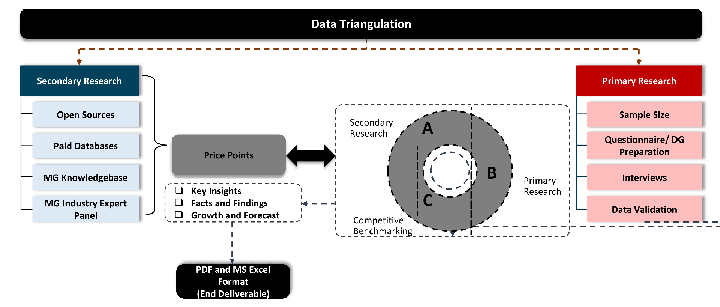
Data triangulation is a validation technique that uses multiple methods, sources, or perspectives to examine the same research question, thereby increasing the credibility and reliability of research findings. In market research, triangulation serves as a quality assurance mechanism that helps identify and minimize bias, validate assumptions, and ensure accuracy in market estimates.
- Data Source Triangulation – Using multiple data sources to examine the same phenomenon
- Methodological Triangulation – Using multiple research methods to study the same research question
- Investigator Triangulation – Using multiple researchers or analysts to examine the same data
- Theoretical Triangulation – Using multiple theoretical perspectives to interpret the same data
Custom Market Research Services
We will customise the research for you, in case the report listed above does not meet your requirements.
Get 10% Free Customisation