Gourmet Packaged Food Market Size, Share & Trends Analysis Report by Product Type (Snacks & Appetizers, Condiments, Sauces & Dressings, Confectionery & Chocolates, Bakery & Pastry Products, Meat, Seafood & Charcuterie, Beverages & Infusions, Ready-to-Eat & Meal Kits, Other Products), Consumer Age Group, Packaging Type, Sales Channel, End-users, and Geography (North America, Europe, Asia Pacific, Middle East, Africa, and South America) – Global Industry Data, Trends, and Forecasts, 2026–2035
|
|
|
Segmental Data Insights |
|
|
Demand Trends |
|
|
Competitive Landscape |
|
|
Strategic Development |
|
|
Future Outlook & Opportunities |
|
Gourmet-Packaged-Food-Market Size, Share, and Growth
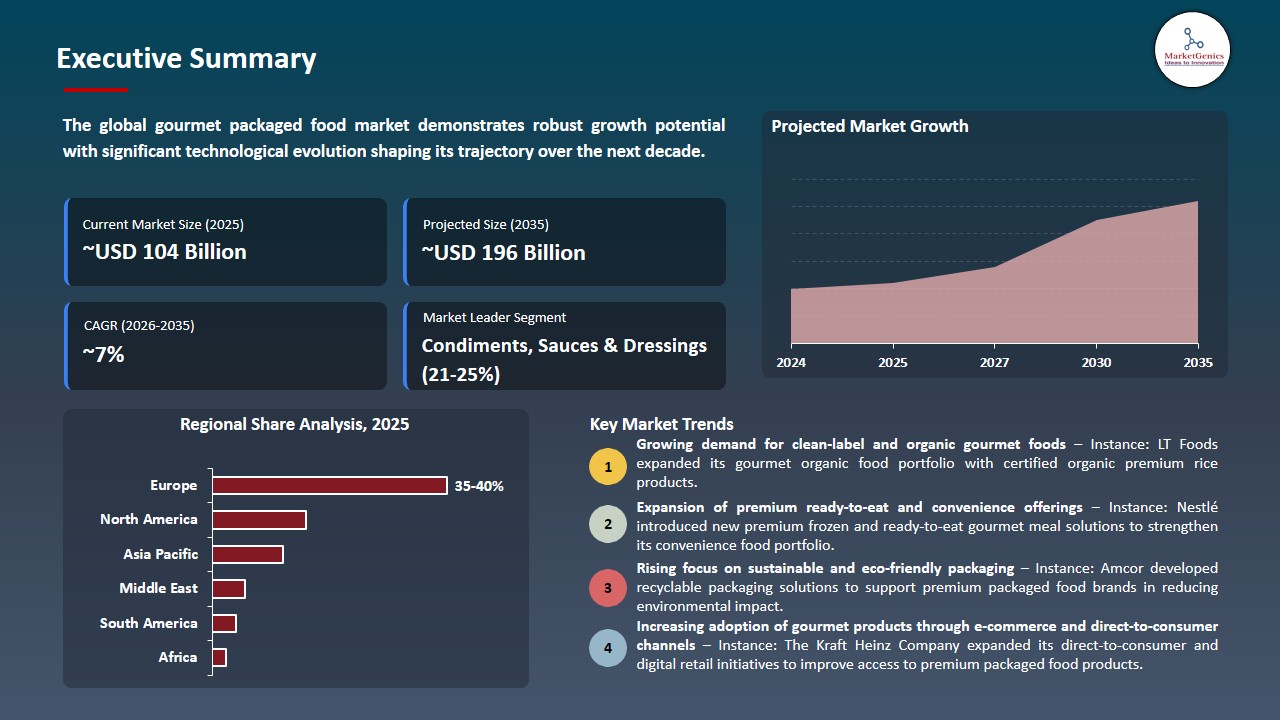
The global gourmet packaged food market is witnessing strong growth, valued at USD 103.7 billion in 2025 and projected to reach USD 196.5 billion by 2035, expanding at a CAGR of 6.6% during the forecast period. Featuring authentic ingredients, culinary expertise, clean-label formulations and innovative food processing technologies, gourmet packaged food products enable consumers to taste some of the world's best dishes and special flavours in convenient meal and snack solutions.
Saurabh Makhija, Director – Nestlé Professional, Nestlé India, commented, "KITKAT remains one of India's most beloved brands. The launch of KITKAT Professional Spread introduces a new way for chefs to incorporate its signature taste and texture into their creations. This innovation reflects our commitment to fostering culinary creativity and enhancing consumer experiences while providing a versatile solution for the HoReCa and institutional segments.
Premium food experiences with better food quality and convenient packaging are driving the continuous growth of the gourmet packaged food market. For instance, in June 2025, Tyson Foods launched Hillshire Snacking Dips & Spreads, a premium range of chef-curated snack kits featuring gourmet flavor combinations and high-quality ingredients, reflecting the growing consumer demand for convenient, restaurant-inspired, and premium packaged food experiences. There is increased demand for artisanal products, international cuisine and high-quality ‘ready to eat' foods, which continue to drive market growth.
Culinary innovation, premium ingredient sourcing and differentiated retail strategies are the areas of focus for market competition. Manufacturers and retailers are growing more product portfolios with high quality and enhancing distribution channels through the omnichannel approach, to make them more accessible. For instance, in August 2025, Flipkart Minutes launched a dedicated 'Gourmet' category featuring over 650 premium products from more than 130 global and domestic brands, enhancing digital access to gourmet packaged foods and supporting the growing demand for premium culinary experiences.
Adjacent opportunities are being created by the fast-developing premium digital food ecosystem and experiential food consumption model. As direct-to-consumer channels grow, gourmet subscription services become more popular, curated meal collections are gaining traction, premium gifting solutions are on the rise and quick-commerce channels are rising at a rapid pace, brands are able to tap into new consumer segments and drive faster global demand for premium packaged food market.
Gourmet Packaged Food market Dynamics and Trends
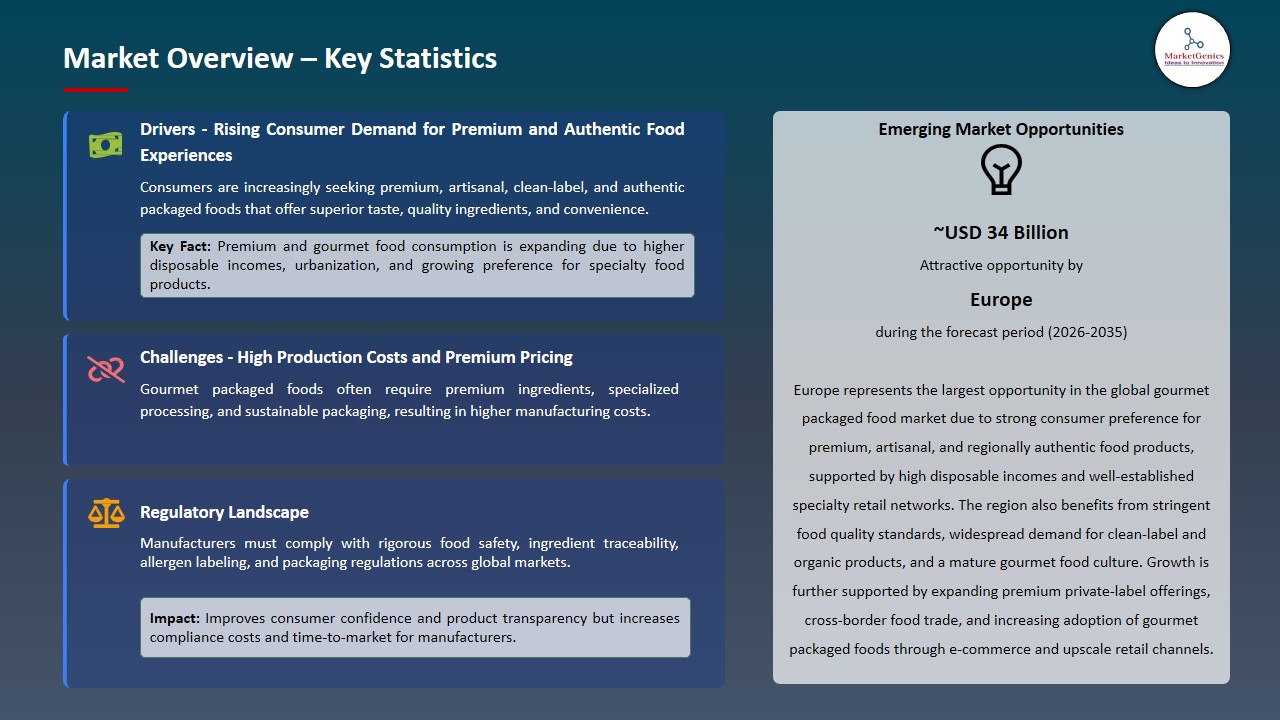
Driver: Rising Consumer Demand for Premium, Authentic, and Convenience-Oriented Food Experiences
- Consumers are increasingly looking for high-quality ingredients and restaurant like experience and are increasingly looking for packaged foods and the global gourmet packaged foods market is growing.
- Manufacturers are adding new high-ticket items to their portfolios that offer flavours inspired by around the world and quick-to-prepare meal ideas. For instance, in April 2026, Nestlé USA launched Minor's Kitchen, its first consumer premium condiment brand featuring chef-crafted sauces made with high-quality ingredients, meeting rising demand for authentic global flavors and restaurant-quality gourmet food experiences at home.
- Overall demand for high-quality convenience foods, authentic global dishes, and chef-driven gourmet packaged foods is growing.
Restraint: Premium Pricing and High Production Costs
- The price of high-quality ingredients, artisanal manufacturing processes and sustainable packaging are driving up the price of gourmet packaged foods especially in markets where price matters more.
- The use of high quality raw materials, the development of new equipment, quality control, and traceability systems are all expensive additions to production costs and selling prices for manufacturers in order to ensure consistent product quality.
- Premium pricing, expensive production and fluctuating raw-materials costs from around the world in production chains are still a problem in the market.
Opportunity: Expansion of Clean-Label, Plant-Based, and Functional Gourmet Foods
- Rapidly increasing demand for clean-label, plant-based, and functional foods is generating immense opportunities for the plant-based gourmet packaged food market as consumers are looking for premium packaged food products with natural ingredients and added nutritional value.
- Innovation is gaining pace in plant-based advanced ingredients and clean label solutions, with manufacturers producing more. For instance, in April 2026, dsm-firmenich introduced next generation Vertis Textured Vegetable Proteins (TVPs) containing built-in ModulaSENSE taste modulation technology, which allowed to create premium plant-based and hybrid gourmet packaged foods with a better taste, texture and clean label formulations.
- The market is set for future growth with ongoing innovation of functional ingredients, plant proteins and high-quality clean label gourmet food solutions.
Key Trend: Premiumization through Flavors, Sustainable Packaging, and Digital Retail
- Growth in the global gourmet packaged food market is fueled by a demand for artisanal ingredients and clean-label products, as well as more sustainable packaging and digital food retail.
- Gourmet food products are growing their premium portfolios with innovative products and with an Omnical approach. In August 2025, No!ce rolled out more than 200 high-quality small-batch packaged food and beverage products in 13 categories via the quick-commerce platforms in collaboration with over 40 local food producers, which enhanced and expanded the accessibility of premium gourmet products in the digital realm and deepened the premiumisation trend among packaged foods.
- Continued product innovation at premium levels, sustainable packaging and growing specialty gourmet and e-commerce retail channels drive the market forward.
Gourmet Packaged Food Market Analysis and Segmental Data
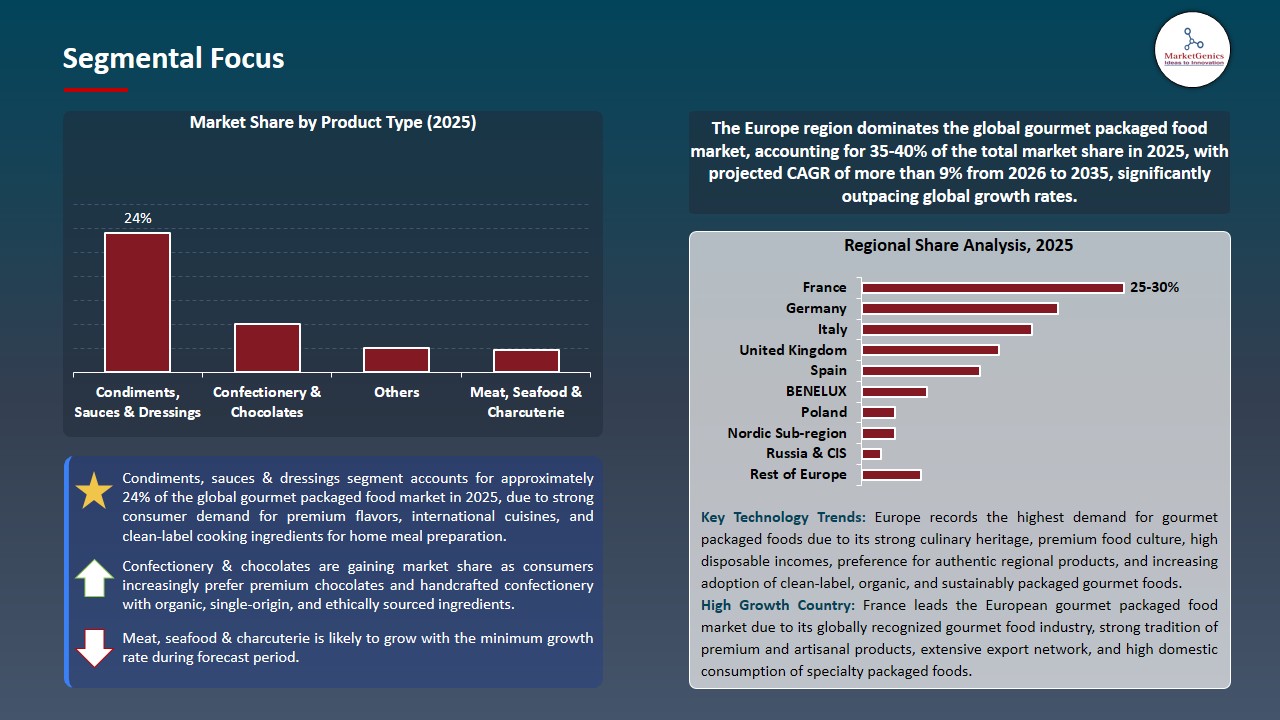
Condiments, Sauces & Dressings Dominate Global Gourmet Packaged Food Market
- Condiments, sauces & dressings dominate the gourmet packaged food market as consumers increasingly demand high quality flavor for premium food, authentic international cuisine and versatile meal accompaniments to enhance their everyday eating experience at home.
- Manufacturers are building their premium condiment lines with clean label recipes, globally inspired flavors, high-quality ingredients, and sustainable packaging to meet increasing consumer demand for convenience, authenticity and culinary differentiation.
- The segment continues to strengthen its market leadership through growing demand for gourmet cooking ingredients, premium meal customization, and value-added condiments across retail, foodservice, and specialty food channels.
Europe Leads Global Gourmet Packaged Food Market Demand
- Europe leads the gourmet packaged food market because of its robust premium food culture, high consumer demand for genuine regional specialties, well-developed gourmet retail movement and its increasing preference towards clean-label, artisanal and sustainably sourced packaged foods.
- Investing in clean label innovation, premium ingredient sourcing, sustainable packaging and value added convenience products, premium food manufacturers continue to invest in bolstering their product differentiation and meeting the changing expectations of consumers for quality and authenticity.
- Europe remains to be the world leader in gourmet packaged food market with the growing specialty food retail, high quality private label foods and the rising demand for authentic, chef-inspired and regionally unique packaged foods.
Gourmet Packaged Food Market Ecosystem
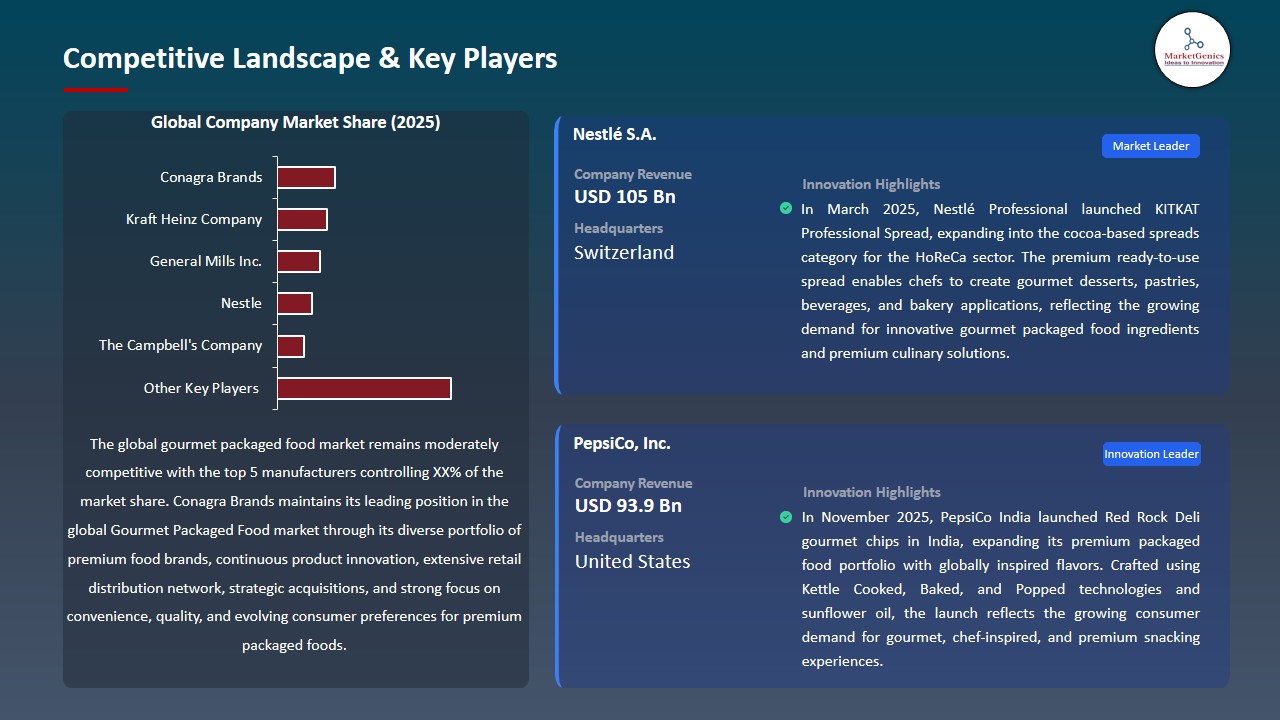
The global gourmet packaged food market is moderately consolidated and is going through evolution as the demand for premium food product, authentic food product and clean label food is increasing with time. Genuine partnerships between the various industry segments ingredient suppliers, food manufacturers, specialty retailers, e-commerce and foodservice operators are increasingly defining the ecosystem and enabling regular product innovation, greater distribution and premium brand positioning for products in the global marketplace.
Companies such as Conagra Brands, The Kraft Heinz Company, General Mills, Inc., Nestlé S.A., and The Campbell's Company represent the competitive core of the ecosystem, leveraging diversified gourmet portfolios, continuous product innovation, advanced food processing capabilities, and extensive global distribution networks. To address consumer desires, these companies are adding new value to their products with high-quality ingredients, clean labels, global flavors, eco-friendly packaging, and omnichannel sales.
Ecosystem convergence is emerging as a key growth driver as the market matures, with increased convergence between raw material suppliers, manufacturers, retailers, and digital commerce platforms. Responsible sourcing, premium product development, smart supply chains and data-driven consumer understanding are building a more resilient, transparent and value-driven Gourmet Packaged Food global value chain.
 Recent Development and Strategic Overview
- In March 2025, Nestlé Professional introduced KITKAT Professional Spread, the company's first cocoa-based spread in the HoReCa market. The spread is ready-to-use and ideal for chefs making gourmet desserts, bakery applications, beverages and pastries, in line with the rise in the demand for innovative gourmet packaged food ingredients and premium culinary solutions.
- In November 2025, PepsiCo India introduced Red Rock Deli gourmet chips as a new addition to its premium packaged food lineup, offering globally inspired flavors. Made with Kettle Cooked, Baked and Popped technologies and sunflower oil, the launch represents the increasing consumer appetite for gourmet, chef inspired and premium snacking experiences.
Report Scope
|
Detail |
|
|
Market Size in 2025 |
USD 103.7 Bn |
|
Market Forecast Value in 2035 |
USD 196.5 Bn |
|
Growth Rate (CAGR) |
6.6% |
|
Forecast Period |
2026 – 2035 |
|
Historical Data Available for |
2021 – 2024 |
|
Market Size Units |
US$ Billion for Value |
|
Report Format |
Electronic (PDF) + Excel |
|
North America |
Europe |
Asia Pacific |
Middle East |
Africa |
South America |
|
|
|
|
|
|
|
Companies Covered |
|||||
|
|
|
|
|
||
Gourmet Packaged Food Market Segmentation and Highlights
|
Segment |
Sub-segment |
|
Gourmet Packaged Food Market, By Product Type |
|
|
Gourmet Packaged Food Market, By Consumer Age Group |
|
|
Gourmet Packaged Food Market, By Packaging Type |
|
|
Gourmet Packaged Food Market, By Sales Channel |
|
|
Gourmet Packaged Food Market, By End-users |
|
Frequently Asked Questions
Table of Contents
- 1. Research Methodology and Assumptions
- 1.1. Definitions
- 1.2. Research Design and Approach
- 1.3. Data Collection Methods
- 1.4. Base Estimates and Calculations
- 1.5. Forecasting Models
- 1.5.1. Key Forecast Factors & Impact Analysis
- 1.6. Secondary Research
- 1.6.1. Open Sources
- 1.6.2. Paid Databases
- 1.6.3. Associations
- 1.7. Primary Research
- 1.7.1. Primary Sources
- 1.7.2. Primary Interviews with Stakeholders across Ecosystem
- 2. Executive Summary
- 2.1. Global Gourmet Packaged Food Market Outlook
- 2.1.1. Gourmet Packaged Food Market Size (Value - US$ Bn), and Forecasts, 2021-2035
- 2.1.2. Compounded Annual Growth Rate Analysis
- 2.1.3. Growth Opportunity Analysis
- 2.1.4. Segmental Share Analysis
- 2.1.5. Geographical Share Analysis
- 2.2. Market Analysis and Facts
- 2.3. Supply-Demand Analysis
- 2.4. Competitive Benchmarking
- 2.5. Go-to- Market Strategy
- 2.5.1. Customer/ End-use Industry Assessment
- 2.5.2. Growth Opportunity Data, 2026-2035
- 2.5.2.1. Regional Data
- 2.5.2.2. Country Data
- 2.5.2.3. Segmental Data
- 2.5.3. Identification of Potential Market Spaces
- 2.5.4. GAP Analysis
- 2.5.5. Potential Attractive Price Points
- 2.5.6. Prevailing Market Risks & Challenges
- 2.5.7. Preferred Sales & Marketing Strategies
- 2.5.8. Key Recommendations and Analysis
- 2.5.9. A Way Forward
- 2.1. Global Gourmet Packaged Food Market Outlook
- 3. Industry Data and Premium Insights
- 3.1. Global Food & Beverages Industry Overview, 2025
- 3.1.1. Food & Beverages Industry Ecosystem Analysis
- 3.1.2. Key Trends for Food & Beverages Industry
- 3.1.3. Regional Distribution for Food & Beverages Industry
- 3.2. Supplier Customer Data
- 3.3. Technology Roadmap and Developments
- 3.4. Trade Analysis
- 3.4.1. Import & Export Analysis, 2025
- 3.4.2. Top Importing Countries
- 3.4.3. Top Exporting Countries
- 3.1. Global Food & Beverages Industry Overview, 2025
- 4. Market Overview
- 4.1. Market Dynamics
- 4.1.1. Drivers
- 4.1.1.1. Rising consumer demand for premium, authentic, and high-quality convenient food products
- 4.1.1.2. Growing urbanization and busy lifestyles driving preference for ready-to-eat gourmet meals
- 4.1.1.3. Expansion of e-commerce and modern retail channels improving accessibility of gourmet packaged foods
- 4.1.2. Restraints
- 4.1.2.1. High product pricing limiting adoption among price-sensitive consumers
- 4.1.2.2. Shorter shelf life and complex storage requirements compared to conventional packaged foods
- 4.1.1. Drivers
- 4.2. Key Trend Analysis
- 4.3. Regulatory Framework
- 4.3.1. Key Regulations, Norms, and Subsidies, by Key Countries
- 4.3.2. Tariffs and Standards
- 4.3.3. Impact Analysis of Regulations on the Market
- 4.4. Value Chain Analysis
- 4.4.1. Raw Material & Premium Ingredient Suppliers
- 4.4.2. Food Processing & Manufacturing
- 4.4.3. Gourmet Food Manufacturers & Brand Owners
- 4.4.4. Distributors and Channel Partners
- 4.4.5. End Users/ Customers
- 4.5. Porter’s Five Forces Analysis
- 4.6. PESTEL Analysis
- 4.7. Global Gourmet Packaged Food Market Demand
- 4.7.1. Historical Market Size – Value (US$ Bn), 2020-2024
- 4.7.2. Current and Future Market Size – Value (US$ Bn), 2026–2035
- 4.7.2.1. Y-o-Y Growth Trends
- 4.7.2.2. Absolute $ Opportunity Assessment
- 4.1. Market Dynamics
- 5. Competition Landscape
- 5.1. Competition structure
- 5.1.1. Fragmented v/s consolidated
- 5.2. Company Share Analysis, 2025
- 5.2.1. Global Company Market Share
- 5.2.2. By Region
- 5.2.2.1. North America
- 5.2.2.2. Europe
- 5.2.2.3. Asia Pacific
- 5.2.2.4. Middle East
- 5.2.2.5. Africa
- 5.2.2.6. South America
- 5.3. Product Comparison Matrix
- 5.3.1. Specifications
- 5.3.2. Market Positioning
- 5.3.3. Pricing
- 5.1. Competition structure
- 6. Global Gourmet Packaged Food Market Analysis, by Product Type
- 6.1. Key Segment Analysis
- 6.2. Gourmet Packaged Food Market Size (Value - US$ Bn), Analysis, and Forecasts, by Product Type, 2021-2035
- 6.2.1. Snacks & Appetizers
- 6.2.2. Condiments, Sauces & Dressings
- 6.2.3. Confectionery & Chocolates
- 6.2.4. Bakery & Pastry Products
- 6.2.5. Meat, Seafood & Charcuterie
- 6.2.6. Beverages & Infusions
- 6.2.7. Ready-to-Eat & Meal Kits
- 6.2.8. Other Products
- 7. Global Gourmet Packaged Food Market Analysis, by Consumer Age Group
- 7.1. Key Segment Analysis
- 7.2. Gourmet Packaged Food Market Size (Value - US$ Bn), Analysis, and Forecasts, by Consumer Age Group, 2021-2035
- 7.2.1. Millennials (25–40 years)
- 7.2.2. Generation X (41–56 years)
- 7.2.3. Baby Boomers (57–75 years)
- 7.2.4. Generation Z (18–24 years)
- 8. Global Gourmet Packaged Food Market Analysis, by Packaging Type
- 8.1. Key Segment Analysis
- 8.2. Gourmet Packaged Food Market Size (Value - US$ Bn), Analysis, and Forecasts, by Packaging Type, 2021-2035
- 8.2.1. Glass Jars & Bottles
- 8.2.2. Premium Metal Tins & Canisters
- 8.2.3. Stand-Up Pouches
- 8.2.4. Vacuum-Sealed Bags
- 8.2.5. Wooden Crates & Boxes
- 8.2.6. Smart QR-Code Enabled
- 8.2.7. Others
- 9. Global Gourmet Packaged Food Market Analysis, by Sales Channel
- 9.1. Key Segment Analysis
- 9.2. Gourmet Packaged Food Market Size (Value - US$ Bn), Analysis, and Forecasts, by Sales Channel, 2021-2035
- 9.2.1. Offline Channels
- 9.2.1.1. Specialty Stores
- 9.2.1.2. Hypermarkets & Supermarkets
- 9.2.1.3. Department Store
- 9.2.1.4. HoReCa Distributors
- 9.2.1.5. Others
- 9.2.2. Online Channels
- 9.2.2.1. Brand DTC Websites
- 9.2.2.2. E-Commerce Marketplaces
- 9.2.2.3. Quick Commerce
- 9.2.2.4. Subscription Box Services
- 9.2.2.5. Others
- 9.2.1. Offline Channels
- 10. Global Gourmet Packaged Food Market Analysis, by End-users
- 10.1. Key Segment Analysis
- 10.2. Gourmet Packaged Food Market Size (Value - US$ Bn), Analysis, and Forecasts, by End-users, 2021-2035
- 10.2.1. Food Service Industry
- 10.2.1.1. Fine Dining & Michelin-Star Restaurants
- 10.2.1.2. Hotels & Luxury Resorts
- 10.2.1.3. Quick Service & Fast Casual Restaurants
- 10.2.1.4. Airlines & Cruise Lines
- 10.2.1.5. Others
- 10.2.2. Retail Industry
- 10.2.3. Hospitality & Travel
- 10.2.3.1. Luxury Hotels & Spas
- 10.2.3.2. Travel Retail (Duty-Free)
- 10.2.4. Corporate & Institutional Sector
- 10.2.5. Healthcare & Wellness
- 10.2.6. Education Sector
- 10.2.7. Household End-Use
- 10.2.1. Food Service Industry
- 11. Global Gourmet Packaged Food Market Analysis and Forecasts, by Region
- 11.1. Key Findings
- 11.2. Gourmet Packaged Food Market Size (Value - US$ Bn), Analysis, and Forecasts, by Region, 2021-2035
- 11.2.1. North America
- 11.2.2. Europe
- 11.2.3. Asia Pacific
- 11.2.4. Middle East
- 11.2.5. Africa
- 11.2.6. South America
- 12. North America Gourmet Packaged Food Market Analysis
- 12.1. Key Segment Analysis
- 12.2. Regional Snapshot
- 12.3. North America Gourmet Packaged Food Market Size (Value - US$ Bn), Analysis, and Forecasts, 2021-2035
- 12.3.1. Product Type
- 12.3.2. Consumer Age Group
- 12.3.3. Packaging Type
- 12.3.4. Sales Channel
- 12.3.5. End-users
- 12.3.6. Country
- 12.3.6.1. USA
- 12.3.6.2. Canada
- 12.3.6.3. Mexico
- 12.4. USA Gourmet Packaged Food Market
- 12.4.1. Country Segmental Analysis
- 12.4.2. Product Type
- 12.4.3. Consumer Age Group
- 12.4.4. Packaging Type
- 12.4.5. Sales Channel
- 12.4.6. End-users
- 12.5. Canada Gourmet Packaged Food Market
- 12.5.1. Country Segmental Analysis
- 12.5.2. Product Type
- 12.5.3. Consumer Age Group
- 12.5.4. Packaging Type
- 12.5.5. Sales Channel
- 12.5.6. End-users
- 12.6. Mexico Gourmet Packaged Food Market
- 12.6.1. Country Segmental Analysis
- 12.6.2. Product Type
- 12.6.3. Consumer Age Group
- 12.6.4. Packaging Type
- 12.6.5. Sales Channel
- 12.6.6. End-users
- 13. Europe Gourmet Packaged Food Market Analysis
- 13.1. Key Segment Analysis
- 13.2. Regional Snapshot
- 13.3. Europe Gourmet Packaged Food Market Size (Value - US$ Bn), Analysis, and Forecasts, 2021-2035
- 13.3.1. Product Type
- 13.3.2. Consumer Age Group
- 13.3.3. Packaging Type
- 13.3.4. Sales Channel
- 13.3.5. End-users
- 13.3.6. Country
- 13.3.6.1. Germany
- 13.3.6.2. United Kingdom
- 13.3.6.3. France
- 13.3.6.4. Italy
- 13.3.6.5. Spain
- 13.3.6.6. Netherlands
- 13.3.6.7. Nordic Countries
- 13.3.6.8. Poland
- 13.3.6.9. Russia & CIS
- 13.3.6.10. Rest of Europe
- 13.4. Germany Gourmet Packaged Food Market
- 13.4.1. Country Segmental Analysis
- 13.4.2. Product Type
- 13.4.3. Consumer Age Group
- 13.4.4. Packaging Type
- 13.4.5. Sales Channel
- 13.4.6. End-users
- 13.5. United Kingdom Gourmet Packaged Food Market
- 13.5.1. Country Segmental Analysis
- 13.5.2. Product Type
- 13.5.3. Consumer Age Group
- 13.5.4. Packaging Type
- 13.5.5. Sales Channel
- 13.5.6. End-users
- 13.6. France Gourmet Packaged Food Market
- 13.6.1. Country Segmental Analysis
- 13.6.2. Product Type
- 13.6.3. Consumer Age Group
- 13.6.4. Packaging Type
- 13.6.5. Sales Channel
- 13.6.6. End-users
- 13.7. Italy Gourmet Packaged Food Market
- 13.7.1. Country Segmental Analysis
- 13.7.2. Product Type
- 13.7.3. Consumer Age Group
- 13.7.4. Packaging Type
- 13.7.5. Sales Channel
- 13.7.6. End-users
- 13.8. Spain Gourmet Packaged Food Market
- 13.8.1. Country Segmental Analysis
- 13.8.2. Product Type
- 13.8.3. Consumer Age Group
- 13.8.4. Packaging Type
- 13.8.5. Sales Channel
- 13.8.6. End-users
- 13.9. Netherlands Gourmet Packaged Food Market
- 13.9.1. Country Segmental Analysis
- 13.9.2. Product Type
- 13.9.3. Consumer Age Group
- 13.9.4. Packaging Type
- 13.9.5. Sales Channel
- 13.9.6. End-users
- 13.10. Nordic Countries Gourmet Packaged Food Market
- 13.10.1. Country Segmental Analysis
- 13.10.2. Product Type
- 13.10.3. Consumer Age Group
- 13.10.4. Packaging Type
- 13.10.5. Sales Channel
- 13.10.6. End-users
- 13.11. Poland Gourmet Packaged Food Market
- 13.11.1. Country Segmental Analysis
- 13.11.2. Product Type
- 13.11.3. Consumer Age Group
- 13.11.4. Packaging Type
- 13.11.5. Sales Channel
- 13.11.6. End-users
- 13.12. Russia & CIS Gourmet Packaged Food Market
- 13.12.1. Country Segmental Analysis
- 13.12.2. Product Type
- 13.12.3. Consumer Age Group
- 13.12.4. Packaging Type
- 13.12.5. Sales Channel
- 13.12.6. End-users
- 13.13. Rest of Europe Gourmet Packaged Food Market
- 13.13.1. Country Segmental Analysis
- 13.13.2. Product Type
- 13.13.3. Consumer Age Group
- 13.13.4. Packaging Type
- 13.13.5. Sales Channel
- 13.13.6. End-users
- 14. Asia Pacific Gourmet Packaged Food Market Analysis
- 14.1. Key Segment Analysis
- 14.2. Regional Snapshot
- 14.3. Asia Pacific Gourmet Packaged Food Market Size (Value - US$ Bn), Analysis, and Forecasts, 2021-2035
- 14.3.1. Product Type
- 14.3.2. Consumer Age Group
- 14.3.3. Packaging Type
- 14.3.4. Sales Channel
- 14.3.5. End-users
- 14.3.6. Country
- 14.3.6.1. China
- 14.3.6.2. India
- 14.3.6.3. Japan
- 14.3.6.4. South Korea
- 14.3.6.5. Australia and New Zealand
- 14.3.6.6. Indonesia
- 14.3.6.7. Malaysia
- 14.3.6.8. Thailand
- 14.3.6.9. Vietnam
- 14.3.6.10. Rest of Asia Pacific
- 14.4. China Gourmet Packaged Food Market
- 14.4.1. Country Segmental Analysis
- 14.4.2. Product Type
- 14.4.3. Consumer Age Group
- 14.4.4. Packaging Type
- 14.4.5. Sales Channel
- 14.4.6. End-users
- 14.5. India Gourmet Packaged Food Market
- 14.5.1. Country Segmental Analysis
- 14.5.2. Product Type
- 14.5.3. Consumer Age Group
- 14.5.4. Packaging Type
- 14.5.5. Sales Channel
- 14.5.6. End-users
- 14.6. Japan Gourmet Packaged Food Market
- 14.6.1. Country Segmental Analysis
- 14.6.2. Product Type
- 14.6.3. Consumer Age Group
- 14.6.4. Packaging Type
- 14.6.5. Sales Channel
- 14.6.6. End-users
- 14.7. South Korea Gourmet Packaged Food Market
- 14.7.1. Country Segmental Analysis
- 14.7.2. Product Type
- 14.7.3. Consumer Age Group
- 14.7.4. Packaging Type
- 14.7.5. Sales Channel
- 14.7.6. End-users
- 14.8. Australia and New Zealand Gourmet Packaged Food Market
- 14.8.1. Country Segmental Analysis
- 14.8.2. Product Type
- 14.8.3. Consumer Age Group
- 14.8.4. Packaging Type
- 14.8.5. Sales Channel
- 14.8.6. End-users
- 14.9. Indonesia Gourmet Packaged Food Market
- 14.9.1. Country Segmental Analysis
- 14.9.2. Product Type
- 14.9.3. Consumer Age Group
- 14.9.4. Packaging Type
- 14.9.5. Sales Channel
- 14.9.6. End-users
- 14.10. Malaysia Gourmet Packaged Food Market
- 14.10.1. Country Segmental Analysis
- 14.10.2. Product Type
- 14.10.3. Consumer Age Group
- 14.10.4. Packaging Type
- 14.10.5. Sales Channel
- 14.10.6. End-users
- 14.11. Thailand Gourmet Packaged Food Market
- 14.11.1. Country Segmental Analysis
- 14.11.2. Product Type
- 14.11.3. Consumer Age Group
- 14.11.4. Packaging Type
- 14.11.5. Sales Channel
- 14.11.6. End-users
- 14.12. Vietnam Gourmet Packaged Food Market
- 14.12.1. Country Segmental Analysis
- 14.12.2. Product Type
- 14.12.3. Consumer Age Group
- 14.12.4. Packaging Type
- 14.12.5. Sales Channel
- 14.12.6. End-users
- 14.13. Rest of Asia Pacific Gourmet Packaged Food Market
- 14.13.1. Country Segmental Analysis
- 14.13.2. Product Type
- 14.13.3. Consumer Age Group
- 14.13.4. Packaging Type
- 14.13.5. Sales Channel
- 14.13.6. End-users
- 15. Middle East Gourmet Packaged Food Market Analysis
- 15.1. Key Segment Analysis
- 15.2. Regional Snapshot
- 15.3. Middle East Gourmet Packaged Food Market Size (Value - US$ Bn), Analysis, and Forecasts, 2021-2035
- 15.3.1. Product Type
- 15.3.2. Consumer Age Group
- 15.3.3. Packaging Type
- 15.3.4. Sales Channel
- 15.3.5. End-users
- 15.3.6. Country
- 15.3.6.1. Turkey
- 15.3.6.2. UAE
- 15.3.6.3. Saudi Arabia
- 15.3.6.4. Israel
- 15.3.6.5. Rest of Middle East
- 15.4. Turkey Gourmet Packaged Food Market
- 15.4.1. Country Segmental Analysis
- 15.4.2. Product Type
- 15.4.3. Consumer Age Group
- 15.4.4. Packaging Type
- 15.4.5. Sales Channel
- 15.4.6. End-users
- 15.5. UAE Gourmet Packaged Food Market
- 15.5.1. Country Segmental Analysis
- 15.5.2. Product Type
- 15.5.3. Consumer Age Group
- 15.5.4. Packaging Type
- 15.5.5. Sales Channel
- 15.5.6. End-users
- 15.6. Saudi Arabia Gourmet Packaged Food Market
- 15.6.1. Country Segmental Analysis
- 15.6.2. Product Type
- 15.6.3. Consumer Age Group
- 15.6.4. Packaging Type
- 15.6.5. Sales Channel
- 15.6.6. End-users
- 15.7. Israel Gourmet Packaged Food Market
- 15.7.1. Country Segmental Analysis
- 15.7.2. Product Type
- 15.7.3. Consumer Age Group
- 15.7.4. Packaging Type
- 15.7.5. Sales Channel
- 15.7.6. End-users
- 15.8. Rest of Middle East Gourmet Packaged Food Market
- 15.8.1. Country Segmental Analysis
- 15.8.2. Product Type
- 15.8.3. Consumer Age Group
- 15.8.4. Packaging Type
- 15.8.5. Sales Channel
- 15.8.6. End-users
- 16. Africa Gourmet Packaged Food Market Analysis
- 16.1. Key Segment Analysis
- 16.2. Regional Snapshot
- 16.3. Africa Gourmet Packaged Food Market Size (Value - US$ Bn), Analysis, and Forecasts, 2021-2035
- 16.3.1. Product Type
- 16.3.2. Consumer Age Group
- 16.3.3. Packaging Type
- 16.3.4. Sales Channel
- 16.3.5. End-users
- 16.3.6. Country
- 16.3.6.1. South Africa
- 16.3.6.2. Egypt
- 16.3.6.3. Nigeria
- 16.3.6.4. Algeria
- 16.3.6.5. Rest of Africa
- 16.4. South Africa Gourmet Packaged Food Market
- 16.4.1. Country Segmental Analysis
- 16.4.2. Product Type
- 16.4.3. Consumer Age Group
- 16.4.4. Packaging Type
- 16.4.5. Sales Channel
- 16.4.6. End-users
- 16.5. Egypt Gourmet Packaged Food Market
- 16.5.1. Country Segmental Analysis
- 16.5.2. Product Type
- 16.5.3. Consumer Age Group
- 16.5.4. Packaging Type
- 16.5.5. Sales Channel
- 16.5.6. End-users
- 16.6. Nigeria Gourmet Packaged Food Market
- 16.6.1. Country Segmental Analysis
- 16.6.2. Product Type
- 16.6.3. Consumer Age Group
- 16.6.4. Packaging Type
- 16.6.5. Sales Channel
- 16.6.6. End-users
- 16.7. Algeria Gourmet Packaged Food Market
- 16.7.1. Country Segmental Analysis
- 16.7.2. Product Type
- 16.7.3. Consumer Age Group
- 16.7.4. Packaging Type
- 16.7.5. Sales Channel
- 16.7.6. End-users
- 16.8. Rest of Africa Gourmet Packaged Food Market
- 16.8.1. Country Segmental Analysis
- 16.8.2. Product Type
- 16.8.3. Consumer Age Group
- 16.8.4. Packaging Type
- 16.8.5. Sales Channel
- 16.8.6. End-users
- 17. South America Gourmet Packaged Food Market Analysis
- 17.1. Key Segment Analysis
- 17.2. Regional Snapshot
- 17.3. South America Gourmet Packaged Food Market Size (Value - US$ Bn), Analysis, and Forecasts, 2021-2035
- 17.3.1. Product Type
- 17.3.2. Consumer Age Group
- 17.3.3. Packaging Type
- 17.3.4. Sales Channel
- 17.3.5. End-users
- 17.3.6. Country
- 17.3.6.1. Brazil
- 17.3.6.2. Argentina
- 17.3.6.3. Rest of South America
- 17.4. Brazil Gourmet Packaged Food Market
- 17.4.1. Country Segmental Analysis
- 17.4.2. Product Type
- 17.4.3. Consumer Age Group
- 17.4.4. Packaging Type
- 17.4.5. Sales Channel
- 17.4.6. End-users
- 17.5. Argentina Gourmet Packaged Food Market
- 17.5.1. Country Segmental Analysis
- 17.5.2. Product Type
- 17.5.3. Consumer Age Group
- 17.5.4. Packaging Type
- 17.5.5. Sales Channel
- 17.5.6. End-users
- 17.6. Rest of South America Gourmet Packaged Food Market
- 17.6.1. Country Segmental Analysis
- 17.6.2. Product Type
- 17.6.3. Consumer Age Group
- 17.6.4. Packaging Type
- 17.6.5. Sales Channel
- 17.6.6. End-users
- 18. Key Players/ Company Profile
- 18.1. Conagra Brands.
- 18.1.1. Company Details/ Overview
- 18.1.2. Company Financials
- 18.1.3. Key Customers and Competitors
- 18.1.4. Business/ Industry Portfolio
- 18.1.5. Product Portfolio/ Specification Details
- 18.1.6. Pricing Data
- 18.1.7. Strategic Overview
- 18.1.8. Recent Developments
- 18.2. Ferrero Group
- 18.3. Fortnum & Mason
- 18.4. General Mills Inc.
- 18.5. Godiva Chocolatier
- 18.6. Harry and David, LLC
- 18.7. Kraft Heinz Company
- 18.8. Nestle
- 18.9. Stonewall Kitchen
- 18.10. The Campbell's Company
- 18.11. Zingerman's
- 18.12. Other Key Players
- 18.1. Conagra Brands.
Note* - This is just tentative list of players. While providing the report, we will cover more number of players based on their revenue and share for each geography
Research Design
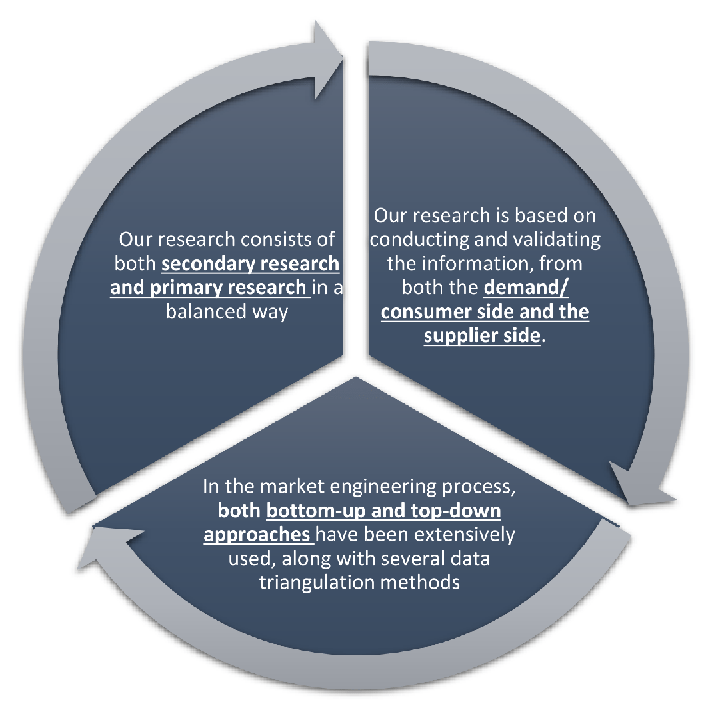
Our research design integrates both demand-side and supply-side analysis through a balanced combination of primary and secondary research methodologies. By utilizing both bottom-up and top-down approaches alongside rigorous data triangulation methods, we deliver robust market intelligence that supports strategic decision-making.
MarketGenics' comprehensive research design framework ensures the delivery of accurate, reliable, and actionable market intelligence. Through the integration of multiple research approaches, rigorous validation processes, and expert analysis, we provide our clients with the insights needed to make informed strategic decisions and capitalize on market opportunities.
MarketGenics leverages a dedicated industry panel of experts and a comprehensive suite of paid databases to effectively collect, consolidate, and analyze market intelligence.
Our approach has consistently proven to be reliable and effective in generating accurate market insights, identifying key industry trends, and uncovering emerging business opportunities.
Through both primary and secondary research, we capture and analyze critical company-level data such as manufacturing footprints, including technical centers, R&D facilities, sales offices, and headquarters.
Our expert panel further enhances our ability to estimate market size for specific brands based on validated field-level intelligence.
Our data mining techniques incorporate both parametric and non-parametric methods, allowing for structured data collection, sorting, processing, and cleaning.
Demand projections are derived from large-scale data sets analyzed through proprietary algorithms, culminating in robust and reliable market sizing.
Research Approach
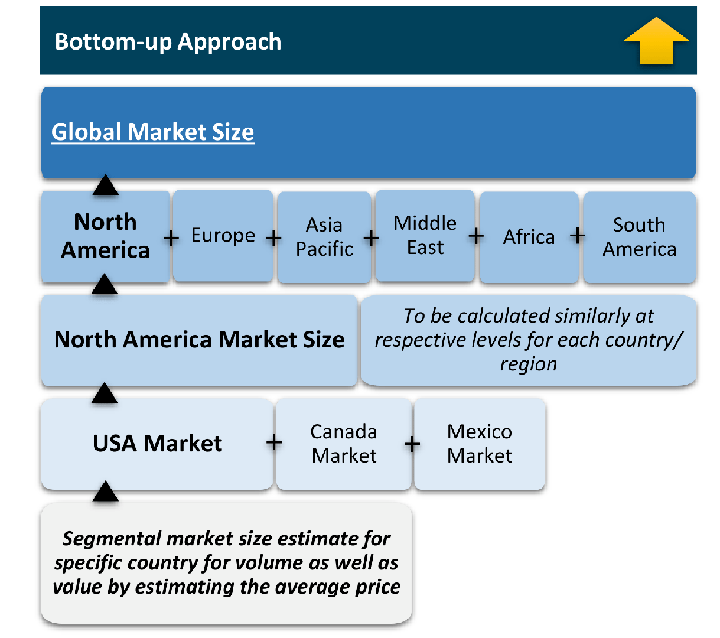
The bottom-up approach builds market estimates by starting with the smallest addressable market units and systematically aggregating them to create comprehensive market size projections.
This method begins with specific, granular data points and builds upward to create the complete market landscape.
Customer Analysis → Segmental Analysis → Geographical Analysis
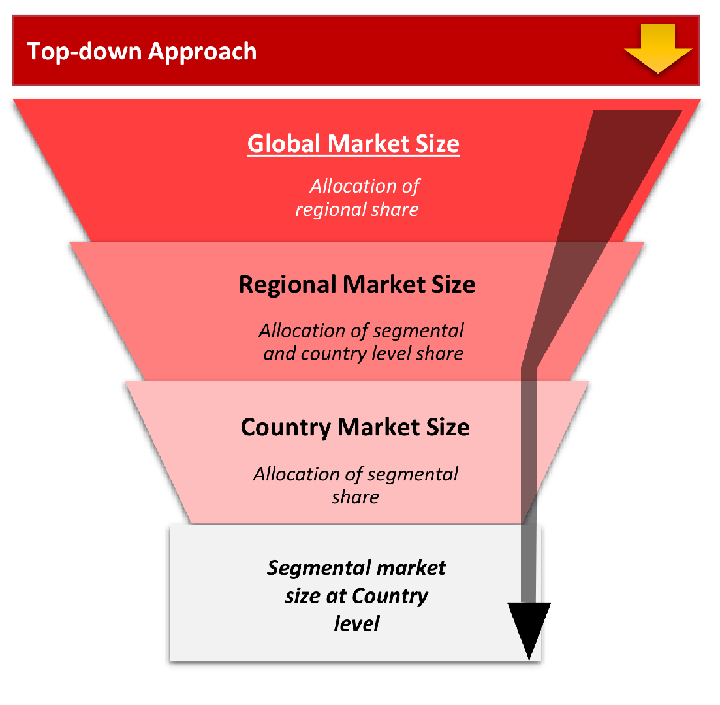
The top-down approach starts with the broadest possible market data and systematically narrows it down through a series of filters and assumptions to arrive at specific market segments or opportunities.
This method begins with the big picture and works downward to increasingly specific market slices.
TAM → SAM → SOM
Research Methods
Desk / Secondary Research
While analysing the market, we extensively study secondary sources, directories, and databases to identify and collect information useful for this technical, market-oriented, and commercial report. Secondary sources that we utilize are not only the public sources, but it is a combination of Open Source, Associations, Paid Databases, MG Repository & Knowledgebase, and others.
- Company websites, annual reports, financial reports, broker reports, and investor presentations
- National government documents, statistical databases and reports
- News articles, press releases and web-casts specific to the companies operating in the market, Magazines, reports, and others
- We gather information from commercial data sources for deriving company specific data such as segmental revenue, share for geography, product revenue, and others
- Internal and external proprietary databases (industry-specific), relevant patent, and regulatory databases
- Governing Bodies, Government Organizations
- Relevant Authorities, Country-specific Associations for Industries
We also employ the model mapping approach to estimate the product level market data through the players' product portfolio
Primary Research
Primary research/ interviews is vital in analyzing the market. Most of the cases involves paid primary interviews. Primary sources include primary interviews through e-mail interactions, telephonic interviews, surveys as well as face-to-face interviews with the different stakeholders across the value chain including several industry experts.
| Type of Respondents | Number of Primaries |
|---|---|
| Tier 2/3 Suppliers | ~20 |
| Tier 1 Suppliers | ~25 |
| End-users | ~25 |
| Industry Expert/ Panel/ Consultant | ~30 |
| Total | ~100 |
MG Knowledgebase
• Repository of industry blog, newsletter and case studies
• Online platform covering detailed market reports, and company profiles
Forecasting Factors and Models
Forecasting Factors
- Historical Trends – Past market patterns, cycles, and major events that shaped how markets behave over time. Understanding past trends helps predict future behavior.
- Industry Factors – Specific characteristics of the industry like structure, regulations, and innovation cycles that affect market dynamics.
- Macroeconomic Factors – Economic conditions like GDP growth, inflation, and employment rates that affect how much money people have to spend.
- Demographic Factors – Population characteristics like age, income, and location that determine who can buy your product.
- Technology Factors – How quickly people adopt new technology and how much technology infrastructure exists.
- Regulatory Factors – Government rules, laws, and policies that can help or restrict market growth.
- Competitive Factors – Analyzing competition structure such as degree of competition and bargaining power of buyers and suppliers.
Forecasting Models / Techniques
Multiple Regression Analysis
- Identify and quantify factors that drive market changes
- Statistical modeling to establish relationships between market drivers and outcomes
Time Series Analysis – Seasonal Patterns
- Understand regular cyclical patterns in market demand
- Advanced statistical techniques to separate trend, seasonal, and irregular components
Time Series Analysis – Trend Analysis
- Identify underlying market growth patterns and momentum
- Statistical analysis of historical data to project future trends
Expert Opinion – Expert Interviews
- Gather deep industry insights and contextual understanding
- In-depth interviews with key industry stakeholders
Multi-Scenario Development
- Prepare for uncertainty by modeling different possible futures
- Creating optimistic, pessimistic, and most likely scenarios
Time Series Analysis – Moving Averages
- Sophisticated forecasting for complex time series data
- Auto-regressive integrated moving average models with seasonal components
Econometric Models
- Apply economic theory to market forecasting
- Sophisticated economic models that account for market interactions
Expert Opinion – Delphi Method
- Harness collective wisdom of industry experts
- Structured, multi-round expert consultation process
Monte Carlo Simulation
- Quantify uncertainty and probability distributions
- Thousands of simulations with varying input parameters
Research Analysis
Our research framework is built upon the fundamental principle of validating market intelligence from both demand and supply perspectives. This dual-sided approach ensures comprehensive market understanding and reduces the risk of single-source bias.
Demand-Side Analysis: We understand end-user/application behavior, preferences, and market needs along with the penetration of the product for specific application.
Supply-Side Analysis: We estimate overall market revenue, analyze the segmental share along with industry capacity, competitive landscape, and market structure.
Validation & Evaluation
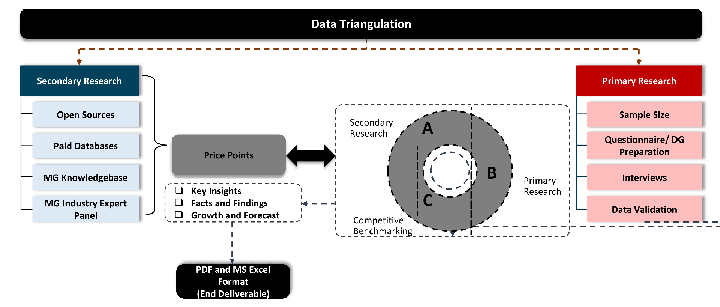
Data triangulation is a validation technique that uses multiple methods, sources, or perspectives to examine the same research question, thereby increasing the credibility and reliability of research findings. In market research, triangulation serves as a quality assurance mechanism that helps identify and minimize bias, validate assumptions, and ensure accuracy in market estimates.
- Data Source Triangulation – Using multiple data sources to examine the same phenomenon
- Methodological Triangulation – Using multiple research methods to study the same research question
- Investigator Triangulation – Using multiple researchers or analysts to examine the same data
- Theoretical Triangulation – Using multiple theoretical perspectives to interpret the same data
Custom Market Research Services
We will customise the research for you, in case the report listed above does not meet your requirements.
Get 10% Free Customisation