Digital Beauty Platforms Market Size, Share & Trends Analysis Report by Product Category Served (Skincare, Makeup & Color Cosmetics, Haircare, Nail Care, Sun Care, Fragrances, Men's Grooming, Wellness & Holistic Beauty), Device Type, Application, Technology, Consumer Demographic, Pricing Model and Geography (North America, Europe, Asia Pacific, Middle East, Africa, and South America) – Global Industry Data, Trends, and Forecasts, 2026–2035
|
|
|
Segmental Data Insights |
|
|
Demand Trends |
|
|
Competitive Landscape |
|
|
Strategic Development |
|
|
Future Outlook & Opportunities |
|
Digital Beauty Platforms market Size, Share, and Growth
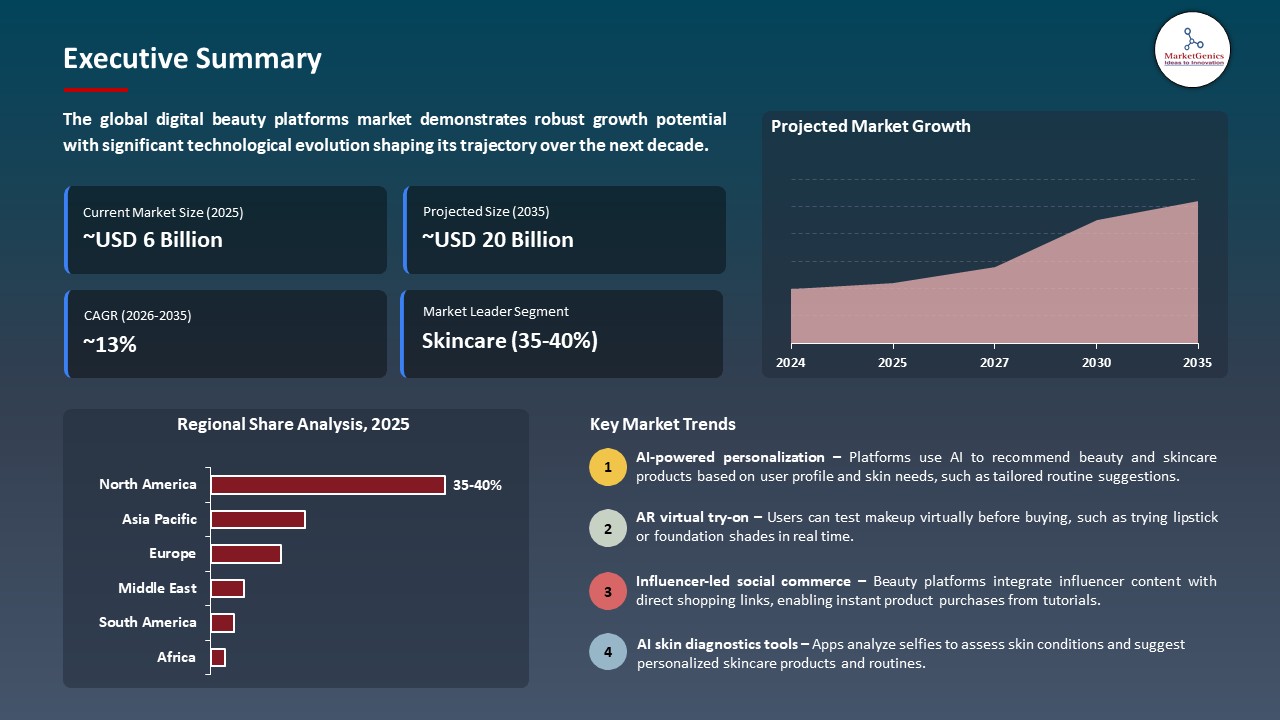
The global digital beauty platforms market is witnessing strong growth, valued at USD 6.2 billion in 2025 and projected to reach USD 20.3 billion by 2035, expanding at a CAGR of 12.6% during the forecast period. Digital beauty platforms empower the modern beauty ecosystem to evolve into a new era by combining AI-driven personalization systems, immersive virtual try-on technologies, and connected digital infrastructure to help consumers and brands interact seamlessly across online, mobile, and in-store channels.
Barbara Lavernos, Deputy Chief Executive Officer in charge of Research, Innovation and Technology at L’Oréal, said, “Our collaboration with NVIDIA brings definitively a new dimension into our L’Oréal Research labs. By applying AI-powered molecular simulation to our most proprietary actives, we are bridging atomic-scale discovery with real-world consumer benefit accelerating the development of more effective, more sensorial and accessible products for consumers around the world.
The digital beauty platforms market is becoming a high-tech and highly intelligent experience-driven ecosystem with the beauty discovery process moving away from a catalogue of products and towards an AI-driven and real-time personalized experience. Combining generative AI, computer vision, and behavioral analytics, platforms can analyze facial features, skin condition, and user preferences to increasingly personalize beauty recommendations on mobile, web and in-store digital channels.
The architecture of the platform is now focused on immersive interaction layers, where a virtual try-on engine, AI skin simulation tools and a conversational beauty assistant are combined to provide a flawless discovery-to-purchase experience. These systems are improving engagement by enabling users to visualize products in real time and provide them with a personalised skin care or makeup advice based on the dynamic digital profiling. This is yet another boost to consumer trust in online beauty products as it decreases uncertainty when choosing beauty products and increases personalisation accuracy throughout all digital channels.
An adjacent opportunity is being created as creator-driven commerce and AI beauty intelligence ecosystems are coming together, as social media, live shopping, and digital beauty engines are becoming one in the same. It is now allowing brands to offer the same real-time, influencer-driven virtual consultations, beauty re-imagining with AI, and hyper-personalized shopping experience within social and retail digital space changing the way consumers interact with beauty products everywhere.
Digital Beauty Platforms market Dynamics and Trends
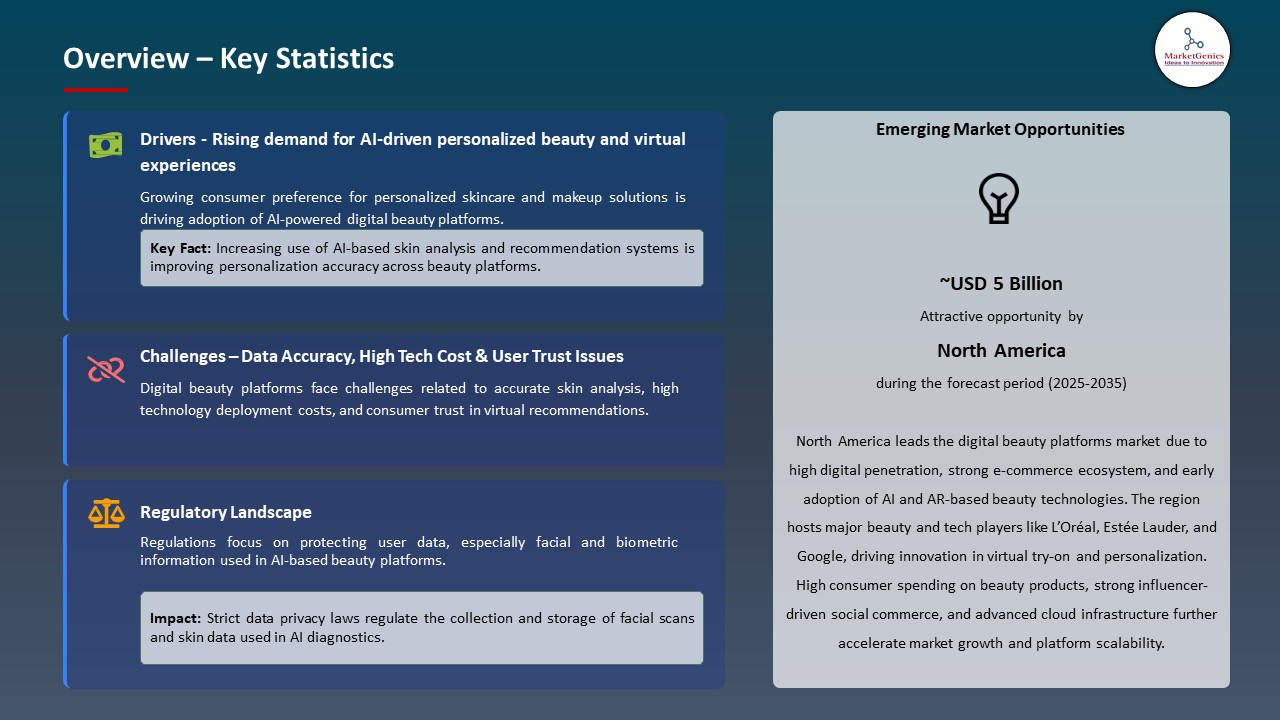
Driver: Rising Demand for AI-Powered Personalization in Beauty Experiences
- The global digital beauty platforms market is growing rapidly as the consumer demand for hyper-personalized skincare and makeup solutions is rising owing to the AI-based diagnostics, virtual try-on tools and real-time beauty recommendation systems that are powered by digital-first beauty platforms.
- Advanced generative AI and computer vision technologies are being integrated to improve the accuracy of virtual try-on and user experience, as technology providers bolster AI-powered beauty personalization features. In December 2024, Ulta Beauty partnered with NVIDIA to leverage AI models in StyleGAN2 in its GLAMlab platform, which added the ability to virtually try on hair with advanced AI models and simulate beauty with high realism in the digital space.
- The market is expected to see further rapid growth in the use of AR visualization tools, predictive recommendation engines, and AI beauty assistants globally.
Restraint: Data Privacy and High Dependence on Quality Visual Data Inputs
- The growing apprehensions about privacy of biometric data arise to be the major constraint in the digital beauty platforms market, as the AI based systems rely on facial scans and skin imagery, which makes consent, security, and regulatory compliance issues an issue.
- Additionally, platform accuracy can be affected by reliance on high-quality visual information, as variations in lighting conditions, camera quality, and image clarity can impact the accuracy of AI-driven skin diagnostics and virtual try-on features.
- However, the increasing attention being paid to the use of sensitive data, and the fluctuating quality of visual input, remains a limitation for the growth and mass adoption of digital beauty platforms around the world.
Opportunity: Expansion of Social Commerce and Virtual Beauty Ecosystems
- Social commerce and an influencer-led ecosystem is changing the way beauty is discovered, making the global digital beauty platforms market expand into content-driven interactive shopping experiences on mobile-first platforms and short video networks.
- Technology vendors are continuing to grow AR-powered virtual beauty and AI-powered customization features to improve product discovery in real time and across channels. In May 2026, Perfect Corp. supplied AR virtual foundation try-on and AI-based shade matching capabilities to TIRTIR's online shop and flagship store, which allowed for an accurate matching of the skin tone and seamless integration with digital and physical retail.
- Social media, virtual beauty tools, and AI personalization are collectively advancing the immersive social commerce landscapes globally at an unprecedented pace.
Key Trend: Integration of Generative AI and Immersive Beauty Technologies
- The global digital beauty platforms market is gaining momentum at a rapid pace, fueled by the growing demand for AI-powered, experience-driven beauty ecosystems that offer highly personalized and interactive beauty discovery journeys across digital platforms, thanks to the integration of generative AI, real-time skin intelligence, and visualization tools.
- Beauty systems with advanced generative AI and AR capabilities are also being integrated into digital platforms, allowing users to experience hyper-realistic digital versions of their skin through try-on features and make intelligent beauty recommendations. In May 2024, Perfect Corp. unveiled its “Beautiful AI” brand solutions with next-generation generative AI features such as BeautyGPT and SkincareGPT that will revolutionize real-time personalisation and interactive beauty experiences on digital platforms.
- Combining generative AI, computer vision, and AR-driven immersive experiences is revolutionizing digital beauty platforms as intelligent, ever-evolving ecosystems that enhance the personalization of every user.
Digital Beauty Platforms Market Analysis and Segmental Data
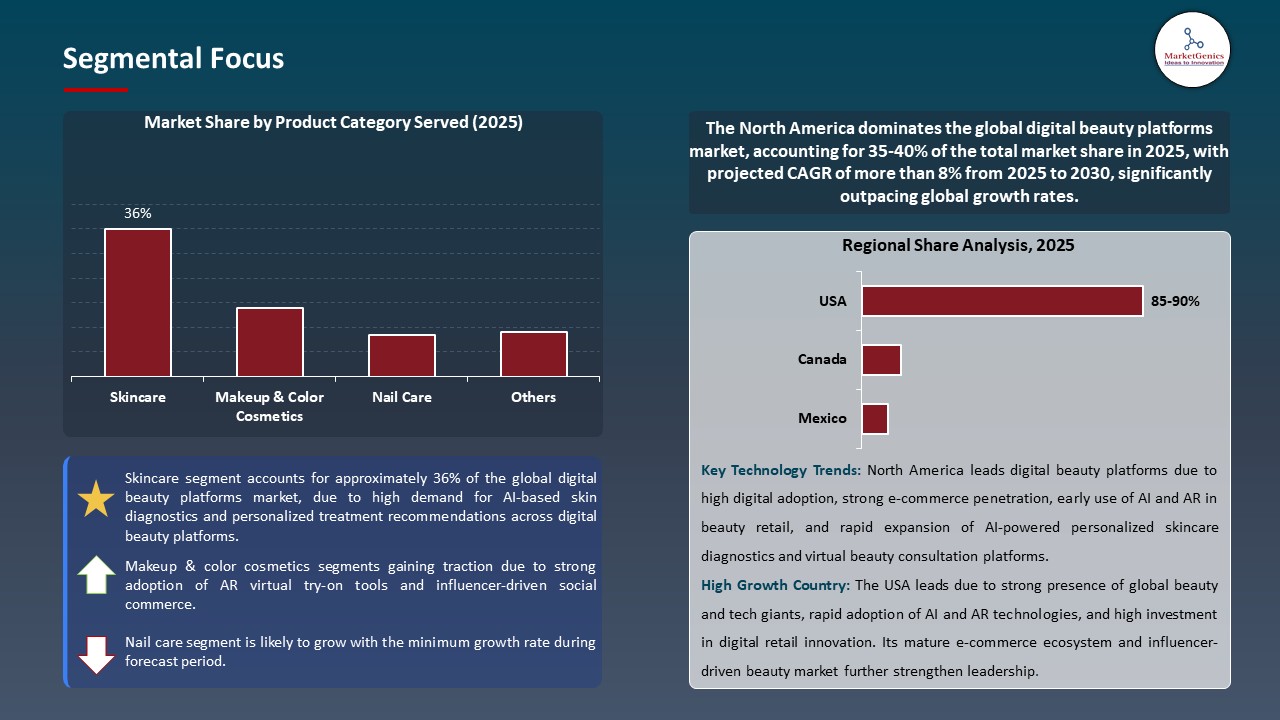
Skincare Dominate Global Digital Beauty Platforms Market
- The global digital beauty platforms market is dominated by skincare as the demand for AI-driven dermatological insights and personalized skincare routines continues to grow, alongside the increasing adoption of mobile-based skin monitoring solutions to prevent and manage skin conditions in digital beauty ecosystems.
- Technology vendors are driving innovation in the AI beauty ecosystem with generative AI, predictive analytics and digital skin intelligence. In June 2025, L’Oréal showcased its latest AI-driven beauty innovations, introducing next-generation digital beauty solutions powered by generative AI and advanced predictive science to enhance personalized skincare experiences across global digital platforms.
- Growing popularity of AI skin intelligence systems, connected skincare devices and cloud-based personalization platforms further solidifies the skin care's leading role in the global digital beauty platforms market.
North America Leads Global Digital Beauty Platforms Market Demand
- North America leads the digital beauty platforms market, with high AR adoption of virtual try-on cosmetics and the rising demand for digital-first skin care consultancy and hyper-personalized cosmetic recommendations in the online beauty retailing space.
- Advanced skin diagnostics and personalisation platforms are driving AI innovation in beauty across the region at an increasingly fast pace, as technology providers invest in the field. In August 2025, Revieve launched its AI Skin Age Diagnostics solution in the United States, in collaboration with RoC Skincare, which will allow for AI-powered skin analysis, custom skincare recommendations, and digital beauty consultations in real-time, both in retail and online.
- North America is projected to remain the global leader in digital beauty platforms market due to the presence of AI-powered beauty platforms, omnichannel retail systems, and data-driven personalization.
Digital Beauty Platforms Market Ecosystem
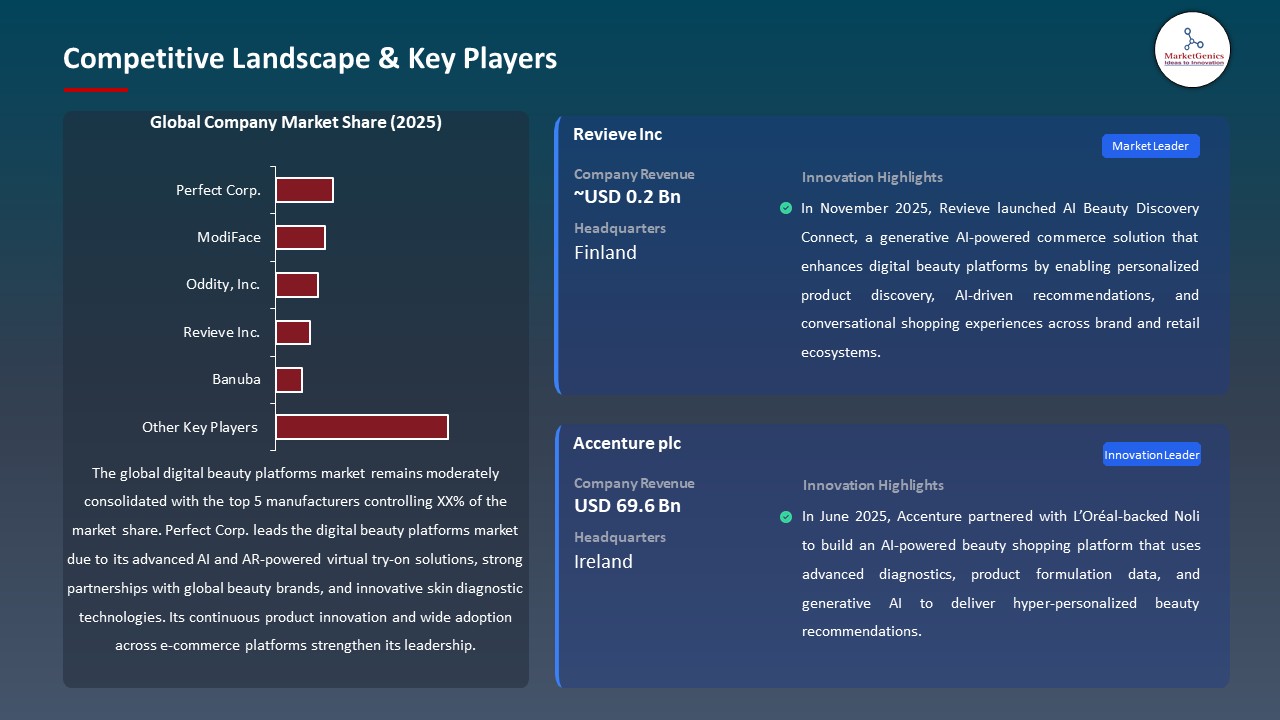
The digital beauty platforms market is moderately consolidated and is progressing to embrace the fast-growing AI-driven personalization, augmented reality (AR) beauty solutions, and data-driven consumer engagement models. AI, computer vision and e-commerce integration are converging to transform the ecosystem, offering consumers seamless beauty discovery, virtual try-on and hyper-personalized skin care and cosmetic product suggestions on their digital platforms and mobile devices.
The competitive ecosystem includes companies focused on the AI beauty technology, virtual try-on, and advanced skin diagnostics like Perfect Corp., ModiFace (L’Oréal Group), Oddity, Inc., Revieve Inc., and Banuba. The companies are consolidating their position by continuously innovating in the area of generative AI, AR visualization engines and machine learning-driven recommendation systems, all of which increase engagement and help improve the journey of digital beauty purchases in all markets.
The market is maturing, and the ecosystem integration is gaining importance, with efforts focused on creating interoperability among different beauty engines, social commerce platforms, and retail e-commerce ecosystems. Virtual consultation, content-driven discovery and seamless product conversion are becoming one and the same, focusing on real-time personalisation, beauty analytics in the cloud and omnichannel integration, to create a unified digital beauty experience.
Recent Development and Strategic Overview
- In March 2026, L'Oréal teamed up with NVIDIA to boost AI-driven beauty discovery with the addition of predictive AI, virtual try on, and cutting-edge personalization features, including the ability to enrich digital beauty platform experiences for consumers worldwide through digital channels.
- In June 2025, Accenture joined Noli, a beauty brand supported by L'Oréal, to create an AI-powered beauty shopping experience, which includes an improved personalized product discovery, virtual beauty recommendations, and digital commerce engagement journey on beauty platforms.
Report Scope
|
Detail |
|
|
Market Size in 2025 |
USD 6.2 Bn |
|
Market Forecast Value in 2035 |
USD 20.3 Bn |
|
Growth Rate (CAGR) |
12.6% |
|
Forecast Period |
2026 – 2035 |
|
Historical Data Available for |
2021 – 2024 |
|
Market Size Units |
US$ Billion for Value |
|
Report Format |
Electronic (PDF) + Excel |
|
North America |
Europe |
Asia Pacific |
Middle East |
Africa |
South America |
|
|
|
|
|
|
|
Companies Covered |
|||||
|
|||||
Digital Beauty Platforms Market Segmentation and Highlights
|
Segment |
Sub-segment |
|
Digital Beauty Platforms Market, By Product Category Served |
|
|
Digital Beauty Platforms Market, By Device Type |
|
|
Digital Beauty Platforms Market, By Application |
|
|
Digital Beauty Platforms Market, By Technology |
|
|
Digital Beauty Platforms Market, By Consumer Demographic |
|
|
Digital Beauty Platforms Market, By Pricing Model |
|
Frequently Asked Questions
Table of Contents
- 1. Research Methodology and Assumptions
- 1.1. Definitions
- 1.2. Research Design and Approach
- 1.3. Data Collection Methods
- 1.4. Base Estimates and Calculations
- 1.5. Forecasting Models
- 1.5.1. Key Forecast Factors & Impact Analysis
- 1.6. Secondary Research
- 1.6.1. Open Sources
- 1.6.2. Paid Databases
- 1.6.3. Associations
- 1.7. Primary Research
- 1.7.1. Primary Sources
- 1.7.2. Primary Interviews with Stakeholders across Ecosystem
- 2. Executive Summary
- 2.1. Global Digital Beauty Platforms Market Outlook
- 2.1.1. Digital Beauty Platforms Market Size (Value - US$ Bn), and Forecasts, 2021-2035
- 2.1.2. Compounded Annual Growth Rate Analysis
- 2.1.3. Growth Opportunity Analysis
- 2.1.4. Segmental Share Analysis
- 2.1.5. Geographical Share Analysis
- 2.2. Market Analysis and Facts
- 2.3. Supply-Demand Analysis
- 2.4. Competitive Benchmarking
- 2.5. Go-to- Market Strategy
- 2.5.1. Customer/ End-use Industry Assessment
- 2.5.2. Growth Opportunity Data, 2026-2035
- 2.5.2.1. Regional Data
- 2.5.2.2. Country Data
- 2.5.2.3. Segmental Data
- 2.5.3. Identification of Potential Market Spaces
- 2.5.4. GAP Analysis
- 2.5.5. Potential Attractive Price Points
- 2.5.6. Prevailing Market Risks & Challenges
- 2.5.7. Preferred Sales & Marketing Strategies
- 2.5.8. Key Recommendations and Analysis
- 2.5.9. A Way Forward
- 2.1. Global Digital Beauty Platforms Market Outlook
- 3. Industry Data and Premium Insights
- 3.1. Global Consumer Goods & Services Industry Overview, 2025
- 3.1.1. Consumer Goods & Services Industry Ecosystem Analysis
- 3.1.2. Key Trends for Consumer Goods & Services Industry
- 3.1.3. Regional Distribution for Consumer Goods & Services Industry
- 3.2. Supplier Customer Data
- 3.3. Technology Roadmap and Developments
- 3.1. Global Consumer Goods & Services Industry Overview, 2025
- 4. Market Overview
- 4.1. Market Dynamics
- 4.1.1. Drivers
- 4.1.1.1. Increasing penetration of smartphones and social media platforms driving online beauty product discovery, virtual try-ons, and influencer-led engagement.
- 4.1.1.2. Rising demand for personalized beauty recommendations powered by AI, AR, and data-driven skin analysis tools.
- 4.1.1.3. Growth of e-commerce and direct-to-consumer beauty brands expanding digital-first sales and customer interaction models
- 4.1.2. Restraints
- 4.1.2.1. Data privacy and security concerns related to collection of sensitive user data such as facial scans and skin profiles.
- 4.1.2.2. Lack of standardized accuracy in virtual try-on and AI-based recommendations leading to trust and adoption limitations
- 4.1.1. Drivers
- 4.2. Key Trend Analysis
- 4.3. Regulatory Framework
- 4.3.1. Key Regulations, Norms, and Subsidies, by Key Countries
- 4.3.2. Tariffs and Standards
- 4.3.3. Impact Analysis of Regulations on the Market
- 4.4. Ecosystem Analysis
- 4.5. Porter’s Five Forces Analysis
- 4.6. PESTEL Analysis
- 4.7. Global Digital Beauty Platforms Market Demand
- 4.7.1. Historical Market Size – Value (US$ Bn), 2020-2024
- 4.7.2. Current and Future Market Size – Value (US$ Bn), 2026–2035
- 4.7.2.1. Y-o-Y Growth Trends
- 4.7.2.2. Absolute $ Opportunity Assessment
- 4.1. Market Dynamics
- 5. Competition Landscape
- 5.1. Competition structure
- 5.1.1. Fragmented v/s consolidated
- 5.2. Company Share Analysis, 2025
- 5.2.1. Global Company Market Share
- 5.2.2. By Region
- 5.2.2.1. North America
- 5.2.2.2. Europe
- 5.2.2.3. Asia Pacific
- 5.2.2.4. Middle East
- 5.2.2.5. Africa
- 5.2.2.6. South America
- 5.3. Product Comparison Matrix
- 5.3.1. Specifications
- 5.3.2. Market Positioning
- 5.3.3. Pricing
- 5.1. Competition structure
- 6. Global Digital Beauty Platforms Market Analysis, by Product Category Served
- 6.1. Key Segment Analysis
- 6.2. Digital Beauty Platforms Market Size (Value - US$ Bn), Analysis, and Forecasts, by Product Category Served, 2021-2035
- 6.2.1. Skincare
- 6.2.2. Makeup & Color Cosmetics
- 6.2.3. Haircare
- 6.2.4. Nail Care
- 6.2.5. Sun Care
- 6.2.6. Fragrances
- 6.2.7. Men's Grooming
- 6.2.8. Wellness & Holistic Beauty
- 7. Global Digital Beauty Platforms Market Analysis, by Device Type
- 7.1. Key Segment Analysis
- 7.2. Digital Beauty Platforms Market Size (Value - US$ Bn), Analysis, and Forecasts, by Device Type, 2021-2035
- 7.2.1. Smartphones & Tablets
- 7.2.2. Desktop & Laptops
- 7.2.3. Smart Mirrors
- 7.2.4. Wearables
- 7.2.5. In-Store Digital Kiosks
- 7.2.6. Others
- 8. Global Digital Beauty Platforms Market Analysis, by Application
- 8.1. Key Segment Analysis
- 8.2. Digital Beauty Platforms Market Size (Value - US$ Bn), Analysis, and Forecasts, by Application, 2021-2035
- 8.2.1. Virtual Makeup Try-On
- 8.2.2. Skin Analysis & Diagnostics
- 8.2.3. Hair Color & Style Simulation
- 8.2.4. Nail Art Try-On
- 8.2.5. Live Video Consultation
- 8.2.6. Multi-Brand Product Aggregation
- 8.2.7. AI Skin Scoring & Health Assessment
- 8.2.8. Personalized Regimen Builders
- 8.2.9. Beauty Education & Tutorials
- 8.2.10. Social Sharing & Community Features
- 8.2.11. Other Applications
- 9. Global Digital Beauty Platforms Market Analysis, by Technology
- 9.1. Key Segment Analysis
- 9.2. Digital Beauty Platforms Market Size (Value - US$ Bn), Analysis, and Forecasts, by Technology, 2021-2035
- 9.2.1. AI & ML Integration
- 9.2.2. AR & VR Capable
- 9.2.3. Computer Vision & Facial Recognition
- 9.2.4. Smart Devices & IoT Integration
- 9.2.5. Generative AI
- 9.2.6. NLP Conversational Interfaces
- 10. Global Digital Beauty Platforms Market Analysis, by Consumer Demographic
- 10.1. Key Segment Analysis
- 10.2. Digital Beauty Platforms Market Size (Value - US$ Bn), Analysis, and Forecasts, by Consumer Demographic, 2021-2035
- 10.2.1. Gen Z (18–26 years)
- 10.2.2. Millennials (27–42 years)
- 10.2.3. Gen X (43–58 years)
- 10.2.4. Baby Boomers (59+ years)
- 11. Global Digital Beauty Platforms Market Analysis, by Pricing Model
- 11.1. Key Segment Analysis
- 11.2. Digital Beauty Platforms Market Size (Value - US$ Bn), Analysis, and Forecasts, by Pricing Model, 2021-2035
- 11.2.1. Subscription-Based (SaaS)
- 11.2.2. Pay-Per-Use
- 11.2.3. One-Time License
- 11.2.4. Graduated Pricing
- 12. Global Digital Beauty Platforms Market Analysis and Forecasts, by Region
- 12.1. Key Findings
- 12.2. Digital Beauty Platforms Market Size (Value - US$ Bn), Analysis, and Forecasts, by Region, 2021-2035
- 12.2.1. North America
- 12.2.2. Europe
- 12.2.3. Asia Pacific
- 12.2.4. Middle East
- 12.2.5. Africa
- 12.2.6. South America
- 13. North America Digital Beauty Platforms Market Analysis
- 13.1. Key Segment Analysis
- 13.2. Regional Snapshot
- 13.3. North America Digital Beauty Platforms Market Size (Value - US$ Bn), Analysis, and Forecasts, 2021-2035
- 13.3.1. Product Category Served
- 13.3.2. Device Type
- 13.3.3. Application
- 13.3.4. Technology
- 13.3.5. Consumer Demographic
- 13.3.6. Pricing Model
- 13.3.7. Country
- 13.3.7.1. USA
- 13.3.7.2. Canada
- 13.3.7.3. Mexico
- 13.4. USA Digital Beauty Platforms Market
- 13.4.1. Country Segmental Analysis
- 13.4.2. Product Category Served
- 13.4.3. Device Type
- 13.4.4. Application
- 13.4.5. Technology
- 13.4.6. Consumer Demographic
- 13.4.7. Pricing Model
- 13.5. Canada Digital Beauty Platforms Market
- 13.5.1. Country Segmental Analysis
- 13.5.2. Product Category Served
- 13.5.3. Device Type
- 13.5.4. Application
- 13.5.5. Technology
- 13.5.6. Consumer Demographic
- 13.5.7. Pricing Model
- 13.6. Mexico Digital Beauty Platforms Market
- 13.6.1. Country Segmental Analysis
- 13.6.2. Product Category Served
- 13.6.3. Device Type
- 13.6.4. Application
- 13.6.5. Technology
- 13.6.6. Consumer Demographic
- 13.6.7. Pricing Model
- 14. Europe Digital Beauty Platforms Market Analysis
- 14.1. Key Segment Analysis
- 14.2. Regional Snapshot
- 14.3. Europe Digital Beauty Platforms Market Size (Value - US$ Bn), Analysis, and Forecasts, 2021-2035
- 14.3.1. Product Category Served
- 14.3.2. Device Type
- 14.3.3. Application
- 14.3.4. Technology
- 14.3.5. Consumer Demographic
- 14.3.6. Pricing Model
- 14.3.7. Country
- 14.3.7.1. Germany
- 14.3.7.2. United Kingdom
- 14.3.7.3. France
- 14.3.7.4. Italy
- 14.3.7.5. Spain
- 14.3.7.6. Netherlands
- 14.3.7.7. Nordic Countries
- 14.3.7.8. Poland
- 14.3.7.9. Russia & CIS
- 14.3.7.10. Rest of Europe
- 14.4. Germany Digital Beauty Platforms Market
- 14.4.1. Country Segmental Analysis
- 14.4.2. Product Category Served
- 14.4.3. Device Type
- 14.4.4. Application
- 14.4.5. Technology
- 14.4.6. Consumer Demographic
- 14.4.7. Pricing Model
- 14.5. United Kingdom Digital Beauty Platforms Market
- 14.5.1. Country Segmental Analysis
- 14.5.2. Product Category Served
- 14.5.3. Device Type
- 14.5.4. Application
- 14.5.5. Technology
- 14.5.6. Consumer Demographic
- 14.5.7. Pricing Model
- 14.6. France Digital Beauty Platforms Market
- 14.6.1. Country Segmental Analysis
- 14.6.2. Product Category Served
- 14.6.3. Device Type
- 14.6.4. Application
- 14.6.5. Technology
- 14.6.6. Consumer Demographic
- 14.6.7. Pricing Model
- 14.7. Italy Digital Beauty Platforms Market
- 14.7.1. Country Segmental Analysis
- 14.7.2. Product Category Served
- 14.7.3. Device Type
- 14.7.4. Application
- 14.7.5. Technology
- 14.7.6. Consumer Demographic
- 14.7.7. Pricing Model
- 14.8. Spain Digital Beauty Platforms Market
- 14.8.1. Country Segmental Analysis
- 14.8.2. Product Category Served
- 14.8.3. Device Type
- 14.8.4. Application
- 14.8.5. Technology
- 14.8.6. Consumer Demographic
- 14.8.7. Pricing Model
- 14.9. Netherlands Digital Beauty Platforms Market
- 14.9.1. Country Segmental Analysis
- 14.9.2. Product Category Served
- 14.9.3. Device Type
- 14.9.4. Application
- 14.9.5. Technology
- 14.9.6. Consumer Demographic
- 14.9.7. Pricing Model
- 14.10. Nordic Countries Digital Beauty Platforms Market
- 14.10.1. Country Segmental Analysis
- 14.10.2. Product Category Served
- 14.10.3. Device Type
- 14.10.4. Application
- 14.10.5. Technology
- 14.10.6. Consumer Demographic
- 14.10.7. Pricing Model
- 14.11. Poland Digital Beauty Platforms Market
- 14.11.1. Country Segmental Analysis
- 14.11.2. Product Category Served
- 14.11.3. Device Type
- 14.11.4. Application
- 14.11.5. Technology
- 14.11.6. Consumer Demographic
- 14.11.7. Pricing Model
- 14.12. Russia & CIS Digital Beauty Platforms Market
- 14.12.1. Country Segmental Analysis
- 14.12.2. Product Category Served
- 14.12.3. Device Type
- 14.12.4. Application
- 14.12.5. Technology
- 14.12.6. Consumer Demographic
- 14.12.7. Pricing Model
- 14.13. Rest of Europe Digital Beauty Platforms Market
- 14.13.1. Country Segmental Analysis
- 14.13.2. Product Category Served
- 14.13.3. Device Type
- 14.13.4. Application
- 14.13.5. Technology
- 14.13.6. Consumer Demographic
- 14.13.7. Pricing Model
- 15. Asia Pacific Digital Beauty Platforms Market Analysis
- 15.1. Key Segment Analysis
- 15.2. Regional Snapshot
- 15.3. Asia Pacific Digital Beauty Platforms Market Size (Value - US$ Bn), Analysis, and Forecasts, 2021-2035
- 15.3.1. Product Category Served
- 15.3.2. Device Type
- 15.3.3. Application
- 15.3.4. Technology
- 15.3.5. Consumer Demographic
- 15.3.6. Pricing Model
- 15.3.7. Country
- 15.3.7.1. China
- 15.3.7.2. India
- 15.3.7.3. Japan
- 15.3.7.4. South Korea
- 15.3.7.5. Australia and New Zealand
- 15.3.7.6. Indonesia
- 15.3.7.7. Malaysia
- 15.3.7.8. Thailand
- 15.3.7.9. Vietnam
- 15.3.7.10. Rest of Asia Pacific
- 15.4. China Digital Beauty Platforms Market
- 15.4.1. Country Segmental Analysis
- 15.4.2. Product Category Served
- 15.4.3. Device Type
- 15.4.4. Application
- 15.4.5. Technology
- 15.4.6. Consumer Demographic
- 15.4.7. Pricing Model
- 15.5. India Digital Beauty Platforms Market
- 15.5.1. Country Segmental Analysis
- 15.5.2. Product Category Served
- 15.5.3. Device Type
- 15.5.4. Application
- 15.5.5. Technology
- 15.5.6. Consumer Demographic
- 15.5.7. Pricing Model
- 15.6. Japan Digital Beauty Platforms Market
- 15.6.1. Country Segmental Analysis
- 15.6.2. Product Category Served
- 15.6.3. Device Type
- 15.6.4. Application
- 15.6.5. Technology
- 15.6.6. Consumer Demographic
- 15.6.7. Pricing Model
- 15.7. South Korea Digital Beauty Platforms Market
- 15.7.1. Country Segmental Analysis
- 15.7.2. Product Category Served
- 15.7.3. Device Type
- 15.7.4. Application
- 15.7.5. Technology
- 15.7.6. Consumer Demographic
- 15.7.7. Pricing Model
- 15.8. Australia and New Zealand Digital Beauty Platforms Market
- 15.8.1. Country Segmental Analysis
- 15.8.2. Product Category Served
- 15.8.3. Device Type
- 15.8.4. Application
- 15.8.5. Technology
- 15.8.6. Consumer Demographic
- 15.8.7. Pricing Model
- 15.9. Indonesia Digital Beauty Platforms Market
- 15.9.1. Country Segmental Analysis
- 15.9.2. Product Category Served
- 15.9.3. Device Type
- 15.9.4. Application
- 15.9.5. Technology
- 15.9.6. Consumer Demographic
- 15.9.7. Pricing Model
- 15.10. Malaysia Digital Beauty Platforms Market
- 15.10.1. Country Segmental Analysis
- 15.10.2. Product Category Served
- 15.10.3. Device Type
- 15.10.4. Application
- 15.10.5. Technology
- 15.10.6. Consumer Demographic
- 15.10.7. Pricing Model
- 15.11. Thailand Digital Beauty Platforms Market
- 15.11.1. Country Segmental Analysis
- 15.11.2. Product Category Served
- 15.11.3. Device Type
- 15.11.4. Application
- 15.11.5. Technology
- 15.11.6. Consumer Demographic
- 15.11.7. Pricing Model
- 15.12. Vietnam Digital Beauty Platforms Market
- 15.12.1. Country Segmental Analysis
- 15.12.2. Product Category Served
- 15.12.3. Device Type
- 15.12.4. Application
- 15.12.5. Technology
- 15.12.6. Consumer Demographic
- 15.12.7. Pricing Model
- 15.13. Rest of Asia Pacific Digital Beauty Platforms Market
- 15.13.1. Country Segmental Analysis
- 15.13.2. Product Category Served
- 15.13.3. Device Type
- 15.13.4. Application
- 15.13.5. Technology
- 15.13.6. Consumer Demographic
- 15.13.7. Pricing Model
- 16. Middle East Digital Beauty Platforms Market Analysis
- 16.1. Key Segment Analysis
- 16.2. Regional Snapshot
- 16.3. Middle East Digital Beauty Platforms Market Size (Value - US$ Bn), Analysis, and Forecasts, 2021-2035
- 16.3.1. Product Category Served
- 16.3.2. Device Type
- 16.3.3. Application
- 16.3.4. Technology
- 16.3.5. Consumer Demographic
- 16.3.6. Pricing Model
- 16.3.7. Country
- 16.3.7.1. Turkey
- 16.3.7.2. UAE
- 16.3.7.3. Saudi Arabia
- 16.3.7.4. Israel
- 16.3.7.5. Rest of Middle East
- 16.4. Turkey Digital Beauty Platforms Market
- 16.4.1. Country Segmental Analysis
- 16.4.2. Product Category Served
- 16.4.3. Device Type
- 16.4.4. Application
- 16.4.5. Technology
- 16.4.6. Consumer Demographic
- 16.4.7. Pricing Model
- 16.5. UAE Digital Beauty Platforms Market
- 16.5.1. Country Segmental Analysis
- 16.5.2. Product Category Served
- 16.5.3. Device Type
- 16.5.4. Application
- 16.5.5. Technology
- 16.5.6. Consumer Demographic
- 16.5.7. Pricing Model
- 16.6. Saudi Arabia Digital Beauty Platforms Market
- 16.6.1. Country Segmental Analysis
- 16.6.2. Product Category Served
- 16.6.3. Device Type
- 16.6.4. Application
- 16.6.5. Technology
- 16.6.6. Consumer Demographic
- 16.6.7. Pricing Model
- 16.7. Israel Digital Beauty Platforms Market
- 16.7.1. Country Segmental Analysis
- 16.7.2. Product Category Served
- 16.7.3. Device Type
- 16.7.4. Application
- 16.7.5. Technology
- 16.7.6. Consumer Demographic
- 16.7.7. Pricing Model
- 16.8. Rest of Middle East Digital Beauty Platforms Market
- 16.8.1. Country Segmental Analysis
- 16.8.2. Product Category Served
- 16.8.3. Device Type
- 16.8.4. Application
- 16.8.5. Technology
- 16.8.6. Consumer Demographic
- 16.8.7. Pricing Model
- 17. Africa Digital Beauty Platforms Market Analysis
- 17.1. Key Segment Analysis
- 17.2. Regional Snapshot
- 17.3. Africa Digital Beauty Platforms Market Size (Value - US$ Bn), Analysis, and Forecasts, 2021-2035
- 17.3.1. Product Category Served
- 17.3.2. Device Type
- 17.3.3. Application
- 17.3.4. Technology
- 17.3.5. Consumer Demographic
- 17.3.6. Pricing Model
- 17.3.7. Country
- 17.3.7.1. South Africa
- 17.3.7.2. Egypt
- 17.3.7.3. Nigeria
- 17.3.7.4. Algeria
- 17.3.7.5. Rest of Africa
- 17.4. South Africa Digital Beauty Platforms Market
- 17.4.1. Country Segmental Analysis
- 17.4.2. Product Category Served
- 17.4.3. Device Type
- 17.4.4. Application
- 17.4.5. Technology
- 17.4.6. Consumer Demographic
- 17.4.7. Pricing Model
- 17.5. Egypt Digital Beauty Platforms Market
- 17.5.1. Country Segmental Analysis
- 17.5.2. Product Category Served
- 17.5.3. Device Type
- 17.5.4. Application
- 17.5.5. Technology
- 17.5.6. Consumer Demographic
- 17.5.7. Pricing Model
- 17.6. Nigeria Digital Beauty Platforms Market
- 17.6.1. Country Segmental Analysis
- 17.6.2. Product Category Served
- 17.6.3. Device Type
- 17.6.4. Application
- 17.6.5. Technology
- 17.6.6. Consumer Demographic
- 17.6.7. Pricing Model
- 17.7. Algeria Digital Beauty Platforms Market
- 17.7.1. Country Segmental Analysis
- 17.7.2. Product Category Served
- 17.7.3. Device Type
- 17.7.4. Application
- 17.7.5. Technology
- 17.7.6. Consumer Demographic
- 17.7.7. Pricing Model
- 17.8. Rest of Africa Digital Beauty Platforms Market
- 17.8.1. Country Segmental Analysis
- 17.8.2. Product Category Served
- 17.8.3. Device Type
- 17.8.4. Application
- 17.8.5. Technology
- 17.8.6. Consumer Demographic
- 17.8.7. Pricing Model
- 18. South America Digital Beauty Platforms Market Analysis
- 18.1. Key Segment Analysis
- 18.2. Regional Snapshot
- 18.3. South America Digital Beauty Platforms Market Size (Value - US$ Bn), Analysis, and Forecasts, 2021-2035
- 18.3.1. Product Category Served
- 18.3.2. Device Type
- 18.3.3. Application
- 18.3.4. Technology
- 18.3.5. Consumer Demographic
- 18.3.6. Pricing Model
- 18.3.7. Country
- 18.3.7.1. Brazil
- 18.3.7.2. Argentina
- 18.3.7.3. Rest of South America
- 18.4. Brazil Digital Beauty Platforms Market
- 18.4.1. Country Segmental Analysis
- 18.4.2. Product Category Served
- 18.4.3. Device Type
- 18.4.4. Application
- 18.4.5. Technology
- 18.4.6. Consumer Demographic
- 18.4.7. Pricing Model
- 18.5. Argentina Digital Beauty Platforms Market
- 18.5.1. Country Segmental Analysis
- 18.5.2. Product Category Served
- 18.5.3. Device Type
- 18.5.4. Application
- 18.5.5. Technology
- 18.5.6. Consumer Demographic
- 18.5.7. Pricing Model
- 18.6. Rest of South America Digital Beauty Platforms Market
- 18.6.1. Country Segmental Analysis
- 18.6.2. Product Category Served
- 18.6.3. Device Type
- 18.6.4. Application
- 18.6.5. Technology
- 18.6.6. Consumer Demographic
- 18.6.7. Pricing Model
- 19. Key Players/ Company Profile
- 19.1. Banuba.
- 19.1.1. Company Details/ Overview
- 19.1.2. Company Financials
- 19.1.3. Key Customers and Competitors
- 19.1.4. Business/ Industry Portfolio
- 19.1.5. Product Portfolio/ Specification Details
- 19.1.6. Pricing Data
- 19.1.7. Strategic Overview
- 19.1.8. Recent Developments
- 19.2. EveLab Insight Inc.
- 19.3. Haut.AI
- 19.4. Holition Ltd
- 19.5. ModiFace (L'Oréal Company)
- 19.6. Oddity, Inc.
- 19.7. Perfect Corp.
- 19.8. PROVEN Skincare
- 19.9. Revieve Inc.
- 19.10. Shiseido Company
- 19.11. Ulta Beauty, Inc.
- 19.12. Other Key Players
- 19.1. Banuba.
Note* - This is just tentative list of players. While providing the report, we will cover more number of players based on their revenue and share for each geography
Research Design
Our research design integrates both demand-side and supply-side analysis through a balanced combination of primary and secondary research methodologies. By utilizing both bottom-up and top-down approaches alongside rigorous data triangulation methods, we deliver robust market intelligence that supports strategic decision-making.
MarketGenics' comprehensive research design framework ensures the delivery of accurate, reliable, and actionable market intelligence. Through the integration of multiple research approaches, rigorous validation processes, and expert analysis, we provide our clients with the insights needed to make informed strategic decisions and capitalize on market opportunities.

MarketGenics leverages a dedicated industry panel of experts and a comprehensive suite of paid databases to effectively collect, consolidate, and analyze market intelligence.
Our approach has consistently proven to be reliable and effective in generating accurate market insights, identifying key industry trends, and uncovering emerging business opportunities.
Through both primary and secondary research, we capture and analyze critical company-level data such as manufacturing footprints, including technical centers, R&D facilities, sales offices, and headquarters.
Our expert panel further enhances our ability to estimate market size for specific brands based on validated field-level intelligence.
Our data mining techniques incorporate both parametric and non-parametric methods, allowing for structured data collection, sorting, processing, and cleaning.
Demand projections are derived from large-scale data sets analyzed through proprietary algorithms, culminating in robust and reliable market sizing.
Research Approach
The bottom-up approach builds market estimates by starting with the smallest addressable market units and systematically aggregating them to create comprehensive market size projections.
This method begins with specific, granular data points and builds upward to create the complete market landscape.
Customer Analysis → Segmental Analysis → Geographical Analysis
The top-down approach starts with the broadest possible market data and systematically narrows it down through a series of filters and assumptions to arrive at specific market segments or opportunities.
This method begins with the big picture and works downward to increasingly specific market slices.
TAM → SAM → SOM


Research Methods
Desk / Secondary Research
While analysing the market, we extensively study secondary sources, directories, and databases to identify and collect information useful for this technical, market-oriented, and commercial report. Secondary sources that we utilize are not only the public sources, but it is a combination of Open Source, Associations, Paid Databases, MG Repository & Knowledgebase, and others.
- Company websites, annual reports, financial reports, broker reports, and investor presentations
- National government documents, statistical databases and reports
- News articles, press releases and web-casts specific to the companies operating in the market, Magazines, reports, and others
- We gather information from commercial data sources for deriving company specific data such as segmental revenue, share for geography, product revenue, and others
- Internal and external proprietary databases (industry-specific), relevant patent, and regulatory databases
- Governing Bodies, Government Organizations
- Relevant Authorities, Country-specific Associations for Industries
We also employ the model mapping approach to estimate the product level market data through the players' product portfolio
Primary Research
Primary research/ interviews is vital in analyzing the market. Most of the cases involves paid primary interviews. Primary sources include primary interviews through e-mail interactions, telephonic interviews, surveys as well as face-to-face interviews with the different stakeholders across the value chain including several industry experts.
| Type of Respondents | Number of Primaries |
|---|---|
| Tier 2/3 Suppliers | ~20 |
| Tier 1 Suppliers | ~25 |
| End-users | ~25 |
| Industry Expert/ Panel/ Consultant | ~30 |
| Total | ~100 |
MG Knowledgebase
• Repository of industry blog, newsletter and case studies
• Online platform covering detailed market reports, and company profiles
Forecasting Factors and Models
Forecasting Factors
- Historical Trends – Past market patterns, cycles, and major events that shaped how markets behave over time. Understanding past trends helps predict future behavior.
- Industry Factors – Specific characteristics of the industry like structure, regulations, and innovation cycles that affect market dynamics.
- Macroeconomic Factors – Economic conditions like GDP growth, inflation, and employment rates that affect how much money people have to spend.
- Demographic Factors – Population characteristics like age, income, and location that determine who can buy your product.
- Technology Factors – How quickly people adopt new technology and how much technology infrastructure exists.
- Regulatory Factors – Government rules, laws, and policies that can help or restrict market growth.
- Competitive Factors – Analyzing competition structure such as degree of competition and bargaining power of buyers and suppliers.
Forecasting Models / Techniques
Multiple Regression Analysis
- Identify and quantify factors that drive market changes
- Statistical modeling to establish relationships between market drivers and outcomes
Time Series Analysis – Seasonal Patterns
- Understand regular cyclical patterns in market demand
- Advanced statistical techniques to separate trend, seasonal, and irregular components
Time Series Analysis – Trend Analysis
- Identify underlying market growth patterns and momentum
- Statistical analysis of historical data to project future trends
Expert Opinion – Expert Interviews
- Gather deep industry insights and contextual understanding
- In-depth interviews with key industry stakeholders
Multi-Scenario Development
- Prepare for uncertainty by modeling different possible futures
- Creating optimistic, pessimistic, and most likely scenarios
Time Series Analysis – Moving Averages
- Sophisticated forecasting for complex time series data
- Auto-regressive integrated moving average models with seasonal components
Econometric Models
- Apply economic theory to market forecasting
- Sophisticated economic models that account for market interactions
Expert Opinion – Delphi Method
- Harness collective wisdom of industry experts
- Structured, multi-round expert consultation process
Monte Carlo Simulation
- Quantify uncertainty and probability distributions
- Thousands of simulations with varying input parameters
Research Analysis
Our research framework is built upon the fundamental principle of validating market intelligence from both demand and supply perspectives. This dual-sided approach ensures comprehensive market understanding and reduces the risk of single-source bias.
Demand-Side Analysis: We understand end-user/application behavior, preferences, and market needs along with the penetration of the product for specific application.
Supply-Side Analysis: We estimate overall market revenue, analyze the segmental share along with industry capacity, competitive landscape, and market structure.
Validation & Evaluation
Data triangulation is a validation technique that uses multiple methods, sources, or perspectives to examine the same research question, thereby increasing the credibility and reliability of research findings. In market research, triangulation serves as a quality assurance mechanism that helps identify and minimize bias, validate assumptions, and ensure accuracy in market estimates.
- Data Source Triangulation – Using multiple data sources to examine the same phenomenon
- Methodological Triangulation – Using multiple research methods to study the same research question
- Investigator Triangulation – Using multiple researchers or analysts to examine the same data
- Theoretical Triangulation – Using multiple theoretical perspectives to interpret the same data

Custom Market Research Services
We will customise the research for you, in case the report listed above does not meet your requirements.
Get 10% Free Customisation