Experience-based Travel Market Size, Share & Trends Analysis Report by Experience Type (Adventure Travel, Cultural & Heritage Travel, Wellness & Retreat Travel, Culinary & Gastronomy Travel, Eco & Sustainable Travel, Luxury Experiential Travel, Entertainment & Event-Based Travel, Educational & Skill-Based Travel, Voluntourism & Community-based Travel, Dark Tourism, Others), Traveler Type, Booking Channel, Tour Format, Duration of Travel, Accommodation Type, and Geography (North America, Europe, Asia Pacific, Middle East, Africa, and South America) – Global Industry Data, Trends, and Forecasts, 2026–2035
|
|
|
Segmental Data Insights |
|
|
Demand Trends |
|
|
Competitive Landscape |
|
|
Strategic Development |
|
|
Future Outlook & Opportunities |
|
Experience-based Travel Market Size, Share, and Growth
The global experience-based travel market is witnessing strong growth, valued at USD 1137.4 billion in 2025 and projected to reach USD 2524.6 billion by 2035, expanding at a CAGR of 8.3% during the forecast period. The experience-based travel market is transforming to an AI-led journey orchestration ecosystem, in which intelligent platforms, powerful generative AI engines and connected travel apps work together to constantly design and optimise end-to-end travel experiences in real time.
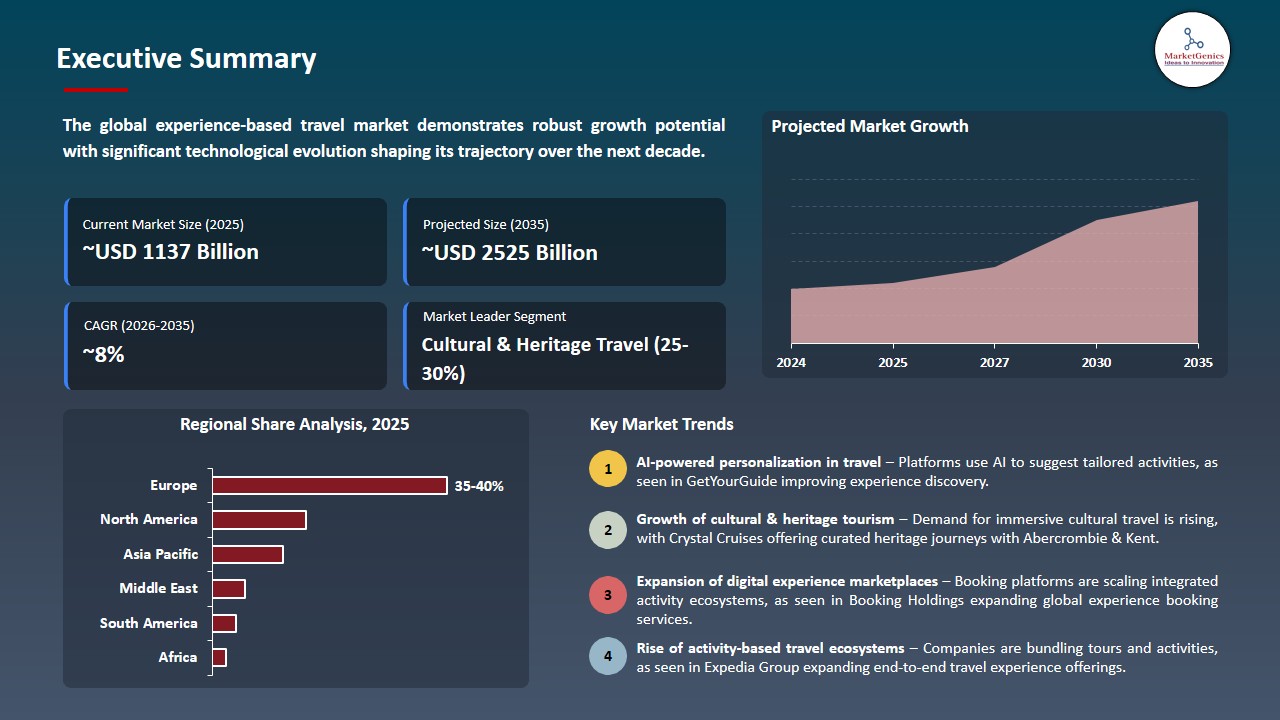
Andrea Carini, CEO of FareHarbor, commented “We’re proud to partner even more closely with Booking.com to give our operators even more ways to grow. This integration unlocks new visibility and demand for experiences on a truly global scale. It’s an exciting step forward in our mission to support local businesses by connecting them to the travelers already booking their trips in their area”.
The experience-based travel market is transforming into a digitally orchestrated journey ecosystem and travel is now a consummation of curated moments, real-time personalization and intent-driven moments of exploration and not the traditional concept of destination based travel. Increasingly, consumers want experiences that are meaningful and have a strong memory, and that immerse them in a travel experience. Consumers' travel needs are changing in global markets, driving preference for meaningful, memory inducing experiences and immersive travel experiences. In October 2025, Marriott International introduced its Outdoor Collection brand, which aims to offer lifestyle-oriented and immersive travel experiences and products through curated nature-based and experience-led lodging formats.
AI-powered tools for journey intelligence, contextual recommendation engines, and real-time mobility data are helping travel platforms to understand user intent more effectively and create dynamic itineraries for the accommodation, transportation, and local experience. This is making travel planning a process that evolves and optimizes continuously, and reacts to behavioural signals, preferences and situational changes along the entire travel lifecycle. This has made personalization a fundamental expectation of travelers in today's day and age.
Adjacent opportunity is emerging as experience-based travel platforms increasingly converge with digital lifestyle ecosystems, where travel planning, mobility services, and experience booking are being integrated into unified super-app environments. This convergence is helping platform-based travel service providers to engage seamlessly across platforms, enhance the user experience and unlock new revenue streams. It is also developing new opportunities to grow the travel industry through the power of the ecosystem.
Experience-based Travel Market Dynamics and Trends
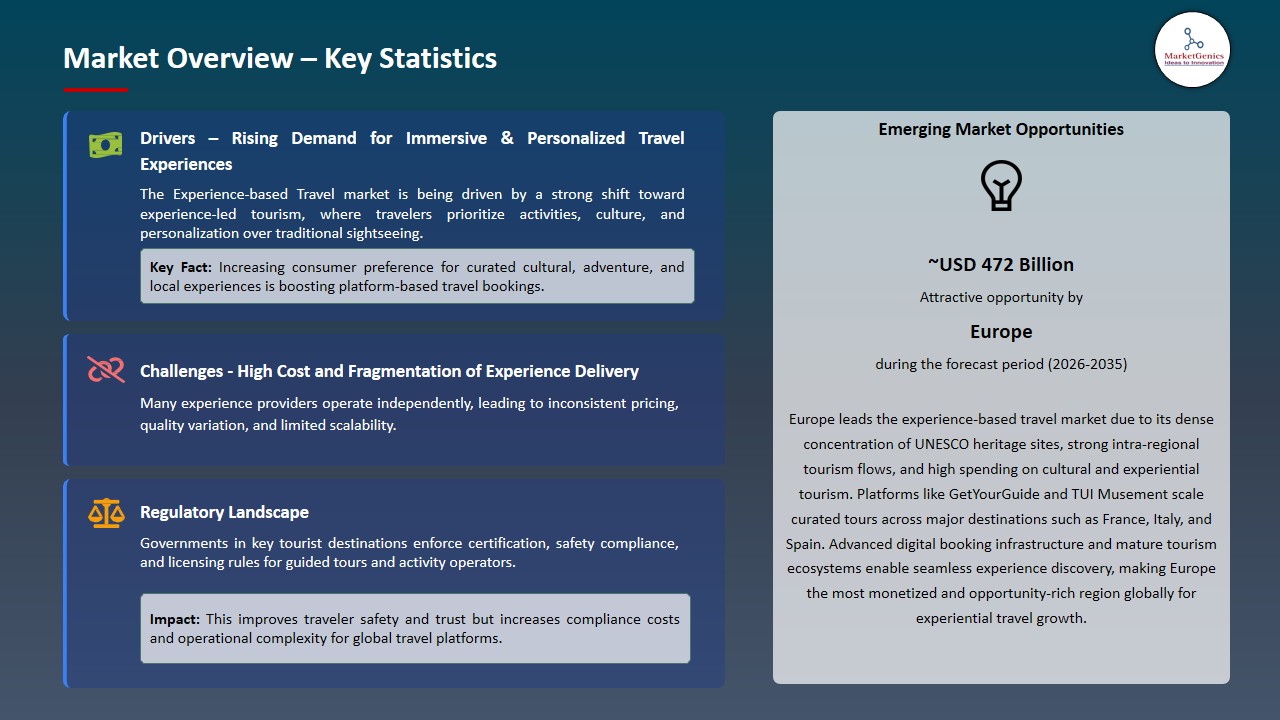
Driver: Rising Demand for Immersive and Personalized Travel Experiences
- The experience-based market is booming globally, with more and more travelers placing a high value on experiences that evoke emotions rather than traditional tourism, and wishing to have curated experiences, offering a blend of culture, adventure, wellness, and local engagement, with highly-personalized travel itineraries.
- AI-powered travel platforms and its incorporation into generative AI is allowing for highly personalized travel planning and real-time recommendations on travel experiences. In October 2024, Klook expanded its collaboration with Google Cloud to bring generative AI features to Klook's platform, which will enrich the personalised discovery and booking of travel experiences with superior AI-driven recommendations.
- As digital marketplaces become more and more a seamless, end-to-end experience for personalized travel, market momentum is increasing.
Restraint: Fragmented Service Ecosystems and Quality Inconsistency
- The experience-based travel market is hampered by disjointed service ecosystems, with fragmented local providers offering poor service quality, impacting traveler experience and reliability of local services across global destinations.
- Lack of uniformity in certification and verification processes for experience providers renders traveler experiences somewhat dubious in terms of authenticity, safety, and consistency of service, particularly in cross-border travel situations where different regions have different regulations for tour operators, making the assurance of services questionable and traveler confidence in digitally booked experiences low.
- Lack of coordination across platforms and local operators creates execution gaps and decreases consistency of end-to-end travel experience across the globe.
Opportunity: Expansion of AI-Driven Experience Aggregation Platforms
- The global experience-based travel market is experiencing growth with the help of AI-powered experience aggregation platforms, which are combining accommodation, transport and local experiences into a single, digital travel hub and providing more personalized and immersive experiences no matter where they go.
- AI recommendation systems and behavioural analytics are revolutionizing the travel discovery and booking journey by offering dynamic, context-aware travel itineraries that align with user preferences and travel intent. In March 2026, GetYourGuide's updated its platform, dubbed the ‘Spring Release,' provides additional artificial intelligence for discovery, as well as greater integration with tours and activities around the globe.
- Digital travel marketplaces and local experience providers are coming together and making travel orchestration end-to-end seamless across discovery, booking and execution of local experiences around the world.
Key Trend: Shift toward Digital Experience Marketplaces and AI-Curated Travel
- The experience-based travel market is transitioning into an AI-curated digital experience marketplaces, where travel platforms embed stays, transport and local experiences into single ecosystems where users can plan their journeys seamlessly through one portal. This is further enhancing experience platforms as focal points of the modern tourist industry.
- AI capabilities are providing insights and analytics that allow for personalized travel experiences in real-time, according to user preferences and the context of the journey. In October 2025, Airbnb released social features for its Experiences platform, enabling travelers to connect with other guests before, during, and after experiences, in order to create a more community-based travel experience ecosystem.
- AI recommendation systems, booking platforms, and experience networks are merging, creating new integrated travel ecosystems where discovery, planning, and booking take place in a seamless travel experience.
Experience-based Travel Market Analysis and Segmental Data
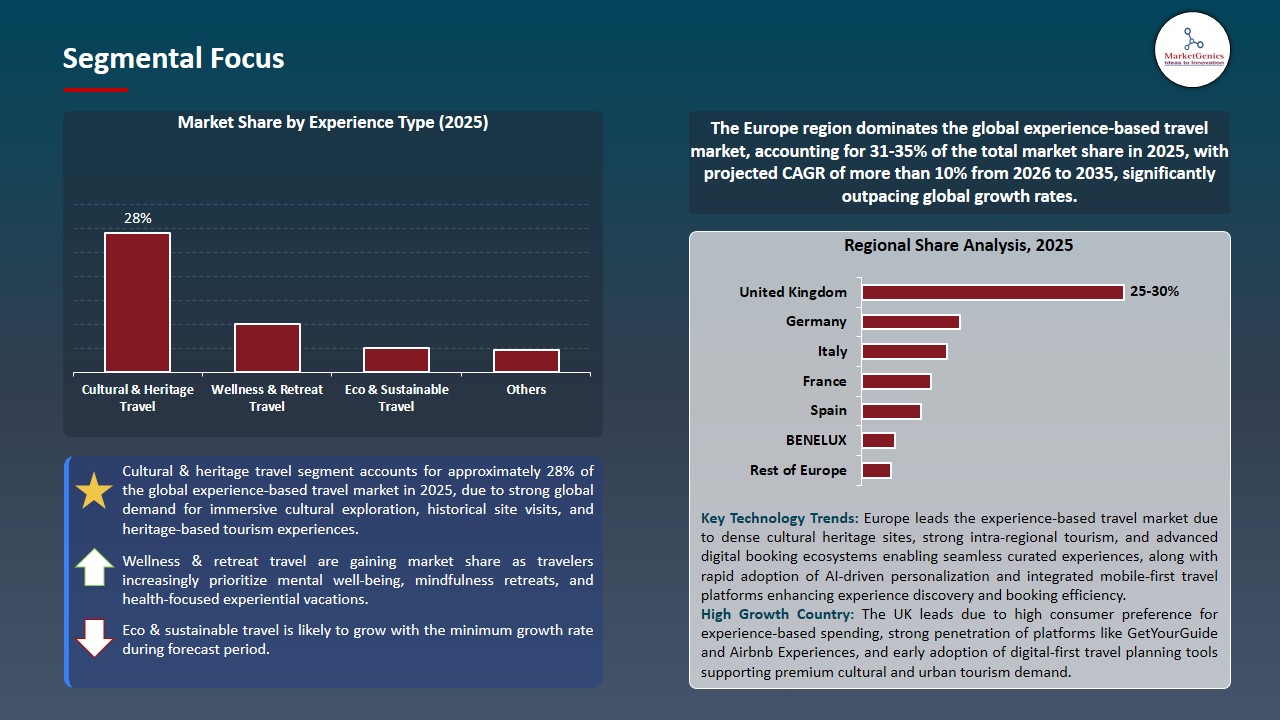
Cultural & Heritage Travel Dominate Global Experience-based Travel Market
- Cultural & heritage Travel leads the global experience-based travel market, fueled by a rise in interest for authentic local experiences, historical exploration and immersive engagement with the local traditions, architecture, and cultural landmarks.
- Travel providers are expanding curated cultural tourism ecosystems to enhance destination immersion. In August 2025, Crystal Cruises partnered with Abercrombie & Kent to launch "By Abercrombie & Kent" experiences, offering exclusive cultural and historical journeys to destinations including Angkor Wat, the Great Wall of China, Tuscany, Rome, and the Taj Mahal.
- The segment's growth is backed by the global experience-based travel market, which remains strong with rising demand for cultural tourism and experiential products and services based on cultural heritage.
Europe Leads Global Experience-based Travel Market Demand
- The experience-based travel market is being led by Europe owing to its rich concentration of cultural destinations, strong demand for immersive tourism, and seamless cross-border travel network. The region has a well-developed tourism sector which contributes to genuine and experiential tourist expenditure.
- The drive to increase the distribution of digitally connected experiences is gaining momentum throughout Europe. In September 2025, TUI Group, via its TUI Musement brand, added over 750 multi-day tours across 30 countries to its TravelExchange platform, thereby enhancing its real-time booking access and distribution of the package tours it offers through its curated travel experiences at key destinations in Europe.
- The rise of AI-driven travel and experience marketplaces and planning solutions adds to Europe's dominance in the experience travel market.
Experience-based Travel Market Ecosystem
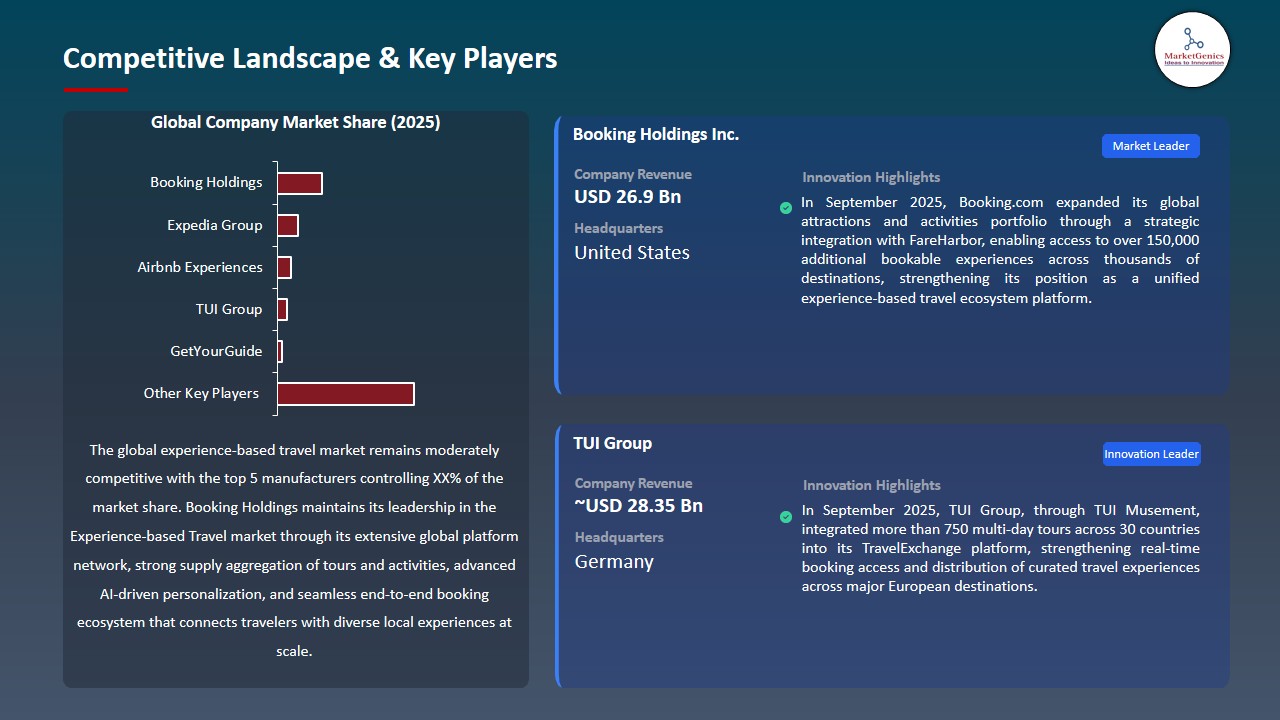
The experience-based travel market is moderately consolidated and is rapidly evolving due to the growing demand for real, personalized and immersive travel experiences. As AI, digital booking systems, mobile apps, and data personalization become a part of the ecosystem, passengers will be able to learn more about their destinations and arrange experiences that go beyond conventional sightseeing. The changing market landscape is also being driven by the desire of consumers for cultural experiences, adventure travel, wellness vacations and community tourism.
Competitors include the companies that create tours, local activities, cultural experiences, adventure trips and customize trips through digital platforms, like Booking Holdings, Expedia Group, Airbnb Experiences, TUI Group, and GetYourGuide. These firms are developing holistic travel ecosystems that encompass travel marketplaces, mobile booking apps, local networks, digital payment solutions, and AI-driven recommendation engines.
The integration with the ecosystem is increasingly significant as the market matures, with the availability management, experience discovery by personalization, seamless booking processes and end-to-end traveler engagement being the key elements that boost customer satisfaction and ensure sustainable growth for the worldwide experience-based travel industry.
 Recent Development and Strategic Overview
- In April 2026, Expedia Group published its insights into “AI Trust Gap”, which showed that, although travelers are turning to AI tools to discover and plan trips, they are still booking through trusted travel brands because of their concerns regarding the trust, safety and assurance in the digital travel ecosystem.
- In September 2025, Booking.com enhanced its global attractions and activities portfolio by partnering with FareHarbor, gaining access to more than 150,000 extra bookable experiences from over 1,000 destinations, further solidifying its role as a single platform for experiences in travel.
Report Scope
|
Detail |
|
|
Market Size in 2025 |
USD 1137.4 Bn |
|
Market Forecast Value in 2035 |
USD 2524.6 Bn |
|
Growth Rate (CAGR) |
8.3% |
|
Forecast Period |
2026 – 2035 |
|
Historical Data Available for |
2021 – 2024 |
|
Market Size Units |
US$ Billion for Value |
|
Report Format |
Electronic (PDF) + Excel |
|
North America |
Europe |
Asia Pacific |
Middle East |
Africa |
South America |
|
|
|
|
|
|
|
Companies Covered |
|||||
|
|||||
Experience-based Travel Market Segmentation and Highlights
|
Segment |
Sub-segment |
|
Experience-based Travel Market, By Experience Type |
|
|
Experience-based Travel Market, By Traveler Type |
|
|
Experience-based Travel Market, By Booking Channel |
|
|
Experience-based Travel Market, By Tour Format |
|
|
Experience-based Travel Market, By Duration of Travel |
|
|
Experience-based Travel Market, By Accommodation Type |
|
Frequently Asked Questions
Table of Contents
- 1. Research Methodology and Assumptions
- 1.1. Definitions
- 1.2. Research Design and Approach
- 1.3. Data Collection Methods
- 1.4. Base Estimates and Calculations
- 1.5. Forecasting Models
- 1.5.1. Key Forecast Factors & Impact Analysis
- 1.6. Secondary Research
- 1.6.1. Open Sources
- 1.6.2. Paid Databases
- 1.6.3. Associations
- 1.7. Primary Research
- 1.7.1. Primary Sources
- 1.7.2. Primary Interviews with Stakeholders across Ecosystem
- 2. Executive Summary
- 2.1. Global Experience-based Travel Market Outlook
- 2.1.1. Experience-based Travel Market Size (Value - US$ Bn), and Forecasts, 2021-2035
- 2.1.2. Compounded Annual Growth Rate Analysis
- 2.1.3. Growth Opportunity Analysis
- 2.1.4. Segmental Share Analysis
- 2.1.5. Geographical Share Analysis
- 2.2. Market Analysis and Facts
- 2.3. Supply-Demand Analysis
- 2.4. Competitive Benchmarking
- 2.5. Go-to- Market Strategy
- 2.5.1. Customer/ End-use Industry Assessment
- 2.5.2. Growth Opportunity Data, 2026-2035
- 2.5.2.1. Regional Data
- 2.5.2.2. Country Data
- 2.5.2.3. Segmental Data
- 2.5.3. Identification of Potential Market Spaces
- 2.5.4. GAP Analysis
- 2.5.5. Potential Attractive Price Points
- 2.5.6. Prevailing Market Risks & Challenges
- 2.5.7. Preferred Sales & Marketing Strategies
- 2.5.8. Key Recommendations and Analysis
- 2.5.9. A Way Forward
- 2.1. Global Experience-based Travel Market Outlook
- 3. Industry Data and Premium Insights
- 3.1. Global Consumer Goods & Services Industry Overview, 2025
- 3.1.1. Consumer Goods & Services Industry Ecosystem Analysis
- 3.1.2. Key Trends for Consumer Goods & Services Industry
- 3.1.3. Regional Distribution for Consumer Goods & Services Industry
- 3.2. Supplier Customer Data
- 3.3. Technology Roadmap and Developments
- 3.4. Trade Analysis
- 3.4.1. Import & Export Analysis, 2025
- 3.4.2. Top Importing Countries
- 3.4.3. Top Exporting Countries
- 3.5. Trump Tariff Impact Analysis
- 3.5.1. Manufacturer
- 3.5.1.1. Based on the component & Raw material
- 3.5.2. Supply Chain
- 3.5.3. End Consumer
- 3.5.1. Manufacturer
- 3.6. Raw Material Analysis
- 3.1. Global Consumer Goods & Services Industry Overview, 2025
- 4. Market Overview
- 4.1. Market Dynamics
- 4.1.1. Drivers
- 4.1.1.1. Rising consumer preference for immersive, authentic, and personalized travel experiences
- 4.1.1.2. Growing adoption of digital booking platforms, AI-powered trip planning, and experience discovery applications
- 4.1.1.3. Increasing demand for cultural, adventure, wellness, and community-based tourism activities
- 4.1.2. Restraints
- 4.1.2.1. High costs associated with premium and curated experiential travel packages
- 4.1.2.2. Economic uncertainty and fluctuations in discretionary consumer spending on travel and leisure activities
- 4.1.1. Drivers
- 4.2. Key Trend Analysis
- 4.3. Regulatory Framework
- 4.3.1. Key Regulations, Norms, and Subsidies, by Key Countries
- 4.3.2. Tariffs and Standards
- 4.3.3. Impact Analysis of Regulations on the Market
- 4.4. Ecosystem Analysis
- 4.5. Porter’s Five Forces Analysis
- 4.6. PESTEL Analysis
- 4.7. Global Experience-based Travel Market Demand
- 4.7.1. Historical Market Size – Value (US$ Bn), 2020-2024
- 4.7.2. Current and Future Market Size – Value (US$ Bn), 2026–2035
- 4.7.2.1. Y-o-Y Growth Trends
- 4.7.2.2. Absolute $ Opportunity Assessment
- 4.1. Market Dynamics
- 5. Competition Landscape
- 5.1. Competition structure
- 5.1.1. Fragmented v/s consolidated
- 5.2. Company Share Analysis, 2025
- 5.2.1. Global Company Market Share
- 5.2.2. By Region
- 5.2.2.1. North America
- 5.2.2.2. Europe
- 5.2.2.3. Asia Pacific
- 5.2.2.4. Middle East
- 5.2.2.5. Africa
- 5.2.2.6. South America
- 5.3. Product Comparison Matrix
- 5.3.1. Specifications
- 5.3.2. Market Positioning
- 5.3.3. Pricing
- 5.1. Competition structure
- 6. Global Experience-based Travel Market Analysis, by Experience Type
- 6.1. Key Segment Analysis
- 6.2. Experience-based Travel Market Size (Value - US$ Bn), Analysis, and Forecasts, by Experience Type, 2021-2035
- 6.2.1. Adventure Travel
- 6.2.2. Cultural & Heritage Travel
- 6.2.3. Wellness & Retreat Travel
- 6.2.4. Culinary & Gastronomy Travel
- 6.2.5. Eco & Sustainable Travel
- 6.2.6. Luxury Experiential Travel
- 6.2.7. Entertainment & Event-Based Travel
- 6.2.8. Educational & Skill-Based Travel
- 6.2.9. Voluntourism & Community-based Travel
- 6.2.10. Dark Tourism
- 6.2.11. Others
- 7. Global Experience-based Travel Market Analysis, by Traveler Type
- 7.1. Key Segment Analysis
- 7.2. Experience-based Travel Market Size (Value - US$ Bn), Analysis, and Forecasts, by Subscription Model Type, 2021-2035
- 7.2.1. Solo Travelers
- 7.2.2. Couples & Honeymooners
- 7.2.3. Family Travelers
- 7.2.4. Group Travelers
- 7.2.5. Senior Travelers
- 7.2.6. Business Travelers
- 8. Global Experience-based Travel Market Analysis, by Booking Channel
- 8.1. Key Segment Analysis
- 8.2. Experience-based Travel Market Size (Value - US$ Bn), Analysis, and Forecasts, by Booking Channel, 2021-2035
- 8.2.1. Online Travel Agencies (OTAs)
- 8.2.2. Direct Booking Platforms
- 8.2.3. Travel Consultants & Agencies
- 8.2.4. Corporate Booking Platforms
- 8.2.5. Destination Management Companies
- 8.2.6. Subscription-Based Travel Platforms
- 9. Global Experience-based Travel Market Analysis, by Tour Format
- 9.1. Key Segment Analysis
- 9.2. Experience-based Travel Market Size (Value - US$ Bn), Analysis, and Forecasts, by Tour Format, 2021-2035
- 9.2.1. Guided Group Tours
- 9.2.2. Private & Customized Tours
- 9.2.3. Self-guided Tours
- 9.2.4. Hosted & Curated Retreats
- 9.2.5. Day Trips & Short Excursions
- 9.2.6. Multi-day Expeditions
- 9.2.7. Virtual & Hybrid Experience Tours
- 10. Global Experience-based Travel Market Analysis, by Duration of Travel
- 10.1. Key Segment Analysis
- 10.2. Experience-based Travel Market Size (Value - US$ Bn), Analysis, and Forecasts, by Duration of Travel, 2021-2035
- 10.2.1. Short Getaways (1–3 Days)
- 10.2.2. Medium-Duration Trips (4–7 Days)
- 10.2.3. Extended Vacations (8–14 Days)
- 10.2.4. Long-Term Immersive Travel
- 10.2.5. Seasonal Travel Programs
- 11. Global Experience-based Travel Market Analysis, by Accommodation Type
- 11.1. Key Segment Analysis
- 11.2. Experience-based Travel Market Size (Value - US$ Bn), Analysis, and Forecasts, by Accommodation Type, 2021-2035
- 11.2.1. Boutique & Heritage Hotels
- 11.2.2. Eco-lodges & Glamping Sites
- 11.2.3. Homestays & Farmstays
- 11.2.4. Luxury Resorts & Retreats
- 11.2.5. Hostels & Social Stay Properties
- 11.2.6. Cruise & Expedition Vesse
- 11.2.7. Overwater Bungalows
- 11.2.8. Others
- 12. Global Experience-based Travel Market Analysis and Forecasts, by Region
- 12.1. Key Findings
- 12.2. Experience-based Travel Market Size (Value - US$ Bn), Analysis, and Forecasts, by Region, 2021-2035
- 12.2.1. North America
- 12.2.2. Europe
- 12.2.3. Asia Pacific
- 12.2.4. Middle East
- 12.2.5. Africa
- 12.2.6. South America
- 13. North America Experience-based Travel Market Analysis
- 13.1. Key Segment Analysis
- 13.2. Regional Snapshot
- 13.3. North America Experience-based Travel Market Size (Value - US$ Bn), Analysis, and Forecasts, 2021-2035
- 13.3.1. Experience Type
- 13.3.2. Traveler Type
- 13.3.3. Booking Channel
- 13.3.4. Tour Format
- 13.3.5. Duration of Travel
- 13.3.6. Accommodation Type
- 13.3.7. Country
- 13.3.7.1. USA
- 13.3.7.2. Canada
- 13.3.7.3. Mexico
- 13.4. USA Experience-based Travel Market
- 13.4.1. Country Segmental Analysis
- 13.4.2. Experience Type
- 13.4.3. Traveler Type
- 13.4.4. Booking Channel
- 13.4.5. Tour Format
- 13.4.6. Duration of Travel
- 13.4.7. Accommodation Type
- 13.5. Canada Experience-based Travel Market
- 13.5.1. Country Segmental Analysis
- 13.5.2. Experience Type
- 13.5.3. Traveler Type
- 13.5.4. Booking Channel
- 13.5.5. Tour Format
- 13.5.6. Duration of Travel
- 13.5.7. Accommodation Type
- 13.6. Mexico Experience-based Travel Market
- 13.6.1. Country Segmental Analysis
- 13.6.2. Experience Type
- 13.6.3. Traveler Type
- 13.6.4. Booking Channel
- 13.6.5. Tour Format
- 13.6.6. Duration of Travel
- 13.6.7. Accommodation Type
- 14. Europe Experience-based Travel Market Analysis
- 14.1. Key Segment Analysis
- 14.2. Regional Snapshot
- 14.3. Europe Experience-based Travel Market Size (Value - US$ Bn), Analysis, and Forecasts, 2021-2035
- 14.3.1. Experience Type
- 14.3.2. Traveler Type
- 14.3.3. Booking Channel
- 14.3.4. Tour Format
- 14.3.5. Duration of Travel
- 14.3.6. Accommodation Type
- 14.3.7. Country
- 14.3.7.1. Germany
- 14.3.7.2. United Kingdom
- 14.3.7.3. France
- 14.3.7.4. Italy
- 14.3.7.5. Spain
- 14.3.7.6. Netherlands
- 14.3.7.7. Nordic Countries
- 14.3.7.8. Poland
- 14.3.7.9. Russia & CIS
- 14.3.7.10. Rest of Europe
- 14.4. Germany Experience-based Travel Market
- 14.4.1. Country Segmental Analysis
- 14.4.2. Experience Type
- 14.4.3. Traveler Type
- 14.4.4. Booking Channel
- 14.4.5. Tour Format
- 14.4.6. Duration of Travel
- 14.4.7. Accommodation Type
- 14.5. United Kingdom Experience-based Travel Market
- 14.5.1. Country Segmental Analysis
- 14.5.2. Experience Type
- 14.5.3. Traveler Type
- 14.5.4. Booking Channel
- 14.5.5. Tour Format
- 14.5.6. Duration of Travel
- 14.5.7. Accommodation Type
- 14.6. France Experience-based Travel Market
- 14.6.1. Country Segmental Analysis
- 14.6.2. Experience Type
- 14.6.3. Traveler Type
- 14.6.4. Booking Channel
- 14.6.5. Tour Format
- 14.6.6. Duration of Travel
- 14.6.7. Accommodation Type
- 14.7. Italy Experience-based Travel Market
- 14.7.1. Country Segmental Analysis
- 14.7.2. Experience Type
- 14.7.3. Traveler Type
- 14.7.4. Booking Channel
- 14.7.5. Tour Format
- 14.7.6. Duration of Travel
- 14.7.7. Accommodation Type
- 14.8. Spain Experience-based Travel Market
- 14.8.1. Country Segmental Analysis
- 14.8.2. Experience Type
- 14.8.3. Traveler Type
- 14.8.4. Booking Channel
- 14.8.5. Tour Format
- 14.8.6. Duration of Travel
- 14.8.7. Accommodation Type
- 14.9. Netherlands Experience-based Travel Market
- 14.9.1. Country Segmental Analysis
- 14.9.2. Experience Type
- 14.9.3. Traveler Type
- 14.9.4. Booking Channel
- 14.9.5. Tour Format
- 14.9.6. Duration of Travel
- 14.9.7. Accommodation Type
- 14.10. Nordic Countries Experience-based Travel Market
- 14.10.1. Country Segmental Analysis
- 14.10.2. Experience Type
- 14.10.3. Traveler Type
- 14.10.4. Booking Channel
- 14.10.5. Tour Format
- 14.10.6. Duration of Travel
- 14.10.7. Accommodation Type
- 14.11. Poland Experience-based Travel Market
- 14.11.1. Country Segmental Analysis
- 14.11.2. Experience Type
- 14.11.3. Traveler Type
- 14.11.4. Booking Channel
- 14.11.5. Tour Format
- 14.11.6. Duration of Travel
- 14.11.7. Accommodation Type
- 14.12. Russia & CIS Experience-based Travel Market
- 14.12.1. Country Segmental Analysis
- 14.12.2. Experience Type
- 14.12.3. Traveler Type
- 14.12.4. Booking Channel
- 14.12.5. Tour Format
- 14.12.6. Duration of Travel
- 14.12.7. Accommodation Type
- 14.13. Rest of Europe Experience-based Travel Market
- 14.13.1. Country Segmental Analysis
- 14.13.2. Experience Type
- 14.13.3. Traveler Type
- 14.13.4. Booking Channel
- 14.13.5. Tour Format
- 14.13.6. Duration of Travel
- 14.13.7. Accommodation Type
- 15. Asia Pacific Experience-based Travel Market Analysis
- 15.1. Key Segment Analysis
- 15.2. Regional Snapshot
- 15.3. Asia Pacific Experience-based Travel Market Size (Value - US$ Bn), Analysis, and Forecasts, 2021-2035
- 15.3.1. Experience Type
- 15.3.2. Traveler Type
- 15.3.3. Booking Channel
- 15.3.4. Tour Format
- 15.3.5. Duration of Travel
- 15.3.6. Accommodation Type
- 15.3.7. Country
- 15.3.7.1. China
- 15.3.7.2. India
- 15.3.7.3. Japan
- 15.3.7.4. South Korea
- 15.3.7.5. Australia and New Zealand
- 15.3.7.6. Indonesia
- 15.3.7.7. Malaysia
- 15.3.7.8. Thailand
- 15.3.7.9. Vietnam
- 15.3.7.10. Rest of Asia Pacific
- 15.4. China Experience-based Travel Market
- 15.4.1. Country Segmental Analysis
- 15.4.2. Experience Type
- 15.4.3. Traveler Type
- 15.4.4. Booking Channel
- 15.4.5. Tour Format
- 15.4.6. Duration of Travel
- 15.4.7. Accommodation Type
- 15.5. India Experience-based Travel Market
- 15.5.1. Country Segmental Analysis
- 15.5.2. Experience Type
- 15.5.3. Traveler Type
- 15.5.4. Booking Channel
- 15.5.5. Tour Format
- 15.5.6. Duration of Travel
- 15.5.7. Accommodation Type
- 15.6. Japan Experience-based Travel Market
- 15.6.1. Country Segmental Analysis
- 15.6.2. Experience Type
- 15.6.3. Traveler Type
- 15.6.4. Booking Channel
- 15.6.5. Tour Format
- 15.6.6. Duration of Travel
- 15.6.7. Accommodation Type
- 15.7. South Korea Experience-based Travel Market
- 15.7.1. Country Segmental Analysis
- 15.7.2. Experience Type
- 15.7.3. Traveler Type
- 15.7.4. Booking Channel
- 15.7.5. Tour Format
- 15.7.6. Duration of Travel
- 15.7.7. Accommodation Type
- 15.8. Australia and New Zealand Experience-based Travel Market
- 15.8.1. Country Segmental Analysis
- 15.8.2. Experience Type
- 15.8.3. Traveler Type
- 15.8.4. Booking Channel
- 15.8.5. Tour Format
- 15.8.6. Duration of Travel
- 15.8.7. Accommodation Type
- 15.9. Indonesia Experience-based Travel Market
- 15.9.1. Country Segmental Analysis
- 15.9.2. Experience Type
- 15.9.3. Traveler Type
- 15.9.4. Booking Channel
- 15.9.5. Tour Format
- 15.9.6. Duration of Travel
- 15.9.7. Accommodation Type
- 15.10. Malaysia Experience-based Travel Market
- 15.10.1. Country Segmental Analysis
- 15.10.2. Experience Type
- 15.10.3. Traveler Type
- 15.10.4. Booking Channel
- 15.10.5. Tour Format
- 15.10.6. Duration of Travel
- 15.10.7. Accommodation Type
- 15.11. Thailand Experience-based Travel Market
- 15.11.1. Country Segmental Analysis
- 15.11.2. Experience Type
- 15.11.3. Traveler Type
- 15.11.4. Booking Channel
- 15.11.5. Tour Format
- 15.11.6. Duration of Travel
- 15.11.7. Accommodation Type
- 15.12. Vietnam Experience-based Travel Market
- 15.12.1. Country Segmental Analysis
- 15.12.2. Experience Type
- 15.12.3. Traveler Type
- 15.12.4. Booking Channel
- 15.12.5. Tour Format
- 15.12.6. Duration of Travel
- 15.12.7. Accommodation Type
- 15.13. Rest of Asia Pacific Experience-based Travel Market
- 15.13.1. Country Segmental Analysis
- 15.13.2. Experience Type
- 15.13.3. Traveler Type
- 15.13.4. Booking Channel
- 15.13.5. Tour Format
- 15.13.6. Duration of Travel
- 15.13.7. Accommodation Type
- 16. Middle East Experience-based Travel Market Analysis
- 16.1. Key Segment Analysis
- 16.2. Regional Snapshot
- 16.3. Middle East Experience-based Travel Market Size (Value - US$ Bn), Analysis, and Forecasts, 2021-2035
- 16.3.1. Experience Type
- 16.3.2. Traveler Type
- 16.3.3. Booking Channel
- 16.3.4. Tour Format
- 16.3.5. Duration of Travel
- 16.3.6. Accommodation Type
- 16.3.7. Country
- 16.3.7.1. Turkey
- 16.3.7.2. UAE
- 16.3.7.3. Saudi Arabia
- 16.3.7.4. Israel
- 16.3.7.5. Rest of Middle East
- 16.4. Turkey Experience-based Travel Market
- 16.4.1. Country Segmental Analysis
- 16.4.2. Experience Type
- 16.4.3. Traveler Type
- 16.4.4. Booking Channel
- 16.4.5. Tour Format
- 16.4.6. Duration of Travel
- 16.4.7. Accommodation Type
- 16.5. UAE Experience-based Travel Market
- 16.5.1. Country Segmental Analysis
- 16.5.2. Experience Type
- 16.5.3. Traveler Type
- 16.5.4. Booking Channel
- 16.5.5. Tour Format
- 16.5.6. Duration of Travel
- 16.5.7. Accommodation Type
- 16.6. Saudi Arabia Experience-based Travel Market
- 16.6.1. Country Segmental Analysis
- 16.6.2. Experience Type
- 16.6.3. Traveler Type
- 16.6.4. Booking Channel
- 16.6.5. Tour Format
- 16.6.6. Duration of Travel
- 16.6.7. Accommodation Type
- 16.7. Israel Experience-based Travel Market
- 16.7.1. Country Segmental Analysis
- 16.7.2. Experience Type
- 16.7.3. Traveler Type
- 16.7.4. Booking Channel
- 16.7.5. Tour Format
- 16.7.6. Duration of Travel
- 16.7.7. Accommodation Type
- 16.8. Rest of Middle East Experience-based Travel Market
- 16.8.1. Country Segmental Analysis
- 16.8.2. Experience Type
- 16.8.3. Traveler Type
- 16.8.4. Booking Channel
- 16.8.5. Tour Format
- 16.8.6. Duration of Travel
- 16.8.7. Accommodation Type
- 17. Africa Experience-based Travel Market Analysis
- 17.1. Key Segment Analysis
- 17.2. Regional Snapshot
- 17.3. Africa Experience-based Travel Market Size (Value - US$ Bn), Analysis, and Forecasts, 2021-2035
- 17.3.1. Experience Type
- 17.3.2. Traveler Type
- 17.3.3. Booking Channel
- 17.3.4. Tour Format
- 17.3.5. Duration of Travel
- 17.3.6. Accommodation Type
- 17.3.7. Country
- 17.3.7.1. South Africa
- 17.3.7.2. Egypt
- 17.3.7.3. Nigeria
- 17.3.7.4. Algeria
- 17.3.7.5. Rest of Africa
- 17.4. South Africa Experience-based Travel Market
- 17.4.1. Country Segmental Analysis
- 17.4.2. Experience Type
- 17.4.3. Traveler Type
- 17.4.4. Booking Channel
- 17.4.5. Tour Format
- 17.4.6. Duration of Travel
- 17.4.7. Accommodation Type
- 17.5. Egypt Experience-based Travel Market
- 17.5.1. Country Segmental Analysis
- 17.5.2. Experience Type
- 17.5.3. Traveler Type
- 17.5.4. Booking Channel
- 17.5.5. Tour Format
- 17.5.6. Duration of Travel
- 17.5.7. Accommodation Type
- 17.6. Nigeria Experience-based Travel Market
- 17.6.1. Country Segmental Analysis
- 17.6.2. Experience Type
- 17.6.3. Traveler Type
- 17.6.4. Booking Channel
- 17.6.5. Tour Format
- 17.6.6. Duration of Travel
- 17.6.7. Accommodation Type
- 17.7. Algeria Experience-based Travel Market
- 17.7.1. Country Segmental Analysis
- 17.7.2. Experience Type
- 17.7.3. Traveler Type
- 17.7.4. Booking Channel
- 17.7.5. Tour Format
- 17.7.6. Duration of Travel
- 17.7.7. Accommodation Type
- 17.8. Rest of Africa Experience-based Travel Market
- 17.8.1. Country Segmental Analysis
- 17.8.2. Experience Type
- 17.8.3. Traveler Type
- 17.8.4. Booking Channel
- 17.8.5. Tour Format
- 17.8.6. Duration of Travel
- 17.8.7. Accommodation Type
- 18. South America Experience-based Travel Market Analysis
- 18.1. Key Segment Analysis
- 18.2. Regional Snapshot
- 18.3. South America Experience-based Travel Market Size (Value - US$ Bn), Analysis, and Forecasts, 2021-2035
- 18.3.1. Experience Type
- 18.3.2. Traveler Type
- 18.3.3. Booking Channel
- 18.3.4. Tour Format
- 18.3.5. Duration of Travel
- 18.3.6. Accommodation Type
- 18.3.7. Country
- 18.3.7.1. Brazil
- 18.3.7.2. Argentina
- 18.3.7.3. Rest of South America
- 18.4. Brazil Experience-based Travel Market
- 18.4.1. Country Segmental Analysis
- 18.4.2. Experience Type
- 18.4.3. Traveler Type
- 18.4.4. Booking Channel
- 18.4.5. Tour Format
- 18.4.6. Duration of Travel
- 18.4.7. Accommodation Type
- 18.5. Argentina Experience-based Travel Market
- 18.5.1. Country Segmental Analysis
- 18.5.2. Experience Type
- 18.5.3. Traveler Type
- 18.5.4. Booking Channel
- 18.5.5. Tour Format
- 18.5.6. Duration of Travel
- 18.5.7. Accommodation Type
- 18.6. Rest of South America Experience-based Travel Market
- 18.6.1. Country Segmental Analysis
- 18.6.2. Experience Type
- 18.6.3. Traveler Type
- 18.6.4. Booking Channel
- 18.6.5. Tour Format
- 18.6.6. Duration of Travel
- 18.6.7. Accommodation Type
- 19. Key Players/ Company Profile
- 19.1. &Beyond.
- 19.1.1. Company Details/ Overview
- 19.1.2. Company Financials
- 19.1.3. Key Customers and Competitors
- 19.1.4. Business/ Industry Portfolio
- 19.1.5. Product Portfolio/ Specification Details
- 19.1.6. Pricing Data
- 19.1.7. Strategic Overview
- 19.1.8. Recent Developments
- 19.2. Abercrombie & Kent
- 19.3. Airbnb Experiences
- 19.4. Booking Holdings
- 19.5. Butterfield & Robinson
- 19.6. Contiki Holidays
- 19.7. Cox & Kings
- 19.8. Expedia Group
- 19.9. G Adventures
- 19.10. GetYourGuide
- 19.11. Intrepid Travel
- 19.12. Lindblad Expeditions
- 19.13. Natural Habitat Adventures
- 19.14. Scott Dunn
- 19.15. Tauck World Discovery
- 19.16. Trafalgar Tours
- 19.17. TUI Group
- 19.18. Viator (TripAdvisor Company)
- 19.19. Other Key Players
- 19.1. &Beyond.
Note* - This is just tentative list of players. While providing the report, we will cover more number of players based on their revenue and share for each geography
Research Design
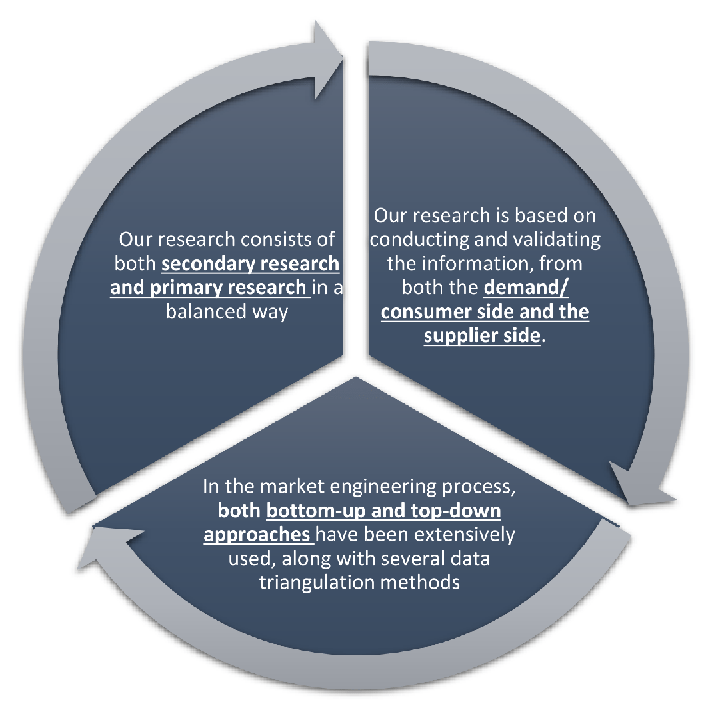
Our research design integrates both demand-side and supply-side analysis through a balanced combination of primary and secondary research methodologies. By utilizing both bottom-up and top-down approaches alongside rigorous data triangulation methods, we deliver robust market intelligence that supports strategic decision-making.
MarketGenics' comprehensive research design framework ensures the delivery of accurate, reliable, and actionable market intelligence. Through the integration of multiple research approaches, rigorous validation processes, and expert analysis, we provide our clients with the insights needed to make informed strategic decisions and capitalize on market opportunities.
MarketGenics leverages a dedicated industry panel of experts and a comprehensive suite of paid databases to effectively collect, consolidate, and analyze market intelligence.
Our approach has consistently proven to be reliable and effective in generating accurate market insights, identifying key industry trends, and uncovering emerging business opportunities.
Through both primary and secondary research, we capture and analyze critical company-level data such as manufacturing footprints, including technical centers, R&D facilities, sales offices, and headquarters.
Our expert panel further enhances our ability to estimate market size for specific brands based on validated field-level intelligence.
Our data mining techniques incorporate both parametric and non-parametric methods, allowing for structured data collection, sorting, processing, and cleaning.
Demand projections are derived from large-scale data sets analyzed through proprietary algorithms, culminating in robust and reliable market sizing.
Research Approach
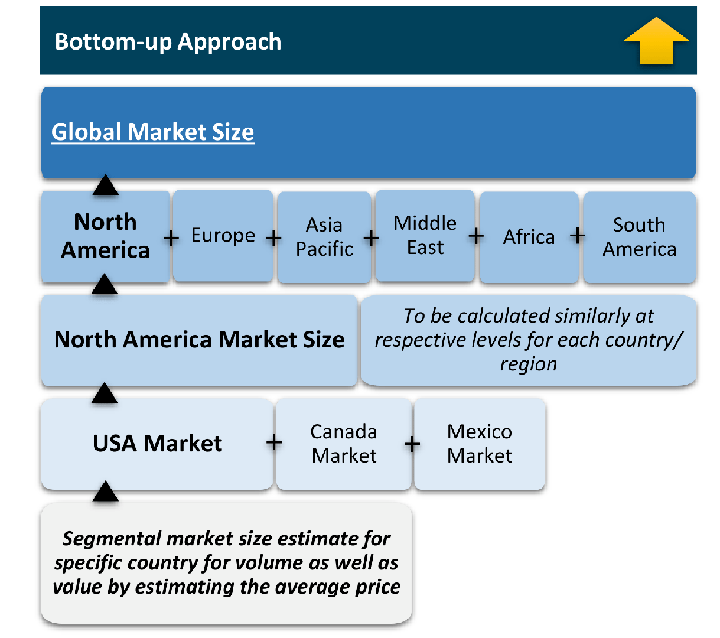
The bottom-up approach builds market estimates by starting with the smallest addressable market units and systematically aggregating them to create comprehensive market size projections.
This method begins with specific, granular data points and builds upward to create the complete market landscape.
Customer Analysis → Segmental Analysis → Geographical Analysis
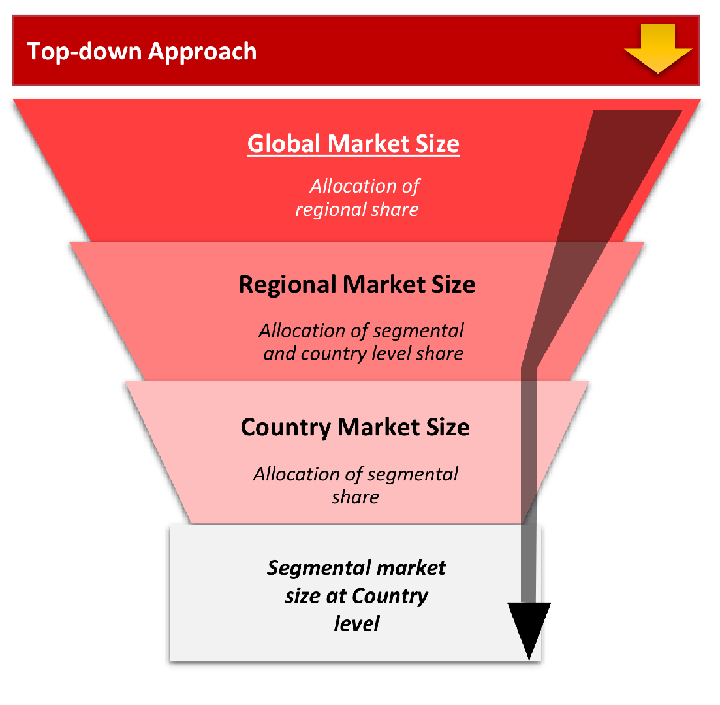
The top-down approach starts with the broadest possible market data and systematically narrows it down through a series of filters and assumptions to arrive at specific market segments or opportunities.
This method begins with the big picture and works downward to increasingly specific market slices.
TAM → SAM → SOM
Research Methods
Desk / Secondary Research
While analysing the market, we extensively study secondary sources, directories, and databases to identify and collect information useful for this technical, market-oriented, and commercial report. Secondary sources that we utilize are not only the public sources, but it is a combination of Open Source, Associations, Paid Databases, MG Repository & Knowledgebase, and others.
- Company websites, annual reports, financial reports, broker reports, and investor presentations
- National government documents, statistical databases and reports
- News articles, press releases and web-casts specific to the companies operating in the market, Magazines, reports, and others
- We gather information from commercial data sources for deriving company specific data such as segmental revenue, share for geography, product revenue, and others
- Internal and external proprietary databases (industry-specific), relevant patent, and regulatory databases
- Governing Bodies, Government Organizations
- Relevant Authorities, Country-specific Associations for Industries
We also employ the model mapping approach to estimate the product level market data through the players' product portfolio
Primary Research
Primary research/ interviews is vital in analyzing the market. Most of the cases involves paid primary interviews. Primary sources include primary interviews through e-mail interactions, telephonic interviews, surveys as well as face-to-face interviews with the different stakeholders across the value chain including several industry experts.
| Type of Respondents | Number of Primaries |
|---|---|
| Tier 2/3 Suppliers | ~20 |
| Tier 1 Suppliers | ~25 |
| End-users | ~25 |
| Industry Expert/ Panel/ Consultant | ~30 |
| Total | ~100 |
MG Knowledgebase
• Repository of industry blog, newsletter and case studies
• Online platform covering detailed market reports, and company profiles
Forecasting Factors and Models
Forecasting Factors
- Historical Trends – Past market patterns, cycles, and major events that shaped how markets behave over time. Understanding past trends helps predict future behavior.
- Industry Factors – Specific characteristics of the industry like structure, regulations, and innovation cycles that affect market dynamics.
- Macroeconomic Factors – Economic conditions like GDP growth, inflation, and employment rates that affect how much money people have to spend.
- Demographic Factors – Population characteristics like age, income, and location that determine who can buy your product.
- Technology Factors – How quickly people adopt new technology and how much technology infrastructure exists.
- Regulatory Factors – Government rules, laws, and policies that can help or restrict market growth.
- Competitive Factors – Analyzing competition structure such as degree of competition and bargaining power of buyers and suppliers.
Forecasting Models / Techniques
Multiple Regression Analysis
- Identify and quantify factors that drive market changes
- Statistical modeling to establish relationships between market drivers and outcomes
Time Series Analysis – Seasonal Patterns
- Understand regular cyclical patterns in market demand
- Advanced statistical techniques to separate trend, seasonal, and irregular components
Time Series Analysis – Trend Analysis
- Identify underlying market growth patterns and momentum
- Statistical analysis of historical data to project future trends
Expert Opinion – Expert Interviews
- Gather deep industry insights and contextual understanding
- In-depth interviews with key industry stakeholders
Multi-Scenario Development
- Prepare for uncertainty by modeling different possible futures
- Creating optimistic, pessimistic, and most likely scenarios
Time Series Analysis – Moving Averages
- Sophisticated forecasting for complex time series data
- Auto-regressive integrated moving average models with seasonal components
Econometric Models
- Apply economic theory to market forecasting
- Sophisticated economic models that account for market interactions
Expert Opinion – Delphi Method
- Harness collective wisdom of industry experts
- Structured, multi-round expert consultation process
Monte Carlo Simulation
- Quantify uncertainty and probability distributions
- Thousands of simulations with varying input parameters
Research Analysis
Our research framework is built upon the fundamental principle of validating market intelligence from both demand and supply perspectives. This dual-sided approach ensures comprehensive market understanding and reduces the risk of single-source bias.
Demand-Side Analysis: We understand end-user/application behavior, preferences, and market needs along with the penetration of the product for specific application.
Supply-Side Analysis: We estimate overall market revenue, analyze the segmental share along with industry capacity, competitive landscape, and market structure.
Validation & Evaluation
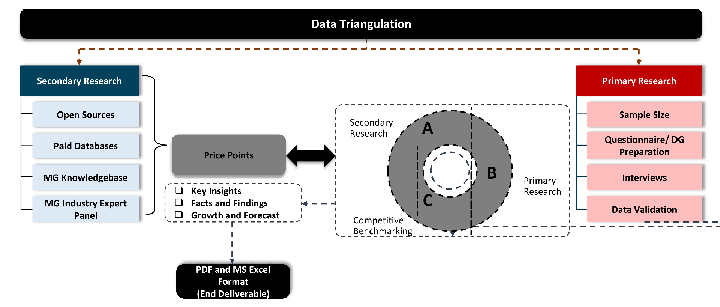
Data triangulation is a validation technique that uses multiple methods, sources, or perspectives to examine the same research question, thereby increasing the credibility and reliability of research findings. In market research, triangulation serves as a quality assurance mechanism that helps identify and minimize bias, validate assumptions, and ensure accuracy in market estimates.
- Data Source Triangulation – Using multiple data sources to examine the same phenomenon
- Methodological Triangulation – Using multiple research methods to study the same research question
- Investigator Triangulation – Using multiple researchers or analysts to examine the same data
- Theoretical Triangulation – Using multiple theoretical perspectives to interpret the same data
Custom Market Research Services
We will customise the research for you, in case the report listed above does not meet your requirements.
Get 10% Free Customisation