Home Fragrance Market Size, Share & Trends Analysis Report by Product Type (Candles, Reed Diffusers, Room Sprays & Mists, Essential Oil Diffusers, Incense, Wax Melts & Tarts, Potpourri, Sachets & Scented Bags, Car & Portable Air Fresheners (adjacent/crossover), Scented Gels & Beads, Others), Fragrance Type, Raw Material / Ingredient Type, Packaging Type, Consumer / Buyer Type, Distribution Channel, and Geography (North America, Europe, Asia Pacific, Middle East, Africa, and South America) – Global Industry Data, Trends, and Forecasts, 2026–2035
|
|
|
Segmental Data Insights |
|
|
Demand Trends |
|
|
Competitive Landscape |
|
|
Strategic Development |
|
|
Future Outlook & Opportunities |
|
Home Fragrance Market Size, Share, and Growth
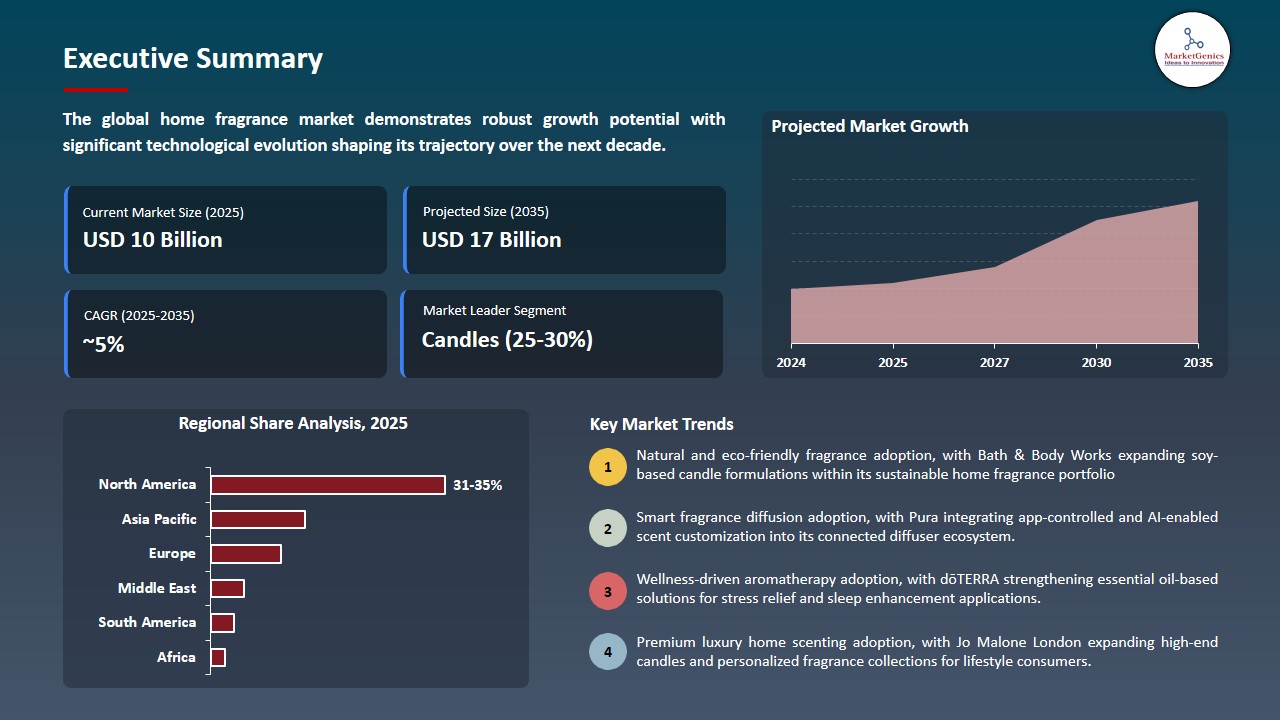
The global home fragrance market is witnessing strong growth, valued at USD 9.8 billion in 2025 and projected to reach USD 16.7 billion by 2035, expanding at a CAGR of 5.4% during the forecast period. Fragrance systems powered by artificial intelligence are revolutionizing ambient scenting, providing users the ability to control, manipulate, and perfect the indoor scentscape through the use of interconnected diffusers, sensor inputs, and advanced scent analysis.
Vivek Sirohi, Head of Unilever Fragrance House, said, India is one of Unilever’s most important growth markets and a critical engine of innovation for our global business. The inauguration of the Unilever Fragrance Hub in Mumbai reflects our continued investment in cutting-edge capabilities that bring together science, technology and deep consumer insights. It enables faster local response, deeper market understanding, improved self-reliance in application and evaluation, and a greater ability to design fragrances from the product and consumer context outward.
The global home fragrance market is witnessing a revolution due to what is being termed as the "scent intelligence system." The design of the aroma in any environment will now be based upon contextual factors such as the presence of people, the quality of the indoor air and the state of mind created by the spatial environment. With the use of new technological applications such as diffusion technology, micro-encapsulation methods and fragrances that can adapt according to the context of the moment, there has been an entire transformation in the way fragrances function.
Home fragrances' product development is moving toward a trend of modular fragrance ecosystems, whereby consumers will have the ability to layer and rotate their fragrances and also customize them via algorithms. Manufacturers are developing diffusers that are precision engineered, scented cartridges, and apps for creating "signature scent environments." The intersection of material technology and digital engineering is facilitating hyper-localized sensory experiences in home settings beyond the conventional scented candles and aerosols.
Adjacent opportunity is emerging as home fragrance integrates with spatial experience design and smart interior ecosystems, where scent becomes a core component of environmental storytelling in residential and hospitality settings. This shift is giving rise to subscription-based scent curation services, AI-assisted fragrance recommendation engines, and interoperable home ambiance platforms that synchronize lighting, sound, and aroma. As experiential living becomes a defining consumer trend, home fragrance is evolving into a key interface for emotional design, memory activation, and immersive domestic environments.
Home Fragrance Market Dynamics and Trends
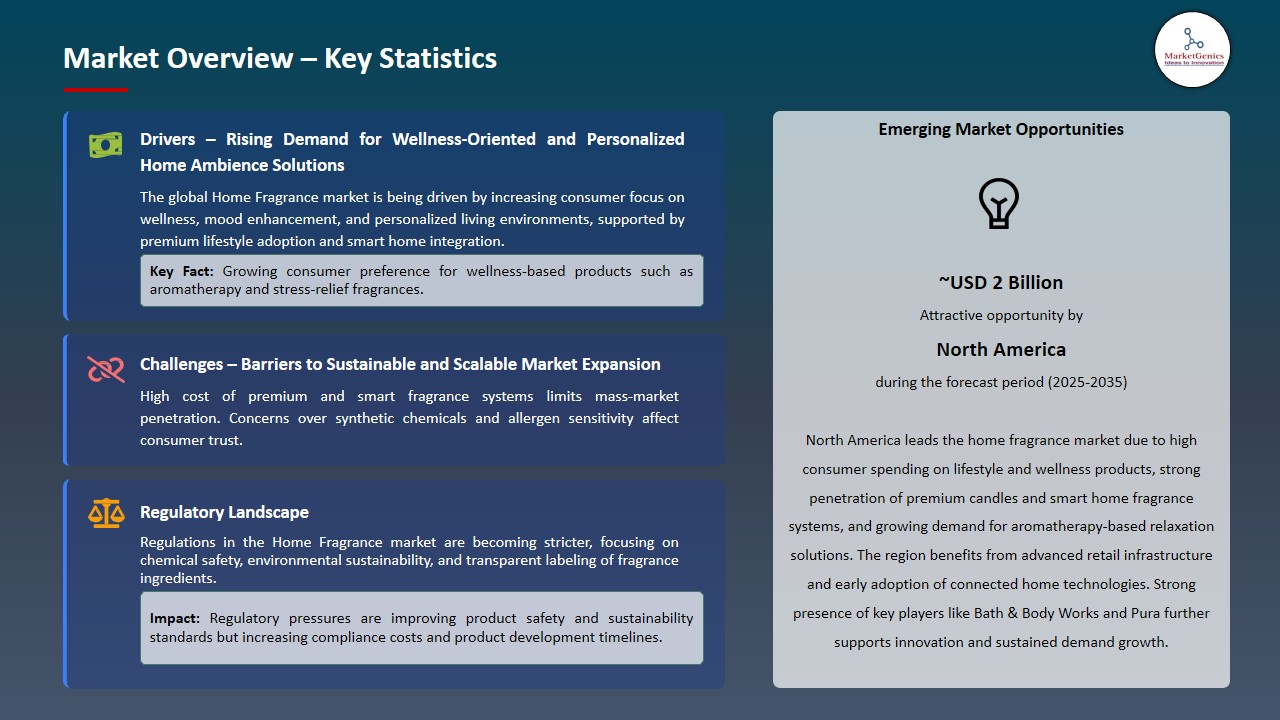
Driver: Rising Demand for Wellness-Oriented Home Environments
- The global home fragrance market is witnessing strong growth due to increasing consumer focus on emotional well-being and ambient home enhancement, driving adoption of scent-based solutions that improve mood, relaxation, and stress reduction in residential living spaces.
- Increasing trend related to integrating brands of wellness and lifestyles into fragrance categories is also leading to a rise in the demand for the same. For instance, in April 2026, Roxy entered the fragrance and personal care category with Broken Top Brands in terms of candles, body care, and scented mists, thus further enhancing their presence in wellness- and lifestyle-driven categories such as fragrance and home fragrances.
- The home luxury scents market is growing owing to the growing demand for premium ambiance solutions, aromatherapy products, and wellness-centric living environment.
Restraint: Volatility in Raw Material Supply and Sustainability Pressures
- The global home fragrance market is facing constraints due to fluctuating availability and pricing of key raw materials such as essential oils, aromatic compounds, natural waxes, and botanical extracts, which are heavily dependent on agricultural output and climate-sensitive supply chains.
- Higher environmental standards and regulatory issues are forcing producers to move towards sustainable, non-toxic, and biodegradable home fragrances that are more difficult to produce and less flexible in terms of product design and commercialization.
- Environmental concerns relating to the use of synthetic compounds and packaging material are contributing to higher costs and slower innovation within the industry.
Opportunity: Expansion of Smart and Personalized Fragrance Ecosystems
- The increased trend towards lifestyle customization and ambient wellness presents immense growth opportunities for the Home Fragrance market across the globe, owing to the emergence of smart homes with personalized scent experiences.
- The development in the field of Internet of Things (IoT) and environmental monitoring is paving way for the emergence of scenting systems that adjust their diffusion in accordance with occupancy rate and quality of air. For instance, January 2026, Chesapeake Bay Fragrance announced the expansion of its product line along with its association with Keep America Beautiful.
- The market is further driven by demand for smart home integration, subscription fragrance models, and personalized scent ecosystems.
Key Trend: Convergence of Scent Design, Wellness, and Smart Living
- The global home fragrance market is moving toward a future where consumers have a smarter living environment and are able to use their sense of smell to interact with other smart elements, including home light and air purification systems.
- Innovations in fragrances have moved toward adaptive scent systems, which make use of artificial intelligence technologies to automatically adjust scent diffusing strength according to usage behavior and house activities. For instance, in February 2026, Bath & Body Works extended its home fragrances offerings through its Amazon collaboration, facilitating digital access to candles and diffusers.
- Smart homes, wellness interior design, and subscriptions in personalized scents also fuel growth in this industry.
Home Fragrance Market Analysis and Segmental Data
Candles Dominate Global Home Fragrance Market
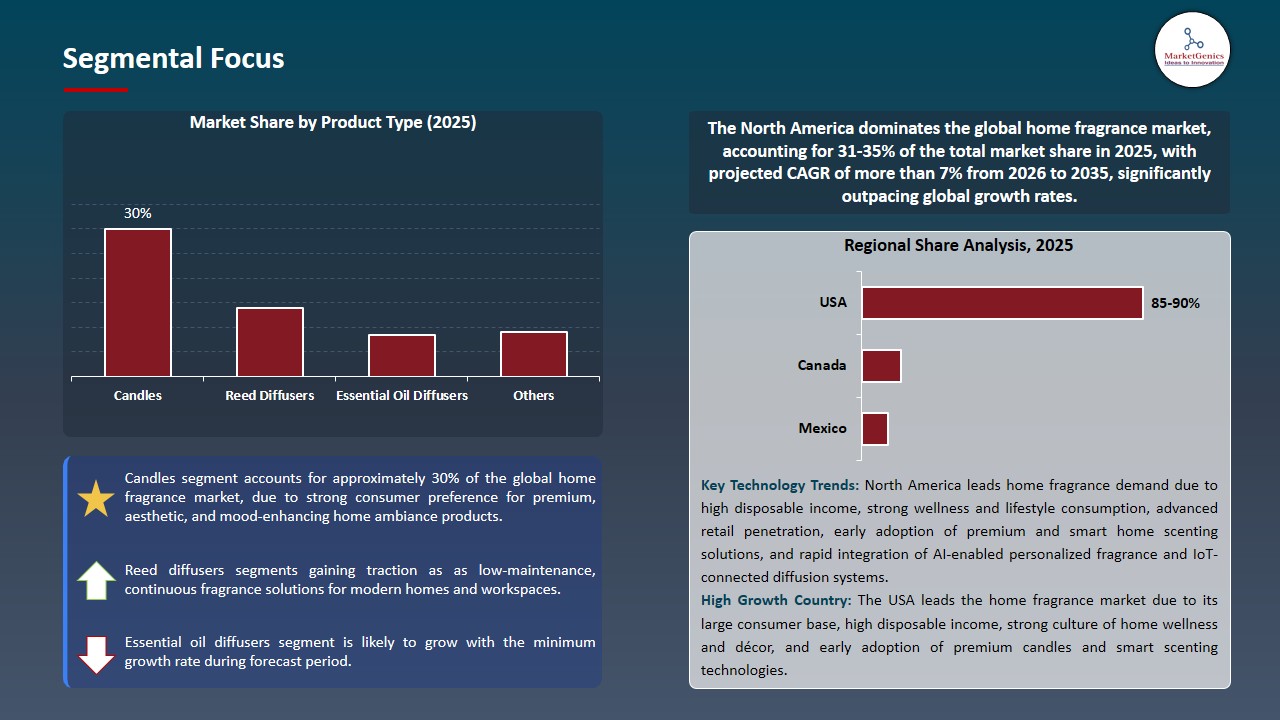
- Candles currently lead in the global home fragrance market because of their high appeal among consumers, owing to preferences for visual ambiance creation and emotional wellness benefits, as well as premium home decoration solutions. The growing popularity of specialty scented and seasonal candles is further enhancing their dominant position in the market.
- The segment is witnessing innovation in clean-burning wax technologies, natural essential oil blends, and longer-lasting fragrance systems designed to improve scent throw and overall user experience. Manufacturers are also focusing on eco-friendly formulations and enhanced fragrance consistency across product ranges.
- The combination of premium aesthetics, wellness-based fragrance experiences, and sustainability in candles is continuously driving candles as one of the key drivers of growth in the essence for home market.
North America Leads Global Home Fragrance Market Demand
- North America dominates the global Home Fragrance market due to owing to high consumer preferences for luxurious lifestyle products and wellness-based home environments. The market also reflects the growing trend among consumers to incorporate fragrances into their day-to-day mood lifting and relaxation practices.
- The market is witnessing rising adoption of advanced fragrance formats such as smart diffusers, long-lasting scent systems, and customizable aroma solutions that allow users to control intensity and timing. Growing focus on personalized home experiences and emotionally engaging living spaces is further driving product innovation and demand across the region.
- North America leads with a highly mature premium home fragrance ecosystem supported by innovation, design-led products, and experience-focused consumption.
Home Fragrance Market Ecosystem
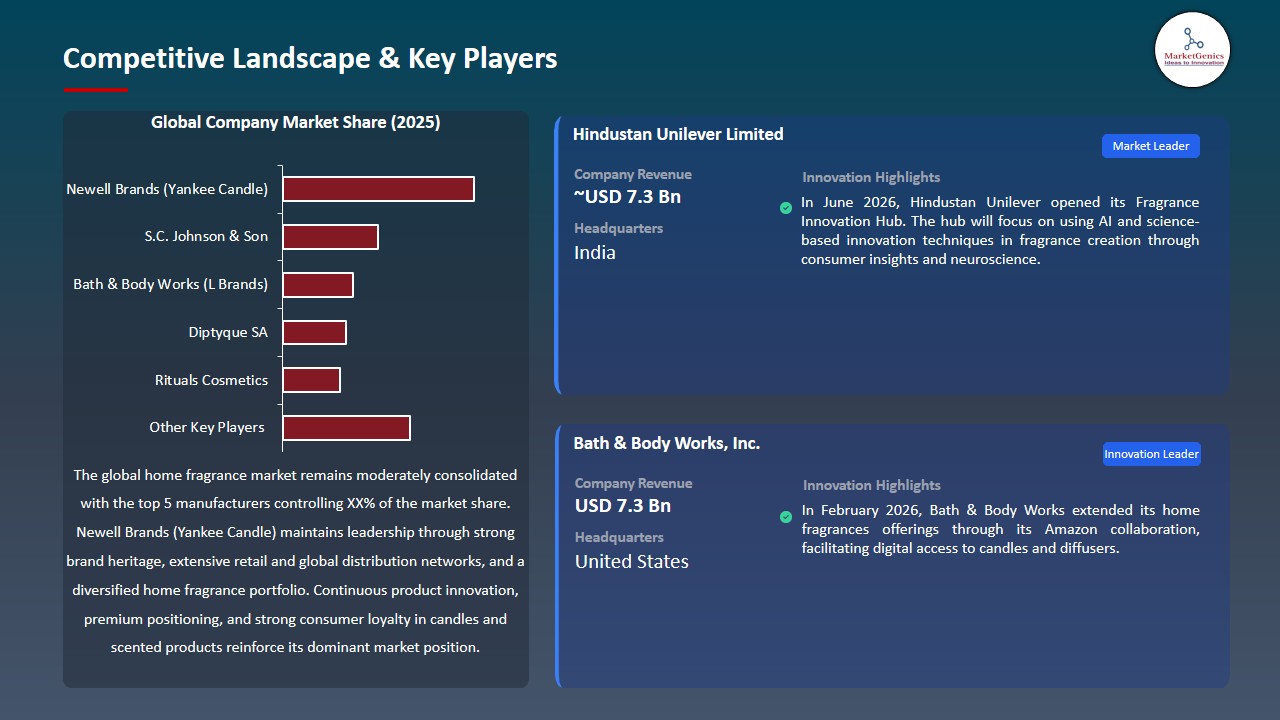
The home fragrance industry ecosystem is moderately consolidated and rapidly changing because of the growing demand for high-end ambient scenting products, health-focused home environments, and customizable sensory experiences. The industry ecosystem is defined by the integration of fragrances production, smart fragrance technology, retail environment designs, and digital customization platforms that allow for the creation of custom scenting solutions. The use of AI-enabled scent profiling and subscription services for personalized scent delivery in homes has also revolutionized the customer experience.
Core competitive activities include competition among large incumbents like Newell Brands (Yankee Candle), S.C. Johnson & Son, Bath & Body Works, Diptyque SA, and Rituals Cosmetics. These brands have gained leadership positions in various sub-sectors, including candles, reed diffusers, sprays, and electrical fragrance dispensers. These companies are also focusing on premiumization, innovation of natural scents, and creating unique retail experiences to drive sales and improve customer loyalty.
Ecosystem expansion is being driven by the integration of digital commerce, smart home devices, and data-driven personalization tools that allow users to tailor fragrance intensity, timing, and scent combinations. Brands such as Bath & Body Works and Rituals Cosmetics are enhancing their portfolios with subscription models and app-connected fragrance experiences that align with evolving lifestyle preferences. Ecosystem convergence is emerging as a key growth enabler, with interoperability between fragrance devices, e-commerce platforms, and wellness applications creating a unified sensory lifestyle ecosystem.
 Recent Development and Strategic Overview
- In June 2026, Hindustan Unilever opened its Fragrance Innovation Hub. The hub will focus on using AI and science-based innovation techniques in fragrance creation through consumer insights and neuroscience.
- In November 2025, Swedish design brand Transparent launched its Aroma Diffuser, expanding from audio technology into home fragrance with a modular, sustainability-focused device that uses ultrasonic technology to diffuse essential oils into fine mist for enhanced sensory home experiences.
Report Scope
|
Detail |
|
|
Market Size in 2025 |
USD 9.8 Bn |
|
Market Forecast Value in 2035 |
USD 16.7 Bn |
|
Growth Rate (CAGR) |
5.4% |
|
Forecast Period |
2026 – 2035 |
|
Historical Data Available for |
2021 – 2024 |
|
Market Size Units |
US$ Billion for Value Thousand Units for Volume |
|
Report Format |
Electronic (PDF) + Excel |
|
North America |
Europe |
Asia Pacific |
Middle East |
Africa |
South America |
|
|
|
|
|
|
|
Companies Covered |
|||||
|
|
|
|
|||
Home Fragrance Market Segmentation and Highlights
|
Segment |
Sub-segment |
|
Home Fragrance Market, By Product Type |
|
|
Home Fragrance Market, By Fragrance Type |
|
|
Home Fragrance Market, By Raw Material / Ingredient Type |
|
|
Home Fragrance Market, By Packaging Type |
|
|
Home Fragrance Market, By Consumer / Buyer Type |
|
|
Home Fragrance Market, By Distribution Channel |
|
Frequently Asked Questions
Table of Contents
- 1. Research Methodology and Assumptions
- 1.1. Definitions
- 1.2. Research Design and Approach
- 1.3. Data Collection Methods
- 1.4. Base Estimates and Calculations
- 1.5. Forecasting Models
- 1.5.1. Key Forecast Factors & Impact Analysis
- 1.6. Secondary Research
- 1.6.1. Open Sources
- 1.6.2. Paid Databases
- 1.6.3. Associations
- 1.7. Primary Research
- 1.7.1. Primary Sources
- 1.7.2. Primary Interviews with Stakeholders across Ecosystem
- 2. Executive Summary
- 2.1. Global Home Fragrance Market Outlook
- 2.1.1. Home Fragrance Market Size (Volume - Thousand Units & Value - US$ Bn), and Forecasts, 2021-2035
- 2.1.2. Compounded Annual Growth Rate Analysis
- 2.1.3. Growth Opportunity Analysis
- 2.1.4. Segmental Share Analysis
- 2.1.5. Geographical Share Analysis
- 2.2. Market Analysis and Facts
- 2.3. Supply-Demand Analysis
- 2.4. Competitive Benchmarking
- 2.5. Go-to- Market Strategy
- 2.5.1. Customer/ End-use Industry Assessment
- 2.5.2. Growth Opportunity Data, 2026-2035
- 2.5.2.1. Regional Data
- 2.5.2.2. Country Data
- 2.5.2.3. Segmental Data
- 2.5.3. Identification of Potential Market Spaces
- 2.5.4. GAP Analysis
- 2.5.5. Potential Attractive Price Points
- 2.5.6. Prevailing Market Risks & Challenges
- 2.5.7. Preferred Sales & Marketing Strategies
- 2.5.8. Key Recommendations and Analysis
- 2.5.9. A Way Forward
- 2.1. Global Home Fragrance Market Outlook
- 3. Industry Data and Premium Insights
- 3.1. Global Consumer Goods & Services Industry Overview, 2025
- 3.1.1. Consumer Goods & Services Industry Ecosystem Analysis
- 3.1.2. Key Trends for Consumer Goods & Services Industry
- 3.1.3. Regional Distribution for Consumer Goods & Services Industry
- 3.2. Supplier Customer Data
- 3.3. Technology Roadmap and Developments
- 3.4. Trade Analysis
- 3.4.1. Import & Export Analysis, 2025
- 3.4.2. Top Importing Countries
- 3.4.3. Top Exporting Countries
- 3.5. Trump Tariff Impact Analysis
- 3.5.1. Manufacturer
- 3.5.1.1. Based on the component & Raw material
- 3.5.2. Supply Chain
- 3.5.3. End Consumer
- 3.5.1. Manufacturer
- 3.6. Raw Material Analysis
- 3.1. Global Consumer Goods & Services Industry Overview, 2025
- 4. Market Overview
- 4.1. Market Dynamics
- 4.1.1. Drivers
- 4.1.1.1. Rising demand for wellness-oriented home environments driving adoption of scented candles, diffusers, and air care products
- 4.1.1.2. Growing urbanization and disposable income increasing spending on premium home lifestyle and luxury fragrance products
- 4.1.1.3. Expanding influence of aromatherapy and self-care trends supporting usage of home fragrance for relaxation and stress relief
- 4.1.2. Restraints
- 4.1.2.1. Health concerns related to synthetic chemicals and indoor air quality limiting usage of certain fragrance products
- 4.1.2.2. High competition and price sensitivity in mass-market segments restricting premium product penetration
- 4.1.1. Drivers
- 4.2. Key Trend Analysis
- 4.3. Regulatory Framework
- 4.3.1. Key Regulations, Norms, and Subsidies, by Key Countries
- 4.3.2. Tariffs and Standards
- 4.3.3. Impact Analysis of Regulations on the Market
- 4.4. Value Chain Analysis
- 4.4.1. Raw Material Suppliers
- 4.4.2. Manufacturer
- 4.4.3. Distributors
- 4.4.4. End Users
- 4.5. Porter’s Five Forces Analysis
- 4.6. PESTEL Analysis
- 4.7. Global Home Fragrance Market Demand
- 4.7.1. Historical Market Size – (Volume - Thousand Units & Value - US$ Bn), 2020-2024
- 4.7.2. Current and Future Market Size – (Volume - Thousand Units & Value - US$ Bn), 2026–2035
- 4.7.2.1. Y-o-Y Growth Trends
- 4.7.2.2. Absolute $ Opportunity Assessment
- 4.1. Market Dynamics
- 5. Competition Landscape
- 5.1. Competition structure
- 5.1.1. Fragmented v/s consolidated
- 5.2. Company Share Analysis, 2025
- 5.2.1. Global Company Market Share
- 5.2.2. By Region
- 5.2.2.1. North America
- 5.2.2.2. Europe
- 5.2.2.3. Asia Pacific
- 5.2.2.4. Middle East
- 5.2.2.5. Africa
- 5.2.2.6. South America
- 5.3. Product Comparison Matrix
- 5.3.1. Specifications
- 5.3.2. Market Positioning
- 5.3.3. Pricing
- 5.1. Competition structure
- 6. Global Home Fragrance Market Analysis, by Product Type
- 6.1. Key Segment Analysis
- 6.2. Home Fragrance Market Size (Volume - Thousand Units & Value - US$ Bn), Analysis, and Forecasts, by Product Type, 2021-2035
- 6.2.1. Candles
- 6.2.1.1. Pillar Candles
- 6.2.1.2. Container/Jar Candles
- 6.2.1.3. Votive Candles
- 6.2.1.4. Taper Candles
- 6.2.1.5. Tealight Candles
- 6.2.1.6. Specialty & Novelty Candles
- 6.2.2. Reed Diffusers
- 6.2.2.1. Classic Reed Diffusers
- 6.2.2.2. Electric Reed Diffusers
- 6.2.3. Room Sprays & Mists
- 6.2.3.1. Water-Based Sprays
- 6.2.3.2. Alcohol-Based Sprays
- 6.2.4. Essential Oil Diffusers
- 6.2.4.1. Ultrasonic Diffusers
- 6.2.4.2. Nebulizing Diffusers
- 6.2.4.3. Heat Diffusers
- 6.2.4.4. Evaporative Diffusers
- 6.2.5. Incense
- 6.2.5.1. Incense Sticks
- 6.2.5.2. Incense Cones
- 6.2.5.3. Incense Coils
- 6.2.5.4. Dhoop & Loose Incense
- 6.2.6. Wax Melts & Tarts
- 6.2.7. Potpourri
- 6.2.7.1. Dried Floral Potpourri
- 6.2.7.2. Scented Wood Potpourri
- 6.2.8. Sachets & Scented Bags
- 6.2.9. Car & Portable Air Fresheners (adjacent/crossover)
- 6.2.10. Scented Gels & Beads
- 6.2.11. Others
- 6.2.1. Candles
- 7. Global Home Fragrance Market Analysis, by Fragrance Type
- 7.1. Key Segment Analysis
- 7.2. Home Fragrance Market Size (Volume - Thousand Units & Value - US$ Bn), Analysis, and Forecasts, by Fragrance Type, 2021-2035
- 7.2.1. Floral
- 7.2.1.1. Rose
- 7.2.1.2. Jasmine
- 7.2.1.3. Lavender
- 7.2.1.4. Lily & Peony
- 7.2.2. Woody & Earthy
- 7.2.2.1. Sandalwood
- 7.2.2.2. Cedarwood
- 7.2.2.3. Patchouli
- 7.2.2.4. Oud
- 7.2.3. Fresh & Citrus
- 7.2.3.1. Lemon
- 7.2.3.2. Orange & Bergamot
- 7.2.3.3. Ocean & Aquatic
- 7.2.4. Oriental & Spicy
- 7.2.4.1. Musk
- 7.2.4.2. Amber
- 7.2.4.3. Cinnamon & Clove
- 7.2.5. Fruity
- 7.2.6. Gourmand (Vanilla, Caramel, Bakery)
- 7.2.7. Herbal & Botanical
- 7.2.8. Seasonal & Limited Edition Blends
- 7.2.9. Others
- 7.2.1. Floral
- 8. Global Home Fragrance Market Analysis, by Raw Material / Ingredient Type
- 8.1. Key Segment Analysis
- 8.2. Home Fragrance Market Size (Volume - Thousand Units & Value - US$ Bn), Analysis, and Forecasts, by Raw Material / Ingredient Type, 2021-2035
- 8.2.1. Natural / Organic
- 8.2.1.1. Plant-Derived Essential Oils
- 8.2.1.2. Beeswax & Soy Wax
- 8.2.1.3. Natural Resins & Gums
- 8.2.2. Synthetic / Aroma Chemicals
- 8.2.2.1. Synthetic Musks
- 8.2.2.2. Aldehydes & Ketones
- 8.2.3. Blended (Natural + Synthetic)
- 8.2.4. Wax Type (for candles)
- 8.2.4.1. Paraffin Wax
- 8.2.4.2. Soy Wax
- 8.2.4.3. Beeswax
- 8.2.4.4. Coconut Wax
- 8.2.4.5. Palm Wax
- 8.2.4.6. Gel Wax
- 8.2.5. Others
- 8.2.1. Natural / Organic
- 9. Global Home Fragrance Market Analysis, by Packaging Type
- 9.1. Key Segment Analysis
- 9.2. Home Fragrance Market Size (Volume - Thousand Units & Value - US$ Bn), Analysis, and Forecasts, by Packaging Type, 2021-2035
- 9.2.1. Glass Containers
- 9.2.2. Metal Tins
- 9.2.3. Ceramic Vessels
- 9.2.4. Plastic Containers
- 9.2.5. Eco-Friendly / Biodegradable Packaging
- 9.2.6. Kraft Paper & Cardboard
- 9.2.7. Recycled & Upcycled Packaging
- 9.2.8. Refillable / Reusable Packaging
- 9.2.9. Gift Sets & Multi-Pack Packaging
- 10. Global Home Fragrance Market Analysis, by Consumer / Buyer Type
- 10.1. Key Segment Analysis
- 10.2. Home Fragrance Market Size (Volume - Thousand Units & Value - US$ Bn), Analysis, and Forecasts, by Consumer / Buyer Type, 2021-2035
- 10.2.1. Individual Consumers
- 10.2.1.1. Young Adults (18–34)
- 10.2.1.2. Middle-Aged Adults (35–54)
- 10.2.1.3. Seniors (55+)
- 10.2.2. Gift Buyers
- 10.2.3. Interior Decorators & Home Stylists
- 10.2.4. Corporate / Institutional Buyers
- 10.2.5. Subscription & Loyalty Buyers
- 10.2.6. Others
- 10.2.1. Individual Consumers
- 11. Global Home Fragrance Market Analysis, by Distribution Channel
- 11.1. Key Segment Analysis
- 11.2. Home Fragrance Market Size (Volume - Thousand Units & Value - US$ Bn), Analysis, and Forecasts, by Distribution Channel, 2021-2035
- 11.2.1. Offline
- 11.2.1.1. Specialty Fragrance Stores
- 11.2.1.2. Hypermarkets & Supermarkets
- 11.2.1.3. Department Stores
- 11.2.1.4. Pharmacies & Drugstores
- 11.2.1.5. Convenience Stores
- 11.2.1.6. Craft & Artisan Markets
- 11.2.2. Online
- 11.2.2.1. Brand Direct-to-Consumer (DTC) Websites
- 11.2.2.2. E-Commerce Marketplaces (Amazon, Flipkart, etc.)
- 11.2.2.3. Social Commerce (Instagram Shops, Pinterest)
- 11.2.2.4. Subscription Box Services
- 11.2.2.5. Wholesale / B2B / Trade Channel
- 11.2.1. Offline
- 12. Global Home Fragrance Market Analysis and Forecasts, by Region
- 12.1. Key Findings
- 12.2. Home Fragrance Market Size (Volume - Thousand Units & Value - US$ Bn), Analysis, and Forecasts, by Region, 2021-2035
- 12.2.1. North America
- 12.2.2. Europe
- 12.2.3. Asia Pacific
- 12.2.4. Middle East
- 12.2.5. Africa
- 12.2.6. South America
- 13. North America Home Fragrance Market Analysis
- 13.1. Key Segment Analysis
- 13.2. Regional Snapshot
- 13.3. North America Home Fragrance Market Size (Volume - Thousand Units & Value - US$ Bn), Analysis, and Forecasts, 2021-2035
- 13.3.1. Product Type
- 13.3.2. Fragrance Type
- 13.3.3. Raw Material / Ingredient Type
- 13.3.4. Packaging Type
- 13.3.5. Consumer / Buyer Type
- 13.3.6. Distribution Channel
- 13.3.7. Country
- 13.3.7.1. USA
- 13.3.7.2. Canada
- 13.3.7.3. Mexico
- 13.4. USA Home Fragrance Market
- 13.4.1. Country Segmental Analysis
- 13.4.2. Product Type
- 13.4.3. Fragrance Type
- 13.4.4. Raw Material / Ingredient Type
- 13.4.5. Packaging Type
- 13.4.6. Consumer / Buyer Type
- 13.4.7. Distribution Channel
- 13.5. Canada Home Fragrance Market
- 13.5.1. Country Segmental Analysis
- 13.5.2. Product Type
- 13.5.3. Fragrance Type
- 13.5.4. Raw Material / Ingredient Type
- 13.5.5. Packaging Type
- 13.5.6. Consumer / Buyer Type
- 13.5.7. Distribution Channel
- 13.6. Mexico Home Fragrance Market
- 13.6.1. Country Segmental Analysis
- 13.6.2. Product Type
- 13.6.3. Fragrance Type
- 13.6.4. Raw Material / Ingredient Type
- 13.6.5. Packaging Type
- 13.6.6. Consumer / Buyer Type
- 13.6.7. Distribution Channel
- 14. Europe Home Fragrance Market Analysis
- 14.1. Key Segment Analysis
- 14.2. Regional Snapshot
- 14.3. Europe Home Fragrance Market Size (Volume - Thousand Units & Value - US$ Bn), Analysis, and Forecasts, 2021-2035
- 14.3.1. Product Type
- 14.3.2. Fragrance Type
- 14.3.3. Raw Material / Ingredient Type
- 14.3.4. Packaging Type
- 14.3.5. Consumer / Buyer Type
- 14.3.6. Distribution Channel
- 14.3.7. Country
- 14.3.7.1. Germany
- 14.3.7.2. United Kingdom
- 14.3.7.3. France
- 14.3.7.4. Italy
- 14.3.7.5. Spain
- 14.3.7.6. Netherlands
- 14.3.7.7. Nordic Countries
- 14.3.7.8. Poland
- 14.3.7.9. Russia & CIS
- 14.3.7.10. Rest of Europe
- 14.4. Germany Home Fragrance Market
- 14.4.1. Country Segmental Analysis
- 14.4.2. Product Type
- 14.4.3. Fragrance Type
- 14.4.4. Raw Material / Ingredient Type
- 14.4.5. Packaging Type
- 14.4.6. Consumer / Buyer Type
- 14.4.7. Distribution Channel
- 14.5. United Kingdom Home Fragrance Market
- 14.5.1. Country Segmental Analysis
- 14.5.2. Product Type
- 14.5.3. Fragrance Type
- 14.5.4. Raw Material / Ingredient Type
- 14.5.5. Packaging Type
- 14.5.6. Consumer / Buyer Type
- 14.5.7. Distribution Channel
- 14.6. France Home Fragrance Market
- 14.6.1. Country Segmental Analysis
- 14.6.2. Product Type
- 14.6.3. Fragrance Type
- 14.6.4. Raw Material / Ingredient Type
- 14.6.5. Packaging Type
- 14.6.6. Consumer / Buyer Type
- 14.6.7. Distribution Channel
- 14.7. Italy Home Fragrance Market
- 14.7.1. Country Segmental Analysis
- 14.7.2. Product Type
- 14.7.3. Fragrance Type
- 14.7.4. Raw Material / Ingredient Type
- 14.7.5. Packaging Type
- 14.7.6. Consumer / Buyer Type
- 14.7.7. Distribution Channel
- 14.8. Spain Home Fragrance Market
- 14.8.1. Country Segmental Analysis
- 14.8.2. Product Type
- 14.8.3. Fragrance Type
- 14.8.4. Raw Material / Ingredient Type
- 14.8.5. Packaging Type
- 14.8.6. Consumer / Buyer Type
- 14.8.7. Distribution Channel
- 14.9. Netherlands Home Fragrance Market
- 14.9.1. Country Segmental Analysis
- 14.9.2. Product Type
- 14.9.3. Fragrance Type
- 14.9.4. Raw Material / Ingredient Type
- 14.9.5. Packaging Type
- 14.9.6. Consumer / Buyer Type
- 14.9.7. Distribution Channel
- 14.10. Nordic Countries Home Fragrance Market
- 14.10.1. Country Segmental Analysis
- 14.10.2. Product Type
- 14.10.3. Fragrance Type
- 14.10.4. Raw Material / Ingredient Type
- 14.10.5. Packaging Type
- 14.10.6. Consumer / Buyer Type
- 14.10.7. Distribution Channel
- 14.11. Poland Home Fragrance Market
- 14.11.1. Country Segmental Analysis
- 14.11.2. Product Type
- 14.11.3. Fragrance Type
- 14.11.4. Raw Material / Ingredient Type
- 14.11.5. Packaging Type
- 14.11.6. Consumer / Buyer Type
- 14.11.7. Distribution Channel
- 14.12. Russia & CIS Home Fragrance Market
- 14.12.1. Country Segmental Analysis
- 14.12.2. Product Type
- 14.12.3. Fragrance Type
- 14.12.4. Raw Material / Ingredient Type
- 14.12.5. Packaging Type
- 14.12.6. Consumer / Buyer Type
- 14.12.7. Distribution Channel
- 14.13. Rest of Europe Home Fragrance Market
- 14.13.1. Country Segmental Analysis
- 14.13.2. Product Type
- 14.13.3. Fragrance Type
- 14.13.4. Raw Material / Ingredient Type
- 14.13.5. Packaging Type
- 14.13.6. Consumer / Buyer Type
- 14.13.7. Distribution Channel
- 15. Asia Pacific Home Fragrance Market Analysis
- 15.1. Key Segment Analysis
- 15.2. Regional Snapshot
- 15.3. Asia Pacific Home Fragrance Market Size (Volume - Thousand Units & Value - US$ Bn), Analysis, and Forecasts, 2021-2035
- 15.3.1. Product Type
- 15.3.2. Fragrance Type
- 15.3.3. Raw Material / Ingredient Type
- 15.3.4. Packaging Type
- 15.3.5. Consumer / Buyer Type
- 15.3.6. Distribution Channel
- 15.3.7. Country
- 15.3.7.1. China
- 15.3.7.2. India
- 15.3.7.3. Japan
- 15.3.7.4. South Korea
- 15.3.7.5. Australia and New Zealand
- 15.3.7.6. Indonesia
- 15.3.7.7. Malaysia
- 15.3.7.8. Thailand
- 15.3.7.9. Vietnam
- 15.3.7.10. Rest of Asia Pacific
- 15.4. China Home Fragrance Market
- 15.4.1. Country Segmental Analysis
- 15.4.2. Product Type
- 15.4.3. Fragrance Type
- 15.4.4. Raw Material / Ingredient Type
- 15.4.5. Packaging Type
- 15.4.6. Consumer / Buyer Type
- 15.4.7. Distribution Channel
- 15.5. India Home Fragrance Market
- 15.5.1. Country Segmental Analysis
- 15.5.2. Product Type
- 15.5.3. Fragrance Type
- 15.5.4. Raw Material / Ingredient Type
- 15.5.5. Packaging Type
- 15.5.6. Consumer / Buyer Type
- 15.5.7. Distribution Channel
- 15.6. Japan Home Fragrance Market
- 15.6.1. Country Segmental Analysis
- 15.6.2. Product Type
- 15.6.3. Fragrance Type
- 15.6.4. Raw Material / Ingredient Type
- 15.6.5. Packaging Type
- 15.6.6. Consumer / Buyer Type
- 15.6.7. Distribution Channel
- 15.7. South Korea Home Fragrance Market
- 15.7.1. Country Segmental Analysis
- 15.7.2. Product Type
- 15.7.3. Fragrance Type
- 15.7.4. Raw Material / Ingredient Type
- 15.7.5. Packaging Type
- 15.7.6. Consumer / Buyer Type
- 15.7.7. Distribution Channel
- 15.8. Australia and New Zealand Home Fragrance Market
- 15.8.1. Country Segmental Analysis
- 15.8.2. Product Type
- 15.8.3. Fragrance Type
- 15.8.4. Raw Material / Ingredient Type
- 15.8.5. Packaging Type
- 15.8.6. Consumer / Buyer Type
- 15.8.7. Distribution Channel
- 15.9. Indonesia Home Fragrance Market
- 15.9.1. Country Segmental Analysis
- 15.9.2. Product Type
- 15.9.3. Fragrance Type
- 15.9.4. Raw Material / Ingredient Type
- 15.9.5. Packaging Type
- 15.9.6. Consumer / Buyer Type
- 15.9.7. Distribution Channel
- 15.10. Malaysia Home Fragrance Market
- 15.10.1. Country Segmental Analysis
- 15.10.2. Product Type
- 15.10.3. Fragrance Type
- 15.10.4. Raw Material / Ingredient Type
- 15.10.5. Packaging Type
- 15.10.6. Consumer / Buyer Type
- 15.10.7. Distribution Channel
- 15.11. Thailand Home Fragrance Market
- 15.11.1. Country Segmental Analysis
- 15.11.2. Product Type
- 15.11.3. Fragrance Type
- 15.11.4. Raw Material / Ingredient Type
- 15.11.5. Packaging Type
- 15.11.6. Consumer / Buyer Type
- 15.11.7. Distribution Channel
- 15.12. Vietnam Home Fragrance Market
- 15.12.1. Country Segmental Analysis
- 15.12.2. Product Type
- 15.12.3. Fragrance Type
- 15.12.4. Raw Material / Ingredient Type
- 15.12.5. Packaging Type
- 15.12.6. Consumer / Buyer Type
- 15.12.7. Distribution Channel
- 15.13. Rest of Asia Pacific Home Fragrance Market
- 15.13.1. Country Segmental Analysis
- 15.13.2. Product Type
- 15.13.3. Fragrance Type
- 15.13.4. Raw Material / Ingredient Type
- 15.13.5. Packaging Type
- 15.13.6. Consumer / Buyer Type
- 15.13.7. Distribution Channel
- 16. Middle East Home Fragrance Market Analysis
- 16.1. Key Segment Analysis
- 16.2. Regional Snapshot
- 16.3. Middle East Home Fragrance Market Size (Volume - Thousand Units & Value - US$ Bn), Analysis, and Forecasts, 2021-2035
- 16.3.1. Product Type
- 16.3.2. Fragrance Type
- 16.3.3. Raw Material / Ingredient Type
- 16.3.4. Packaging Type
- 16.3.5. Consumer / Buyer Type
- 16.3.6. Distribution Channel
- 16.3.7. Country
- 16.3.7.1. Turkey
- 16.3.7.2. UAE
- 16.3.7.3. Saudi Arabia
- 16.3.7.4. Israel
- 16.3.7.5. Rest of Middle East
- 16.4. Turkey Home Fragrance Market
- 16.4.1. Country Segmental Analysis
- 16.4.2. Product Type
- 16.4.3. Fragrance Type
- 16.4.4. Raw Material / Ingredient Type
- 16.4.5. Packaging Type
- 16.4.6. Consumer / Buyer Type
- 16.4.7. Distribution Channel
- 16.5. UAE Home Fragrance Market
- 16.5.1. Country Segmental Analysis
- 16.5.2. Product Type
- 16.5.3. Fragrance Type
- 16.5.4. Raw Material / Ingredient Type
- 16.5.5. Packaging Type
- 16.5.6. Consumer / Buyer Type
- 16.5.7. Distribution Channel
- 16.6. Saudi Arabia Home Fragrance Market
- 16.6.1. Country Segmental Analysis
- 16.6.2. Product Type
- 16.6.3. Fragrance Type
- 16.6.4. Raw Material / Ingredient Type
- 16.6.5. Packaging Type
- 16.6.6. Consumer / Buyer Type
- 16.6.7. Distribution Channel
- 16.7. Israel Home Fragrance Market
- 16.7.1. Country Segmental Analysis
- 16.7.2. Product Type
- 16.7.3. Fragrance Type
- 16.7.4. Raw Material / Ingredient Type
- 16.7.5. Packaging Type
- 16.7.6. Consumer / Buyer Type
- 16.7.7. Distribution Channel
- 16.8. Rest of Middle East Home Fragrance Market
- 16.8.1. Country Segmental Analysis
- 16.8.2. Product Type
- 16.8.3. Fragrance Type
- 16.8.4. Raw Material / Ingredient Type
- 16.8.5. Packaging Type
- 16.8.6. Consumer / Buyer Type
- 16.8.7. Distribution Channel
- 17. Africa Home Fragrance Market Analysis
- 17.1. Key Segment Analysis
- 17.2. Regional Snapshot
- 17.3. Africa Home Fragrance Market Size (Volume - Thousand Units & Value - US$ Bn), Analysis, and Forecasts, 2021-2035
- 17.3.1. Product Type
- 17.3.2. Fragrance Type
- 17.3.3. Raw Material / Ingredient Type
- 17.3.4. Packaging Type
- 17.3.5. Consumer / Buyer Type
- 17.3.6. Distribution Channel
- 17.3.7. Country
- 17.3.7.1. South Africa
- 17.3.7.2. Egypt
- 17.3.7.3. Nigeria
- 17.3.7.4. Algeria
- 17.3.7.5. Rest of Africa
- 17.4. South Africa Home Fragrance Market
- 17.4.1. Country Segmental Analysis
- 17.4.2. Product Type
- 17.4.3. Fragrance Type
- 17.4.4. Raw Material / Ingredient Type
- 17.4.5. Packaging Type
- 17.4.6. Consumer / Buyer Type
- 17.4.7. Distribution Channel
- 17.5. Egypt Home Fragrance Market
- 17.5.1. Country Segmental Analysis
- 17.5.2. Product Type
- 17.5.3. Fragrance Type
- 17.5.4. Raw Material / Ingredient Type
- 17.5.5. Packaging Type
- 17.5.6. Consumer / Buyer Type
- 17.5.7. Distribution Channel
- 17.6. Nigeria Home Fragrance Market
- 17.6.1. Country Segmental Analysis
- 17.6.2. Product Type
- 17.6.3. Fragrance Type
- 17.6.4. Raw Material / Ingredient Type
- 17.6.5. Packaging Type
- 17.6.6. Consumer / Buyer Type
- 17.6.7. Distribution Channel
- 17.7. Algeria Home Fragrance Market
- 17.7.1. Country Segmental Analysis
- 17.7.2. Product Type
- 17.7.3. Fragrance Type
- 17.7.4. Raw Material / Ingredient Type
- 17.7.5. Packaging Type
- 17.7.6. Consumer / Buyer Type
- 17.7.7. Distribution Channel
- 17.8. Rest of Africa Home Fragrance Market
- 17.8.1. Country Segmental Analysis
- 17.8.2. Product Type
- 17.8.3. Fragrance Type
- 17.8.4. Raw Material / Ingredient Type
- 17.8.5. Packaging Type
- 17.8.6. Consumer / Buyer Type
- 17.8.7. Distribution Channel
- 18. South America Home Fragrance Market Analysis
- 18.1. Key Segment Analysis
- 18.2. Regional Snapshot
- 18.3. South America Home Fragrance Market Size (Volume - Thousand Units & Value - US$ Bn), Analysis, and Forecasts, 2021-2035
- 18.3.1. Product Type
- 18.3.2. Fragrance Type
- 18.3.3. Raw Material / Ingredient Type
- 18.3.4. Packaging Type
- 18.3.5. Consumer / Buyer Type
- 18.3.6. Distribution Channel
- 18.3.7. Country
- 18.3.7.1. Brazil
- 18.3.7.2. Argentina
- 18.3.7.3. Rest of South America
- 18.4. Brazil Home Fragrance Market
- 18.4.1. Country Segmental Analysis
- 18.4.2. Product Type
- 18.4.3. Fragrance Type
- 18.4.4. Raw Material / Ingredient Type
- 18.4.5. Packaging Type
- 18.4.6. Consumer / Buyer Type
- 18.4.7. Distribution Channel
- 18.5. Argentina Home Fragrance Market
- 18.5.1. Country Segmental Analysis
- 18.5.2. Product Type
- 18.5.3. Fragrance Type
- 18.5.4. Raw Material / Ingredient Type
- 18.5.5. Packaging Type
- 18.5.6. Consumer / Buyer Type
- 18.5.7. Distribution Channel
- 18.6. Rest of South America Home Fragrance Market
- 18.6.1. Country Segmental Analysis
- 18.6.2. Product Type
- 18.6.3. Fragrance Type
- 18.6.4. Raw Material / Ingredient Type
- 18.6.5. Packaging Type
- 18.6.6. Consumer / Buyer Type
- 18.6.7. Distribution Channel
- 19. Key Players/ Company Profile
- 19.1. Bath & Body Works (L Brands).
- 19.1.1. Company Details/ Overview
- 19.1.2. Company Financials
- 19.1.3. Key Customers and Competitors
- 19.1.4. Business/ Industry Portfolio
- 19.1.5. Product Portfolio/ Specification Details
- 19.1.6. Pricing Data
- 19.1.7. Strategic Overview
- 19.1.8. Recent Developments
- 19.2. Cire Trudon
- 19.3. Diptyque SA
- 19.4. Givaudan SA
- 19.5. Henkel AG & Co. KGaA
- 19.6. International Flavors & Fragrances (IFF)
- 19.7. Mane SA
- 19.8. Newell Brands (Yankee Candle)
- 19.9. Rituals Cosmetics
- 19.10. Robertet Group
- 19.11. S.C. Johnson & Son
- 19.12. Skandinavisk
- 19.13. Symrise AG
- 19.14. Takasago International Corporation
- 19.15. The Chesapeake Bay Candle Co.
- 19.16. The White Company
- 19.17. Voluspa (Archipelago Botanicals)
- 19.18. Other Key Players
- 19.1. Bath & Body Works (L Brands).
Note* - This is just tentative list of players. While providing the report, we will cover more number of players based on their revenue and share for each geography
Research Design
Our research design integrates both demand-side and supply-side analysis through a balanced combination of primary and secondary research methodologies. By utilizing both bottom-up and top-down approaches alongside rigorous data triangulation methods, we deliver robust market intelligence that supports strategic decision-making.
MarketGenics' comprehensive research design framework ensures the delivery of accurate, reliable, and actionable market intelligence. Through the integration of multiple research approaches, rigorous validation processes, and expert analysis, we provide our clients with the insights needed to make informed strategic decisions and capitalize on market opportunities.
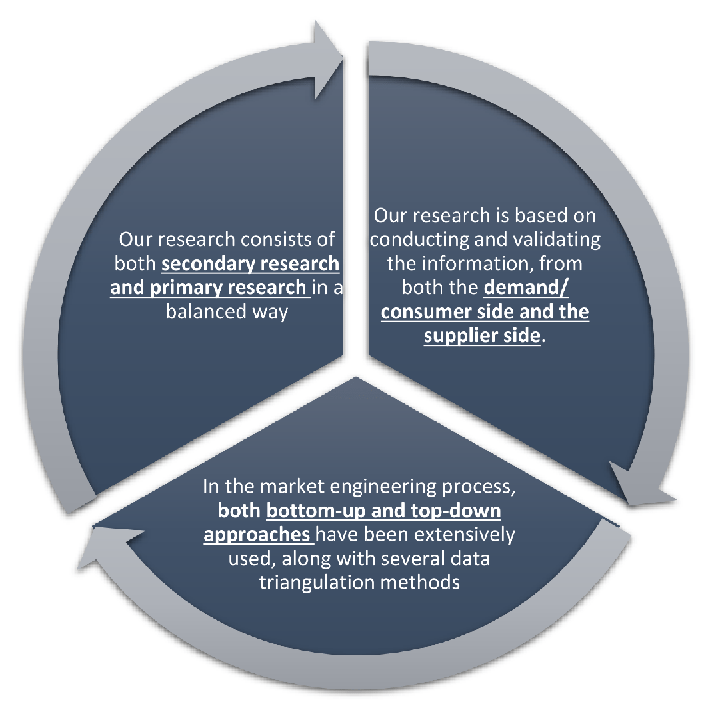
MarketGenics leverages a dedicated industry panel of experts and a comprehensive suite of paid databases to effectively collect, consolidate, and analyze market intelligence.
Our approach has consistently proven to be reliable and effective in generating accurate market insights, identifying key industry trends, and uncovering emerging business opportunities.
Through both primary and secondary research, we capture and analyze critical company-level data such as manufacturing footprints, including technical centers, R&D facilities, sales offices, and headquarters.
Our expert panel further enhances our ability to estimate market size for specific brands based on validated field-level intelligence.
Our data mining techniques incorporate both parametric and non-parametric methods, allowing for structured data collection, sorting, processing, and cleaning.
Demand projections are derived from large-scale data sets analyzed through proprietary algorithms, culminating in robust and reliable market sizing.
Research Approach
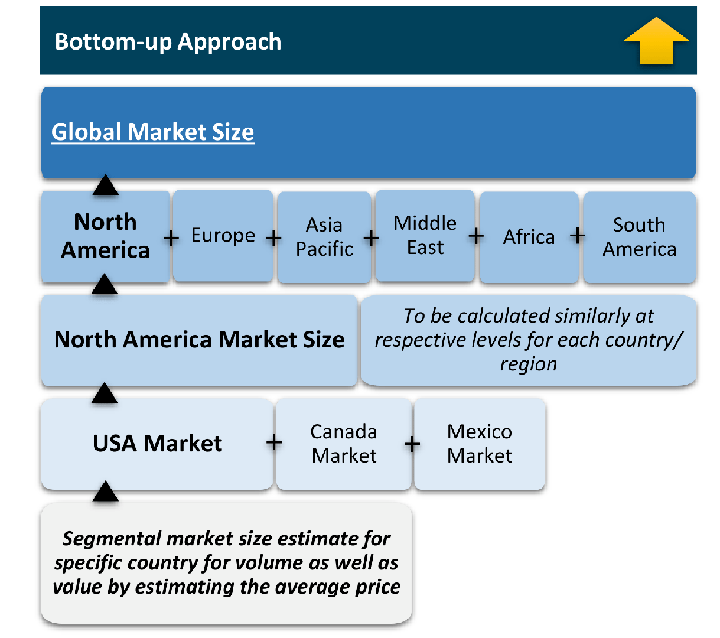
The bottom-up approach builds market estimates by starting with the smallest addressable market units and systematically aggregating them to create comprehensive market size projections.
This method begins with specific, granular data points and builds upward to create the complete market landscape.
Customer Analysis → Segmental Analysis → Geographical Analysis
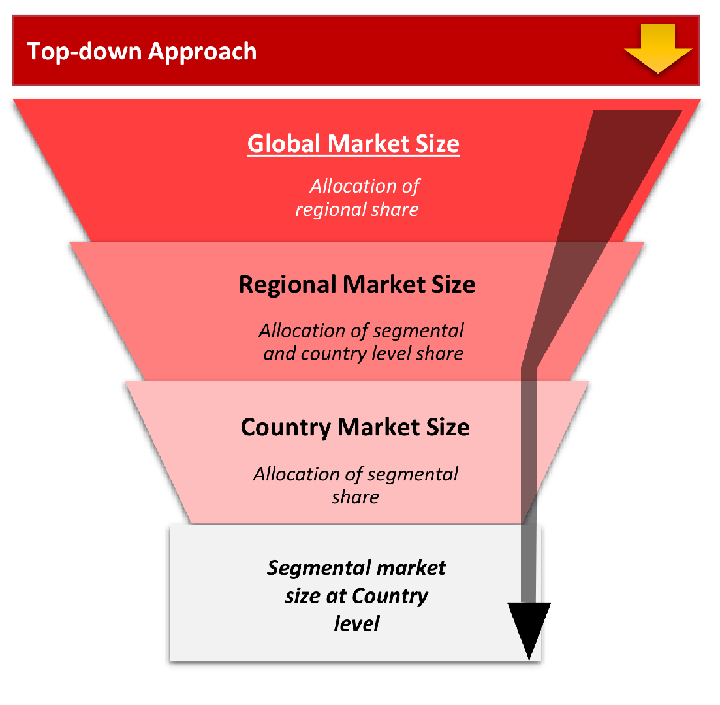
The top-down approach starts with the broadest possible market data and systematically narrows it down through a series of filters and assumptions to arrive at specific market segments or opportunities.
This method begins with the big picture and works downward to increasingly specific market slices.
TAM → SAM → SOM
Research Methods
Desk / Secondary Research
While analysing the market, we extensively study secondary sources, directories, and databases to identify and collect information useful for this technical, market-oriented, and commercial report. Secondary sources that we utilize are not only the public sources, but it is a combination of Open Source, Associations, Paid Databases, MG Repository & Knowledgebase, and others.
- Company websites, annual reports, financial reports, broker reports, and investor presentations
- National government documents, statistical databases and reports
- News articles, press releases and web-casts specific to the companies operating in the market, Magazines, reports, and others
- We gather information from commercial data sources for deriving company specific data such as segmental revenue, share for geography, product revenue, and others
- Internal and external proprietary databases (industry-specific), relevant patent, and regulatory databases
- Governing Bodies, Government Organizations
- Relevant Authorities, Country-specific Associations for Industries
We also employ the model mapping approach to estimate the product level market data through the players' product portfolio
Primary Research
Primary research/ interviews is vital in analyzing the market. Most of the cases involves paid primary interviews. Primary sources include primary interviews through e-mail interactions, telephonic interviews, surveys as well as face-to-face interviews with the different stakeholders across the value chain including several industry experts.
| Type of Respondents | Number of Primaries |
|---|---|
| Tier 2/3 Suppliers | ~20 |
| Tier 1 Suppliers | ~25 |
| End-users | ~25 |
| Industry Expert/ Panel/ Consultant | ~30 |
| Total | ~100 |
MG Knowledgebase
• Repository of industry blog, newsletter and case studies
• Online platform covering detailed market reports, and company profiles
Forecasting Factors and Models
Forecasting Factors
- Historical Trends – Past market patterns, cycles, and major events that shaped how markets behave over time. Understanding past trends helps predict future behavior.
- Industry Factors – Specific characteristics of the industry like structure, regulations, and innovation cycles that affect market dynamics.
- Macroeconomic Factors – Economic conditions like GDP growth, inflation, and employment rates that affect how much money people have to spend.
- Demographic Factors – Population characteristics like age, income, and location that determine who can buy your product.
- Technology Factors – How quickly people adopt new technology and how much technology infrastructure exists.
- Regulatory Factors – Government rules, laws, and policies that can help or restrict market growth.
- Competitive Factors – Analyzing competition structure such as degree of competition and bargaining power of buyers and suppliers.
Forecasting Models / Techniques
Multiple Regression Analysis
- Identify and quantify factors that drive market changes
- Statistical modeling to establish relationships between market drivers and outcomes
Time Series Analysis – Seasonal Patterns
- Understand regular cyclical patterns in market demand
- Advanced statistical techniques to separate trend, seasonal, and irregular components
Time Series Analysis – Trend Analysis
- Identify underlying market growth patterns and momentum
- Statistical analysis of historical data to project future trends
Expert Opinion – Expert Interviews
- Gather deep industry insights and contextual understanding
- In-depth interviews with key industry stakeholders
Multi-Scenario Development
- Prepare for uncertainty by modeling different possible futures
- Creating optimistic, pessimistic, and most likely scenarios
Time Series Analysis – Moving Averages
- Sophisticated forecasting for complex time series data
- Auto-regressive integrated moving average models with seasonal components
Econometric Models
- Apply economic theory to market forecasting
- Sophisticated economic models that account for market interactions
Expert Opinion – Delphi Method
- Harness collective wisdom of industry experts
- Structured, multi-round expert consultation process
Monte Carlo Simulation
- Quantify uncertainty and probability distributions
- Thousands of simulations with varying input parameters
Research Analysis
Our research framework is built upon the fundamental principle of validating market intelligence from both demand and supply perspectives. This dual-sided approach ensures comprehensive market understanding and reduces the risk of single-source bias.
Demand-Side Analysis: We understand end-user/application behavior, preferences, and market needs along with the penetration of the product for specific application.
Supply-Side Analysis: We estimate overall market revenue, analyze the segmental share along with industry capacity, competitive landscape, and market structure.
Validation & Evaluation
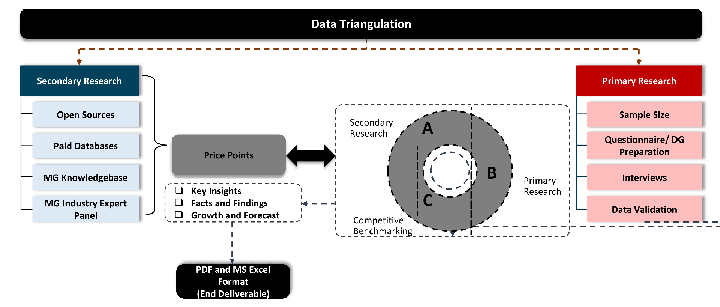
Data triangulation is a validation technique that uses multiple methods, sources, or perspectives to examine the same research question, thereby increasing the credibility and reliability of research findings. In market research, triangulation serves as a quality assurance mechanism that helps identify and minimize bias, validate assumptions, and ensure accuracy in market estimates.
- Data Source Triangulation – Using multiple data sources to examine the same phenomenon
- Methodological Triangulation – Using multiple research methods to study the same research question
- Investigator Triangulation – Using multiple researchers or analysts to examine the same data
- Theoretical Triangulation – Using multiple theoretical perspectives to interpret the same data
Custom Market Research Services
We will customise the research for you, in case the report listed above does not meet your requirements.
Get 10% Free Customisation