Luxury Tourism Market Size, Share & Trends Analysis Report by Tour Type (Adventure Tourism, Cultural & Heritage Tourism, Wellness & Spa Tourism, Culinary & Gastronomic Tourism, Wildlife & Safari Tourism, Cruise Tourism, Eco & Sustainable Tourism, Spiritual & Retreat Tourism, Sports & Recreation Tourism, Others), Traveler Type, Booking Channel, Accommodation Type, Duration of Stay, Consumer Demographics, and Geography (North America, Europe, Asia Pacific, Middle East, Africa, and South America) – Global Industry Data, Trends, and Forecasts, 2026–2035
Market Overview:
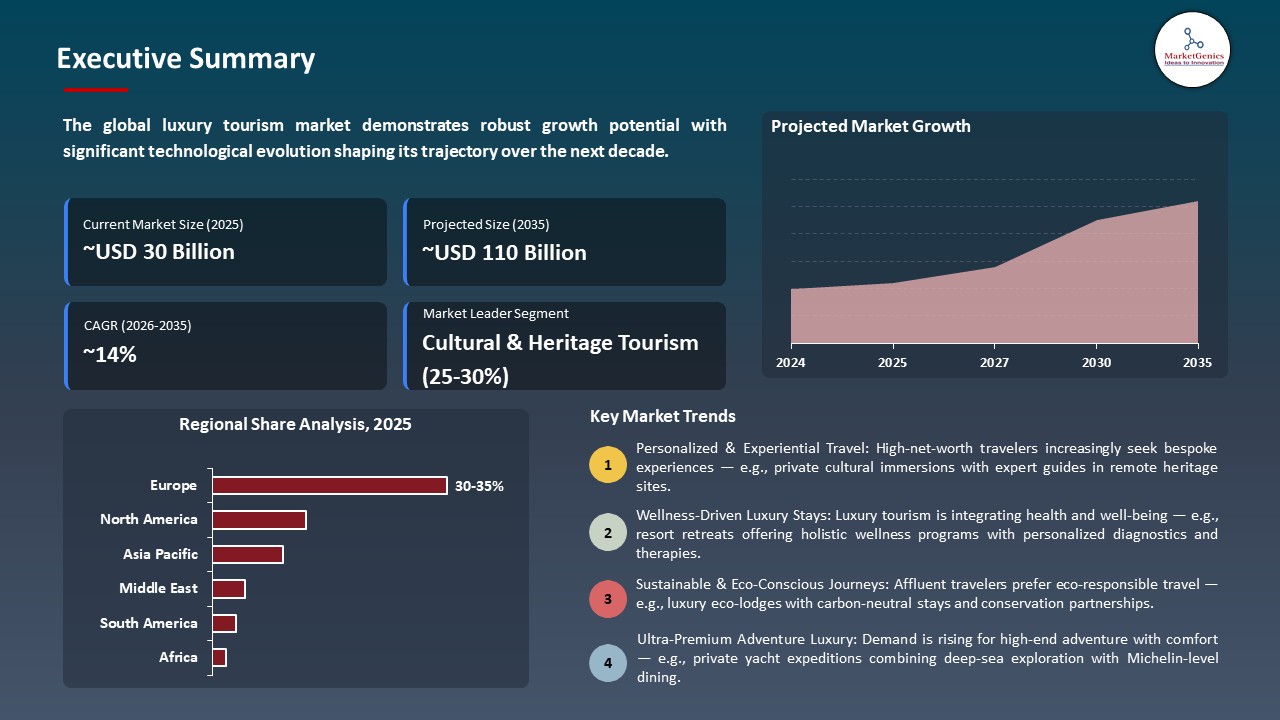
According to MarketGenics analysis, the global luxury tourism market is witnessing strong growth, valued at approximately USD 30.4 billion in 2025 and projected to reach around USD 109.8 billion by 2035, expanding at a CAGR of 13.7% during the forecast period.
|
|
|
Segmental Data Insights |
|
|
Demand Trends |
|
|
Competitive Landscape |
|
|
Strategic Development |
|
|
Future Outlook & Opportunities |
|
Luxury-Tourism-Market Size, Share, and Growth
The global luxury tourism market is increasingly relying on AI-driven automation, cloud analytics, and real-time operational dashboards, which allow operators to monitor complex service processes, optimize the guest experience, and make informed business decisions through analytics and data interpretation.
Michael Yeomans, Senior Vice President, Business Intelligence and Data Solutions, Hospitality, Amadeus, “At Amadeus, we are committed to innovation as we work to shape the future of hospitality technology, and the Amadeus Advisor chatbot powered by Azure OpenAI Service is a great example of this ambition coming to life. This is a transformational step forward in our offering to provide more intelligent and responsive technology, an improved user experience, and remove the need for hoteliers to manually comb through data. The tool quickly presents complex information in a simple and easy-to-understand format, freeing up time for hoteliers to focus on more strategic initiatives that drive revenue.”
The global luxury tourism market is evolving quickly, with the growing demand for experiential and ultra-customized services leading luxury tourism operators to shift for immersive digital platforms that enable them to provide unique value propositions to their customers. Operators are leveraging advanced technologies to consolidate multiple systems, enhance collaboration across departments, and provide high-touch experiences that cater to the needs of luxury travelers.
The luxury tourism business processes are changing dramatically, and is being complemented by rising interest in experiential tourism, including cultural immersion, adventure-based luxury, and multi-generational travel, alongside the integration of advanced concierge services and high-end amenities such as Michelin-starred dining and bespoke wellness programs. For instance, Four Seasons Hotels and Resorts launched its ultra-luxury yacht “Four Seasons I” in 2026, offering exclusive suites and curated maritime experiences targeting elite travellers, driven by resilient demand for premium accommodations such as Ritz-Carlton and St. Regis.
The luxury tourism industry is also observing several adjacent opportunities such as private aviation charters, luxury yacht services, high-end wellness retreats, premium travel technology platforms, and bespoke concierge and lifestyle management services, all benefiting from rising demand for exclusivity and seamless experiences among affluent travelers. The luxury tourism industry is changing dramatically and is becoming a highly agile industry that is delivering ultra-customized experiences, memorable experiences, and sustainable competitive differentiation to the global luxury tourism market.
Luxury Tourism Market Dynamics and Trends
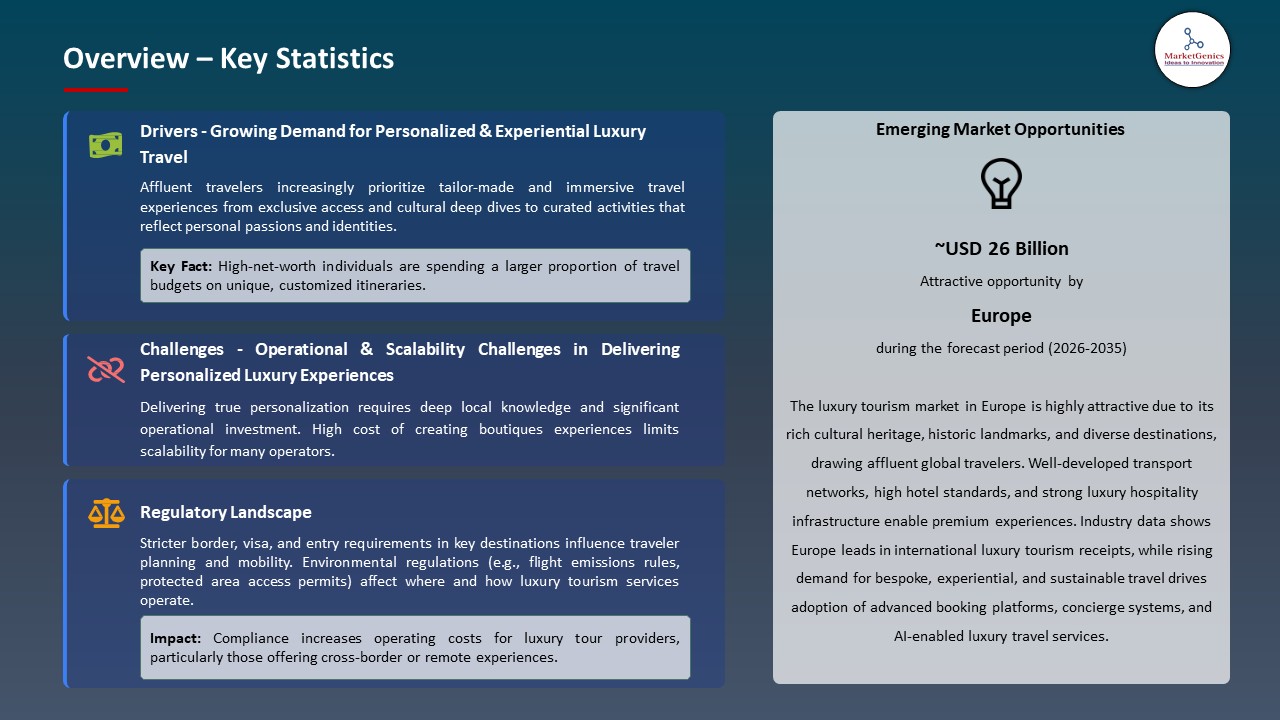
Driver: Personalized & Experiential Travel
- The growing need for real-time visibility into guest behavior and operations is driving the global luxury tourism market, and operators are relying on technology to improve business processes without changing their IT infrastructure.
- With the help of artificial intelligence and automation, luxury travel organizations are now able to gain insights and process things in advance. In June 2024, Amadeus launched an AI-driven hotel business intelligence solution, leveraging Generative AI, which offers real-time insights and enables luxury hospitality teams to make quick decisions and offer personalization.
- Integrated enterprise platforms enable luxury travel providers to operate efficiently and deliver more personalised, experiential stays globally.
Restraint: Economic Uncertainty
- Macroeconomic factors, including rising interest rates, reduced GDP growth, and declining consumer financial confidence, have made luxury travelers reduce their expenditure on luxury trips, thereby affecting the demand for luxury travel.
- Luxury travel operators face uneven investment conditions as economic policy uncertainty increases the cost of capital, complicates demand forecasting and tightens financing for large digital transformation and innovation initiatives.
- For smaller luxury travel organizations, there is a higher risk factor associated with investing in technology, considering the ROI and maintenance costs.
Opportunity: AI & Digital Platform Integration
- Embedding generative AI and autonomous agents into luxury travel platforms enables companies to deliver hyper-personalized experiences, optimize operations, and unlock new revenue streams while building deeper customer loyalty.
- AI agents are increasingly automating high-value travel operations like itinerary optimization and predictive recommendations. In February 2026, ixigo partnered with OpenAI to embed generative AI tools, enabling AI-first personalized travel experiences.
- AI-powered luxury travel platforms provide faster insights, seamless engagement, and scalable operational intelligence.
Key Trend: Heritage, Cultural & Sustainable Tourism
- The global luxury tourism market is shifting towards cultural authenticity and sustainability, as high-net-worth individuals are now more focused on immersing themselves in the local culture, traditions, and customs, as opposed to the traditional concept of luxury.
- Purpose-driven, experiential luxury travel products are growing rapidly to meet this demand. For instance, in March 2026, Tourism Selangor introduced its Selangor Surprisingly Unique Experiences packages, including traditional performances, local crafts, and community-led cultural immersion activities targeting high-end international travelers.
- Cultural immersion combined with eco-friendly activities is changing luxury tourism around the globe.
Luxury Tourism Market Analysis and Segmental Data
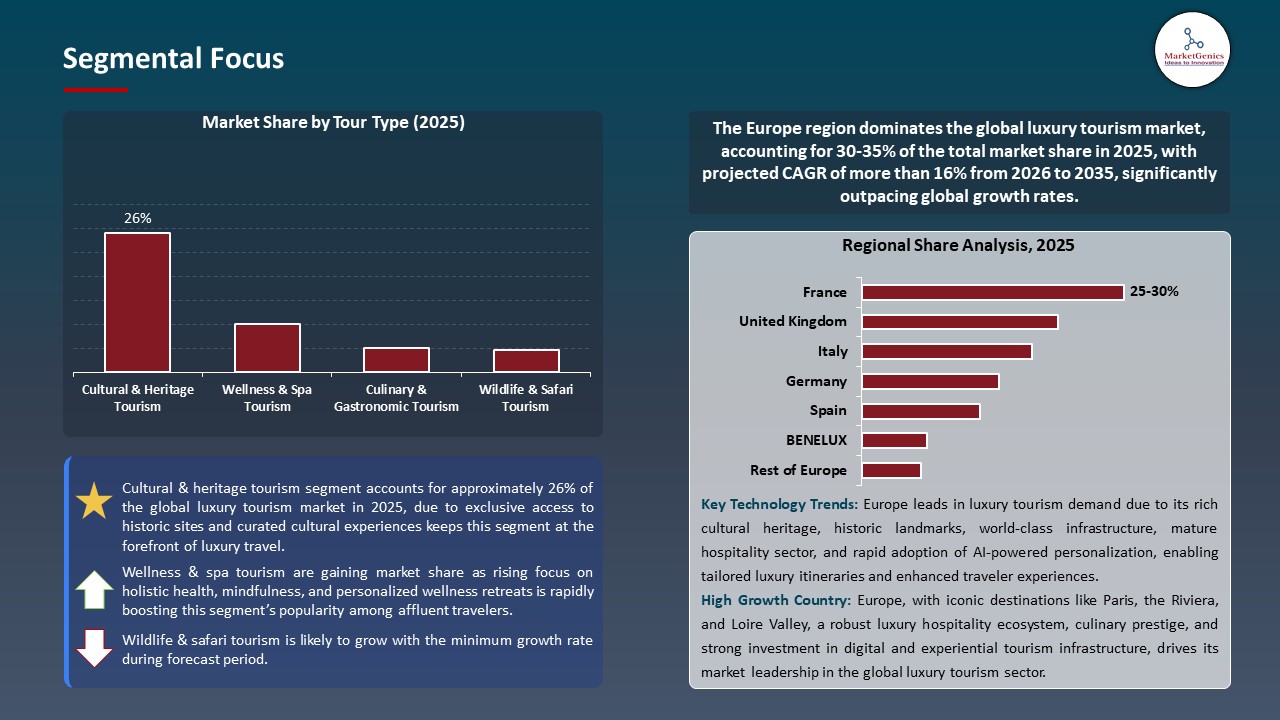
Cultural & Heritage Tourism Dominate Global Luxury Tourism Market
- Cultural and heritage tourism has dominated the luxury tourism market, with travelers increasingly opting for immersive experiences and experiences related to history and culture, and luxury travelers leading this demand.
- Multi-destination cultural and heritage-based luxury travel packages are also being optimized for personalized, data-driven travel experiences. For instance, in July 2025, The Travel Corporation (TTC) introduced 16 new luxury heritage journeys in Europe, the Americas, and Asia, including historic city explorations, heritage site visits, and authentic local experiences.
- Integration with AI-based booking, digital concierge, and personalization platforms has ensured that cultural and heritage-based luxury travel remains a key segment in driving the luxury tourism market.
Europe Leads Global Luxury Tourism Market Demand
- Europe has dominated the Luxury Tourism market, with travelers from Asia, the Middle East, and the US opting for European luxury travel due to its rich cultural heritage, historic landmarks, and hospitality.
- Accelerated adoption of digital booking, AI-driven concierge, and experiential management systems is seen as operators modernize. In November 2025, Belmond Ltd. launched its Villeggiatura by Train series on the Venice Simplon‑Orient‑Express, connecting Venice, Florence, Portofino, and Amalfi Coast properties with immersive luxury rail experiences.
- The strong vendor network and digital adoption are a testament to the fact that Europe remains at the vanguard of personalized and data-driven luxury travel.
Luxury Tourism Market Ecosystem
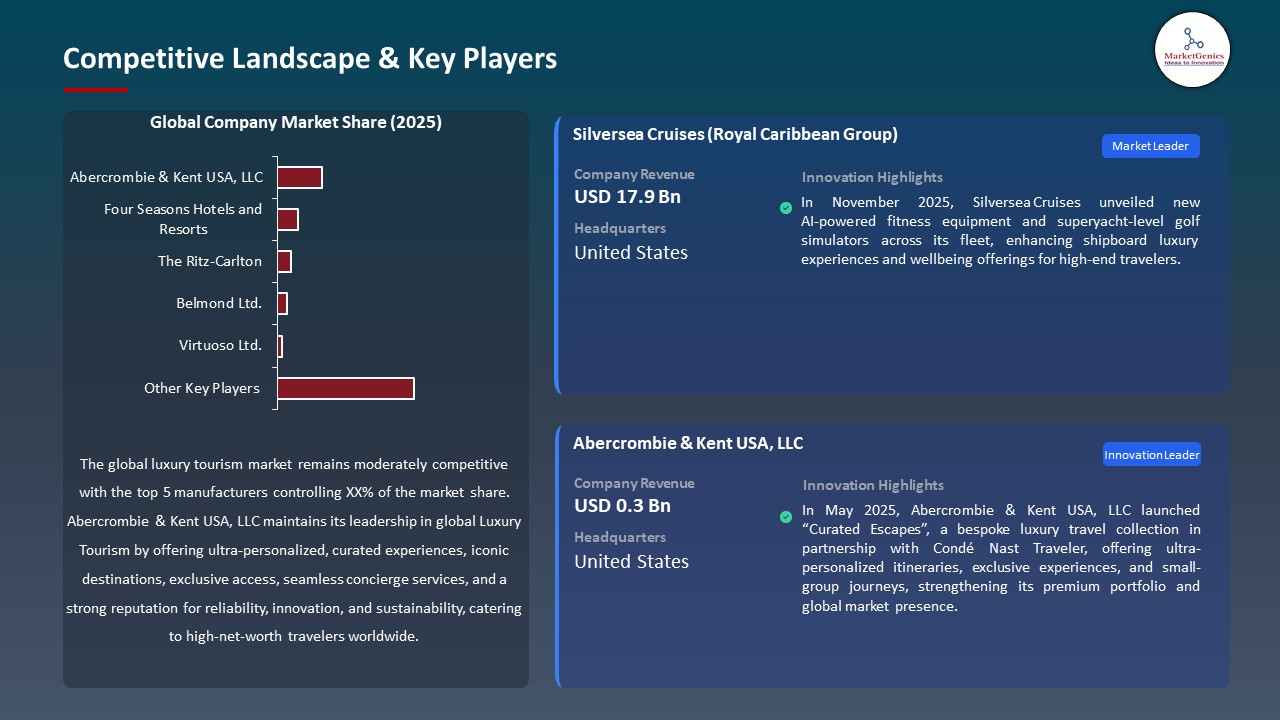
The luxury tourism market is a moderately consolidated marketplace with a strong focus on differentiated experiential offers, premium service integration, access and sustainability, and global distribution partnerships. Key players like Abercrombie & Kent USA, LLC, Four Seasons Hotels and Resorts, The Ritz-Carlton, Belmond Ltd., and Virtuoso Ltd., among others, collectively contribute to the ecosystem by providing ultra-luxury travel products and personalized guest experience with end-to-end service delivery to high-net-worth travelers around the world.
Abercrombie & Kent USA, LLC specializes in curated expeditions with bespoke journeys and concierge services. Four Seasons Hotels and Resorts provides luxury travel experiences on land, sea, and at destinations with premium hotel and wellness packages. The Ritz-Carlton specializes in iconic properties and signature guest experiences. Belmond Ltd. provides heritage luxury rail travel, cruises, and properties. Virtuoso Ltd. provides exclusive access and integrated booking platforms with suppliers.
Partnerships with airlines, cruises, private aviation, luxury retail, and tourism boards add value to the ecosystem and the brand. Digital transformation with AI-driven personalization, mobile-first strategy, real-time support, and integrated CRM/loyalty programs enables seamless travel and provides a platform for differentiation with strategic partnerships.
Recent Development and Strategic Overview
- In March 2026, L Catterton Real Estate & Cedar Capital Partners announced joint venture with the aim of building a leading luxury hospitality platform, particularly targeting five-star and luxury hotel properties in key urban and resort locations in Europe and North America, with an aim of acquiring, repositioning, and redeveloping these properties.
- In March 2026, Marriott International partnered with Lefay Resorts to launch a new luxury wellness brand and expand the high-end experiential tourism segment with curated wellness-centric properties and services under the Marriott Bonvoy brand.
Report Scope
|
Detail |
|
|
Market Size in 2025 |
USD 30.4 Bn |
|
Market Forecast Value in 2035 |
USD 109.8 Bn |
|
Growth Rate (CAGR) |
13.7% |
|
Forecast Period |
2026 – 2035 |
|
Historical Data Available for |
2021 – 2024 |
|
Market Size Units |
US$ Billion for Value |
|
Report Format |
Electronic (PDF) + Excel |
|
North America |
Europe |
Asia Pacific |
Middle East |
Africa |
South America |
|
|
|
|
|
|
|
Companies Covered |
|||||
|
|
|
|
|
|
|
Luxury Tourism Market Segmentation and Highlights
|
Segment |
Sub-segment |
|
Luxury Tourism Market, By Tour Type |
|
|
Luxury Tourism Market, By Traveler Type |
|
|
Luxury Tourism Market, By Booking Channel |
|
|
Luxury Tourism Market, By Accommodation Type |
|
|
Luxury Tourism Market, By Duration of Stay |
|
|
Luxury Tourism Market, By Consumer Demographics |
|
Frequently Asked Questions
Table of Contents
- 1. Research Methodology and Assumptions
- 1.1. Definitions
- 1.2. Research Design and Approach
- 1.3. Data Collection Methods
- 1.4. Base Estimates and Calculations
- 1.5. Forecasting Models
- 1.5.1. Key Forecast Factors & Impact Analysis
- 1.6. Secondary Research
- 1.6.1. Open Sources
- 1.6.2. Paid Databases
- 1.6.3. Associations
- 1.7. Primary Research
- 1.7.1. Primary Sources
- 1.7.2. Primary Interviews with Stakeholders across Ecosystem
- 2. Executive Summary
- 2.1. Global Luxury Tourism Market Outlook
- 2.1.1. Luxury Tourism Market Size (Value - US$ Bn), and Forecasts, 2021-2035
- 2.1.2. Compounded Annual Growth Rate Analysis
- 2.1.3. Growth Opportunity Analysis
- 2.1.4. Segmental Share Analysis
- 2.1.5. Geographical Share Analysis
- 2.2. Market Analysis and Facts
- 2.3. Supply-Demand Analysis
- 2.4. Competitive Benchmarking
- 2.5. Go-to- Market Strategy
- 2.5.1. Customer/ End-use Industry Assessment
- 2.5.2. Growth Opportunity Data, 2026-2035
- 2.5.2.1. Regional Data
- 2.5.2.2. Country Data
- 2.5.2.3. Segmental Data
- 2.5.3. Identification of Potential Market Spaces
- 2.5.4. GAP Analysis
- 2.5.5. Potential Attractive Price Points
- 2.5.6. Prevailing Market Risks & Challenges
- 2.5.7. Preferred Sales & Marketing Strategies
- 2.5.8. Key Recommendations and Analysis
- 2.5.9. A Way Forward
- 2.1. Global Luxury Tourism Market Outlook
- 3. Industry Data and Premium Insights
- 3.1. Global Consumer Goods & Services Industry Overview, 2025
- 3.1.1. Consumer Goods & Services Industry Ecosystem Analysis
- 3.1.2. Key Trends for Consumer Goods & Services Industry
- 3.1.3. Regional Distribution for Consumer Goods & Services Industry
- 3.2. Supplier Customer Data
- 3.3. Technology Roadmap and Developments
- 3.4. Trade Analysis
- 3.4.1. Import & Export Analysis, 2025
- 3.4.2. Top Importing Countries
- 3.4.3. Top Exporting Countries
- 3.5. Trump Tariff Impact Analysis
- 3.5.1. Manufacturer
- 3.5.1.1. Based on the component & Raw material
- 3.5.2. Supply Chain
- 3.5.3. End Consumer
- 3.5.1. Manufacturer
- 3.6. Raw Material Analysis
- 3.1. Global Consumer Goods & Services Industry Overview, 2025
- 4. Market Overview
- 4.1. Market Dynamics
- 4.1.1. Drivers
- 4.1.1.1. Rising disposable income among high-net-worth individuals
- 4.1.1.2. Growing demand for personalized and experiential travel
- 4.1.1.3. Expansion of premium hospitality infrastructure and services
- 4.1.2. Restraints
- 4.1.2.1. High cost of luxury travel and services
- 4.1.2.2. Economic uncertainty and geopolitical instability impacting travel demand
- 4.1.1. Drivers
- 4.2. Key Trend Analysis
- 4.3. Regulatory Framework
- 4.3.1. Key Regulations, Norms, and Subsidies, by Key Countries
- 4.3.2. Tariffs and Standards
- 4.3.3. Impact Analysis of Regulations on the Market
- 4.4. Value Chain Analysis
- 4.4.1. Raw Material & Asset Development
- 4.4.2. Luxury Asset Owners & Developers
- 4.4.3. Service & Experience Providers
- 4.4.4. Technology & Platform Integrators
- 4.4.5. Distribution & Sales Channels
- 4.4.6. End-Users/ Customers
- 4.4.7. After-Service & Loyalty Ecosystem
- 4.5. Porter’s Five Forces Analysis
- 4.6. PESTEL Analysis
- 4.7. Global Luxury Tourism Market Demand
- 4.7.1. Historical Market Size – Value (US$ Bn), 2020-2024
- 4.7.2. Current and Future Market Size – Value (US$ Bn), 2026–2035
- 4.7.2.1. Y-o-Y Growth Trends
- 4.7.2.2. Absolute $ Opportunity Assessment
- 4.1. Market Dynamics
- 5. Competition Landscape
- 5.1. Competition structure
- 5.1.1. Fragmented v/s consolidated
- 5.2. Company Share Analysis, 2025
- 5.2.1. Global Company Market Share
- 5.2.2. By Region
- 5.2.2.1. North America
- 5.2.2.2. Europe
- 5.2.2.3. Asia Pacific
- 5.2.2.4. Middle East
- 5.2.2.5. Africa
- 5.2.2.6. South America
- 5.3. Product Comparison Matrix
- 5.3.1. Specifications
- 5.3.2. Market Positioning
- 5.3.3. Pricing
- 5.1. Competition structure
- 6. Global Luxury Tourism Market Analysis, by Tour Type
- 6.1. Key Segment Analysis
- 6.2. Luxury Tourism Market Size (Value - US$ Bn), Analysis, and Forecasts, by Tour Type, 2021-2035
- 6.2.1. Adventure Tourism
- 6.2.2. Cultural & Heritage Tourism
- 6.2.3. Wellness & Spa Tourism
- 6.2.4. Culinary & Gastronomic Tourism
- 6.2.5. Wildlife & Safari Tourism
- 6.2.6. Cruise Tourism
- 6.2.7. Eco & Sustainable Tourism
- 6.2.8. Spiritual & Retreat Tourism
- 6.2.9. Sports & Recreation Tourism
- 6.2.10. Others
- 7. Global Luxury Tourism Market Analysis, by Traveler Type
- 7.1. Key Segment Analysis
- 7.2. Luxury Tourism Market Size (Value - US$ Bn), Analysis, and Forecasts, by Traveler Type, 2021-2035
- 7.2.1. Solo Travelers
- 7.2.2. Couples & Honeymooners
- 7.2.3. Family Travelers
- 7.2.4. Group Travelers
- 7.2.5. Corporate & Business Travelers
- 7.2.6. Others
- 8. Global Luxury Tourism Market Analysis, by Booking Channel
- 8.1. Key Segment Analysis
- 8.2. Luxury Tourism Market Size (Value - US$ Bn), Analysis, and Forecasts, by Booking Channel, 2021-2035
- 8.2.1. Direct Hotel/Resort Booking
- 8.2.2. Luxury Travel Agencies & Tour Operators
- 8.2.3. Online Travel Agencies (OTAs)
- 8.2.4. Private Concierge Services
- 8.2.5. Membership-Based Travel Clubs
- 9. Global Luxury Tourism Market Analysis, by Accommodation Type
- 9.1. Key Segment Analysis
- 9.2. Luxury Tourism Market Size (Value - US$ Bn), Analysis, and Forecasts, by Accommodation Type, 2021-2035
- 9.2.1. Ultra-Luxury Hotels & Resorts
- 9.2.2. Boutique Luxury Hotels
- 9.2.3. Private Villas & Estate Rentals
- 9.2.4. Luxury Cruise Ships & Yachts
- 9.2.5. Private Island Resorts
- 9.2.6. Heritage Palaces & Châteaux
- 9.2.7. Others
- 10. Global Luxury Tourism Market Analysis, by Duration of Stay
- 10.1. Key Segment Analysis
- 10.2. Luxury Tourism Market Size (Value - US$ Bn), Analysis, and Forecasts, by Duration of Stay, 2021-2035
- 10.2.1. Short-Haul Trips
- 10.2.2. Weekend Getaways
- 10.2.3. Extended Holidays
- 10.2.4. Long-Stay Retreats
- 10.2.5. Expedition & Round-the-World
- 11. Global Luxury Tourism Market Analysis, by Consumer Demographics
- 11.1. Key Segment Analysis
- 11.2. Luxury Tourism Market Size (Value - US$ Bn), Analysis, and Forecasts, by Consumer Demographics, 2021-2035
- 11.2.1. By Age Group
- 11.2.1.1. Millennials (25–40 Years)
- 11.2.1.2. Gen X (41–55 Years)
- 11.2.1.3. Baby Boomers (56–70 Years)
- 11.2.1.4. Senior Affluent (70+ Years)
- 11.2.2. By Income Level
- 11.2.2.1. High Net Worth Individuals (HNWIs)
- 11.2.2.2. Ultra-High Net Worth Individuals (UHNWIs)
- 11.2.2.3. Mass Affluent Segment
- 11.2.1. By Age Group
- 12. Global Luxury Tourism Market Analysis and Forecasts, by Region
- 12.1. Key Findings
- 12.2. Luxury Tourism Market Size (Value - US$ Bn), Analysis, and Forecasts, by Region, 2021-2035
- 12.2.1. North America
- 12.2.2. Europe
- 12.2.3. Asia Pacific
- 12.2.4. Middle East
- 12.2.5. Africa
- 12.2.6. South America
- 13. North America Luxury Tourism Market Analysis
- 13.1. Key Segment Analysis
- 13.2. Regional Snapshot
- 13.3. North America Luxury Tourism Market Size (Value - US$ Bn), Analysis, and Forecasts, 2021-2035
- 13.3.1. Tour Type
- 13.3.2. Traveler Type
- 13.3.3. Booking Channel
- 13.3.4. Accommodation Type
- 13.3.5. Duration of Stay
- 13.3.6. Consumer Demographics
- 13.3.7. Country
- 13.3.7.1. USA
- 13.3.7.2. Canada
- 13.3.7.3. Mexico
- 13.4. USA Luxury Tourism Market
- 13.4.1. Country Segmental Analysis
- 13.4.2. Tour Type
- 13.4.3. Traveler Type
- 13.4.4. Booking Channel
- 13.4.5. Accommodation Type
- 13.4.6. Duration of Stay
- 13.4.7. Consumer Demographics
- 13.5. Canada Luxury Tourism Market
- 13.5.1. Country Segmental Analysis
- 13.5.2. Tour Type
- 13.5.3. Traveler Type
- 13.5.4. Booking Channel
- 13.5.5. Accommodation Type
- 13.5.6. Duration of Stay
- 13.5.7. Consumer Demographics
- 13.6. Mexico Luxury Tourism Market
- 13.6.1. Country Segmental Analysis
- 13.6.2. Tour Type
- 13.6.3. Traveler Type
- 13.6.4. Booking Channel
- 13.6.5. Accommodation Type
- 13.6.6. Duration of Stay
- 13.6.7. Consumer Demographics
- 14. Europe Luxury Tourism Market Analysis
- 14.1. Key Segment Analysis
- 14.2. Regional Snapshot
- 14.3. Europe Luxury Tourism Market Size (Value - US$ Bn), Analysis, and Forecasts, 2021-2035
- 14.3.1. Tour Type
- 14.3.2. Traveler Type
- 14.3.3. Booking Channel
- 14.3.4. Accommodation Type
- 14.3.5. Duration of Stay
- 14.3.6. Consumer Demographics
- 14.3.7. Country
- 14.3.7.1. Germany
- 14.3.7.2. United Kingdom
- 14.3.7.3. France
- 14.3.7.4. Italy
- 14.3.7.5. Spain
- 14.3.7.6. Netherlands
- 14.3.7.7. Nordic Countries
- 14.3.7.8. Poland
- 14.3.7.9. Russia & CIS
- 14.3.7.10. Rest of Europe
- 14.4. Germany Luxury Tourism Market
- 14.4.1. Country Segmental Analysis
- 14.4.2. Tour Type
- 14.4.3. Traveler Type
- 14.4.4. Booking Channel
- 14.4.5. Accommodation Type
- 14.4.6. Duration of Stay
- 14.4.7. Consumer Demographics
- 14.5. United Kingdom Luxury Tourism Market
- 14.5.1. Country Segmental Analysis
- 14.5.2. Tour Type
- 14.5.3. Traveler Type
- 14.5.4. Booking Channel
- 14.5.5. Accommodation Type
- 14.5.6. Duration of Stay
- 14.5.7. Consumer Demographics
- 14.6. France Luxury Tourism Market
- 14.6.1. Country Segmental Analysis
- 14.6.2. Tour Type
- 14.6.3. Traveler Type
- 14.6.4. Booking Channel
- 14.6.5. Accommodation Type
- 14.6.6. Duration of Stay
- 14.6.7. Consumer Demographics
- 14.7. Italy Luxury Tourism Market
- 14.7.1. Country Segmental Analysis
- 14.7.2. Tour Type
- 14.7.3. Traveler Type
- 14.7.4. Booking Channel
- 14.7.5. Accommodation Type
- 14.7.6. Duration of Stay
- 14.7.7. Consumer Demographics
- 14.8. Spain Luxury Tourism Market
- 14.8.1. Country Segmental Analysis
- 14.8.2. Tour Type
- 14.8.3. Traveler Type
- 14.8.4. Booking Channel
- 14.8.5. Accommodation Type
- 14.8.6. Duration of Stay
- 14.8.7. Consumer Demographics
- 14.9. Netherlands Luxury Tourism Market
- 14.9.1. Country Segmental Analysis
- 14.9.2. Tour Type
- 14.9.3. Traveler Type
- 14.9.4. Booking Channel
- 14.9.5. Accommodation Type
- 14.9.6. Duration of Stay
- 14.9.7. Consumer Demographics
- 14.10. Nordic Countries Luxury Tourism Market
- 14.10.1. Country Segmental Analysis
- 14.10.2. Tour Type
- 14.10.3. Traveler Type
- 14.10.4. Booking Channel
- 14.10.5. Accommodation Type
- 14.10.6. Duration of Stay
- 14.10.7. Consumer Demographics
- 14.11. Poland Luxury Tourism Market
- 14.11.1. Country Segmental Analysis
- 14.11.2. Tour Type
- 14.11.3. Traveler Type
- 14.11.4. Booking Channel
- 14.11.5. Accommodation Type
- 14.11.6. Duration of Stay
- 14.11.7. Consumer Demographics
- 14.12. Russia & CIS Luxury Tourism Market
- 14.12.1. Country Segmental Analysis
- 14.12.2. Tour Type
- 14.12.3. Traveler Type
- 14.12.4. Booking Channel
- 14.12.5. Accommodation Type
- 14.12.6. Duration of Stay
- 14.12.7. Consumer Demographics
- 14.13. Rest of Europe Luxury Tourism Market
- 14.13.1. Country Segmental Analysis
- 14.13.2. Tour Type
- 14.13.3. Traveler Type
- 14.13.4. Booking Channel
- 14.13.5. Accommodation Type
- 14.13.6. Duration of Stay
- 14.13.7. Consumer Demographics
- 15. Asia Pacific Luxury Tourism Market Analysis
- 15.1. Key Segment Analysis
- 15.2. Regional Snapshot
- 15.3. Asia Pacific Luxury Tourism Market Size (Value - US$ Bn), Analysis, and Forecasts, 2021-2035
- 15.3.1. Tour Type
- 15.3.2. Traveler Type
- 15.3.3. Booking Channel
- 15.3.4. Accommodation Type
- 15.3.5. Duration of Stay
- 15.3.6. Consumer Demographics
- 15.3.7. Country
- 15.3.7.1. China
- 15.3.7.2. India
- 15.3.7.3. Japan
- 15.3.7.4. South Korea
- 15.3.7.5. Australia and New Zealand
- 15.3.7.6. Indonesia
- 15.3.7.7. Malaysia
- 15.3.7.8. Thailand
- 15.3.7.9. Vietnam
- 15.3.7.10. Rest of Asia Pacific
- 15.4. China Luxury Tourism Market
- 15.4.1. Country Segmental Analysis
- 15.4.2. Tour Type
- 15.4.3. Traveler Type
- 15.4.4. Booking Channel
- 15.4.5. Accommodation Type
- 15.4.6. Duration of Stay
- 15.4.7. Consumer Demographics
- 15.5. India Luxury Tourism Market
- 15.5.1. Country Segmental Analysis
- 15.5.2. Tour Type
- 15.5.3. Traveler Type
- 15.5.4. Booking Channel
- 15.5.5. Accommodation Type
- 15.5.6. Duration of Stay
- 15.5.7. Consumer Demographics
- 15.6. Japan Luxury Tourism Market
- 15.6.1. Country Segmental Analysis
- 15.6.2. Tour Type
- 15.6.3. Traveler Type
- 15.6.4. Booking Channel
- 15.6.5. Accommodation Type
- 15.6.6. Duration of Stay
- 15.6.7. Consumer Demographics
- 15.7. South Korea Luxury Tourism Market
- 15.7.1. Country Segmental Analysis
- 15.7.2. Tour Type
- 15.7.3. Traveler Type
- 15.7.4. Booking Channel
- 15.7.5. Accommodation Type
- 15.7.6. Duration of Stay
- 15.7.7. Consumer Demographics
- 15.8. Australia and New Zealand Luxury Tourism Market
- 15.8.1. Country Segmental Analysis
- 15.8.2. Tour Type
- 15.8.3. Traveler Type
- 15.8.4. Booking Channel
- 15.8.5. Accommodation Type
- 15.8.6. Duration of Stay
- 15.8.7. Consumer Demographics
- 15.9. Indonesia Luxury Tourism Market
- 15.9.1. Country Segmental Analysis
- 15.9.2. Tour Type
- 15.9.3. Traveler Type
- 15.9.4. Booking Channel
- 15.9.5. Accommodation Type
- 15.9.6. Duration of Stay
- 15.9.7. Consumer Demographics
- 15.10. Malaysia Luxury Tourism Market
- 15.10.1. Country Segmental Analysis
- 15.10.2. Tour Type
- 15.10.3. Traveler Type
- 15.10.4. Booking Channel
- 15.10.5. Accommodation Type
- 15.10.6. Duration of Stay
- 15.10.7. Consumer Demographics
- 15.11. Thailand Luxury Tourism Market
- 15.11.1. Country Segmental Analysis
- 15.11.2. Tour Type
- 15.11.3. Traveler Type
- 15.11.4. Booking Channel
- 15.11.5. Accommodation Type
- 15.11.6. Duration of Stay
- 15.11.7. Consumer Demographics
- 15.12. Vietnam Luxury Tourism Market
- 15.12.1. Country Segmental Analysis
- 15.12.2. Tour Type
- 15.12.3. Traveler Type
- 15.12.4. Booking Channel
- 15.12.5. Accommodation Type
- 15.12.6. Duration of Stay
- 15.12.7. Consumer Demographics
- 15.13. Rest of Asia Pacific Luxury Tourism Market
- 15.13.1. Country Segmental Analysis
- 15.13.2. Tour Type
- 15.13.3. Traveler Type
- 15.13.4. Booking Channel
- 15.13.5. Accommodation Type
- 15.13.6. Duration of Stay
- 15.13.7. Consumer Demographics
- 16. Middle East Luxury Tourism Market Analysis
- 16.1. Key Segment Analysis
- 16.2. Regional Snapshot
- 16.3. Middle East Luxury Tourism Market Size (Value - US$ Bn), Analysis, and Forecasts, 2021-2035
- 16.3.1. Tour Type
- 16.3.2. Traveler Type
- 16.3.3. Booking Channel
- 16.3.4. Accommodation Type
- 16.3.5. Duration of Stay
- 16.3.6. Consumer Demographics
- 16.3.7. Country
- 16.3.7.1. Turkey
- 16.3.7.2. UAE
- 16.3.7.3. Saudi Arabia
- 16.3.7.4. Israel
- 16.3.7.5. Rest of Middle East
- 16.4. Turkey Luxury Tourism Market
- 16.4.1. Country Segmental Analysis
- 16.4.2. Tour Type
- 16.4.3. Traveler Type
- 16.4.4. Booking Channel
- 16.4.5. Accommodation Type
- 16.4.6. Duration of Stay
- 16.4.7. Consumer Demographics
- 16.5. UAE Luxury Tourism Market
- 16.5.1. Country Segmental Analysis
- 16.5.2. Tour Type
- 16.5.3. Traveler Type
- 16.5.4. Booking Channel
- 16.5.5. Accommodation Type
- 16.5.6. Duration of Stay
- 16.5.7. Consumer Demographics
- 16.6. Saudi Arabia Luxury Tourism Market
- 16.6.1. Country Segmental Analysis
- 16.6.2. Tour Type
- 16.6.3. Traveler Type
- 16.6.4. Booking Channel
- 16.6.5. Accommodation Type
- 16.6.6. Duration of Stay
- 16.6.7. Consumer Demographics
- 16.7. Israel Luxury Tourism Market
- 16.7.1. Country Segmental Analysis
- 16.7.2. Tour Type
- 16.7.3. Traveler Type
- 16.7.4. Booking Channel
- 16.7.5. Accommodation Type
- 16.7.6. Duration of Stay
- 16.7.7. Consumer Demographics
- 16.8. Rest of Middle East Luxury Tourism Market
- 16.8.1. Country Segmental Analysis
- 16.8.2. Tour Type
- 16.8.3. Traveler Type
- 16.8.4. Booking Channel
- 16.8.5. Accommodation Type
- 16.8.6. Duration of Stay
- 16.8.7. Consumer Demographics
- 17. Africa Luxury Tourism Market Analysis
- 17.1. Key Segment Analysis
- 17.2. Regional Snapshot
- 17.3. Africa Luxury Tourism Market Size (Value - US$ Bn), Analysis, and Forecasts, 2021-2035
- 17.3.1. Tour Type
- 17.3.2. Traveler Type
- 17.3.3. Booking Channel
- 17.3.4. Accommodation Type
- 17.3.5. Duration of Stay
- 17.3.6. Consumer Demographics
- 17.3.7. Country
- 17.3.7.1. South Africa
- 17.3.7.2. Egypt
- 17.3.7.3. Nigeria
- 17.3.7.4. Algeria
- 17.3.7.5. Rest of Africa
- 17.4. South Africa Luxury Tourism Market
- 17.4.1. Country Segmental Analysis
- 17.4.2. Tour Type
- 17.4.3. Traveler Type
- 17.4.4. Booking Channel
- 17.4.5. Accommodation Type
- 17.4.6. Duration of Stay
- 17.4.7. Consumer Demographics
- 17.5. Egypt Luxury Tourism Market
- 17.5.1. Country Segmental Analysis
- 17.5.2. Tour Type
- 17.5.3. Traveler Type
- 17.5.4. Booking Channel
- 17.5.5. Accommodation Type
- 17.5.6. Duration of Stay
- 17.5.7. Consumer Demographics
- 17.6. Nigeria Luxury Tourism Market
- 17.6.1. Country Segmental Analysis
- 17.6.2. Tour Type
- 17.6.3. Traveler Type
- 17.6.4. Booking Channel
- 17.6.5. Accommodation Type
- 17.6.6. Duration of Stay
- 17.6.7. Consumer Demographics
- 17.7. Algeria Luxury Tourism Market
- 17.7.1. Country Segmental Analysis
- 17.7.2. Tour Type
- 17.7.3. Traveler Type
- 17.7.4. Booking Channel
- 17.7.5. Accommodation Type
- 17.7.6. Duration of Stay
- 17.7.7. Consumer Demographics
- 17.8. Rest of Africa Luxury Tourism Market
- 17.8.1. Country Segmental Analysis
- 17.8.2. Tour Type
- 17.8.3. Traveler Type
- 17.8.4. Booking Channel
- 17.8.5. Accommodation Type
- 17.8.6. Duration of Stay
- 17.8.7. Consumer Demographics
- 18. South America Luxury Tourism Market Analysis
- 18.1. Key Segment Analysis
- 18.2. Regional Snapshot
- 18.3. South America Luxury Tourism Market Size (Value - US$ Bn), Analysis, and Forecasts, 2021-2035
- 18.3.1. Tour Type
- 18.3.2. Traveler Type
- 18.3.3. Booking Channel
- 18.3.4. Accommodation Type
- 18.3.5. Duration of Stay
- 18.3.6. Consumer Demographics
- 18.3.7. Country
- 18.3.7.1. Brazil
- 18.3.7.2. Argentina
- 18.3.7.3. Rest of South America
- 18.4. Brazil Luxury Tourism Market
- 18.4.1. Country Segmental Analysis
- 18.4.2. Tour Type
- 18.4.3. Traveler Type
- 18.4.4. Booking Channel
- 18.4.5. Accommodation Type
- 18.4.6. Duration of Stay
- 18.4.7. Consumer Demographics
- 18.5. Argentina Luxury Tourism Market
- 18.5.1. Country Segmental Analysis
- 18.5.2. Tour Type
- 18.5.3. Traveler Type
- 18.5.4. Booking Channel
- 18.5.5. Accommodation Type
- 18.5.6. Duration of Stay
- 18.5.7. Consumer Demographics
- 18.6. Rest of South America Luxury Tourism Market
- 18.6.1. Country Segmental Analysis
- 18.6.2. Tour Type
- 18.6.3. Traveler Type
- 18.6.4. Booking Channel
- 18.6.5. Accommodation Type
- 18.6.6. Duration of Stay
- 18.6.7. Consumer Demographics
- 19. Key Players/ Company Profile
- 19.1. &Beyond
- 19.1.1. Company Details/ Overview
- 19.1.2. Company Financials
- 19.1.3. Key Customers and Competitors
- 19.1.4. Business/ Industry Portfolio
- 19.1.5. Product Portfolio/ Specification Details
- 19.1.6. Pricing Data
- 19.1.7. Strategic Overview
- 19.1.8. Recent Developments
- 19.2. Abercrombie & Kent USA, LLC
- 19.3. Aman Resorts
- 19.4. Artisans of Leisure
- 19.5. Belmond Ltd.
- 19.6. Butterfield & Robinson Inc.
- 19.7. Cox & Kings
- 19.8. Crystal Cruises
- 19.9. Four Seasons Hotels and Resorts
- 19.10. Kerzner International
- 19.11. Micato Safaris
- 19.12. National Geographic Expeditions, LLC
- 19.13. Regent Seven Seas Cruises
- 19.14. Remote Lands Inc
- 19.15. Rosewood Hotels & Resorts
- 19.16. Scott Dunn
- 19.17. Silversea Cruises
- 19.18. Singita
- 19.19. Six Senses Hotels Resorts Spas
- 19.20. Tauck World Discovery
- 19.21. The Ritz-Carlton
- 19.22. Virtuoso Ltd.
- 19.23. Other Key Players
- 19.1. &Beyond
Note* - This is just tentative list of players. While providing the report, we will cover more number of players based on their revenue and share for each geography
Research Design
Our research design integrates both demand-side and supply-side analysis through a balanced combination of primary and secondary research methodologies. By utilizing both bottom-up and top-down approaches alongside rigorous data triangulation methods, we deliver robust market intelligence that supports strategic decision-making.
MarketGenics' comprehensive research design framework ensures the delivery of accurate, reliable, and actionable market intelligence. Through the integration of multiple research approaches, rigorous validation processes, and expert analysis, we provide our clients with the insights needed to make informed strategic decisions and capitalize on market opportunities.

MarketGenics leverages a dedicated industry panel of experts and a comprehensive suite of paid databases to effectively collect, consolidate, and analyze market intelligence.
Our approach has consistently proven to be reliable and effective in generating accurate market insights, identifying key industry trends, and uncovering emerging business opportunities.
Through both primary and secondary research, we capture and analyze critical company-level data such as manufacturing footprints, including technical centers, R&D facilities, sales offices, and headquarters.
Our expert panel further enhances our ability to estimate market size for specific brands based on validated field-level intelligence.
Our data mining techniques incorporate both parametric and non-parametric methods, allowing for structured data collection, sorting, processing, and cleaning.
Demand projections are derived from large-scale data sets analyzed through proprietary algorithms, culminating in robust and reliable market sizing.
Research Approach
The bottom-up approach builds market estimates by starting with the smallest addressable market units and systematically aggregating them to create comprehensive market size projections.
This method begins with specific, granular data points and builds upward to create the complete market landscape.
Customer Analysis → Segmental Analysis → Geographical Analysis
The top-down approach starts with the broadest possible market data and systematically narrows it down through a series of filters and assumptions to arrive at specific market segments or opportunities.
This method begins with the big picture and works downward to increasingly specific market slices.
TAM → SAM → SOM


Research Methods
Desk / Secondary Research
While analysing the market, we extensively study secondary sources, directories, and databases to identify and collect information useful for this technical, market-oriented, and commercial report. Secondary sources that we utilize are not only the public sources, but it is a combination of Open Source, Associations, Paid Databases, MG Repository & Knowledgebase, and others.
- Company websites, annual reports, financial reports, broker reports, and investor presentations
- National government documents, statistical databases and reports
- News articles, press releases and web-casts specific to the companies operating in the market, Magazines, reports, and others
- We gather information from commercial data sources for deriving company specific data such as segmental revenue, share for geography, product revenue, and others
- Internal and external proprietary databases (industry-specific), relevant patent, and regulatory databases
- Governing Bodies, Government Organizations
- Relevant Authorities, Country-specific Associations for Industries
We also employ the model mapping approach to estimate the product level market data through the players' product portfolio
Primary Research
Primary research/ interviews is vital in analyzing the market. Most of the cases involves paid primary interviews. Primary sources include primary interviews through e-mail interactions, telephonic interviews, surveys as well as face-to-face interviews with the different stakeholders across the value chain including several industry experts.
| Type of Respondents | Number of Primaries |
|---|---|
| Tier 2/3 Suppliers | ~20 |
| Tier 1 Suppliers | ~25 |
| End-users | ~25 |
| Industry Expert/ Panel/ Consultant | ~30 |
| Total | ~100 |
MG Knowledgebase
• Repository of industry blog, newsletter and case studies
• Online platform covering detailed market reports, and company profiles
Forecasting Factors and Models
Forecasting Factors
- Historical Trends – Past market patterns, cycles, and major events that shaped how markets behave over time. Understanding past trends helps predict future behavior.
- Industry Factors – Specific characteristics of the industry like structure, regulations, and innovation cycles that affect market dynamics.
- Macroeconomic Factors – Economic conditions like GDP growth, inflation, and employment rates that affect how much money people have to spend.
- Demographic Factors – Population characteristics like age, income, and location that determine who can buy your product.
- Technology Factors – How quickly people adopt new technology and how much technology infrastructure exists.
- Regulatory Factors – Government rules, laws, and policies that can help or restrict market growth.
- Competitive Factors – Analyzing competition structure such as degree of competition and bargaining power of buyers and suppliers.
Forecasting Models / Techniques
Multiple Regression Analysis
- Identify and quantify factors that drive market changes
- Statistical modeling to establish relationships between market drivers and outcomes
Time Series Analysis – Seasonal Patterns
- Understand regular cyclical patterns in market demand
- Advanced statistical techniques to separate trend, seasonal, and irregular components
Time Series Analysis – Trend Analysis
- Identify underlying market growth patterns and momentum
- Statistical analysis of historical data to project future trends
Expert Opinion – Expert Interviews
- Gather deep industry insights and contextual understanding
- In-depth interviews with key industry stakeholders
Multi-Scenario Development
- Prepare for uncertainty by modeling different possible futures
- Creating optimistic, pessimistic, and most likely scenarios
Time Series Analysis – Moving Averages
- Sophisticated forecasting for complex time series data
- Auto-regressive integrated moving average models with seasonal components
Econometric Models
- Apply economic theory to market forecasting
- Sophisticated economic models that account for market interactions
Expert Opinion – Delphi Method
- Harness collective wisdom of industry experts
- Structured, multi-round expert consultation process
Monte Carlo Simulation
- Quantify uncertainty and probability distributions
- Thousands of simulations with varying input parameters
Research Analysis
Our research framework is built upon the fundamental principle of validating market intelligence from both demand and supply perspectives. This dual-sided approach ensures comprehensive market understanding and reduces the risk of single-source bias.
Demand-Side Analysis: We understand end-user/application behavior, preferences, and market needs along with the penetration of the product for specific application.
Supply-Side Analysis: We estimate overall market revenue, analyze the segmental share along with industry capacity, competitive landscape, and market structure.
Validation & Evaluation
Data triangulation is a validation technique that uses multiple methods, sources, or perspectives to examine the same research question, thereby increasing the credibility and reliability of research findings. In market research, triangulation serves as a quality assurance mechanism that helps identify and minimize bias, validate assumptions, and ensure accuracy in market estimates.
- Data Source Triangulation – Using multiple data sources to examine the same phenomenon
- Methodological Triangulation – Using multiple research methods to study the same research question
- Investigator Triangulation – Using multiple researchers or analysts to examine the same data
- Theoretical Triangulation – Using multiple theoretical perspectives to interpret the same data

Custom Market Research Services
We will customise the research for you, in case the report listed above does not meet your requirements.
Get 10% Free Customisation