Travel Tech Platforms Market Size, Share & Trends Analysis Report by Platform Type (Online Travel Agencies (OTAs), Global Distribution Systems (GDS), Travel Booking Engines, Airline Reservation Platforms, Hospitality Technology Platforms, Mobility-as-a-Service (MaaS) Platforms, Travel Metasearch Platforms, Other Types), Deployment Mode, Enterprise Size, Service Type, Application, End-users and Geography (North America, Europe, Asia Pacific, Middle East, Africa and South America) – Global Industry Data, Trends and Forecasts, 2026–2035
|
|
|
Segmental Data Insights |
|
|
Demand Trends |
|
|
Competitive Landscape |
|
|
Strategic Development |
|
|
Future Outlook & Opportunities |
|
Travel Tech Platforms Market Size, Share, and Growth
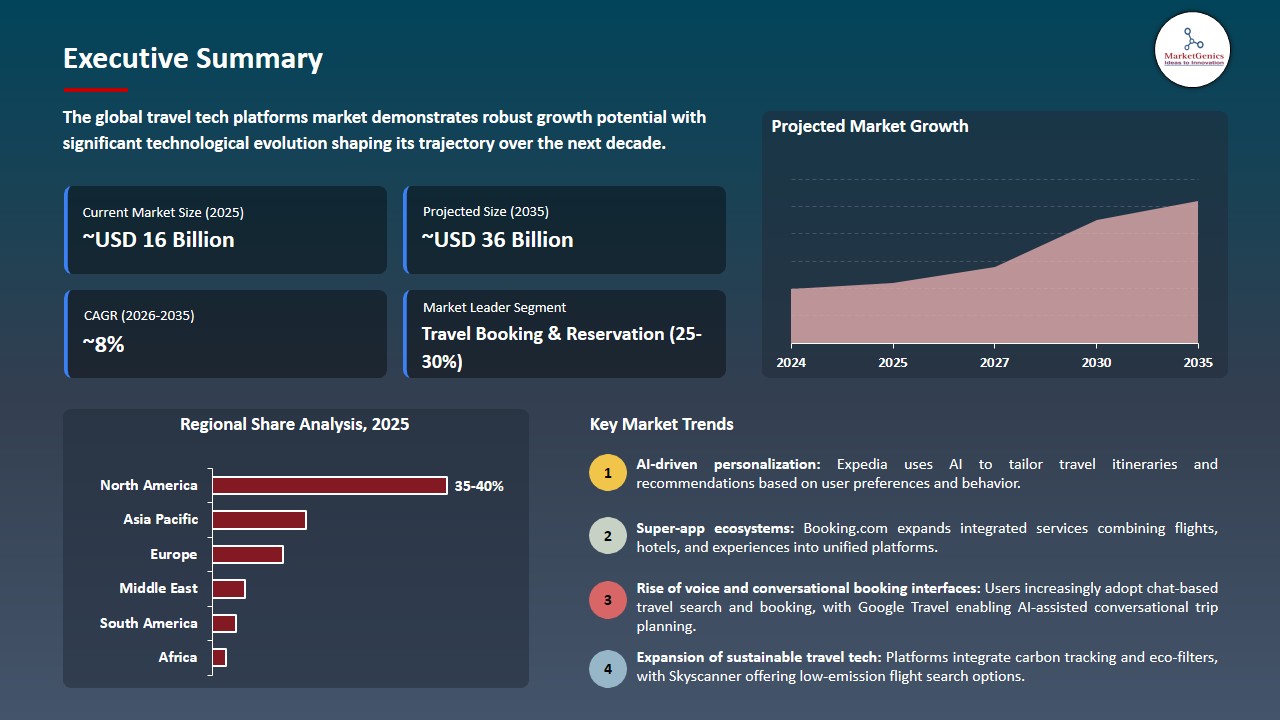
The global travel tech platforms market is exhibiting strong growth, with an estimated value of USD 16.2 billion in 2025 and USD 36.3 billion by 2035, achieving a CAGR of 8.4%, during the forecast period. Asia Pacific is the fastest-growing region in the travel tech platforms market due to rising online travel bookings, rapid smartphone adoption, expanding middle-class tourism, digital payment growth, and increasing investments in AI-driven travel technologies.
Sandeep Kumar, Founder & CEO of Zourney, outlined the long-term vision: "The real opportunity in B2B travel isn't just about widening access; it's about enabling partners with smarter infrastructure. We see this as an important step toward building a more resilient and intelligence-led travel distribution network."
AI integration is driving growth in travel tech platforms by enabling predictive search, dynamic pricing, and highly personalized itinerary creation. For instance, Booking Holdings has implemented AI-powered travel assistants that are integrated throughout Booking.com and Priceline, offering on-the-spot recommendations, automated booking assistance and custom accommodation suggestions through user behavior. Improves booking efficiency, boosts conversion rates, and fosters customer retention by ensuring seamless and personalized travel experiences.
Moreover, travel platforms are propelling growth by becoming an integrated platform that handles travel, accommodation, mobility, experience, etc. from a single place. For example, Expedia Group has been reinforcing its travel package business by introducing AI trip planning tools and cross-service booking functionality for our customers on Expedia, Vrbo, and Hotels.com, further improving the end-to-end user experience. Improves user convenience, boosts cross-selling opportunities, and increases overall platform engagement and booking value.
The adjacent opportunities for the global travel tech platforms market include AI-powered travel analytics services, fintech-based travel payment solutions, immersive AR/VR travel experiences, sustainable tourism technology platforms, and corporate travel management systems. These areas extend platform capabilities beyond booking into experience optimization, financial integration, and virtual engagement, enhancing ecosystem value and user retention across the travel technology landscape. Increases monetization opportunities, further deepens ecosystem integration and digital transformation in travel.
Travel Tech Platforms Market Dynamics and Trends
Driver: Expansion of AI-Enabled End-to-End Travel Personalization Ecosystems Across Digital Platforms
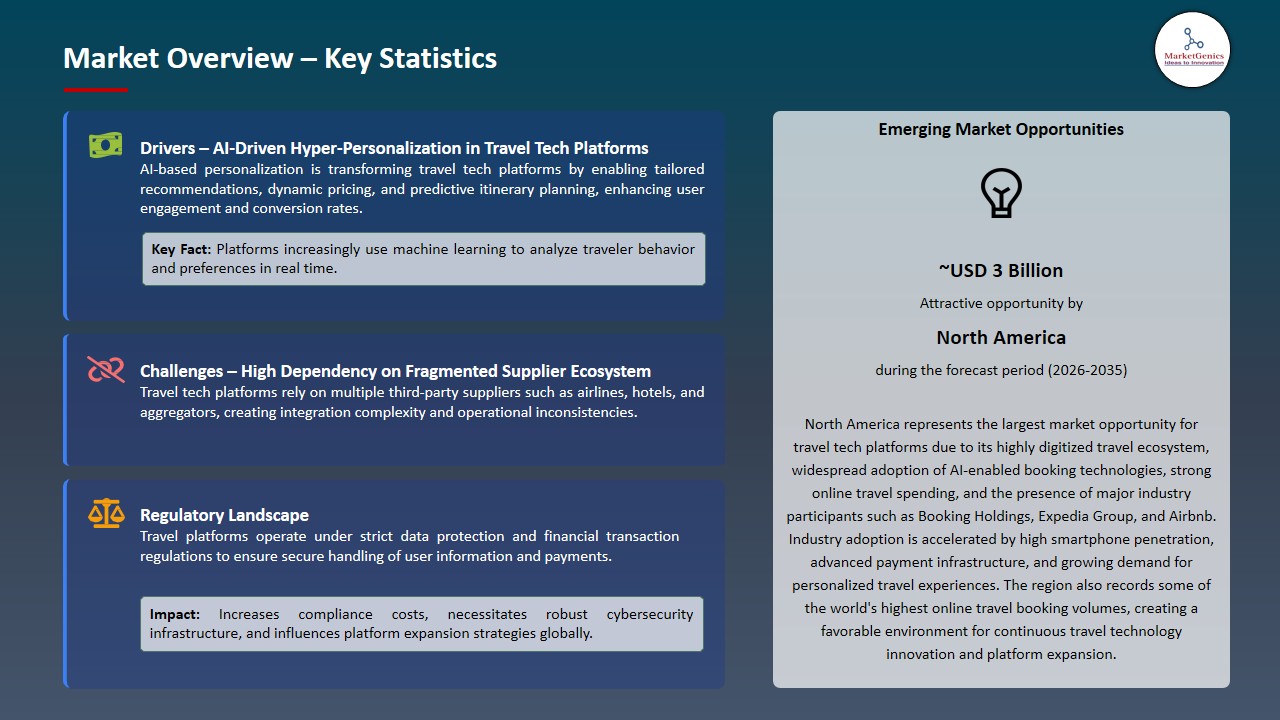
- The travel tech platforms market is growing as AI-powered personalization systems are rapidly integrated, creating a single platform for travel discovery, booking, and post-trip engagement, and connecting them in one digital platform. These platforms are evolving from booking engines to smart systems that can make recommendations in real-time, anticipate trips and optimize prices dynamically.
- This change is increasing conversion efficiency, increasing user engagement, and positively influencing user retention. For instance, Booking Holdings has introduced generative AI into their platforms, including Booking.com, KAYAK, and Priceline, to streamline trip planning and enhance customer experience, while diversifying their offerings with flights and attractions, which increased by 37% and 80% respectively in 2025.
- This transition is bolstering a competitive edge, marketability, and better conversion efficiency, as well as long-term customer retention using AI-based personalization.
Restraint: Intensifying Cost Pressures from Digital Acquisition and Competitive Distribution Dependency
- Growing customer acquisition expenses are a limiting factor for the travel tech platforms market, as it is heavily relying on digital marketing channels like search engine advertising, metasearch bidding, and affiliate networks. The margin pressure is ongoing, despite continued gross booking growth, as a result of these structural dependencies.
- Simultaneously, travel suppliers are making a concerted effort to increase their direct-to-consumer business strategy, where they are competing with OTA's more severely and cutting commissions. Moreover, volatile demand and the wrong allocation of marketing budgets further reduce the overall stability of profitability and scalability across platforms.
- Travel platforms' margin scaling and profitability are held back by rising acquisition costs and supplier disintermediation.
Opportunity: Strategic Expansion of Embedded Travel Within Super-App and Cross-Sector Digital Ecosystems
- The expansion of embedded travel services within super-app ecosystems and cross-industry digital networks, such as financial, mobility, and retail loyalty programs, presents a tremendous opportunity for travel tech platforms to flourish. This model facilitates embedding travel offers into high frequency user environments, enabling distribution to go beyond search-fuelled booking channels and customer acquisition efficiency.
- For instance, in April 2026, Uber and Expedia Group launched a new feature that allows Uber users to book hotels directly from the Uber app, with access to over 700,000 hotel and vacation rental properties via Vrbo, as well as rewards-based pricing on Uber One. This is indicative of the growth of mobility and travel services towards a digital single ecosystem.
- Travel ecosystems are becoming embedded, driving greater demand access and optimizing multi-channel distribution.
Key Trend: Structural Migration Toward B2B Travel Infrastructure and White-Label Commerce Enablement
- The travel tech market is evolving from consumer facing bookings platforms to back-end providers and white label versions with an emphasis on diversifying revenue streams, consistent margins and minimizing reliance on cyclical demand.
- API-based travel solutions are seeing more players lead the way in providing banks, airlines, loyalty programs and retailers with the ability to book into third party ecosystems. For instance, in 2025, Expedia Group B2B represented approximately 30% of the total gross bookings, as the platform has built partnerships with global banks, airlines and retailers, and Booking Holdings and Hopper are growing embedded travel infrastructure for enterprise distribution.
- The market is moving towards an infrastructure-led ecosystem, which improves scalability, diversification and enterprise integration.
Travel Tech Platforms Market Analysis and Segmental Data
Travel Booking & Reservation Dominate Global Travel Tech Platforms Market
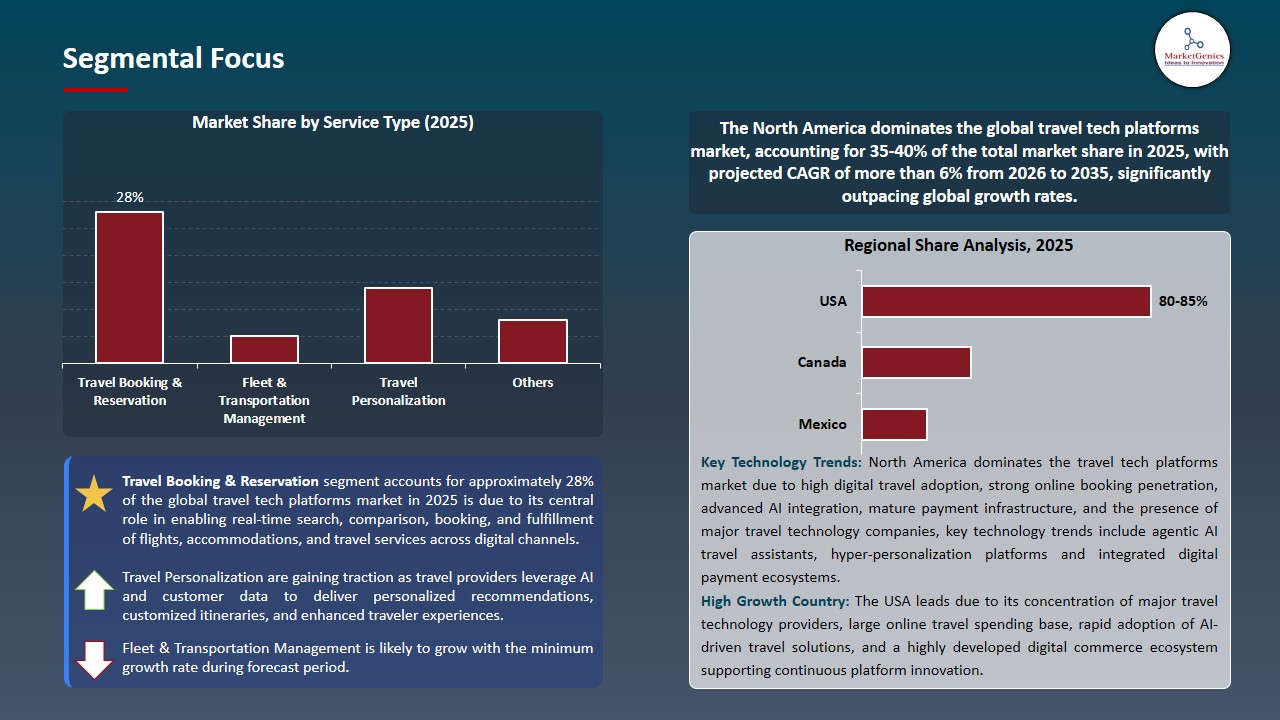
- The travel booking & reservation segment dominates the global travel tech platforms market as it serves as the main communication channel which facilitates the interaction between travelers and airlines, hotel and car rental services etc. on a single platform via digital means. Its dominance grows as demand for seamless booking experiences on the web and mobile devices, along with real-time availability and automated processing systems, increases.
- For instance, Travelport Worldwide Ltd.'s Travelport+ platform, which provides access to hundreds of airlines, millions of hotel properties and rental brands under one unified platform for travel retail efficiency and content aggregation, has enhanced the capability of the industry.
- The increasing prevalence of booking and reservation platforms has boosted digitalization in the travel industry, resulting in greater efficiency in booking processes, improved customer experience and higher revenue opportunities for service providers.
North America Leads Global Travel Tech Platforms Market Demand
- North America dominate the travel tech platforms market owing to the region's well-established digital infrastructure enables smooth online booking and embedded travel services. For instance, Expedia Group has a platform that is scaled to aggregate and connect all travel components (flights, hotel and packages) globally, which strengthens effective digital travel commerce and transaction volumes.
- Moreover, AI and data analytics are used to improve customer engagement and pricing efficiency, as seen in North American travel platforms, which are showing early adoption and extensive use. For instance, Booking Holdings uses AI-driven personalization and dynamic pricing features on its platforms, allowing for personalized travel recommendations and optimized booking processes in real-time.
- This solid technological base and innovation-driven ecosystem remain to strengthen North America's position in the global travel technology market adoption and market demand.
Travel Tech Platforms Market Ecosystem
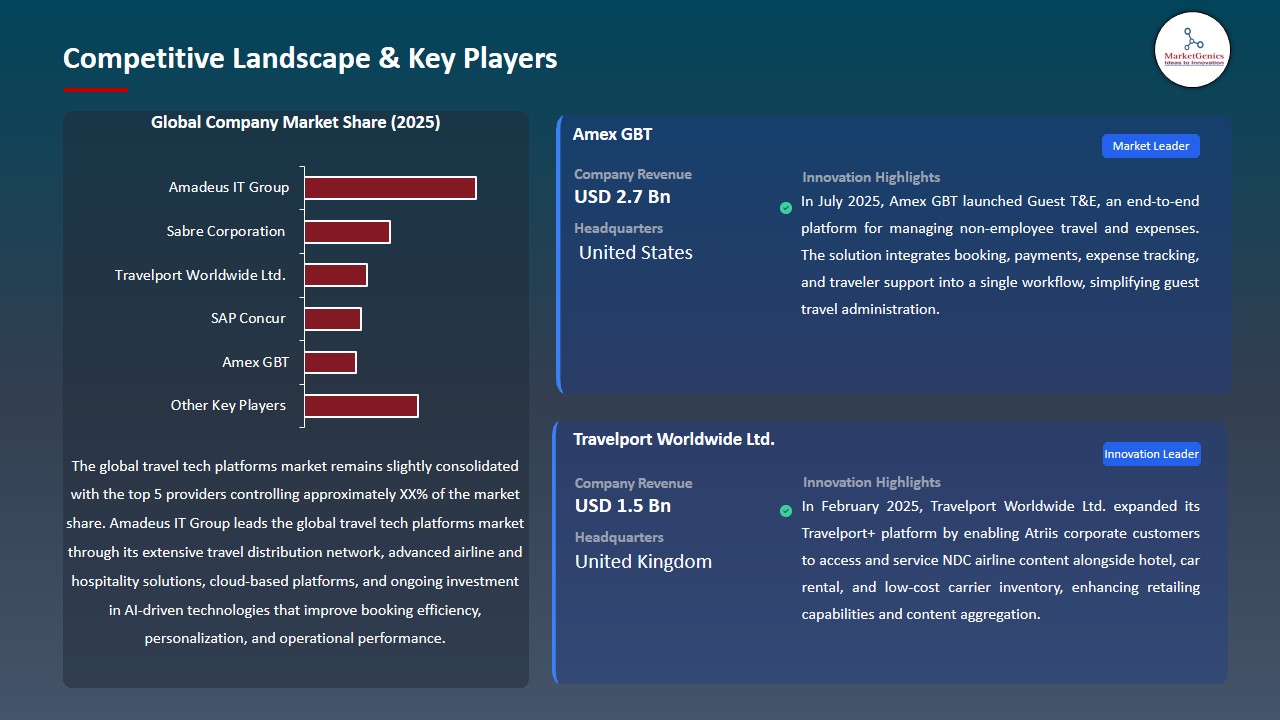
The global travel tech platforms market is slightly consolidated, with major participants such as Amadeus IT Group, Sabre Corporation, Travelport Worldwide Ltd., SAP Concur, and Amex GBT commanding a significant share of the market through advanced cloud computing, artificial intelligence (AI), data analytics, and integrated travel management technologies. These companies are well-positioned to use the vast distribution networks and digital platforms that they have in place to bolster their competitive edge and foster industry innovation.
Leading providers emphasize specialty travel technologies such as AI-based retailing, revenue optimization, NDC-based distribution of travel content, automated travel and expense management, and integrated corporate travel solutions. They improve operational efficiency, personalization, and customer interaction, and enable innovation throughout the travel industry.
AI-powered travel management software market is becoming cloud-based and integrated, helping travel service providers with improved traveler experience, revenue generation, and greater competitive differentiation, while accelerating the industry's digital transformation journey in the process.
 Recent Development and Strategic Overview:
- In April 2026, Staynex Group acquired European travel-tech platform Sleap.io to create a unified global travel ecosystem combining Sleap’s hotel booking engine and European market expertise with Staynex’s Asian distribution network, AI-driven trip planning, and Web3 token-based loyalty system. The integration strengthens cross-regional scalability, enhances platform infrastructure, and expands crypto-native travel capabilities through partnerships across the digital asset ecosystem.
- In June 2025, Priceline (Booking Holdings) launched the upgraded “Penny” AI travel assistant using Anthropic’s Claude, enabling agentic trip planning that interprets complex travel requests, compares real-time flights and hotels, and delivers personalized recommendations within a conversational interface. The system integrates live inventory, user preferences, and multi-language support to streamline end-to-end booking without leaving the chat experience.
Report Scope
|
Detail |
|
|
Market Size in 2025 |
USD 16.2 Bn |
|
Market Forecast Value in 2035 |
USD 36.3 Bn |
|
Growth Rate (CAGR) |
8.4% |
|
Forecast Period |
2026 – 2035 |
|
Historical Data Available for |
2021 – 2024 |
|
Market Size Units |
US$ Billion for Value |
|
Report Format |
Electronic (PDF) + Excel |
|
North America |
Europe |
Asia Pacific |
Middle East |
Africa |
South America |
|
|
|
|
|
|
|
Companies Covered |
|||||
|
|||||
Travel Tech Platforms Market Segmentation and Highlights
|
Segment |
Sub-segment |
|
Travel Tech Platforms Market, By Platform Type |
|
|
Travel Tech Platforms Market, By Deployment Mode |
|
|
Travel Tech Platforms Market, By Enterprise Size |
|
|
Travel Tech Platforms Market, By Service Type |
|
|
Travel Tech Platforms Market, By Application |
|
|
Travel Tech Platforms Market, By End-users |
|
Frequently Asked Questions
Table of Contents
- 1. Research Methodology and Assumptions
- 1.1. Definitions
- 1.2. Research Design and Approach
- 1.3. Data Collection Methods
- 1.4. Base Estimates and Calculations
- 1.5. Forecasting Models
- 1.5.1. Key Forecast Factors & Impact Analysis
- 1.6. Secondary Research
- 1.6.1. Open Sources
- 1.6.2. Paid Databases
- 1.6.3. Associations
- 1.7. Primary Research
- 1.7.1. Primary Sources
- 1.7.2. Primary Interviews with Stakeholders across Ecosystem
- 2. Executive Summary
- 2.1. Global Travel Tech Platforms Market Outlook
- 2.1.1. Travel Tech Platforms Market Size (Value - US$ Bn), and Forecasts, 2021-2035
- 2.1.2. Compounded Annual Growth Rate Analysis
- 2.1.3. Growth Opportunity Analysis
- 2.1.4. Segmental Share Analysis
- 2.1.5. Geographical Share Analysis
- 2.2. Market Analysis and Facts
- 2.3. Supply-Demand Analysis
- 2.4. Competitive Benchmarking
- 2.5. Go-to- Market Strategy
- 2.5.1. Customer/ End-use Industry Assessment
- 2.5.2. Growth Opportunity Data, 2026-2035
- 2.5.2.1. Regional Data
- 2.5.2.2. Country Data
- 2.5.2.3. Segmental Data
- 2.5.3. Identification of Potential Market Spaces
- 2.5.4. GAP Analysis
- 2.5.5. Potential Attractive Price Points
- 2.5.6. Prevailing Market Risks & Challenges
- 2.5.7. Preferred Sales & Marketing Strategies
- 2.5.8. Key Recommendations and Analysis
- 2.5.9. A Way Forward
- 2.1. Global Travel Tech Platforms Market Outlook
- 3. Industry Data and Premium Insights
- 3.1. Global Consumer Goods & Services Industry Overview, 2025
- 3.1.1. Consumer Goods & Services Ecosystem Analysis
- 3.1.2. Key Trends for Consumer Goods & Services Industry
- 3.1.3. Regional Distribution for Consumer Goods & Services Industry
- 3.2. Supplier Customer Data
- 3.3. Technology Roadmap and Developments
- 3.4. Trade Analysis
- 3.4.1. Import & Export Analysis, 2025
- 3.4.2. Top Importing Countries
- 3.4.3. Top Exporting Countries
- 3.5. Trump Tariff Impact Analysis
- 3.5.1. Manufacturer
- 3.5.1.1. Based on the component & Raw material
- 3.5.2. Supply Chain
- 3.5.3. End Consumer
- 3.5.1. Manufacturer
- 3.1. Global Consumer Goods & Services Industry Overview, 2025
- 4. Market Overview
- 4.1. Market Dynamics
- 4.1.1. Drivers
- 4.1.1.1. Rapid digitalization of travel booking and itinerary management systems
- 4.1.1.2. Rising smartphone penetration enabling seamless travel platform access globally
- 4.1.1.3. Growing demand for AI-driven personalized travel planning and recommendations
- 4.1.2. Restraints
- 4.1.2.1. Data privacy and cybersecurity risks in online travel transactions
- 4.1.2.2. Dependence on third-party suppliers affecting service reliability and integration consistency
- 4.1.1. Drivers
- 4.2. Key Trend Analysis
- 4.3. Regulatory Framework
- 4.3.1. Key Regulations, Norms, and Subsidies, by Key Countries
- 4.3.2. Tariffs and Standards
- 4.3.3. Impact Analysis of Regulations on the Market
- 4.4. Ecosystem Analysis
- 4.5. Porter’s Five Forces Analysis
- 4.6. PESTEL Analysis
- 4.7. Global Travel Tech Platforms Market Demand
- 4.7.1. Historical Market Size – in Value (US$ Bn), 2020-2024
- 4.7.2. Current and Future Market Size – in Value (US$ Bn), 2026–2035
- 4.7.2.1. Y-o-Y Growth Trends
- 4.7.2.2. Absolute $ Opportunity Assessment
- 4.1. Market Dynamics
- 5. Competition Landscape
- 5.1. Competition structure
- 5.1.1. Fragmented v/s consolidated
- 5.2. Company Share Analysis, 2025
- 5.2.1. Global Company Market Share
- 5.2.2. By Region
- 5.2.2.1. North America
- 5.2.2.2. Europe
- 5.2.2.3. Asia Pacific
- 5.2.2.4. Middle East
- 5.2.2.5. Africa
- 5.2.2.6. South America
- 5.3. Product Comparison Matrix
- 5.3.1. Specifications
- 5.3.2. Market Positioning
- 5.3.3. Pricing
- 5.1. Competition structure
- 6. Global Travel Tech Platforms Market Analysis, by Platform Type
- 6.1. Key Segment Analysis
- 6.2. Travel Tech Platforms Market Size (Value - US$ Bn), Analysis, and Forecasts, by Platform Type, 2021-2035
- 6.2.1. Online Travel Agencies (OTAs)
- 6.2.2. Global Distribution Systems (GDS)
- 6.2.3. Travel Booking Engines
- 6.2.4. Airline Reservation Platforms
- 6.2.5. Hospitality Technology Platforms
- 6.2.6. Mobility-as-a-Service (MaaS) Platforms
- 6.2.7. Travel Metasearch Platforms
- 6.2.8. Other Types
- 7. Global Travel Tech Platforms Market Analysis, by Deployment Mode
- 7.1. Key Segment Analysis
- 7.2. Travel Tech Platforms Market Size (Value - US$ Bn), Analysis, and Forecasts, by Deployment Mode, 2021-2035
- 7.2.1. Cloud-Based
- 7.2.2. On-Premises
- 7.2.3. Hybrid Deployment
- 8. Global Travel Tech Platforms Market Analysis, by Enterprise Size
- 8.1. Key Segment Analysis
- 8.2. Travel Tech Platforms Market Size (Value - US$ Bn), Analysis, and Forecasts, by Enterprise Size, 2021-2035
- 8.2.1. Small & Medium Enterprises (SMEs)
- 8.2.2. Large Enterprises
- 9. Global Travel Tech Platforms Market Analysis, by Service Type
- 9.1. Key Segment Analysis
- 9.2. Travel Tech Platforms Market Size (Value - US$ Bn), Analysis, and Forecasts, by Service Type, 2021-2035
- 9.2.1. Travel Booking & Reservation
- 9.2.2. Revenue Management
- 9.2.3. Customer Relationship Management (CRM)
- 9.2.4. Itinerary Management
- 9.2.5. Expense & Invoice Management
- 9.2.6. Dynamic Pricing & Yield Management
- 9.2.7. Fleet & Transportation Management
- 9.2.8. Marketing & Personalization
- 9.2.9. Digital Payment Processing
- 9.2.10. Travel Personalization
- 9.2.11. Others
- 10. Global Travel Tech Platforms Market Analysis, by Application
- 10.1. Key Segment Analysis
- 10.2. Travel Tech Platforms Market Size (Value - US$ Bn), Analysis, and Forecasts, by Application, 2021-2035
- 10.2.1. Flight Booking
- 10.2.2. Hotel Booking
- 10.2.3. Car Rental Booking
- 10.2.4. Cruise Booking
- 10.2.5. Rail Booking
- 10.2.6. Business Travel Coordination
- 10.2.7. Destination Management
- 10.2.8. Visa & Documentation Assistance
- 10.2.9. Other Applications
- 11. Global Travel Tech Platforms Market Analysis, by End-users
- 11.1. Key Segment Analysis
- 11.2. Travel Tech Platforms Market Size (Value - US$ Bn), Analysis, and Forecasts, by End-users, 2021-2035
- 11.2.1. Airlines
- 11.2.2. Corporate/Business Travel
- 11.2.3. Event & Tourism Boards
- 11.2.4. Financial & Travel Insurance
- 11.2.5. Hospitality
- 11.2.6. Technology Providers & Aggregators
- 11.2.7. Transportation
- 11.2.8. Travel Agencies
- 11.2.9. Others
- 12. Global Travel Tech Platforms Market Analysis, by Region
- 12.1. Key Findings
- 12.2. Travel Tech Platforms Market Size (Value - US$ Bn), Analysis, and Forecasts, by Region, 2021-2035
- 12.2.1. North America
- 12.2.2. Europe
- 12.2.3. Asia Pacific
- 12.2.4. Middle East
- 12.2.5. Africa
- 12.2.6. South America
- 13. North America Travel Tech Platforms Market Analysis
- 13.1. Key Segment Analysis
- 13.2. Regional Snapshot
- 13.3. North America Travel Tech Platforms Market Size (Value - US$ Bn), Analysis, and Forecasts, 2021-2035
- 13.3.1. Platform Type
- 13.3.2. Deployment Mode
- 13.3.3. Enterprise Size
- 13.3.4. Service Type
- 13.3.5. Application
- 13.3.6. End-users
- 13.3.7. Country
- 13.3.7.1. USA
- 13.3.7.2. Canada
- 13.3.7.3. Mexico
- 13.4. USA Travel Tech Platforms Market
- 13.4.1. Country Segmental Analysis
- 13.4.2. Platform Type
- 13.4.3. Deployment Mode
- 13.4.4. Enterprise Size
- 13.4.5. Service Type
- 13.4.6. Application
- 13.4.7. End-users
- 13.5. Canada Travel Tech Platforms Market
- 13.5.1. Country Segmental Analysis
- 13.5.2. Platform Type
- 13.5.3. Deployment Mode
- 13.5.4. Enterprise Size
- 13.5.5. Service Type
- 13.5.6. Application
- 13.5.7. End-users
- 13.6. Mexico Travel Tech Platforms Market
- 13.6.1. Country Segmental Analysis
- 13.6.2. Platform Type
- 13.6.3. Deployment Mode
- 13.6.4. Enterprise Size
- 13.6.5. Service Type
- 13.6.6. Application
- 13.6.7. End-users
- 14. Europe Travel Tech Platforms Market Analysis
- 14.1. Key Segment Analysis
- 14.2. Regional Snapshot
- 14.3. Europe Travel Tech Platforms Market Size (Value - US$ Bn), Analysis, and Forecasts, 2021-2035
- 14.3.1. Platform Type
- 14.3.2. Deployment Mode
- 14.3.3. Enterprise Size
- 14.3.4. Service Type
- 14.3.5. Application
- 14.3.6. End-users
- 14.3.7. Country
- 14.3.7.1. Germany
- 14.3.7.2. United Kingdom
- 14.3.7.3. France
- 14.3.7.4. Italy
- 14.3.7.5. Spain
- 14.3.7.6. Netherlands
- 14.3.7.7. Nordic Countries
- 14.3.7.8. Poland
- 14.3.7.9. Russia & CIS
- 14.3.7.10. Rest of Europe
- 14.4. Germany Travel Tech Platforms Market
- 14.4.1. Country Segmental Analysis
- 14.4.2. Platform Type
- 14.4.3. Deployment Mode
- 14.4.4. Enterprise Size
- 14.4.5. Service Type
- 14.4.6. Application
- 14.4.7. End-users
- 14.5. United Kingdom Travel Tech Platforms Market
- 14.5.1. Country Segmental Analysis
- 14.5.2. Platform Type
- 14.5.3. Deployment Mode
- 14.5.4. Enterprise Size
- 14.5.5. Service Type
- 14.5.6. Application
- 14.5.7. End-users
- 14.6. France Travel Tech Platforms Market
- 14.6.1. Country Segmental Analysis
- 14.6.2. Platform Type
- 14.6.3. Deployment Mode
- 14.6.4. Enterprise Size
- 14.6.5. Service Type
- 14.6.6. Application
- 14.6.7. End-users
- 14.7. Italy Travel Tech Platforms Market
- 14.7.1. Country Segmental Analysis
- 14.7.2. Platform Type
- 14.7.3. Deployment Mode
- 14.7.4. Enterprise Size
- 14.7.5. Service Type
- 14.7.6. Application
- 14.7.7. End-users
- 14.8. Spain Travel Tech Platforms Market
- 14.8.1. Country Segmental Analysis
- 14.8.2. Platform Type
- 14.8.3. Deployment Mode
- 14.8.4. Enterprise Size
- 14.8.5. Service Type
- 14.8.6. Application
- 14.8.7. End-users
- 14.9. Netherlands Travel Tech Platforms Market
- 14.9.1. Country Segmental Analysis
- 14.9.2. Platform Type
- 14.9.3. Deployment Mode
- 14.9.4. Enterprise Size
- 14.9.5. Service Type
- 14.9.6. Application
- 14.9.7. End-users
- 14.10. Nordic Countries Travel Tech Platforms Market
- 14.10.1. Country Segmental Analysis
- 14.10.2. Platform Type
- 14.10.3. Deployment Mode
- 14.10.4. Enterprise Size
- 14.10.5. Service Type
- 14.10.6. Application
- 14.10.7. End-users
- 14.11. Poland Travel Tech Platforms Market
- 14.11.1. Country Segmental Analysis
- 14.11.2. Platform Type
- 14.11.3. Deployment Mode
- 14.11.4. Enterprise Size
- 14.11.5. Service Type
- 14.11.6. Application
- 14.11.7. End-users
- 14.12. Russia & CIS Travel Tech Platforms Market
- 14.12.1. Country Segmental Analysis
- 14.12.2. Platform Type
- 14.12.3. Deployment Mode
- 14.12.4. Enterprise Size
- 14.12.5. Service Type
- 14.12.6. Application
- 14.12.7. End-users
- 14.13. Rest of Europe Travel Tech Platforms Market
- 14.13.1. Country Segmental Analysis
- 14.13.2. Platform Type
- 14.13.3. Deployment Mode
- 14.13.4. Enterprise Size
- 14.13.5. Service Type
- 14.13.6. Application
- 14.13.7. End-users
- 15. Asia Pacific Travel Tech Platforms Market Analysis
- 15.1. Key Segment Analysis
- 15.2. Regional Snapshot
- 15.3. Asia Pacific Travel Tech Platforms Market Size (Value - US$ Bn), Analysis, and Forecasts, 2021-2035
- 15.3.1. Platform Type
- 15.3.2. Deployment Mode
- 15.3.3. Enterprise Size
- 15.3.4. Service Type
- 15.3.5. Application
- 15.3.6. End-users
- 15.3.7. Country
- 15.3.7.1. China
- 15.3.7.2. India
- 15.3.7.3. Japan
- 15.3.7.4. South Korea
- 15.3.7.5. Australia and New Zealand
- 15.3.7.6. Indonesia
- 15.3.7.7. Malaysia
- 15.3.7.8. Thailand
- 15.3.7.9. Vietnam
- 15.3.7.10. Rest of Asia Pacific
- 15.4. China Travel Tech Platforms Market
- 15.4.1. Country Segmental Analysis
- 15.4.2. Platform Type
- 15.4.3. Deployment Mode
- 15.4.4. Enterprise Size
- 15.4.5. Service Type
- 15.4.6. Application
- 15.4.7. End-users
- 15.5. India Travel Tech Platforms Market
- 15.5.1. Country Segmental Analysis
- 15.5.2. Platform Type
- 15.5.3. Deployment Mode
- 15.5.4. Enterprise Size
- 15.5.5. Service Type
- 15.5.6. Application
- 15.5.7. End-users
- 15.6. Japan Travel Tech Platforms Market
- 15.6.1. Country Segmental Analysis
- 15.6.2. Platform Type
- 15.6.3. Deployment Mode
- 15.6.4. Enterprise Size
- 15.6.5. Service Type
- 15.6.6. Application
- 15.6.7. End-users
- 15.7. South Korea Travel Tech Platforms Market
- 15.7.1. Country Segmental Analysis
- 15.7.2. Platform Type
- 15.7.3. Deployment Mode
- 15.7.4. Enterprise Size
- 15.7.5. Service Type
- 15.7.6. Application
- 15.7.7. End-users
- 15.8. Australia and New Zealand Travel Tech Platforms Market
- 15.8.1. Country Segmental Analysis
- 15.8.2. Platform Type
- 15.8.3. Deployment Mode
- 15.8.4. Enterprise Size
- 15.8.5. Service Type
- 15.8.6. Application
- 15.8.7. End-users
- 15.9. Indonesia Travel Tech Platforms Market
- 15.9.1. Country Segmental Analysis
- 15.9.2. Platform Type
- 15.9.3. Deployment Mode
- 15.9.4. Enterprise Size
- 15.9.5. Service Type
- 15.9.6. Application
- 15.9.7. End-users
- 15.10. Malaysia Travel Tech Platforms Market
- 15.10.1. Country Segmental Analysis
- 15.10.2. Platform Type
- 15.10.3. Deployment Mode
- 15.10.4. Enterprise Size
- 15.10.5. Service Type
- 15.10.6. Application
- 15.10.7. End-users
- 15.11. Thailand Travel Tech Platforms Market
- 15.11.1. Country Segmental Analysis
- 15.11.2. Platform Type
- 15.11.3. Deployment Mode
- 15.11.4. Enterprise Size
- 15.11.5. Service Type
- 15.11.6. Application
- 15.11.7. End-users
- 15.12. Vietnam Travel Tech Platforms Market
- 15.12.1. Country Segmental Analysis
- 15.12.2. Platform Type
- 15.12.3. Deployment Mode
- 15.12.4. Enterprise Size
- 15.12.5. Service Type
- 15.12.6. Application
- 15.12.7. End-users
- 15.13. Rest of Asia Pacific Travel Tech Platforms Market
- 15.13.1. Country Segmental Analysis
- 15.13.2. Platform Type
- 15.13.3. Deployment Mode
- 15.13.4. Enterprise Size
- 15.13.5. Service Type
- 15.13.6. Application
- 15.13.7. End-users
- 16. Middle East Travel Tech Platforms Market Analysis
- 16.1. Key Segment Analysis
- 16.2. Regional Snapshot
- 16.3. Middle East Travel Tech Platforms Market Size (Value - US$ Bn), Analysis, and Forecasts, 2021-2035
- 16.3.1. Platform Type
- 16.3.2. Deployment Mode
- 16.3.3. Enterprise Size
- 16.3.4. Service Type
- 16.3.5. Application
- 16.3.6. End-users
- 16.3.7. Country
- 16.3.7.1. Turkey
- 16.3.7.2. UAE
- 16.3.7.3. Saudi Arabia
- 16.3.7.4. Israel
- 16.3.7.5. Rest of Middle East
- 16.4. Turkey Travel Tech Platforms Market
- 16.4.1. Country Segmental Analysis
- 16.4.2. Platform Type
- 16.4.3. Deployment Mode
- 16.4.4. Enterprise Size
- 16.4.5. Service Type
- 16.4.6. Application
- 16.4.7. End-users
- 16.5. UAE Travel Tech Platforms Market
- 16.5.1. Country Segmental Analysis
- 16.5.2. Platform Type
- 16.5.3. Deployment Mode
- 16.5.4. Enterprise Size
- 16.5.5. Service Type
- 16.5.6. Application
- 16.5.7. End-users
- 16.6. Saudi Arabia Travel Tech Platforms Market
- 16.6.1. Country Segmental Analysis
- 16.6.2. Platform Type
- 16.6.3. Deployment Mode
- 16.6.4. Enterprise Size
- 16.6.5. Service Type
- 16.6.6. Application
- 16.6.7. End-users
- 16.7. Israel Travel Tech Platforms Market
- 16.7.1. Country Segmental Analysis
- 16.7.2. Platform Type
- 16.7.3. Deployment Mode
- 16.7.4. Enterprise Size
- 16.7.5. Service Type
- 16.7.6. Application
- 16.7.7. End-users
- 16.8. Rest of Middle East Travel Tech Platforms Market
- 16.8.1. Country Segmental Analysis
- 16.8.2. Platform Type
- 16.8.3. Deployment Mode
- 16.8.4. Enterprise Size
- 16.8.5. Service Type
- 16.8.6. Application
- 16.8.7. End-users
- 17. Africa Travel Tech Platforms Market Analysis
- 17.1. Key Segment Analysis
- 17.2. Regional Snapshot
- 17.3. Africa Travel Tech Platforms Market Size (Value - US$ Bn), Analysis, and Forecasts, 2021-2035
- 17.3.1. Platform Type
- 17.3.2. Deployment Mode
- 17.3.3. Enterprise Size
- 17.3.4. Service Type
- 17.3.5. Application
- 17.3.6. End-users
- 17.3.7. Country
- 17.3.7.1. South Africa
- 17.3.7.2. Egypt
- 17.3.7.3. Nigeria
- 17.3.7.4. Algeria
- 17.3.7.5. Rest of Africa
- 17.4. South Africa Travel Tech Platforms Market
- 17.4.1. Country Segmental Analysis
- 17.4.2. Platform Type
- 17.4.3. Deployment Mode
- 17.4.4. Enterprise Size
- 17.4.5. Service Type
- 17.4.6. Application
- 17.4.7. End-users
- 17.5. Egypt Travel Tech Platforms Market
- 17.5.1. Country Segmental Analysis
- 17.5.2. Platform Type
- 17.5.3. Deployment Mode
- 17.5.4. Enterprise Size
- 17.5.5. Service Type
- 17.5.6. Application
- 17.5.7. End-users
- 17.6. Nigeria Travel Tech Platforms Market
- 17.6.1. Country Segmental Analysis
- 17.6.2. Platform Type
- 17.6.3. Deployment Mode
- 17.6.4. Enterprise Size
- 17.6.5. Service Type
- 17.6.6. Application
- 17.6.7. End-users
- 17.7. Algeria Travel Tech Platforms Market
- 17.7.1. Country Segmental Analysis
- 17.7.2. Platform Type
- 17.7.3. Deployment Mode
- 17.7.4. Enterprise Size
- 17.7.5. Service Type
- 17.7.6. Application
- 17.7.7. End-users
- 17.8. Rest of Africa Travel Tech Platforms Market
- 17.8.1. Country Segmental Analysis
- 17.8.2. Platform Type
- 17.8.3. Deployment Mode
- 17.8.4. Enterprise Size
- 17.8.5. Service Type
- 17.8.6. Application
- 17.8.7. End-users
- 18. South America Travel Tech Platforms Market Analysis
- 18.1. Key Segment Analysis
- 18.2. Regional Snapshot
- 18.3. South America Travel Tech Platforms Market Size (Value - US$ Bn), Analysis, and Forecasts, 2021-2035
- 18.3.1. Platform Type
- 18.3.2. Deployment Mode
- 18.3.3. Enterprise Size
- 18.3.4. Service Type
- 18.3.5. Application
- 18.3.6. End-users
- 18.3.7. Country
- 18.3.7.1. Brazil
- 18.3.7.2. Argentina
- 18.3.7.3. Rest of South America
- 18.4. Brazil Travel Tech Platforms Market
- 18.4.1. Country Segmental Analysis
- 18.4.2. Platform Type
- 18.4.3. Deployment Mode
- 18.4.4. Enterprise Size
- 18.4.5. Service Type
- 18.4.6. Application
- 18.4.7. End-users
- 18.5. Argentina Travel Tech Platforms Market
- 18.5.1. Country Segmental Analysis
- 18.5.2. Platform Type
- 18.5.3. Deployment Mode
- 18.5.4. Enterprise Size
- 18.5.5. Service Type
- 18.5.6. Application
- 18.5.7. End-users
- 18.6. Rest of South America Travel Tech Platforms Market
- 18.6.1. Country Segmental Analysis
- 18.6.2. Platform Type
- 18.6.3. Deployment Mode
- 18.6.4. Enterprise Size
- 18.6.5. Service Type
- 18.6.6. Application
- 18.6.7. End-users
- 19. Key Players/ Company Profile
- 19.1. Amadeus IT Group
- 19.1.1. Company Details/ Overview
- 19.1.2. Company Financials
- 19.1.3. Key Customers and Competitors
- 19.1.4. Business/ Industry Portfolio
- 19.1.5. Product Portfolio/ Specification Details
- 19.1.6. Pricing Data
- 19.1.7. Strategic Overview
- 19.1.8. Recent Developments
- 19.2. Amex GBT
- 19.3. HBX Group
- 19.4. Infor
- 19.5. Mews
- 19.6. Navan, Inc.
- 19.7. QuadLabs Technologies Pvt. Ltd.
- 19.8. Sabre Corporation
- 19.9. SAP Concur
- 19.10. TBO.COM
- 19.11. TraveloPro
- 19.12. Travelport Worldwide Ltd.
- 19.13. Other Key Players
- 19.1. Amadeus IT Group
Note* - This is just tentative list of players. While providing the report, we will cover more number of players based on their revenue and share for each geography
Research Design
Our research design integrates both demand-side and supply-side analysis through a balanced combination of primary and secondary research methodologies. By utilizing both bottom-up and top-down approaches alongside rigorous data triangulation methods, we deliver robust market intelligence that supports strategic decision-making.
MarketGenics' comprehensive research design framework ensures the delivery of accurate, reliable, and actionable market intelligence. Through the integration of multiple research approaches, rigorous validation processes, and expert analysis, we provide our clients with the insights needed to make informed strategic decisions and capitalize on market opportunities.

MarketGenics leverages a dedicated industry panel of experts and a comprehensive suite of paid databases to effectively collect, consolidate, and analyze market intelligence.
Our approach has consistently proven to be reliable and effective in generating accurate market insights, identifying key industry trends, and uncovering emerging business opportunities.
Through both primary and secondary research, we capture and analyze critical company-level data such as manufacturing footprints, including technical centers, R&D facilities, sales offices, and headquarters.
Our expert panel further enhances our ability to estimate market size for specific brands based on validated field-level intelligence.
Our data mining techniques incorporate both parametric and non-parametric methods, allowing for structured data collection, sorting, processing, and cleaning.
Demand projections are derived from large-scale data sets analyzed through proprietary algorithms, culminating in robust and reliable market sizing.
Research Approach
The bottom-up approach builds market estimates by starting with the smallest addressable market units and systematically aggregating them to create comprehensive market size projections.
This method begins with specific, granular data points and builds upward to create the complete market landscape.
Customer Analysis → Segmental Analysis → Geographical Analysis
The top-down approach starts with the broadest possible market data and systematically narrows it down through a series of filters and assumptions to arrive at specific market segments or opportunities.
This method begins with the big picture and works downward to increasingly specific market slices.
TAM → SAM → SOM


Research Methods
Desk / Secondary Research
While analysing the market, we extensively study secondary sources, directories, and databases to identify and collect information useful for this technical, market-oriented, and commercial report. Secondary sources that we utilize are not only the public sources, but it is a combination of Open Source, Associations, Paid Databases, MG Repository & Knowledgebase, and others.
- Company websites, annual reports, financial reports, broker reports, and investor presentations
- National government documents, statistical databases and reports
- News articles, press releases and web-casts specific to the companies operating in the market, Magazines, reports, and others
- We gather information from commercial data sources for deriving company specific data such as segmental revenue, share for geography, product revenue, and others
- Internal and external proprietary databases (industry-specific), relevant patent, and regulatory databases
- Governing Bodies, Government Organizations
- Relevant Authorities, Country-specific Associations for Industries
We also employ the model mapping approach to estimate the product level market data through the players' product portfolio
Primary Research
Primary research/ interviews is vital in analyzing the market. Most of the cases involves paid primary interviews. Primary sources include primary interviews through e-mail interactions, telephonic interviews, surveys as well as face-to-face interviews with the different stakeholders across the value chain including several industry experts.
| Type of Respondents | Number of Primaries |
|---|---|
| Tier 2/3 Suppliers | ~20 |
| Tier 1 Suppliers | ~25 |
| End-users | ~25 |
| Industry Expert/ Panel/ Consultant | ~30 |
| Total | ~100 |
MG Knowledgebase
• Repository of industry blog, newsletter and case studies
• Online platform covering detailed market reports, and company profiles
Forecasting Factors and Models
Forecasting Factors
- Historical Trends – Past market patterns, cycles, and major events that shaped how markets behave over time. Understanding past trends helps predict future behavior.
- Industry Factors – Specific characteristics of the industry like structure, regulations, and innovation cycles that affect market dynamics.
- Macroeconomic Factors – Economic conditions like GDP growth, inflation, and employment rates that affect how much money people have to spend.
- Demographic Factors – Population characteristics like age, income, and location that determine who can buy your product.
- Technology Factors – How quickly people adopt new technology and how much technology infrastructure exists.
- Regulatory Factors – Government rules, laws, and policies that can help or restrict market growth.
- Competitive Factors – Analyzing competition structure such as degree of competition and bargaining power of buyers and suppliers.
Forecasting Models / Techniques
Multiple Regression Analysis
- Identify and quantify factors that drive market changes
- Statistical modeling to establish relationships between market drivers and outcomes
Time Series Analysis – Seasonal Patterns
- Understand regular cyclical patterns in market demand
- Advanced statistical techniques to separate trend, seasonal, and irregular components
Time Series Analysis – Trend Analysis
- Identify underlying market growth patterns and momentum
- Statistical analysis of historical data to project future trends
Expert Opinion – Expert Interviews
- Gather deep industry insights and contextual understanding
- In-depth interviews with key industry stakeholders
Multi-Scenario Development
- Prepare for uncertainty by modeling different possible futures
- Creating optimistic, pessimistic, and most likely scenarios
Time Series Analysis – Moving Averages
- Sophisticated forecasting for complex time series data
- Auto-regressive integrated moving average models with seasonal components
Econometric Models
- Apply economic theory to market forecasting
- Sophisticated economic models that account for market interactions
Expert Opinion – Delphi Method
- Harness collective wisdom of industry experts
- Structured, multi-round expert consultation process
Monte Carlo Simulation
- Quantify uncertainty and probability distributions
- Thousands of simulations with varying input parameters
Research Analysis
Our research framework is built upon the fundamental principle of validating market intelligence from both demand and supply perspectives. This dual-sided approach ensures comprehensive market understanding and reduces the risk of single-source bias.
Demand-Side Analysis: We understand end-user/application behavior, preferences, and market needs along with the penetration of the product for specific application.
Supply-Side Analysis: We estimate overall market revenue, analyze the segmental share along with industry capacity, competitive landscape, and market structure.
Validation & Evaluation
Data triangulation is a validation technique that uses multiple methods, sources, or perspectives to examine the same research question, thereby increasing the credibility and reliability of research findings. In market research, triangulation serves as a quality assurance mechanism that helps identify and minimize bias, validate assumptions, and ensure accuracy in market estimates.
- Data Source Triangulation – Using multiple data sources to examine the same phenomenon
- Methodological Triangulation – Using multiple research methods to study the same research question
- Investigator Triangulation – Using multiple researchers or analysts to examine the same data
- Theoretical Triangulation – Using multiple theoretical perspectives to interpret the same data

Custom Market Research Services
We will customise the research for you, in case the report listed above does not meet your requirements.
Get 10% Free Customisation