Wired Earphone Market Size, Share & Trends Analysis Report by Product Type (In-Ear Wired Earphones, On-Ear Wired Headphones, Over-Ear Wired Headphones, Neckband Wired Earphones, Sports Wired Earphones, Gaming Wired Earphones, Studio Monitoring Earphones, Noise-Isolating Wired Earphones, Others), Connector Type, Sound Technology, Feature Type, Application, End User, Distribution Channel, and Geography (North America, Europe, Asia Pacific, Middle East, Africa, and South America) – Global Industry Data, Trends, and Forecasts, 2026–2035
|
|
|
Segmental Data Insights |
|
|
Demand Trends |
|
|
Competitive Landscape |
|
|
Strategic Development |
|
|
Future Outlook & Opportunities |
|
Wired Earphone Market Size, Share, and Growth
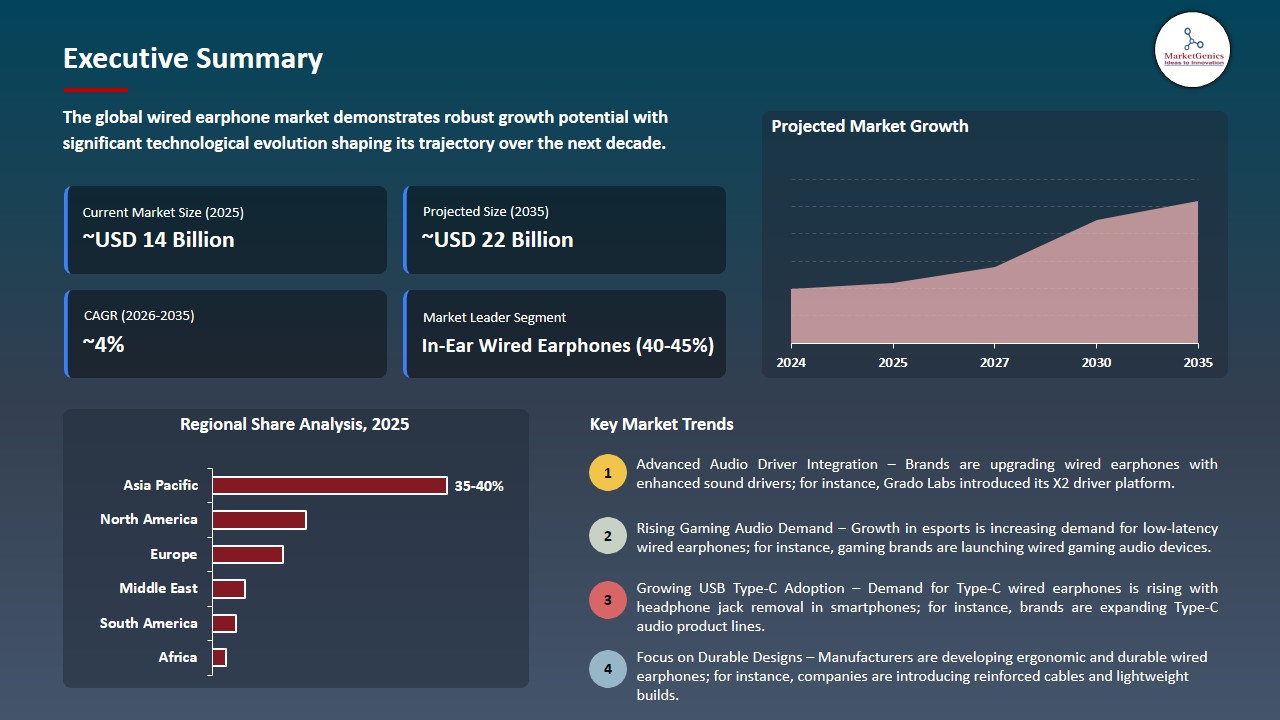
The global wired earphone market is exhibiting strong growth, with an estimated value of USD 14.4 billion in 2025 and USD 21.8 billion by 2035, achieving a CAGR of 4.2%, during the forecast period. The wired earphone market is rapidly growing in North America due to rising demand for high-quality low-latency audio, increasing gaming and content consumption, and continued preference for affordable plug-and-play audio devices.
Jonathan Levine, Founder & CEO, said: “The ME05 Earphones have always been one of our favorite and most sought after products. The design has stood the test of time and it’s a product I use personally every day. I’m proud to re-introduce this iconic analog product now with improved performance and compatibility.”
The increasing popularity of the wired earphones is due to the growing demand for high-fidelity audio, low latency sound transmission and seamless connectivity in gaming, music production and professional communication applications. The demand for products is being further driven by the growing use of digital entertainment, online gaming and virtual meetings. The demand for products is further being driven by advancing adoption of digital entertainment, online gaming and virtual meetings, especially in emerging economies where affordability is a major purchase determinant. Sony Group Corporation drastically improved its standing in the premium audio space by launching a line of studio-ready wired in-ear monitors (IEM) and headphones for the studio professional, musician, and high-fidelity community in 2025.
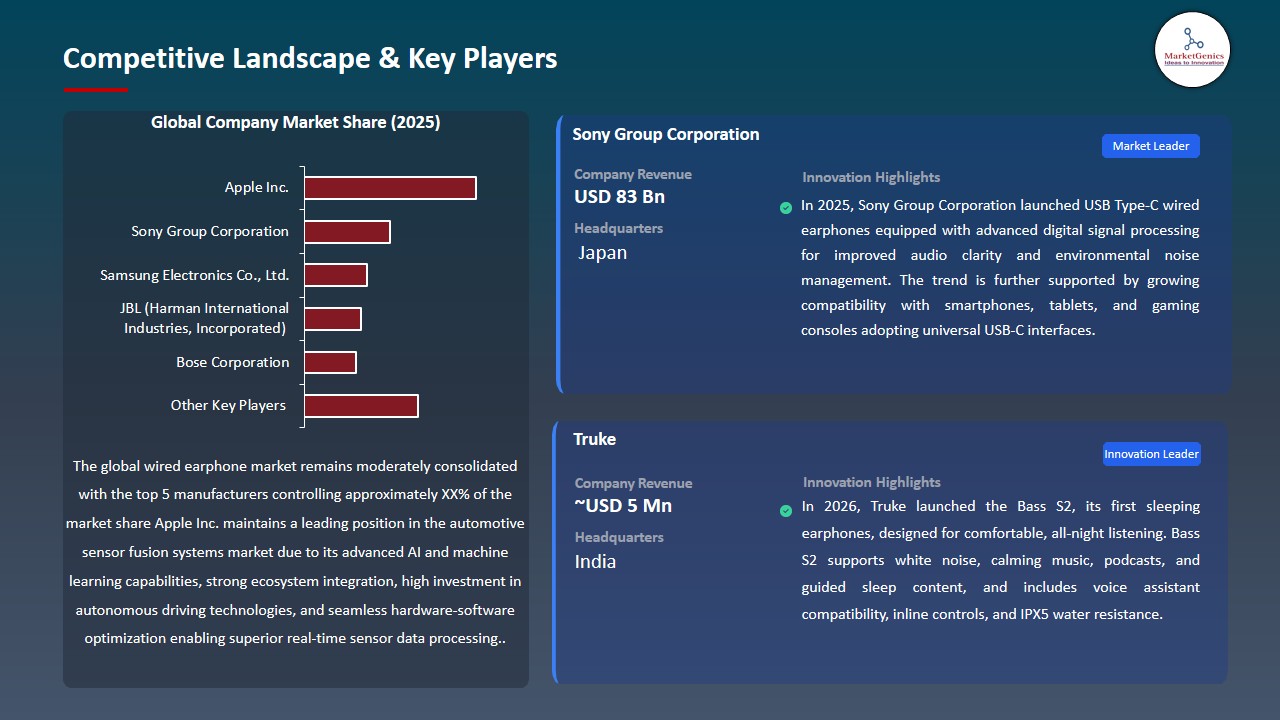
Wired earphones still provide better consistency of sound quality, no charging requirement and are compatible with studio quality equipment, making them a favorite choice for audiophiles and professionals. Further, the rising demand for USB Type-C and HD audio support is driving manufacturers to come up with technologically sophisticated wired earphones featuring robust designs and improved comfort. In February 2026, Truke launched the Bass S2, its first sleeping earphones, designed for comfortable, all-night listening. Bass S2 boasts the functionality of white noise, relaxing music, podcasts, and sleep-inducing audio along with voice assistant compatibility, inline controls, and IPX5 water resistance.
Adjacent opportunities include gaming headsets, professional audio equipment, USB Type-C accessories, smart learning audio devices, and in-car infotainment audio solutions, where wired earphone technologies support stable, high-quality sound transmission. Increasing demand for content creation and digital communication devices is further expanding integration opportunities across connected audio ecosystems.
Wired Earphone Market Dynamics and Trends
Driver: Growing Popularity of High-Resolution Audio Consumption Supporting Wired Earphone Adoption Globally
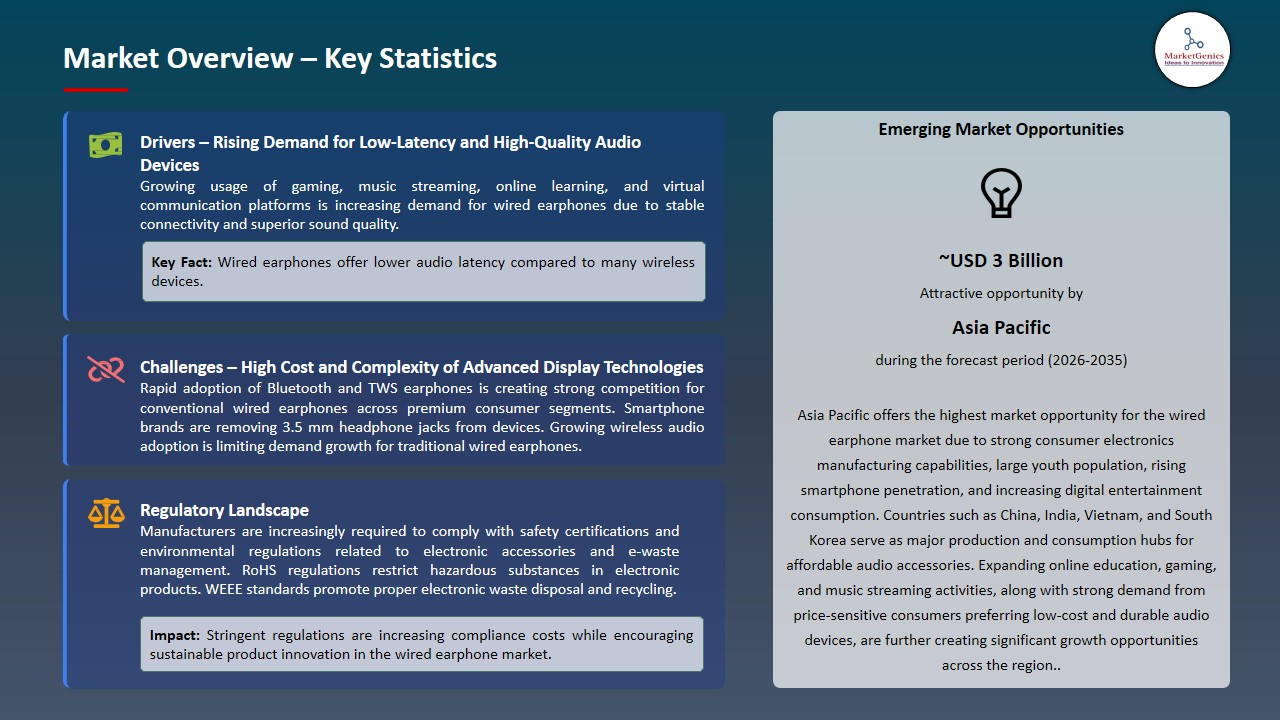
- Demand for wired earphones is getting a considerable boost from the growing consumption of high resolution and lossless audio, particularly among audiophiles, gamers and professional content creators who demand audio fidelity and also uninterrupted signal transmission. Wireless earphones generally offer higher latency, narrower frequency range, and less reliable connections than wired earphones. In those high-end listening moments, it's best to use wired earphones.
- In addition, the expansion of music streaming services that provide lossless audio is fuelling that demand. In 2025, Shure Incorporated rolled out upgraded professional wired in ear monitors, with improved acoustic isolation, and high-definition audio capability aimed at musicians and studio folks. Meanwhile, Audio-Technica expanded its wired earphone range for mobile high-resolution listening, with an emphasis on improved clarity of sound reproduction and durability.
- The demand for wired earphones is also being fueled by a growing preference towards premium and lossless audio experience, which is leaving a lasting demand for these products.
Restraint: Declining Smartphone Headphone Jack Availability Restricting Mainstream Consumer Accessibility Globally
- The 3.5 mm audio connector is being phased out from cell phone and portable gadgets, which presents a significant barrier to the growth of the wired earphone market. It restricts plug-and-play and it also makes people more reliant on adapters or on the USB-C port, you know. That transition to an ecosystem of wireless products by the big OEMs has seriously diminished the convenience of the average consumer and affected the products they are buying, towards Bluetooth.
- In 2024, Apple continued to emphasize wireless audio, for example, by providing ecosystem-first product integration; this continued the overall trend towards moving away from traditional wired connectivity. In addition, Samsung Electronics broadened its audio offering with a wireless focus, while reducing their standard headphone jack support in their flagship devices.
- Lower adoption of reduced headphone jack is limiting mass-market accessibility and impacting mainstream wired earphones demand.
Opportunity: Expansion of Esports And Professional Gaming Ecosystems Creating Specialized Audio Demand
- Esports tournaments, online multiplayer games, and live-streaming platforms are proliferating, providing substantial opportunity for wired earphones, particularly when it comes to their ability to provide ultra-low latency, consistent audio transmission, and the competitive edge. As for professional gamers and streamers, they are increasingly moving towards wired audio gear for clips that involve talk, or simply for that sound to be synced up with their gameplay.
- Razer's wired gaming audio lineup was expanded to feature better surround sound, and tournament-grade communication features for esports pros in 2025. HyperX also beefed up its wired earphone and headset lineup, aimed at competitive gaming, at the same time, which is definitely a sign of the demand from both gamers and pro-gamers.
- The growing esports and gaming industry is creating new unique spaces for wired audio hardware manufacturers.
Key Trend: Rising Adoption of USB Type-C Integrated Smart Audio Connectivity Solutions
- The shift to USB Type-C connectivity is developing as one of the most significant features in the wired earphone market, offering advanced digital audio capabilities, optimized power usage, and built-in smart features. For listeners, it's definitely an enhanced experience in today's modern devices, as manufacturers are adding more and more functionality, including a built in DAC, adaptive sound refinement, and smarter controls.
- In 2025, Sony Group Corporation launched USB Type-C wired earphones, these come with advanced digital signal processing, which helps with clearer sound reproduction, and more effective environmental noise management. It is also being bolstered by the push for universal USB-C ports from smartphone manufacturers, tablet makers, and even console manufacturers. USB Type-C earphones are also more attractive to tech-savvy buyers thanks to their durability, speed of data transfer and capacity to play high resolution audio.
- Integrating the USB Type-C is modernizing the wired earphone functionality and ushering in continued technology development in the market.
Wired Earphone Market Analysis and Segmental Data
Compact Design and Superior Portability Driving In-Ear Wired Earphone Dominance
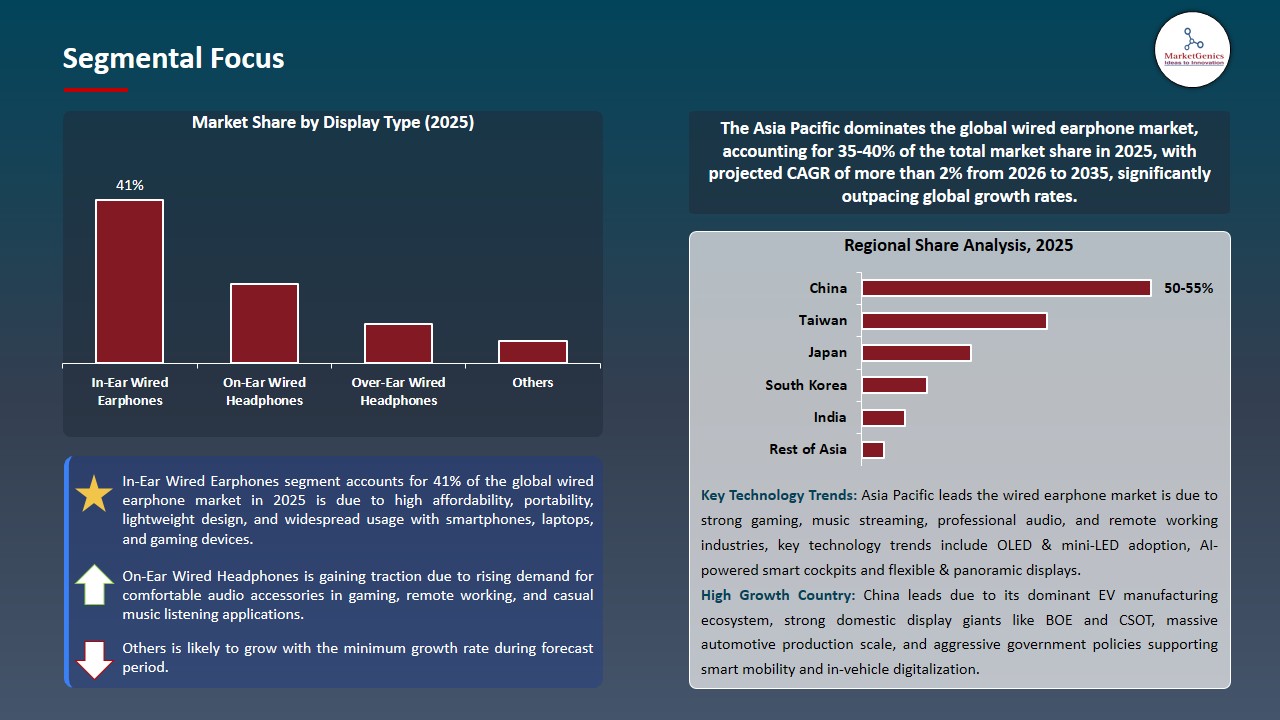
- In-ear wired earphones have the highest demand within the product type segment since they are compact, lightweight and highly portable making them almost a no-brainer for everyday mobile use, gaming and professional communication. They manage to achieve efficient passive noise isolation, as well as a direct sound path that further contributes to an intuitive user experience for entertainment and productivity purposes. In 2025 1MORE quietly extended its high-end wired in-ear series with high-resolution audio support for mobile audio enthusiasts and content consumers.
- In addition, the in-ear wired earphones' level of affordability and broad compatibility further cement their leadership, particularly in the growing economies and in users who value on-budget price points. Compared to over-ear earbuds, the amount of materials used tends to be reduced, and the sound quality remains high enough to be widely used. In March 2026, Meze Audio launched its Astru – a high-end wired in-ear monitor system with a high-quality anodized aluminium cable and gold-plated balanced termination (4.4mm) and a 4.4mm to 3.5mm adapter.
- In-ear wired earphones continue to dominate global consumer markets due to their high portability, affordability and compatibility.
Mass Consumer Electronics Adoption and Cost-Sensitive Demand Driving Asia Pacific Leadership
- Asia Pacific records the highest demand for wired earphones, mostly because it has this massive consumer electronics user base, plus smartphone penetration is still expanding, and people there generally prefer cheaper audio add-ons across very crowded markets like India China and Southeast Asia. Wired earphones stay a top pick for students, commuters, and mobile gamers who want an economical and dependable sound setup. In 2025, Realme expanded its budget minded wired earphone lineup across Asian markets, aiming at mobile entertainment and gaming crowds
- The region also somehow benefits from wide local manufacturing ecosystems, and retail distribution channels that let companies produce at lower cost and push new products out fast. At the same time, growing digital entertainment consumption, along with online education use, is keeping demand for wired audio devices steady in high volumes. In 2024, OPPO bolstered its wired audio accessory range, bundled with mid-range smartphones in Asia Pacific, which in turn reinforces the big scale adoption of wired earphones.
- High smartphone usage, affordability preferences, and strong manufacturing ecosystems are sustaining Asia Pacific’s dominance in the wired earphone market.
Wired Earphone Market Ecosystem
The wired earphone market demonstrates a moderately consolidated competitive structure, with major players such as Apple Inc., Sony Group Corporation, Samsung Electronics Co., Ltd., JBL (Harman International Industries, Incorporated) and Bose Corporation, dominating global revenue through technologically advanced and premium audio solutions. These companies leverage high-resolution audio processing, digital signal enhancement, ergonomic acoustic engineering, and advanced driver technologies to maintain strong competitive positioning across consumer and professional audio segments.
Meanwhile leading manufacturers are also turning their attention more toward smaller or niche audio needs. Think studio-grade monitoring, esports communication, immersive gaming audio, and audiophile-grade listening experiences, because that angle really supports differentiation. Companies like Shure Incorporated and Beyerdynamic GmbH & Co. KG are expanding their professional in-ear monitor options, including detachable cables, customizable acoustic tuning, and passive noise isolation technologies. These efforts are aimed at musicians, broadcasters and sound engineers. At the same time, boAt Lifestyle (Imagine Marketing Limited) and Zebronics India Pvt. Ltd. keep strengthening their budget wired gaming and entertainment earphone lineups, especially for customers in emerging markets where value matters.
Another layer comes from government-backed research institutions and acoustic laboratories, which are pushing forward digital audio technologies and hearing-oriented enhancement systems. In March 2025, researchers at Fraunhofer Institute for Digital Media Technology developed an AI-enabled spatial audio optimization platform, intended to improve sound localization and also lower distortion in compact earphone designs. The result is better audio clarity and a stronger sense of immersion, which should fit both professional use and entertainment scenarios, without needing a bulky form factor.
Market participants are increasingly emphasizing product diversification through USB-C audio interfaces, integrated DAC technologies, sustainable materials, and multifunctional communication-enabled earphones compatible with smartphones, gaming consoles, and enterprise collaboration systems. In January 2026, Logitech International S.A. introduced AI-enhanced wired communication headsets featuring intelligent noise filtering and adaptive voice optimization, delivering measurable improvements in call clarity and reducing background audio interference during enterprise communication workflows.
 Recent Development and Strategic Overview:
- In May 2026, Dongguan Sivga Electronic Technology introduced the M260, a budget-friendly pair of wired in-ear monitors (IEMs) designed for both music enthusiasts and gamers in 3.5mm version & USB-C variant. The USB-C version of the M260 is equipped with an integrated digital-to-analogue converter (DAC), designed around the Realtek ALC5686 chipset.
- In March 2026, Grado Labs introduced its new “Classic Series” wired headphones featuring the advanced X2 driver platform designed to improve sound clarity, balance, durability, and audio precision. The upgraded lineup includes popular models such as the SR325x, SR80x, and GS3000x, highlighting the increasing focus of manufacturers on enhancing premium wired audio experiences.
Report Scope
|
Detail |
|
|
Market Size in 2025 |
USD 14.4 Bn |
|
Market Forecast Value in 2035 |
USD 21.8 Bn |
|
Growth Rate (CAGR) |
4.2% |
|
Forecast Period |
2026 – 2035 |
|
Historical Data Available for |
2021 – 2024 |
|
Market Size Units |
US$ Billion for Value Million Units for Volume |
|
Report Format |
Electronic (PDF) + Excel |
|
North America |
Europe |
Asia Pacific |
Middle East |
Africa |
South America |
|
|
|
|
|
|
|
Companies Covered |
|||||
|
|||||
Wired Earphone Market Segmentation and Highlights
|
Segment |
Sub-segment |
|
Wired Earphone Market, By Product Type |
|
|
Wired Earphone Market, By Connector Type |
|
|
Wired Earphone Market, By Sound Technology |
|
|
Wired Earphone Market, By MIMO Feature Type |
|
|
Wired Earphone Market, By Application |
|
|
Wired Earphone Market, By Data End User |
|
|
Wired Earphone Market, By Distribution Channel |
|
Frequently Asked Questions
Table of Contents
- 1. Research Methodology and Assumptions
- 1.1. Definitions
- 1.2. Research Design and Approach
- 1.3. Data Collection Methods
- 1.4. Base Estimates and Calculations
- 1.5. Forecasting Models
- 1.5.1. Key Forecast Factors & Impact Analysis
- 1.6. Secondary Research
- 1.6.1. Open Sources
- 1.6.2. Paid Databases
- 1.6.3. Associations
- 1.7. Primary Research
- 1.7.1. Primary Sources
- 1.7.2. Primary Interviews with Stakeholders across Ecosystem
- 2. Executive Summary
- 2.1. Global Wired Earphone Market Outlook
- 2.1.1. Wired Earphone Market Size (Volume - Million Units and Value - US$ Bn), and Forecasts, 2021-2035
- 2.1.2. Compounded Annual Growth Rate Analysis
- 2.1.3. Growth Opportunity Analysis
- 2.1.4. Segmental Share Analysis
- 2.1.5. Geographical Share Analysis
- 2.2. Market Analysis and Facts
- 2.3. Supply-Demand Analysis
- 2.4. Competitive Benchmarking
- 2.5. Go-to- Market Strategy
- 2.5.1. Customer/ End-use Industry Assessment
- 2.5.2. Growth Opportunity Data, 2026-2035
- 2.5.2.1. Regional Data
- 2.5.2.2. Country Data
- 2.5.2.3. Segmental Data
- 2.5.3. Identification of Potential Market Spaces
- 2.5.4. GAP Analysis
- 2.5.5. Potential Attractive Price Points
- 2.5.6. Prevailing Market Risks & Challenges
- 2.5.7. Preferred Sales & Marketing Strategies
- 2.5.8. Key Recommendations and Analysis
- 2.5.9. A Way Forward
- 2.1. Global Wired Earphone Market Outlook
- 3. Industry Data and Premium Insights
- 3.1. Global Consumer Goods & Services Industry Overview, 2025
- 3.1.1. Consumer Goods & Services Ecosystem Analysis
- 3.1.2. Key Trends for Consumer Goods & Services Industry
- 3.1.3. Regional Distribution for Consumer Goods & Services Industry
- 3.2. Supplier Customer Data
- 3.3. Technology Roadmap and Developments
- 3.4. Trade Analysis
- 3.4.1. Import & Export Analysis, 2025
- 3.4.2. Top Importing Countries
- 3.4.3. Top Exporting Countries
- 3.5. Trump Tariff Impact Analysis
- 3.5.1. Manufacturer
- 3.5.1.1. Based on the component & Raw material
- 3.5.2. Supply Chain
- 3.5.3. End Consumer
- 3.5.1. Manufacturer
- 3.1. Global Consumer Goods & Services Industry Overview, 2025
- 4. Market Overview
- 4.1. Market Dynamics
- 4.1.1. Drivers
- 4.1.1.1. Rising demand for affordable audio devices.
- 4.1.1.2. Growing use in gaming and online communication.
- 4.1.1.3. Preference for stable, high-quality audio.
- 4.1.2. Restraints
- 4.1.2.1. Increasing adoption of wireless/TWS devices.
- 4.1.2.2. Removal of headphone jacks in smartphones.
- 4.1.1. Drivers
- 4.2. Key Trend Analysis
- 4.3. Regulatory Framework
- 4.3.1. Key Regulations, Norms, and Subsidies, by Key Countries
- 4.3.2. Tariffs and Standards
- 4.3.3. Impact Analysis of Regulations on the Market
- 4.4. Value Chain Analysis
- 4.4.1. Component Suppliers
- 4.4.2. Wired Earphone Manufacturers
- 4.4.3. Distributors & Wholesalers
- 4.4.4. End Users/Consumers
- 4.5. Porter’s Five Forces Analysis
- 4.6. PESTEL Analysis
- 4.7. Global Wired Earphone Market Demand
- 4.7.1. Historical Market Size – in Volume (Million Units) & Value (US$ Bn), 2020-2024
- 4.7.2. Current and Future Market Size – in Volume (Million Units) & Value (US$ Bn), 2026–2035
- 4.7.2.1. Y-o-Y Growth Trends
- 4.7.2.2. Absolute $ Opportunity Assessment
- 4.1. Market Dynamics
- 5. Competition Landscape
- 5.1. Competition structure
- 5.1.1. Fragmented v/s consolidated
- 5.2. Company Share Analysis, 2025
- 5.2.1. Global Company Market Share
- 5.2.2. By Region
- 5.2.2.1. North America
- 5.2.2.2. Europe
- 5.2.2.3. Asia Pacific
- 5.2.2.4. Middle East
- 5.2.2.5. Africa
- 5.2.2.6. South America
- 5.3. Product Comparison Matrix
- 5.3.1. Specifications
- 5.3.2. Market Positioning
- 5.3.3. Pricing
- 5.1. Competition structure
- 6. Global Wired Earphone Market Analysis, by Product Type
- 6.1. Key Segment Analysis
- 6.2. Wired Earphone Market Size (Volume - Million Units and Value - US$ Bn), Analysis, and Forecasts, by Product Type, 2021-2035
- 6.2.1. In-Ear Wired Earphones
- 6.2.2. On-Ear Wired Headphones
- 6.2.3. Over-Ear Wired Headphones
- 6.2.4. Neckband Wired Earphones
- 6.2.5. Sports Wired Earphones
- 6.2.6. Gaming Wired Earphones
- 6.2.7. Studio Monitoring Earphones
- 6.2.8. Noise-Isolating Wired Earphones
- 6.2.9. Others
- 7. Global Wired Earphone Market Analysis, by Connector Type
- 7.1. Key Segment Analysis
- 7.2. Wired Earphone Market Size (Volume - Million Units and Value - US$ Bn), Analysis, and Forecasts, by Connector Type, 2021-2035
- 7.2.1. 5 mm Audio Jack
- 7.2.2. USB Type-C Wired Earphones
- 7.2.3. Lightning Connector Earphones
- 7.2.4. Dual Jack Wired Earphones
- 7.2.5. Detachable Cable Earphones
- 7.2.6. Gold-Plated Connector Earphones
- 7.2.7. Universal Wired Connectors
- 7.2.8. Custom Audio Connectors
- 7.2.9. Others
- 8. Global Wired Earphone Market Analysis, by Sound Technology
- 8.1. Key Segment Analysis
- 8.2. Wired Earphone Market Size (Volume - Million Units and Value - US$ Bn), Analysis, and Forecasts, by Sound Technology, 2021-2035
- 8.2.1. Dynamic Driver Earphones
- 8.2.2. Balanced Armature Earphones
- 8.2.3. Hybrid Driver Earphones
- 8.2.4. Electrostatic Driver Earphones
- 8.2.5. Magnetic Planar Driver Earphones
- 8.2.6. Hi-Resolution Audio Earphones
- 8.2.7. Bass-Enhanced Wired Earphones
- 8.2.8. Surround Sound Wired Earphones
- 8.2.9. Others
- 9. Global Wired Earphone Market Analysis, by Feature Type
- 9.1. Key Segment Analysis
- 9.2. Wired Earphone Market Size (Volume - Million Units and Value - US$ Bn), Analysis, and Forecasts, by Feature Type, 2021-2035
- 9.2.1. Built-In Microphone Earphones
- 9.2.2. Noise-Canceling Wired Earphones
- 9.2.3. Sweat-Resistant Wired Earphones
- 9.2.4. Foldable Wired Earphones
- 9.2.5. Volume Control Enabled Earphones
- 9.2.6. Voice Assistant Compatible Earphones
- 9.2.7. Tangle-Free Cable Earphones
- 9.2.8. High-Durability Wired Earphones
- 9.2.9. Others
- 10. Global Wired Earphone Market Analysis, by Application
- 10.1. Key Segment Analysis
- 10.2. Wired Earphone Market Size (Volume - Million Units and Value - US$ Bn), Analysis, and Forecasts, by Application, 2021-2035
- 10.2.1. Music and Entertainment
- 10.2.2. Gaming
- 10.2.3. Fitness and Sports
- 10.2.4. Professional Audio Monitoring
- 10.2.5. Communication and Calling
- 10.2.6. E-Learning and Education
- 10.2.7. Corporate and Office Use
- 10.2.8. Travel and Daily Commute
- 10.2.9. Others
- 11. Global Wired Earphone Market Analysis, by End User
- 11.1. Key Segment Analysis
- 11.2. Wired Earphone Market Size (Volume - Million Units and Value - US$ Bn), Analysis, and Forecasts, by End User, 2021-2035
- 11.2.1. Individual Consumers
- 11.2.2. Audiophiles
- 11.2.3. Gamers
- 11.2.4. Corporate Professionals
- 11.2.5. Students
- 11.2.6. Fitness Enthusiasts
- 11.2.7. Audio Engineers
- 11.2.8. Content Creators
- 11.2.9. Others
- 12. Global Wired Earphone Market Analysis, by Distribution Channel
- 12.1. Key Segment Analysis
- 12.2. Wired Earphone Market Size Volume - Million Units and Value - US$ Bn), Analysis, and Forecasts, by Distribution Channel, 2021-2035
- 12.2.1. Online Retail
- 12.2.2. Offline Electronics Stores
- 12.2.3. Brand-Owned Stores
- 12.2.4. Hypermarkets and Supermarkets
- 12.2.5. Specialty Audio Stores
- 12.2.6. E-Commerce Marketplaces
- 12.2.7. Telecom Retail Stores
- 12.2.8. Institutional Sales
- 13. Global Wired Earphone Market Analysis, by Region
- 13.1. Key Findings
- 13.2. Wired Earphone Market Size (Volume - Million Units and Value - US$ Bn), Analysis, and Forecasts, by Region, 2021-2035
- 13.2.1. North America
- 13.2.2. Europe
- 13.2.3. Asia Pacific
- 13.2.4. Middle East
- 13.2.5. Africa
- 13.2.6. South America
- 14. North America Wired Earphone Market Analysis
- 14.1. Key Segment Analysis
- 14.2. Regional Snapshot
- 14.3. North America Wired Earphone Market Size (Volume - Million Units and Value - US$ Bn), Analysis, and Forecasts, 2021-2035
- 14.3.1. Product Type
- 14.3.2. Connector Type
- 14.3.3. Sound Technology
- 14.3.4. Feature Type
- 14.3.5. Application
- 14.3.6. End User
- 14.3.7. Distribution Channel
- 14.3.8. Country
- 14.3.8.1. USA
- 14.3.8.2. Canada
- 14.3.8.3. Mexico
- 14.4. USA Wired Earphone Market
- 14.4.1. Country Segmental Analysis
- 14.4.2. Product Type
- 14.4.3. Connector Type
- 14.4.4. Sound Technology
- 14.4.5. Feature Type
- 14.4.6. Application
- 14.4.7. End User
- 14.4.8. Distribution Channel
- 14.5. Canada Wired Earphone Market
- 14.5.1. Country Segmental Analysis
- 14.5.2. Product Type
- 14.5.3. Connector Type
- 14.5.4. Sound Technology
- 14.5.5. Feature Type
- 14.5.6. Application
- 14.5.7. End User
- 14.5.8. Distribution Channel
- 14.6. Mexico Wired Earphone Market
- 14.6.1. Country Segmental Analysis
- 14.6.2. Product Type
- 14.6.3. Connector Type
- 14.6.4. Sound Technology
- 14.6.5. Feature Type
- 14.6.6. Application
- 14.6.7. End User
- 14.6.8. Distribution Channel
- 15. Europe Wired Earphone Market Analysis
- 15.1. Key Segment Analysis
- 15.2. Regional Snapshot
- 15.3. Europe Wired Earphone Market Size (Volume - Million Units and Value - US$ Bn), Analysis, and Forecasts, 2021-2035
- 15.3.1. Product Type
- 15.3.2. Connector Type
- 15.3.3. Sound Technology
- 15.3.4. Feature Type
- 15.3.5. Application
- 15.3.6. End User
- 15.3.7. Distribution Channel
- 15.3.8. Country
- 15.3.8.1. Germany
- 15.3.8.2. United Kingdom
- 15.3.8.3. France
- 15.3.8.4. Italy
- 15.3.8.5. Spain
- 15.3.8.6. Netherlands
- 15.3.8.7. Nordic Countries
- 15.3.8.8. Poland
- 15.3.8.9. Russia & CIS
- 15.3.8.10. Rest of Europe
- 15.4. Germany Wired Earphone Market
- 15.4.1. Country Segmental Analysis
- 15.4.2. Product Type
- 15.4.3. Connector Type
- 15.4.4. Sound Technology
- 15.4.5. Feature Type
- 15.4.6. Application
- 15.4.7. End User
- 15.4.8. Distribution Channel
- 15.5. United Kingdom Wired Earphone Market
- 15.5.1. Country Segmental Analysis
- 15.5.2. Product Type
- 15.5.3. Connector Type
- 15.5.4. Sound Technology
- 15.5.5. Feature Type
- 15.5.6. Application
- 15.5.7. End User
- 15.5.8. Distribution Channel
- 15.6. France Wired Earphone Market
- 15.6.1. Country Segmental Analysis
- 15.6.2. Product Type
- 15.6.3. Connector Type
- 15.6.4. Sound Technology
- 15.6.5. Feature Type
- 15.6.6. Application
- 15.6.7. End User
- 15.6.8. Distribution Channel
- 15.7. Italy Wired Earphone Market
- 15.7.1. Country Segmental Analysis
- 15.7.2. Product Type
- 15.7.3. Connector Type
- 15.7.4. Sound Technology
- 15.7.5. Feature Type
- 15.7.6. Application
- 15.7.7. End User
- 15.7.8. Distribution Channel
- 15.8. Spain Wired Earphone Market
- 15.8.1. Country Segmental Analysis
- 15.8.2. Product Type
- 15.8.3. Connector Type
- 15.8.4. Sound Technology
- 15.8.5. Feature Type
- 15.8.6. Application
- 15.8.7. End User
- 15.8.8. Distribution Channel
- 15.9. Netherlands Wired Earphone Market
- 15.9.1. Country Segmental Analysis
- 15.9.2. Product Type
- 15.9.3. Connector Type
- 15.9.4. Sound Technology
- 15.9.5. Feature Type
- 15.9.6. Application
- 15.9.7. End User
- 15.9.8. Distribution Channel
- 15.10. Nordic Countries Wired Earphone Market
- 15.10.1. Country Segmental Analysis
- 15.10.2. Product Type
- 15.10.3. Connector Type
- 15.10.4. Sound Technology
- 15.10.5. Feature Type
- 15.10.6. Application
- 15.10.7. End User
- 15.10.8. Distribution Channel
- 15.11. Poland Wired Earphone Market
- 15.11.1. Country Segmental Analysis
- 15.11.2. Product Type
- 15.11.3. Connector Type
- 15.11.4. Sound Technology
- 15.11.5. Feature Type
- 15.11.6. Application
- 15.11.7. End User
- 15.11.8. Distribution Channel
- 15.12. Russia & CIS Wired Earphone Market
- 15.12.1. Country Segmental Analysis
- 15.12.2. Product Type
- 15.12.3. Connector Type
- 15.12.4. Sound Technology
- 15.12.5. Feature Type
- 15.12.6. Application
- 15.12.7. End User
- 15.12.8. Distribution Channel
- 15.13. Rest of Europe Wired Earphone Market
- 15.13.1. Country Segmental Analysis
- 15.13.2. Product Type
- 15.13.3. Connector Type
- 15.13.4. Sound Technology
- 15.13.5. Feature Type
- 15.13.6. Application
- 15.13.7. End User
- 15.13.8. Distribution Channel
- 16. Asia Pacific Wired Earphone Market Analysis
- 16.1. Key Segment Analysis
- 16.2. Regional Snapshot
- 16.3. Asia Pacific Wired Earphone Market Size (Volume - Million Units and Value - US$ Bn), Analysis, and Forecasts, 2021-2035
- 16.3.1. Product Type
- 16.3.2. Connector Type
- 16.3.3. Sound Technology
- 16.3.4. Feature Type
- 16.3.5. Application
- 16.3.6. End User
- 16.3.7. Distribution Channel
- 16.3.8. Country
- 16.3.8.1. China
- 16.3.8.2. India
- 16.3.8.3. Japan
- 16.3.8.4. South Korea
- 16.3.8.5. Australia and New Zealand
- 16.3.8.6. Indonesia
- 16.3.8.7. Malaysia
- 16.3.8.8. Thailand
- 16.3.8.9. Vietnam
- 16.3.8.10. Rest of Asia Pacific
- 16.4. China Wired Earphone Market
- 16.4.1. Country Segmental Analysis
- 16.4.2. Product Type
- 16.4.3. Connector Type
- 16.4.4. Sound Technology
- 16.4.5. Feature Type
- 16.4.6. Application
- 16.4.7. End User
- 16.4.8. Distribution Channel
- 16.5. India Wired Earphone Market
- 16.5.1. Country Segmental Analysis
- 16.5.2. Product Type
- 16.5.3. Connector Type
- 16.5.4. Sound Technology
- 16.5.5. Feature Type
- 16.5.6. Application
- 16.5.7. End User
- 16.5.8. Distribution Channel
- 16.6. Japan Wired Earphone Market
- 16.6.1. Country Segmental Analysis
- 16.6.2. Product Type
- 16.6.3. Connector Type
- 16.6.4. Sound Technology
- 16.6.5. Feature Type
- 16.6.6. Application
- 16.6.7. End User
- 16.6.8. Distribution Channel
- 16.7. South Korea Wired Earphone Market
- 16.7.1. Country Segmental Analysis
- 16.7.2. Product Type
- 16.7.3. Connector Type
- 16.7.4. Sound Technology
- 16.7.5. Feature Type
- 16.7.6. Application
- 16.7.7. End User
- 16.7.8. Distribution Channel
- 16.8. Australia and New Zealand Wired Earphone Market
- 16.8.1. Country Segmental Analysis
- 16.8.2. Product Type
- 16.8.3. Connector Type
- 16.8.4. Sound Technology
- 16.8.5. Feature Type
- 16.8.6. Application
- 16.8.7. End User
- 16.8.8. Distribution Channel
- 16.9. Indonesia Wired Earphone Market
- 16.9.1. Country Segmental Analysis
- 16.9.2. Product Type
- 16.9.3. Connector Type
- 16.9.4. Sound Technology
- 16.9.5. Feature Type
- 16.9.6. Application
- 16.9.7. End User
- 16.9.8. Distribution Channel
- 16.10. Malaysia Wired Earphone Market
- 16.10.1. Country Segmental Analysis
- 16.10.2. Product Type
- 16.10.3. Connector Type
- 16.10.4. Sound Technology
- 16.10.5. Feature Type
- 16.10.6. Application
- 16.10.7. End User
- 16.10.8. Distribution Channel
- 16.11. Thailand Wired Earphone Market
- 16.11.1. Country Segmental Analysis
- 16.11.2. Product Type
- 16.11.3. Connector Type
- 16.11.4. Sound Technology
- 16.11.5. Feature Type
- 16.11.6. Application
- 16.11.7. End User
- 16.11.8. Distribution Channel
- 16.12. Vietnam Wired Earphone Market
- 16.12.1. Country Segmental Analysis
- 16.12.2. Product Type
- 16.12.3. Connector Type
- 16.12.4. Sound Technology
- 16.12.5. Feature Type
- 16.12.6. Application
- 16.12.7. End User
- 16.12.8. Distribution Channel
- 16.13. Rest of Asia Pacific Wired Earphone Market
- 16.13.1. Country Segmental Analysis
- 16.13.2. Product Type
- 16.13.3. Connector Type
- 16.13.4. Sound Technology
- 16.13.5. Feature Type
- 16.13.6. Application
- 16.13.7. End User
- 16.13.8. Distribution Channel
- 17. Middle East Wired Earphone Market Analysis
- 17.1. Key Segment Analysis
- 17.2. Regional Snapshot
- 17.3. Middle East Wired Earphone Market Size (Volume - Million Units and Value - US$ Bn), Analysis, and Forecasts, 2021-2035
- 17.3.1. Product Type
- 17.3.2. Connector Type
- 17.3.3. Sound Technology
- 17.3.4. Feature Type
- 17.3.5. Application
- 17.3.6. End User
- 17.3.7. Distribution Channel
- 17.3.8. Country
- 17.3.8.1. Turkey
- 17.3.8.2. UAE
- 17.3.8.3. Saudi Arabia
- 17.3.8.4. Israel
- 17.3.8.5. Rest of Middle East
- 17.4. Turkey Wired Earphone Market
- 17.4.1. Country Segmental Analysis
- 17.4.2. Product Type
- 17.4.3. Connector Type
- 17.4.4. Sound Technology
- 17.4.5. Feature Type
- 17.4.6. Application
- 17.4.7. End User
- 17.4.8. Distribution Channel
- 17.5. UAE Wired Earphone Market
- 17.5.1. Country Segmental Analysis
- 17.5.2. Product Type
- 17.5.3. Connector Type
- 17.5.4. Sound Technology
- 17.5.5. Feature Type
- 17.5.6. Application
- 17.5.7. End User
- 17.5.8. Distribution Channel
- 17.6. Saudi Arabia Wired Earphone Market
- 17.6.1. Country Segmental Analysis
- 17.6.2. Product Type
- 17.6.3. Connector Type
- 17.6.4. Sound Technology
- 17.6.5. Feature Type
- 17.6.6. Application
- 17.6.7. End User
- 17.6.8. Distribution Channel
- 17.7. Israel Wired Earphone Market
- 17.7.1. Country Segmental Analysis
- 17.7.2. Product Type
- 17.7.3. Connector Type
- 17.7.4. Sound Technology
- 17.7.5. Feature Type
- 17.7.6. Application
- 17.7.7. End User
- 17.7.8. Distribution Channel
- 17.8. Rest of Middle East Wired Earphone Market
- 17.8.1. Country Segmental Analysis
- 17.8.2. Product Type
- 17.8.3. Connector Type
- 17.8.4. Sound Technology
- 17.8.5. Feature Type
- 17.8.6. Application
- 17.8.7. End User
- 17.8.8. Distribution Channel
- 18. Africa Wired Earphone Market Analysis
- 18.1. Key Segment Analysis
- 18.2. Regional Snapshot
- 18.3. Africa Wired Earphone Market Size (Volume - Million Units and Value - US$ Bn), Analysis, and Forecasts, 2021-2035
- 18.3.1. Product Type
- 18.3.2. Connector Type
- 18.3.3. Sound Technology
- 18.3.4. Feature Type
- 18.3.5. Application
- 18.3.6. End User
- 18.3.7. Distribution Channel
- 18.3.8. Country
- 18.3.8.1. South Africa
- 18.3.8.2. Egypt
- 18.3.8.3. Nigeria
- 18.3.8.4. Algeria
- 18.3.8.5. Rest of Africa
- 18.4. South Africa Wired Earphone Market
- 18.4.1. Country Segmental Analysis
- 18.4.2. Product Type
- 18.4.3. Connector Type
- 18.4.4. Sound Technology
- 18.4.5. Feature Type
- 18.4.6. Application
- 18.4.7. End User
- 18.4.8. Distribution Channel
- 18.5. Egypt Wired Earphone Market
- 18.5.1. Country Segmental Analysis
- 18.5.2. Product Type
- 18.5.3. Connector Type
- 18.5.4. Sound Technology
- 18.5.5. Feature Type
- 18.5.6. Application
- 18.5.7. End User
- 18.5.8. Distribution Channel
- 18.6. Nigeria Wired Earphone Market
- 18.6.1. Country Segmental Analysis
- 18.6.2. Product Type
- 18.6.3. Connector Type
- 18.6.4. Sound Technology
- 18.6.5. Feature Type
- 18.6.6. Application
- 18.6.7. End User
- 18.6.8. Distribution Channel
- 18.7. Algeria Wired Earphone Market
- 18.7.1. Country Segmental Analysis
- 18.7.2. Product Type
- 18.7.3. Connector Type
- 18.7.4. Sound Technology
- 18.7.5. Feature Type
- 18.7.6. Application
- 18.7.7. End User
- 18.7.8. Distribution Channel
- 18.8. Rest of Africa Wired Earphone Market
- 18.8.1. Country Segmental Analysis
- 18.8.2. Product Type
- 18.8.3. Connector Type
- 18.8.4. Sound Technology
- 18.8.5. Feature Type
- 18.8.6. Application
- 18.8.7. End User
- 18.8.8. Distribution Channel
- 19. South America Wired Earphone Market Analysis
- 19.1. Key Segment Analysis
- 19.2. Regional Snapshot
- 19.3. South America Wired Earphone Market Size (Volume - Million Units and Value - US$ Bn), Analysis, and Forecasts, 2021-2035
- 19.3.1. Product Type
- 19.3.2. Connector Type
- 19.3.3. Sound Technology
- 19.3.4. Feature Type
- 19.3.5. Application
- 19.3.6. End User
- 19.3.7. Distribution Channel
- 19.3.8. Country
- 19.3.8.1. Brazil
- 19.3.8.2. Argentina
- 19.3.8.3. Rest of South America
- 19.4. Brazil Wired Earphone Market
- 19.4.1. Country Segmental Analysis
- 19.4.2. Product Type
- 19.4.3. Connector Type
- 19.4.4. Sound Technology
- 19.4.5. Feature Type
- 19.4.6. Application
- 19.4.7. End User
- 19.4.8. Distribution Channel
- 19.5. Argentina Wired Earphone Market
- 19.5.1. Country Segmental Analysis
- 19.5.2. Display Technology
- 19.5.3. Product Type
- 19.5.4. Connector Type
- 19.5.5. Sound Technology
- 19.5.6. Feature Type
- 19.5.7. Application
- 19.5.8. End User
- 19.5.9. Distribution Channel
- 19.6. Rest of South America Wired Earphone Market
- 19.6.1. Country Segmental Analysis
- 19.6.2. Product Type
- 19.6.3. Connector Type
- 19.6.4. Sound Technology
- 19.6.5. Feature Type
- 19.6.6. Application
- 19.6.7. End User
- 19.6.8. Distribution Channel
- 20. Key Players/ Company Profile
- 20.1. AKG Acoustics GmbH
- 20.1.1. Company Details/ Overview
- 20.1.2. Company Financials
- 20.1.3. Key Customers and Competitors
- 20.1.4. Business/ Industry Portfolio
- 20.1.5. Product Portfolio/ Specification Details
- 20.1.6. Pricing Data
- 20.1.7. Strategic Overview
- 20.1.8. Recent Developments
- 20.2. Apple Inc.
- 20.3. Audio-Technica Corporation
- 20.4. Bang & Olufsen A/S
- 20.5. Beyerdynamic GmbH & Co. KG
- 20.6. boAt Lifestyle (Imagine Marketing Limited)
- 20.7. Bose Corporation
- 20.8. JBL (Harman International Industries, Incorporated)
- 20.9. JVC Kenwood Corporation
- 20.10. Logitech International S.A.
- 20.11. OnePlus Technology (Shenzhen) Co., Ltd.
- 20.12. Panasonic Holdings Corporation
- 20.13. Philips (Koninklijke Philips N.V.)
- 20.14. Samsung Electronics Co., Ltd.
- 20.15. Sennheiser electronic GmbH & Co. KG
- 20.16. Shure Incorporated
- 20.17. Skullcandy, Inc.
- 20.18. Sony Group Corporation
- 20.19. Xiaomi Corporation
- 20.20. Zebronics India Pvt. Ltd.
- 20.21. Other Key Players
- 20.1. AKG Acoustics GmbH
Note* - This is just tentative list of players. While providing the report, we will cover more number of players based on their revenue and share for each geography
Research Design
Our research design integrates both demand-side and supply-side analysis through a balanced combination of primary and secondary research methodologies. By utilizing both bottom-up and top-down approaches alongside rigorous data triangulation methods, we deliver robust market intelligence that supports strategic decision-making.
MarketGenics' comprehensive research design framework ensures the delivery of accurate, reliable, and actionable market intelligence. Through the integration of multiple research approaches, rigorous validation processes, and expert analysis, we provide our clients with the insights needed to make informed strategic decisions and capitalize on market opportunities.

MarketGenics leverages a dedicated industry panel of experts and a comprehensive suite of paid databases to effectively collect, consolidate, and analyze market intelligence.
Our approach has consistently proven to be reliable and effective in generating accurate market insights, identifying key industry trends, and uncovering emerging business opportunities.
Through both primary and secondary research, we capture and analyze critical company-level data such as manufacturing footprints, including technical centers, R&D facilities, sales offices, and headquarters.
Our expert panel further enhances our ability to estimate market size for specific brands based on validated field-level intelligence.
Our data mining techniques incorporate both parametric and non-parametric methods, allowing for structured data collection, sorting, processing, and cleaning.
Demand projections are derived from large-scale data sets analyzed through proprietary algorithms, culminating in robust and reliable market sizing.
Research Approach
The bottom-up approach builds market estimates by starting with the smallest addressable market units and systematically aggregating them to create comprehensive market size projections.
This method begins with specific, granular data points and builds upward to create the complete market landscape.
Customer Analysis → Segmental Analysis → Geographical Analysis
The top-down approach starts with the broadest possible market data and systematically narrows it down through a series of filters and assumptions to arrive at specific market segments or opportunities.
This method begins with the big picture and works downward to increasingly specific market slices.
TAM → SAM → SOM


Research Methods
Desk / Secondary Research
While analysing the market, we extensively study secondary sources, directories, and databases to identify and collect information useful for this technical, market-oriented, and commercial report. Secondary sources that we utilize are not only the public sources, but it is a combination of Open Source, Associations, Paid Databases, MG Repository & Knowledgebase, and others.
- Company websites, annual reports, financial reports, broker reports, and investor presentations
- National government documents, statistical databases and reports
- News articles, press releases and web-casts specific to the companies operating in the market, Magazines, reports, and others
- We gather information from commercial data sources for deriving company specific data such as segmental revenue, share for geography, product revenue, and others
- Internal and external proprietary databases (industry-specific), relevant patent, and regulatory databases
- Governing Bodies, Government Organizations
- Relevant Authorities, Country-specific Associations for Industries
We also employ the model mapping approach to estimate the product level market data through the players' product portfolio
Primary Research
Primary research/ interviews is vital in analyzing the market. Most of the cases involves paid primary interviews. Primary sources include primary interviews through e-mail interactions, telephonic interviews, surveys as well as face-to-face interviews with the different stakeholders across the value chain including several industry experts.
| Type of Respondents | Number of Primaries |
|---|---|
| Tier 2/3 Suppliers | ~20 |
| Tier 1 Suppliers | ~25 |
| End-users | ~25 |
| Industry Expert/ Panel/ Consultant | ~30 |
| Total | ~100 |
MG Knowledgebase
• Repository of industry blog, newsletter and case studies
• Online platform covering detailed market reports, and company profiles
Forecasting Factors and Models
Forecasting Factors
- Historical Trends – Past market patterns, cycles, and major events that shaped how markets behave over time. Understanding past trends helps predict future behavior.
- Industry Factors – Specific characteristics of the industry like structure, regulations, and innovation cycles that affect market dynamics.
- Macroeconomic Factors – Economic conditions like GDP growth, inflation, and employment rates that affect how much money people have to spend.
- Demographic Factors – Population characteristics like age, income, and location that determine who can buy your product.
- Technology Factors – How quickly people adopt new technology and how much technology infrastructure exists.
- Regulatory Factors – Government rules, laws, and policies that can help or restrict market growth.
- Competitive Factors – Analyzing competition structure such as degree of competition and bargaining power of buyers and suppliers.
Forecasting Models / Techniques
Multiple Regression Analysis
- Identify and quantify factors that drive market changes
- Statistical modeling to establish relationships between market drivers and outcomes
Time Series Analysis – Seasonal Patterns
- Understand regular cyclical patterns in market demand
- Advanced statistical techniques to separate trend, seasonal, and irregular components
Time Series Analysis – Trend Analysis
- Identify underlying market growth patterns and momentum
- Statistical analysis of historical data to project future trends
Expert Opinion – Expert Interviews
- Gather deep industry insights and contextual understanding
- In-depth interviews with key industry stakeholders
Multi-Scenario Development
- Prepare for uncertainty by modeling different possible futures
- Creating optimistic, pessimistic, and most likely scenarios
Time Series Analysis – Moving Averages
- Sophisticated forecasting for complex time series data
- Auto-regressive integrated moving average models with seasonal components
Econometric Models
- Apply economic theory to market forecasting
- Sophisticated economic models that account for market interactions
Expert Opinion – Delphi Method
- Harness collective wisdom of industry experts
- Structured, multi-round expert consultation process
Monte Carlo Simulation
- Quantify uncertainty and probability distributions
- Thousands of simulations with varying input parameters
Research Analysis
Our research framework is built upon the fundamental principle of validating market intelligence from both demand and supply perspectives. This dual-sided approach ensures comprehensive market understanding and reduces the risk of single-source bias.
Demand-Side Analysis: We understand end-user/application behavior, preferences, and market needs along with the penetration of the product for specific application.
Supply-Side Analysis: We estimate overall market revenue, analyze the segmental share along with industry capacity, competitive landscape, and market structure.
Validation & Evaluation
Data triangulation is a validation technique that uses multiple methods, sources, or perspectives to examine the same research question, thereby increasing the credibility and reliability of research findings. In market research, triangulation serves as a quality assurance mechanism that helps identify and minimize bias, validate assumptions, and ensure accuracy in market estimates.
- Data Source Triangulation – Using multiple data sources to examine the same phenomenon
- Methodological Triangulation – Using multiple research methods to study the same research question
- Investigator Triangulation – Using multiple researchers or analysts to examine the same data
- Theoretical Triangulation – Using multiple theoretical perspectives to interpret the same data

Custom Market Research Services
We will customise the research for you, in case the report listed above does not meet your requirements.
Get 10% Free Customisation